
1 Chronicles 21:24

Hebrew (Westminster Leningrad Codex) 1 Chronicles 21:24 appears in the Hebrew Old Testament. The text above is from the Westminster Leningrad Codex. Each word links to its Strong’s number, a concise gloss, and parsing drawn from the Open Scriptures Hebrew Bible morphology. Click any word for its full Brown-Driver-Briggs (BDB) entry.
Download image
Cite this verse

1 Chronicles 21:24 (World English Bible). Public Domain. Lemma interlinear Bible study tool, https://lemma.gebible.app/v/1-chronicles/21/24.

Show BibTeX & RIS
BibTeX
RIS
English Translation
King David said to Ornan, No; but I will most assuredly buy it for the full price: for I will not take that which is your for Yahweh, nor offer a burnt-offering without cost.
World English Bible · Public Domain
Download a study sheet

One document with this verse’s original text, its word-by-word gloss line, the meaning frame, cross-references with their text, attributed commentary, and full source and license credits — printable, and it pastes into notes with its structure intact.

This verse Autodidact and up

Study sheet (.html) Plain text (.txt)

A passage Seminary Student

Up to 50 verses in one chapter. A passage sheet keeps up to 6 commentary sources and 12 cross-references per verse, in the order this page ranks them, and says so on the sheet whenever that leaves anything out. Ask for a single verse and you get the Autodidact verse sheet above.

Everything on this page stays free to read, with no account — the sheet is a download of what is already on screen, not access to it.

Want to remove ads? Support Godless Engineer
Compare translations 3

The same verse in 3 English versions, stacked beneath the original-language interlinear above. Click any original word for its lexicon entry.

Each is an independent rendering of the whole verse — the interlinear is not word-aligned to these translations.

Highlighted words mark where these versions differ — a whole-verse word diff, not a word-by-word alignment.

  • World English Bible Public Domain
    King David said to Ornan, No; but I will most assuredly buy it for the full price: for I will not take that which is your for Yahweh, nor offer a burnt-offering without cost.
  • King James Version Public Domain
    And king David said to Ornan, Nay; but I will verily buy it for the full price: for I will not take that which is thine for the LORD, nor offer burnt offerings without cost.
  • unfoldingWord Literal Text CC BY-SA 4.0
    And King David said to Ornan, “No, for buying, I will buy for the full silver, for I will not lift up to Yahweh what to you and offer a burnt offering without cost.”

unfoldingWord Literal Text — © unfoldingWord, licensed CC BY-SA 4.0. Word-aligned USFM3 via Door43 (git.door43.org/unfoldingWord/en_ult).

Versions to compare (up to 4)

3 of 4 selected

Show all 18 translations

Every available English version of this verse, each an independent rendering of the whole verse.

  • World English Bible Public Domain
    King David said to Ornan, No; but I will most assuredly buy it for the full price: for I will not take that which is your for Yahweh, nor offer a burnt-offering without cost.
  • Berean Standard Bible Public Domain
    “No,” replied King David, “I insist on paying the full price, for I will not take for the LORD what belongs to you, nor will I offer burnt offerings that cost me nothing.”
  • Majority Standard Bible Public Domain
    “No,” replied King David, “I insist on paying the full price, for I will not take for the LORD what belongs to you, nor will I offer burnt offerings that cost me nothing.”
  • King James Version Public Domain
    And king David said to Ornan, Nay; but I will verily buy it for the full price: for I will not take that which is thine for the LORD, nor offer burnt offerings without cost.
  • American Standard Version (1901) Public Domain
    And king David said to Ornan, Nay; but I will verily buy it for the full price: for I will not take that which is thine for Jehovah, nor offer a burnt-offering without cost.
  • Revised Version (1885) Public Domain
    And king David said to Ornan, Nay; but I will verily buy it for the full price: for I will not take that which is thine for the LORD, nor offer a burnt offering without cost.
  • Geneva Bible (1599) Public Domain
    And King Dauid saide to Ornan, Not so: but I will bye it for sufficient money: for I wil not take that which is thine for the Lord, nor offer burnt offrings without cost.
  • Douay-Rheims (1899) Public Domain
    And Ornan said to David: Take it, and let my lord the king do all that pleaseth him: and moreover the oxen also I give for a holocaust, and the drays for wood, and the wheat for the sacrifice: I will give it all willingly.
  • Young's Literal Translation Public Domain
    And king David saith to Ornan, `Nay, for I surely buy for full silver; for I do not lift up that which is thine to Jehovah, so as to offer a burnt-offering without cost.'
  • Literal Standard Version CC BY-SA 4.0
    And King David says to Ornan, “No, for I surely buy [it] for full price; for I do not lift up that which is yours to YHWH, so as to offer a burnt-offering without cost.”
  • Unlocked Literal Bible CC BY-SA 4.0
    King David said to Ornan, “No, I insist on buying it for the full price. I will not take what is yours and offer it as a burnt offering to Yahweh if it costs me nothing.”
  • unfoldingWord Literal Text CC BY-SA 4.0
    And King David said to Ornan, “No, for buying, I will buy for the full silver, for I will not lift up to Yahweh what to you and offer a burnt offering without cost.”
  • Darby Bible Public Domain
    And king David said to Ornan, No; but I will in any case buy [them] for the full money; for I will not take that which is thine for Jehovah, to offer up a burnt-offering without cost.
  • World Messianic Bible Public Domain
    King David said to Ornan, “No, but I will most certainly buy it for the full price. For I will not take that which is yours for the LORD, nor offer a burnt offering that costs me nothing.”
  • Webster's Bible Public Domain
    And king David said to Ornan, No; but I will verily buy it for the full price: for I will not take that which is thine for the LORD, nor offer burnt-offerings without cost.
  • Free Bible Version CC BY-SA 4.0
    “No, I insist, I will pay the full price,” replied King David “I won't take for the Lord what is yours or present burnt offerings that didn't cost me anything.”
  • Bible in Basic English Public Domain
    And King David said to Ornan, No; I will certainly give you the full price for it, because I will not take for the Lord what is yours, or give a burned offering without payment.
  • JPS Tanakh (1917) Public Domain
    And king David said to Ornan: 'Nay, but I will verily buy it for the full price; for I will not take that which is thine for the LORD, nor offer a burnt-offering without cost.'

Literal Standard Version (2020), Covenant Press — licensed CC BY-SA 4.0. Text via the HelloAO Bible API (eBible.org). Unlocked Literal Bible (unfoldingWord) — licensed CC BY-SA 4.0. Text via the HelloAO Bible API (eBible.org). unfoldingWord Literal Text — © unfoldingWord, licensed CC BY-SA 4.0. Word-aligned USFM3 via Door43 (git.door43.org/unfoldingWord/en_ult). Free Bible Version, Dr. Jonathan Gallagher — licensed CC BY-SA 4.0. Text via the HelloAO Bible API (eBible.org).

Word by word

More ways to search: Search by grammar → Find every occurrence → Compare this word →

Practice this passage: Drill this verse → Learn its vocabulary →

לְאָרְנָ֔ן
ʼOrnân
H771
“to/for · Ornan”
Preposition + Noun, Proper
Part of Speech
Preposition + Noun
Type
Proper
Full BDB Definition

Origin: probably from H766

TWOT: None

Ornan = "light was perpetuated: their fir trees" - a Jebusite who sold, to David, a threshing floor for an altar
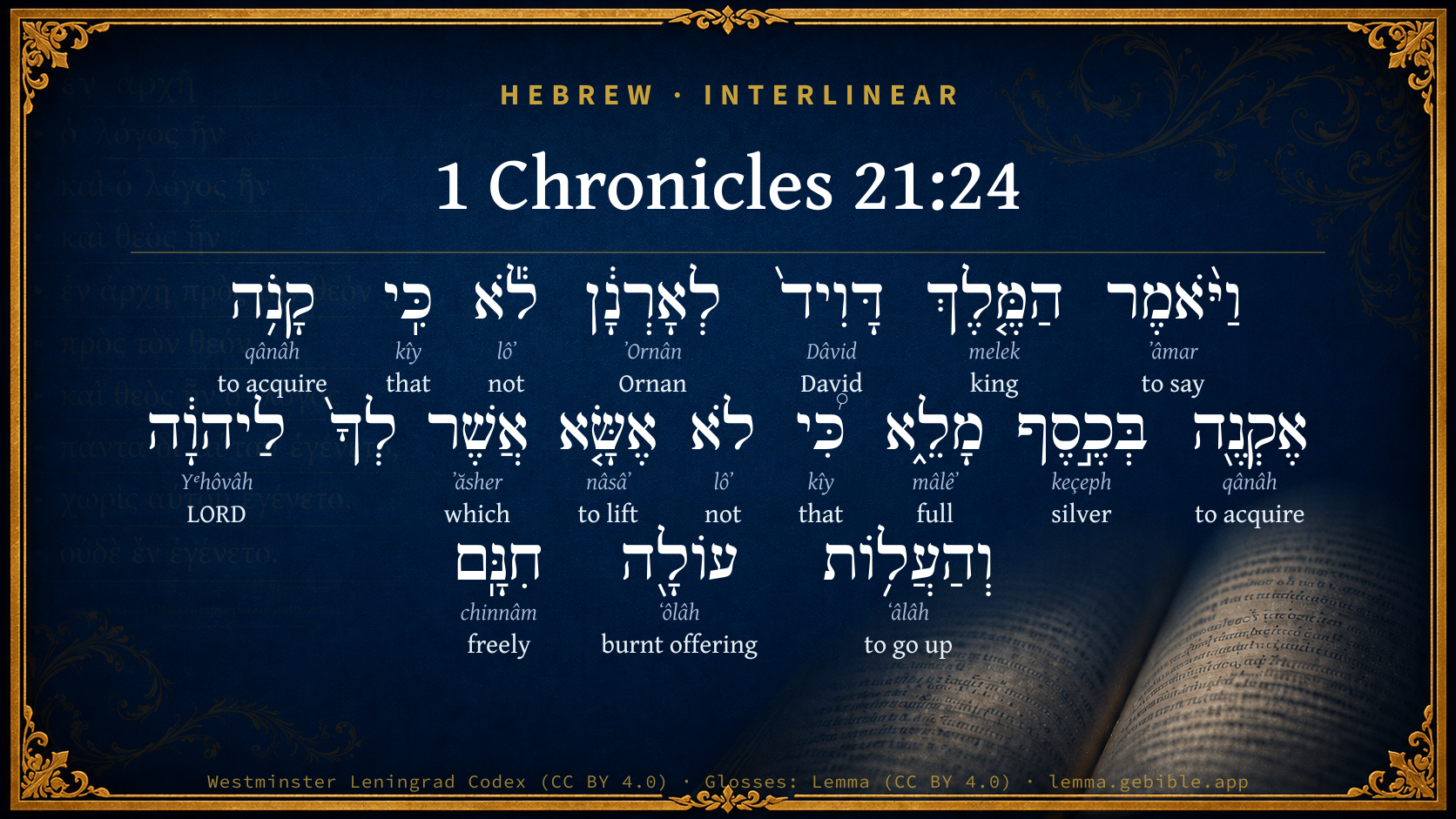
  1. וַיֹּ֨אמֶר ʼâmar H559 “and · to say” Conjunction + Verb, Qal, Sequential Imperfect, 3rd Person, Masculine, Singular
  2. הַמֶּ֤לֶךְ melek H4428 “the · king” Particle, Definite Article + Noun, Common, Masculine, Singular, Absolute
  3. דָּוִיד֙ Dâvid H1732 “David” Noun, Proper
  4. לֹ֕א lôʼ H3808 “not” Particle, Negative
  5. כִּֽי kîy H3588 “that” Conjunction
  6. קָנֹ֥ה qânâh H7069 “to acquire” Verb, Qal, Infinitive Absolute
  7. אֶקְנֶ֖ה qânâh H7069 “to acquire” Verb, Qal, Imperfect, 1st Person, Common, Singular
  8. בְּכֶ֣סֶף keçeph H3701 “in/at · silver” Preposition + Noun, Common, Masculine, Singular, Absolute
  9. מָלֵ֑א mâlêʼ H4392 “full” Adjective, Adjective, Masculine, Singular, Absolute
  10. כִּ֠י kîy H3588 “that” Conjunction
  11. לֹא lôʼ H3808 “not” Particle, Negative
  12. אֶשָּׂ֤א nâsâʼ H5375 “to lift” Verb, Qal, Imperfect, 1st Person, Common, Singular
  13. אֲשֶׁר ʼăsher H834 “which” Particle, Relative
  14. לַיהוָ֔ה Yᵉhôvâh H3068 “to/for · LORD” Preposition + Noun, Proper
  15. וְהַעֲל֥וֹת ʻâlâh H5927 “and · to go up” Conjunction + Verb, Hiphil, Infinitive Construct
  16. עוֹלָ֖ה ʻôlâh H5930 “burnt offering” Noun, Common, Feminine, Singular, Absolute
  17. חִנָּֽם chinnâm H2600 “freely” Adverb

About this verse

These counts appear in no published source. They are computed here, from the morphology-tagged text and Lemma’s own curated glosses. What Lemma adds →

19
words
15
distinct lemmas
Historical
section

Notable vocabulary

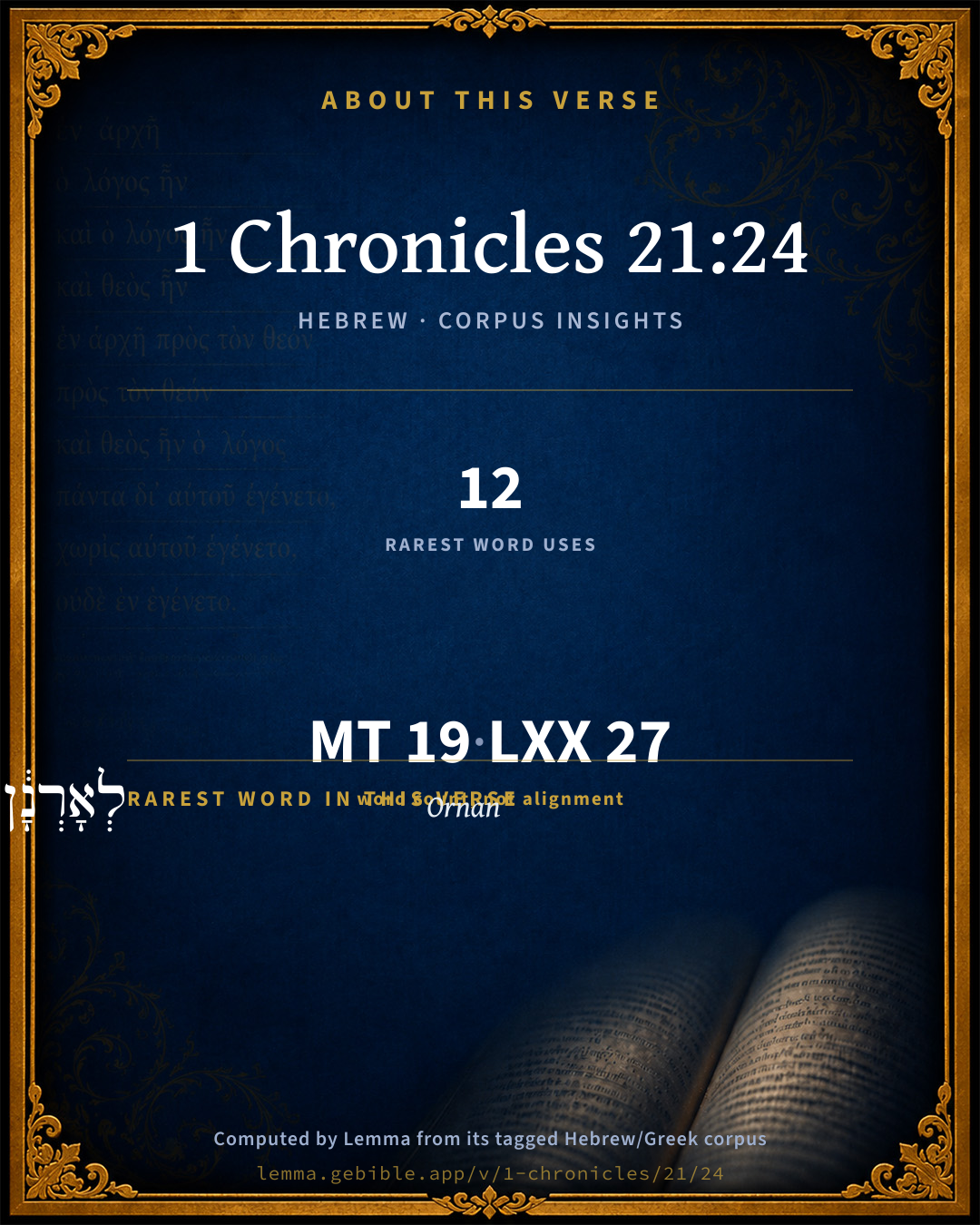
The rarest word here is לְאָרְנָ֔ן Ornan H771 — appearing just 12 times in the whole Hebrew Bible.

Shared distinctive vocabulary

לְאָרְנָ֔ן Ornan H771 occurs in 10 verses of the Hebrew Bible. Also found in:

Grammatical profile

  • 5 verbs
  • 6 nouns
  • 1 adjective
  • 1 preposition
  • 2 conjunctions
  • 1 adverb
  • 3 particles

Verb forms

  • וַיֹּ֨אמֶר Qal · Sequential Imperfect
  • קָנֹ֥ה Qal · Infinitive Absolute
  • אֶקְנֶ֖ה Qal · Imperfect
  • אֶשָּׂ֤א Qal · Imperfect
  • וְהַעֲל֥וֹת Hiphil · Infinitive Construct

Repetition

Words recur within this verse — often emphatic in Hebrew:

  • קָנֹ֥ה to acquire H7069 ×2
  • לֹ֕א not H3808 ×2
  • כִּֽי that H3588 ×2

Hebrew & Septuagint length

In English translation the verse runs 34 words from the Hebrew and 41 from the Septuagint (LXX English) — closely comparable.

A rough comparison of the two English renderings, which tokenize alike — not a word-level alignment.

Word counts can differ between the Hebrew and the Greek without any difference in meaning — e.g. the Hebrew direct-object marker אֵת has no separate Greek word, and Greek often adds the article ὁ.

In the original languages it is 19 Hebrew tokens and 27 Greek tokens — but the two are counted differently (Hebrew bundles its prefixes and suffixes into one token; the Greek is in lemma form), so that isn’t a like-for-like length.

Cross-references

4

Topical passages linked to 1 Chronicles 21:24 in the Treasury of Scripture Knowledge — connected by theme and wording, ordered by reader-vote popularity; previews shown in the World English Bible.

  • Deuteronomy 16:16–17 Three times in a year shall all your males appear before Yahweh your God in the place which he shall choose: in the feast of unleavened bread, and in the feast of weeks, and in the feast of tents; and they shall not appear before Yahweh empty:
  • Genesis 14:23 that I will not take a thread nor a shoe-latchet nor anything that is yours, lest you should say, 'I have made Abram rich.'
  • Genesis 23:13 He spoke to Ephron in the audience of the people of the land, saying, "But if you will, please hear me. I will give the price of the field. Take it from me, and I will bury my dead there."
  • Malachi 1:12–14 "But you profane it, in that you say, 'Yahweh's table is polluted, and its fruit, even its food, is contemptible.'

Cross-references courtesy of OpenBible.info (CC BY 4.0).

Hebrew and Greek witnesses Masoretic Hebrew ↔ Greek Septuagint

The same verse in the two great witnesses to the Old Testament, shown verse-for-verse.

These are two independent witnesses, not word-aligned to each other, and the Septuagint is shown in lemma (dictionary) form.

Hebrew 1 Chronicles 21:24 Masoretic · Westminster Leningrad Codex

וַיֹּ֨אמֶר הַמֶּ֤לֶךְ דָּוִיד֙ לְאָרְנָ֔ן לֹ֕א כִּֽי קָנֹ֥ה אֶקְנֶ֖ה בְּכֶ֣סֶף מָלֵ֑א כִּ֠י לֹא אֶשָּׂ֤א אֲשֶׁר לְךָ֙ לַיהוָ֔ה וְהַעֲל֥וֹת עוֹלָ֖ה חִנָּֽם

King David said to Ornan, No; but I will most assuredly buy it for the full price: for I will not take that which is your for Yahweh, nor offer a burnt-offering without cost.

World English Bible · Public Domain

Greek LXX 1 Chronicles 21:24 Septuagint · lemma form

καί εἶπον ὁ βασιλεύς δαυίδ ὁ ορνα οὐ ὅτι ἀγοράζω ἀγοράζω ἐν ἀργύριον ἄξιος ὅτι οὐ μή λαμβάνω ὅς εἰμί σύ κύριος ὁ ἀναφέρω ὁλοκαύτωσις δωρεά κύριος

And king David said to Orna, Nay; for I will surely buy it for its worth in money: for I will not take your property for the Lord, to offer a whole burnt offering to the Lord without cost to myself.

LXX2012 (modern English Septuagint) · Public Domain

Hebrew: Westminster Leningrad Codex (CC BY 4.0). Greek: Septuagint (public domain); English from LXX2012 (modern English Septuagint) (Public Domain). How the Septuagint differs from the Hebrew →

Commentary

Notes on 1 Chronicles 21:24 from classic Christian and Jewish commentators (each source and its license shown beneath its notes). The classic Christian expositions comment on the surrounding passage and are grouped to its opening verse, so a note may address several verses; the Jewish commentaries on the Tanakh (Rashi and others) are per-verse, so they appear only where the commentator wrote on this verse.

Lemma curates 59 commentaries, every one of them public domain or Creative Commons licensed, each selected and text-cleaned for this edition rather than reprinted as found. About our sources →

Geneva Bible (1599)

Geneva Bible translators

That is, as much as it is worth: for having enough of his own, and yet to have taken of another man’s goods to offer unto the Lord, it had been theft and not acceptable to God.

Geneva Bible (1599) marginal notes — public domain. Text via Bolls.life.

Adam Clarke's Commentary

Verse 24. For the full price] That is, six hundred shekels full weight of pure gold.

Adam Clarke's Commentary on the Bible (1810–1826) — public domain. Text from a community e-Sword/MySword module.

Ellicott's Commentary for English Readers

(24) For the full price.—Samuel simply, “At a price” (different word). The next clause does not appear in Samuel, but may well be original.

Nor offer burnt offerings without cost.—So Samuel: “Nor will I offer to the Lord my God burnt offerings without cost.” It was of the essence of sacrifice to surrender something valued in order to win from God a greater good (Ewald).

A Bible Commentary for English Readers, edited by Charles John Ellicott (1878–1897) — public domain. Text from a community e-Sword module.

The Pulpit Commentary

Cheap sacrifice disdained.

It is a scene of historical and of sacred interest. Upon the threshing-floor of the old Jebusite chieftain, the son of Jesse, by his repentance and prayer, secured the cessation of the pestilence which was desolating the land. The Divine command enjoins that on this spot where the plague was stayed, an altar shall be reared to Jehovah in acknowledgment of sparing mercy. The site is the property of Ornan, who with his four sons is threshing wheat. When David approaches, the Jebusite bows before him with reverence. The representatives of "the old order" and "the new" meet together. The scene is truly Oriental. The king asks for the site; the chief offers it as a gift; the king refuses to accept it upon such terms; and an agreement is entered into that the site shall become David"s in exchange for six hundred shekels of gold. Thus is acquired the land upon which an altar is built, and which is to become hereafter the site of the splendid temple of Solomon. David"s conduct and language convey a general principle of universal validity, viz. that it does not become man to offer, and that God will not accept, a gift or sacrifice which costs the giver nothing.

I OUR GOD HAS A RIGHT AND CLAIM TO ALL THAT WE CALL OURS. We call it ours, but our possession is derived from and is subordinate to his creative bounty, his providential goodness. What have we that we did not receive from him? Our property, and our powers of body and of mind, we have from him and owe to him. That we cannot enrich him by our giving, this is certain. But we can please him and can advantage ourselves by giving to his people and to his cause.

II GIFTS AND SACRIFICES THAT COST US NOTHING ARE CONTEMNED AND REJECTED BY GOD. David felt this, and expressed it in noble and memorable language, when he said, "I will not take that which is thine for the Lord, nor offer burnt offerings without cost." Every sincerely religious mind must sympathize with the spirit here displayed. We are reminded that the widow"s mite was approved and accepted by our Lord Jesus. It is not the magnitude of the gift, but the proportion of the gift to the giver"s means, and, above all, the spirit of self-denial displayed in the act of giving, which meets with the approbation of the Searcher of hearts.

III THERE IS PLEASURE AND PROFIT IN SELF-SACRIFICE FOR THE CAUSE OF GOD, The King of Israel found this to be so in his own experience, and the experience of all who in this have followed his example coincides with David"s. Our Lord has said, "It is more blessed to give than to receive. T.

Right feeling concerning giving to God.

David apprehended that the value of a gift greatly depends on the self-denial for which it finds expression. Compare the very interesting scene of Abraham negotiating with the sons of Heth for the purchase of the field and cave of Machpelah. There, considerations of personal dignity prevented his taking the property; and he felt that he could not lay his beloved partner down, save in a place which was his by purchase. Here, in the case of David, the feeling is a different one, yet it is in full harmony with the sentiment of the elder patriarch; right religious feeling, the sense of what was due to God, prevented David from offering what was not really his by right of purchase. Personal dignity, and sensitiveness to what is befitting, both in social intercourse and in matters of religion, have their appropriate place; and their due cultivation is a part of Christian duty. Some account of the symbolical significance of the burnt offering may fitly explain why David chose this form of sacrifice as appropriate to this occasion. Its central and characteristic meaning may be thus expressed in the words of Ewald: "In this, man"s share in the consumption of the offering altogether vanished. The sacrificer consecrated to the Deity alone the enjoyment of the whole, and this not to punish himself, or because he was punished, on account of a special consciousness of guilt by deprivation of sensuous participation, but rather from free resolve and purest self-denial. " Kurtz says, "The burning by fire was the chief point in this class of offering, and marked it as an expression of perpetual obligation to complete, sanctified, self-surrender to Jehovah." The sacrifice was a solemn declaration that the offerer belonged wholly to God, and that he dedicated himself, soul and body, to him, and placed his life at his disposal. We treat David"s burnt offering as a typical religious service, and consider

I THAT THE VALUE OF ALL RELIGIOUS SERVICE LIES IN THE SPIRIT OF HIM WHO BENDERS IT. A burnt offering is in itself a valueless and unacceptable thing; and so is every act of formal worship. Therefore in the unspiritual days of later Judaism, the prophets, as Isaiah, went so far as to say that God hated" the mere formalities of religion, and found them a weariness" to him. All a man"s gifts and acts must, like his words, carry a feeling, and express a desire and purpose. A man must utter himself in his words, or his words will be worthless. And so a man must utter himself in his offerings, sacrifices, and services, or God will say he cannot away with them." This point may be searchingly applied to our spiritual fitness for present-day services. Still it is true that our feeling must be the life of our worship.

II THE BEST THING WE CAN EXPRESS TO GOD IS OUR SELFDEVOTEMENT. This is the main idea of the burnt offering. This is the proper feeling cherished by David, and expressed in his sacrifice. It may be shown as the ultimate and comprehensive demand of St. Paul, in Rom_12:1, "I beseech you that ye present your bodies a living sacrifice.

III Such SELF-DEVOTEMENT CAN BE BEST EXPRESSED BY SELF-DENIAL. This David felt, and it led him to refuse to offer to God some one else"s self-denial. He would have it to be his own sacrifice, the act of his own self-denial. Show that what is given to God should be a mans own, and all the better if it is a man"s own by conscious effort, and if to set it aside for God involves some severe self-mastery. Such self-denials carry into expression the soul-feeling which alone is acceptable to God.

This subject lends itself to careful applications connected with modem religious worship and duty. It would be the dawn of a glorious day for the Church if every man felt as David did that he must utter his soul to God in gifts and offerings, and that these must come out of his "own proper good," and carry a noble burden of self-denials. R.T.

The Pulpit Commentary (1880–1919), ed. H.D.M. Spence-Jones & Joseph S. Exell — public domain. Text from a community e-Sword module.

Lesson kit

Teaching starters — assembled from the data on this page, not authored interpretation. Every prompt links to the verse data it draws on. Edit before teaching.

1 Chronicles, in the Historical, opens this verse with 19 words (15 distinct Hebrew lemmas). Its most distinctive word is ʼOrnân (“Ornan”). A historical commentator’s framing appears above. Read the whole chapter for the surrounding context.

Discussion questions

  1. The word ʼOrnân carries the sense “Ornan.” How does it shape the verse?
  2. 1 Chronicles 21:15 shares the word «Ornan» with this verse. How do the two illuminate each other?
  3. “to acquire” occurs 2× in this one verse. What is the effect of the repetition?
  4. The translations on this page render this verse differently — a whole-verse word diff, not a word-by-word alignment. What might account for the different wordings?
  5. The verb «וַיֹּ֨אמֶר» is Qal Sequential Imperfect. How does its form color the action?
  6. Reading how Geneva Bible (1599) and Adam Clarke's Commentary read this verse, where do the two commentators agree and where do they part?

Things to notice

Reading settings

Reading text

Shown beneath each verse's original-language words.

Old Testament
Old Testament edition

Read the OT as the Masoretic Hebrew (MT) or the Greek Septuagint (LXX).

English shown for the Greek Septuagint (in the Hebrew ↔ Greek comparison).

Comparing translations? Open the Compare panel on any verse page to stack up to four side by side.