
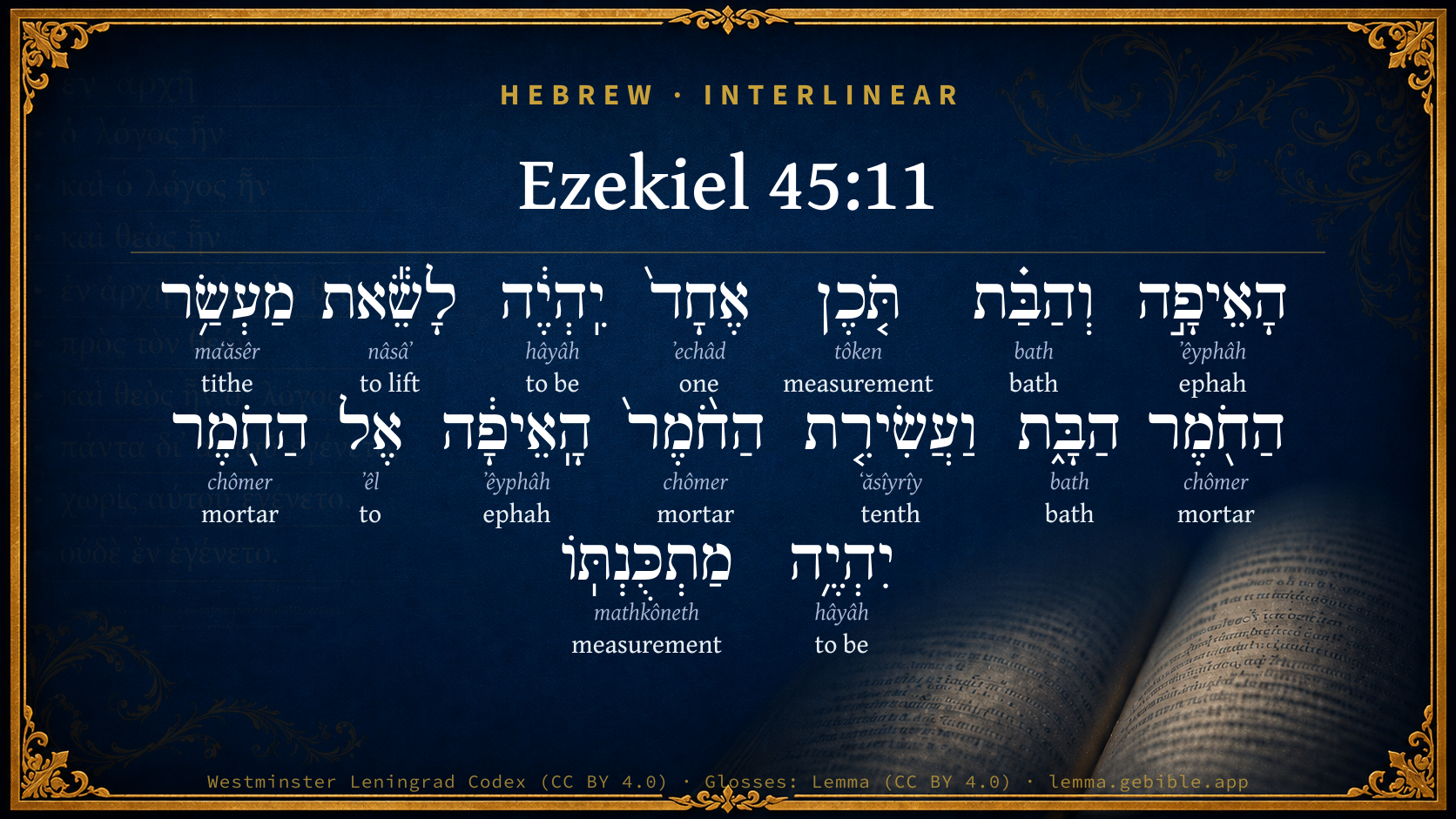
Ezekiel 45:11

Hebrew (Westminster Leningrad Codex) Ezekiel 45:11 appears in the Hebrew Old Testament. The text above is from the Westminster Leningrad Codex. Each word links to its Strong’s number, a concise gloss, and parsing drawn from the Open Scriptures Hebrew Bible morphology. Click any word for its full Brown-Driver-Briggs (BDB) entry.
Download image
Cite this verse

Ezekiel 45:11 (World English Bible). Public Domain. Lemma interlinear Bible study tool, https://lemma.gebible.app/v/ezekiel/45/11.

Show BibTeX & RIS
BibTeX
RIS
English Translation
The ephah and the bath shall be of one measure, that the bath may contain the tenth part of a homer, and the ephah the tenth part of a homer: the measure of it shall be after the homer.
World English Bible · Public Domain
Download a study sheet

One document with this verse’s original text, its word-by-word gloss line, the meaning frame, cross-references with their text, attributed commentary, and full source and license credits — printable, and it pastes into notes with its structure intact.

This verse Autodidact and up

Study sheet (.html) Plain text (.txt)

A passage Seminary Student

Up to 50 verses in one chapter. A passage sheet keeps up to 6 commentary sources and 12 cross-references per verse, in the order this page ranks them, and says so on the sheet whenever that leaves anything out. Ask for a single verse and you get the Autodidact verse sheet above.

Everything on this page stays free to read, with no account — the sheet is a download of what is already on screen, not access to it.

Want to remove ads? Support Godless Engineer
Compare translations 3

The same verse in 3 English versions, stacked beneath the original-language interlinear above. Click any original word for its lexicon entry.

Each is an independent rendering of the whole verse — the interlinear is not word-aligned to these translations.

Highlighted words mark where these versions differ — a whole-verse word diff, not a word-by-word alignment.

  • World English Bible Public Domain
    The ephah and the bath shall be of one measure, that the bath may contain the tenth part of a homer, and the ephah the tenth part of a homer: the measure of it shall be after the homer.
  • King James Version Public Domain
    The ephah and the bath shall be of one measure, that the bath may contain the tenth part of an homer, and the ephah the tenth part of an homer: the measure thereof shall be after the homer.
  • unfoldingWord Literal Text CC BY-SA 4.0
    The ephah and the bath will be the same amount, so that a bath will be a tenth of a homer; the ephah will be a tenth of a homer. Their measure will be corresponding to the homer.

unfoldingWord Literal Text — © unfoldingWord, licensed CC BY-SA 4.0. Word-aligned USFM3 via Door43 (git.door43.org/unfoldingWord/en_ult).

Versions to compare (up to 4)

3 of 4 selected

Show all 18 translations

Every available English version of this verse, each an independent rendering of the whole verse.

  • World English Bible Public Domain
    The ephah and the bath shall be of one measure, that the bath may contain the tenth part of a homer, and the ephah the tenth part of a homer: the measure of it shall be after the homer.
  • Berean Standard Bible Public Domain
    The ephah and the bath shall be the same quantity so that the bath will contain a tenth of a homer, and the ephah a tenth of a homer; the homer will be the standard measure for both.
  • Majority Standard Bible Public Domain
    The ephah and the bath shall be the same quantity so that the bath will contain a tenth of a homer, and the ephah a tenth of a homer; the homer will be the standard measure for both.
  • King James Version Public Domain
    The ephah and the bath shall be of one measure, that the bath may contain the tenth part of an homer, and the ephah the tenth part of an homer: the measure thereof shall be after the homer.
  • American Standard Version (1901) Public Domain
    The ephah and the bath shall be of one measure, that the bath may contain the tenth part of a homer, and the ephah the tenth part of a homer: the measure thereof shall be after the homer.
  • Revised Version (1885) Public Domain
    The ephah and the bath shall be of one measure, that the bath may contain the tenth part of an homer, and the ephah the tenth part of an homer: the measure thereof shall be after the homer.
  • Geneva Bible (1599) Public Domain
    The Ephah and the Bath shalbe equall: a Bath shall conteyne the tenth part of an Homer, and an Ephah the tenth part of an Homer: the equalitie thereof shalbe after the Homer.
  • Douay-Rheims (1899) Public Domain
    The ephi and the bate shall be equal, and of one measure: that the bate may contain the tenth part of a core, and the ephi the tenth part of a core: their weight shall be equal according to the measure of a core.
  • Young's Literal Translation Public Domain
    The ephah and the bath is of one measure, for the bath to bear a tenth of the homer, and the ephah a tenth of the homer: according to the homer is its measurement.
  • Literal Standard Version CC BY-SA 4.0
    The ephah and the bath is of one measure, for the bath to carry a tenth of the homer, and the ephah a tenth of the homer: its measurement is according to the homer.
  • Unlocked Literal Bible CC BY-SA 4.0
    The ephah and the bath will be the same amount, so that a bath will be a tenth of a homer; the ephah will be a tenth of a homer. Their measure will be corresponding to the homer.
  • unfoldingWord Literal Text CC BY-SA 4.0
    The ephah and the bath will be the same amount, so that a bath will be a tenth of a homer; the ephah will be a tenth of a homer. Their measure will be corresponding to the homer.
  • Darby Bible Public Domain
    The ephah and the bath shall be of one measure, so that the bath may contain the tenth part of a homer, and the ephah the tenth part of a homer: the measure thereof shall be according to the homer.
  • World Messianic Bible Public Domain
    The efah and the bath shall be of one measure, that the bath may contain one tenth of a homer, and the efah one tenth of a homer. Its measure shall be the same as the homer.
  • Webster's Bible Public Domain
    The ephah and the bath shall be of one measure, that the bath may contain the tenth part of a homer, and the ephah the tenth part of a homer: the measure of it shall be after the homer.
  • Free Bible Version CC BY-SA 4.0
    The ephah and the bath shall be the same quantity of volume. The bath will be equivalent to a tenth of a homer, and the ephah will also be equivalent to a tenth of a homer. The homer is to be the fundamental measurement.
  • Bible in Basic English Public Domain
    The ephah and the bath are to be of the same measure, so that the bath is equal to a tenth of a homer, and the ephah to a tenth of a homer: the unit of measure is to be a homer.
  • JPS Tanakh (1917) Public Domain
    The ephah and the bath shall be of one measure, that the bath may contain the tenth part of a homer, and the ephah the tenth part of a homer; the measure thereof shall be after the homer.

Literal Standard Version (2020), Covenant Press — licensed CC BY-SA 4.0. Text via the HelloAO Bible API (eBible.org). Unlocked Literal Bible (unfoldingWord) — licensed CC BY-SA 4.0. Text via the HelloAO Bible API (eBible.org). unfoldingWord Literal Text — © unfoldingWord, licensed CC BY-SA 4.0. Word-aligned USFM3 via Door43 (git.door43.org/unfoldingWord/en_ult). Free Bible Version, Dr. Jonathan Gallagher — licensed CC BY-SA 4.0. Text via the HelloAO Bible API (eBible.org).

Word by word

More ways to search: Search by grammar → Find every occurrence → Compare this word →

Practice this passage: Drill this verse → Learn its vocabulary →

תֹּ֤כֶן
tôken
H8506
“measurement”
Noun, Common, Masculine, Singular, Absolute
Part of Speech
Noun
Type
Common
Gender
Masculine
Number
Singular
State
Absolute
Full BDB Definition

Origin: from H8505

TWOT: 2511a

measurement, a measured amount
  1. הָאֵיפָ֣ה ʼêyphâh H374 “the · ephah” Particle, Definite Article + Noun, Common, Feminine, Singular, Absolute
  2. וְהַבַּ֗ת bath H1324 “and · the · bath” Conjunction + Particle, Definite Article + Noun, Common, Both, Singular, Absolute
  3. אֶחָד֙ ʼechâd H259 “one” Adjective, Cardinal number, Masculine, Singular, Absolute
  4. יִֽהְיֶ֔ה hâyâh H1961 “to be” Verb, Qal, Imperfect, 3rd Person, Masculine, Singular
  5. לָשֵׂ֕את nâsâʼ H5375 “to lift” Preposition + Verb, Qal, Infinitive Construct
  6. מַעְשַׂ֥ר maʻăsêr H4643 “tithe of” Noun, Common, Masculine, Singular, Construct
  7. הַחֹ֖מֶר chômer H2563 “the · mortar” Particle, Definite Article + Noun, Common, Masculine, Singular, Absolute
  8. הַבָּ֑ת bath H1324 “the · bath” Particle, Definite Article + Noun, Common, Both, Singular, Absolute
  9. וַעֲשִׂירִ֤ת ʻăsîyrîy H6224 “and · tenth” Conjunction + Adjective, Ordinal number, Feminine, Singular, Construct
  10. הַחֹ֨מֶר֙ chômer H2563 “the · mortar” Particle, Definite Article + Noun, Common, Masculine, Singular, Absolute
  11. הָֽאֵיפָ֔ה ʼêyphâh H374 “the · ephah” Particle, Definite Article + Noun, Common, Feminine, Singular, Absolute
  12. אֶל ʼêl H413 “to” Preposition
  13. הַחֹ֖מֶר chômer H2563 “the · mortar” Particle, Definite Article + Noun, Common, Masculine, Singular, Absolute
  14. יִהְיֶ֥ה hâyâh H1961 “to be” Verb, Qal, Imperfect, 3rd Person, Masculine, Singular
  15. מַתְכֻּנְתּֽוֹ mathkôneth H4971 “measurement · his” Noun, Common, Feminine, Singular, Construct + Suffix, Personal, 3rd Person, Masculine, Singular

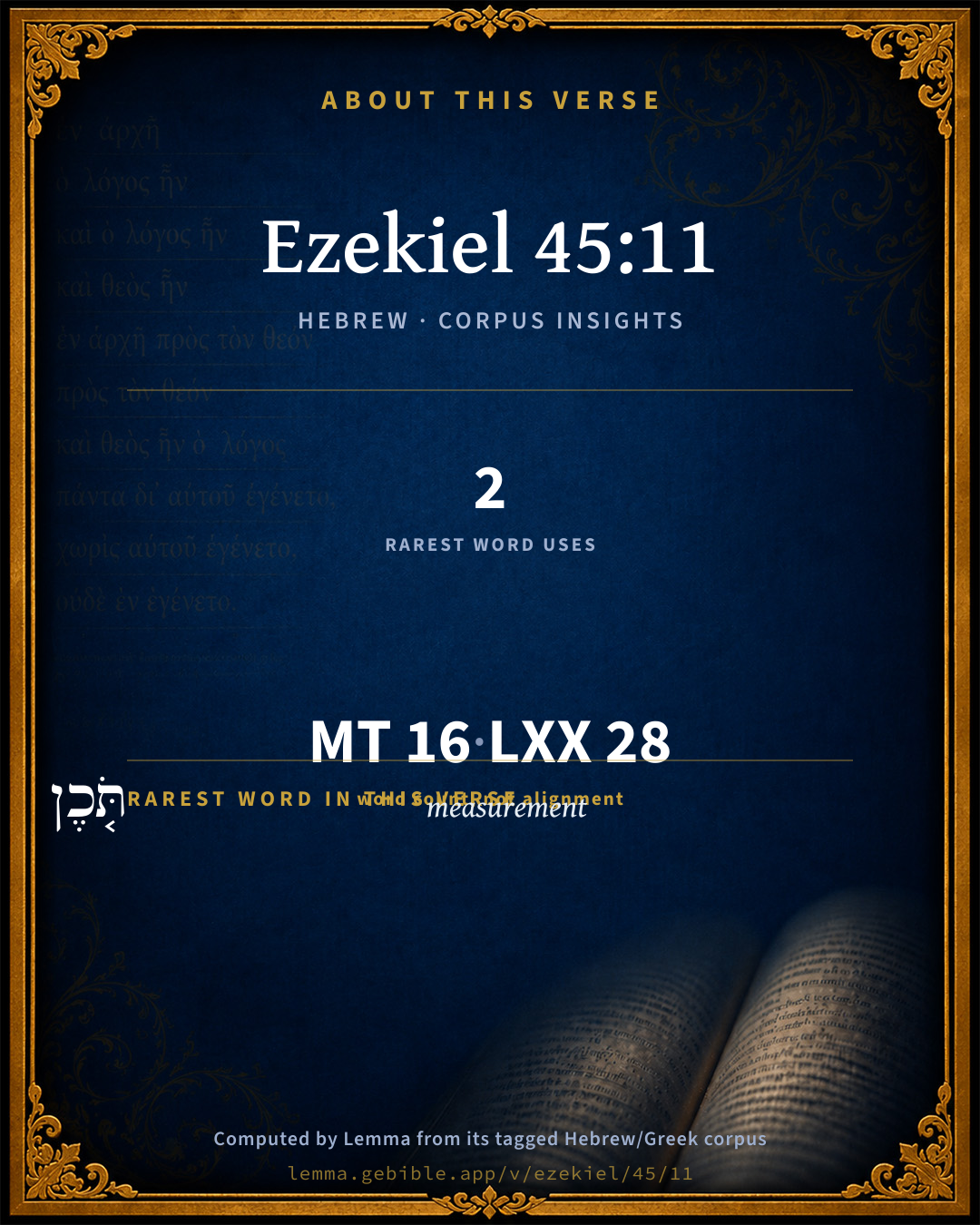
About this verse

These counts appear in no published source. They are computed here, from the morphology-tagged text and Lemma’s own curated glosses. What Lemma adds →

16
words
11
distinct lemmas
Prophets
section

Notable vocabulary

The rarest word here is תֹּ֤כֶן measurement H8506 — appearing just 2 times in the whole Hebrew Bible.

Shared distinctive vocabulary

תֹּ֤כֶן measurement H8506 occurs in 2 verses of the Hebrew Bible. Also found in:

Grammatical profile

  • 3 verbs
  • 10 nouns
  • 2 adjectives
  • 1 preposition

Verb forms

  • יִֽהְיֶ֔ה Qal · Imperfect
  • לָשֵׂ֕את Qal · Infinitive Construct
  • יִהְיֶ֥ה Qal · Imperfect

Repetition

Words recur within this verse — often emphatic in Hebrew:

  • הַחֹ֖מֶר mortar H2563 ×3
  • הָאֵיפָ֣ה ephah H374 ×2
  • וְהַבַּ֗ת bath H1324 ×2
  • יִֽהְיֶ֔ה to be H1961 ×2

Hebrew & Septuagint length

In English translation the verse runs 39 words from the Hebrew and 37 from the Septuagint (LXX English) — closely comparable.

A rough comparison of the two English renderings, which tokenize alike — not a word-level alignment.

Word counts can differ between the Hebrew and the Greek without any difference in meaning — e.g. the Hebrew direct-object marker אֵת has no separate Greek word, and Greek often adds the article ὁ.

In the original languages it is 16 Hebrew tokens and 28 Greek tokens — but the two are counted differently (Hebrew bundles its prefixes and suffixes into one token; the Greek is in lemma form), so that isn’t a like-for-like length.

Cross-references

1

Topical passages linked to Ezekiel 45:11 in the Treasury of Scripture Knowledge — connected by theme and wording, ordered by reader-vote popularity; previews shown in the World English Bible.

  • Isaiah 5:10 For ten acres of vineyard shall yield one bath, And a homer of seed shall yield an ephah."

Cross-references courtesy of OpenBible.info (CC BY 4.0).

Hebrew and Greek witnesses Masoretic Hebrew ↔ Greek Septuagint

The same verse in the two great witnesses to the Old Testament, shown verse-for-verse.

These are two independent witnesses, not word-aligned to each other, and the Septuagint is shown in lemma (dictionary) form.

Hebrew Ezekiel 45:11 Masoretic · Westminster Leningrad Codex

הָאֵיפָ֣ה וְהַבַּ֗ת תֹּ֤כֶן אֶחָד֙ יִֽהְיֶ֔ה לָשֵׂ֕את מַעְשַׂ֥ר הַחֹ֖מֶר הַבָּ֑ת וַעֲשִׂירִ֤ת הַחֹ֨מֶר֙ הָֽאֵיפָ֔ה אֶל הַחֹ֖מֶר יִהְיֶ֥ה מַתְכֻּנְתּֽוֹ

The ephah and the bath shall be of one measure, that the bath may contain the tenth part of a homer, and the ephah the tenth part of a homer: the measure of it shall be after the homer.

World English Bible · Public Domain

Greek LXX Ezekiel 45:11 Septuagint · lemma form

ὁ μέτρον καί ὁ χοῖνιξ ὁμοίως εἷς εἰμί ὁ λαμβάνω ὁ δέκατος ὁ γομορ ὁ χοῖνιξ καί ὁ δέκατος ὁ γομορ ὁ μέτρον πρός ὁ γομορ εἰμί ἴσος

And in like manner there shall be one choenix as a measure of capacity; the tenth of the homer shall be the choenix, and the tenth of the homer shall be in fair proportion to the homer.

LXX2012 (modern English Septuagint) · Public Domain

Hebrew: Westminster Leningrad Codex (CC BY 4.0). Greek: Septuagint (public domain); English from LXX2012 (modern English Septuagint) (Public Domain). How the Septuagint differs from the Hebrew →

Targum (Aramaic paraphrase)

1

The Targum is the ancient Jewish Aramaic paraphrase of the Hebrew Scriptures — an interpretive translation, not the Hebrew text itself. Onkelos (literal) and Pseudo-Jonathan (expansive) render the Torah, and Jonathan the Prophets. Coverage is partial: where no permissively-licensed English translation exists for a verse, only the Aramaic is shown. This is verse-level text, not a word-by-word alignment to the Hebrew.

  1. Targum Jonathan Prophets (Joshua–Malachi)
    מְכִלְתָּא וּבֵיתָא טִקוּס חַד יְהֵי לְכוֹן סְכוֹם תְּלַת סָאִין לְמִסַב מַעֲשַׂר כּוֹרָא בִּמְכִלְתָּא רַטִיבָא בֵּיתָא וַעֲשַׂר כּוֹרָא יַבִּישָׁא מְכִלְתָּא מִן כּוֹרָא יְהֵי טְקוּסֵיהּ:

    (no public-domain English translation for this verse)

    Targum Jonathan — Aramaic: “Mikraot Gedolot” (public domain). English: “Sefaria Community Translation” (CC0 1.0 (public-domain dedication)); “London "Chaldee Paraphrase," 1871” (public domain). Text via Sefaria.

Commentary

Notes on Ezekiel 45:11 from classic Christian and Jewish commentators (each source and its license shown beneath its notes). The classic Christian expositions comment on the surrounding passage and are grouped to its opening verse, so a note may address several verses; the Jewish commentaries on the Tanakh (Rashi and others) are per-verse, so they appear only where the commentator wrote on this verse.

Lemma curates 59 commentaries, every one of them public domain or Creative Commons licensed, each selected and text-cleaned for this edition rather than reprinted as found. About our sources →

Trapp's Complete Commentary

John Trapp

Eze 45:11 The ephah and the bath shall be of one measure, that the bath may contain the tenth part of an homer, and the ephah the tenth part of an homer: the measure thereof shall be after the homer.

Ver. 11. The ephah and the bath shall be of one measure.] Of the same capacity, only the ephah is the measure of dry things, and the bath of moist.

John Trapp, A Commentary or Exposition upon All the Books of the Old and New Testament (1647–1656) — public domain. Text from a community e-Sword module.

Ellicott's Commentary for English Readers

(11) Shall be of one measure.—The Ephah is first mentioned in Exo_16:36, and appears to be a word of Egyptian origin; it was used for dry measure. The Bath is not met with before 1Ki_7:26, and was the largest of the liquid measures in use. The statement that these were of the same capacity, and each equal to the tenth part of the Homer, is important in the comparison of the Hebrew dry and liquid measures, but it is exceedingly difficult to determine their absolute value. If we calculate on the estimates of Josephus, the Homer was 86, 696 English gallons; if on those of the Rabbinists, 42, 286. Modern estimates differ nearly as much. The Homer, which was ten Ephahs, is to be carefully distinguished from the Omer, which was the tenth part of an Ephah. The two words are quite different in Hebrew.

A Bible Commentary for English Readers, edited by Charles John Ellicott (1878–1897) — public domain. Text from a community e-Sword module.

The Cambridge Bible for Schools and Colleges

gen. ed. J. J. S. Perowne

11. The homer is assumed as the standard both for liquid and dry measures. The ephah was a tenth of the homer, dry measure; and the bath a tenth of the homer, liquid measure, Isa_5:10.

The Cambridge Bible for Schools and Colleges (gen. ed. J. J. S. Perowne; Cambridge University Press, 1878–1918) — public domain. Text from a community e-Sword module.

John Gill's Exposition

The ephah and the bath shall be of one measure,.... The one held as much of dry things as the other of liquor; which, according to Bishop Cumberland, were seven wine gallons, four pints, and a little more:

that the bath may contain the tenth part of an homer, and the ephah the tenth part of an homer; this "homer" must be carefully distinguished from another measure, called "omer", written without an "h", which was but the tenth part of an "ephah", Exo 16:36,

the measure thereof shall be after the homer: "as the homer was", so should the ephah and bath be, just the tenth part of it.

John Gill's Exposition of the Whole Bible (1746–1763) — public domain (CC PDM 1.0). Text via the HelloAO Bible API.

Albert Barnes' Notes on the Bible

The ephah was in use for dry measure, the bath for liquid. The homer seems to have contained about 75 gallons (see Exo 29:40, note; Lev 19:36, note).

After the homer - i. e., according to the standard of the homer.

Albert Barnes' Notes on the Bible (1834–1885) — public domain. Text from a community e-Sword/MySword module.

Haydock's Catholic Bible Commentary

The ephi and the bate. These measures were of equal capacity; but the bate served for liquids, and the ephi for dry things, (Challoner) ver. 13, 14. (Worthington) --- Ezechiel specifies the measures, that the people might not use those of Babylon, after their return.

George Leo Haydock (1774–1849), Haydock's Catholic Family Bible and Commentary, 1859 edition — public domain. Excludes Psalms (Douay-Rheims chapter numbering differs from Protestant) and Deuterocanonical books (Catholic canon only).

Matthew Poole's English Annotations

One shall contain as much as the other, the ephah shall contain as many gallons of dry, as the bath doth contain of liquid things.

An homer is commonly said to be thirty bushels, or near it. So that the ephah will be some three bushels, in dry things, and the bath sixty-four pints, or eight gallons, in liquid things.

Matthew Poole's English Annotations on the Holy Bible (1683–1685) — public domain. Text from a community e-Sword/MySword module.

The Pulpit Commentary

The ephah (a word of Egyptian origin) and the bath shall be of one measure. That is, each was to be the tenth part of an homer (see Lev_27:16; Num_11:32) or cot rko, korov, (Luk_16:7) which appears to have contained about seventy-five gallons, or thirty-two pecks. The homer (or, cheroot) is to be distinguished from the omer of Exo_16:36, which was the tenth part of an ephah.

The Pulpit Commentary (1880–1919), ed. H.D.M. Spence-Jones & Joseph S. Exell — public domain. Text from a community e-Sword module.

John Wesley's Explanatory Notes

Of one measure - One shall contain as much as the other, the ephah shall contain as many gallons of dry, as the bath of liquid things. An homer - Thirty bushels. So the ephah will be three bushels in dry things, and the bath eight gallons in liquid things.

John Wesley, Explanatory Notes Upon the Whole Bible (1754–1765) — public domain. Text via the GEBible commentary corpus.

Rashi

Rabbi Shlomo Yitzchaki (Rashi)

the homer [A measure known further as] kor, moy(d) or muy(d) in Old French, a measure.

one volume [Heb. תֹּכן,] a word denoting number, like (Exod. 5:18): “and a quota (וְתֹכֶן) of bricks you must deliver.” One measure is equivalent to one tenth of a “homer” of dry measure, which equals thirty “se’ah,” and which is a tenth of a “homer” of liquid measure. “Ephah” and “bath” are words for [units of] measurement.

shall contain [Heb. לָשֵּׂאת,] similar to לָקַחַת, to take, and so too did Jonathan render it: לְמֵיסַב. A tenth part of a “homer” shall be a “bath,” and a tenth part of the dry “homer,” shall be an “ephah.”

according to the homer shall be its volume The total amount of [the volume of] the “bath” and the “ephah” shall be according to the size of the “homer.”

Rashi on the Tanakh — English translations: “The Judaica Press complete Tanach with Rashi, translated by A. J. Rosenberg” (CC BY 4.0); “Pentateuch with Rashi's commentary by M. Rosenbaum and A.M. Silbermann, 1929-1934” (public domain); “The Metsudah Tanach series, Lakewood, N.J” (CC BY 4.0); and “The Book of Joshua, Metsudah Publications, 1997” (CC BY 4.0). Text via Sefaria.

Lesson kit

Teaching starters — assembled from the data on this page, not authored interpretation. Every prompt links to the verse data it draws on. Edit before teaching.

Ezekiel, in the Prophets, opens this verse with 16 words (11 distinct Hebrew lemmas). Its most distinctive word is tôken (“measurement”). A historical commentator’s framing appears above. Read the whole chapter for the surrounding context.

Discussion questions

  1. The word tôken carries the sense “measurement.” How does it shape the verse?
  2. Exodus 5:18 shares the word «measurement» with this verse. How do the two illuminate each other?
  3. “mortar” occurs 3× in this one verse. What is the effect of the repetition?
  4. These translations render this verse differently; the difference is in the English rendering, not the original. What questions does that raise?
  5. The verb «יִֽהְיֶ֔ה» is Qal Imperfect. How does its form color the action?
  6. Reading how Trapp's Complete Commentary and Ellicott's Commentary for English Readers read this verse, where do the two commentators agree and where do they part?

Things to notice

Reading settings

Reading text

Shown beneath each verse's original-language words.

Old Testament
Old Testament edition

Read the OT as the Masoretic Hebrew (MT) or the Greek Septuagint (LXX).

English shown for the Greek Septuagint (in the Hebrew ↔ Greek comparison).

Comparing translations? Open the Compare panel on any verse page to stack up to four side by side.