
Psalms 96:8

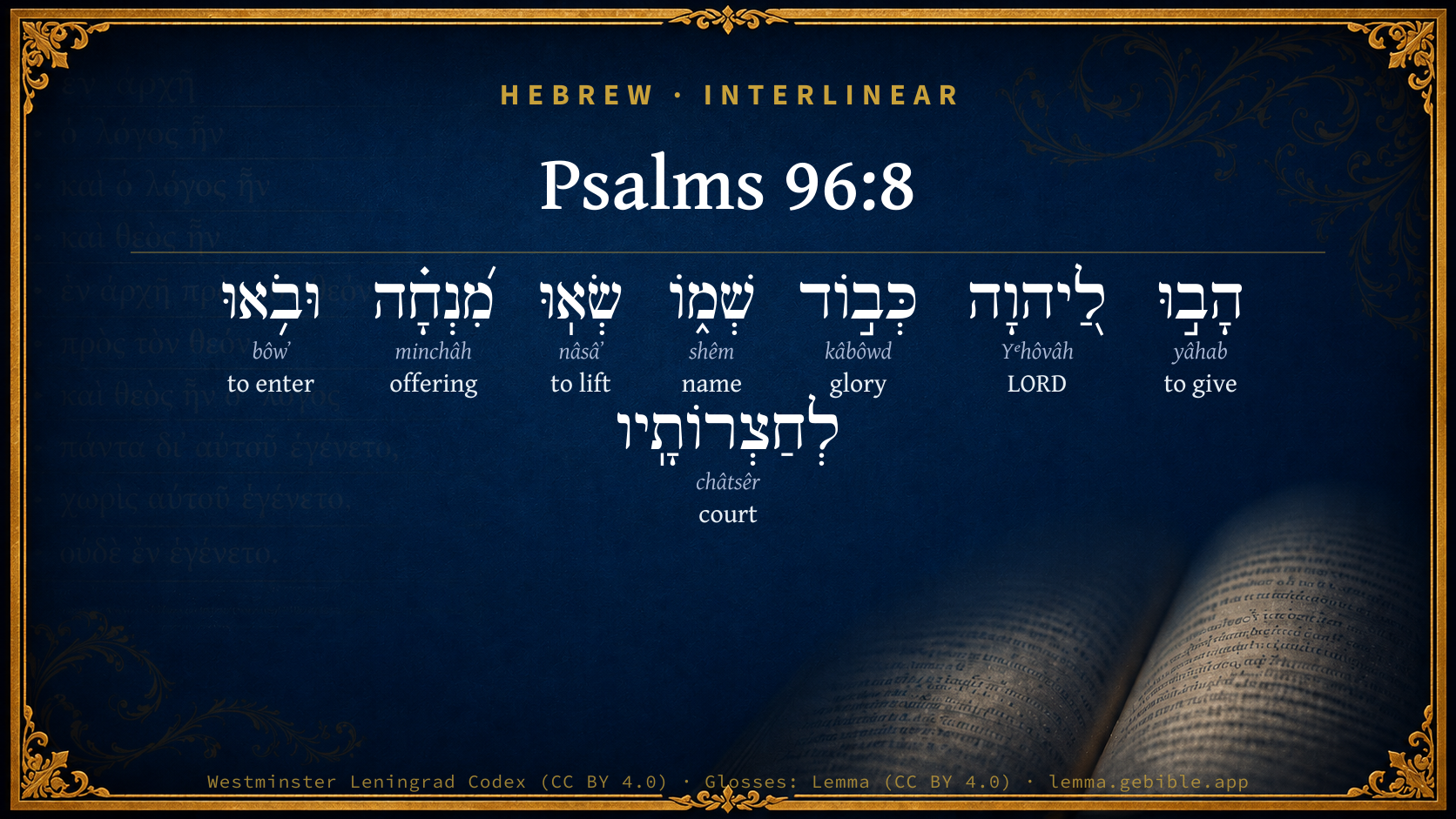
Hebrew (Westminster Leningrad Codex) Psalms 96:8 appears in the Hebrew Old Testament. The text above is from the Westminster Leningrad Codex. Each word links to its Strong’s number, a concise gloss, and parsing drawn from the Open Scriptures Hebrew Bible morphology. Click any word for its full Brown-Driver-Briggs (BDB) entry.
Download image
Cite this verse

Psalms 96:8 (World English Bible). Public Domain. Lemma interlinear Bible study tool, https://lemma.gebible.app/v/psalms/96/8.

Show BibTeX & RIS
BibTeX
RIS
English Translation
Ascribe to Yahweh the glory due to his name. Bring an offering, and come into his courts.
World English Bible · Public Domain
Download a study sheet

One document with this verse’s original text, its word-by-word gloss line, the meaning frame, cross-references with their text, attributed commentary, and full source and license credits — printable, and it pastes into notes with its structure intact.

This verse Autodidact and up

Study sheet (.html) Plain text (.txt)

A passage Seminary Student

Up to 50 verses in one chapter. A passage sheet keeps up to 6 commentary sources and 12 cross-references per verse, in the order this page ranks them, and says so on the sheet whenever that leaves anything out. Ask for a single verse and you get the Autodidact verse sheet above.

Everything on this page stays free to read, with no account — the sheet is a download of what is already on screen, not access to it.

Want to remove ads? Support Godless Engineer
Compare translations 3

The same verse in 3 English versions, stacked beneath the original-language interlinear above. Click any original word for its lexicon entry.

Each is an independent rendering of the whole verse — the interlinear is not word-aligned to these translations.

Highlighted words mark where these versions differ — a whole-verse word diff, not a word-by-word alignment.

  • World English Bible Public Domain
    Ascribe to Yahweh the glory due to his name. Bring an offering, and come into his courts.
  • King James Version Public Domain
    Give unto the LORD the glory due unto his name: bring an offering, and come into his courts.
  • unfoldingWord Literal Text CC BY-SA 4.0
    Give to Yahweh the glory of his name. Bring an offering and come into his courts.

unfoldingWord Literal Text — © unfoldingWord, licensed CC BY-SA 4.0. Word-aligned USFM3 via Door43 (git.door43.org/unfoldingWord/en_ult).

Versions to compare (up to 4)

3 of 4 selected

Show all 18 translations

Every available English version of this verse, each an independent rendering of the whole verse.

  • World English Bible Public Domain
    Ascribe to Yahweh the glory due to his name. Bring an offering, and come into his courts.
  • Berean Standard Bible Public Domain
    Ascribe to the LORD the glory due His name; bring an offering and enter His courts.
  • Majority Standard Bible Public Domain
    Ascribe to the LORD the glory due His name; bring an offering and enter His courts.
  • King James Version Public Domain
    Give unto the LORD the glory due unto his name: bring an offering, and come into his courts.
  • American Standard Version (1901) Public Domain
    Ascribe unto Jehovah the glory due unto his name: Bring an offering, and come into his courts.
  • Revised Version (1885) Public Domain
    Give unto the LORD the glory due unto his name: bring an offering, and come into his courts.
  • Geneva Bible (1599) Public Domain
    Giue vnto the Lord the glory of his Name: bring an offering, and enter into his courtes.
  • Douay-Rheims (1899) Public Domain
    bring to the Lord glory unto his name. Bring up sacrifices, and come into his courts:
  • Young's Literal Translation Public Domain
    Ascribe to Jehovah the honour of His name, Lift up a present and come in to His courts.
  • Literal Standard Version CC BY-SA 4.0
    Ascribe to YHWH the glory of His Name, || Lift up a present and come into His courts.
  • Unlocked Literal Bible CC BY-SA 4.0
    Give to Yahweh the glory that his name deserves. Bring an offering and come into his courts.
  • unfoldingWord Literal Text CC BY-SA 4.0
    Give to Yahweh the glory of his name. Bring an offering and come into his courts.
  • Darby Bible Public Domain
    Give unto Jehovah the glory of his name; bring an oblation and come into his courts;
  • World Messianic Bible Public Domain
    Ascribe to the LORD the glory due to his name. Bring an offering, and come into his courts.
  • Webster's Bible Public Domain
    Give to the LORD the glory due to his name: bring an offering, and come into his courts.
  • Free Bible Version CC BY-SA 4.0
    Give the Lord the glory he deserves; bring an offering and come into his courts.
  • Bible in Basic English Public Domain
    Give to the Lord the glory of his name; take with you an offering and come into his house.
  • JPS Tanakh (1917) Public Domain
    Ascribe unto the LORD the glory due unto His name; bring an offering, and come into His courts.

Literal Standard Version (2020), Covenant Press — licensed CC BY-SA 4.0. Text via the HelloAO Bible API (eBible.org). Unlocked Literal Bible (unfoldingWord) — licensed CC BY-SA 4.0. Text via the HelloAO Bible API (eBible.org). unfoldingWord Literal Text — © unfoldingWord, licensed CC BY-SA 4.0. Word-aligned USFM3 via Door43 (git.door43.org/unfoldingWord/en_ult). Free Bible Version, Dr. Jonathan Gallagher — licensed CC BY-SA 4.0. Text via the HelloAO Bible API (eBible.org).

Word by word

More ways to search: Search by grammar → Find every occurrence → Compare this word →

Practice this passage: Drill this verse → Learn its vocabulary →

About this verse

These counts appear in no published source. They are computed here, from the morphology-tagged text and Lemma’s own curated glosses. What Lemma adds →

8
words
8
distinct lemmas
Wisdom
section

Shared distinctive vocabulary

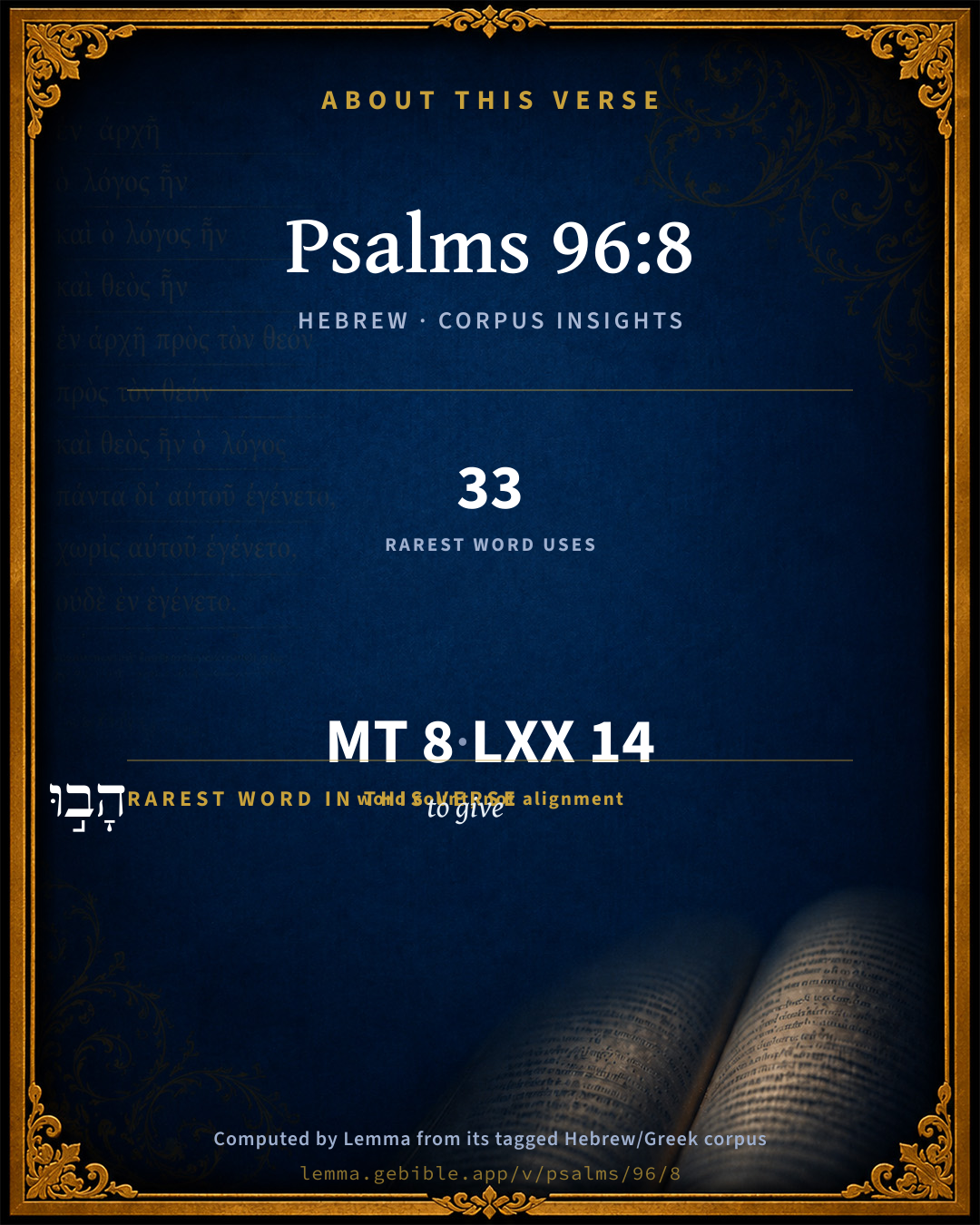
הָב֣וּ to give H3051 occurs in 29 verses of the Hebrew Bible. Also found in:

Grammatical profile

  • 3 verbs
  • 5 nouns

Verb forms

  • הָב֣וּ Qal · Imperative
  • שְׂאֽוּ Qal · Imperative
  • וּבֹ֥אוּ Qal · Imperative

Hebrew & Septuagint length

In English translation the verse runs 17 words from the Hebrew and 16 from the Septuagint (LXX English) — closely comparable.

A rough comparison of the two English renderings, which tokenize alike — not a word-level alignment.

Word counts can differ between the Hebrew and the Greek without any difference in meaning — e.g. the Hebrew direct-object marker אֵת has no separate Greek word, and Greek often adds the article ὁ.

In the original languages it is 8 Hebrew tokens and 14 Greek tokens — but the two are counted differently (Hebrew bundles its prefixes and suffixes into one token; the Greek is in lemma form), so that isn’t a like-for-like length.

Cross-references

18

Topical passages linked to Psalms 96:8 in the Treasury of Scripture Knowledge — connected by theme and wording, ordered by reader-vote popularity; previews shown in the World English Bible.

  • Psalms 100:4 Enter into his gates with thanksgiving, Into his courts with praise. Give thanks to him, and bless his name.
  • Romans 12:1 Therefore I urge you, brothers, by the mercies of God, to present your bodies a living sacrifice, holy, acceptable to God, which is your spiritual service.
  • Exodus 34:5–9 Yahweh descended in the cloud, and stood with him there, and proclaimed the name of Yahweh.
  • Hebrews 13:15–16 Through him, then, let us offer up a sacrifice of praise to God continually, that is, the fruit of lips which make confession to his name.
  • Psalms 45:12 The daughter of Tyre comes with a gift. The rich among the people entreat your favor.
  • Psalms 72:10 The kings of Tarshish and of the isles will bring tribute. The kings of Sheba and Seba shall offer gifts.
  • Psalms 108:3–5 I will give thanks to you, Yahweh, among the nations. I will sing praises to you among the peoples.
  • Malachi 1:11 For from the rising of the sun even to the going down of the same, my name is great among the nations, and in every place incense will be offered to my name, and a pure offering: for my name is great among the nations," says Yahweh of Hosts.
  • Psalms 111:9 He has sent redemption to his people. He has ordained his covenant forever. His name is holy and awesome!
  • Psalms 148:13–14 Let them praise the name of Yahweh, For his name alone is exalted. His glory is above the earth and the heavens.
  • Isaiah 60:6–7 The multitude of camels shall cover you, the dromedaries of Midian and Ephah; all they from Sheba shall come; they shall bring gold and frankincense, and shall proclaim the praises of Yahweh.
  • Romans 15:16 that I should be a servant of Christ Jesus to the Gentiles, ministering as a priest the Gospel of God, that the offering up of the Gentiles might be made acceptable, sanctified by the Holy Spirit.
  • Philippians 2:17 Yes, and if I am poured out on the sacrifice and service of your faith, I rejoice, and rejoice with you all.
  • Philippians 4:18 But I have all things, and abound. I am filled, having received from Epaphroditus the things that came from you, a sweet-smelling fragrance, an acceptable and well-pleasing sacrifice to God.
  • Hebrews 13:13 Let us therefore go forth to him outside of the camp, bearing his reproach.
  • 1 Peter 2:5 You also, as living stones, are built up as a spiritual house, to be a holy priesthood, to offer up spiritual sacrifices, acceptable to God through Jesus Christ.
  • Revelation 8:3–4 Another angel came and stood over the altar, having a golden censer. Much incense was given to him, that he should add it to the prayers of all the saints on the golden altar which was before the throne.
  • Revelation 15:4 Who wouldn't fear you, Lord, And glorify your name? For you only are holy. For all the nations will come and worship before you. For your righteous acts have been revealed."

Cross-references courtesy of OpenBible.info (CC BY 4.0).

Hebrew and Greek witnesses Masoretic Hebrew ↔ Greek Septuagint

The same verse in the two great witnesses to the Old Testament, shown verse-for-verse.

You’re reading Greek Psalm 95 (Hebrew Psalm 96). The Septuagint counts the superscription, so verse numbers can differ from the Hebrew — chapter-level alignment, not verse-by-verse. Numbering follows Rahlfs.

These are two independent witnesses, not word-aligned to each other, and the Septuagint is shown in lemma (dictionary) form.

Hebrew Psalms 96:8 Masoretic · Westminster Leningrad Codex

הָב֣וּ לַ֭יהוָה כְּב֣וֹד שְׁמ֑וֹ שְׂאֽוּ מִ֝נְחָ֗ה וּבֹ֥אוּ לְחַצְרוֹתָֽיו

Ascribe to Yahweh the glory due to his name. Bring an offering, and come into his courts.

World English Bible · Public Domain

Greek LXX Greek Psalm 95:8 Septuagint · lemma form

φέρω ὁ κύριος δόξα ὄνομα αὐτός αἴρω θυσία καί εἰςπορεύομαι εἰς ὁ αὐλή αὐτός

Bring to the Lord the glory becoming his name: take offerings, and go into his courts.

LXX2012 (modern English Septuagint) · Public Domain

Hebrew: Westminster Leningrad Codex (CC BY 4.0). Greek: Septuagint (public domain); English from LXX2012 (modern English Septuagint) (Public Domain). How the Septuagint differs from the Hebrew →

Commentary

Notes on Psalms 96:8 from classic Christian and Jewish commentators (each source and its license shown beneath its notes). The classic Christian expositions comment on the surrounding passage and are grouped to its opening verse, so a note may address several verses; the Jewish commentaries on the Tanakh (Rashi and others) are per-verse, so they appear only where the commentator wrote on this verse.

Lemma curates 59 commentaries, every one of them public domain or Creative Commons licensed, each selected and text-cleaned for this edition rather than reprinted as found. About our sources →

Trapp's Complete Commentary

John Trapp

Psa 96:8 Give unto the LORD the glory [due unto] his name: bring an offering, and come into his courts.

Ver. 8. Give unto the Lord the glory, &c.] It was hard for the heathens to forego their superstitions (Cicero resolved he would never do it, &c.), therefore they are here so pressed to it. See Rev 14:6-7, with the notes there. One expositor giveth this note here, Ternarius numerus est sacer ob mysterium Triadis; ideo enim eo scriptura gaudet. The Scripture oft presseth or expresseth things thrice over, in reference to the mystery of the holy Trinity.

Bring an offering] Reasonable service, Rom 12:1; spiritual sacrifices acceptable by Jesus Christ, 1Pe 2:5.

John Trapp, A Commentary or Exposition upon All the Books of the Old and New Testament (1647–1656) — public domain. Text from a community e-Sword module.

The Biblical Illustrator

Joseph S. Exell

Psa_96:8-9

Give unto the Lord the glory due unto His name: bring an offering, and come into His courts.

Public worship

I. Prayer. As we all have religious feelings to express, sins to acknowledge, mercies temporal and spiritual for which to give thanks, evils to feel or fear, with regard to ourselves and others, it highly becomes us to join together, and to lift up our hearts with one accord, in a public and social manner, to the hearer of prayer, and thus to offer unto Him our united homage and supplication with thanksgiving. Prayer is not only a duty, it is a high privilege and honour; the nearest approach to God, and the highest enjoyment of Him which we are capable of in this world.

II. Praise. The saints on high, and the angels around the throne, praise God in the highest, and well does it become men upon earth to join their humble notes of praise to the anthem of the heavenly choirs, in exalting together His great and glorious name. All the works of God praise Him, from the heights of heaven to the depths of the earth; the angels around the throne praise Him; the sun, and moon, and stars of light praise Him in their courses; the mountains, and valleys, and woods, and fields, and seas, and streams of water praise Him; the elements of nature praise Him and obey His Word.

III. The preaching and hearing of the word. Both the ministers and the hearers of the Word should watch over themselves, that they may have singleness of eye and heart to the glory of God, more desirous of the Divine approbation than of human applause, avoiding all vain and vexatious questions, which profit not, but engender strife and ungodliness, and which violate that heavenly charity without which all our services are hateful in the sight of God.

IV. The giving and receiving of the Sacrament of the Lords Supper. We should consider the nature and design of the Lords Supper, the dispositions which are required for an acceptable participation, and the graces which it is calculated to cherish. The Lords Supper thus observed would be attended with the happiest and most beneficial effects on our hearts and lives, in confirming our faith, enlivening our hope and charity, and in promoting our progress in holiness, and in meetness for the pure and perfect service of heaven. (J. Wightman, D. D.)

Worship

Worship may be called the flower of the religious life. It will be absent where there is no religion at all; it will be scanty or poor when ones religion is feeble; it blossoms into beauty and perfection only when godliness is assiduously cultivated in daily practice and the soul is accustomed to dwell habitually under the shadow of the Almighty. Here, then, you have a very useful test by which to judge of your real religious condition. Is worship irksome? Do you find your affections generally cold, your desires languid, or your thoughts wandering when you come to church? Search within for the cause; see if there be not a negligent state of the soul behind this undevout frame of yours; inquire into your daily habits of obedience, your vigilance against known sin, your study of Gods will and mind, your practice of repentance, and of faith in the Saviour. As a Christian lives well or ill so will he worship. Again, his worship, if it be hearty and constant, must feed and purify his spiritual life. And here let me speak a little on the utterances which the devout mind finds for its feelings towards God; because it should be recollected that although worship begins in a state of the heart it does not stop there--to feel penitence, or gratitude, or adoration is not just the same thing as to worship; worship or homage begins when the hidden emotions of a devout mind, stirred up at the thought of God, run out into some form of utterance. The utterance may, no doubt, be secret and silent--no voice--hardly even the lips moving, like pious Hannahs, the soul talking only to its God. This is how people commonly worship when they are alone. No matter; there is none the less real outflow and utterance of the man. An outflow of the heart towards the Most High there must be, perfectly well understood by Him whether discernible to men or not--then the soul worships. Now, of what nature is this outflow from the religious heart? Briefly, it is of the nature of an offering of a sacrifice. Foremost of all, that of which it is expressly said, The sacrifices of God are a broken spirit, etc. Next comes the offering of our grateful and joyous praise for Him who hath been sent among us to heal the broken-hearted; I mean the words of our lips giving thanks to His name in song and audible confession of His mercy, for with such sacrifices, likewise, God is well pleased. One other offering alone I shall name which we ought to bring within His courts--it is that which the apostle has described as a service reasonable on our part and acceptable to God--I mean the dedication to His service of ourselves. Christian homage to the Redeemer finds its supreme utterance here in the recognition of the fact that we are no longer our own, at our own bidding and disposal, but are His who bought us with a price, willingly devoted, separated of our own choice, to the service and honour of our Redeemer, living and dying body and soul the Lords. (J. O. Dykes, D. D.)

The duty of prayer

1. The primary foundation of this duty is the souls relation to God. Every consideration by which we commend filial piety towards earthly parents holds still more forcibly in reference to our heavenly Father. How unnatural the child that never asked his father for anything, that never made his mother the confidante of his troubles and difficulties, that could drink the cup of enjoyment and success, and never ask his parents to share it, or that never poured into their hungering ears the expressions of affection and honour. What opportunities the wants, troubles, and enjoyments of childhood afford for intercourse between parent and child, for the moulding influence of the parent to exert itself upon the childs character, for the play of mutual affection and delight. Judging from human analogy, it would seem quite sufficient reason for Gods making the bestowment of His best blessings to depend upon their being sought in prayer, that communications concerning giving and receiving send themselves so directly to the expression and strengthening of love.

2. Prayer is a duty we owe to Gods name, an offering which we ought to make to His blessedness. God is love, and love has its expectations, its satisfactions, its dues, its delights. Will a man rob God? the prophet asks. Ah, we have robbed Him of dearer treasure than tithes and offerings. Where is the husband or wife, the father or daughter, who would not account the withholding of the affection that was their just expectation a more grievous wrong than any passing injury or lapse of material gifts? Our obligation as Christians to live in communion with God is all the stronger that in these last days He hath spoken unto us by His Son.

3. Public worship is a duty we owe to God as witnesses to His existence, authority, and grace. The maintenance of this testimony is a most efficient means of advancing His kingdom in the world. When we render it, we are doing in a humble way the work of such men as Elijah and Daniel. This is one important use of public worship. Such worship, by uniting many suppliants in one request, calls forth more abundant praise when it is granted: it provides, also, a fuller expression of adoration than the individual soul can compass, and therefore intensifies and exalts its feeling; further, it exhibits the sympathy and concord of human beings in the loftiest employment of their powers; but beyond all this, it lifts up a clear and striking testimony to the reality of Gods authority and grace, and bids men everywhere bow down before their Maker.

4. The neglect of prayer indicates a general indifference to duty. Since we are really dependent upon the inspiration and guidance of God for the power to serve Him acceptably, to neglect the means of obtaining these is to be careless where we ought to be most careful. If out of the heart are the issues of life, and prayer is the chief instrument of heart culture, how blamable our want of diligence in it. To neglect prayer is to leave our loyalty open to every hostile temptation, to burn our lamp and make no provision to replace the exhausted oil. (E. W. Shalders, B.A.)

Worship the Lord in the beauty of holiness.

The Churchs worship in the beauty of holiness

Slightly changing the order of the psalmists biddings, I will invite you to lend to him your attentive ears, first, as he says to you and to all, Worship the Lord, and that in the beauty of holiness; and then, as he summons you to one duty, or rather one privilege, more, Bring presents, and come into His courts. And first, as he says to you, Worship the Lord, this house being first and chiefly a house of prayer, according to that word of the prophet, afterwards made His own by Christ the Lord, My house shall be called a house of prayer. Seek ye My face, He says to each that enters its gates. They only enter those gates with profit, they only carry away a blessing, who make answer from the heart, Thy face, Lord, will we seek. But this worship, how shall it be offered, and with what accompaniments? In the beauty of holiness. Other beauty is good in its place and its degree; has its worth, although that altogether a subordinate worth. The outward apparel of the kings daughter may be of wrought gold (and who would grudge her this, where it may be fitly had?) but she must be all glorious within, glorious with the inward graces of faith and love, humility and holiness, if that Lord for whom she adorns herself is indeed to delight Himself in her or to behold any beauty in her, that He should desire it. But how worship Him in the beauty of holiness? We unholy, we defiled, our souls not beautiful, but ugly with sin, how shall we fulfil the condition which the psalmist requires? First, then, I reply, or rather the Word of God replies, he only who has his conscience purged from dead works through the blood of sprinkling can do this. And the second condition is like to it, that we, as the true Israel, worship God in the spirit, praying in the Holy Ghost. But what else does the psalmist say? Bring presents, and come into His courts. And first, lest there should be any mistake here, let me remind you of that without which every other present will be worthless in the sight of Him who does not weigh what we give, but with what spirit we give it. See, then, that you offer first and chiefly yourselves, your souls and bodies, acceptable through Christ, washed with His blood, sanctified by His Spirit. Give, and that without keeping anything back, yourselves to God. But, this done, bring other presents, other gifts; they will all, indeed, have been included in this all-embracing one, to Him. If you have leisure, leave not your clergy to cope single-handed with the ignorance, the vice, and the misery around them; range yourselves among their helpers; give them some of that lay assistance which is so invaluable to them. If you have means, suffer not the Churchs charities at home, her missions abroad, to be starved and stunted through contributions by you withholden altogether, or doled out with a niggard hand. If you have any special talent, see if it cannot be enlisted in the service of God, and find its highest consecration there. (Abp. Trench.)

Worship

I. Its nature. It consists in devout exercises of the soul, whether in meditation, adoration, admiration, or supplication. It is the spirit disentangled from the sensuous and engaged in fellowship with the Invisible and Divine.

1. Worship is a necessity of mans nature. He is no mere machine, or thinker, or theorist; he is pre-eminently a worshipper, distinctively moral in his make, religious in his proclivities, akin in the great spiritual invisibilities of his nature to the all-glorious Creator.

2. Worship is an evidence of mans greatness. The existence of moral intuitions amid the sad wreck of the soul by sin proclaims a fallen nobility, a crownless royalty: yea, tells it even now to be--Sublime in ruins and grand in woe.

3. In worship man finds his native element. Like the bird which has been encaged for weary months, that breaks through the wires of its prison and escapes on swift wing, pealing forth its song of freedom as it finds its native element, so the believer, escaping from the din and turmoil of the world, or of business, and entering into the hallowed retreat of the closet, or the holy place of the tabernacle of the Most High, hears amid its hush and stillness angelic voices whispering, The Lord is in His holy Temple, and finds in His presence the society for which he was made, and the fellowship for which he pants. There is a kinship of soul, an affinity of sympathy, a unity of will, a oneness of spirit, a reciprocity of affection.

II. Its object. Worship the Lord.

1. He should be worshipped in His sovereign and paternal relationship to us.

2. He should be worshipped in the Tri-unity of His nature. Though it be impossible to give a positive definition of the distinction between Father, and Son, and Holy Spirit, yet this is no sufficient reason for denying the distinction itself, of which the Bible assures us; for reason, when left to herself, sets before us objects concerning which we, indeed, know that they exist, but concerning whose nature we have no positive knowledge. We can only distinguish between them and some false representations, or determine what they are net; but of their intrinsic nature, how they are we have not the slightest knowledge.

3. Man becomes assimilated to the object of his worship. How vastly important, then, that our knowledge of God should be intelligent, correct, scriptural, and true.

III. Its spirit. In the beauty of holiness.

1. Reality.

2. Simplicity. (J. O. Keen, D.D.)

Beauty o/ soul

Why do we think that nature is beautiful? Because it is the external world formed by the same hand that made us. We, partakers of the likeness of God, naturally admire our Fathers works. We see beauty and divinity in them, and if He hath made the external world beautiful He hath made the human soul also, and devised that it shall be beautiful, like a great and beautiful temple, full of costly and beautiful things, a soul in harmony with itself, a soul in harmony with other souls that seek with it to do Gods will, a soul filled with purity, light, gladness, charity, a soul overflowing with the love of God, with love of our fellow men, with the earnest desire to do always the things that are pure and virtuous. Look into such a soul and see how beautiful it is, the marvellous symmetry in the human soul, the marvellous colours, divinely gifted, in the human soul, the marvellous possibilities in the human soul. It is Gods wonderful picture, His wonderful dream. God made the human soul, and the beauty of God, the beauty of the Divine conception that was in Gods mind is expressed there. What a wonder is a beautiful soul! The soul that has been recognized in this world as transcendently beautiful is the soul of Jesus Christ. It has drawn other souls that had been contaminated with sin, drawn them to itself and transformed them to the glorious image; it has influenced more than anything else that we know the whole mind, the whole movement of the human family. The beauty of the soul of Christ--transcendent, heavenly, bewitching--we gaze upon it, and we say, whatever divinity may be we cannot tell, but this is divine enough, it is the summation of divinest ideals for us. And gazing thus on the beautiful soul of the Christ, we are drawn up and beautified, filled with His love, transformed to His likeness, made more and more divine in the excellence of that grace which He gives to those souls that seek, for His sweet sake, that love to forsake evil, to put away the deformity, the debasement and the ugliness of vice, and to lay a herd of the Divine ideal, the beauty of Christ, and to worship God through Him and in His likeness, laying our noblest and our best, our best thoughts and our best feelings, and our noblest actions on the high altar of dedication to Him who has invited us in the old words of the psalm to worship Him in the beauty of holiness. (A. Bennie, B.D.)

Holiness

What is this holiness which is so beautiful? It is not justice--though it must include justice and have its root in strong integrity. It is not charity--though it must make man charitable with that finer love which not so much denies itself as simply forgets itself. It is not purity, but it is only in the pure soul that holiness can live; and purity which may be as cold as marble, touched by holiness takes on a glow as warm and radiant as the light of heaven. And it is no fancy of mine to make holiness include these things. Do you remember that holiness in its original derivation is simply wholeness, though the words have grown so curiously out of likeness in the spelling? Wholeness--the wholeness and completeness of character! Do you note the great, far-reaching meaning of this? I might figure the complete whole of human character as a pyramid: broad based in bodily power and aptitudes of strength or skill for lifes basal work; then, above this the various grades of intellectual faculty; above these, again, the moral with the lofty sense of conscience and right, and, still in these higher reaches of character, those human affections which give a tenderer grace to mere rigid morality; and, then, rising highest of all, capping and crowning all, the apex to the pyramid--religion. As a fact, holiness has come to mean, not all this wholeness, but especially that crowning and completing religious element which makes life whole at the higher end of it. And I do not want it taken away from that meaning, but it does want recognizing that the other is included, that for real holiness there must be wholeness; that holiness is not just a little religious element up in the heights of soul, and which may have nothing underneath it, but that it must have strong, full manliness or womanliness underneath it. The holiness that is not based on manly wholeness is not what the world wants. Mans being, in this common work-a-day world, has to be based on capable manhood; man has to have his feet firm on the solid earth. But now the other side of all this wants recognizing also. For that strong manly wholeness to come to any fine worth, there has to be this crowning element of holiness. The manhood that stops at strength, ability, or even intel-lect; the manhood that is not adding to these some crowning grace of earnest religiousness, is a poor truncated manhood. That is the most common trouble to-day. Men--men especially--are too content in lifes lower levels. They are strong, busy, capable there, but there they are content to stop. Life never was stronger at its base, but there is too little effort to build it up towards that finest manhood which is made whole by genuine, unashamed religion. And life loses immeasurably by this. It loses its highest outlook, its loftiest hopes, and all its noblest spring and power. Life wants to be made whole at the top. (B. Herford, D.D.)

The Biblical Illustrator, edited by Joseph S. Exell (c. 1880s–1900s) — public domain. Text from a community e-Sword module.

J. A. Alexander on Psalms

Joseph Addison Alexander

8. (Psa 96:8) Give unto Jehovah the glory of his name; take an offering and come to his courts. With the first clause compare Psa 29:2. The verb translated take includes the ideas of taking up and carrying. See above, on Psa 68:29; Psa 72:10; Psa 76:12, and compare 2Sa 8:2. The word offering is the one used to denote the bloodless or vegetable oblation of the Mosaic ritual. His courts, see above, on Psa 65:4; Psa 84:2; Psa 92:13. The parallel passage (1Ch 16:29) has before him.

Joseph Addison Alexander, The Psalms Translated and Explained (1850) — public domain. Text from a community e-Sword module.

Tyndale Open Study Notes

Tyndale Open Resources

96:8 The courts of God’s sanctuary were usually off-limits to non-Jewish people. In this psalm the nations of the world—the non-Jews—are invited in (65:4; 84:2, 10; 100:4; 116:19; 135:2; Isa 1:12).

Tyndale Open Study Notes — © Tyndale Open Resources, licensed CC BY-SA 4.0. Text via the HelloAO Bible API.

Geneva Bible (1599)

Geneva Bible translators

By offering up yourselves wholly unto God, declare that you worship him only.

Geneva Bible (1599) marginal notes — public domain. Text via Bolls.life.

Adam Clarke's Commentary

Verse 8. Come into his courts.] Probably referring to the second temple. The reference must be either to the tabernacle or temple.

Adam Clarke's Commentary on the Bible (1810–1826) — public domain. Text from a community e-Sword/MySword module.

Ellicott's Commentary for English Readers

(8) Offering.—The minchah, or sacrifice of fine flour.

A Bible Commentary for English Readers, edited by Charles John Ellicott (1878–1897) — public domain. Text from a community e-Sword module.

The Cambridge Bible for Schools and Colleges

gen. ed. J. J. S. Perowne

8. The glory of his name is given to Jehovah when He is acknowledged as the One Living and True God. The offering is the ‘present’ which subjects bring to their lord in token of their submission (2Sa_8:2). Cp. Isa_60:5 ff.

For into his courts 1Ch_16:29 reads before him, to suit the time when the Temple was not yet built.

The Cambridge Bible for Schools and Colleges (gen. ed. J. J. S. Perowne; Cambridge University Press, 1878–1918) — public domain. Text from a community e-Sword module.

John Gill's Exposition

Give unto the Lord the glory due unto his name,.... Or "the glory of his name" (q); whose name is glorious and excellent, because of his nature and perfections, because of the works done by him, and because of his benefits and blessings bestowed on his creatures; wherefore it is his due, and their duty, to give him glory; See Gill on Psa 29:2; see Gill on Psa 66:2, the word "Jehovah", or "Lord", being thrice mentioned in this and the preceding verse, in the ascription of glory, may lead our thoughts to the trinity of Persons, Jehovah, Father, Son, and Spirit, to whom glory is to be equally given:

bring an offering, and come into his courts; not ceremonial sacrifices, which are abolished under the Gospel dispensation, to which times this psalm belongs; but either the saints themselves, their bodies, as a holy, living, and acceptable sacrifice, and especially the sacrifices of a broken heart, with as much of their substance as is necessary for the relief of the poor, the support of the ministry, and the carrying on of the cause and interest of the Redeemer: the allusion is to the law that enjoined the Israelites not to appear empty before the Lord; but everyone to bring his gift according to his ability, Deu 16:16, or else their sacrifices of prayer and praise, which are the spiritual sacrifices of the Gospel dispensation, and are to be offered by the saints, as priests, to God through Christ; or rather the sacrifice of Christ himself, which is of a sweet smelling savour to God, makes way for access unto him, and acceptance with him; and which should be brought in the arms of faith, when they enter into the house of the Lord, and attend his word and ordinances; for, through this, their persons and services become acceptable to God, and the sins of their holy things are taken away.

(q) "gloriam nominis ejus", Pagninus, Montanus, Cocceius, Gejerus; so Ainsworth, Junius & Tremellius, Piscator.

John Gill's Exposition of the Whole Bible (1746–1763) — public domain (CC PDM 1.0). Text via the HelloAO Bible API.

Albert Barnes' Notes on the Bible

Give unto the Lord the glory due unto his name - This also is literally taken from 1 Chr. 16: Psa 96:1-13 :28. The margin here is, as in Hebrew, of “his name:” the honor of his name. The idea is that which is expressed in our translation. Bring to God what is due to him; or, render such an acknowledgment as he deserves and claims. Acknowledge him as God, and acknowledge him to be such a God as he is. Let the honor due to God as such be given him; and let the honor due to him, for the character which he actually has, be ascribed to him.

Bring an offering - This is language taken from the temple-worship, and means that God is to be worshipped, in the manner which he has prescribed, as a suitable expression of his majesty. The word here rendered “offering” - מנחה minchāh - is that which is commonly used to denote a “bloodless” offering - a thank-offering. See the notes at Isa 1:13.

And come into his courts - The courts or areas around the tabernacle and the temple, where sacrifices were made, and where the people worshipped. See the notes at Mat 21:12.

Albert Barnes' Notes on the Bible (1834–1885) — public domain. Text from a community e-Sword/MySword module.

Matthew Poole's English Annotations

Into the courts of his house. But under this one part of worship he comprehends the whole worship of God; and he speaks of the worship of the New Testament under the expressions of legal worship, as the prophets elsewhere do, as Mat 1:11, and elsewhere.

Matthew Poole's English Annotations on the Holy Bible (1683–1685) — public domain. Text from a community e-Sword/MySword module.

The Treasury of David

Charles H. Spurgeon

Ver. 8. Give unto the LORD the glory due unto his name. But who can do that to the full? Can all the nations of the earth put together discharge the mighty debt? All conceivable honour is due to our Creator, Preserver, Benefactor, and Redeemer, and however much of zealous homage we may offer to him, we cannot give him more than his due. If we cannot bring in the full revenue which he justly claims, at least let us not fail from want of honest endeavour.

Bring an offering, and come into his courts. Come with an unbloody sacrifice; atonement for sin having been made, it only remains to bring thank offerings, and let not these be forgotten. To him who gives us all, we ought gladly to give our grateful tithe. When assembling for public worship we should make a point of bringing with us a contribution to his cause, according to that ancient word, "None of you shall appear before me empty." The time will come when from all ranks and nations the Lord will receive gifts when they gather together for his worship. 0 long expected day begin!

Ver. 8. Give unto the LORD the glory due unto his name. It is a debt; and a debt, in equity, must be paid. The honour due to his name is to acknowledge him to be holy, just, true, powerful: "The Lord, the faithful God, ""good, merciful, long suffering, "etc. Defraud not his name of the least honour. Adam Clarke.

Ver. 8. Give unto the LORD the glory due unto his name. Is all the glory due unto God's name, and ought it, in strict justice, to have been ascribed unto him by men, ever since man began to exist? How immeasurably great then is the debt which our world has contracted, and under the burden of which it now groans! During every day and every hour which has elapsed since the apostasy of man, this debt has been increasing; for every day and every hour all men ought to have given unto Jehovah the glory which is due to his name. But no man has ever done this fully. And a vast proportion of our race have never done it at all. Now the difference between the tribute which men ought to have paid to God and that which they actually have paid constitutes the debt of which we are speaking. How vast, then, how incalculable is it! Edward Payson.

Ver. 8. Give unto the LORD the glory due unto his name. Every glory will not serve the turn, but such glory as is proper and peculiar for that God we serve. It is a stated rule in Scripture that, respects to God must be proportioned to the nature of God. God is a spirit, therefore will be worshipped in spirit and truth. God is a God of peace, therefore lift up pure hands, without wrath and doubting. God is a holy God, therefore will be sanctified. They which worship the sun, among the heathens, they used a flying horse, as a thing most suitable to the swift motion of the sun. Well, then, they that will glorify and honour God with a glory due to his name, must sanctify him as well as honour him. Why? For "God is glorious in holiness, "Ex 15:11. This is that which God counteth to be his chief excellency, and the glory which he will manifest among the sons of men. Thomas Minton.

Ver. 8. Bring an offering. This is language taken from the temple worship, and means that God is to be worshipped, in the manner which he has prescribed, as a suitable expression of his majesty. The word here rendered "offering" hxkm, minkhah is that which is commonly used to denote a bloodless offering, a thank offering. Albert Barnes.

Ver. 8. Jehovah possesses a nature and character peculiar to himself; he sustains various offices and relations, and he has performed many works which he alone could perform. On all these accounts something is due to him from his creatures. And when we regard him with such affections, and yield him such services, as his nature, character, offices, and works deserve, then we give unto him the glory which is due to his name.

1. Let us inquire what is due to Jehovah on account of his nature.

2. What is due to Jehovah on account of the character he possesses.

3. What is due to God on account of the relations and offices which he sustainsthat of a creator, preserver.

4. What is due to Jehovah on account of the works which he has performed, in nature, providence and redemption. E. Payson.

Ver. 8. The object of worship. The nature of worship. The accompaniment of worship (an offering). The place of worship. C. D..

Psalms 96:9*

Charles H. Spurgeon's The Treasury of David (1869–1885) — public domain. Psalms only. Text from a community e-Sword/MySword module.

Whedon's Commentary on the Bible

Daniel D. Whedon

8. Glory due unto his name—Literally, The glory of his name; that is, ascribe to him the “glory” of his self-manifestations, whether in creation, providence, or redemption. See on Psa_96:5.

Bring an offering—The call is still to the nations. See the anticipation of their conversion further delineated, Isaiah 60. There is no religion without worship; and worship, to be acceptable, must include an offering to God and a public confession according to our relations to him. See on Psa_50:14; Psa_51:16-17

Daniel D. Whedon (gen. ed.), Commentary on the Old and New Testaments (1874–1909) — public domain. Text from a community e-Sword module.

The Pulpit Commentary

Give unto the Lord the glory due unto his Name; literally, the glory of his Name. Bring an. offering, and come into his courts. The parallel expression in 1Ch_16:29 is, "Come before him. " "Courts" would be inappropriate until the temple was built. (For the bringing of "an offering" (minchah) by the Gentiles, see Mal_1:11)

"Bring an offering, and come into his courts.

This psalm is one continuous appeal for all to render praise unto the Lord. Not men alone, though they, of course, chief of all, are to join in the song unto the Lord; but the heavens, the earth, the sea, the fields, the trees, all are to testify to their Creator"s praise. And the psalm tells of a threefold expression of this joy in God.

1. The song. All are to join in; no stopping to inquire into the motives, but all are to sing (ver. 1). It will be good even for evil men, as well as the people of God, to unite in his praise. It may help them to pass over to the side of God"s people.

2. Preaching. The very idea of missions as here set forth is the overflowing, the exuberance, of the Church"s joy. So only can missions really succeed (see homily on ver. 3).

3. Offerings. Of these we would specially speak. For our text lays down

I THE DUTY OF OFFERING TO GOD.

1. The witnesses to this will of God are numerous.

(1) The patriarchs. See their sacrifices. Noah"s offerings. Abraham"s tithes. (Gen_14:20) Jacob"s vow. (Gen_28:22)

(2) The Jews. The tithes they had to pay amounted to nearly a third of their income. The treasury was a constituent part of the temple, and large sums were continually cast in there. (Mar_12:41-43)

(3) The early Church. They had a common fund. (Act_2:44, Act_2:45) Paul and Barnabas (Act_11:29, Act_11:30) gathered for the poor of Jerusalem. Paul from the Corinthians. (1Co_16:1) Christ said, "It is more blessed to give than to receive"; (see parable of unjust steward, Mat_24:6, etc.)

2. The need of it is so great. Think of the multiplied objects which call for such offerings. The Church of God needs such aid for the maintenance of her ministers, her fabric, her missions, and her varied religious agencies. The poor rightly claim our help. If we have not compassion for them, how dwelleth the love of God in us? Our own spiritual life demands that we make such offerings. The only way to overcome that idolatry of money which seduces so many is to give it away in wise and Christian manner. If we hoard and keep it, the love of it will drive out the love of God.

II THE MANNER OF FULFILLING THIS DUTY.

1. Presenting it in the house of God when we come to worship. This was the custom of the Jews. (see 1Ch_16:1) Also of the early Christian Church. (see 1Co_16:1 2Co 8 and 2Co 9) St. Paul"s argument on this matter is very interesting and noteworthy. He was very anxious to relieve his own countrymen; to fulfil his own promise; (Gal_2:10) to prove the reality of the faith of the Gentile Churches and their love to their Jewish brethren, and thus to heal the breach that so sadly severed the Jewish and Gentile Churches. Hence he was very anxious about this collection, and hence, also, he would be sure to seek out the best means for securing it. Hence he directed that there should be the weekly Lord"s day storing for this end. (1Co_16:2) Now, as this plan is so good, and no other is so commended to us, we may regard it as having special claim on our attention.

2. For it has great advantages. It takes away the temptation to neglect of this duty which arises from:

(1) The largeness of the offering asked. What is given week by week is not felt as when a great sum is asked for all at once.

(2) Delay of offering.

(3) Infrequency.

(4) Dependence upon the excitement of the moment. Moreover:

(5) It makes worship more real.

(6) It is far more productive

(7) It is a witness bearing for Christ.

(8) It nourishes our own spiritual life.

But, of course, this especial manner of offering is not obligatory, though it has especial sanction.

III THE MOTIVE. Love to Christ. (2Co_8:9) That is the only worthy and reliable motive. Others are sure to break down sooner or later, and to miserably fail in securing the end sought after. Let Christ possess a man"s heart, all else will go along with that. S.C.

Offerings associated with worship.

Oriental custom demands that every person seeking an audience with a king shall offer him a present. An Eastern traveller writes, "It is counted uncivil to visit in this country without an offering in hand. All great men expect it as a kind of tribute due to their character and authority, and look upon themselves as affronted, and indeed defrauded, when this compliment is omitted." For illustration, reference may be made to Saul, anxious about a present for the man of God; to the gifts, gold, frankincense, and myrrh, offered by the Magi to the infant Saviour; and to the Malagasy custom known as making "hasina." Offerings to the gods involve the heathen, oftentimes, in ruin, so exorbitant are the demands made by the priests. The psalmist is full of the idea of God as the actual, present, though unseen, King of the nation, and he is thinking of the offering as the acknowledgment of allegiance, the outward sign of loyalty. There is no idea of God"s needing offerings; the psalmist thinks only of what is fitting on the part of the people. Distinguish between taking an honourable share in the support of Christian worship, and making offerings as a sign of loyalty. See under what conditions offerings are still acceptable, showing first how far the King-figure for God may be used by us.

I OFFERINGS FOR GOD MUST BE REASONABLE. That term includes two distinct things:

(1) proportionate;

(2) thoughtful.

There may be times when an impulsive gift is acceptable; but as a rule no proper gift can be made to God save upon due consideration of all our claims. God asks but a proportion of our time, our land, or our labour. Our care should be to get and keep an honourable proportion. There is some danger in our over-valuing mere impulsive acts. They "loom large" to our view. Whereas the man who, thoughtfully estimating his means, sets aside his offering for God, lays a far nobler gift on God"s altar. It is a gift of mind, and not of merely excited feeling.

II OFFERINGS FOR GOD MUST BE MADE TO MATCH INDIVIDUALS. Two young pigeons for a mother if she be poor. Two mites for a widow; but gold for the rich. The gift should match means and good will.

III OFFERINGS FOR GOD MUST BE EXPRESSIVE OF OFFERED SELF. To God there can be no value in things. What he asks for, and can alone accept, is the spiritual offering of the man himself his will, his love. This can find expression in a material offering. God will only receive the offering when it is the voice of the man. R.T.

The Pulpit Commentary (1880–1919), ed. H.D.M. Spence-Jones & Joseph S. Exell — public domain. Text from a community e-Sword module.

Lesson kit

Teaching starters — assembled from the data on this page, not authored interpretation. Every prompt links to the verse data it draws on. Edit before teaching.

Psalms, in the Wisdom, opens this verse with 8 words (8 distinct Hebrew lemmas). Its most distinctive word is yâhab (“to give”). A historical commentator’s framing appears above. Read the whole chapter for the surrounding context.

Discussion questions

  1. The word yâhab carries the sense “to give.” How does it shape the verse?
  2. How does Genesis 11:3, which shares the word «to give», read alongside this verse?
  3. These translations render this verse differently. What is at stake in choosing one wording over another?
  4. «הָב֣וּ» is a Qal Imperative verb. How does that grammatical form shape the action described?
  5. Compare how Trapp's Complete Commentary and The Biblical Illustrator read this verse. Where do they agree or differ?

Things to notice

Reading settings

Reading text

Shown beneath each verse's original-language words.

Old Testament
Old Testament edition

Read the OT as the Masoretic Hebrew (MT) or the Greek Septuagint (LXX).

English shown for the Greek Septuagint (in the Hebrew ↔ Greek comparison).

Comparing translations? Open the Compare panel on any verse page to stack up to four side by side.