
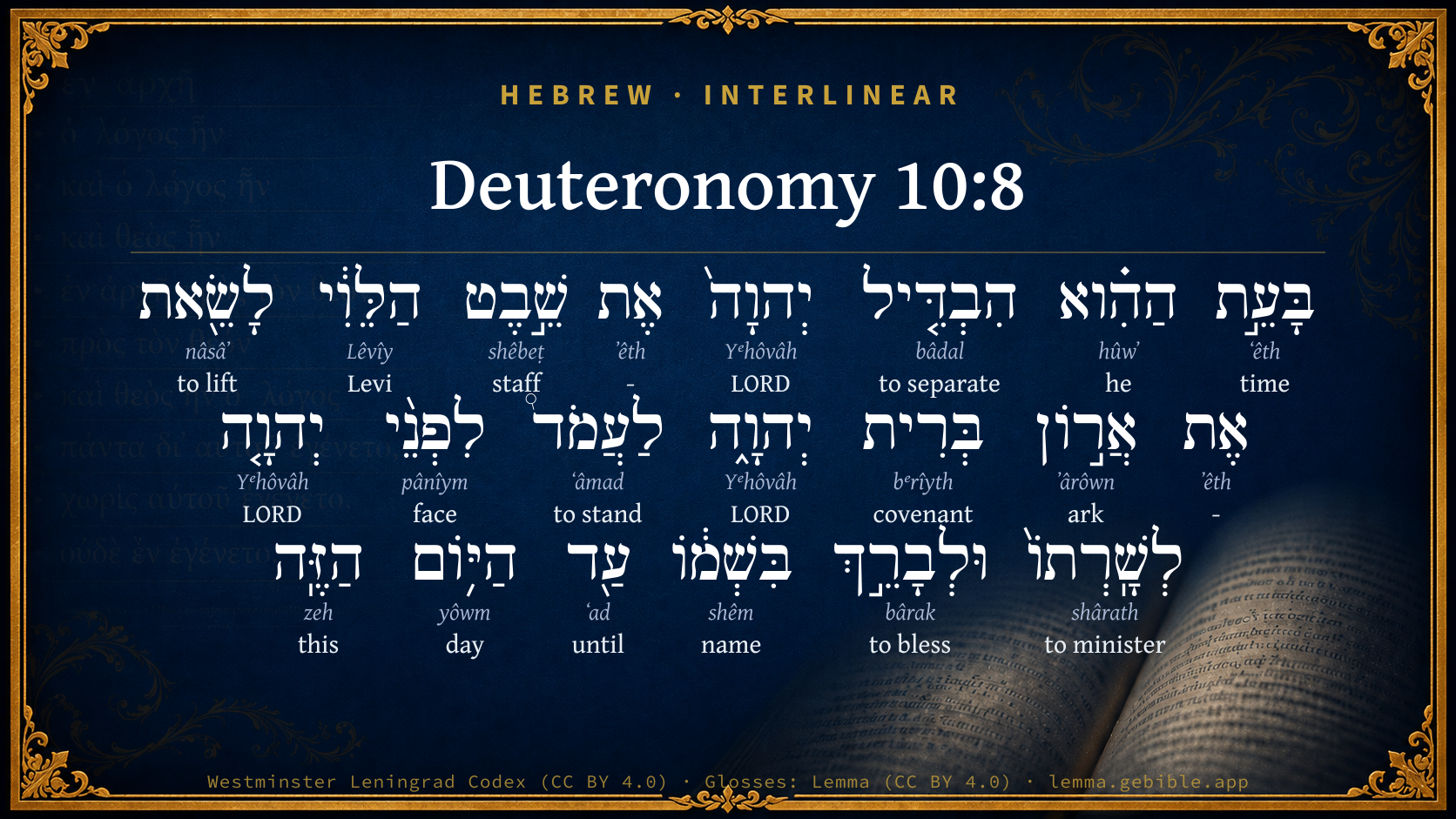
Deuteronomy 10:8

Hebrew (Westminster Leningrad Codex) Deuteronomy 10:8 appears in the Hebrew Old Testament. The text above is from the Westminster Leningrad Codex. Each word links to its Strong’s number, a concise gloss, and parsing drawn from the Open Scriptures Hebrew Bible morphology. Click any word for its full Brown-Driver-Briggs (BDB) entry.
Download image
Cite this verse

Deuteronomy 10:8 (World English Bible). Public Domain. Lemma interlinear Bible study tool, https://lemma.gebible.app/v/deuteronomy/10/8.

Show BibTeX & RIS
BibTeX
RIS
English Translation
At that time Yahweh set apart the tribe of Levi, to bear the ark of the covenant of Yahweh, to stand before Yahweh to minister to him, and to bless in his name, to this day.
World English Bible · Public Domain
Download a study sheet

One document with this verse’s original text, its word-by-word gloss line, the meaning frame, cross-references with their text, attributed commentary, and full source and license credits — printable, and it pastes into notes with its structure intact.

This verse Autodidact and up

Study sheet (.html) Plain text (.txt)

A passage Seminary Student

Up to 50 verses in one chapter. A passage sheet keeps up to 6 commentary sources and 12 cross-references per verse, in the order this page ranks them, and says so on the sheet whenever that leaves anything out. Ask for a single verse and you get the Autodidact verse sheet above.

Everything on this page stays free to read, with no account — the sheet is a download of what is already on screen, not access to it.

Want to remove ads? Support Godless Engineer
Compare translations 3

The same verse in 3 English versions, stacked beneath the original-language interlinear above. Click any original word for its lexicon entry.

Each is an independent rendering of the whole verse — the interlinear is not word-aligned to these translations.

Highlighted words mark where these versions differ — a whole-verse word diff, not a word-by-word alignment.

  • World English Bible Public Domain
    At that time Yahweh set apart the tribe of Levi, to bear the ark of the covenant of Yahweh, to stand before Yahweh to minister to him, and to bless in his name, to this day.
  • King James Version Public Domain
    At that time the LORD separated the tribe of Levi, to bear the ark of the covenant of the LORD, to stand before the LORD to minister unto him, and to bless in his name, unto this day.
  • unfoldingWord Literal Text CC BY-SA 4.0
    At that time Yahweh separated the tribe of Levi to carry the box of the covenant of Yahweh, to stand to the face of Yahweh to serve him, and to bless in his name, until this day.

unfoldingWord Literal Text — © unfoldingWord, licensed CC BY-SA 4.0. Word-aligned USFM3 via Door43 (git.door43.org/unfoldingWord/en_ult).

Versions to compare (up to 4)

3 of 4 selected

Show all 18 translations

Every available English version of this verse, each an independent rendering of the whole verse.

  • World English Bible Public Domain
    At that time Yahweh set apart the tribe of Levi, to bear the ark of the covenant of Yahweh, to stand before Yahweh to minister to him, and to bless in his name, to this day.
  • Berean Standard Bible Public Domain
    At that time the LORD set apart the tribe of Levi to carry the ark of the covenant of the LORD, to stand before the LORD to serve Him, and to pronounce blessings in His name, as they do to this day.
  • Majority Standard Bible Public Domain
    At that time the LORD set apart the tribe of Levi to carry the ark of the covenant of the LORD, to stand before the LORD to serve Him, and to pronounce blessings in His name, as they do to this day.
  • King James Version Public Domain
    At that time the LORD separated the tribe of Levi, to bear the ark of the covenant of the LORD, to stand before the LORD to minister unto him, and to bless in his name, unto this day.
  • American Standard Version (1901) Public Domain
    At that time Jehovah set apart the tribe of Levi, to bear the ark of the covenant of Jehovah, to stand before Jehovah to minister unto him, and to bless in his name, unto this day.
  • Revised Version (1885) Public Domain
    At that time the LORD separated the tribe of Levi, to bear the ark of the covenant of the LORD, to stand before the LORD to minister unto him, and to bless in his name, unto this day.
  • Geneva Bible (1599) Public Domain
    The same time ye Lord separated the tribe of Leui to beare the Arke of the couenant of the Lord, and to stand before ye Lord, to minister vnto him, and to blesse in his Name vnto this day.
  • Douay-Rheims (1899) Public Domain
    At that time he separated the tribe of Levi, to carry the ark of the covenant of the Lord, and to stand before him in the ministry, and to bless in his name until this present day.
  • Young's Literal Translation Public Domain
    `At that time hath Jehovah separated the tribe of Levi, to bear the ark of the covenant of Jehovah, to stand before Jehovah, to serve Him, and to bless in His name, unto this day,
  • Literal Standard Version CC BY-SA 4.0
    At that time YHWH has separated the tribe of Levi to carry the Ark of the Covenant of YHWH, to stand before YHWH, to serve Him, and to bless in His Name to this day;
  • Unlocked Literal Bible CC BY-SA 4.0
    At that time Yahweh chose the tribe of Levi to carry the ark of the covenant of Yahweh, to stand before Yahweh to serve him, and to bless people in his name, as today.
  • unfoldingWord Literal Text CC BY-SA 4.0
    At that time Yahweh separated the tribe of Levi to carry the box of the covenant of Yahweh, to stand to the face of Yahweh to serve him, and to bless in his name, until this day.
  • Darby Bible Public Domain
    At that time Jehovah separated the tribe of Levi, to bear the ark of the covenant of Jehovah, to stand before Jehovah to do service unto him, and to bless in his name, unto this day.
  • World Messianic Bible Public Domain
    At that time the LORD set apart the tribe of Levi to bear the ark of the LORD’s covenant, to stand before the LORD to minister to him, and to bless in his name, to this day.
  • Webster's Bible Public Domain
    At that time the LORD separated the tribe of Levi, to bear the ark of the covenant of the LORD, to stand before the LORD to minister to him, and to bless in his name, to this day.
  • Free Bible Version CC BY-SA 4.0
    At this time the Lord put the tribe of Levi in charge of carrying the Ark of the Lord's Agreement, as well as serving the Lord by standing in his presence, and of pronouncing blessings in his name, as they continue to do to this day.
  • Bible in Basic English Public Domain
    At that time the Lord had the tribe of Levi marked out to take up the ark of the Lord's agreement, to be before the Lord and to do his work and to give blessings in his name, to this day.
  • JPS Tanakh (1917) Public Domain
    At that time the LORD separated the tribe of Levi, to bear the ark of the covenant of the LORD, to stand before the LORD to minister unto Him, and to bless in His name, unto this day.

Literal Standard Version (2020), Covenant Press — licensed CC BY-SA 4.0. Text via the HelloAO Bible API (eBible.org). Unlocked Literal Bible (unfoldingWord) — licensed CC BY-SA 4.0. Text via the HelloAO Bible API (eBible.org). unfoldingWord Literal Text — © unfoldingWord, licensed CC BY-SA 4.0. Word-aligned USFM3 via Door43 (git.door43.org/unfoldingWord/en_ult). Free Bible Version, Dr. Jonathan Gallagher — licensed CC BY-SA 4.0. Text via the HelloAO Bible API (eBible.org).

Word by word

More ways to search: Search by grammar → Find every occurrence → Compare this word →

Practice this passage: Drill this verse → Learn its vocabulary →

הִבְדִּ֤יל
bâdal
H914
“to separate”
Verb, Hiphil, Perfect, 3rd Person, Masculine, Singular
Part of Speech
Verb
Stem
Hiphil
Form
Perfect
Person
3rd Person
Gender
Masculine
Number
Singular
Full BDB Definition

Origin: a primitive root

TWOT: 203

to divide, separate - (Hiphil) - to divide, separate, sever - to separate, set apart - to make a distinction, difference - to divide into parts - (Niphal) - to separate oneself from (reflexive of 1a2) - to withdraw from - to separate oneself unto - to be separated - to be excluded - to be set apart
  1. בָּעֵ֣ת ʻêth H6256 “in/at the · time” Preposition, Determined + Noun, Common, Both, Singular, Absolute
  2. הַהִ֗וא hûwʼ H1931 “the · he” Particle, Definite Article + Pronoun, Personal, 3rd Person, Feminine, Singular
  3. יְהוָה֙ Yᵉhôvâh H3068 “LORD” Noun, Proper
  4. אֶת ʼêth H853 “-” Particle, Direct Object
  5. שֵׁ֣בֶט shêbeṭ H7626 “staff of” Noun, Common, Masculine, Singular, Construct
  6. הַלֵּוִ֔י Lêvîy H3878 “the · Levi” Particle, Definite Article + Noun, Gentilic, Masculine, Singular, Absolute
  7. לָשֵׂ֖את nâsâʼ H5375 “to lift” Preposition + Verb, Qal, Infinitive Construct
  8. אֶת ʼêth H853 “-” Particle, Direct Object
  9. אֲר֣וֹן ʼârôwn H727 “ark of” Noun, Common, Both, Singular, Construct
  10. בְּרִית bᵉrîyth H1285 “covenant of” Noun, Common, Feminine, Singular, Construct
  11. יְהוָ֑ה Yᵉhôvâh H3068 “LORD” Noun, Proper
  12. לַעֲמֹד֩ ʻâmad H5975 “to stand” Preposition + Verb, Qal, Infinitive Construct
  13. לִפְנֵ֨י pânîym H6440 “to/for · face(s) of” Preposition + Noun, Common, Both, Plural, Construct
  14. יְהוָ֤ה Yᵉhôvâh H3068 “LORD” Noun, Proper
  15. לְשָֽׁרְתוֹ֙ shârath H8334 “to minister · him” Preposition + Verb, Piel, Infinitive Construct + Suffix, Personal, 3rd Person, Masculine, Singular
  16. וּלְבָרֵ֣ךְ bârak H1288 “and · to bless” Conjunction + Preposition + Verb, Piel, Infinitive Construct
  17. בִּשְׁמ֔וֹ shêm H8034 “in/at · name · his” Preposition + Noun, Common, Masculine, Singular, Construct + Suffix, Personal, 3rd Person, Masculine, Singular
  18. עַ֖ד ʻad H5704 “until” Preposition
  19. הַיּ֥וֹם yôwm H3117 “the · day” Particle, Definite Article + Noun, Common, Masculine, Singular, Absolute
  20. הַזֶּֽה zeh H2088 “the · this” Particle, Definite Article + Pronoun, Demonstrative, Masculine, Singular

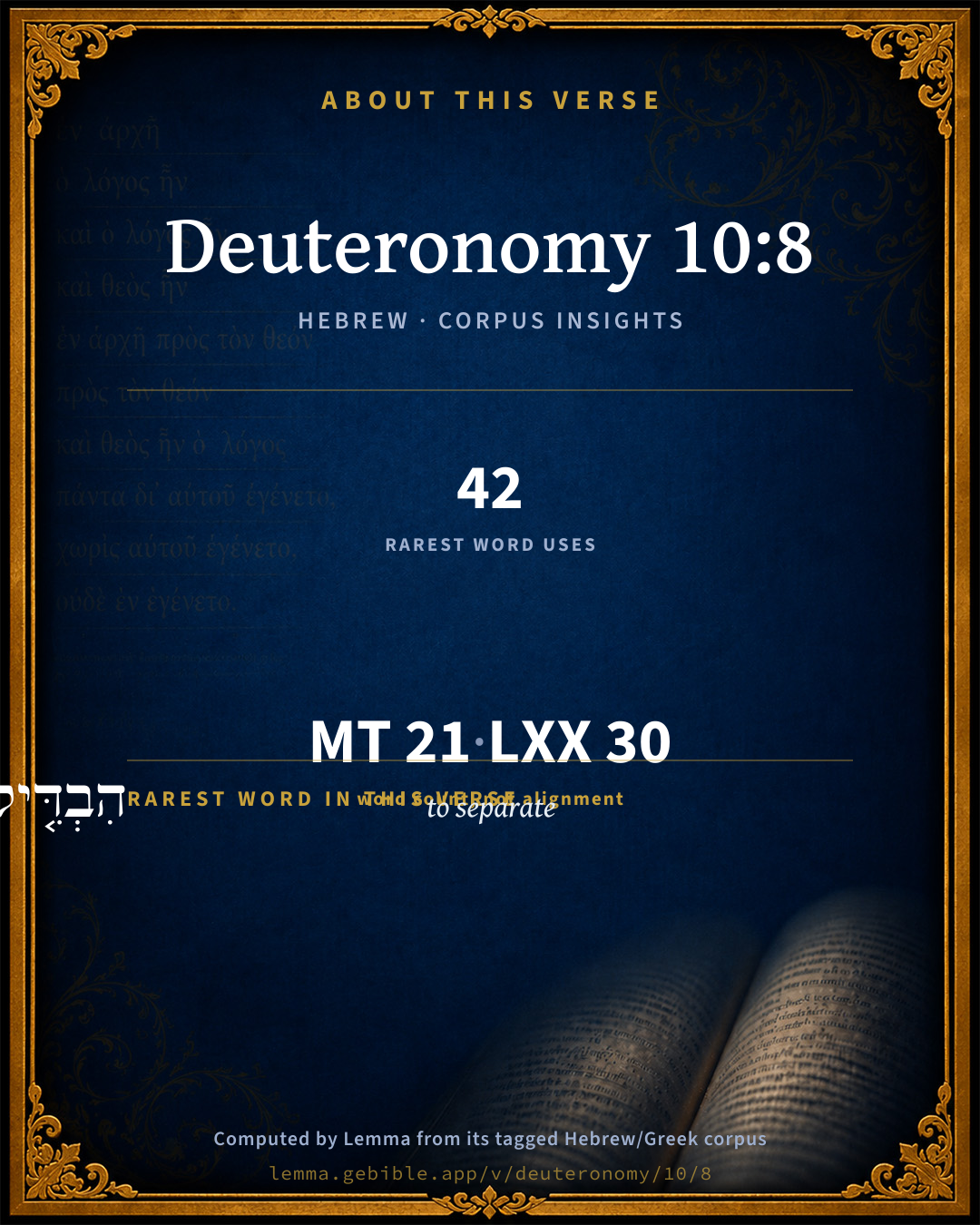
About this verse

These counts appear in no published source. They are computed here, from the morphology-tagged text and Lemma’s own curated glosses. What Lemma adds →

21
words
18
distinct lemmas
Pentateuch
section

Shared distinctive vocabulary

הִבְדִּ֤יל to separate H914 occurs in 40 verses of the Hebrew Bible. Also found in:

Grammatical profile

  • 5 verbs
  • 11 nouns
  • 2 pronouns
  • 1 preposition
  • 2 particles

Verb forms

  • הִבְדִּ֤יל Hiphil · Perfect
  • לָשֵׂ֖את Qal · Infinitive Construct
  • לַעֲמֹד֩ Qal · Infinitive Construct
  • לְשָֽׁרְתוֹ֙ Piel · Infinitive Construct
  • וּלְבָרֵ֣ךְ Piel · Infinitive Construct

Repetition

A word recurs within this verse — often emphatic in Hebrew:

  • יְהוָה֙ LORD H3068 ×3

Hebrew & Septuagint length

In English translation the verse runs 36 words from the Hebrew and 36 from the Septuagint (LXX English) — the same length.

A rough comparison of the two English renderings, which tokenize alike — not a word-level alignment.

Word counts can differ between the Hebrew and the Greek without any difference in meaning — e.g. the Hebrew direct-object marker אֵת has no separate Greek word, and Greek often adds the article ὁ.

In the original languages it is 21 Hebrew tokens and 30 Greek tokens — but the two are counted differently (Hebrew bundles its prefixes and suffixes into one token; the Greek is in lemma form), so that isn’t a like-for-like length.

Cross-references

34

Topical passages linked to Deuteronomy 10:8 in the Treasury of Scripture Knowledge — connected by theme and wording, ordered by reader-vote popularity; previews shown in the World English Bible.

  • Deuteronomy 21:5 The priests the sons of Levi shall come near; for them Yahweh your God has chosen to minister to him, and to bless in the name of Yahweh; and according to their word shall every controversy and every stroke be.
  • Deuteronomy 18:5 For Yahweh your God has chosen him out of all your tribes, to stand to minister in the name of Yahweh, him and his sons for ever.
  • Numbers 3:6 "Bring the tribe of Levi near, and set them before Aaron the priest, that they may minister to him.
  • Numbers 4:15 "When Aaron and his sons have finished covering the sanctuary, and all the furniture of the sanctuary, as the camp moves forward; after that, the sons of Kohath shall come to carry it: but they shall not touch the sanctuary, lest they die. These things are the burden of the sons of Kohath in the Tent of Meeting.
  • Numbers 6:23–26 "Speak to Aaron and to his sons, saying, 'This is how you shall bless the children of Israel.' You shall tell them,
  • Numbers 16:9–10 [seems it but] a small thing to you, that the God of Israel has separated you from the congregation of Israel, to bring you near to himself, to do the service of the tent of Yahweh, and to stand before the congregation to minister to them;
  • 2 Chronicles 30:27 Then the priests the Levites arose and blessed the people: and their voice was heard, and their prayer came up to his holy habitation, even to heaven.
  • Jeremiah 15:19 Therefore thus says Yahweh, If you return, then will I bring you again, that you may stand before me; and if you take forth the precious from the vile, you shall be as my mouth: they shall return to you, but you shall not return to them.
  • John 15:16 You didn't choose me, but I chose you, and appointed you, that you should go and bear fruit, and that your fruit should remain; that whatever you will ask of the Father in my name, he may give it to you.
  • Exodus 29:1–37 "This is the thing that you shall do to them to make them holy, to minister to me in the priest's office: take one young bull and two rams without blemish,
  • Leviticus 9:22 Aaron lifted up his hands toward the people, and blessed them; and he came down from offering the sin offering, and the burnt offering, and the peace offerings.
  • Numbers 1:47–53 But the Levites after the tribe of their fathers were not numbered among them.
  • Numbers 18:1–32 Yahweh said to Aaron, You and your sons and your fathers' house with you shall bear the iniquity of the sanctuary; and you and your sons with you shall bear the iniquity of your priesthood.
  • 1 Chronicles 15:12–15 and said to them, You are the heads of the fathers' [houses] of the Levites: sanctify yourselves, both you and your brothers, that you may bring up the ark of Yahweh, the God of Israel, to [the place] that I have prepared for it.
  • 1 Chronicles 15:26 It happened, when God helped the Levites who bore the ark of the covenant of Yahweh, that they sacrificed seven bulls and seven rams.
  • Psalms 135:2 You who stand in the house of Yahweh, In the courts of our God's house.
  • Romans 12:7 or service, let us give ourselves to service; or he who teaches, to his teaching;
  • Leviticus 8:9 He set the turban on his head; and on the turban, in front, he set the golden plate, the holy crown; as Yahweh commanded Moses.
  • Numbers 3:1–4 Now this is the history of the generations of Aaron and Moses in the day that Yahweh spoke with Moses in Mount Sinai.
  • Numbers 3:31 Their charge shall be the ark, the table, the lamp stand, the altars, the vessels of the sanctuary with which they minister, and the screen, and all its service.
  • Numbers 8:1–26 Yahweh spoke to Moses, saying,
  • Deuteronomy 17:12 The man who does presumptuously, in not listening to the priest who stands to minister there before Yahweh your God, or to the judge, even that man shall die: and you shall put away the evil from Israel.
  • 1 Kings 8:3–4 All the elders of Israel came, and the priests took up the ark.
  • 1 Kings 8:6 The priests brought in the ark of the covenant of Yahweh to its place, into the oracle of the house, to the most holy place, even under the wings of the cherubim.
  • 1 Chronicles 23:26 and also the Levites shall no more have need to carry the tent and all the vessels of it for the service of it.
  • 2 Chronicles 5:4–5 All the elders of Israel came: and the Levites took up the ark;
  • 2 Chronicles 29:11 My sons, don't be negligent now; for Yahweh has chosen you to stand before him, to minister to him, and that you should be his ministers, and burn incense.
  • Psalms 134:2 Lift up your hands in the sanctuary. Praise Yahweh!
  • Ezekiel 44:11 Yet they shall be ministers in my sanctuary, having oversight at the gates of the house, and ministering in the house: they shall kill the burnt offering and the sacrifice for the people, and they shall stand before them to minister to them.
  • Ezekiel 44:15 But the priests the Levites, the sons of Zadok, who kept the charge of my sanctuary when the children of Israel went astray from me, they shall come near to me to minister to me; and they shall stand before me to offer to me the fat and the blood, says the Lord Yahweh:
  • Acts 13:2 As they served the Lord and fasted, the Holy Spirit said, "Separate Barnabas and Saul for me, for the work to which I have called them."
  • Romans 1:1 Paul, a servant of Jesus Christ, called to be an apostle, set apart for the Gospel of God,
  • 2 Corinthians 6:17 Therefore, "'Come out from among them, And be separate,' says the Lord, 'Touch no unclean thing. I will receive you.
  • Galatians 1:15 But when it was the good pleasure of God, who separated me from my mother's womb, and called me through his grace,

Cross-references courtesy of OpenBible.info (CC BY 4.0).

Hebrew and Greek witnesses Masoretic Hebrew ↔ Greek Septuagint

The same verse in the two great witnesses to the Old Testament, shown verse-for-verse.

These are two independent witnesses, not word-aligned to each other, and the Septuagint is shown in lemma (dictionary) form.

Hebrew Deuteronomy 10:8 Masoretic · Westminster Leningrad Codex

בָּעֵ֣ת הַהִ֗וא הִבְדִּ֤יל יְהוָה֙ אֶת שֵׁ֣בֶט הַלֵּוִ֔י לָשֵׂ֖את אֶת אֲר֣וֹן בְּרִית יְהוָ֑ה לַעֲמֹד֩ לִפְנֵ֨י יְהוָ֤ה לְשָֽׁרְתוֹ֙ וּלְבָרֵ֣ךְ בִּשְׁמ֔וֹ עַ֖ד הַיּ֥וֹם הַזֶּֽה

At that time Yahweh set apart the tribe of Levi, to bear the ark of the covenant of Yahweh, to stand before Yahweh to minister to him, and to bless in his name, to this day.

World English Bible · Public Domain

Greek LXX Deuteronomy 10:8 Septuagint · lemma form

ἐν ἐκεῖνος ὁ καιρός διαστέλλω κύριος ὁ φυλή ὁ λευί αἴρω ὁ κιβωτός ὁ διαθήκη κύριος παραἵστημι ἔναντι κύριος λειτουργέω καί ἐπιεὔχομαι ἐπί ὁ ὄνομα αὐτός ἕως ὁ ἡμέρα οὗτος

At that time the Lord separated the tribe of Levi, to bear the ark of the covenant of the Lord, to stand near before the Lord, to minister and bless in his name to this day.

LXX2012 (modern English Septuagint) · Public Domain

Hebrew: Westminster Leningrad Codex (CC BY 4.0). Greek: Septuagint (public domain); English from LXX2012 (modern English Septuagint) (Public Domain). How the Septuagint differs from the Hebrew →

Targum (Aramaic paraphrase)

2

The Targum is the ancient Jewish Aramaic paraphrase of the Hebrew Scriptures — an interpretive translation, not the Hebrew text itself. Onkelos (literal) and Pseudo-Jonathan (expansive) render the Torah, and Jonathan the Prophets. Coverage is partial: where no permissively-licensed English translation exists for a verse, only the Aramaic is shown. This is verse-level text, not a word-by-word alignment to the Hebrew.

  1. Targum Onkelos Torah (Genesis–Deuteronomy)
    בְּעִדָנָא הַהִיא אַפְרֵשׁ יְיָ יָת שִׁבְטָּא דְלֵוִי לְמִטַל יָת אֲרוֹן קְיָמָא דַיְיָ לְמֵיקַם קֳדָם יְיָ לְשַׁמָשׁוּתֵהּ וּלְבָרָכָא בִשְׁמֵהּ עַד יוֹמָא הָדֵין

    (no public-domain English translation for this verse)

    Targum Onkelos — Aramaic: “Onkelos Genesis” (public domain); “Onkelos Exodus” (public domain); “Onkelos Leviticus” (public domain); “Onkelos Numbers” (public domain); “Onkelos Deuteronomy” (public domain). English: “Sefaria Community Translation” (CC0 1.0 (public-domain dedication)); “J.W. Etheridge. The Targums of Onkelos and Jonathan Ben Uzziel on the Pentateuch. London: Longmans, Green, 1862” (public domain). Text via Sefaria.

  2. Targum Pseudo-Jonathan Torah (Genesis–Deuteronomy)
    בְּעִידָנָא הַהוּא אַפְרֵישׁ יְיָ יַת שִׁבְטָא דְלֵוִי מְטוּל דְּקַנִּיאוּ לִשְׁמֵיהּ לְאִתְקְטָלָא בְּגִין יְקָרֵיהּ לִמְסוֹבְרָא יַת אֲרוֹן קְיָימָא דַיְיָ לְמֵיקוּם קֳדָם יְיָ לְשַׁמָּשׁוּתֵיהּ וּלְבָרְכָא בִּשְׁמֵיהּ עַד זְמַן יוֹמָא הָדֵין

    At that time the Lord distinguished the tribe of Levi, because they had been zealous (even) to slay for His honour; that they should bear the ark of the Lord’s covenant, and stand before the Lord to minister unto Him and to bless in His Name until this day.

    Targum Pseudo-Jonathan — Aramaic: “Targum Jonathan on Genesis” (public domain); “Targum Jonathan on Exodus” (public domain); “Targum Jonathan on Leviticus” (public domain); “Targum Jonathan on Numbers” (public domain); “Targum Jonathan on Deuteronomy” (public domain). English: “The Targum of Jonathan ben Uzziel, trans. J. W. Etheridge, London, 1862” (public domain). Text via Sefaria.

Commentary

Notes on Deuteronomy 10:8 from classic Christian and Jewish commentators (each source and its license shown beneath its notes). The classic Christian expositions comment on the surrounding passage and are grouped to its opening verse, so a note may address several verses; the Jewish commentaries on the Tanakh (Rashi and others) are per-verse, so they appear only where the commentator wrote on this verse.

Lemma curates 59 commentaries, every one of them public domain or Creative Commons licensed, each selected and text-cleaned for this edition rather than reprinted as found. About our sources →

The Cambridge Bible for Schools and Colleges

gen. ed. J. J. S. Perowne

8. At that time] Cp. Deu_9:20, Deu_10:1. If, as we have seen to be most probable, Deu_10:6-7 are a later intrusion and out of place where they stand, that time is not that of the sojourn at Yoṭbathah after Aaron’s death (though the editor who inserted Deu_10:6-7 may have meant to imply this; see the general note to these vv.), but the time at Ḥoreb (Deu_10:1). This conclusion is confirmed (a) by the subsequent Deu_10:10, in which the retrospect still rests on Ḥoreb; (b) by the natural connection between the mention of the making of the Ark and that of the appointment of its bearers; (c) by the fact that another line of tradition, P, assigns to Ḥoreb the consecration of Levites to priestly duties, and also makes this follow the order to build the ark (and sanctuary); and (d) because, although no such setting apart is recorded in JE, these lines of the tradition may also have originally contained it and even hint at it in Exo_32:29, immediately after the account of the zeal of all the sons of Levi in the punishment of the people’s apostasy with the golden calf (see Dillmann on that and on this passage; also Driver’s note on Exo_32:29).

the Lord separated] set apart, with a solemn religious sense, as for Himself; the verb is used when He takes Israel from other peoples, Lev_20:24 (H); or when Moses is directed to separate the Levites from the midst of the children of Israel, Num_16:9 (P), that the Levites may be mine, Num_8:14 (P); or of the separation of the cities of refuge, Deu_4:41, Deu_19:2; Deu_19:7; and even of separating a person to evil, Deu_29:21 (20), and putting aside beasts that are unclean, Lev_20:25.

the tribe of Levi] Unambiguous, leaving no question possible as to whether they are meant in part or whole—a question which would have arisen had the term the Levites (in view of its narrower meaning in P) been used. Cp. Deu_18:1, all the tribe of Levi.

to bear the ark of the covenant of the Lord] D’s name for the Ark; see on Deu_10:2. The O.T. data of the bearing of the Ark are summarily these. In JE, Jos_3:6, the priests bear the Ark; and the priests bear it also at the consecration of Solomon’s Temple, 1Ki_8:3; 1Ki_8:6. Here in D the office is assigned to the whole (see above) tribe of Levi. These terms are combined in Deu_31:9 according to which the Ark is borne by the priests the sons of Levi; cp. the deuteronomic verse, Jos_3:3, the priests the Levites bearing it. But in P, Num_4:1; Num_4:4; Num_4:15, the bearing of the Ark is specially allotted to one clan of Levi, the Kohathites, who are distinguished from the priests—in P, Aaron and his sons—by being forbidden to perform the more sacred priestly functions, Num_4:15; Num_4:17-20. Clearly then P differs from D, in which the whole tribe of Levi is regarded as priests and as such carry the Ark, besides performing the other more sacred functions which now follow.

to stand before the Lord to minister unto him] Both vbs, which are used of a servant’s attitude and duty to his human master (stand before, 1Ki_10:8; minister, Gen_39:4) are also employed (with and without the name of God, and either together or separately), specially to express religious service and in particular the distinctive office and functions of the priests, Deu_17:12 (before Jehovah); Jdg_20:28 (before the Ark), Eze_44:15; 2Ch_29:11. In D these are laid upon the whole tribe of Levi as here, in Deu_18:5; Deu_18:7, God hath chosen him, Levi, out of all thy tribes to stand to minister in the name of Jehovah, him and his sons for ever; and Deu_21:5, the priests the sons of Levi … for them hath Jehovah chosen to minister unto him. P uses the phrase to stand before Jehovah neither of the priests nor of the Levites, but says that the Levites stand before the congregation. The verb to minister (shârçth) P, both of Aaron and his sons, the priests, and of the Levites. Of the priests either absolutely Exo_28:35; Exo_39:26, or within the holy place Exo_28:43, Exo_29:30, Exo_39:1, and in the priests’ office Exo_35:19, Exo_39:41; or of their ministry of the altar, i.e. the sacrifices, Exo_30:20; and only once with regard to God Himself, Exo_28:41, to minister unto me. Of the Levites P never uses to minister to Jehovah; but either to minister alone, Num_3:31; or to the camp, Num_4:9; or in the sanctuary, Num_4:12, cp. Num_1:50; or at the altar (in preparing it for the priests), Num_4:24; or to Aaron, Num_18:2. P and D then differ thus, that while D uses the double phrase, stand before and minister to Jehovah of the whole tribe of Levi, P says that the Levites stand before the congregation, and uses the phrase minister to Jehovah only of the priests, and intends by it the most sacred priestly functions of sacrifice, etc., the Levites’ ministering being confined to less sacred duties in regard to the care of the fabric of the Tabernacle and the Camp and in assisting the priests.

to bless in his name] So Deu_21:5 again of the sons of Levi, the priests. This is another of the distinctive priestly duties (though sometimes discharged by kïngs, 2Sa_6:18; 1Ki_8:14; 1Ki_8:55). It is twice assigned by P to Aaron: Lev_9:22, Num_6:23; and it is included in 1Ch_23:18 among the offices to which Aaron was set apart.

unto this day] Cp. for ever in Deu_18:5.

Our detailed examination of this verse, and other O.T. passages relevant to the subject, makes it clear that in the Book of Deuteronomy all the tribe of Levi or sons of Levi are regarded as priests; and that every son of Levi, or Levite, could perform the distinctive priestly functions; whereas in P all these functions are limited to Aaron and his sons, except the bearing of the Ark, which is assigned to a Levite clan the Kohathites; while Levite has become a technical name for the non-Aaronic members of the tribe, to whom priestly functions were forbidden and who had less sacred duties about the altar and sanctuary. These distinctions are unknown to D: to him Levites and priests are identical terms. It is impossible to suppose that D silently presupposed the distinctions in P. There is not the slightest sign anywhere in his language that this was the case. On the contrary his addition, that the exercise of the priests’ office by all Levites continued to his own day and was for ever proves that he did not know P. And this is confirmed with its consequence, a late date for P, by the evidence of the earlier historical writings and especially by a comparison of Samuel and Kings with Chronicles. See further Chapman in Int. to the Pent. (in this series), pp. 154 ff., and App. vii. 5 and cp. below on Deu_18:1-8.

8, 9. The setting apart of the tribe of Levi to bear the Ark and perform other priestly functions. It is not wholly certain whether this passage belongs to the address itself or is another intrusion; yet with its opening clause (cp. Deu_10:1) the deuteronomic phraseology is resumed, and the appointment of the bearers of the Ark follows naturally upon 1–5, which record the making of the Ark; see further on Deu_10:8. The general question arising from the difference between the data of Deut. (and the pre-deuteronomic writers) and those of P regarding the tribe of Levi and the offices here assigned to the whole tribe, will be more suitably discussed later on.

The Cambridge Bible for Schools and Colleges (gen. ed. J. J. S. Perowne; Cambridge University Press, 1878–1918) — public domain. Text from a community e-Sword module.

Trapp's Complete Commentary

John Trapp

Deu 10:8 At that time the LORD separated the tribe of Levi, to bear the ark of the covenant of the LORD, to stand before the LORD to minister unto him, and to bless in his name, unto this day.

Ver. 8. At that time,] viz., While they were yet at Mount Sinai; for the two former verses are inserted by a parenthesis.

The Lord separated the tribe of Levi.] This setting up of the ministry amongst them is reckoned as a sign of God’s singular love to them. And so it is to us, no doubt, albeit a late pamphleteer {a} makes that sacred and tremendous function of the ministry to be as mere an imposture, as very a mystery of iniquity, as arrant a fruad, as the Papacy itself. Now the Lord rebuke thee, Satan.

To stand before the Lord.] As also the angels do. {Luk 1:19}

{a} The Compassionate Samaritan.

John Trapp, A Commentary or Exposition upon All the Books of the Old and New Testament (1647–1656) — public domain. Text from a community e-Sword module.

Joseph Benson's Commentary

Deu 10:8. At that time — About that time, that is, when I was come down from the mount, as was said, Deu 10:5. To stand before the Lord — A phrase used concerning the prophets, 1Ki 17:1; 1Ki 18:15, this being the posture of servants, Hence the angels are said to stand, 2Ch 18:18; and Luk 1:19. To bless — The people, by performing those holy ministrations for them, and giving those instructions to them, to and with which God’s blessing was promised; and this they did in God’s name, that is, by command and commission from him. Let it be observed here, that a settled ministry is a great blessing to a people, and a special token of God’s love to them. But they who are blessed with it should take care that it do not become a curse through their abuse or non-improvement of it.

Joseph Benson's Commentary on the Old and New Testaments (1811–1818) — public domain. Text from a community e-Sword module.

Keil & Delitzsch

C. F. Keil & F. Delitzsch

In Deu 10:8, Moses returns to the form of an address again, and refers to the separation of the tribe of Levi for the holy service, as a manifestation of mercy on the part of the Lord towards Israel. The expression "at that time" is not to be understood as relating to the time of Aaron's death in the fortieth year of the march, in which Knobel finds a contradiction to the other books. It refers quite generally, as in Deu 9:20 and Deu 10:1, to the time of which Moses is speaking here, viz., the time when the covenant was restored at Sinai. The appointment of the tribe of Levi for service at the sanctuary took place in connection with the election of Aaron and his sons to the priesthood (Ex 28 and 29), although their call to this service, instead of the first-born of Israel, was not carried out till the numbering and mustering of the people (Num 1:49., Deu 4:17., Deu 8:6.). Moses is speaking here of the election of the whole of the tribe of Levi, including the priests (Aaron and his sons), as is very evident from the account of their service. It is true that the carrying of the ark upon the march through the desert was the business of the (non-priestly) Levites, viz., the Kohathites (Num 4:4.); but on solemn occasions the priests had to carry it (cf. Jos 3:3, Jos 3:6, Jos 3:8; Jos 6:6; Kg1 8:3.). "Standing before the Lord, to serve Him, and to bless in His name," was exclusively the business of the priests (cf. Deu 18:5; Deu 21:5, and Num 6:23.), whereas the Levites were only assistants of the priests in their service (see at Deu 18:7). This tribe therefore received no share and possession with the other tribes, as was already laid down in Num 18:20 with reference to the priests, and in Num 18:24 with regard to all the Levites; to which passages the words "as the Lord thy God promised him" refer. - Lastly, in Deu 10:10, Deu 10:11, Moses sums up the result of his intercession in the words, "And I stood upon the mount as the first days, forty days (a resumption of Deu 9:18 and Deu 9:25); and the Lord hearkened to me this time also (word for word, as in Deu 9:19). "Jehovah would not destroy thee (Israel)." Therefore He commanded Moses to arise to depart before the people, i.e., as leader of the people to command and superintend their removal and march. In form, this command is connected with Exo 34:1; but Moses refers here not only to that word of the Lord with the limitation added there in Exo 34:2, but to the ultimate, full, and unconditional assurance of God, in which the Lord Himself promised to go with His people and bring them to Canaan (Exo 34:14.).

Keil & Delitzsch — Biblical Commentary on the Old Testament (1861–1891) — public domain (CC PDM 1.0). Text via the HelloAO Bible API. (Old Testament only.)

Geneva Bible (1599)

Geneva Bible translators

That is, to offer sacrifice, and to declare the Law to the people.

Geneva Bible (1599) marginal notes — public domain. Text via Bolls.life.

Ellicott's Commentary for English Readers

(8) At that time—i.e., at Sinai, after Moses’ second descent from the mount, not at the time of Aaron’s death. Yet the death of Aaron and the separation of the tribe of Levi are similar events in their way: both alike lose territorial inheritance through bearing the burden of the Law.

To bear the ark of the covenant of the Lord, to stand before the Lord to minister unto him, and to bless in his name.—A recent critic has said that the writer of Deuteronomy knows no distinction between priests and Levites. (See on this point Deu_11:6.) Rashi’s note on this verse is better: “To bear the ark (He separated)—the Levites; to stand before Jehovah to minister to Him, and to bless in His name—the priests.”

A Bible Commentary for English Readers, edited by Charles John Ellicott (1878–1897) — public domain. Text from a community e-Sword module.

John Gill's Exposition

At that time the Lord separated the tribe of Levi,.... Not at the time that Moses came down from the mount with the tables of the law, but some considerable time after, even after the tabernacle was erected; nor at the time that Aaron died, and Eleazar succeeded him, but many years before that; unless there was a fresh separation of them, or a renewal of it when Eleazar became high priest in his father's stead; and so that being mentioned is the reason of its being repeated here:

to bear the ark of the covenant of the Lord; even that into which the law, sometimes called the covenant, was put, and therefore here called the ark of the covenant: when this was carried from place to place, as it was especially in the wilderness, it was the business of the Levites to bear it, particularly the Kohathites; Num 3:31,

to stand before the Lord to minister unto him; that is, to his priests, in the tabernacle, and to keep and guard that:

and to bless in his name unto this day; not to bless the people, which was the work of the priest, but to sing praise in the name of the Lord, to give thanks unto him, and bless and praise him.

John Gill's Exposition of the Whole Bible (1746–1763) — public domain (CC PDM 1.0). Text via the HelloAO Bible API.

Haydock's Catholic Bible Commentary

Time, during the pontificate of Aaron, Numbers iii. 6. (Menochius) --- God had made this appointment at Sinai, (Exodus xxviii. 1,) where he ordered the tabernacle and the priests to be consecrated. Upon the sedition of Core, which probably took place at Jetebata, he confirmed the rights of the Levitical tribe, Numbers xvi. 17, 18. (Calmet) --- Ark. The priests carried it, on more solemn occasions, (Josue iii. 3,) as they also blessed the people. (Menochius) --- Yet the Levites sung the praises of God, in which sense the word is often used, 1 Paralipomenon xxiii. 13. Hence Castalio translates, "to celebrate his name."

George Leo Haydock (1774–1849), Haydock's Catholic Family Bible and Commentary, 1859 edition — public domain. Excludes Psalms (Douay-Rheims chapter numbering differs from Protestant) and Deuterocanonical books (Catholic canon only).

Matthew Poole's English Annotations

At that time, about that time, i.e. when I was come down from the mount, as was said Deu 10:5; for these words manifestly look to that verse, the sixth and seventh verses being put in by way of parenthesis, as was said before. Or, if it relate to the words immediately foregoing, this may be meant of a second separation of them upon Aaron’s death; and having mentioned the separation of Eleazar to the office of the high priest in his father’s stead, Deu 10:6, he now repeats it, that the Levites who were his, as they had been his father’s servants, were separated as before, or were confirmed in their office.

To stand before the Lord; a phrase used concerning the prophets, 1Ki 17:1; 18:15, this being the posture of ministers. Hence the angels are said to stand, 2Ch 18:18; Luk 1:19.

To bless in his name; either,

1. Particularly, to pronounce the solemn blessing of God upon the congregation, which was done in God’s name, of which see Lev 9:23; Num 6:23, &c. But that work was peculiar to the priests, not common to all the Levites. Or, more generally, to bless, either,

1. God, i.e. to praise him, which being a considerable part of the Levites’ work, 1Ch 16, it is not probable it would be omitted here, where their office is so particularly described. Or,

2. The people, whom they did bless by performance of those holy ministrations for the people, and giving those instructions to them, to which God’s blessing was promised and usually given; and this they did in God’s name, i.e. by command and commission from him.

Matthew Poole's English Annotations on the Holy Bible (1683–1685) — public domain. Text from a community e-Sword/MySword module.

Whedon's Commentary on the Bible

Daniel D. Whedon

8. At that time — This expression is to be understood, not as referring to the time subsequent to the death of Aaron, but as in the first verse of this chapter and in Deu_9:20, to the time when the covenant was renewed on Sinai. The apostasy of the people when the golden calf was made and worshipped is present to the mind of the speaker. The tribe of Levi, the great lawgiver’s own tribe, showed their fidelity to him. “Then Moses stood in the gate of the camp and said, Who is on the Lord’s side? Let him come unto me. And all the sons of Levi gathered themselves together unto him.” Exo_32:26. The tribe of Levi was set apart for special service connected with worship and sacrifice. It is evident from Num_4:4, and following verses, that the office of carrying the ark on the march devolved on the non-priestly Levites, namely, the Kohathites, but on some special occasions it was borne by the priests. See Jos_3:3; Jos_3:6; Jos_3:8; also Deu_6:6, and 1Ki_8:3. Comp. Deu_31:9, of this book.

Daniel D. Whedon (gen. ed.), Commentary on the Old and New Testaments (1874–1909) — public domain. Text from a community e-Sword module.

The Pulpit Commentary

Vers. 8, 9. Moses, here resuming the form of address, refers to the separation of the tribe of Levi to the holy service.

At that time; the time when the covenant was restored at Sinai, not the time when Aaron died. The appointment of the tribe of Levi for service took place in connection with that of Aaron and his sons to the priesthood. (Num_3:4) The service to which the tribe of Levi was chosen appertained to the tribe as such, including the priests as well as the non-priestly Levites, though parts of it specially belonged to the one class rather than the other. Thus the bearing of the ark was the special duty of non-priestly Levites, the Kohathites (Num_4:4, etc.; 1Ch_15:15) but was also, on peculiarly solemn occasions, discharged by the priests. (Jos_3:6, etc.; Jos_6:6 Jos_8:33 1Ki_8:3, 1Ki_8:6, etc.) To stand before the Lord to minister unto him was the special function of the priests; (Deu_17:12 Deu_21:5 Eze_40:46 Eze_44:15, Eze_44:16) but as the service of the Levites was also a sacred service, they too are said to stand to minister before the Lord (Deu_18:7; 1Ch_15:2 2Ch_23:6 2Ch_29:4, 2Ch_29:5, 2Ch_29:11, 2Ch_29:12) To bless in his name does not mean, as some propose, to invoke the Name of God, or to praise his Name, but to pronounce a benediction or invoke a blessing on the people in his Name (cf. 2Sa_6:18; 1Ch_16:2) This was the special duty of the priests (cf. Num_6:22-27; Deu_21:5; 1Ch_23:13) but might also be done by others (as by David), and in this benediction the Levites might join. (2Ch_25:27)

The Pulpit Commentary (1880–1919), ed. H.D.M. Spence-Jones & Joseph S. Exell — public domain. Text from a community e-Sword module.

John Wesley's Explanatory Notes

At that time - About that time, that is, when I was come down from the mount, as was said, ver. 5. To stand before the Lord - A phrase used concerning the prophets, 1 Kings xvii, 1; xviii, 15, this being the posture of ministers. Hence the angels are said to stand, 2Chr xviii, 18 Luke i, 19. To bless - The people, by performance of those holy ministrations for the people, and giving those instructions to them, to which God's blessing was promised; and this they did in God's name, that is, by command, and commission from him.

John Wesley, Explanatory Notes Upon the Whole Bible (1754–1765) — public domain. Text via the GEBible commentary corpus.

unfoldingWord translationNotes

Door43 World Missions Community

General Information:

The writer gives background information about the tribe of Levi. (See: Background Information)

to stand before Yahweh to serve him

This is an idiom. "to offer the sacrifices that Yahweh requires" (See: Idiom)

in his name

Here "name" refers to authority. AT: "as representatives of Yahweh" (See: Metonymy)

as today

"as they are doing today"

no portion nor inheritance of land

The tribe of Levi did not receive a portion of the promised land when they arrived there. The full meaning of this statement may be made explicit. (See: Assumed Knowledge and Implicit Information)

Yahweh is his inheritance

Yahweh speaks of the special relationship that Aaron and his descendants will have with him as if Yahweh were something that they will inherit. AT: "Yahweh is what they will have" or "Yahweh will allow them to serve him and he will provide for them through that service"

Yahweh your God

Moses speaks to the Israelites as if they were one man, so the word "your" here is singular. (See: Forms of You)

spoke to him

"spoke to the tribe of Levi"

translationWords

Yahweh

tribe

Levi

ark of the covenant

servant

bless

name

inherit

brother

God

unfoldingWord translationNotes — © Distant Shores Media and the Door43 World Missions Community, licensed CC BY-SA 4.0. Source: git.door43.org/Door43/en_tn.

Rashi

Rabbi Shlomo Yitzchaki (Rashi)

בעת ההוא הבדיל ה׳ וגו׳ AT THAT TIME THE LORD SEPARATED [THE TRIBE OF LEVI] — This is to be connected with the former narrative (that which speaks of the tablets of stone, ending at v. 5; vv. 6—8 which contain reference to Aaron’s death being interpolated for the reason given by Rashi);

בעת ההוא AT THAT TIME accordingly means: In the first year of the Exodus from Egypt, when ye sinned by worshipping the golden calf, but the sons of Levi did not thus sin. — at that time God separated them from you. It places this verse in juxtaposition with the retreat to Bene Jaakon to tell you that in this matter also, the sons of Levi did not sin, but stood steadfast in their faith.

לשאת את ארון TO BEAR THE ARK — [This was the function of] the Levites (such as were not כהנים).

‎ לעמד לפני ה׳ לשרתו ולברך בשמו TO STAND BEFORE THE LORD, TO MINISTER UNTO HIM AND TO BLESS IN HIS NAME — This (to bless in His Name) was the function of the priests and refers to the “raising of the hands” (a technical term for reciting the priestly benediction which is done with uplifted hands) (Arakhin 11a).

Rashi on the Tanakh — English translations: “The Judaica Press complete Tanach with Rashi, translated by A. J. Rosenberg” (CC BY 4.0); “Pentateuch with Rashi's commentary by M. Rosenbaum and A.M. Silbermann, 1929-1934” (public domain); “The Metsudah Tanach series, Lakewood, N.J” (CC BY 4.0); and “The Book of Joshua, Metsudah Publications, 1997” (CC BY 4.0). Text via Sefaria.

Ramban (Nachmanides)

Rabbi Moshe ben Nachman (Ramban / Nachmanides)

AT THAT TIME THE ETERNAL SEPARATED THE TRIBE OF LEVI. “This refers back to the first subject. At that time, in the first year of your departure from Egypt when you sinned by worshipping the calf and the sons of Levi did not sin, G-d separated them from you.” This is Rashi’s language. And if so, he is stating that from that time the sons of Levi were separated before Him, blessed be He [but only in thought], for He did not separate them in fact until the second year in the second month [after the first census which took place on the first day of the second month, in the second year after they were come out of the land of Egypt]! Or it may be that he is alluding to what he said to them [at the affair of the calf], Consecrate yourselves today to the Eternal, for thereby you dedicate yourselves to the service of priests and Levites.The correct interpretation, it appears to me, is that the expression at that time means that the second [giving of the Tablets] was like the first. For, from the time He said to Moses Hew thee two Tablets of stone, 34:1. He was reconciled with Israel, and Moses was instructed regarding the construction of the Tabernacle. Then He was reconciled also with Aaron, and Moses was commanded, and they shall make holy garments for Aaron thy brother, and his sons — to sanctify him — that he may minister unto Me in the priest’s office, 28:4. The phrase to sanctify him is found there in Verse 3. and He further commanded him concerning the initiation [of the priests]. Therefore he said [here in Verse 6] that Eleazar ministered in the priest’s office in his father’s stead, since their anointing was to them for an everlasting priesthood throughout their generations., 40:15. Moses regarded the separation of the entire tribe [of Levi — priests and Levites] as one matter [therefore he said here, At that time — when the second Tablets were given, even though only the priests were formally separated, it was equivalent to a designation of the entire tribe, with the formal designation of the Levites to come after the first census], for, from that day on it was [resolved] before Him that His tribe be wholly given unto Him to perform the service of the Tabernacle. Or perhaps he is saying that the tribe of Levi was separated at that time for the priests to be [chosen] from them, for they [i.e., the priests] also carried the ark. … Now, according to the interpretation that the verse means that the tribe of Levi was separated to be the source of the priests, rather than as a special tribe in its entirety, the following question arises: The verse indicates that the priests [derived from the tribe of Levi] were to carry the ark, but it is known that the Levites, not the priests, carried the ark (Numbers 7:9). Ramban answers that the priests, too, were permitted to carry the ark. See “The Commandments.” Vol. I, pp. 43-44, for a fuller discussion on this subject. And so it is said, and he [Moses] delivered it [the Torah] unto the priests the sons of Levi; that bore the ark of the covenant of the Eternal, and they [the priests] are the ones who minister to G-d and bless in His Name [as the verse before us concludes]. And the meaning of the expression unto this day [at the end of this verse] is that it refers [back] to Eleazar’s ministering in the priest’s office [in Aaron’s stead — mentioned in Verse 6], as if saying: “then He separated them [the priests] to minister to Him, and it [so] was to this day” [i.e., the time when Moses spoke these words, that Eleazar served as High Priest]. (Verse 8) as referring to the designating of the priests, from the tribe of Levi, to minister in the Tabernacle, why does the verse conclude with the expression, unto this day, since on “this day,” when Moses spoke these words, the whole tribe of Levi was already elevated to its exalted position? But if it refers back to Eleazar’s office as High Priest (mentioned in Verse 6) that it was so “unto this day,” there is of course no difficulty as to why the Levites are not mentioned here.

Ramban (Nachmanides) on the Tanakh — English translation: “Commentary on the Torah by Ramban (Nachmanides). Translated and annotated by Charles B. Chavel. New York, Shilo Pub. House, 1971-1976” (CC BY 4.0). Text via Sefaria.

Lesson kit

Teaching starters — assembled from the data on this page, not authored interpretation. Every prompt links to the verse data it draws on. Edit before teaching.

Deuteronomy, in the Pentateuch, opens this verse with 21 words (18 distinct Hebrew lemmas). Its most distinctive word is bâdal (“to separate”). A historical commentator’s framing appears above. Read the whole chapter for the surrounding context.

Discussion questions

  1. How does “to separate” (bâdal) shape what this verse is saying?
  2. Genesis 1:4 shares the word «to separate» with this verse. How do the two illuminate each other?
  3. “LORD” occurs 3× in this one verse. What is the effect of the repetition?
  4. These translations render this verse differently; the difference is in the English rendering, not the original. What questions does that raise?
  5. The verb «הִבְדִּ֤יל» is Hiphil Perfect. How does its form color the action?
  6. Reading how The Cambridge Bible for Schools and Colleges and Trapp's Complete Commentary read this verse, where do the two commentators agree and where do they part?

Things to notice

Reading settings

Reading text

Shown beneath each verse's original-language words.

Old Testament
Old Testament edition

Read the OT as the Masoretic Hebrew (MT) or the Greek Septuagint (LXX).

English shown for the Greek Septuagint (in the Hebrew ↔ Greek comparison).

Comparing translations? Open the Compare panel on any verse page to stack up to four side by side.