Ezekiel 36:8

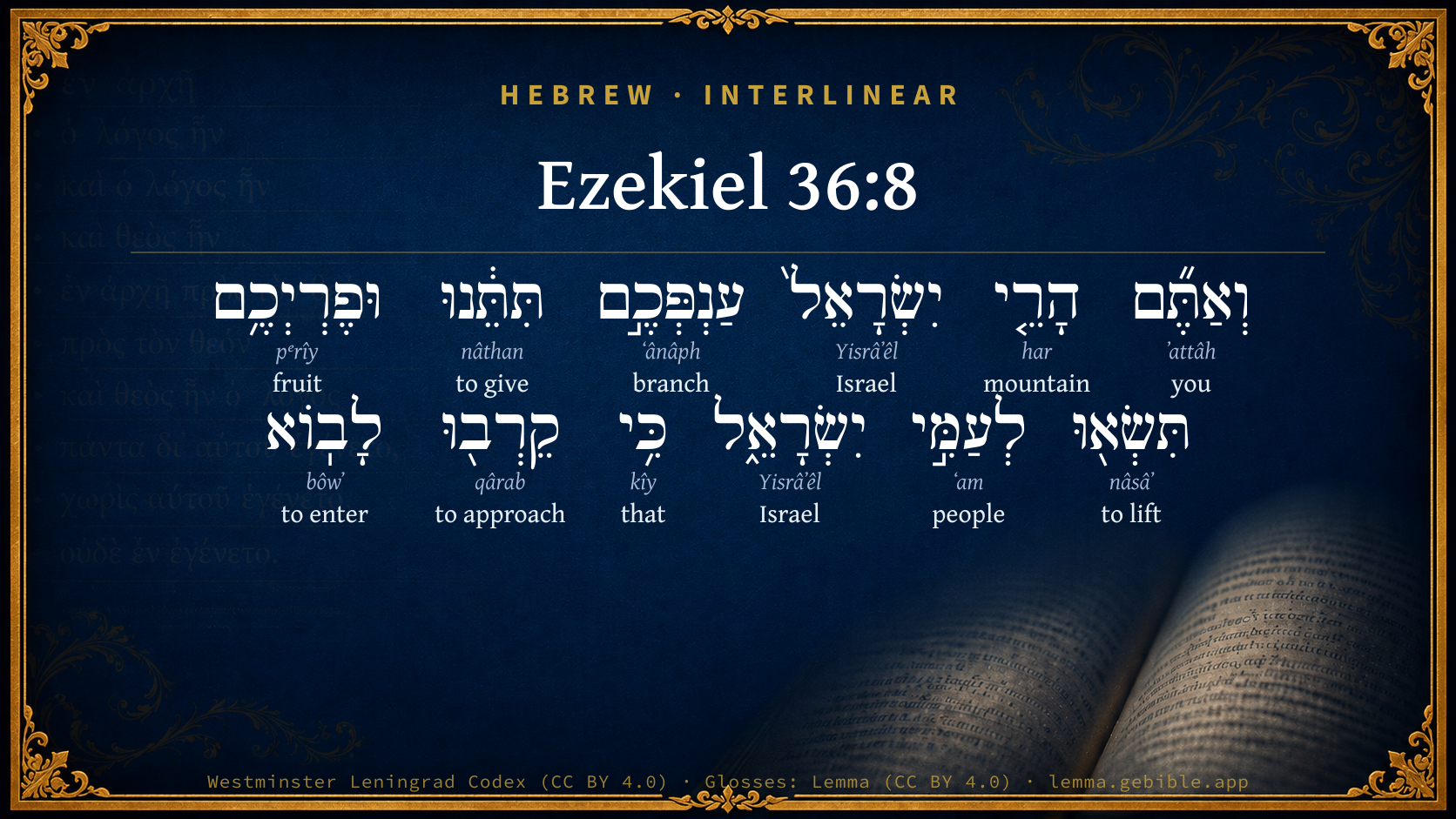
Hebrew (Westminster Leningrad Codex) Ezekiel 36:8 appears in the Hebrew Old Testament. The text above is from the Westminster Leningrad Codex. Each word links to its Strong’s number, a concise gloss, and parsing drawn from the Open Scriptures Hebrew Bible morphology. Click any word for its full Brown-Driver-Briggs (BDB) entry.
Download image
Cite this verse

Ezekiel 36:8 (World English Bible). Public Domain. Lemma interlinear Bible study tool, https://lemma.gebible.app/v/ezekiel/36/8.

Show BibTeX & RIS
BibTeX
RIS
English Translation
But you, mountains of Israel, you shall shoot forth your branches, and yield your fruit to my people Israel; for they are at hand to come.
World English Bible · Public Domain
Download a study sheet

One document with this verse’s original text, its word-by-word gloss line, the meaning frame, cross-references with their text, attributed commentary, and full source and license credits — printable, and it pastes into notes with its structure intact.

This verse Autodidact and up

Study sheet (.html) Plain text (.txt)

A passage Seminary Student

Up to 50 verses in one chapter. A passage sheet keeps up to 6 commentary sources and 12 cross-references per verse, in the order this page ranks them, and says so on the sheet whenever that leaves anything out. Ask for a single verse and you get the Autodidact verse sheet above.

Everything on this page stays free to read, with no account — the sheet is a download of what is already on screen, not access to it.

Want to remove ads? Support Godless Engineer
Compare translations 3

The same verse in 3 English versions, stacked beneath the original-language interlinear above. Click any original word for its lexicon entry.

Each is an independent rendering of the whole verse — the interlinear is not word-aligned to these translations.

Highlighted words mark where these versions differ — a whole-verse word diff, not a word-by-word alignment.

  • World English Bible Public Domain
    But you, mountains of Israel, you shall shoot forth your branches, and yield your fruit to my people Israel; for they are at hand to come.
  • King James Version Public Domain
    But ye, O mountains of Israel, ye shall shoot forth your branches, and yield your fruit to my people of Israel; for they are at hand to come.
  • unfoldingWord Literal Text CC BY-SA 4.0
    But you, mountains of Israel, you will grow branches and bear fruit for my people Israel, since they will soon come back to you.

unfoldingWord Literal Text — © unfoldingWord, licensed CC BY-SA 4.0. Word-aligned USFM3 via Door43 (git.door43.org/unfoldingWord/en_ult).

Versions to compare (up to 4)

3 of 4 selected

Show all 18 translations

Every available English version of this verse, each an independent rendering of the whole verse.

  • World English Bible Public Domain
    But you, mountains of Israel, you shall shoot forth your branches, and yield your fruit to my people Israel; for they are at hand to come.
  • Berean Standard Bible Public Domain
    But you, O mountains of Israel, will produce branches and bear fruit for My people Israel, for they will soon come home.
  • Majority Standard Bible Public Domain
    But you, O mountains of Israel, will produce branches and bear fruit for My people Israel, for they will soon come home.
  • King James Version Public Domain
    But ye, O mountains of Israel, ye shall shoot forth your branches, and yield your fruit to my people of Israel; for they are at hand to come.
  • American Standard Version (1901) Public Domain
    But ye, O mountains of Israel, ye shall shoot forth your branches, and yield your fruit to my people Israel; for they are at hand to come.
  • Revised Version (1885) Public Domain
    But ye, O mountains of Israel, ye shall shoot forth your branches, and yield your fruit to my people Israel; for they are at hand to come.
  • Geneva Bible (1599) Public Domain
    But you, O mountaines of Israel, yee shall shoote forth your branches, and bring foorth your fruite to my people of Israel: for they are ready to come.
  • Douay-Rheims (1899) Public Domain
    But as for you, O mountains of Israel, shoot ye forth your branches, and yield your fruit to my people of Israel: for they are at hand to come.
  • Young's Literal Translation Public Domain
    And ye, O mountains of Israel, Your branch ye give out, and your fruits ye bear for My people Israel, For they have drawn near to come.
  • Literal Standard Version CC BY-SA 4.0
    And you, O mountains of Israel, || You give out your branch, || And you bear your fruits for My people Israel, || For they have drawn near to come.
  • Unlocked Literal Bible CC BY-SA 4.0
    But you, mountains of Israel, you will grow branches and bear fruit for my people Israel, since they will soon come back to you.
  • unfoldingWord Literal Text CC BY-SA 4.0
    But you, mountains of Israel, you will grow branches and bear fruit for my people Israel, since they will soon come back to you.
  • Darby Bible Public Domain
    And ye mountains of Israel shall shoot forth your branches, and yield your fruit to my people Israel: for they are at hand to come.
  • World Messianic Bible Public Domain
    “‘“But you, mountains of Israel, you shall shoot out your branches and yield your fruit to my people Israel; for they are at hand to come.
  • Webster's Bible Public Domain
    But ye, O mountains of Israel, ye shall shoot forth your branches, and yield your fruit to my people of Israel; for they are at hand to come.
  • Free Bible Version CC BY-SA 4.0
    But you, mountains of Israel, will grow trees that will produce fruit for my people Israel, for soon they'll be coming home.
  • Bible in Basic English Public Domain
    But you, O mountains of Israel, will put out your branches and give your fruit to my people Israel; for they are ready to come.
  • JPS Tanakh (1917) Public Domain
    But ye, O mountains of Israel, ye shall shoot forth your branches, and yield your fruit to My people Israel; for they are at hand to come.

Literal Standard Version (2020), Covenant Press — licensed CC BY-SA 4.0. Text via the HelloAO Bible API (eBible.org). Unlocked Literal Bible (unfoldingWord) — licensed CC BY-SA 4.0. Text via the HelloAO Bible API (eBible.org). unfoldingWord Literal Text — © unfoldingWord, licensed CC BY-SA 4.0. Word-aligned USFM3 via Door43 (git.door43.org/unfoldingWord/en_ult). Free Bible Version, Dr. Jonathan Gallagher — licensed CC BY-SA 4.0. Text via the HelloAO Bible API (eBible.org).

Word by word

More ways to search: Search by grammar → Find every occurrence → Compare this word →

Practice this passage: Drill this verse → Learn its vocabulary →

עַנְפְּכֶ֣ם
ʻânâph
H6057
“branch · your”
Noun, Common, Masculine, Singular, Construct + Suffix, Personal, 2nd Person, Masculine, Plural
Part of Speech
Noun
Type
Common
Gender
Masculine
Number
Singular
State
Construct
Full BDB Definition

Origin: from an unused root meaning to cover

TWOT: 1657a

bough, branch
  1. וְאַתֶּ֞ם ʼattâh H859 “and · you” Conjunction + Pronoun, Personal, 2nd Person, Masculine, Plural
  2. הָרֵ֤י har H2022 “mountains of” Noun, Common, Masculine, Plural, Construct
  3. יִשְׂרָאֵל֙ Yisrâʼêl H3478 “Israel” Noun, Proper
  4. תִּתֵּ֔נוּ nâthan H5414 “to give” Verb, Qal, Imperfect, 2nd Person, Masculine, Plural
  5. וּפֶרְיְכֶ֥ם pᵉrîy H6529 “and · fruit · your” Conjunction + Noun, Common, Masculine, Singular, Construct + Suffix, Personal, 2nd Person, Masculine, Plural
  6. תִּשְׂא֖וּ nâsâʼ H5375 “to lift” Verb, Qal, Imperfect, 2nd Person, Masculine, Plural
  7. לְעַמִּ֣י ʻam H5971 “to/for · people · my” Preposition + Noun, Common, Masculine, Singular, Construct + Suffix, Personal, 1st Person, Common, Singular
  8. יִשְׂרָאֵ֑ל Yisrâʼêl H3478 “Israel” Noun, Proper
  9. כִּ֥י kîy H3588 “that” Conjunction
  10. קֵרְב֖וּ qârab H7126 “to approach” Verb, Piel, Perfect, 3rd Person, Common, Plural
  11. לָבֽוֹא bôwʼ H935 “to enter” Preposition + Verb, Qal, Infinitive Construct

About this verse

These counts appear in no published source. They are computed here, from the morphology-tagged text and Lemma’s own curated glosses. What Lemma adds →

12
words
11
distinct lemmas
Prophets
section

Notable vocabulary

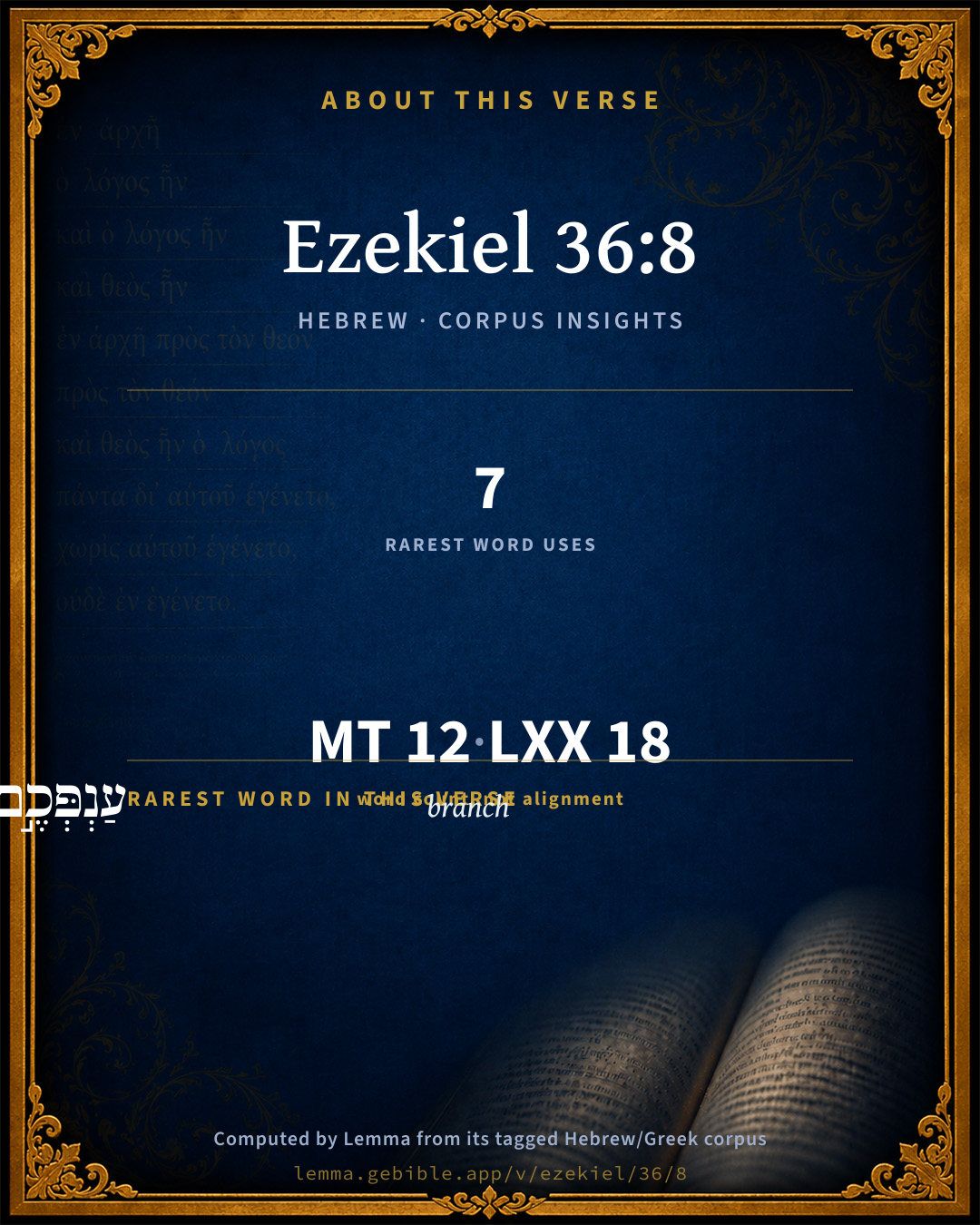
The rarest word here is עַנְפְּכֶ֣ם branch H6057 — appearing just 7 times in the whole Hebrew Bible.

Shared distinctive vocabulary

עַנְפְּכֶ֣ם branch H6057 occurs in 7 verses of the Hebrew Bible. Also found in:

Grammatical profile

  • 4 verbs
  • 6 nouns
  • 1 pronoun
  • 1 conjunction

Verb forms

  • תִּתֵּ֔נוּ Qal · Imperfect
  • תִּשְׂא֖וּ Qal · Imperfect
  • קֵרְב֖וּ Piel · Perfect
  • לָבֽוֹא Qal · Infinitive Construct

Repetition

A word recurs within this verse — often emphatic in Hebrew:

  • יִשְׂרָאֵל֙ Israel H3478 ×2

Hebrew & Septuagint length

In English translation the verse runs 26 words from the Hebrew and 20 from the Septuagint (LXX English) — closely comparable.

A rough comparison of the two English renderings, which tokenize alike — not a word-level alignment.

Word counts can differ between the Hebrew and the Greek without any difference in meaning — e.g. the Hebrew direct-object marker אֵת has no separate Greek word, and Greek often adds the article ὁ.

In the original languages it is 12 Hebrew tokens and 18 Greek tokens — but the two are counted differently (Hebrew bundles its prefixes and suffixes into one token; the Greek is in lemma form), so that isn’t a like-for-like length.

Cross-references

13

Topical passages linked to Ezekiel 36:8 in the Treasury of Scripture Knowledge — connected by theme and wording, ordered by reader-vote popularity; previews shown in the World English Bible.

  • Isaiah 27:6 In days to come shall Jacob take root; Israel shall blossom and bud; and they shall fill the surface of the world with fruit.
  • Ezekiel 34:26–29 I will make them and the places round about my hill a blessing; and I will cause the shower to come down in its season; there shall be showers of blessing.
  • Hebrews 10:37 "In a very little while, He who comes will come, and will not wait.
  • Psalms 67:6 The earth has yielded its increase. God, even our own God, will bless us.
  • Psalms 85:12 Yes, Yahweh will give that which is good. Our land will yield its increase.
  • Isaiah 4:2 In that day, Yahweh's branch will be beautiful and glorious, and the fruit of the land will be the beauty and glory of the survivors of Israel.
  • Isaiah 30:23 He will give the rain for your seed, with which you shall sow the ground; and bread of the increase of the ground, and it shall be fat and plenteous. In that day shall your cattle feed in large pastures;
  • Ezekiel 12:25 For I am Yahweh; I will speak, and the word that I shall speak shall be performed; it shall be no more deferred: for in your days, rebellious house, will I speak the word, and will perform it, says the Lord Yahweh.
  • Ezekiel 17:23 in the mountain of the height of Israel will I plant it; and it shall bring forth boughs, and bear fruit, and be a goodly cedar: and under it shall dwell all birds of every wing; in the shade of the branches of it shall they dwell.
  • Hosea 2:21–23 It will happen in that day, I will respond," says Yahweh, I will respond to the heavens, And they will respond to the earth;
  • Amos 9:13–15 "Behold, the days come," says Yahweh, "That the plowman shall overtake the reaper, And the one treading grapes him who sows seed; And sweet wine will drip from the mountains, And flow from the hills.
  • Philippians 4:5 Let your gentleness be known to all men. The Lord is at hand.
  • James 5:8–9 You also be patient. Establish your hearts, for the coming of the Lord is at hand.

Cross-references courtesy of OpenBible.info (CC BY 4.0).

Hebrew and Greek witnesses Masoretic Hebrew ↔ Greek Septuagint

The same verse in the two great witnesses to the Old Testament, shown verse-for-verse.

These are two independent witnesses, not word-aligned to each other, and the Septuagint is shown in lemma (dictionary) form.

Hebrew Ezekiel 36:8 Masoretic · Westminster Leningrad Codex

וְאַתֶּ֞ם הָרֵ֤י יִשְׂרָאֵל֙ עַנְפְּכֶ֣ם תִּתֵּ֔נוּ וּפֶרְיְכֶ֥ם תִּשְׂא֖וּ לְעַמִּ֣י יִשְׂרָאֵ֑ל כִּ֥י קֵרְב֖וּ לָבֽוֹא

But you, mountains of Israel, you shall shoot forth your branches, and yield your fruit to my people Israel; for they are at hand to come.

World English Bible · Public Domain

Greek LXX Ezekiel 36:8 Septuagint · lemma form

σύ δέ ὄρος ἰσραήλ ὁ σταφυλή καί ὁ καρπός σύ καταἐσθίω ὁ λαός ἐγώ ὅτι ἐγγίζω ὁ ἔρχομαι

But your grapes and your fruits, O mountains of Israel, shall my people eat; for they are hoping to come.

LXX2012 (modern English Septuagint) · Public Domain

Hebrew: Westminster Leningrad Codex (CC BY 4.0). Greek: Septuagint (public domain); English from LXX2012 (modern English Septuagint) (Public Domain). How the Septuagint differs from the Hebrew →

Targum (Aramaic paraphrase)

1

The Targum is the ancient Jewish Aramaic paraphrase of the Hebrew Scriptures — an interpretive translation, not the Hebrew text itself. Onkelos (literal) and Pseudo-Jonathan (expansive) render the Torah, and Jonathan the Prophets. Coverage is partial: where no permissively-licensed English translation exists for a verse, only the Aramaic is shown. This is verse-level text, not a word-by-word alignment to the Hebrew.

  1. Targum Jonathan Prophets (Joshua–Malachi)
    וְאַתּוּן טוּרֵי יִשְׂרָאֵל אִבְּכוֹן תִּצְלְחוּן וּפִרְיֵכוֹן תִּתְעֲנוּן לְעַמִי יִשְׂרָאֵל אֲרֵי קָרִיב יוֹם פּוּרְקָנִי לְמֵיתֵי:

    (no public-domain English translation for this verse)

    Targum Jonathan — Aramaic: “Mikraot Gedolot” (public domain). English: “Sefaria Community Translation” (CC0 1.0 (public-domain dedication)); “London "Chaldee Paraphrase," 1871” (public domain). Text via Sefaria.

Commentary

Notes on Ezekiel 36:8 from classic Christian and Jewish commentators (each source and its license shown beneath its notes). The classic Christian expositions comment on the surrounding passage and are grouped to its opening verse, so a note may address several verses; the Jewish commentaries on the Tanakh (Rashi and others) are per-verse, so they appear only where the commentator wrote on this verse.

Lemma curates 59 commentaries, every one of them public domain or Creative Commons licensed, each selected and text-cleaned for this edition rather than reprinted as found. About our sources →

The Cambridge Bible for Schools and Colleges

gen. ed. J. J. S. Perowne

8. at hand to come] The presentiment of the prophet is that the restoration of the people and the age to which all these promises which he gives (ch. 33–37) belong is close at hand.

8–15. Positive promise to the mountain-land of Israel. In the age of the regeneration, which is at the door, it shall be luxuriantly fruitful (Eze_36:8-9), and populous (Eze_36:10-12); it shall no more kill its inhabitants with scarcity (Eze_36:13-14), nor any more be subject to the reproach of the nations on this account (Eze_36:15).

The Cambridge Bible for Schools and Colleges (gen. ed. J. J. S. Perowne; Cambridge University Press, 1878–1918) — public domain. Text from a community e-Sword module.

Trapp's Complete Commentary

John Trapp

Eze 36:8 But ye, O mountains of Israel, ye shall shoot forth your branches, and yield your fruit to my people of Israel; for they are at hand to come.

Ver. 8. Ye shall shoot forth your branches.] Reflourish and fructify; the Christian churches (those spiritual mountains) shall especially. {Rev 22:2}

For they are at hand to come.] To come home out of captivity, or to return to God by repentance. The fall of Antichrist cannot be far off.

John Trapp, A Commentary or Exposition upon All the Books of the Old and New Testament (1647–1656) — public domain. Text from a community e-Sword module.

Joseph Benson's Commentary

Eze 36:8-12. But ye, O mountains of Israel, shall yield your fruit, &c. — Here the land of Judea is ordered to provide for the sustenance of the people of Israel, who were about to return out of captivity to dwell there again: for, says the prophet, they are at hand to come — That is, the deliverance of my people shall be effected in a short time. This prophecy seems to have an immediate reference to the return of the Jews from Babylon; but there can be no doubt, as Calmet justly observes, that it has also a further reference, even to the general return of the Israelites, and to the kingdom of the Messiah; the longest distance of time that the things of this world can extend to being but a moment in respect of eternity. For I am for you, and will return unto you, &c. — I will send down again my blessing upon you, and favourable seasons; and cause you to be inhabited, so that you shall again be cultivated and fruitful. This is also addressed, as it were, to the land of Judea. And the cities shall be inhabited — The cities and towns that lie in ruins shall be built again. And I will multiply upon you man and beast — As God, in his judgments, threatened to cut off man and beast from the land, (Eze 14:17,) so here he promises to replenish it with both. And will do better unto you than at your beginning — In bestowing upon you the blessings of the gospel, the promises of which were first made to the Jews and to their children, Act 2:39. The words may likewise imply, that God would give them a more lasting and secure possession of their land than ever they had before: see the following verses. Yea, I will cause men to walk upon you — O mountains, or land of Israel, Eze 36:8. And thou shalt no more henceforth bereave them of men — That is, thou shall no more be remarkable for thy inhabitants dying in uncommon numbers, by pestilence, the sword, and famine.

Joseph Benson's Commentary on the Old and New Testaments (1811–1818) — public domain. Text from a community e-Sword module.

Whedon's Commentary on the Bible

Daniel D. Whedon

8-14. Let the mountains of Israel rejoice and bear good crops, for the return of the rightful inhabitants is “at hand” (Eze_36:8, compare Eze_11:17), and Jehovah will again return to the land from which he had departed (Eze_10:18-20; Eze_11:13-20, etc.), and the fields shall be fruitful and the villages multiplied (Eze_36:33; Eze_34:13-14), and the Lord’s people shall be greater than even at the beginning (Deu_30:5), as they walk again over their old inheritance, Which shall no more deserve its former reputation of being a devourer of men (Eze_36:13), and bringing destruction upon its “children” (Eze_36:12, A.V., men) because of the frequent famines (Eze_36:30, compare Num_13:32) and other judgments upon the “nation” (Eze_36:13-15, Hebrews) for its wickedness (Eze_36:12; Eze_36:17; Eze_34:28).

Daniel D. Whedon (gen. ed.), Commentary on the Old and New Testaments (1874–1909) — public domain. Text from a community e-Sword module.

Tyndale Open Study Notes

Tyndale Open Resources

36:8-11 When God’s people returned, Israel would experience an increase in population and fruitfulness, fulfilling the creation mandate of Gen 1:28.

Tyndale Open Study Notes — © Tyndale Open Resources, licensed CC BY-SA 4.0. Text via the HelloAO Bible API.

Geneva Bible (1599)

Geneva Bible translators

God declareth his mercies and goodness toward his Church, who still preserveth his, even when he destroyeth his enemies.

Geneva Bible (1599) marginal notes — public domain. Text via Bolls.life.

Jamieson, Fausset & Brown

Robert Jamieson, A. R. Fausset & David Brown

they are at hand to come--that is the Israelites are soon about to return to their land. This proves that the primary reference of the prophecy is to the return from Babylon, which was "at hand," or comparatively near. But this only in part fulfilled the prediction, the full and final blessing in future, and the restoration from Babylon was an earnest of it.

Jamieson, Fausset & Brown — Commentary Critical and Explanatory on the Whole Bible (1871) — public domain (CC PDM 1.0). Text via the HelloAO Bible API.

Adam Clarke's Commentary

Verse 8. For they are at hand to come.] The restoration of the Jews is so absolutely determined that you may rest assured it will take place; and be as confident relative to it, as if you saw the different families entering into the Israelitish borders. It was near at hand in God's determination, though there were about fifty-eight of the seventy years unelapsed.

Adam Clarke's Commentary on the Bible (1810–1826) — public domain. Text from a community e-Sword/MySword module.

Ellicott's Commentary for English Readers

(8) Shoot forth your branches.—The land of Israel, represented by its mountains, is now to put forth its fruit, for the time is at hand when the people will return—a strong and vivid way of setting forth at once the certainty and the nearness of the return.

A Bible Commentary for English Readers, edited by Charles John Ellicott (1878–1897) — public domain. Text from a community e-Sword module.

John Gill's Exposition

But ye, O mountains of Israel,.... Literally understood, as appears by what follows; for though they could not hear what was said, the proprietors of them could, now in captivity; and the efficacy of the word should be seen on them, producing the following effects:

ye shall shoot forth your branches; that is, the trees that grew upon them should; the vines, and the olive trees, planted on hills and mountains, as was usual, as appears from the mount of Olives, and other places:

and yield your fruit to my people of Israel; not only put forth branches, but bear fruit; and which should be given to the right owners, the people of Israel, and not to the Heathens, who had claimed the ancient mountains for their possession:

for they are at hand to come; the Israelites; either by repentance, as Kimchi; or by a return from the Babylonish captivity, which was about forty or fifty years after this prophecy; and which was but a shadow and figure of their restoration in the latter day, yet to come; which might be said to be at hand, or near, with respect to God, with whom two or three thousand years are as nothing. The Targum is,

"for the day of my redemption is near to come.''

John Gill's Exposition of the Whole Bible (1746–1763) — public domain (CC PDM 1.0). Text via the HelloAO Bible API.

Albert Barnes' Notes on the Bible

They are at hand to come - i. e., under Zerubbabel.

Albert Barnes' Notes on the Bible (1834–1885) — public domain. Text from a community e-Sword/MySword module.

Haydock's Catholic Bible Commentary

Israel. Some apply what follows to the captives returning; others, perceiving that the expressions were not then literally verified, have recourse to the reign of 1000 years. Others again explain the whole of Christ’s Church. But some expressions refer to it, and others to the captives; which, though mixed together, induce no confusion, as what belongs to the Jews was a figure of what regarded Christ; and the predictions of the Messias might be applied to the Jews in a hyperbolical sense. (St. Augustine, Doct. iii. 34.) (St. Jerome) (Menochius) (Tirinus) (Calmet)

George Leo Haydock (1774–1849), Haydock's Catholic Family Bible and Commentary, 1859 edition — public domain. Excludes Psalms (Douay-Rheims chapter numbering differs from Protestant) and Deuterocanonical books (Catholic canon only).

Matthew Poole's English Annotations

Shall shoot; shall be fruitful, and send forth the branches, trees, plants, herbs, and grass, that are proper for you, and these branches shall not have leaves only, but they shall bring forth their fruit.

They are at hand; the time will come, yea is near, when my people shall come out of Babylonish captivity to resettle in their own land. I will perform my word, and give them assured peace, and this will not be long ere it is begun at least.

Matthew Poole's English Annotations on the Holy Bible (1683–1685) — public domain. Text from a community e-Sword/MySword module.

The Pulpit Commentary

For they are at hand to come. Keil and Plumptre make the subject of the verb the material blessings in which Israel"s prosperity is depicted as consisting, viz. the foliage and fruit her mountains were soon to bear for the people of Jehovah. The majority of expositors believe the subject to be the people whose return from exile was in this way declared to be approaching. Nor is there any reason why Ezekiel should not have represented the return from exile as an event soon to take place, since of the seventy years of captivity predicted by Jeremiah (Jer_25:11) at least twenty years had passed, if its commencement be dated from the fourth year of Jehoiakim; (Eze_33:21) and the fulfillment of Jehovah"s promise was to the prophet so much a matter of certainty (Eze_11:17) that his fervent imagination conceived it as at hand.

Vers. 8, 9. Returning prosperity.

I RESTORATION OF CHARACTER BRINGS A RETURN OF PROSPERITY. During the absence of the captives in Babylon their land fell into decay. The mountains which had been carefully terraced for vines were neglected, just as they are today on the hills about Jerusalem, where rows of stones mark the site of the ancient terraces. Sin ultimately ruins the outer as well as the inner man, for the prosperity of the wicked is but temporary, and though it may extend through an individual lifetime, it must break down during the course of the longer life of a nation. But on the other hand, restoration to God undoes the ruin of the outer life. This too may be a slow process. The individual man who has beggared himself with sinful extravagance may never become rich; but the nation that has returned to better ways of living will in time reap the good results of its renovation of character even on earth. When we think not only of external prosperity, but of inward blessedness, the result is seen sooner, and it is found in every individual soul that is pardoned and renewed. No one need despair of his present desolation. Repentance renews the face of the penitent"s whole life.

II This RETURN OF PROSPERITY IS CAUSED BY A RETURN OF GOD. "For behold I am with you, and I will turn unto you." God had abandoned the guilty land. Therefore a blight had fallen upon it. If God deserts a man, nothing can really prosper with him. He may still coin gold in his business, but it will be a curse to him. When God smiles upon a man"s life he brings, not necessarily wealth, but certainly welfare. It would be well for everybody to ask himself Is my business such that I dare ask God into it? Can I regard my workshop as a temple, or my work as a sacrifice? For these are the conditions on which true prosperity depends, because they are the conditions of God"s gracious help.

III THE RETURN OF GOD IS ACCOMPANIED BY A REVIVAL OF HUMAN ACTIVITY. "And ye shall be tilled and sown." That work will not be done directly by God, nor will it be accomplished by the unseen hands of angel-husbandmen. Men must till and sow. God"s blessing does not dispense with man"s labor. Assuredly it is not an excuse for human idleness. On the contrary, it is the inspiration of the highest activity. God blesses by stirring men up to wise and earnest work. St. Paul teaches us that God gives the increase after man"s sowing and watering (. (1Co_3:6) But Ezekiel shows that God"s great work does not only follow man"s smaller toil; it precedes that toil, and is the spring from which the energy for it proceeds. We are first told that God will turn unto his people, and not till after this is it said, "And ye shall be tilled and sown." This is the happiest way of giving prosperity. If all the glory is God"s, still the joy of service is man"s. The same is true of spiritual prosperity. If we would reap a harvest in Christian work, we must not only bring it to God and ask his blessing upon it; we must first of all seek his presence m it, that it may be his work from the first. Then he will be the Inspiration of his servants" activity. We shall be able to till and sow just because God is with us. The glorious prosperity will come from God as a fruit of his gracious benediction, and it will come through us as the human instruments who are called by God like laborers to work in his vineyard.

HOMILIES BY J.R. THOMSON Vers. 8-12. Promise of revival.

Ezekiel is inspired to foretell the confusion of the enemies of Israel who have brought about her calamities, and who delight in her humiliation, and in their contempt deride her sorrows. But this in itself is small con-solution. And he adds predictions of the restoration, recovery, and revival of Israel after "her warfare is accomplished, and her iniquity is pardoned." The land and its inhabitants are naturally, as well as poetically, associated in his mind. The restored and rejoicing sons of Jacob till the soil which has been long neglected, and the soil rewards their labors with abundant fruitfulness. It is obvious that these prophetic descriptions have an application to the spiritual renovation of a repenting nation, to the Church of Christ under the genial influences of the Holy Spirit, and to the ransomed race of men in millennial prosperity.

I THE AUTHOR OF THIS REVIVAL. "I," says the Lord, "am for you, and I will turn unto you." The Creator is the Source and Giver of all life, both in the natural and in the spiritual realm. If the wilderness is to be as the garden of God, it must be through the fall of showers from heaven, through dews of grace, through the Divine breath awakening the dead to life, through the sunshine from God"s own countenance calling forth the vitality and the fragrance of the spiritual spring.

II THE SCENE OF THIS REVIVAL. The land which has been so long desolate by reason of its occupation by hostile armies, and by reason of the deportation of its inhabitants, is visited by reviving mercy. The waste places, the dismantled and forsaken cities, are regarded in compassion and visited in mercy.

III THE SUBJECTS OF THIS REVIVAL. These are living men, moral natures, capable of true life. "I will multiply men upon you;" "I will cause men to walk upon you." It is the men who make the land what it is, who till the soil, occupy the cities, garrison the fortresses, fill the temples, raise to heaven the free song of trust and praise. The return of the Hebrew captives to their inheritance, the land given to their fathers, was a joyful occasion, and was the earnest of good things to come. When God gives blessing, it is to living, spiritual, immortal natures that he gives it. He blesses his Church by raising up and consecrating to his service holy men and women, who in every position and vocation of life fulfill duty under a sacred impulse and with a noble aim.

IV THE TOKENS OF THIS REVIVAL. Fruitfulness, increase, abundance, these am the signs that God is working, that the winter is over and past, that the blossoms of the spring, the promise of the year, have not been delusive. "Herein," says Christ, "is my Father glorified, that ye bear much fruit.

V THE MEASURE OF REVIVAL. "I will do better unto you than at your beginnings." Such is the gracious assurance of the Almighty. Israel had known times of benediction and prosperity; she should know them again, only more abundantly. All past experience is transcended when the Lord stretches out his hand to bless. T.

The Pulpit Commentary (1880–1919), ed. H.D.M. Spence-Jones & Joseph S. Exell — public domain. Text from a community e-Sword module.

John Wesley's Explanatory Notes

At hand - The time is near, when my people shall come out of Babylon to settle in their own land.

John Wesley, Explanatory Notes Upon the Whole Bible (1754–1765) — public domain. Text via the GEBible commentary corpus.

unfoldingWord translationNotes

Door43 World Missions Community

General Information:

This continues Yahweh's message to the mountains of Israel. The message is intended for the people of Israel.

you will grow branches and bear fruit

Here "you" refers to the mountain of Israel which here represents the trees on the mountain that will grow fruit. AT: "your trees will grow branches and bear fruit" (See: Synecdoche)

behold, I

"pay attention, because what I am about to say is both true and important: I"

I am for you

"I want to do good things to you." The word "you" refers to the mountains of Israel.

I treat you with favor

"I will be kind to you"

you will be plowed and sown with seed

This can be stated in active form. AT: "my people, Israel, will plow your ground and sow it with seed" (See: Active or Passive)

translationWords

people of God

favor

plow

plant

seed

unfoldingWord translationNotes — © Distant Shores Media and the Door43 World Missions Community, licensed CC BY-SA 4.0. Source: git.door43.org/Door43/en_tn.

Lesson kit

Teaching starters — assembled from the data on this page, not authored interpretation. Every prompt links to the verse data it draws on. Edit before teaching.

Ezekiel, in the Prophets, opens this verse with 12 words (11 distinct Hebrew lemmas). Its most distinctive word is ʻânâph (“branch”). A historical commentator’s framing appears above. Read the whole chapter for the surrounding context.

Discussion questions

  1. How does “branch” (ʻânâph) shape what this verse is saying?
  2. Leviticus 23:40 shares the word «branch» with this verse. How do the two illuminate each other?
  3. “Israel” occurs 2× in this one verse. What is the effect of the repetition?
  4. The translations on this page render this verse differently — a whole-verse word diff, not a word-by-word alignment. What might account for the different wordings?
  5. The verb «תִּתֵּ֔נוּ» is Qal Imperfect. How does its form color the action?
  6. Reading how The Cambridge Bible for Schools and Colleges and Trapp's Complete Commentary read this verse, where do the two commentators agree and where do they part?

Things to notice

Reading settings

Reading text

Shown beneath each verse's original-language words.

Old Testament
Old Testament edition

Read the OT as the Masoretic Hebrew (MT) or the Greek Septuagint (LXX).

English shown for the Greek Septuagint (in the Hebrew ↔ Greek comparison).

Comparing translations? Open the Compare panel on any verse page to stack up to four side by side.