
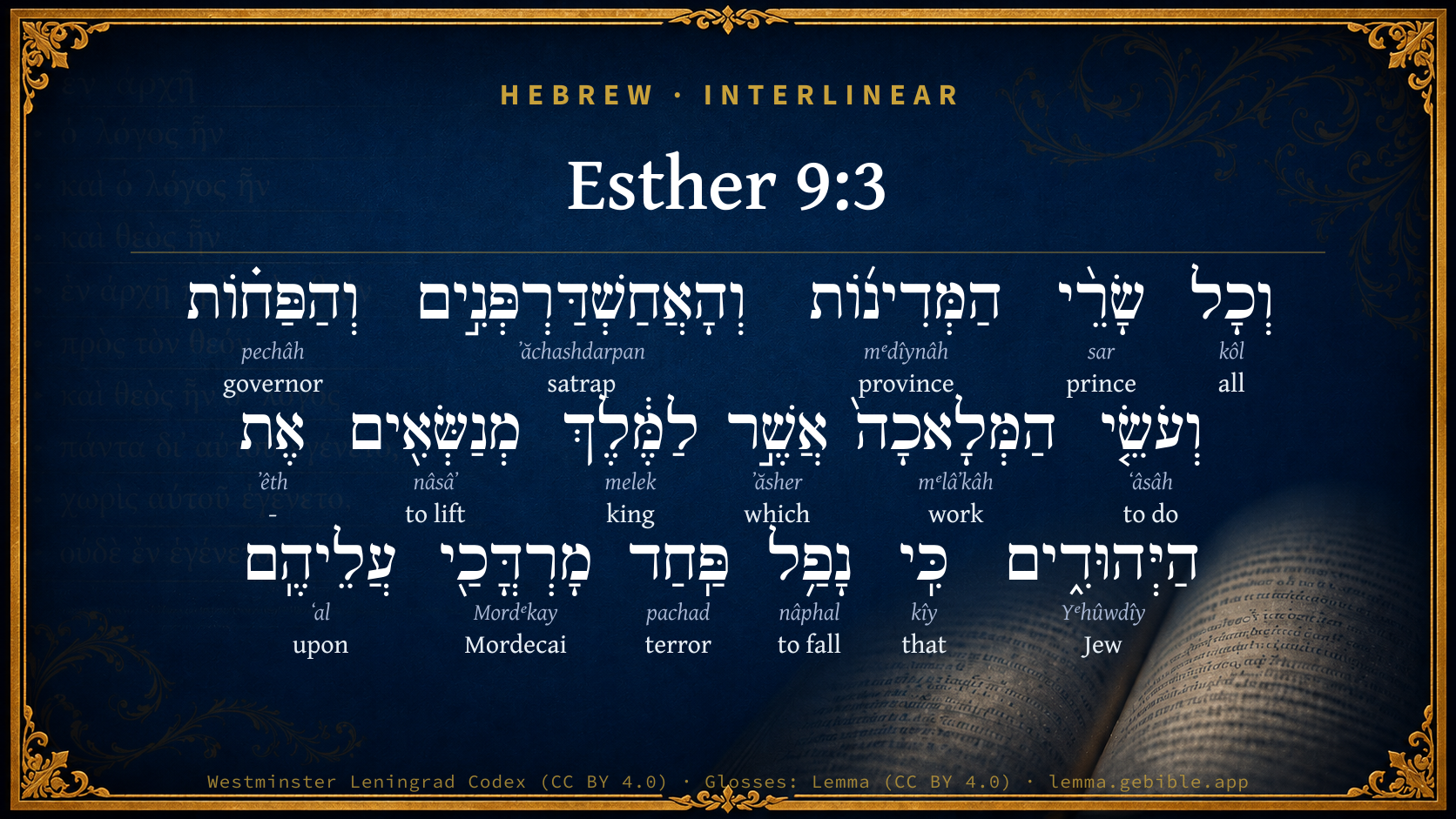
Esther 9:3

Hebrew (Westminster Leningrad Codex) Esther 9:3 appears in the Hebrew Old Testament. The text above is from the Westminster Leningrad Codex. Each word links to its Strong’s number, a concise gloss, and parsing drawn from the Open Scriptures Hebrew Bible morphology. Click any word for its full Brown-Driver-Briggs (BDB) entry.
Download image
Cite this verse

Esther 9:3 (World English Bible). Public Domain. Lemma interlinear Bible study tool, https://lemma.gebible.app/v/esther/9/3.

Show BibTeX & RIS
BibTeX
RIS
English Translation
All the princes of the provinces, and the satraps, and the governors, and those who did the king's business, helped the Jews; because the fear of Mordecai was fallen on them.
World English Bible · Public Domain
Download a study sheet

One document with this verse’s original text, its word-by-word gloss line, the meaning frame, cross-references with their text, attributed commentary, and full source and license credits — printable, and it pastes into notes with its structure intact.

This verse Autodidact and up

Study sheet (.html) Plain text (.txt)

A passage Seminary Student

Up to 50 verses in one chapter. A passage sheet keeps up to 6 commentary sources and 12 cross-references per verse, in the order this page ranks them, and says so on the sheet whenever that leaves anything out. Ask for a single verse and you get the Autodidact verse sheet above.

Everything on this page stays free to read, with no account — the sheet is a download of what is already on screen, not access to it.

Want to remove ads? Support Godless Engineer
Compare translations 3

The same verse in 3 English versions, stacked beneath the original-language interlinear above. Click any original word for its lexicon entry.

Each is an independent rendering of the whole verse — the interlinear is not word-aligned to these translations.

Highlighted words mark where these versions differ — a whole-verse word diff, not a word-by-word alignment.

  • World English Bible Public Domain
    All the princes of the provinces, and the satraps, and the governors, and those who did the king's business, helped the Jews; because the fear of Mordecai was fallen on them.
  • King James Version Public Domain
    And all the rulers of the provinces, and the lieutenants, and the deputies, and officers of the king, helped the Jews; because the fear of Mordecai fell upon them.
  • unfoldingWord Literal Text CC BY-SA 4.0
    And all the officials of the provinces, and the satraps and the governors and those doing the work that was for the king were lifting up the Jews, for dread of Mordecai had fallen on them.

unfoldingWord Literal Text — © unfoldingWord, licensed CC BY-SA 4.0. Word-aligned USFM3 via Door43 (git.door43.org/unfoldingWord/en_ult).

Versions to compare (up to 4)

3 of 4 selected

Show all 18 translations

Every available English version of this verse, each an independent rendering of the whole verse.

  • World English Bible Public Domain
    All the princes of the provinces, and the satraps, and the governors, and those who did the king's business, helped the Jews; because the fear of Mordecai was fallen on them.
  • Berean Standard Bible Public Domain
    And all the officials of the provinces, the satraps, the governors, and the king’s administrators helped the Jews, because the fear of Mordecai had fallen upon them.
  • Majority Standard Bible Public Domain
    And all the officials of the provinces, the satraps, the governors, and the king’s administrators helped the Jews, because the fear of Mordecai had fallen upon them.
  • King James Version Public Domain
    And all the rulers of the provinces, and the lieutenants, and the deputies, and officers of the king, helped the Jews; because the fear of Mordecai fell upon them.
  • American Standard Version (1901) Public Domain
    And all the princes of the provinces, and the satraps, and the governors, and they that did the king's business, helped the Jews; because the fear of Mordecai was fallen upon them.
  • Revised Version (1885) Public Domain
    And all the princes of the provinces, and the satraps, and the governors, and they that did the king’s business, helped the Jews; because the fear of Mordecai was fallen upon them.
  • Geneva Bible (1599) Public Domain
    And all the rulers of the prouinces, and the princes and the captaines, and the officers of the King exalted the Iewes: for the feare of Mordecai fell vpon them.
  • Douay-Rheims (1899) Public Domain
    And the judges of the provinces, and the governors, and lieutenants, and every one in dignity, that presided over every place and work, extolled the Jews for fear of Mardochai:
  • Young's Literal Translation Public Domain
    And all heads of the provinces, and the lieutenants, and the governors, and those doing the work that the king hath, are lifting up the Jews, for a fear of Mordecai hath fallen upon them;
  • Literal Standard Version CC BY-SA 4.0
    And all heads of the provinces, and the lieutenants, and the governors, and those doing the work that the king has, are lifting up the Jews, for a fear of Mordecai has fallen on them;
  • Unlocked Literal Bible CC BY-SA 4.0
    All the officials of the provinces, the provincial governors, the governors, and the king's administrators, helped the Jews because the fear of Mordecai had fallen on them.
  • unfoldingWord Literal Text CC BY-SA 4.0
    And all the officials of the provinces, and the satraps and the governors and those doing the work that was for the king were lifting up the Jews, for dread of Mordecai had fallen on them.
  • Darby Bible Public Domain
    And all the princes of the provinces, and the satraps, and the governors and officers of the king, helped the Jews; for the fear of Mordecai had fallen upon them.
  • World Messianic Bible Public Domain
    All the princes of the provinces, the local governors, the governors, and those who did the king’s business helped the Jews, because the fear of Mordecai had fallen on them.
  • Webster's Bible Public Domain
    And all the rulers of the provinces, and the lieutenants, and the deputies, and officers of the king helped the Jews; because the fear of Mordecai fell upon them.
  • Free Bible Version CC BY-SA 4.0
    All the officials of the provinces, the chief officers, the governors, and the king's officials helped the Jews, because they were afraid of Mordecai.
  • Bible in Basic English Public Domain
    And all the chiefs and the captains and the rulers and those who did the king's business gave support to the Jews; because the fear of Mordecai had come on them.
  • JPS Tanakh (1917) Public Domain
    And all the princes of the provinces, and the satraps, and the governors, and they that did the king's business, helped the Jews; because the fear of Mordecai was fallen upon them.

Literal Standard Version (2020), Covenant Press — licensed CC BY-SA 4.0. Text via the HelloAO Bible API (eBible.org). Unlocked Literal Bible (unfoldingWord) — licensed CC BY-SA 4.0. Text via the HelloAO Bible API (eBible.org). unfoldingWord Literal Text — © unfoldingWord, licensed CC BY-SA 4.0. Word-aligned USFM3 via Door43 (git.door43.org/unfoldingWord/en_ult). Free Bible Version, Dr. Jonathan Gallagher — licensed CC BY-SA 4.0. Text via the HelloAO Bible API (eBible.org).

Word by word

More ways to search: Search by grammar → Find every occurrence → Compare this word →

Practice this passage: Drill this verse → Learn its vocabulary →

וְהָאֲחַשְׁדַּרְפְּנִ֣ים
ʼăchashdarpan
H323
“and · the · satraps”
Conjunction + Particle, Definite Article + Noun, Common, Masculine, Plural, Absolute
Part of Speech
Conjunction + Particle + Noun
Type
Common
Gender
Masculine
Number
Plural
State
Absolute
Full BDB Definition

Origin: of Persian derivation

TWOT: 69

satrap, a governor of a Persian province
  1. וְכָל kôl H3605 “and · all of” Conjunction + Noun, Common, Masculine, Singular, Construct
  2. שָׂרֵ֨י sar H8269 “princes of” Noun, Common, Masculine, Plural, Construct
  3. הַמְּדִינ֜וֹת mᵉdîynâh H4082 “the · provinces” Particle, Definite Article + Noun, Common, Feminine, Plural, Absolute
  4. וְהַפַּח֗וֹת pechâh H6346 “and · the · governors” Conjunction + Particle, Definite Article + Noun, Common, Masculine, Plural, Absolute
  5. וְעֹשֵׂ֤י ʻâsâh H6213 “and · doing” Conjunction + Verb, Qal, Participle Active, Masculine, Plural, Construct
  6. הַמְּלָאכָה֙ mᵉlâʼkâh H4399 “the · work” Particle, Definite Article + Noun, Common, Feminine, Singular, Absolute
  7. אֲשֶׁ֣ר ʼăsher H834 “which” Particle, Relative
  8. לַמֶּ֔לֶךְ melek H4428 “to/for the · king” Preposition, Determined + Noun, Common, Masculine, Singular, Absolute
  9. מְנַשְּׂאִ֖ים nâsâʼ H5375 “lifting” Verb, Piel, Participle Active, Masculine, Plural, Absolute
  10. אֶת ʼêth H853 “-” Particle, Direct Object
  11. הַיְּהוּדִ֑ים Yᵉhûwdîy H3064 “the · Jews” Particle, Definite Article + Noun, Gentilic, Masculine, Plural, Absolute
  12. כִּֽי kîy H3588 “that” Conjunction
  13. נָפַ֥ל nâphal H5307 “to fall” Verb, Qal, Perfect, 3rd Person, Masculine, Singular
  14. פַּֽחַד pachad H6343 “terror of” Noun, Common, Masculine, Singular, Construct
  15. מָרְדֳּכַ֖י Mordᵉkay H4782 “Mordecai” Noun, Proper
  16. עֲלֵיהֶֽם ʻal H5921 “upon · them” Preposition + Suffix, Personal, 3rd Person, Masculine, Plural

About this verse

These counts appear in no published source. They are computed here, from the morphology-tagged text and Lemma’s own curated glosses. What Lemma adds →

17
words
17
distinct lemmas
Historical
section

Notable vocabulary

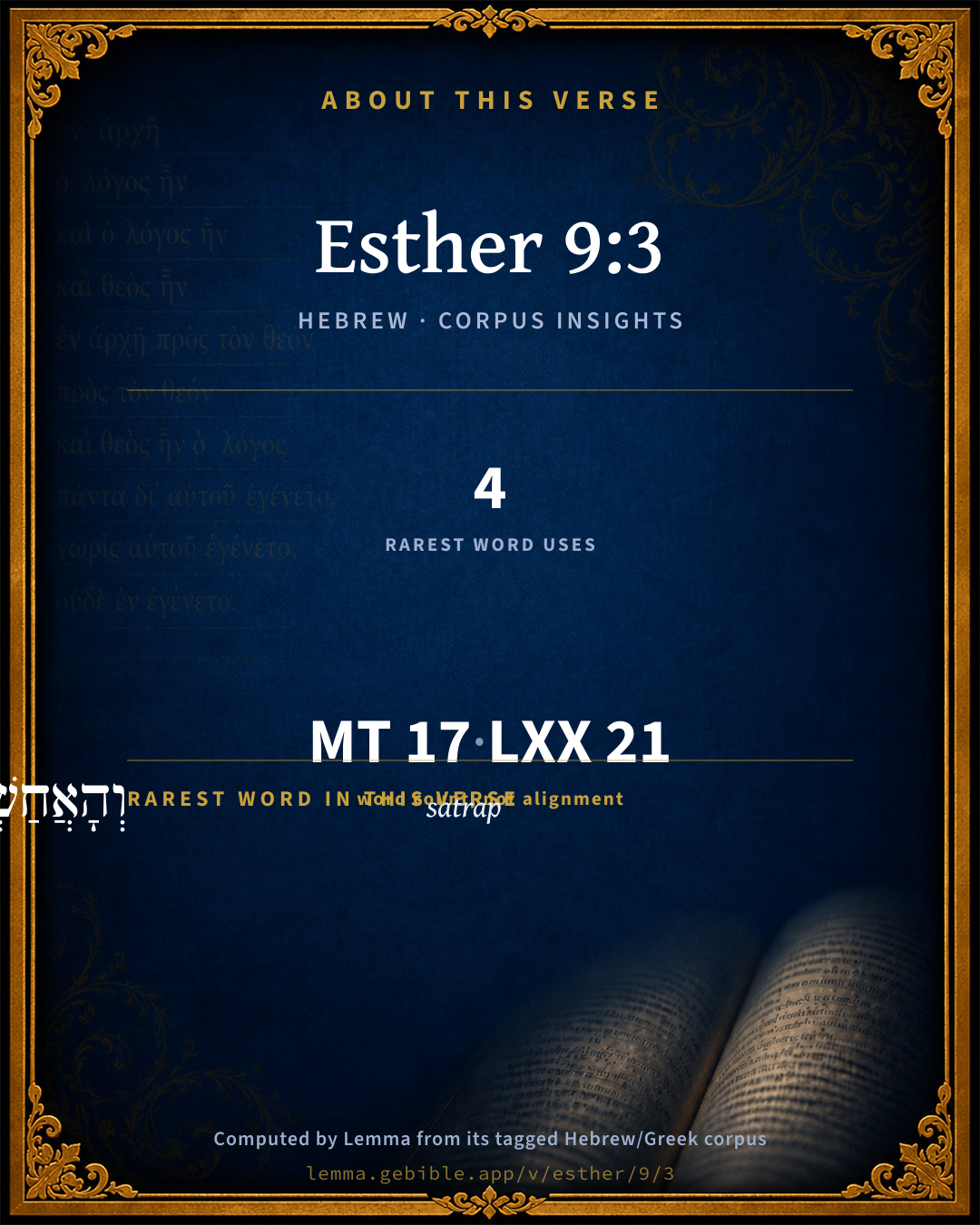
The rarest word here is וְהָאֲחַשְׁדַּרְפְּנִ֣ים satrap H323 — appearing just 4 times in the whole Hebrew Bible.

Shared distinctive vocabulary

וְהָאֲחַשְׁדַּרְפְּנִ֣ים satrap H323 occurs in 4 verses of the Hebrew Bible. Also found in:

Grammatical profile

  • 3 verbs
  • 10 nouns
  • 1 preposition
  • 1 conjunction
  • 2 particles

Verb forms

  • וְעֹשֵׂ֤י Qal · Participle Active
  • מְנַשְּׂאִ֖ים Piel · Participle Active
  • נָפַ֥ל Qal · Perfect

Hebrew & Septuagint length

In English translation the verse runs 31 words from the Hebrew and 24 from the Septuagint (LXX English) — closely comparable.

A rough comparison of the two English renderings, which tokenize alike — not a word-level alignment.

Word counts can differ between the Hebrew and the Greek without any difference in meaning — e.g. the Hebrew direct-object marker אֵת has no separate Greek word, and Greek often adds the article ὁ.

In the original languages it is 17 Hebrew tokens and 21 Greek tokens — but the two are counted differently (Hebrew bundles its prefixes and suffixes into one token; the Greek is in lemma form), so that isn’t a like-for-like length.

Cross-references

7

Topical passages linked to Esther 9:3 in the Treasury of Scripture Knowledge — connected by theme and wording, ordered by reader-vote popularity; previews shown in the World English Bible.

  • Ezra 8:36 They delivered the king's commissions to the king's satraps, and to the governors beyond the River: and they furthered the people and the house of God.
  • Esther 3:2–6 All the king's servants, who were in the king's gate, bowed down, and did reverence to Haman; for the king had so commanded concerning him. But Mordecai didn't bow down, nor did him reverence.
  • Esther 3:12 Then were the king's scribes called in the first month, on the thirteenth day of it; and there was written according to all that Haman commanded to the king's satraps, and to the governors who were over every province, and to the princes of every people, to every province according to the writing of it, and to every people after their language; in the name of king Ahasuerus was it written, and it was sealed with the king's ring.
  • Esther 8:5 She said, If it please the king, and if I have found favor in his sight, and the thing seem right before the king, and I be pleasing in his eyes, let it be written to reverse the letters devised by Haman, the son of Hammedatha the Agagite, which he wrote to destroy the Jews who are in all the king's provinces:
  • Esther 8:9 Then were the king's scribes called at that time, in the third month Sivan, on the three and twentieth [day] of it; and it was written according to all that Mordecai commanded to the Jews, and to the satraps, and the governors and princes of the provinces which are from India to Ethiopia, one hundred twenty-seven provinces, to every province according to the writing of it, and to every people after their language, and to the Jews according to their writing, and according to their language.
  • Daniel 3:2 Then Nebuchadnezzar the king sent to gather together the satraps, the deputies, and the governors, the judges, the treasurers, the counselors, the sheriffs, and all the rulers of the provinces, to come to the dedication of the image which Nebuchadnezzar the king had set up.
  • Daniel 6:1–2 It pleased Darius to set over the kingdom one hundred twenty satraps, who should be throughout the whole kingdom;

Cross-references courtesy of OpenBible.info (CC BY 4.0).

Hebrew and Greek witnesses Masoretic Hebrew ↔ Greek Septuagint

The same verse in the two great witnesses to the Old Testament, shown verse-for-verse.

These are two independent witnesses, not word-aligned to each other, and the Septuagint is shown in lemma (dictionary) form.

Hebrew Esther 9:3 Masoretic · Westminster Leningrad Codex

וְכָל שָׂרֵ֨י הַמְּדִינ֜וֹת וְהָאֲחַשְׁדַּרְפְּנִ֣ים וְהַפַּח֗וֹת וְעֹשֵׂ֤י הַמְּלָאכָה֙ אֲשֶׁ֣ר לַמֶּ֔לֶךְ מְנַשְּׂאִ֖ים אֶת הַיְּהוּדִ֑ים כִּֽי נָפַ֥ל פַּֽחַד מָרְדֳּכַ֖י עֲלֵיהֶֽם

All the princes of the provinces, and the satraps, and the governors, and those who did the king's business, helped the Jews; because the fear of Mordecai was fallen on them.

World English Bible · Public Domain

Greek LXX Esther 9:3 Septuagint · lemma form

ὁ γάρ ἄρχων ὁ σατράπης καί ὁ τύραννος καί ὁ βασιλικός γραμματεύς τιμάω ὁ ἰουδαῖος ὁ γάρ φόβος μαρδοχαῖος ἐνκεῖμαι αὐτός

For the chiefs of the satraps, and the princes and the royal scribes, honored the Jews; for the fear of Mardochaeus lay upon them.

LXX2012 (modern English Septuagint) · Public Domain

On this verse, Haydock's Catholic Bible Commentary discusses the Septuagint’s reading. Read the note in Commentary ↓

Hebrew: Westminster Leningrad Codex (CC BY 4.0). Greek: Septuagint (public domain); English from LXX2012 (modern English Septuagint) (Public Domain). How the Septuagint differs from the Hebrew →

Commentary

Notes on Esther 9:3 from classic Christian and Jewish commentators (each source and its license shown beneath its notes). The classic Christian expositions comment on the surrounding passage and are grouped to its opening verse, so a note may address several verses; the Jewish commentaries on the Tanakh (Rashi and others) are per-verse, so they appear only where the commentator wrote on this verse.

Lemma curates 59 commentaries, every one of them public domain or Creative Commons licensed, each selected and text-cleaned for this edition rather than reprinted as found. About our sources →

Trapp's Complete Commentary

John Trapp

Est 9:3 And all the rulers of the provinces, and the lieutenants, and the deputies, and officers of the king, helped the Jews; because the fear of Mordecai fell upon them.

Ver. 3. And all the rulers of the provinces … helped the Jews] Heb. Gave them a lift, sc. over the brook, the brake, or whatsoever lay in their way of deliverance. This they did out of their respect to the king, rather than for any great goodwill to the Jews, who were generally hated for their religion, and wished out of the world. Sit divus mode non sit virus, Let god be, only not let poison be, said the Roman emperor of his brother, whom he maliciously murdered.

, Because the fear of Mordecai fell upon them] But much more, because God himself over awed them, and dispirited them {See Trapp on "Est 9:2"} How else should he appear to be the God of the spirits of all flesh, and that in the thing wherein people deal proudly he was above them? Exo 18:11. How should they come to know themselves to be but men, Psa 9:20, and not God; and their horses flesh, and not spirit, &c., Isa 31:3; if he did not otherwhiles make their hearts heartless, Hos 7:11, their hands feeble, Jer 6:24 Isa 13:7 Eze 21:7, their eyes fail, Deu 28:28, their knees knock together, as Belshazzar’s did, Dan 5:6. How else would they ever be brought to bring presents unto him that ought to be feared, Psa 76:7-8, and to say unto him, Lord, be not thou a terror to me? &c., Jer 17:17. If Mordecai be feared, it is because God hath put a majesty upon him, and made him dreadful, as Abraham likewise was to Abimelech, Gen 21:22-23, David to Saul, 1Sa 18:29, the Baptist to Herod, our Saviour to the Pharisees, Mar 11:18, Paul and Silas to their persecutors, Act 16:27, &c. And this the Lord still doth, that he may dwell upon earth, Psa 68:18, sc. in his faithful worshippers, which wicked men would not suffer, if not thus reined in and restrained. And, secondly, that praise may wait for him in Zion, and unto him may the vow be performed, Psa 65:1.

John Trapp, A Commentary or Exposition upon All the Books of the Old and New Testament (1647–1656) — public domain. Text from a community e-Sword module.

Joseph Benson's Commentary

Est 9:3-4. All the rulers of the provinces, &c., and officers of the king — Hebrews and those that did the king’s business; that is, not only the chief persons, signified by the foregoing words, but all the king’s other ministers or officers, of what quality soever; helped the Jews; because the fear of Mordecai fell upon them — He having manifestly the countenance both of God and the king. For Mordecai was great — The greatest in place, and power, and favour with the king, both for his near relation to the queen, and for the good service he had done for the king himself, in preserving his life, and managing his affairs; and for those excellent abilities and virtues which the king discovered in him. And his fame went throughout all the provinces — He was not only great in the king’s house, and caressed by the courtiers, as many are who have no intrinsic worth to support their reputation; but his fame for wisdom and virtue went out from thence throughout all the king’s dominions, and in all places he was extolled as a great man, and as one that was waxing greater and greater. Hence all, even the king’s officers, saw it to be their interest to help his friends.

Joseph Benson's Commentary on the Old and New Testaments (1811–1818) — public domain. Text from a community e-Sword module.

Tyndale Open Study Notes

Tyndale Open Resources

9:3-4 People saw that Mordecai was the man in charge, so they knew it would not be wise to oppose him.

Tyndale Open Study Notes — © Tyndale Open Resources, licensed CC BY-SA 4.0. Text via the HelloAO Bible API.

Geneva Bible (1599)

Geneva Bible translators

Did them honor, and showed them friendship.

Geneva Bible (1599) marginal notes — public domain. Text via Bolls.life.

Adam Clarke's Commentary

Verse 3. And all the rulers of the provinces] Mordecai being raised to the highest confidence of the king, and to have authority over the whole realm, these officers assisted the Jews, no doubt, with the troops under their command, to overthrow those who availed themselves of the former decree to molest the Jews. For it does not appear that the Jews slew any person who did not rise up to destroy them. See Es 9:5.

Adam Clarke's Commentary on the Bible (1810–1826) — public domain. Text from a community e-Sword/MySword module.

Ellicott's Commentary for English Readers

(3) Helped.—Literally, lifted up. The same Hebrew verb is rendered furthered (Ezr_8:36).

A Bible Commentary for English Readers, edited by Charles John Ellicott (1878–1897) — public domain. Text from a community e-Sword module.

The Cambridge Bible for Schools and Colleges

gen. ed. J. J. S. Perowne

3. they that did the king’s business] See on Est_3:9.

The Cambridge Bible for Schools and Colleges (gen. ed. J. J. S. Perowne; Cambridge University Press, 1878–1918) — public domain. Text from a community e-Sword module.

John Gill's Exposition

And all the rulers of the provinces, and the lieutenants, and the deputies, and officers of the king, blessed the Jews,.... Countenanced them and encouraged them, and gave them all assistance in their power; extolled them, as the word signifies, lifted them up, and spoke well of them, or praised them, as the Targum:

because the fear of Mordecai was upon them; he being now chief minister, they might fear, if they took part with the enemies of the Jews against them, they might be turned out of their places.

John Gill's Exposition of the Whole Bible (1746–1763) — public domain (CC PDM 1.0). Text via the HelloAO Bible API.

Albert Barnes' Notes on the Bible

All the rulers ... helped the Jews - i. e. the Persians, who formed the standing army which kept the Empire in subjection, and were at the disposal of the various governors of provinces, took the Jews’ side. The enemies of the Jews (e. g. Est 9:16) were almost entirely to be found among the idolatrous people of the subject nations, for whose lives neither the Persians generally, nor their monarchs, cared greatly.

Albert Barnes' Notes on the Bible (1834–1885) — public domain. Text from a community e-Sword/MySword module.

Haydock's Catholic Bible Commentary

Extolled. Protestants, "helped." Septuagint, "the king’s secretaries honoured the Jews." (Haydock)

George Leo Haydock (1774–1849), Haydock's Catholic Family Bible and Commentary, 1859 edition — public domain. Excludes Psalms (Douay-Rheims chapter numbering differs from Protestant) and Deuterocanonical books (Catholic canon only).

Matthew Poole's English Annotations

And officers of the king, Heb. and all them that did the king’s business, i.e. not only the chief persons designed by the foregoing words, but all his other ministers or officers, of what quality soever.

Matthew Poole's English Annotations on the Holy Bible (1683–1685) — public domain. Text from a community e-Sword/MySword module.

Whedon's Commentary on the Bible

Daniel D. Whedon

3. The rulers of the provinces — Called princes in the common version of Est_1:3, though the Hebrew word is the same in each passage.

Lieutenants — Satraps. See on Ezr_8:36.

Deputies — Governors or prefects. See on Ezr_5:3.

Officers of the king — Hebrew, Doers of the business that pertained to the king. See note on Est_3:9.

Helped the Jews — To what extent is not stated. They probably facilitated the Jews in their preparations to defend themselves.

Because the fear of Mordecai fell upon them — They were men of artful policy, careful to keep in favour with the highest minister of the royal court; and because the prime minister was now a Jew, they feared to take sides with the Jews’ enemies.

Daniel D. Whedon (gen. ed.), Commentary on the Old and New Testaments (1874–1909) — public domain. Text from a community e-Sword module.

The Pulpit Commentary

All the rulers of the provinces, and the lieutenants, and the deputies. Compare Est_3:12 and Est_8:9, where the same enumeration is made, though not quite in the same order. And officers of the king. Literally, "they who did the work of the king." The Septuagint renders by basilikoi grammateiv, "royal scribes;" but officials of all classes seem to be intended. Helped the Jews. Rather, "upheld, supported" Active physical help does not seem to be meant, but rather the moral aid and support that a government easily gives to the side which it favours in a civil disturbance. The fear of Mordecai fell upon them. It would give the sense better to translate "had fallen."

The Pulpit Commentary (1880–1919), ed. H.D.M. Spence-Jones & Joseph S. Exell — public domain. Text from a community e-Sword module.

unfoldingWord translationNotes

Door43 World Missions Community

provincial governors

"governors of the provinces"

the fear of Mordecai had fallen on them

Fear falling on people represents people becoming afraid. AT: "they had become afraid of Mordecai" (See: Metaphor)

was great in the king's house

"was very important in the king's palace"

his fame spread throughout all the provinces

Fame spreading through places represents people in those places learning about how great he was. AT: "throughout the provinces people learned about how great he was" (See: Metaphor)

translationWords

administration

Mordecai

Jew

unfoldingWord translationNotes — © Distant Shores Media and the Door43 World Missions Community, licensed CC BY-SA 4.0. Source: git.door43.org/Door43/en_tn.

Rashi

Rabbi Shlomo Yitzchaki (Rashi)

and those that conduct the king’s affairs those who were appointed to conduct the king’s affairs.

Rashi on the Tanakh — English translations: “The Judaica Press complete Tanach with Rashi, translated by A. J. Rosenberg” (CC BY 4.0); “Pentateuch with Rashi's commentary by M. Rosenbaum and A.M. Silbermann, 1929-1934” (public domain); “The Metsudah Tanach series, Lakewood, N.J” (CC BY 4.0); and “The Book of Joshua, Metsudah Publications, 1997” (CC BY 4.0). Text via Sefaria.

Lesson kit

Teaching starters — assembled from the data on this page, not authored interpretation. Every prompt links to the verse data it draws on. Edit before teaching.

Esther, in the Historical, opens this verse with 17 words (17 distinct Hebrew lemmas). Its most distinctive word is ʼăchashdarpan (“satrap”). A historical commentator’s framing appears above. Read the whole chapter for the surrounding context.

Discussion questions

  1. The word ʼăchashdarpan carries the sense “satrap.” How does it shape the verse?
  2. How does Ezra 8:36, which shares the word «satrap», read alongside this verse?
  3. These translations render this verse differently; the difference is in the English rendering, not the original. What questions does that raise?
  4. «וְעֹשֵׂ֤י» is a Qal Participle Active verb. How does that grammatical form shape the action described?
  5. Compare how Trapp's Complete Commentary and Joseph Benson's Commentary read this verse. Where do they agree or differ?

Things to notice

Reading settings

Reading text

Shown beneath each verse's original-language words.

Old Testament
Old Testament edition

Read the OT as the Masoretic Hebrew (MT) or the Greek Septuagint (LXX).

English shown for the Greek Septuagint (in the Hebrew ↔ Greek comparison).

Comparing translations? Open the Compare panel on any verse page to stack up to four side by side.