
Judges 21:23

Hebrew (Westminster Leningrad Codex) Judges 21:23 appears in the Hebrew Old Testament. The text above is from the Westminster Leningrad Codex. Each word links to its Strong’s number, a concise gloss, and parsing drawn from the Open Scriptures Hebrew Bible morphology. Click any word for its full Brown-Driver-Briggs (BDB) entry.
Download image
Cite this verse

Judges 21:23 (World English Bible). Public Domain. Lemma interlinear Bible study tool, https://lemma.gebible.app/v/judges/21/23.

Show BibTeX & RIS
BibTeX
RIS
English Translation
The children of Benjamin did so, and took them wives, according to their number, of those who danced, whom they carried off: and they went and returned to their inheritance, and built the cities, and lived in them.
World English Bible · Public Domain
Download a study sheet

One document with this verse’s original text, its word-by-word gloss line, the meaning frame, cross-references with their text, attributed commentary, and full source and license credits — printable, and it pastes into notes with its structure intact.

This verse Autodidact and up

Study sheet (.html) Plain text (.txt)

A passage Seminary Student

Up to 50 verses in one chapter. A passage sheet keeps up to 6 commentary sources and 12 cross-references per verse, in the order this page ranks them, and says so on the sheet whenever that leaves anything out. Ask for a single verse and you get the Autodidact verse sheet above.

Everything on this page stays free to read, with no account — the sheet is a download of what is already on screen, not access to it.

Want to remove ads? Support Godless Engineer
Compare translations 3

The same verse in 3 English versions, stacked beneath the original-language interlinear above. Click any original word for its lexicon entry.

Each is an independent rendering of the whole verse — the interlinear is not word-aligned to these translations.

Highlighted words mark where these versions differ — a whole-verse word diff, not a word-by-word alignment.

  • World English Bible Public Domain
    The children of Benjamin did so, and took them wives, according to their number, of those who danced, whom they carried off: and they went and returned to their inheritance, and built the cities, and lived in them.
  • King James Version Public Domain
    And the children of Benjamin did so, and took them wives, according to their number, of them that danced, whom they caught: and they went and returned unto their inheritance, and repaired the cities, and dwelt in them.
  • unfoldingWord Literal Text CC BY-SA 4.0
    And the sons of Benjamin did thus, and they carried away wives for their number from the ones dancing, whom they caught. And they went and returned to their inheritance, and they built the cities and dwelled in them.

unfoldingWord Literal Text — © unfoldingWord, licensed CC BY-SA 4.0. Word-aligned USFM3 via Door43 (git.door43.org/unfoldingWord/en_ult).

Versions to compare (up to 4)

3 of 4 selected

Show all 18 translations

Every available English version of this verse, each an independent rendering of the whole verse.

  • World English Bible Public Domain
    The children of Benjamin did so, and took them wives, according to their number, of those who danced, whom they carried off: and they went and returned to their inheritance, and built the cities, and lived in them.
  • Berean Standard Bible Public Domain
    The Benjamites did as instructed and carried away the number of women they needed from the dancers they caught. They went back to their own inheritance, rebuilt their cities, and settled in them.
  • Majority Standard Bible Public Domain
    The Benjamites did as instructed and carried away the number of women they needed from the dancers they caught. They went back to their own inheritance, rebuilt their cities, and settled in them.
  • King James Version Public Domain
    And the children of Benjamin did so, and took them wives, according to their number, of them that danced, whom they caught: and they went and returned unto their inheritance, and repaired the cities, and dwelt in them.
  • American Standard Version (1901) Public Domain
    And the children of Benjamin did so, and took them wives, according to their number, of them that danced, whom they carried off: and they went and returned unto their inheritance, and built the cities, and dwelt in them.
  • Revised Version (1885) Public Domain
    And the children of Benjamin did so, and took them wives, according to their number, of them that danced, whom they carried off: and they went and returned unto their inheritance, and built the cities, and dwelt in them.
  • Geneva Bible (1599) Public Domain
    And the children of Beniamin did so, and tooke wiues of them that danced according to their nomber: which they tooke, and went away, and returned to their inheritance, and repaired the cities and dwelt in them.
  • Douay-Rheims (1899) Public Domain
    And the children of Benjamin did, as they had been commanded: and according to their number, they carried off for themselves every man his wife of them that were dancing: and they went into their possession and built up their cities, and dwelt in them.
  • Young's Literal Translation Public Domain
    And the sons of Benjamin do so, and take women according to their number, out of the dancers whom they have taken violently away; and they go, and turn back unto their inheritance, and build the cities, and dwell in them.
  • Literal Standard Version CC BY-SA 4.0
    And the sons of Benjamin do so, and take women according to their number, out of the dancers whom they have seized; and they go, and return to their inheritance, and build the cities, and dwell in them.
  • Unlocked Literal Bible CC BY-SA 4.0
    The people of Benjamin did so. They took the number of wives that they needed from the girls who were dancing and they carried them off to be their wives. They went and returned to the place of their inheritance. They rebuilt the towns and lived in them.
  • unfoldingWord Literal Text CC BY-SA 4.0
    And the sons of Benjamin did thus, and they carried away wives for their number from the ones dancing, whom they caught. And they went and returned to their inheritance, and they built the cities and dwelled in them.
  • Darby Bible Public Domain
    And the Benjaminites did so, and took their wives, according to their number, from the dancers whom they carried off; then they went and returned to their inheritance, and rebuilt the towns, and dwelt in them.
  • World Messianic Bible Public Domain
    The children of Benjamin did so, and took wives for themselves according to their number, of those who danced, whom they carried off. They went and returned to their inheritance, built the cities, and lived in them.
  • Webster's Bible Public Domain
    And the children of Benjamin did so, and took them wives, according to their number, of them that danced, whom they caught: and they went and returned to their inheritance, and repaired the cities and dwelt in them.
  • Free Bible Version CC BY-SA 4.0
    The Benjaminites did as they were ordered. Each man grabbed one of the women dancers up to the total needed and carried her off to be his wife. Then they went back to their own land, where they rebuilt their towns and lived in them.
  • Bible in Basic English Public Domain
    So the men of Benjamin did this, and got wives for themselves for every one of their number, taking them away by force from the dance; then they went back to their heritage, building up their towns and living in them.
  • JPS Tanakh (1917) Public Domain
    And the children of Benjamin did so, and took them wives, according to their number, of them that danced, whom they carried off; and they went and returned unto their inheritance, and built the cities, and dwelt in them.

Literal Standard Version (2020), Covenant Press — licensed CC BY-SA 4.0. Text via the HelloAO Bible API (eBible.org). Unlocked Literal Bible (unfoldingWord) — licensed CC BY-SA 4.0. Text via the HelloAO Bible API (eBible.org). unfoldingWord Literal Text — © unfoldingWord, licensed CC BY-SA 4.0. Word-aligned USFM3 via Door43 (git.door43.org/unfoldingWord/en_ult). Free Bible Version, Dr. Jonathan Gallagher — licensed CC BY-SA 4.0. Text via the HelloAO Bible API (eBible.org).

Word by word

More ways to search: Search by grammar → Find every occurrence → Compare this word →

Practice this passage: Drill this verse → Learn its vocabulary →

גָּזָ֑לוּ
gâzal
H1497
“to plunder”
Verb, Qal, Perfect, 3rd Person, Common, Plural
Part of Speech
Verb
Stem
Qal
Form
Perfect
Person
3rd Person
Gender
Common
Number
Plural
Full BDB Definition

Origin: a primitive root

TWOT: 337

to tear away, seize, plunder, tear off, pull off, rob, take away by force - (Qal) - to tear away, rob - to seize, plunder (with acc cognate) - (Niphal) - to be robbed - to be taken away
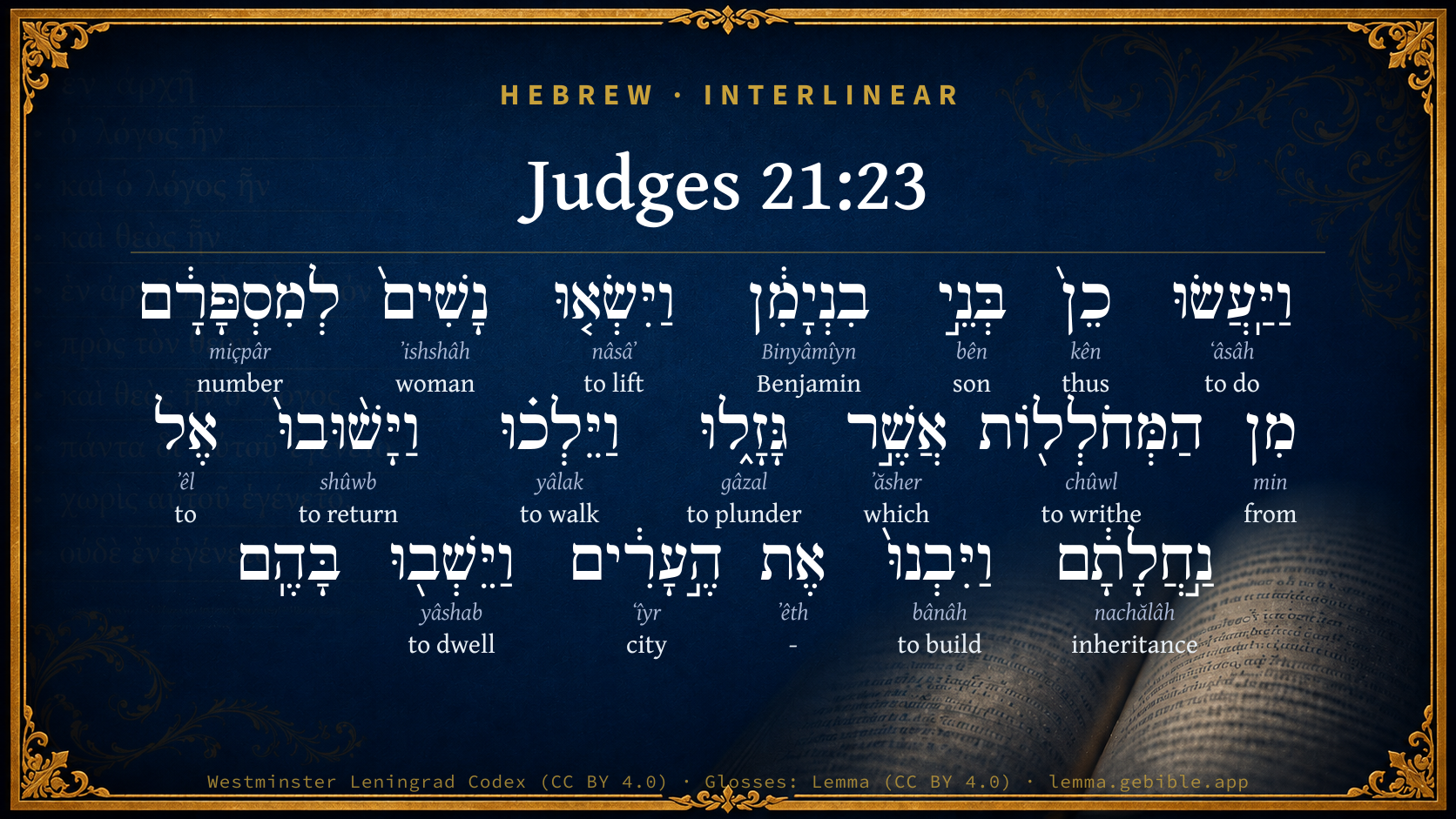
  1. וַיַּֽעֲשׂוּ ʻâsâh H6213 “and · to do” Conjunction + Verb, Qal, Sequential Imperfect, 3rd Person, Masculine, Plural
  2. כֵן֙ kên H3651 “thus” Adverb
  3. בְּנֵ֣י bên H1121 “sons of” Noun, Common, Masculine, Plural, Construct
  4. בִנְיָמִ֔ן Binyâmîyn H1144 “Benjamin” Noun, Proper
  5. וַיִּשְׂא֤וּ nâsâʼ H5375 “and · to lift” Conjunction + Verb, Qal, Sequential Imperfect, 3rd Person, Masculine, Plural
  6. נָשִׁים֙ ʼishshâh H802 “women” Noun, Common, Feminine, Plural, Absolute
  7. לְמִסְפָּרָ֔ם miçpâr H4557 “to/for · number · their” Preposition + Noun, Common, Masculine, Singular, Construct + Suffix, Personal, 3rd Person, Masculine, Plural
  8. מִן min H4480 “from” Preposition
  9. הַמְּחֹלְל֖וֹת chûwl H2342 “the · writhing” Particle, Definite Article + Verb, Polel, Participle Active, Feminine, Plural, Absolute
  10. אֲשֶׁ֣ר ʼăsher H834 “which” Particle, Relative
  11. וַיֵּלְכ֗וּ yâlak H3212 “and · to walk” Conjunction + Verb, Qal, Sequential Imperfect, 3rd Person, Masculine, Plural
  12. וַיָּשׁ֨וּבוּ֙ shûwb H7725 “and · to return” Conjunction + Verb, Qal, Sequential Imperfect, 3rd Person, Masculine, Plural
  13. אֶל ʼêl H413 “to” Preposition
  14. נַ֣חֲלָתָ֔ם nachălâh H5159 “inheritance · their” Noun, Common, Feminine, Singular, Construct + Suffix, Personal, 3rd Person, Masculine, Plural
  15. וַיִּבְנוּ֙ bânâh H1129 “and · to build” Conjunction + Verb, Qal, Sequential Imperfect, 3rd Person, Masculine, Plural
  16. אֶת ʼêth H853 “-” Particle, Direct Object
  17. הֶ֣עָרִ֔ים ʻîyr H5892 “the · cities” Particle, Definite Article + Noun, Common, Feminine, Plural, Absolute
  18. וַיֵּשְׁב֖וּ yâshab H3427 “and · to dwell” Conjunction + Verb, Qal, Sequential Imperfect, 3rd Person, Masculine, Plural

About this verse

These counts appear in no published source. They are computed here, from the morphology-tagged text and Lemma’s own curated glosses. What Lemma adds →

20
words
19
distinct lemmas
Historical
section

Shared distinctive vocabulary

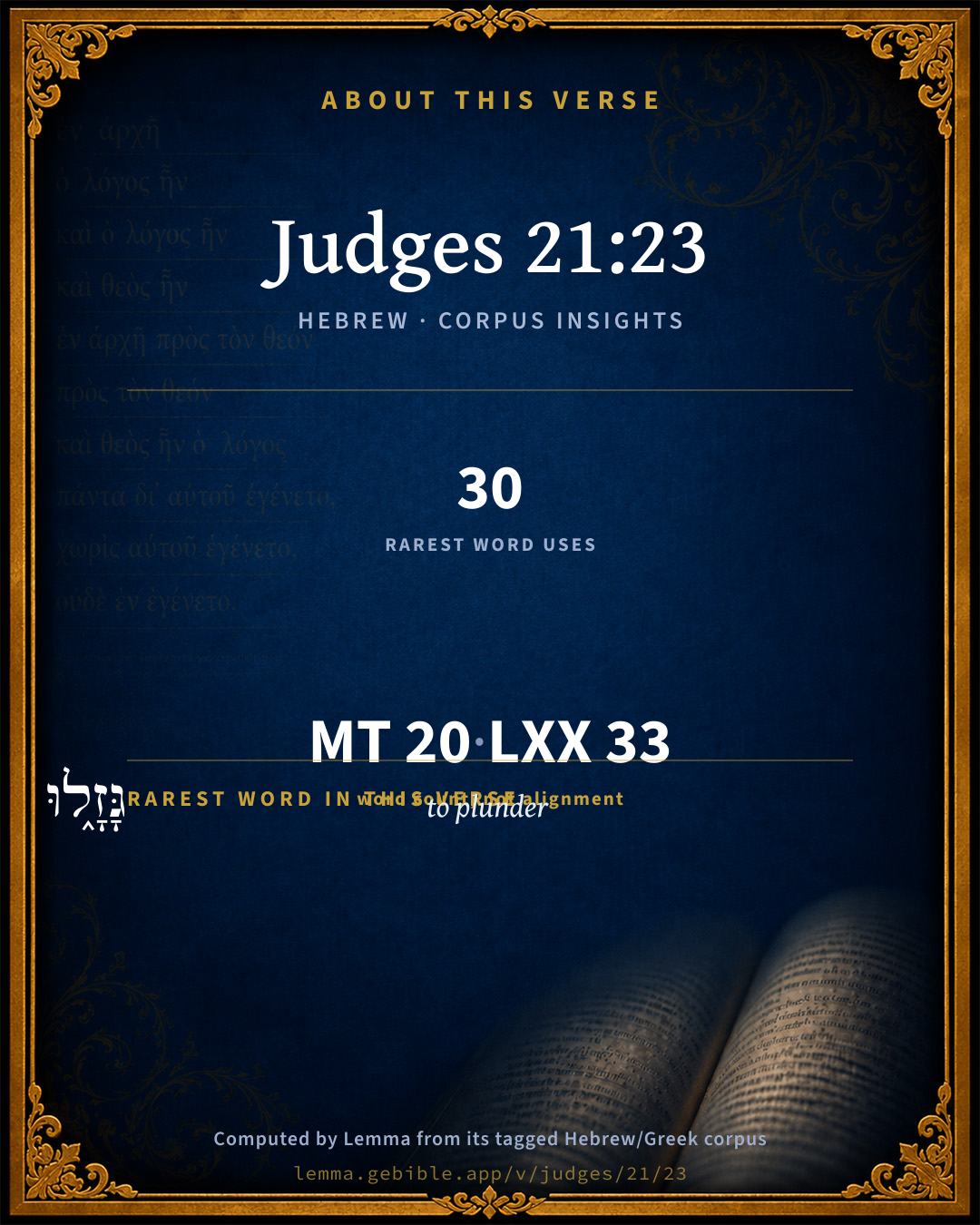
גָּזָ֑לוּ to plunder H1497 occurs in 30 verses of the Hebrew Bible. Also found in:

Grammatical profile

  • 8 verbs
  • 6 nouns
  • 3 prepositions
  • 1 adverb
  • 2 particles

Verb forms

  • וַיַּֽעֲשׂוּ Qal · Sequential Imperfect
  • וַיִּשְׂא֤וּ Qal · Sequential Imperfect
  • הַמְּחֹלְל֖וֹת Polel · Participle Active
  • גָּזָ֑לוּ Qal · Perfect
  • וַיֵּלְכ֗וּ Qal · Sequential Imperfect
  • וַיָּשׁ֨וּבוּ֙ Qal · Sequential Imperfect
  • וַיִּבְנוּ֙ Qal · Sequential Imperfect
  • וַיֵּשְׁב֖וּ Qal · Sequential Imperfect

Hebrew & Septuagint length

In English translation the verse runs 38 words from the Hebrew and 37 from the Septuagint (LXX English) — closely comparable.

A rough comparison of the two English renderings, which tokenize alike — not a word-level alignment.

Word counts can differ between the Hebrew and the Greek without any difference in meaning — e.g. the Hebrew direct-object marker אֵת has no separate Greek word, and Greek often adds the article ὁ.

In the original languages it is 20 Hebrew tokens and 33 Greek tokens — but the two are counted differently (Hebrew bundles its prefixes and suffixes into one token; the Greek is in lemma form), so that isn’t a like-for-like length.

Cross-references

1

Topical passages linked to Judges 21:23 in the Treasury of Scripture Knowledge — connected by theme and wording, ordered by reader-vote popularity; previews shown in the World English Bible.

  • Judges 20:48 The men of Israel turned again on the children of Benjamin, and struck them with the edge of the sword, both the entire city, and the cattle, and all that they found: moreover all the cities which they found they set on fire.

Cross-references courtesy of OpenBible.info (CC BY 4.0).

Hebrew and Greek witnesses Masoretic Hebrew ↔ Greek Septuagint

The same verse in the two great witnesses to the Old Testament, shown verse-for-verse.

These are two independent witnesses, not word-aligned to each other, and the Septuagint is shown in lemma (dictionary) form.

Hebrew Judges 21:23 Masoretic · Westminster Leningrad Codex

וַיַּֽעֲשׂוּ כֵן֙ בְּנֵ֣י בִנְיָמִ֔ן וַיִּשְׂא֤וּ נָשִׁים֙ לְמִסְפָּרָ֔ם מִן הַמְּחֹלְל֖וֹת אֲשֶׁ֣ר גָּזָ֑לוּ וַיֵּלְכ֗וּ וַיָּשׁ֨וּבוּ֙ אֶל נַ֣חֲלָתָ֔ם וַיִּבְנוּ֙ אֶת הֶ֣עָרִ֔ים וַיֵּשְׁב֖וּ בָּהֶֽם

The children of Benjamin did so, and took them wives, according to their number, of those who danced, whom they carried off: and they went and returned to their inheritance, and built the cities, and lived in them.

World English Bible · Public Domain

Greek LXX Judges 21:23 Septuagint · lemma form

καί ποιέω οὕτως ὁ υἱός βενιαμίν καί λαμβάνω γυνή εἰς ἀριθμός αὐτός ἀπό ὁ χορεύω ὅς ἁρπάζω καί πορεύομαι καί ὑποστρέφω εἰς ὁ κληρονομία αὐτός καί οἰκοδομέω ὁ πόλις καί καταἵζω ἐν αὐτός

And the children of Benjamin did so; and they took wives according to their number from the dancers whom they seized: and they went and returned to their inheritance, and built the cities, and lived in them.

LXX2012 (modern English Septuagint) · Public Domain

Hebrew: Westminster Leningrad Codex (CC BY 4.0). Greek: Septuagint (public domain); English from LXX2012 (modern English Septuagint) (Public Domain). How the Septuagint differs from the Hebrew →

Targum (Aramaic paraphrase)

1

The Targum is the ancient Jewish Aramaic paraphrase of the Hebrew Scriptures — an interpretive translation, not the Hebrew text itself. Onkelos (literal) and Pseudo-Jonathan (expansive) render the Torah, and Jonathan the Prophets. Coverage is partial: where no permissively-licensed English translation exists for a verse, only the Aramaic is shown. This is verse-level text, not a word-by-word alignment to the Hebrew.

  1. Targum Jonathan Prophets (Joshua–Malachi)
    וַעֲבָדוּ כֵּן בְּנֵי בִנְיָמִן וּנְסִיבוּ נְשִׁין לְמִנְיָנֵיהוֹן מִן חִנְגַיָא דִי אֲנָסוּ וַאֲזַלוּ וְתָבוּ לְאַחְסַנְתְּהוֹן וּבְנוֹ יַת קִרְוַיָא וִיתִיבוּ בְהוֹן:

    (no public-domain English translation for this verse)

    Targum Jonathan — Aramaic: “Mikraot Gedolot” (public domain). English: “Sefaria Community Translation” (CC0 1.0 (public-domain dedication)); “London "Chaldee Paraphrase," 1871” (public domain). Text via Sefaria.

Commentary

Notes on Judges 21:23 from classic Christian and Jewish commentators (each source and its license shown beneath its notes). The classic Christian expositions comment on the surrounding passage and are grouped to its opening verse, so a note may address several verses; the Jewish commentaries on the Tanakh (Rashi and others) are per-verse, so they appear only where the commentator wrote on this verse.

Lemma curates 59 commentaries, every one of them public domain or Creative Commons licensed, each selected and text-cleaned for this edition rather than reprinted as found. About our sources →

Trapp's Complete Commentary

John Trapp

Jdg 21:23 And the children of Benjamin did so, and took [them] wives, according to their number, of them that danced, whom they caught: and they went and returned unto their inheritance, and repaired the cities, and dwelt in them.

Ver. 23. And took them wives.] Without consent of parents or parties, to the great grief of both no doubt. Much mischief hath followed upon such rapes, and many bloody wars: as between the Grecians and Trojans, the Romans and Sabines, the Emperor Maximilian and Charles VIII king of France, about Anne the only daughter of the Duke of Britanny, espoused to Maximilian, but violently taken away by Charles. The Britons, or Welsh, that, being driven out by the Saxons, first came into that dukedom, and gave the name to it, taking wives of that country, and finding them troublesome, are said to have cut out their tongues. It is likely there was somewhat to do, ere these couples could agree that came together so ungainly: but necessity, which is a hard weapon, and a later consent might heal all, and the women keep their tongues in their heads.

John Trapp, A Commentary or Exposition upon All the Books of the Old and New Testament (1647–1656) — public domain. Text from a community e-Sword module.

Joseph Benson's Commentary

Jdg 21:23. They took them wives according to their number — That is, each man took his wife. By which we may see, they had no very favourable opinion of polygamy, because they did not allow it in this case, when it might seem most necessary for the reparation of a lost tribe. And repaired the cities — By degrees, increasing their buildings as their number increased.

Joseph Benson's Commentary on the Old and New Testaments (1811–1818) — public domain. Text from a community e-Sword module.

Geneva Bible (1599)

Geneva Bible translators

Meaning, two hundred.

Geneva Bible (1599) marginal notes — public domain. Text via Bolls.life.

Adam Clarke's Commentary

Verse 23. They went and returned unto their inheritance] It appears that the Benjamites acted in the most honourable way by the women whom they had thus violently carried off; and we may rest assured they took them to an inheritance at least equal to their own, for it does not appear that any part of the lands of the Benjamites was alienated from them, and the six hundred men in question shared, for the present, the inheritance of many thousands.

Adam Clarke's Commentary on the Bible (1810–1826) — public domain. Text from a community e-Sword/MySword module.

The Cambridge Bible for Schools and Colleges

gen. ed. J. J. S. Perowne

23. took them wives … carried off] Render carried off wives … seized. The expression to take wives in the sense of marry is found only in late writings; the reference here, however, is not to marriage, but to capture. This verse closes the narrative of A.

The Cambridge Bible for Schools and Colleges (gen. ed. J. J. S. Perowne; Cambridge University Press, 1878–1918) — public domain. Text from a community e-Sword module.

John Gill's Exposition

And the children of Benjamin did so,.... Went and laid wait in the vineyards, and when the daughters of Shiloh came out to dance, they rushed upon them:

and took them wives according to their number; two hundred of them, each man a wife, and no more; for though polygamy was in use in those times, and if at any time necessary, and could be excused, it might seem now; yet it was not indulged to, neither by the elders, nor by the children of Benjamin:

of them that danced whom they caught; the rape of the Sabine virgins by Romulus, at the arena plays and shows, mentioned by various authors (h), and the carrying off of fifteen Spartan virgins from the dances by Aristomenes the Messenian (i), are sometimes observed as parallel cases to this, and justified by it, particularly that of Romulus (k):

and they went and returned unto their inheritance; the six hundred Benjaminites, with their wives, returned to their own tribe, which was their inheritance by lot; and these, being the only survivors, had a right to the whole:

and repaired the cities, and dwelt in them: in process of time they rebuilt the cities the Israelites had burnt in the late war, and repeopled them as their posterity increased. And the Jewish writers say, that in later times they were allowed to marry with other tribes as before, since the oath only bound those present at Mizpeh; for they observe, that it ran only:

there shall not any of us, &c. not any of our sons; they might give wives to Benjamin, and so in time they became numerous again.

(h) Liv. Hist. l. 1. p. 7, 8. Flor Hist. Rom. l. 1. c. 1. Aurel. Victor. de Vir Illustr. c. 2. Valer. Maxim. l. 1. c. 4. (i) Hierop adv. Jovinian. l. 1. fol. 17. B, C. (k) Vid. Albericum Gentil. de armis Roman l. 2. p. 114.

John Gill's Exposition of the Whole Bible (1746–1763) — public domain (CC PDM 1.0). Text via the HelloAO Bible API.

Albert Barnes' Notes on the Bible

Compare the very similar account of the rape of the Sabine women by the Romero youths at the festival of the Consualia, as related by Livy.

Albert Barnes' Notes on the Bible (1834–1885) — public domain. Text from a community e-Sword/MySword module.

Matthew Poole's English Annotations

According to their number, i.e. each man his wife, as is said, Jdg 21:22. By which we may see they had no very favourable opinion of polygamy, because they did not allow it is this case, when it might seem most necessary for the reparation of a lost tribe.

Returned into their inheritance; which being very near the place, they could speedily do before the parents could obtain redress.

Repaired the cities,

and dwelt in them; not at that instant, which could not be; but by degrees, increasing their buildings as their number increased.

Matthew Poole's English Annotations on the Holy Bible (1683–1685) — public domain. Text from a community e-Sword/MySword module.

Whedon's Commentary on the Bible

Daniel D. Whedon

23. Repaired the cities — A great work for six hundred men to do, for all the cities of their tribe had been destroyed. Jdg_20:48.

Daniel D. Whedon (gen. ed.), Commentary on the Old and New Testaments (1874–1909) — public domain. Text from a community e-Sword module.

The Pulpit Commentary

According to their number, i.e. so as to provide the 200 with wives. The cities, as in Jud_1:20:15, 42.

The Pulpit Commentary (1880–1919), ed. H.D.M. Spence-Jones & Joseph S. Exell — public domain. Text from a community e-Sword module.

John Wesley's Explanatory Notes

And took, &c. - That is, each man his wife. By which we may see, they had no very favourable opinion of polygamy, because they did not allow it in this case, when it might seem most necessary for the reparation of a lost tribe. Repaired - By degrees, increasing their buildings as their number increased.

John Wesley, Explanatory Notes Upon the Whole Bible (1754–1765) — public domain. Text via the GEBible commentary corpus.

Keil & Delitzsch

C. F. Keil & F. Delitzsch

The Benjaminites adopted this advice. They took to themselves wives according to their number, i.e., two hundred (according to Jdg 21:12, compared with Jdg 20:47), whom they caught from the dancing daughters of Shiloh, and returned with them into their inheritance, where they rebuilt the towns that had been reduced to ashes, and dwelt therein.

Keil & Delitzsch — Biblical Commentary on the Old Testament (1861–1891) — public domain (CC PDM 1.0). Text via the HelloAO Bible API. (Old Testament only.)

unfoldingWord translationNotes

Door43 World Missions Community

the number of wives that they needed

This refers to one wife for each of the two hundred Benjamite men who did not receive wives from Jabesh Gilead (See: Judges 21:14).

translationWords

Benjamin

inherit

Israel

tribe

clan

unfoldingWord translationNotes — © Distant Shores Media and the Door43 World Missions Community, licensed CC BY-SA 4.0. Source: git.door43.org/Door43/en_tn.

Lesson kit

Teaching starters — assembled from the data on this page, not authored interpretation. Every prompt links to the verse data it draws on. Edit before teaching.

Judges, in the Historical, opens this verse with 20 words (19 distinct Hebrew lemmas). Its most distinctive word is gâzal (“to plunder”). A historical commentator’s framing appears above. Read the whole chapter for the surrounding context.

Discussion questions

  1. The word gâzal carries the sense “to plunder.” How does it shape the verse?
  2. Genesis 21:25 shares the word «to plunder» with this verse. How do the two illuminate each other?
  3. These translations render this verse differently. What is at stake in choosing one wording over another?
  4. The verb «וַיַּֽעֲשׂוּ» is Qal Sequential Imperfect. How does its form color the action?
  5. Reading how Trapp's Complete Commentary and Joseph Benson's Commentary read this verse, where do the two commentators agree and where do they part?

Things to notice

Reading settings

Reading text

Shown beneath each verse's original-language words.

Old Testament
Old Testament edition

Read the OT as the Masoretic Hebrew (MT) or the Greek Septuagint (LXX).

English shown for the Greek Septuagint (in the Hebrew ↔ Greek comparison).

Comparing translations? Open the Compare panel on any verse page to stack up to four side by side.