
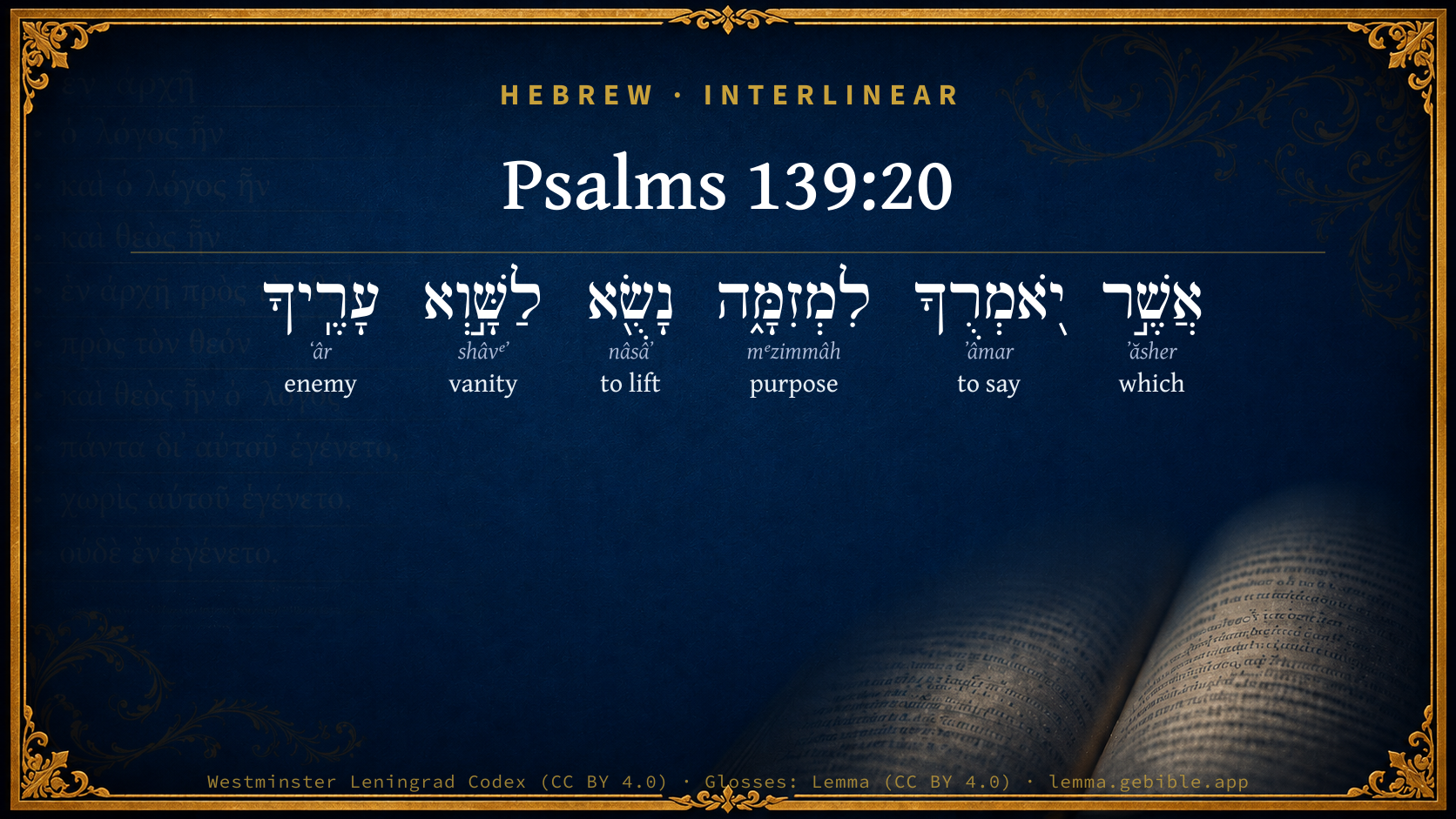
Psalms 139:20

Hebrew (Westminster Leningrad Codex) Psalms 139:20 appears in the Hebrew Old Testament. The text above is from the Westminster Leningrad Codex. Each word links to its Strong’s number, a concise gloss, and parsing drawn from the Open Scriptures Hebrew Bible morphology. Click any word for its full Brown-Driver-Briggs (BDB) entry.
Download image
Cite this verse

Psalms 139:20 (World English Bible). Public Domain. Lemma interlinear Bible study tool, https://lemma.gebible.app/v/psalms/139/20.

Show BibTeX & RIS
BibTeX
RIS
English Translation
For they speak against you wickedly. Your enemies take your name in vain.
World English Bible · Public Domain
Download a study sheet

One document with this verse’s original text, its word-by-word gloss line, the meaning frame, cross-references with their text, attributed commentary, and full source and license credits — printable, and it pastes into notes with its structure intact.

This verse Autodidact and up

Study sheet (.html) Plain text (.txt)

A passage Seminary Student

Up to 50 verses in one chapter. A passage sheet keeps up to 6 commentary sources and 12 cross-references per verse, in the order this page ranks them, and says so on the sheet whenever that leaves anything out. Ask for a single verse and you get the Autodidact verse sheet above.

Everything on this page stays free to read, with no account — the sheet is a download of what is already on screen, not access to it.

Want to remove ads? Support Godless Engineer
Compare translations 3

The same verse in 3 English versions, stacked beneath the original-language interlinear above. Click any original word for its lexicon entry.

Each is an independent rendering of the whole verse — the interlinear is not word-aligned to these translations.

Highlighted words mark where these versions differ — a whole-verse word diff, not a word-by-word alignment.

  • World English Bible Public Domain
    For they speak against you wickedly. Your enemies take your name in vain.
  • King James Version Public Domain
    For they speak against thee wickedly, and thine enemies take thy name in vain.
  • unfoldingWord Literal Text CC BY-SA 4.0
    who speak of you for an evil purpose; they lift up to emptiness—your enemies.

unfoldingWord Literal Text — © unfoldingWord, licensed CC BY-SA 4.0. Word-aligned USFM3 via Door43 (git.door43.org/unfoldingWord/en_ult).

Versions to compare (up to 4)

3 of 4 selected

Show all 17 translations

Every available English version of this verse, each an independent rendering of the whole verse.

  • World English Bible Public Domain
    For they speak against you wickedly. Your enemies take your name in vain.
  • Berean Standard Bible Public Domain
    who speak of You deceitfully; Your enemies take Your name in vain.
  • Majority Standard Bible Public Domain
    who speak of You deceitfully; Your enemies take Your name in vain.
  • King James Version Public Domain
    For they speak against thee wickedly, and thine enemies take thy name in vain.
  • American Standard Version (1901) Public Domain
    For they speak against thee wickedly, And thine enemies take `thy name' in vain.
  • Revised Version (1885) Public Domain
    For they speak against thee wickedly, and thine enemies take thy name in vain.
  • Geneva Bible (1599) Public Domain
    Which speake wickedly of thee, and being thine enemies are lifted vp in vaine.
  • Young's Literal Translation Public Domain
    Who exchange Thee for wickedness, Lifted up to vanity `are' Thine enemies.
  • Literal Standard Version CC BY-SA 4.0
    Who exchange You for wickedness, || Your enemies [are] lifted up to vanity.
  • Unlocked Literal Bible CC BY-SA 4.0
    They rebel against you and act deceitfully; your enemies tell lies.
  • unfoldingWord Literal Text CC BY-SA 4.0
    who speak of you for an evil purpose; they lift up to emptiness—your enemies.
  • Darby Bible Public Domain
    For they speak of thee wickedly, they take [thy name] in vain, thine enemies.
  • World Messianic Bible Public Domain
    For they speak against you wickedly. Your enemies take your name in vain.
  • Webster's Bible Public Domain
    For they speak against thee wickedly, and thy enemies take thy name in vain.
  • Free Bible Version CC BY-SA 4.0
    When they speak of you they're being deceptively evil. Since they are your enemies, they call on you in vain.
  • Bible in Basic English Public Domain
    For they go against you with evil designs, and your haters make sport of your name.
  • JPS Tanakh (1917) Public Domain
    Who utter Thy name with wicked thought, they take it for falsehood, even Thine enemies —

Literal Standard Version (2020), Covenant Press — licensed CC BY-SA 4.0. Text via the HelloAO Bible API (eBible.org). Unlocked Literal Bible (unfoldingWord) — licensed CC BY-SA 4.0. Text via the HelloAO Bible API (eBible.org). unfoldingWord Literal Text — © unfoldingWord, licensed CC BY-SA 4.0. Word-aligned USFM3 via Door43 (git.door43.org/unfoldingWord/en_ult). Free Bible Version, Dr. Jonathan Gallagher — licensed CC BY-SA 4.0. Text via the HelloAO Bible API (eBible.org).

Word by word

More ways to search: Search by grammar → Find every occurrence → Compare this word →

Practice this passage: Drill this verse → Learn its vocabulary →

About this verse

These counts appear in no published source. They are computed here, from the morphology-tagged text and Lemma’s own curated glosses. What Lemma adds →

6
words
6
distinct lemmas
Wisdom
section

Notable vocabulary

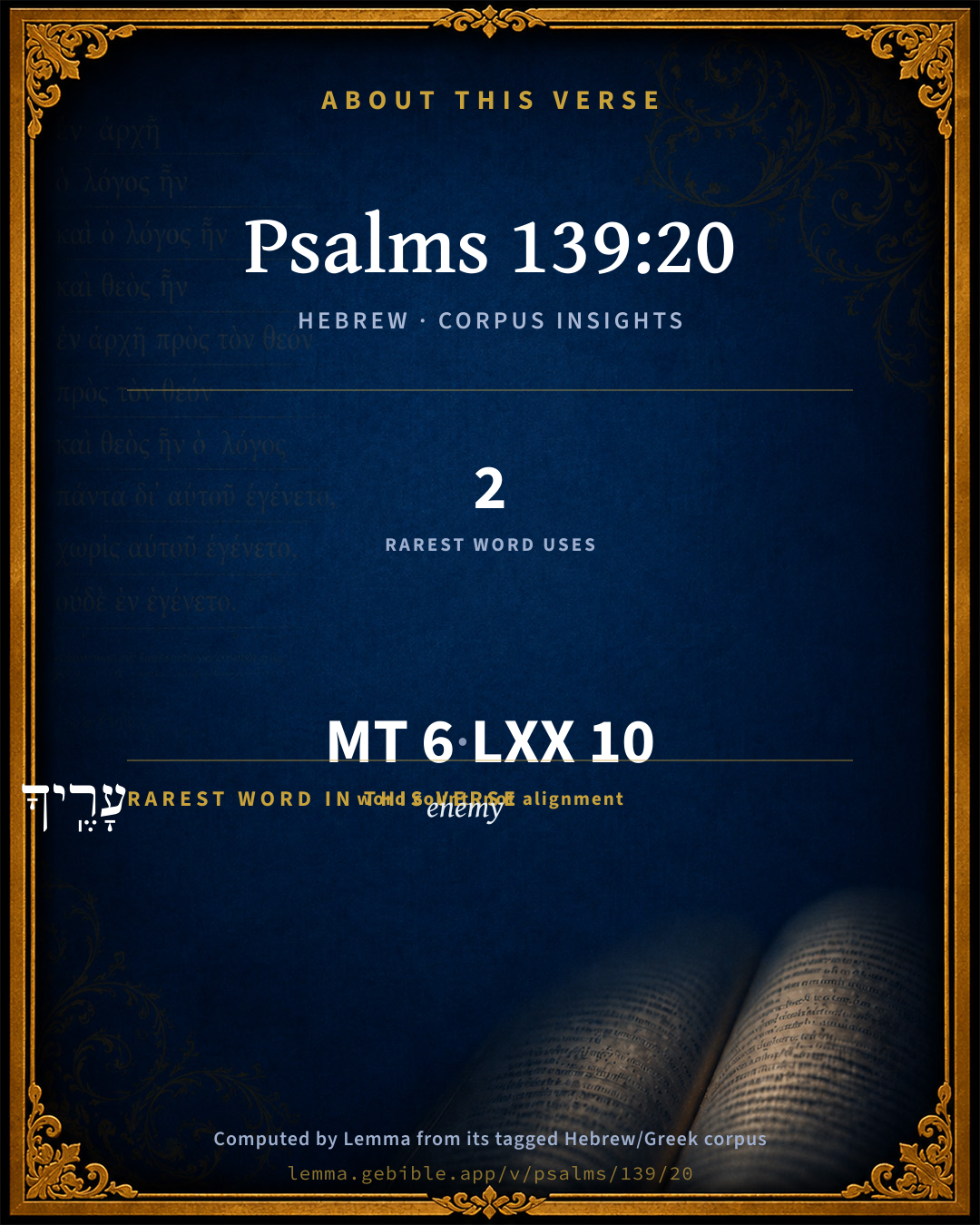
The rarest word here is עָרֶֽיךָ enemy H6145 — appearing just 2 times in the whole Hebrew Bible.

Shared distinctive vocabulary

עָרֶֽיךָ enemy H6145 occurs in 2 verses of the Hebrew Bible. Also found in:

Grammatical profile

  • 2 verbs
  • 3 nouns
  • 1 particle

Verb forms

  • יֹ֭אמְרֻךָ Qal · Imperfect
  • נָשֻׂ֖א Qal · Perfect

Hebrew & Septuagint length

In English translation the verse runs 13 words from the Hebrew and 15 from the Septuagint (LXX English) — closely comparable.

A rough comparison of the two English renderings, which tokenize alike — not a word-level alignment.

Word counts can differ between the Hebrew and the Greek without any difference in meaning — e.g. the Hebrew direct-object marker אֵת has no separate Greek word, and Greek often adds the article ὁ.

In the original languages it is 6 Hebrew tokens and 10 Greek tokens — but the two are counted differently (Hebrew bundles its prefixes and suffixes into one token; the Greek is in lemma form), so that isn’t a like-for-like length.

Cross-references

10

Topical passages linked to Psalms 139:20 in the Treasury of Scripture Knowledge — connected by theme and wording, ordered by reader-vote popularity; previews shown in the World English Bible.

  • Jude 1:15 to execute judgment on all, and to convict all the ungodly of all their works of ungodliness which they have done in an ungodly way, and of all the hard things which ungodly sinners have spoken against him."
  • Exodus 20:7 "You shall not take the name of Yahweh your God in vain, for Yahweh will not hold him guiltless who takes his name in vain.
  • Psalms 74:18 Remember this, that the enemy has mocked you, Yahweh. Foolish people have blasphemed your name.
  • Psalms 2:1–3 Why do the nations rage, And the peoples plot a vain thing?
  • Psalms 73:8–9 They scoff and speak with malice. In arrogance, they threaten oppression.
  • Psalms 74:22–23 Arise, God! Plead your own cause. Remember how the foolish man mocks you all day.
  • Isaiah 37:23 Whom have you defied and blasphemed? and against whom have you exalted your voice and lifted up your eyes on high? [even] against the Holy One of Israel.
  • Isaiah 37:28–29 But I know your sitting down, and your going out, and your coming in, and your raging against me.
  • Revelation 13:6 He opened his mouth for blasphemy against God, to blaspheme his name, and his dwelling, those who dwell in heaven.
  • Job 21:14–15 They tell God, 'Depart from us, For we don't want to know about your ways.

Cross-references courtesy of OpenBible.info (CC BY 4.0).

Hebrew and Greek witnesses Masoretic Hebrew ↔ Greek Septuagint

The same verse in the two great witnesses to the Old Testament, shown verse-for-verse.

You’re reading Greek Psalm 138 (Hebrew Psalm 139). The Septuagint counts the superscription, so verse numbers can differ from the Hebrew — chapter-level alignment, not verse-by-verse. Numbering follows Rahlfs.

These are two independent witnesses, not word-aligned to each other, and the Septuagint is shown in lemma (dictionary) form.

Hebrew Psalms 139:20 Masoretic · Westminster Leningrad Codex

אֲשֶׁ֣ר יֹ֭אמְרֻךָ לִמְזִמָּ֑ה נָשֻׂ֖א לַשָּׁ֣וְא עָרֶֽיךָ

For they speak against you wickedly. Your enemies take your name in vain.

World English Bible · Public Domain

Greek LXX Greek Psalm 138:20 Septuagint · lemma form

ὅτι εἶπον εἰς διαλογισμός λαμβάνω εἰς ματαιότης ὁ πόλις σύ

For you will say concerning their thought, that they shall take your cities in vain.

LXX2012 (modern English Septuagint) · Public Domain

Hebrew: Westminster Leningrad Codex (CC BY 4.0). Greek: Septuagint (public domain); English from LXX2012 (modern English Septuagint) (Public Domain). How the Septuagint differs from the Hebrew →

Commentary

Notes on Psalms 139:20 from classic Christian and Jewish commentators (each source and its license shown beneath its notes). The classic Christian expositions comment on the surrounding passage and are grouped to its opening verse, so a note may address several verses; the Jewish commentaries on the Tanakh (Rashi and others) are per-verse, so they appear only where the commentator wrote on this verse.

Lemma curates 59 commentaries, every one of them public domain or Creative Commons licensed, each selected and text-cleaned for this edition rather than reprinted as found. About our sources →

Trapp's Complete Commentary

John Trapp

Psa 139:20 For they speak against thee wickedly, [and] thine enemies take [thy name] in vain.

Ver. 20. For they speak against thee wickedly] Inasmuch as they speak against me; Tua causa erit inca causa, Your cause will be my cause, said Charles V, emperor, to Julius Pflugius, who complained he had been wronged by the Duke of Saxony; so saith God to every David. This Luther knew, and therefore wrote thus to Melancthon, Causa ut sit magna, magnus est actor, et auctor eius; neque enim nostra est. The cause is Christ’s; and he will see to it and us. Moses told the people that their murmurings were not against him, but against the Lord, Exo 16:8. As unskilful hunters, shooting at wild beasts, kill a man sometimes, so while men shoot at Christians, they hit Christ.

And thine enemies take thy name in vain] While they would despoil thee of thine omnipresence, omnipotence, &c., casting thee into a dishonourable mould, as it were, and having base and bald conceits and speeches of thee and thine. Kimchi interpreteth it of heretics, those false friends, but true enemies to God; of whom they make great boasts, as did the Gnostics, Manichees, Novations, and lately the Swenckfeldians (who styled themselves the confessors of the glory of Christ), and many of our modern sects. p &&& Heretics-False friends of God

John Trapp, A Commentary or Exposition upon All the Books of the Old and New Testament (1647–1656) — public domain. Text from a community e-Sword module.

Joseph Benson's Commentary

Psa 139:20. For they speak against thee wickedly — It is not so much me that they persecute, in opposing, misrepresenting, and speaking against me, as virtue and piety, in persecuting which they oppose and speak against thee; contemning thy omniscience and omnipresence, and thy superintending providence. And thine enemies take thy name in vain — Or, according to the order of the Hebrew words, They take thy name in vain, and are thine enemies. Or, are haters of thee, as it follows, Psa 139:21. They abuse thy blessed name with oaths, blasphemies, and perjuries, calling thee to witness the truth of their lies and calumnies. Or, as some render the clause, Thine enemies take thee to falsehood, (the words; thy name, being not in the Hebrew,) “they take thee, only to swear falsely by thee.”

Joseph Benson's Commentary on the Old and New Testaments (1811–1818) — public domain. Text from a community e-Sword module.

J. A. Alexander on Psalms

Joseph Addison Alexander

20. (Psa 139:20) Who speak of thee for wickedness and take in vain—thy foes. Speak of thee, or name thee, use thy name, for the accomplishment of wicked ends. The other clause will then be strictly parallel, and take (thy name) in vain, as in Exo 20:7. For the meaning of this difficult expression, see above, on Psa 24:4. The subject of the proposition is placed emphatically at the end.

Joseph Addison Alexander, The Psalms Translated and Explained (1850) — public domain. Text from a community e-Sword module.

Adam Clarke's Commentary

Verse 20. Thine enemies take thy name in vain.] Bishop Horsley translates the whole verse thus: -

"They have deserted me who are disobedient to thee;

"They who are sworn to a rash purpose - thy

refractory adversaries."

The original is obscure: but I cannot see these things in it. Some translate the Hebrew thus: "Those who oppose thee iniquitously seize unjustly upon thy cities;" and so almost all the Versions. The words, thus translated, may apply to Sanballat, Tobiah, and the other enemies of the returned Jews, who endeavoured to drive them from the land, that they might possess the cities of Judea.

Adam Clarke's Commentary on the Bible (1810–1826) — public domain. Text from a community e-Sword/MySword module.

John Calvin's Commentaries

20. Who have spoken of thee wickedly. He intimates the extent to which the wicked proceed when God spares them, and forbears to visit them with vengeance. They not merely conclude that they may perpetrate any crime with impunity, but openly blaspheme their Judge. He takes notice of their speaking wickedly, in the sense of their taking no pains to disguise their sin under plausible pretences, as persons who have some shame remaining will exercise a certain restraint upon their language, but they make no secret of the contempt they entertain for God. The second clause, where he speaks of their taking God’s name falsely, some have interpreted too restrictedly with reference to their sin of perjury. Those come nearer the truth who consider that the wicked are spoken of as taking God’s name in vain, when they conceive of him according to their own idle fancies. We see from experience, that most men are ignorant of what God is, and judge of him rather as one dead than alive. In words they all acknowledge him to be judge of the world, but the acknowledgment comes to nothing, as they straightway denude him of his office of judgment, which is to take God’s name in vain, by tarnishing the glory of it, and, in a manner, deforming it. But as name is not in the original, and נשא, nasa, means to lift Up, or on high, I think we are warranted rather to interpret the passage as meaning’, that they carried themselves with an arrogant and false pride. This elation or haughtiness of spirit is almost always allied with that petulance of which he had previously taken notice. What other reason can be given for their vending such poisonous rancour against God, but pride, and forgetfulness, on the one hand, of their own insignificance as men, and on the other, of the power which belongeth unto the Lord? On this account he calls them God’s adversaries, for all who exalt themselves above the place which they should occupy, act the part of the giants who warred against heaven.

John Calvin's Commentaries (1540-1563) — public domain. Text from the Calvin Translation Society English edition (1840s-50s) via the Christian Classics Ethereal Library (ccel.org). Calvin's coverage is partial (roughly two-thirds of the Bible); uncommented books and verses are honest gaps, never fabricated. The 19th-century editor's footnotes and remarks are omitted so the notes are faithfully Calvin's own voice.

Ellicott's Commentary for English Readers

(20) For they speak.—Better, Who rebel against thee. This is actually the reading of the fifth of the Greek translations preserved by Origen, and entails only a change of the vowel pointing.

And thine enemies.—The state of the text is unsatisfactory. The subject to the verb must be that of the last clause, and the rendering “enemies” of a word properly meaning cities is very doubtful, in spite of 1Sa_28:16 (but Aquila has “rivals,” and Symmachus” adversaries”), where there is also a textual correction required.

Of the various proposed emendations, the simplest produces

“And rise up against them in vain.”

A Bible Commentary for English Readers, edited by Charles John Ellicott (1878–1897) — public domain. Text from a community e-Sword module.

The Cambridge Bible for Schools and Colleges

gen. ed. J. J. S. Perowne

20. For they speak against thee] This rendering involves a questionable construction. That of R.V. marg. utter thy name, lit. thee, i.e. swear falsely by thy name, suits the parallelism, but is also doubtful. Most probably the word should be read with different vowels, rebel against thee (יַמְרוּךָ for יֹמְרוּךָ); cp. Psa_78:40.

thine enemies take thy name in vain] The text is difficult and perhaps corrupt. The word rendered thine enemies has this meaning in Aramaic, but not in Hebrew: thy name is not expressed: the verb is spelt anomalously. But slight alterations of the text would give the sense, and take thy name in vain.

The Cambridge Bible for Schools and Colleges (gen. ed. J. J. S. Perowne; Cambridge University Press, 1878–1918) — public domain. Text from a community e-Sword module.

John Gill's Exposition

Do not I hate them, O Lord, that hate thee?.... Wicked men are haters of God; of his word, both law and Gospel; of his ordinances, ways, and worship; of his people, cause, and interest; and therefore good men hate them: not as men, as the creatures of God, and as their fellow creatures, whom they are taught by the Gospel to love, to do good unto, and pray for; but as haters of God, and because they are so; not their persons, but their works; and for the truth of this the omniscient God is appealed unto;

and am not I grieved with those that rise up against thee? as wicked men do, in their hearts, in their words, and in their actions. They rebel against God, and contend with him, which is folly and madness; and this is grieving to good men, because of their insolence and impudence, the ruin and destruction they expose themselves to, and the dishonour done to God: and this arises from their great love and strong affection for him, not being able to bear such behaviour to him; as a man is filled with grief and indignation when another rises up against his father or his friend; see Psa 119:136.

John Gill's Exposition of the Whole Bible (1746–1763) — public domain (CC PDM 1.0). Text via the HelloAO Bible API.

Albert Barnes' Notes on the Bible

For they speak against thee wickedly - This is one form or manifestation of their character as wicked people, that they speak maliciously against God. The psalmist, therefore, desired to have nothing to do with them. It is always a sufficient reason for avoiding the society, the friendship, and the fellowship of others, when they profane, blaspheme, or calumniate the name of God. From such men we should at once withdraw. Piety shrinks from the society of such men, whatever may be their rank, or their social qualities, and turns away in pain, in sorrow, in abhorrence. See the notes at Psa 26:9.

And thine enemies take thy name in vain - It is proof that they are thine enemies that they take thy name in vain, or that they are profane men; it is a sufficient reason for desiring to be separated from them.

Albert Barnes' Notes on the Bible (1834–1885) — public domain. Text from a community e-Sword/MySword module.

Matthew Poole's English Annotations

They speak against thee wickedly, by profane scoffs, and a professed denial or contempt of thine omniscience and providence. Or,

they speak of thee in or unto wickedness; they make use of religion to cover or further their wicked designs. But our translation is more favoured by the context, which speaks of God’s open and professed enemies.

And thine enemies take thy name in vain; or, according to the order of the Hebrew words, and take thy name in vain, and are thine enemies, or haters of thee, as it follows Psa 139:21. These words,

thy name, are understood here, as also Isa 3:7, out of Exo 20:7, where they are expressed. They abuse thy blessed name with hellish oaths, and perjuries, and blasphemies.

Matthew Poole's English Annotations on the Holy Bible (1683–1685) — public domain. Text from a community e-Sword/MySword module.

The Treasury of David

Charles H. Spurgeon

Ver. 20. For they speak against thee wickedly. Why should I bear their company when their talk sickens me? They vent their treasons and blasphemies as often as they please, doing so without the slightest excuse or provocation; let them therefore be gone, where they may find a more congenial associate than I can be. When men speak against God they will be sure to speak against us, if they find it serve their turn; hence godless men are not the stuff out of which true friends can ever be made. God gave these men their tongues, and they turn them against their Benefactor, wickedly, from sheer malice, and with great perverseness.

And thine enemies take thy name in vain. This is their sport: to insult Jehovah's glorious name is their amusement. To blaspheme the name of the Lord is a gratuitous wickedness in which there can be no pleasure, and from which there can be no profit. This is a sure mark of the "enemies" of the Lord, that they have the impudence to assail his honour, and treat his glory with irreverence. How can God do other than slay them? How can we do other than withdraw from every sort of association with them? What a wonder of sin it is that men should rail against so good a Being as the Lord our God! The impudence of those who talk wickedly is a singular fact, and it is the more singular when we reflect that the Lord against whom they speak is all around them, and lays to heart every dishonour which they render to his holy name. We ought not to wonder that men slander and deride us, for they do the same with the Most High God.

Ver. 20. Thine enemies take thy name in vain. In every action three things are considerable, the end, the agent, the work. These three duly weighed, we shall soon see what it is to take God's name in vain.

1. That which hath no end proposed or is done to no end, may truly be said to be done in vain. As the sowing of seed without reaping the fruit, the planting a vineyard without a vintage, or feeding a flock without eating the milk of it. These are labours in vain. So he that taketh the name of God to no end, neither to God's glory, nor the private or public good, taketh it in vain. Cui bono? is a question in all undertakings. If to no good, as good and better not undertaken at all; it is to no end, it is in vain. If a man have well fashioned legs, and they be lame, frustra pulchras habet tibia claudus, the lame man hath them in vain. The chief end, therefore, in taking this name must be,

a) The glory of God, otherwise we open our mouths in vain, as it is in Job. God is willing to impart all his blessings to us, and requires nothing of as again but glory, which if we return not, he may say, as David did of Nabal, for whom he had done many good turns, in securing his shepherds and flocks, etc.; and when he desired nothing but a little meat for the young men he denied it: All that I have done for this fellow is in vain; in vain have I kept all he hath. So, God having done so much for us, and expecting nothing but the glory of his name, if we be defective herein, he may well say all that he hath done for us is in vain.

b) Next to God's glory is the good of ourselves and others; and so to take God's name without reference to this end, if we neither promote our own good nor the good of others, it is in vain, ex privatione finis, because it wants a right end; therefore Saint Paul rejoiced, having by his preaching laboured for the saving of souls,

c) rejoice, saith he, that I have not run in vain, neither laboured in vain.

2. In the agent the heart and soul is to be considered, which in the person acting is the chief mover. If the soul be Rachah, vain and light, as when we take God's name without due advice and reverence, though we propound a right end, yet we take his name in vain. Therefore the wise man advises "not to be rash with our mouth" (Ec 5:2); and the Psalmist professes that his heart was fixed when he praised God (Ps 57:7): the heart ought to be fixed and stablished by a due consideration of God's greatness when we speak of him. This is opposed to rashness, inconstancy, and lightness, such as are in chaff and smoke, which are apt to be carried away with every blast, and such as are so qualified do take God's name in vain.

3. In the work itself may be a twofold vanity, which must be avoided. Firstly, Falsehood. Secondly, Injustice.

a) If it be false, then is it also vain, as theirs in Isa 28:15: "We have made a covenant with death, and with hell are we at agreement; when the overflowing scourge shall pass through, it shall not come unto us: for we have made lies our refuge, and under falsehood have we hid ourselves." And this is that actio erroris, work of error, of which Jeremiah speaketh. Vanitas opponitur veritati, vanity is opposed to verity and truth; therefore a thing is said to be vain when it is false or erroneous. "They are vanity, the work of errors", saith the prophet (Jer 10:15); and as there is truth in natural things, so is there a truth in moral things, which if it be wanting, our speech is vain.

b) If unjust it is vain too. "If I be wicked, why then labour I in vain?" saith holy Job 9:29; and, "The very hope of unjust men perisheth", saith the wise man (Pr 11:7); and, "They walk in a vain shadow, and disquiet themselves in vain" (Ps 39:6). If justice be wanting in our actions, or truth in our assertions and promises, they are vain; and to use God's name in either is to take his name in vain. So that if either we take the name of God to no end, but make it common, and take it up as a custom till it come to a habit, not for any good end; or if our hearts be not stable or fixed, but light and inconstant when we take it; or if we take it to colour or bolster up any falsehood or any unjust act, we take it in vain, and break the commandment. Lancelot Andrews.

Ver. 20. Two scandalous offences against God.

1. To speak slanderously of him.

2. To speak irreverently of him. These are committed only by his enemies.

Psalms 139:21*

Charles H. Spurgeon's The Treasury of David (1869–1885) — public domain. Psalms only. Text from a community e-Sword/MySword module.

Whedon's Commentary on the Bible

Daniel D. Whedon

20. For they speak against thee—This is the ground and nature of his hatred of the wicked.

Daniel D. Whedon (gen. ed.), Commentary on the Old and New Testaments (1874–1909) — public domain. Text from a community e-Sword module.

The Pulpit Commentary

For they speak against thee wickedly; literally, who speak of thee for wickedness; i.e. use thy Name for the accomplishment of wicked ends. And thine enemies take thy Name in vain. The text must be altered to produce this meaning. As it stands, it can only be rendered, "Thine enemies lift up their scull to vanity". (comp. Psa_24:4)

The Pulpit Commentary (1880–1919), ed. H.D.M. Spence-Jones & Joseph S. Exell — public domain. Text from a community e-Sword module.

Rashi

Rabbi Shlomo Yitzchaki (Rashi)

Who mention You with wicked thought They mention Your name regarding all the thoughts of their evil and call their deities with Your name.

took it up Heb. נשוא, like נשאו, they took up.

Your enemies...in vain Your enemies took up Your name in vain.

Rashi on the Tanakh — English translations: “The Judaica Press complete Tanach with Rashi, translated by A. J. Rosenberg” (CC BY 4.0); “Pentateuch with Rashi's commentary by M. Rosenbaum and A.M. Silbermann, 1929-1934” (public domain); “The Metsudah Tanach series, Lakewood, N.J” (CC BY 4.0); and “The Book of Joshua, Metsudah Publications, 1997” (CC BY 4.0). Text via Sefaria.

Lesson kit

Teaching starters — assembled from the data on this page, not authored interpretation. Every prompt links to the verse data it draws on. Edit before teaching.

Psalms, in the Wisdom, opens this verse with 6 words (6 distinct Hebrew lemmas). Its most distinctive word is ʻâr (“enemy”). A historical commentator’s framing appears above. Read the whole chapter for the surrounding context.

Discussion questions

  1. How does “enemy” (ʻâr) shape what this verse is saying?
  2. How does 1 Samuel 28:16, which shares the word «enemy», read alongside this verse?
  3. These translations render this verse differently. What is at stake in choosing one wording over another?
  4. «יֹ֭אמְרֻךָ» is a Qal Imperfect verb. How does that grammatical form shape the action described?
  5. Compare how Trapp's Complete Commentary and Joseph Benson's Commentary read this verse. Where do they agree or differ?

Things to notice

Reading settings

Reading text

Shown beneath each verse's original-language words.

Old Testament
Old Testament edition

Read the OT as the Masoretic Hebrew (MT) or the Greek Septuagint (LXX).

English shown for the Greek Septuagint (in the Hebrew ↔ Greek comparison).

Comparing translations? Open the Compare panel on any verse page to stack up to four side by side.