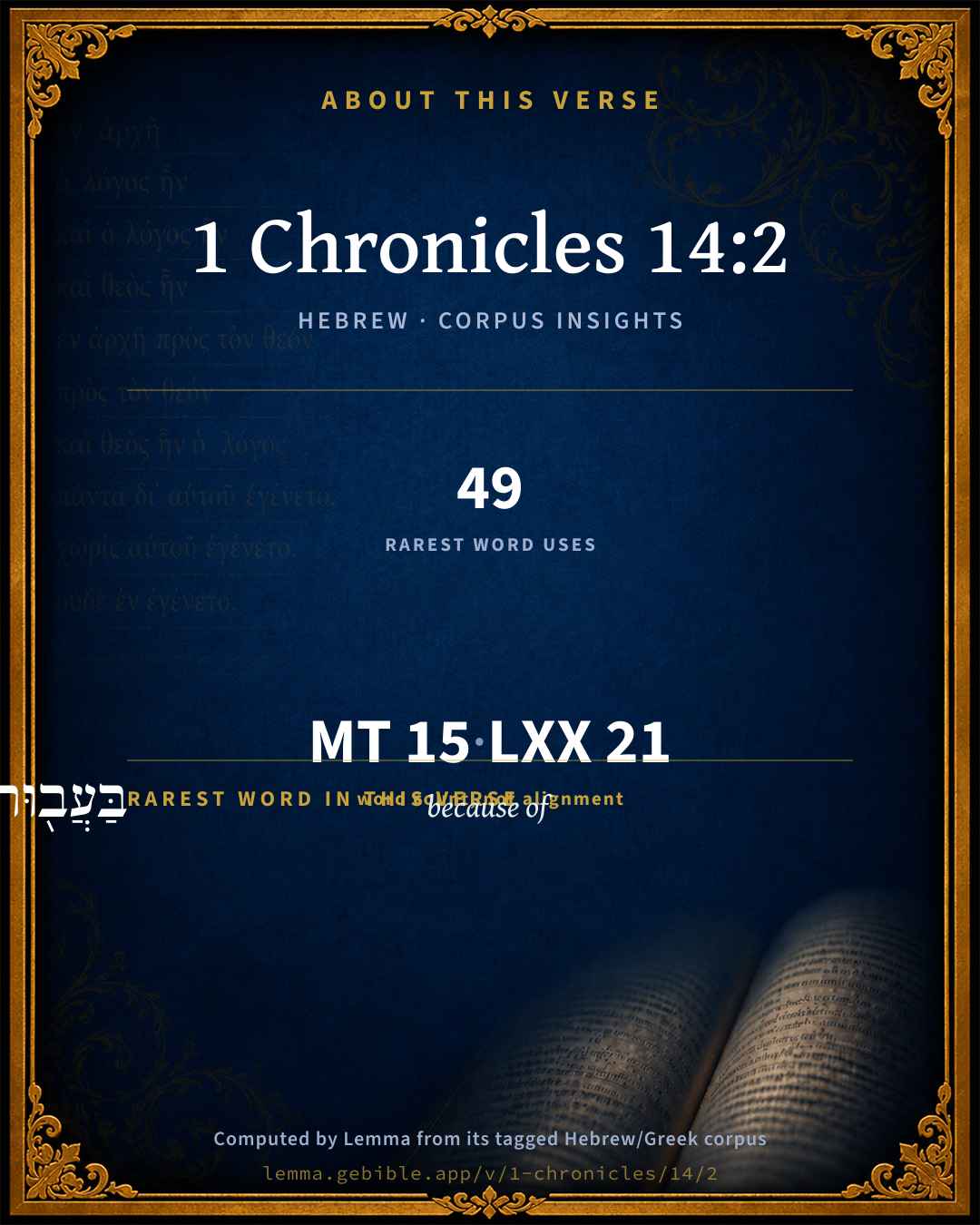
1 Chronicles 14:2

Hebrew (Westminster Leningrad Codex) 1 Chronicles 14:2 appears in the Hebrew Old Testament. The text above is from the Westminster Leningrad Codex. Each word links to its Strong’s number, a concise gloss, and parsing drawn from the Open Scriptures Hebrew Bible morphology. Click any word for its full Brown-Driver-Briggs (BDB) entry.
Download image
Cite this verse

1 Chronicles 14:2 (World English Bible). Public Domain. Lemma interlinear Bible study tool, https://lemma.gebible.app/v/1-chronicles/14/2.

Show BibTeX & RIS
BibTeX
RIS
English Translation
David perceived that Yahweh had established him king over Israel; for his kingdom was exalted on high, for his people Israel's sake.
World English Bible · Public Domain
Download a study sheet

One document with this verse’s original text, its word-by-word gloss line, the meaning frame, cross-references with their text, attributed commentary, and full source and license credits — printable, and it pastes into notes with its structure intact.

This verse Autodidact and up

Study sheet (.html) Plain text (.txt)

A passage Seminary Student

Up to 50 verses in one chapter. A passage sheet keeps up to 6 commentary sources and 12 cross-references per verse, in the order this page ranks them, and says so on the sheet whenever that leaves anything out. Ask for a single verse and you get the Autodidact verse sheet above.

Everything on this page stays free to read, with no account — the sheet is a download of what is already on screen, not access to it.

Want to remove ads? Support Godless Engineer
Compare translations 3

The same verse in 3 English versions, stacked beneath the original-language interlinear above. Click any original word for its lexicon entry.

Each is an independent rendering of the whole verse — the interlinear is not word-aligned to these translations.

Highlighted words mark where these versions differ — a whole-verse word diff, not a word-by-word alignment.

  • World English Bible Public Domain
    David perceived that Yahweh had established him king over Israel; for his kingdom was exalted on high, for his people Israel's sake.
  • King James Version Public Domain
    And David perceived that the LORD had confirmed him king over Israel, for his kingdom was lifted up on high, because of his people Israel.
  • unfoldingWord Literal Text CC BY-SA 4.0
    Then David knew that Yahweh had established him as king over Israel, that his kingdom had been lifted to the height for the sake of his people Israel.

unfoldingWord Literal Text — © unfoldingWord, licensed CC BY-SA 4.0. Word-aligned USFM3 via Door43 (git.door43.org/unfoldingWord/en_ult).

Versions to compare (up to 4)

3 of 4 selected

Show all 18 translations

Every available English version of this verse, each an independent rendering of the whole verse.

  • World English Bible Public Domain
    David perceived that Yahweh had established him king over Israel; for his kingdom was exalted on high, for his people Israel's sake.
  • Berean Standard Bible Public Domain
    And David realized that the LORD had established him as king over Israel and had highly exalted his kingdom for the sake of His people Israel.
  • Majority Standard Bible Public Domain
    And David realized that the LORD had established him as king over Israel and had highly exalted his kingdom for the sake of His people Israel.
  • King James Version Public Domain
    And David perceived that the LORD had confirmed him king over Israel, for his kingdom was lifted up on high, because of his people Israel.
  • American Standard Version (1901) Public Domain
    And David perceived that Jehovah had established him king over Israel; for his kingdom was exalted on high, for his people Israel's sake.
  • Revised Version (1885) Public Domain
    And David perceived that the LORD had established him king over Israel, for his kingdom was exalted on high, for his people Israel’s sake.
  • Geneva Bible (1599) Public Domain
    Therefore Dauid knewe that the Lord had confirmed him King ouer Israel, and that his kingdome was lift vp on hie, because of his people Israel.
  • Douay-Rheims (1899) Public Domain
    And David perceived that the Lord had confirmed him king over Israel, and that his kingdom was exalted over his people Israel.
  • Young's Literal Translation Public Domain
    And David knoweth that Jehovah hath established him for king over Israel, because of the lifting up on high of his kingdom, for the sake of His people Israel.
  • Literal Standard Version CC BY-SA 4.0
    And David knows that YHWH has established him for king over Israel, because of the lifting up on high of his kingdom, for the sake of His people Israel.
  • Unlocked Literal Bible CC BY-SA 4.0
    David knew that Yahweh had established him as king over Israel, and that his kingdom was exalted on high for the sake of his people Israel.
  • unfoldingWord Literal Text CC BY-SA 4.0
    Then David knew that Yahweh had established him as king over Israel, that his kingdom had been lifted to the height for the sake of his people Israel.
  • Darby Bible Public Domain
    And David perceived that Jehovah had established him king over Israel, for his kingdom was highly exalted, because of his people Israel.
  • World Messianic Bible Public Domain
    David perceived that the LORD had established him king over Israel, for his kingdom was highly exalted, for his people Israel’s sake.
  • Webster's Bible Public Domain
    And David perceived that the LORD had confirmed him king over Israel, for his kingdom was exalted on high, because of his people Israel.
  • Free Bible Version CC BY-SA 4.0
    In this way David realized that the Lord had placed him on the throne as king of Israel and had blessed him by supporting his kingdom for the sake of the Lord's people Israel.
  • Bible in Basic English Public Domain
    And David saw that the Lord had made his position safe as king over Israel, lifting up his kingdom on high because of his people Israel.
  • JPS Tanakh (1917) Public Domain
    And David perceived that the LORD had established him king over Israel, for his kingdom was exalted exceedingly, for His people Israel's sake.

Literal Standard Version (2020), Covenant Press — licensed CC BY-SA 4.0. Text via the HelloAO Bible API (eBible.org). Unlocked Literal Bible (unfoldingWord) — licensed CC BY-SA 4.0. Text via the HelloAO Bible API (eBible.org). unfoldingWord Literal Text — © unfoldingWord, licensed CC BY-SA 4.0. Word-aligned USFM3 via Door43 (git.door43.org/unfoldingWord/en_ult). Free Bible Version, Dr. Jonathan Gallagher — licensed CC BY-SA 4.0. Text via the HelloAO Bible API (eBible.org).

Word by word

More ways to search: Search by grammar → Find every occurrence → Compare this word →

Practice this passage: Drill this verse → Learn its vocabulary →

בַּעֲב֖וּר
ʻâbûwr
H5668
“in/at · because of of”
Preposition + Noun, Common, Masculine, Singular, Construct
Part of Speech
Preposition + Noun
Type
Common
Gender
Masculine
Number
Singular
State
Construct
Full BDB Definition

Origin: pass part of H5674

TWOT: 1556g

for the sake of, on account of, because of, in order to (preposition) - in order that (conjunction)
  1. וַיֵּ֣דַע yâdaʻ H3045 “and · to know” Conjunction + Verb, Qal, Sequential Imperfect, 3rd Person, Masculine, Singular
  2. דָּוִ֔יד Dâvid H1732 “David” Noun, Proper
  3. כִּֽי kîy H3588 “that” Conjunction
  4. הֱכִינ֧וֹ kûwn H3559 “to be established · him” Verb, Hiphil, Perfect, 3rd Person, Masculine, Singular + Suffix, Personal, 3rd Person, Masculine, Singular
  5. יְהוָ֛ה Yᵉhôvâh H3068 “LORD” Noun, Proper
  6. לְמֶ֖לֶךְ melek H4428 “to/for · king” Preposition + Noun, Common, Masculine, Singular, Absolute
  7. עַל ʻal H5921 “upon” Preposition
  8. יִשְׂרָאֵ֑ל Yisrâʼêl H3478 “Israel” Noun, Proper
  9. כִּֽי kîy H3588 “that” Conjunction
  10. נִשֵּׂ֤את nâsâʼ H5375 “to lift” Verb, Niphal, Perfect, 3rd Person, Feminine, Singular
  11. לְמַ֨עְלָה֙ maʻal H4605 “to/for · above · toward” Preposition + Adverb + Suffix, Demonstrative
  12. מַלְכוּת֔וֹ malkûwth H4438 “kingdom · his” Noun, Common, Feminine, Singular, Construct + Suffix, Personal, 3rd Person, Masculine, Singular
  13. עַמּ֥וֹ ʻam H5971 “people · his” Noun, Common, Masculine, Singular, Construct + Suffix, Personal, 3rd Person, Masculine, Singular
  14. יִשְׂרָאֵֽל Yisrâʼêl H3478 “Israel” Noun, Proper

About this verse

These counts appear in no published source. They are computed here, from the morphology-tagged text and Lemma’s own curated glosses. What Lemma adds →

15
words
13
distinct lemmas
Historical
section

Shared distinctive vocabulary

בַּעֲב֖וּר because of H5668 occurs in 47 verses of the Hebrew Bible. Also found in:

Grammatical profile

  • 3 verbs
  • 8 nouns
  • 1 preposition
  • 2 conjunctions
  • 1 adverb

Verb forms

  • וַיֵּ֣דַע Qal · Sequential Imperfect
  • הֱכִינ֧וֹ Hiphil · Perfect
  • נִשֵּׂ֤את Niphal · Perfect

Repetition

Words recur within this verse — often emphatic in Hebrew:

  • יִשְׂרָאֵ֑ל Israel H3478 ×2
  • כִּֽי that H3588 ×2

Hebrew & Septuagint length

In English translation the verse runs 22 words from the Hebrew and 26 from the Septuagint (LXX English) — closely comparable.

A rough comparison of the two English renderings, which tokenize alike — not a word-level alignment.

Word counts can differ between the Hebrew and the Greek without any difference in meaning — e.g. the Hebrew direct-object marker אֵת has no separate Greek word, and Greek often adds the article ὁ.

In the original languages it is 15 Hebrew tokens and 21 Greek tokens — but the two are counted differently (Hebrew bundles its prefixes and suffixes into one token; the Greek is in lemma form), so that isn’t a like-for-like length.

Cross-references

10

Topical passages linked to 1 Chronicles 14:2 in the Treasury of Scripture Knowledge — connected by theme and wording, ordered by reader-vote popularity; previews shown in the World English Bible.

  • Psalms 89:20–37 I have found David, my servant. I have anointed him with my holy oil,
  • Numbers 24:7 Water shall flow from his buckets, His seed shall be in many waters, His king shall be higher than Agag, His kingdom shall be exalted.
  • 2 Samuel 7:16 Your house and your kingdom shall be made sure for ever before you: your throne shall be established forever.
  • 1 Kings 10:9 Blessed be Yahweh your God, who delighted in you, to set you on the throne of Israel: because Yahweh loved Israel forever, therefore made he you king, to do justice and righteousness.
  • 2 Chronicles 2:11 Then Huram the king of Tyre answered in writing, which he sent to Solomon, Because Yahweh loves his people, he has made you king over them.
  • Esther 4:14 For if you altogether hold your peace at this time, then will relief and deliverance arise to the Jews from another place, but you and your father's house will perish: and who knows whether you haven't come to the kingdom for such a time as this?
  • Daniel 2:30 But as for me, this secret is not revealed to me for any wisdom that I have more than any living, but to the intent that the interpretation may be made known to the king, and that you may know the thoughts of your heart.
  • 1 Chronicles 17:17 This was a small thing in your eyes, God; but you have spoken of your servant's house for a great while to come, and have regarded me according to the estate of a man of high degree, Yahweh God.
  • Isaiah 1:25–27 And I will turn my hand on you, Thoroughly purge away your dross, And will take away all your tin.
  • 2 Samuel 7:8 Now therefore thus shall you tell my servant David, Thus says Yahweh of Hosts, I took you from the sheep pen, from following the sheep, that you should be prince over my people, over Israel;

Cross-references courtesy of OpenBible.info (CC BY 4.0).

Hebrew and Greek witnesses Masoretic Hebrew ↔ Greek Septuagint

The same verse in the two great witnesses to the Old Testament, shown verse-for-verse.

These are two independent witnesses, not word-aligned to each other, and the Septuagint is shown in lemma (dictionary) form.

Hebrew 1 Chronicles 14:2 Masoretic · Westminster Leningrad Codex

וַיֵּ֣דַע דָּוִ֔יד כִּֽי הֱכִינ֧וֹ יְהוָ֛ה לְמֶ֖לֶךְ עַל יִשְׂרָאֵ֑ל כִּֽי נִשֵּׂ֤את לְמַ֨עְלָה֙ מַלְכוּת֔וֹ בַּעֲב֖וּר עַמּ֥וֹ יִשְׂרָאֵֽל

David perceived that Yahweh had established him king over Israel; for his kingdom was exalted on high, for his people Israel's sake.

World English Bible · Public Domain

Greek LXX 1 Chronicles 14:2 Septuagint · lemma form

καί γιγνώσκω δαυίδ ὅτι ἑτοιμάζω αὐτός κύριος ἐπί ἰσραήλ ὅτι αὐξάνω εἰς ὕψος ὁ βασιλεία αὐτός διά ὁ λαός αὐτός ἰσραήλ

And David knew that the Lord had designed him to be king over Israel; because his kingdom was highly exalted, on account of his people Israel.

LXX2012 (modern English Septuagint) · Public Domain

On this verse, Haydock's Catholic Bible Commentary discusses the Septuagint’s reading. Read the note in Commentary ↓

Hebrew: Westminster Leningrad Codex (CC BY 4.0). Greek: Septuagint (public domain); English from LXX2012 (modern English Septuagint) (Public Domain). How the Septuagint differs from the Hebrew →

Commentary

Notes on 1 Chronicles 14:2 from classic Christian and Jewish commentators (each source and its license shown beneath its notes). The classic Christian expositions comment on the surrounding passage and are grouped to its opening verse, so a note may address several verses; the Jewish commentaries on the Tanakh (Rashi and others) are per-verse, so they appear only where the commentator wrote on this verse.

Lemma curates 59 commentaries, every one of them public domain or Creative Commons licensed, each selected and text-cleaned for this edition rather than reprinted as found. About our sources →

Trapp's Complete Commentary

John Trapp

1Ch 14:2 And David perceived that the LORD had confirmed him king over Israel, for his kingdom was lifted up on high, because of his people Israel.

Ver. 2. Because of his people.] For their behoof and benefit.

John Trapp, A Commentary or Exposition upon All the Books of the Old and New Testament (1647–1656) — public domain. Text from a community e-Sword module.

Geneva Bible (1599)

Geneva Bible translators

Because of God’s promise made to the people of Israel.

Geneva Bible (1599) marginal notes — public domain. Text via Bolls.life.

Jamieson, Fausset & Brown

Robert Jamieson, A. R. Fausset & David Brown

his kingdom was lifted up on high, because of his people Israel--This is an important truth, that sovereigns are invested with royal honor and authority, not for their own sakes so much as for that of their people. But while it is true of all kings, it was especially applicable to the monarchs of Israel, and even David was made to know that all his glory and greatness were given only to fit him, as the minister of God, to execute the divine purposes towards the chosen people.

Jamieson, Fausset & Brown — Commentary Critical and Explanatory on the Whole Bible (1871) — public domain (CC PDM 1.0). Text via the HelloAO Bible API.

Ellicott's Commentary for English Readers

(2) And David perceived . . .—And David knew that Jehovah had appointed him. The willing alliance of the powerful sovereign of Phoenician Tyre was so understood by David. The favour of man is sometimes a sign of the approval of God—always, when it results from well-doing (Gen_39:21; Luk_2:52).

For his kingdom was lifted up on high.—Samuel, “and (he knew) that he had lifted up his kingdom.” Perhaps our text should be rendered, viz., that his kingdom was lifted up on high.”

Lifted up.—Aramaic form (nissêth).

Because of.—For the sake of.

On high.—A favourite intensive expression with the chronicler (1Ch_20:5; 1Ch_21:17, &c.).

Kingdom.—The Hebrew term (malkûth) is more modern than that in Samuel (mamlãkhãh).

This verse helps us to understand how David was “a man after God’s own heart.” His innate humility recognises at once the ground of his own exaltation as not personal, but national.

A Bible Commentary for English Readers, edited by Charles John Ellicott (1878–1897) — public domain. Text from a community e-Sword module.

The Cambridge Bible for Schools and Colleges

gen. ed. J. J. S. Perowne

2. confirmed him king … was lift up … because of his people Israel] R.V. established him king … was exalted … for his people Israel’s sake (cp. 2Sa_5:12).

The Cambridge Bible for Schools and Colleges (gen. ed. J. J. S. Perowne; Cambridge University Press, 1878–1918) — public domain. Text from a community e-Sword module.

Haydock's Catholic Bible Commentary

Perceived, by divine revelation, or by his constant success, (Menochius) as well as by the presents of "the king of Tyre, and the unanimity" of all the people. (Du Hamel) --- Over his. Hebrew and Septuagint, on account of his people. Kings are more for their subjects than for themselves. (Calmet)

George Leo Haydock (1774–1849), Haydock's Catholic Family Bible and Commentary, 1859 edition — public domain. Excludes Psalms (Douay-Rheims chapter numbering differs from Protestant) and Deuterocanonical books (Catholic canon only).

Matthew Poole's English Annotations

David perceived, by the remembrance of God’s promise, and his providence complying with it, &c. But of this and the following verses, See Poole "2Sa 5:12", &c., where the same history is related.

Matthew Poole's English Annotations on the Holy Bible (1683–1685) — public domain. Text from a community e-Sword/MySword module.

The Pulpit Commentary

Was lifted up. The passage in Samuel reads aCeni, the Piel conjugation. The present form is obscure, taceni. It may be considered either an irregular Niphal third pers. fem.; or Niphal infin, absolute; (2Sa_19:43) or possibly even an irregular Piel form, in which case the pronoun "he" will need to be supplied as the subject. Supposing that any special connection subsists between this and the previous verse, it is not necessary to consider it remote. Then, as now, the building of a house for one"s self, much more the building of a noble palace on the part of a king, is an indication of feeling settled and "confirmed." It was a partial indication of the "lifted-up kingdom" that the king should have a palace of unwonted magnificence. This must have weighed all the more in the case of a nation which, not for its sacred things, nor for its king, nor for its people, had ever had as yet any adequate and worthy housing,

HOMILIES BY J.R. THOMSON Ver. 2.

The Lord confirmed him king.

To many readers this phraseology seems simply the language of superstition, to be classed with similar language in which primitive and heathen nations are wont to attribute the triumphs of their warriors and the greatness of their kings to their tutelar and national deities. But believers in the inspiration and authority of Holy Scripture will see in this declaration an assurance of that wise and watchful care which God exercises over all men and all communities, and which is, for wise purposes, so clearly and devoutly related and recorded in the documents of Hebrew history.

I THE QUALIFICATIONS AND THE PREPARATION OF RULERS ARE FROM GOD. The strength of character, wisdom and sagacity, firmess, justice, clemency, affability, all qualities that make an able ruler of men, are the endowment of the supreme Lord. In the case of David we observe peculiar gifts lavishly bestowed. The same providential care is to be recognized in the long and severe discipline by which the son of Jesse was fitted for a throne. It was doubtless this preparatory training, combined with the sore experience through which the nation had passed, which rendered David"s accession so popular.

II THE JUST EXERCISE OF CIVIL POWER IS DIVINELY AUTHORIZED. The Lord having prepared David for the throne and the throne for him, the monarch proceeded to fulfil his royal duties with the happy assurance that the hearts of his people were subject to him, and with the knowledge that he was supported by faithful and powerful allies. It cannot, indeed, be said that monarchy is the favourite form of government with the Lord of all; for when he gave Israel a king it was in condescension to their infirmities. The form of government is of secondary importance, but the necessity of civil rule is written upon the constitution of man and of society. Equity, impartiality, righteousness, these are the principles of all true moral rule, human and Divine. The governor who is guided by personal ambition, who is the prey of petty prejudices, who is given to intrigues, who rules by oppression, is no true king of men.

III THE CONSCIOUSNESS OF A DIVINE COMMISSION GIVES POWER AND GRACE TO THE EXERCISE OF AUTHORITY. "David perceived that the Lord had confirmed him king." Thus his faith was strengthened and his courage was sustained. The man who, in the fulfilment of life"s duties, cannot see beyond his own purposes and plans, is for all high intents enfeebled by this unworthy view of his life; whilst he who recognizes that he is the "minister of God," is supported by this conviction, his aims are ennobled and his influence is hallowed by it. Especially must this be the case with those whose influence and responsibility are unusually great.

IV IF AUTHORITY IS FROM GOD, ACCOUNTABILITY IS TO GOD. Some rulers have been called to account by their fellow-potentates and some by their subjects. There is, however, danger lest the powerful should forget their inevitable responsibility. At the bar of God all kings must stand; at his throne they too must sue for mercy, when there they take their places with their subjects, as before the highest and the final tribunal.

wise now therefore, O ye kings: be instructed, ye judges of the earth.

T.

Selfward, Godward, manward.

Here is

I SOMETHING ON WHICH DAVID COULD CONGRATULATE HIMSELF. He "perceived that the Lord had confirmed him king his kingdom was lifted up on high." He observed that the first success was being satisfactorily sustained, and that his power was being felt beyond the limits of his own land. We may congratulate ourselves when we have made a good beginning, whether of school life, or of apprenticeship, or of management of affairs or official position, or of alliance with another, or of life itself; but we have greater reason for congratulating ourselves when the first start has settled down into lasting strength, has solidified and become an established success. Too often the first brilliancy proves to be nothing more than the shooting blaze of the rocket. It is well when it proves to be nothing less than the lasting light of the beacon-fire. We have also reason to congratulate ourselves when success rises so high as to attract the attention of those beyond our own circle; we are then making ourselves felt as well as known; and while a wise man will care but little for the mere breath of fame, a good man, if he be also a wise man, will care much that he is a power and not a cypher in the world.

II SOMETHING WHICH TURNED DAVID"S THOUGHTS TO GOD. "David perceived that the Lord had confirmed him." He had shown much statesmanlike ability since he had been made king, and might have been, as we all are, under the temptation to attribute his success to his own sagacity. But he did not yield to the enemy if thus assailed. He let his prosperity direct his thoughts to him from whom cometh down every good gift. So also shall we, if the spirit of Christ be in us. We shall let all things speak to us of the Father, of his presence with us, his mindfulness of us, his love toward us, his wisdom in all his dealing with us. And we shall not permit our prosperity to do that which it has a tendency to do elevate us in our own esteem, and hide the Divine Author of all our mercies from the view of our soul. We shall see that it, with all other experiences, turns our thoughts in reverential love to him.

III THE TRUE ASPECT IN WHICH PROSPERITY SHOULD BE VIEWED. "His kingdom was lifted up on high, because of his people Israel," or "for his people Israel"s sake", (2Sa_5:12) David perceived that God had exalted him, not only nor chiefly that he and his family might be distinguished, but that the nation might thereby be blessed; that he might confer on the people over whom he was to rule the unspeakable blessings of a pious and upright reign. It is an admirable thing in rulers when they "perceive" that they are lifted up for the sake of the people, and not for their own sake. It is an equally desirable if not an equally important thing that all who occupy posts of prominence and power statesmen, magistrates, councillors, presidents, ministers, secretaries, etc. should perceive the same truth, should regard their elevation in the same light. If God sends us prosperity, power, influence, it is not only that we may rejoice therein ourselves, but it is also, and principally, that we may use our opportunity to confer light, healing, help, hope, blessedness, on those who are less favoured than we are, and whom we can reach with our ministering hand. C.

The Pulpit Commentary (1880–1919), ed. H.D.M. Spence-Jones & Joseph S. Exell — public domain. Text from a community e-Sword module.

Rashi

Rabbi Shlomo Yitzchaki (Rashi)

And David knew that the Lord had established him as king when he saw that the kings of the nations sent him gifts.

Rashi on the Tanakh — English translations: “The Judaica Press complete Tanach with Rashi, translated by A. J. Rosenberg” (CC BY 4.0); “Pentateuch with Rashi's commentary by M. Rosenbaum and A.M. Silbermann, 1929-1934” (public domain); “The Metsudah Tanach series, Lakewood, N.J” (CC BY 4.0); and “The Book of Joshua, Metsudah Publications, 1997” (CC BY 4.0). Text via Sefaria.

Lesson kit

Teaching starters — assembled from the data on this page, not authored interpretation. Every prompt links to the verse data it draws on. Edit before teaching.

1 Chronicles, in the Historical, opens this verse with 15 words (13 distinct Hebrew lemmas). Its most distinctive word is ʻâbûwr (“because of”). A historical commentator’s framing appears above. Read the whole chapter for the surrounding context.

Discussion questions

  1. The word ʻâbûwr carries the sense “because of.” How does it shape the verse?
  2. Genesis 3:17 shares the word «because of» with this verse. How do the two illuminate each other?
  3. “Israel” occurs 2× in this one verse. What is the effect of the repetition?
  4. These translations render this verse differently; the difference is in the English rendering, not the original. What questions does that raise?
  5. The verb «וַיֵּ֣דַע» is Qal Sequential Imperfect. How does its form color the action?
  6. Reading how Trapp's Complete Commentary and Geneva Bible (1599) read this verse, where do the two commentators agree and where do they part?

Things to notice

Reading settings

Reading text

Shown beneath each verse's original-language words.

Old Testament
Old Testament edition

Read the OT as the Masoretic Hebrew (MT) or the Greek Septuagint (LXX).

English shown for the Greek Septuagint (in the Hebrew ↔ Greek comparison).

Comparing translations? Open the Compare panel on any verse page to stack up to four side by side.