

1 Samuel 17:41

Hebrew (Westminster Leningrad Codex) 1 Samuel 17:41 appears in the Hebrew Old Testament. The text above is from the Westminster Leningrad Codex. Each word links to its Strong’s number, a concise gloss, and parsing drawn from the Open Scriptures Hebrew Bible morphology. Click any word for its full Brown-Driver-Briggs (BDB) entry.
Download image
Cite this verse

1 Samuel 17:41 (World English Bible). Public Domain. Lemma interlinear Bible study tool, https://lemma.gebible.app/v/1-samuel/17/41.

Show BibTeX & RIS
BibTeX
RIS
English Translation
The Philistine came on and drew near to David; and the man who bore the shield went before him.
World English Bible · Public Domain
Download a study sheet

One document with this verse’s original text, its word-by-word gloss line, the meaning frame, cross-references with their text, attributed commentary, and full source and license credits — printable, and it pastes into notes with its structure intact.

This verse Autodidact and up

Study sheet (.html) Plain text (.txt)

A passage Seminary Student

Up to 50 verses in one chapter. A passage sheet keeps up to 6 commentary sources and 12 cross-references per verse, in the order this page ranks them, and says so on the sheet whenever that leaves anything out. Ask for a single verse and you get the Autodidact verse sheet above.

Everything on this page stays free to read, with no account — the sheet is a download of what is already on screen, not access to it.

Want to remove ads? Support Godless Engineer
Compare translations 3

The same verse in 3 English versions, stacked beneath the original-language interlinear above. Click any original word for its lexicon entry.

Each is an independent rendering of the whole verse — the interlinear is not word-aligned to these translations.

Highlighted words mark where these versions differ — a whole-verse word diff, not a word-by-word alignment.

  • World English Bible Public Domain
    The Philistine came on and drew near to David; and the man who bore the shield went before him.
  • King James Version Public Domain
    And the Philistine came on and drew near unto David; and the man that bare the shield went before him.
  • unfoldingWord Literal Text CC BY-SA 4.0
    And the Philistine came, coming and near to David. And the man carrying the shield to his face.

unfoldingWord Literal Text — © unfoldingWord, licensed CC BY-SA 4.0. Word-aligned USFM3 via Door43 (git.door43.org/unfoldingWord/en_ult).

Versions to compare (up to 4)

3 of 4 selected

Show all 18 translations

Every available English version of this verse, each an independent rendering of the whole verse.

  • World English Bible Public Domain
    The Philistine came on and drew near to David; and the man who bore the shield went before him.
  • Berean Standard Bible Public Domain
    Now the Philistine came closer and closer to David, with his shield-bearer before him.
  • Majority Standard Bible Public Domain
    Now the Philistine came closer and closer to David, with his shield-bearer before him.
  • King James Version Public Domain
    And the Philistine came on and drew near unto David; and the man that bare the shield went before him.
  • American Standard Version (1901) Public Domain
    And the Philistine came on and drew near unto David; and the man that bare the shield went before him.
  • Revised Version (1885) Public Domain
    And the Philistine came on and drew near unto David; and the man that bare the shield went before him.
  • Geneva Bible (1599) Public Domain
    And the Philistim came and drew neere vnto Dauid, and the man that bare the shielde went before him.
  • Douay-Rheims (1899) Public Domain
    And the Philistine came on, and drew nigh against David, and his armourbearer before him.
  • Young's Literal Translation Public Domain
    And the Philistine goeth on, going and drawing near unto David, and the man bearing the buckler `is' before him,
  • Literal Standard Version CC BY-SA 4.0
    And the Philistine goes on, going and drawing near to David, and the man carrying the buckler [is] before him,
  • Unlocked Literal Bible CC BY-SA 4.0
    The Philistine came and approached David, with his shield bearer in front of him.
  • unfoldingWord Literal Text CC BY-SA 4.0
    And the Philistine came, coming and near to David. And the man carrying the shield to his face.
  • Darby Bible Public Domain
    And the Philistine came on and approached David; and the man that bore the shield was before him.
  • World Messianic Bible Public Domain
    The Philistine walked and came near to David; and the man who bore the shield went before him.
  • Webster's Bible Public Domain
    And the Philistine advanced and drew near to David; and the man that bore the shield went before him.
  • Free Bible Version CC BY-SA 4.0
    The Philistine came towards David, closer and closer, with his shield-bearer in front of him.
  • Bible in Basic English Public Domain
    And the Philistine came nearer to David; and the man who had his body-cover went before him.
  • JPS Tanakh (1917) Public Domain
    And the Philistine came nearer and nearer unto David; and the man that bore the shield went before him.

Literal Standard Version (2020), Covenant Press — licensed CC BY-SA 4.0. Text via the HelloAO Bible API (eBible.org). Unlocked Literal Bible (unfoldingWord) — licensed CC BY-SA 4.0. Text via the HelloAO Bible API (eBible.org). unfoldingWord Literal Text — © unfoldingWord, licensed CC BY-SA 4.0. Word-aligned USFM3 via Door43 (git.door43.org/unfoldingWord/en_ult). Free Bible Version, Dr. Jonathan Gallagher — licensed CC BY-SA 4.0. Text via the HelloAO Bible API (eBible.org).

Word by word

More ways to search: Search by grammar → Find every occurrence → Compare this word →

Practice this passage: Drill this verse → Learn its vocabulary →

וְקָרֵ֖ב
qârêb
H7131
“and · near”
Conjunction + Adjective, Adjective, Masculine, Singular, Absolute
Part of Speech
Conjunction + Adjective
Type
Adjective
Gender
Masculine
Number
Singular
State
Absolute
Full BDB Definition

Origin: from H7126

TWOT: 2065a

near, approaching
  1. וַיֵּ֨לֶךְ֙ yâlak H3212 “and · to walk” Conjunction + Verb, Qal, Sequential Imperfect, 3rd Person, Masculine, Singular
  2. הַפְּלִשְׁתִּ֔י Pᵉlishtîy H6430 “the · Philistine” Particle, Definite Article + Noun, Gentilic, Masculine, Singular, Absolute
  3. הֹלֵ֥ךְ hâlak H1980 “walking” Verb, Qal, Participle Active, Masculine, Singular, Absolute
  4. אֶל ʼêl H413 “to” Preposition
  5. דָּוִ֑ד Dâvid H1732 “David” Noun, Proper
  6. וְהָאִ֛ישׁ ʼîysh H376 “and · the · man” Conjunction + Particle, Definite Article + Noun, Common, Masculine, Singular, Absolute
  7. נֹשֵׂ֥א nâsâʼ H5375 “lifting” Verb, Qal, Participle Active, Masculine, Singular, Absolute
  8. הַצִּנָּ֖ה tsinnâh H6793 “the · shield” Particle, Definite Article + Noun, Common, Feminine, Singular, Absolute
  9. לְפָנָֽיו pânîym H6440 “to/for · face(s) · his” Preposition + Noun, Common, Both, Plural, Construct + Suffix, Personal, 3rd Person, Masculine, Singular

About this verse

These counts appear in no published source. They are computed here, from the morphology-tagged text and Lemma’s own curated glosses. What Lemma adds →

10
words
10
distinct lemmas
Historical
section

Notable vocabulary

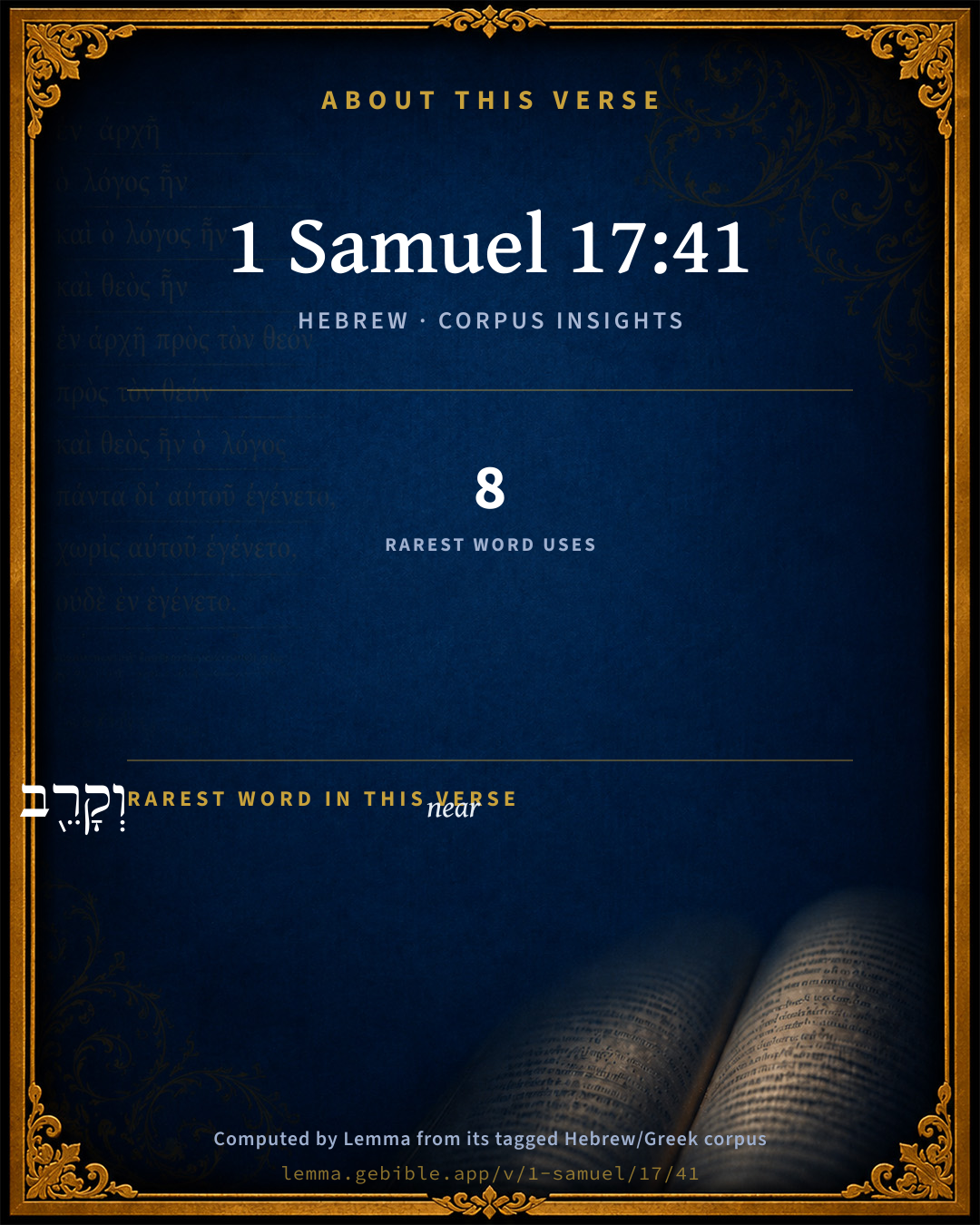
The rarest word here is וְקָרֵ֖ב near H7131 — appearing just 8 times in the whole Hebrew Bible.

Shared distinctive vocabulary

וְקָרֵ֖ב near H7131 occurs in 7 verses of the Hebrew Bible. Also found in:

Grammatical profile

  • 3 verbs
  • 5 nouns
  • 1 adjective
  • 1 preposition

Verb forms

  • וַיֵּ֨לֶךְ֙ Qal · Sequential Imperfect
  • הֹלֵ֥ךְ Qal · Participle Active
  • נֹשֵׂ֥א Qal · Participle Active

Hebrew & Septuagint length

In English translation the verse runs 19 words from the Hebrew and 23 from the Septuagint (LXX English) — closely comparable.

A rough comparison of the two English renderings, which tokenize alike — not a word-level alignment.

Word counts can differ between the Hebrew and the Greek without any difference in meaning — e.g. the Hebrew direct-object marker אֵת has no separate Greek word, and Greek often adds the article ὁ.

Hebrew and Greek witnesses Masoretic Hebrew ↔ Greek Septuagint

The same verse in the two great witnesses to the Old Testament, shown verse-for-verse.

These are two independent witnesses, not word-aligned to each other, and the Septuagint is shown in lemma (dictionary) form.

Hebrew 1 Samuel 17:41 Masoretic · Westminster Leningrad Codex

וַיֵּ֨לֶךְ֙ הַפְּלִשְׁתִּ֔י הֹלֵ֥ךְ וְקָרֵ֖ב אֶל דָּוִ֑ד וְהָאִ֛ישׁ נֹשֵׂ֥א הַצִּנָּ֖ה לְפָנָֽיו

The Philistine came on and drew near to David; and the man who bore the shield went before him.

World English Bible · Public Domain

Greek LXX 1 Samuel 17:41 Septuagint · lemma form
And the Philistine advanced and drew near to David, and a man bearing his shield went before him, and the Philistine looked on.

LXX2012 (modern English Septuagint) · Public Domain

On this verse, The Pulpit Commentary discusses the Septuagint’s reading. Read the note in Commentary ↓

Hebrew: Westminster Leningrad Codex (CC BY 4.0). Greek: Septuagint (public domain); English from LXX2012 (modern English Septuagint) (Public Domain). How the Septuagint differs from the Hebrew →

Targum (Aramaic paraphrase)

1

The Targum is the ancient Jewish Aramaic paraphrase of the Hebrew Scriptures — an interpretive translation, not the Hebrew text itself. Onkelos (literal) and Pseudo-Jonathan (expansive) render the Torah, and Jonathan the Prophets. Coverage is partial: where no permissively-licensed English translation exists for a verse, only the Aramaic is shown. This is verse-level text, not a word-by-word alignment to the Hebrew.

  1. Targum Jonathan Prophets (Joshua–Malachi)
    וַאֲזַל פְּלִשְׁתָּאָה אָזֵיל וְקָרֵיב לְוַת דָוִד וְגַבְרָא נָטֵיל תְּרֵיסָא קֳדָמוֹהִי:

    (no public-domain English translation for this verse)

    Targum Jonathan — Aramaic: “Mikraot Gedolot” (public domain). English: “Sefaria Community Translation” (CC0 1.0 (public-domain dedication)); “London "Chaldee Paraphrase," 1871” (public domain). Text via Sefaria.

Commentary

Notes on 1 Samuel 17:41 from classic Christian and Jewish commentators (each source and its license shown beneath its notes). The classic Christian expositions comment on the surrounding passage and are grouped to its opening verse, so a note may address several verses; the Jewish commentaries on the Tanakh (Rashi and others) are per-verse, so they appear only where the commentator wrote on this verse.

Lemma curates 59 commentaries, every one of them public domain or Creative Commons licensed, each selected and text-cleaned for this edition rather than reprinted as found. About our sources →

Trapp's Complete Commentary

John Trapp

1Sa 17:41 And the Philistine came on and drew near unto David; and the man that bare the shield [went] before him.

Ver. 41. And the Philistine came on and drew near.] When he saw David, that τυτθος ανηρ, presuming to make his approach: he considered not that

“ A cane non magno saepe tenetur aper. ”

John Trapp, A Commentary or Exposition upon All the Books of the Old and New Testament (1647–1656) — public domain. Text from a community e-Sword module.

The Biblical Illustrator

Joseph S. Exell

1Sa_17:41

And the Philistine came on and drew near unto David.

Combat and consequences

The inward preparation through outward trial may have been hidden from David. We are not permitted to know the why of many an hour of discipline; God lets when wait on why! David urges his suit; he wishes to go. Every warrior called of God has weapons for use that no Saul can give. Dependence alone upon God gives wonderful independence of men. Behind the outer world record, there is always the inner and spiritual. From the outward view, Abraham leaving country and kindred was only in consonance with the restlessness of a nomadic life. From the inward we know it was the call of God. David was being trained for triumph, trained for his future as king. This panel is the closing one in the story of his shepherd days. The old peaceful, songful, careless days end. They end with a conflict and a victory. Do not the epochs of our lives close with combat? We close the days of our boyhood really when we enter our first contest, when we close with some temptation that never came as a temptation in the old days. The doors are open, the steps are hidden he who would enter must climb.

I. The apparent inequality of the combatants. To the eye of sense the conflict between the Church of God and that armed Goliath of the world appears as if it could only end in the Churchs defeat! It does really sound like presumption and folly to sing of victory when we present only ruddy and unarmoured Davids. There is a quantity the worlds eye never sees!--chariots whose wheels, horses whose hoofs move noiselessly, such as Elishas servant once saw. There is a quality the world knows not and has no more power to recognise than had Herod to recognise the kingliness of purity, when Christ stood before him.

II. The real inequality of the combatants. Things ere not what they seem. There is more than eye can see. David tells him of dependence upon Divine power (1Sa_17:46). How calm one can be when dependent wholly and alone on the Lord! How strangely at variance with appearances a mans words may then be! This day. So Elijah could stand before Ahab, or the priests of Baal or Carmel, or Bunyan before the judges at Bedford. Do not mistake presumption for dependence; they differ eternally. Dependence upon God never opposes commonsense, but sanctifies it, Davids heart is resting in his God, his head and hand fulfilling the Divine command. How often at fault is the judgment of sense! Yet this old-world scene occurs every day. We may still see aggregations of mere material strength--walking mountains of brass, to quote Matthew Henry. It is no dream, no fancy, to remind you that before the enthusiasm of faith, and by Divine direction, these shall fall. The Church has yet to learn the deep meaning of the words, The weapons of our warfare are not carnal but spiritual. Who can successfully cope with evil licensed by Government, the fearful monopolies of vice, prostitution under British rule in India, gambling beneath the very eye of the legislative assembly? This victory was fraught with momentous consequences for David. From that moment he became acquainted with life in quite another aspect than that of his Bethlehem home. As Dr. MacLaren beautifully says, He began to learn its hate and effort, hollow fame, whispering calumnies, and political intrigues. Until then he had not heard the hollow tone of courtiers nor the frenzied laugh of disappointment. The door of victory was for David, as it is for all Gods warriors, the door of trial. It was needful for David to know sorrow, to become acquainted with grief. He must learn the meaning of hate and deceit; not to practise, but avoid; must come into touch with natures he will afterwards have to rule. He must gain a mastery over himself. The metal must be annealed. (H. E. Stone.)

David and Goliath

Sauls simple blessing, Go, and the Lord shall be with thee, ought to have been allowed to stand as the veterans farewell charge to the new recruit. It would have been as sufficient as the mothers parting kiss add God bless you when her boy leaves his home of poverty to make his way in the great city with all his goods tied up in a handkerchief and his Bible in his pocket. When we have done a good thing, especially a spiritual one, it is difficult to be persuaded to leave the single impression without some private brand of our own. Hunters use in the pursuit of wild game an expanding bullet, which enlarges as it enters the side of its victim. When one has uttered a gracious truth it can often be left to itself to work its way to the heart. Saul could not quite keep his hands off the new enterprise. The latent jealousy of the old commander would rise at any scheme conducted entirely by an underling. The veteran could not be content to see the stripling champion of the Lords cause without some of the traditional military costume. We remark as in contrast to this:--

I. The wisdom of following the Spirits suggestions as to the method of a work of faith. And Saul clad David with his apparel, and he put an helmet of brass upon his head, and he clad him with a coat of mail. For the moment Saul was allowed to array David in the heavy war suit of the day. A sense of the ridiculous may have come first to the relief of the lad. He was not so large a man as the king, and the clanking plates of metal would impede the free movement of the volunteer. There are times when an appreciation of the humorous elements of a situation will prevent serious folly. If good people who overwork prophecy on every possible occasion had only a slight intuition of the appearance of their performances, they would be aware that something must be wrong in their outfit. Scripture does not lend itself to grotesque interpretations without exacting penalties from its manipulators. There are fads of false science which are so silly that they cannot be meant to be incorporated into the great body of the worlds dignified truth. The boy in his grandfathers coat is not counted a serious actor on the stage of life. But beyond this feeling of unfitness there was this reason, I have not proved them. The youth felt the seriousness of the crisis, notwithstanding his bravery. He knew the long practice required to get an unerring aim with the sling. Beyond all these motives which influenced David would be the assurance that God, who gave him a work to do, would show the method of it. The Lord who called to the bold undertaking would give the plan.

II. The range of gifts which the spirit can use and bless in an enterprise of faith. And he took his staff in his hand, and chose him five smooth stones out of the brook, and put them in the shepherds bag which he had, even his scrip; and his sling was in his hand. This was not the first experience of the Lords consecration of the youths gifts. Thy servant smote both the lion and the bear. The Lord often makes use of mens gifts to get them to a position of vantage from which they can do more efficient service. Sir Hope Grant when a youth was selected because of his skill in playing the flute for the staff of Lord Saltoun, who was going out to take command of the British forces in China. The long voyage of months around the Cape of Good Hope to their destination was thus to be made more tolerable for the officers. Grant soon became the foremost Christian in the English army in the East and one of its most successful generals. Davids reputation for music got him a place at the court of Saul, and perhaps the story of his rugged valour among the shepherds secured him a hearing as a champion of Israel. Guizots gifts as a diplomat made him necessary to his Catholic sovereigns and gave him a position from which he could exert a beneficent influence for an oppressed church in France. John Wycliffes parliamentary skill and zeal for liberty mede him an important ally of the House of Lancaster and gained him the protection which he needed to spread the doctrines of the Gospel. Many accomplishments of the Christian may be of service in gaining an entrance to doors and hearts closed to direct religious appeal. Dr. Asa Gray, the botanist, records of his long and singularly successful career as a Christian and a man of science that when he was ready for any forward movement he almost always found that things were prepared for him. Let one have himself in training for a useful life and he will find a place and opportunity awaiting the employment of his gifts.

III. A consecrated youth early begins to bear his countrys burdens as a work of faith. But I come to thee in the name of the Lord of hosts, the God of the armies of Israel, which thou hast defied. David belongs to a legion of those out of every nation who have consecrated their youth to their countrys freedom and to God. They are a nobler band than Sons of the Revolution. They have been the sires of States. The war song that has made all Germans merge their local differences in one great purpose--the common fatherland--that united Bavarians, Prussians, Saxons, end Wurtembergers in 1870, and the Imperial Crown to the House of Hohenzollern--that song is Die Wacht am Rheim. It was written at the age of twenty-one by a poor German roused against the French aggressions upon his native land. Not all such heroic souls have been permitted to take up arms. Their stanzas, their speeches, their deeds of mercy have made them members of this patriotic and Christian fraternity. Every nation has contributed its quota for this ancient peerage to which David belonged. It is older than all orders, chapters, and lodges. The people who are to be preserved in their inheritance and liberties must still be able to call forth the devotion of these volunteer champions of law, institutions, faith, and native land. (W. R. Campbell.)

The Biblical Illustrator, edited by Joseph S. Exell (c. 1880s–1900s) — public domain. Text from a community e-Sword module.

Adam Clarke's Commentary

Verse 41. The man that bare the shield] See on 1Sa 17:7.

Adam Clarke's Commentary on the Bible (1810–1826) — public domain. Text from a community e-Sword/MySword module.

The Cambridge Bible for Schools and Colleges

gen. ed. J. J. S. Perowne

41–54. The victory of faith. The flight of the Philistines

41. This verse is not found in the Sept. (B).

The Cambridge Bible for Schools and Colleges (gen. ed. J. J. S. Perowne; Cambridge University Press, 1878–1918) — public domain. Text from a community e-Sword module.

John Gill's Exposition

And the Philistine came on, and drew near unto David,.... By slow paces, because of the weight of his armour, and bulk of his body, yet with a haughty air, and a proud gait:

and the man that bare the shield went before him; See Gill on Sa1 17:7.

John Gill's Exposition of the Whole Bible (1746–1763) — public domain (CC PDM 1.0). Text via the HelloAO Bible API.

The Pulpit Commentary

COMBAT OF DAVID AND GOLIATH (vers. 41-54).

Vers. 41-44. When David had crossed the ravine, Goliath and his armour bearer advanced towards him; and when he saw that the Israelite champion was but a lad (see ver. 33), with red hair, which added to his youthful appearance, and handsome, but with nothing more than a staff in his hand, he regarded this light equipment as an insult, and asks, Am I a dog, an animal held in great aversion in the East,that thou comest to me with staves? The plural is used as a contemptuous generalisation, but the Septuagint is offended at it, and with amusing matter of fact exactness translates, "With a staff and stones." And the Philistine cursed David by his gods. The Hebrew is singular, "by his god," i.e. the deity whom he had selected to be his especial patron.

Vers. 41-51.

The governing principle of life.

The facts are

1. The Philistine, on observing the youth and simple weapons of David,disdains and curses him, and boasts of soon giving his flesh to bird and beast.

2. David, in reply, declares that he comes in the name of God, andexpresses his assurance that, in the speedy death of his foe, all men would learn that the battle is the Lord"s.

3. Goliath falls by means of the sling and stone.

4. Seizing his sword, David cuts off his head, whereon the Philistines flee.We may regard Goliath and David as representatives of two very distinct orders of character the one serving as a foil to the other. The low human purpose, the boastful trust in human strength, and the vanity of gaining personal renown, on the one side, set off in bold relief the execution of a Divine purpose, the quiet trust in Divine strength, and the supreme desire to see God glorified, on the other side. "I come to thee in the name of the Lord of hosts, the God of the armies of Israel, whom thou hast defied here is the great principle that governed David"s conduct. In the name of the Lord did the stripling raise his voice, select his stones, and use his sling. Nor was this a mere accident in his life. A crisis may bring out into clear and bold expression the principle which governs a good man"s life, bait it does not create it. "In the name of the Lord" was his motto when feeding the sheep, slaying the lion and bear, and composing the Psalms. Consider

I The NATURE AND RANGE OF THE GOVERNING PRINCIPLE OF a GOOD MAN"S LIFE. There are various mental acts entering into and lying at the spring of conduct some more original than others. Life cannot be fully understood without an analysis of them and a recognition of their mutual relation. At one time a passion may be regarded as the governing principlee.g. "The love of Christ constraineth us;" at another, supreme regard for righte.g. "Do justly;" at another, obedience to a superior wille.g. "Not my will, but thine be done." But these and others of kindred nature are in Scripture summarised in the beautiful formula, "In the name of the Lord." David"s conduct brings this principle into triple forth.

1. The purpose of life is the purpose of God. That which God, by the revelations of his mercy and the ordinations of providence, is working out the cutting off of evil and the establishment of righteousness is theadopted and cherished purpose of life. In every calling, pursuit, enterprise, alliance, pleasure, secular or spiritual conflict, the true man goes forth "in the name of the Lord" to destroy the foe of God and man. He is conscious of a definite unity of purpose, and wills that it be identical with the one purpose of God.

1. The power trusted to is the power of God. The Lord in whose name David went forth "sayeth not with sword and spear." The stripling did not expect Goliath to fall down dead while he lay at rest in his tent, but be went forth using those means natural to him as a youth, and this too because of the unseen hand which taught "his fingers to fight." God"s strength is not a vast reserve locked up for use on some far distant day, when some new system of worlds has to be created, any more than that it has been all poured forth into laws and forces now acting. The Eternal Spirit is eternally strong, and as a Spirit is in such contact with us that, by placing ourselves in a certain attitude of loving trust, we receive from him according to our need.

2. The glory sought is that of the Lord. The motive of David was not to become notorious among men, not to promote some private advantage, but that "all the earth might know that there is a God in Israel." Here the stripling warrior was governed by the same reference to God as was recognised by the Apostle Paul when he said, "Do all to the glory of God". (1Co_10:31) This abnegation of self, this joy in the honour of the holy name, this ambition to see men bowing in reverence to the Lord of all, enters into the private and public, the secular and spiritual, works of the renewed man. See the beautiful and impressive language of saints of different ages (2Sa_22:33, 2Sa_22:35; 2Ch_32:7, 2Ch_32:8; Psa_20:5 Psa_63:4 Psa_115:1; 2Co_10:4; Heb_11:32-34)

II The TRUE GOVERNING PRINCIPLE OF LIFE IS NOT UNDERSTOOD BY THOSE WHO ARE NOT UNDER ITS INFLUENCE. Goliath, judging others by the principles that governed his own conduct, disdained David: his abusive language shows that he had no conception of the nature of the inspiration that made the stripling so cool and brave. Some men live in a world not penetrated even by the vision of others. Spheres of life come into collision, but do not intersect. The scorn and contempt of the ungodly is a common fact. (Psa_123:4; 1Co_1:18 1Co_4:13) Christ and his apostles were treated with contempt, and their design of subduing the world was, and still is, by some referred to madness. Ridicule of prayer, of missions to savage men, of expectation of Christ"s gospel being accepted by all, still abounds. Are not the people "few," the means contemptible out of harmony with the age, and opposed to the principles of physical science? It is the old story of a boastful Goliath. It is the same revelation of profound ignorance. Verily, if there were no more in Christian men than in their foes, the conflict would soon be settled. (2Co_4:4)

III The TRIUMPH OF THE OUTWORKING OF THE TRUE GOVERNING PRINCIPLE OF LIFE IS ASSURED. David was sure that on that very day his foe would fall, and so illustrate the supremacy of the good man"s principle. Events confirmed the truth. The issue of the great conflict between Christ"s Church and opposing forces of evil is thus foreshadowed. We may go forth with the same assurance that at the end of the world"s great day of battle we shall be in a position to say, "Now thanks be unto God, who always causeth us to triumph in Christ". (2Co_2:14; 1Co_15:57, 1Co_15:58) The same result may be looked for in respect of our own personal conflicts with sin; for though we may be weak, and pained by the scorning of the proud, yet, using our sling and stone in the strength of God, it will be found at last that we are "more than conquerors." And this, which applies to life as a whole, is of equal force in respect to any form of vice or moral evil we contend with day by Psa_44:6, Psa_44:7; Mic_7:8

General lessons:

1. The continued boasting of the enemies of Christianity is an illustration of its spiritual nature and the truth of its predictions. (2Pe_3:3)

2. The great need for Christians is to rise to the height of their powers andprivileges as soldiers of Christ. (1Co_16:13)

3. Every triumph achieved for Christ over sins, or individuals, or obstaclesis a pledge of coming victories.

The Pulpit Commentary (1880–1919), ed. H.D.M. Spence-Jones & Joseph S. Exell — public domain. Text from a community e-Sword module.

John Wesley's Explanatory Notes

Drew near - Probably a signal was made, that his challenge was accepted.

John Wesley, Explanatory Notes Upon the Whole Bible (1754–1765) — public domain. Text via the GEBible commentary corpus.

unfoldingWord translationNotes

Door43 World Missions Community

with his shield bearer in front of him

"and his shield bearer walked in front of him"

he despised him

"he hated him"

and ruddy

"and healthy looking"

Am I a dog, that you come to me with sticks?

Here a dog represents a small animal that a person can easily kill. The word "sticks" refers to David's staff and shows Goliath's opinion that it is not a good weapon. Goliath uses this question to accuse David of insulting him. AT: "You insult me by coming at me with mere sticks as if I were just a dog!" (See: Metaphor and Rhetorical Question)

translationWords

Philistines

David

shield

curse

false god

unfoldingWord translationNotes — © Distant Shores Media and the Door43 World Missions Community, licensed CC BY-SA 4.0. Source: git.door43.org/Door43/en_tn.

Lesson kit

Teaching starters — assembled from the data on this page, not authored interpretation. Every prompt links to the verse data it draws on. Edit before teaching.

1 Samuel, in the Historical, opens this verse with 10 words (10 distinct Hebrew lemmas). Its most distinctive word is qârêb (“near”). A historical commentator’s framing appears above. Read the whole chapter for the surrounding context.

Discussion questions

  1. The word qârêb carries the sense “near.” How does it shape the verse?
  2. How does Numbers 17:13, which shares the word «near», read alongside this verse?
  3. These translations render this verse differently. What is at stake in choosing one wording over another?
  4. «וַיֵּ֨לֶךְ֙» is a Qal Sequential Imperfect verb. How does that grammatical form shape the action described?
  5. Compare how Trapp's Complete Commentary and The Biblical Illustrator read this verse. Where do they agree or differ?

Things to notice

Reading settings

Reading text

Shown beneath each verse's original-language words.

Old Testament
Old Testament edition

Read the OT as the Masoretic Hebrew (MT) or the Greek Septuagint (LXX).

English shown for the Greek Septuagint (in the Hebrew ↔ Greek comparison).

Comparing translations? Open the Compare panel on any verse page to stack up to four side by side.