
1 Kings 9:11

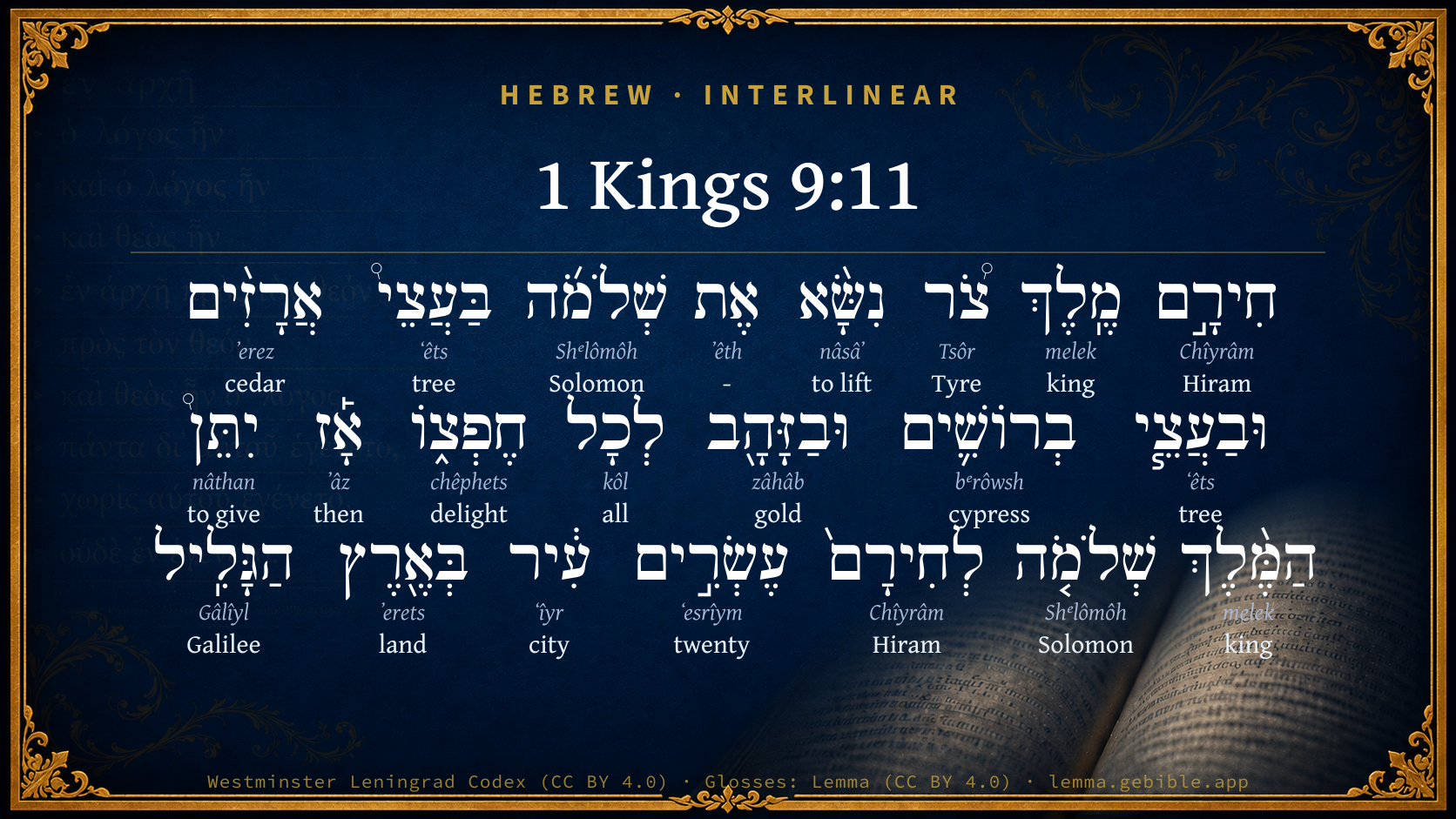
Hebrew (Westminster Leningrad Codex) 1 Kings 9:11 appears in the Hebrew Old Testament. The text above is from the Westminster Leningrad Codex. Each word links to its Strong’s number, a concise gloss, and parsing drawn from the Open Scriptures Hebrew Bible morphology. Click any word for its full Brown-Driver-Briggs (BDB) entry.
Download image
Cite this verse

1 Kings 9:11 (World English Bible). Public Domain. Lemma interlinear Bible study tool, https://lemma.gebible.app/v/1-kings/9/11.

Show BibTeX & RIS
BibTeX
RIS
English Translation
(now Hiram the king of Tyre had furnished Solomon with cedar trees and fir trees, and with gold, according to all his desire), that then king Solomon gave Hiram twenty cities in the land of Galilee.
World English Bible · Public Domain
Download a study sheet

One document with this verse’s original text, its word-by-word gloss line, the meaning frame, cross-references with their text, attributed commentary, and full source and license credits — printable, and it pastes into notes with its structure intact.

This verse Autodidact and up

Study sheet (.html) Plain text (.txt)

A passage Seminary Student

Up to 50 verses in one chapter. A passage sheet keeps up to 6 commentary sources and 12 cross-references per verse, in the order this page ranks them, and says so on the sheet whenever that leaves anything out. Ask for a single verse and you get the Autodidact verse sheet above.

Everything on this page stays free to read, with no account — the sheet is a download of what is already on screen, not access to it.

Want to remove ads? Support Godless Engineer
Compare translations 3

The same verse in 3 English versions, stacked beneath the original-language interlinear above. Click any original word for its lexicon entry.

Each is an independent rendering of the whole verse — the interlinear is not word-aligned to these translations.

Highlighted words mark where these versions differ — a whole-verse word diff, not a word-by-word alignment.

  • World English Bible Public Domain
    (now Hiram the king of Tyre had furnished Solomon with cedar trees and fir trees, and with gold, according to all his desire), that then king Solomon gave Hiram twenty cities in the land of Galilee.
  • King James Version Public Domain
    (Now Hiram the king of Tyre had furnished Solomon with cedar trees and fir trees, and with gold, according to all his desire,) that then king Solomon gave Hiram twenty cities in the land of Galilee.
  • unfoldingWord Literal Text CC BY-SA 4.0
    Hiram, the king of Tyre, had supplied Solomon with trees of cedar and with trees of cypress and with gold, according to all of his delight. Then King Solomon gave to Hiram 20 cities in the land of Galilee.

unfoldingWord Literal Text — © unfoldingWord, licensed CC BY-SA 4.0. Word-aligned USFM3 via Door43 (git.door43.org/unfoldingWord/en_ult).

Versions to compare (up to 4)

3 of 4 selected

Show all 18 translations

Every available English version of this verse, each an independent rendering of the whole verse.

  • World English Bible Public Domain
    (now Hiram the king of Tyre had furnished Solomon with cedar trees and fir trees, and with gold, according to all his desire), that then king Solomon gave Hiram twenty cities in the land of Galilee.
  • Berean Standard Bible Public Domain
    King Solomon gave twenty towns in the land of Galilee to Hiram king of Tyre, who had supplied him with cedar and cypress logs and gold for his every desire.
  • Majority Standard Bible Public Domain
    King Solomon gave twenty towns in the land of Galilee to Hiram king of Tyre, who had supplied him with cedar and cypress logs and gold for his every desire.
  • King James Version Public Domain
    (Now Hiram the king of Tyre had furnished Solomon with cedar trees and fir trees, and with gold, according to all his desire,) that then king Solomon gave Hiram twenty cities in the land of Galilee.
  • American Standard Version (1901) Public Domain
    (now Hiram the king of Tyre had furnished Solomon with cedar-trees and fir-trees, and with gold, according to all his desire), that then king Solomon gave Hiram twenty cities in the land of Galilee.
  • Revised Version (1885) Public Domain
    (now Hiram the king of Tyre had furnished Solomon with cedar trees and fir trees, and with gold, according to all his desire,) that then king Solomon gave Hiram twenty cities in the land of Galilee.
  • Geneva Bible (1599) Public Domain
    (For the which Hiram the King of Tyrus had brought to Salomon timber of cedar, and firre trees, and golde, and whatsoeuer he desired) then King Salomon gaue to Hiram twentie cities in the land of Galil.
  • Douay-Rheims (1899) Public Domain
    11(Hiram the king of Tyre furnishing Solomon with cedar trees and fir trees, and gold according to all he had need of.) then Solomon gave Hiram twenty cities in the land of Galilee.
  • Young's Literal Translation Public Domain
    Hiram king of Tyre hath assisted Solomon with cedar-trees, and with fir-trees, and with gold, according to all his desire; then doth king Solomon give to Hiram twenty cities in the land of Galilee.
  • Literal Standard Version CC BY-SA 4.0
    Hiram king of Tyre has assisted Solomon with cedar-trees, and with fir-trees, and with gold, according to all his desire; then King Solomon gives to Hiram twenty cities in the land of Galilee.
  • Unlocked Literal Bible CC BY-SA 4.0
    Now Hiram, the king of Tyre, had furnished Solomon with cedar and cypress trees, and with gold—all that Solomon desired—so King Solomon gave Hiram twenty cities in the land of Galilee.
  • unfoldingWord Literal Text CC BY-SA 4.0
    Hiram, the king of Tyre, had supplied Solomon with trees of cedar and with trees of cypress and with gold, according to all of his delight. Then King Solomon gave to Hiram 20 cities in the land of Galilee.
  • Darby Bible Public Domain
    Hiram the king of Tyre having furnished Solomon with cedar-trees and cypress-trees, and with gold, according to all his desire, -- that then king Solomon gave Hiram twenty cities in the land of Galilee.
  • World Messianic Bible Public Domain
    (now Hiram the king of Tyre had furnished Solomon with cedar trees and cypress trees, and with gold, according to all his desire), King Solomon gave Hiram twenty cities in the land of Galilee.
  • Webster's Bible Public Domain
    (Now Hiram the king of Tyre had furnished Solomon with cedar trees and fir trees, and with gold, according to all his desire,) that then king Solomon gave Hiram twenty cities in the land of Galilee.
  • Free Bible Version CC BY-SA 4.0
    King Solomon gave twenty towns in Galilee to Hiram king of Tyre, because Hiram had provided him with all the cedar and juniper and gold he wanted.
  • Bible in Basic English Public Domain
    (Hiram, king of Tyre, had given Solomon cedar-trees and cypress-trees and gold, as much as he had need of,) King Solomon gave Hiram twenty towns in the land of Galilee.
  • JPS Tanakh (1917) Public Domain
    now Hiram the king of Tyre had furnished Solomon with cedar-trees and cypress-trees, and with gold, according to all his desire — that then king Solomon gave Hiram twenty cities in the land of Galilee.

Literal Standard Version (2020), Covenant Press — licensed CC BY-SA 4.0. Text via the HelloAO Bible API (eBible.org). Unlocked Literal Bible (unfoldingWord) — licensed CC BY-SA 4.0. Text via the HelloAO Bible API (eBible.org). unfoldingWord Literal Text — © unfoldingWord, licensed CC BY-SA 4.0. Word-aligned USFM3 via Door43 (git.door43.org/unfoldingWord/en_ult). Free Bible Version, Dr. Jonathan Gallagher — licensed CC BY-SA 4.0. Text via the HelloAO Bible API (eBible.org).

Word by word

More ways to search: Search by grammar → Find every occurrence → Compare this word →

Practice this passage: Drill this verse → Learn its vocabulary →

הַגָּלִֽיל
Gâlîyl
H1551
“the · Galilee”
Particle, Definite Article + Noun, Proper
Part of Speech
Particle + Noun
Type
Proper
Full BDB Definition

Origin: the same as H1550

TWOT: None

Galilee = "circuit, district" - a territory in Naphtali largely occupied by heathen; a circuit of towns around Kedesh-Naphtali, in which were situated the 20 towns given by Solomon to Hiram king of Tyre as payment for his work in conveying timber from Lebanon to Jerusalem
  1. חִירָ֣ם Chîyrâm H2438 “Hiram” Noun, Proper
  2. מֶֽלֶךְ melek H4428 “king of” Noun, Common, Masculine, Singular, Construct
  3. צֹ֠ר Tsôr H6865 “Tyre” Noun, Proper
  4. נִשָּׂ֨א nâsâʼ H5375 “to lift” Verb, Piel, Perfect, 3rd Person, Masculine, Singular
  5. אֶת ʼêth H853 “-” Particle, Direct Object
  6. שְׁלֹמֹ֜ה Shᵉlômôh H8010 “Solomon” Noun, Proper
  7. בַּעֲצֵי֩ ʻêts H6086 “in/at · trees of” Preposition + Noun, Common, Masculine, Plural, Construct
  8. אֲרָזִ֨ים ʼerez H730 “cedars” Noun, Common, Masculine, Plural, Absolute
  9. וּבַעֲצֵ֧י ʻêts H6086 “and · in/at · trees of” Conjunction + Preposition + Noun, Common, Masculine, Plural, Construct
  10. בְרוֹשִׁ֛ים bᵉrôwsh H1265 “cypresses” Noun, Common, Masculine, Plural, Absolute
  11. וּבַזָּהָ֖ב zâhâb H2091 “and · in/at the · gold” Conjunction + Preposition, Determined + Noun, Common, Masculine, Singular, Absolute
  12. לְכָל kôl H3605 “to/for · all of” Preposition + Noun, Common, Masculine, Singular, Construct
  13. חֶפְצ֑וֹ chêphets H2656 “delight · his” Noun, Common, Masculine, Singular, Construct + Suffix, Personal, 3rd Person, Masculine, Singular
  14. אָ֡ז ʼâz H227 “then” Adverb
  15. יִתֵּן֩ nâthan H5414 “to give” Verb, Qal, Imperfect, 3rd Person, Masculine, Singular
  16. הַמֶּ֨לֶךְ melek H4428 “the · king” Particle, Definite Article + Noun, Common, Masculine, Singular, Absolute
  17. שְׁלֹמֹ֤ה Shᵉlômôh H8010 “Solomon” Noun, Proper
  18. לְחִירָם֙ Chîyrâm H2438 “to/for · Hiram” Preposition + Noun, Proper
  19. עֶשְׂרִ֣ים ʻesrîym H6242 “twenty” Adjective, Cardinal number, Both, Plural, Absolute
  20. עִ֔יר ʻîyr H5892 “city” Noun, Common, Feminine, Singular, Absolute
  21. בְּאֶ֖רֶץ ʼerets H776 “in/at · land of” Preposition + Noun, Common, Both, Singular, Construct

About this verse

These counts appear in no published source. They are computed here, from the morphology-tagged text and Lemma’s own curated glosses. What Lemma adds →

22
words
18
distinct lemmas
Historical
section

Notable vocabulary

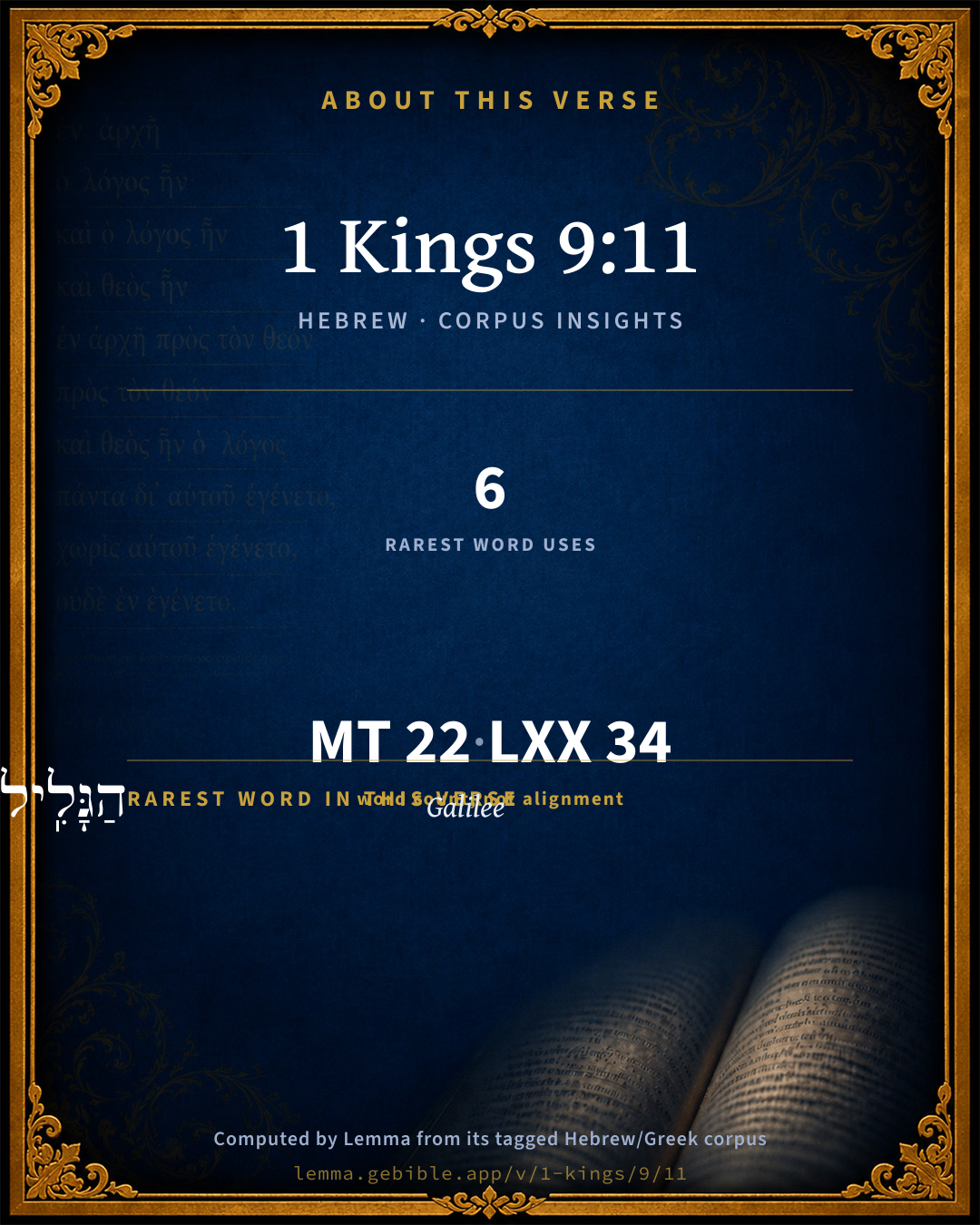
The rarest word here is הַגָּלִֽיל Galilee H1551 — appearing just 6 times in the whole Hebrew Bible.

Shared distinctive vocabulary

הַגָּלִֽיל Galilee H1551 occurs in 6 verses of the Hebrew Bible. Also found in:

Grammatical profile

  • 2 verbs
  • 17 nouns
  • 1 adjective
  • 1 adverb
  • 1 particle

Verb forms

  • נִשָּׂ֨א Piel · Perfect
  • יִתֵּן֩ Qal · Imperfect

Repetition

Words recur within this verse — often emphatic in Hebrew:

  • חִירָ֣ם Hiram H2438 ×2
  • מֶֽלֶךְ king H4428 ×2
  • שְׁלֹמֹ֜ה Solomon H8010 ×2
  • בַּעֲצֵי֩ tree H6086 ×2

Hebrew & Septuagint length

In English translation the verse runs 36 words from the Hebrew and 33 from the Septuagint (LXX English) — closely comparable.

A rough comparison of the two English renderings, which tokenize alike — not a word-level alignment.

Word counts can differ between the Hebrew and the Greek without any difference in meaning — e.g. the Hebrew direct-object marker אֵת has no separate Greek word, and Greek often adds the article ὁ.

In the original languages it is 22 Hebrew tokens and 34 Greek tokens — but the two are counted differently (Hebrew bundles its prefixes and suffixes into one token; the Greek is in lemma form), so that isn’t a like-for-like length.

Cross-references

5

Topical passages linked to 1 Kings 9:11 in the Treasury of Scripture Knowledge — connected by theme and wording, ordered by reader-vote popularity; previews shown in the World English Bible.

  • 2 Chronicles 8:2 that the cities which Huram had given to Solomon, Solomon built them, and caused the children of Israel to dwell there.
  • Joshua 20:7 They set apart Kedesh in Galilee in the hill-country of Naphtali, and Shechem in the hill-country of Ephraim, and Kiriath Arba (the same is Hebron) in the hill-country of Judah.
  • 1 Kings 5:6–10 Now therefore command you that they cut me cedar trees out of Lebanon; and my servants shall be with your servants; and I will give you hire for your servants according to all that you shall say: for you know that there is not among us any who knows how to cut timber like the Sidonians.
  • 2 Chronicles 2:8–10 Send me also cedar trees, fir trees, and algum trees, out of Lebanon; for I know that your servants know how to cut timber in Lebanon: and, behold, my servants shall be with your servants,
  • 2 Chronicles 2:16 and we will cut wood out of Lebanon, as much as you shall need; and we will bring it to you in floats by sea to Joppa; and you shall carry it up to Jerusalem.

Cross-references courtesy of OpenBible.info (CC BY 4.0).

Hebrew and Greek witnesses Masoretic Hebrew ↔ Greek Septuagint

The same verse in the two great witnesses to the Old Testament, shown verse-for-verse.

These are two independent witnesses, not word-aligned to each other, and the Septuagint is shown in lemma (dictionary) form.

Hebrew 1 Kings 9:11 Masoretic · Westminster Leningrad Codex

חִירָ֣ם מֶֽלֶךְ צֹ֠ר נִשָּׂ֨א אֶת שְׁלֹמֹ֜ה בַּעֲצֵי֩ אֲרָזִ֨ים וּבַעֲצֵ֧י בְרוֹשִׁ֛ים וּבַזָּהָ֖ב לְכָל חֶפְצ֑וֹ אָ֡ז יִתֵּן֩ הַמֶּ֨לֶךְ שְׁלֹמֹ֤ה לְחִירָם֙ עֶשְׂרִ֣ים עִ֔יר בְּאֶ֖רֶץ הַגָּלִֽיל

(now Hiram the king of Tyre had furnished Solomon with cedar trees and fir trees, and with gold, according to all his desire), that then king Solomon gave Hiram twenty cities in the land of Galilee.

World English Bible · Public Domain

Greek LXX 1 Kings 9:11 Septuagint · lemma form

χιραμ βασιλεύς τύρος ἀντιλαμβάνω ὁ σαλωμών ἐν ξύλον κέδρινος καί ἐν ξύλον πεύκινος καί ἐν χρυσίον καί ἐν πᾶς θέλημα αὐτός τότε δίδωμι ὁ βασιλεύς ὁ χιραμ εἴκοσι πόλις ἐν ὁ γῆ ὁ γαλιλαία

Chiram king of Tyre helped Solomon with cedar wood, and fir wood, and with gold, and all that he wished for: then the king gave Chiram twenty cities in the land of Galilee.

LXX2012 (modern English Septuagint) · Public Domain

Hebrew: Westminster Leningrad Codex (CC BY 4.0). Greek: Septuagint (public domain); English from LXX2012 (modern English Septuagint) (Public Domain). How the Septuagint differs from the Hebrew →

Targum (Aramaic paraphrase)

1

The Targum is the ancient Jewish Aramaic paraphrase of the Hebrew Scriptures — an interpretive translation, not the Hebrew text itself. Onkelos (literal) and Pseudo-Jonathan (expansive) render the Torah, and Jonathan the Prophets. Coverage is partial: where no permissively-licensed English translation exists for a verse, only the Aramaic is shown. This is verse-level text, not a word-by-word alignment to the Hebrew.

  1. Targum Jonathan Prophets (Joshua–Malachi)
    חִירָם מַלְכָּא דְצוֹר סוֹבַר יַת שְׁלֹמֹה בַּאֲעֵי אַרְזִין וּבַאֲעֵי בִירְוָן וּבְדַהֲבָא לְכָל צוֹרְכֵיהּ בְּכֵן יָהִיב מַלְכָּא שְׁלֹמֹה לְחִירָם עַסְרִין קִרְוִין בְּאַרְעָא גְלִילָא:

    (no public-domain English translation for this verse)

    Targum Jonathan — Aramaic: “Mikraot Gedolot” (public domain). English: “Sefaria Community Translation” (CC0 1.0 (public-domain dedication)); “London "Chaldee Paraphrase," 1871” (public domain). Text via Sefaria.

Commentary

Notes on 1 Kings 9:11 from classic Christian and Jewish commentators (each source and its license shown beneath its notes). The classic Christian expositions comment on the surrounding passage and are grouped to its opening verse, so a note may address several verses; the Jewish commentaries on the Tanakh (Rashi and others) are per-verse, so they appear only where the commentator wrote on this verse.

Lemma curates 59 commentaries, every one of them public domain or Creative Commons licensed, each selected and text-cleaned for this edition rather than reprinted as found. About our sources →

Trapp's Complete Commentary

John Trapp

1Ki 9:11 ([Now] Hiram the king of Tyre had furnished Solomon with cedar trees and fir trees, and with gold, according to all his desire,) that then king Solomon gave Hiram twenty cities in the land of Galilee.

Ver. 11. In the land of Galilee.] Called Galilee of the Gentiles, {Isa 9:1} because by them inhabited, {Jdg 1:31-32} till Solomon dispossessed them, and thus disposed of their country.

John Trapp, A Commentary or Exposition upon All the Books of the Old and New Testament (1647–1656) — public domain. Text from a community e-Sword module.

Joseph Benson's Commentary

1Ki 9:11-14. Solomon gave Hiram twenty cities in the land of Galilee — Or, near the land of Galilee, bordering upon it; in those parts which were near, and adjoining to, Hiram’s dominions: with the cities, understand the territories belonging to them. These cities, though they were within those large bounds which God fixed to the land of promise, (Gen 15:18; Jos 1:4,) yet were not within those parts which were distributed by lot in Joshua’s time. It is probable they were not inhabited by Israelites, but by Canaanites, or other heathen; who having been subdued and made tributary by David or Solomon, those cities became a part of their dominions; and afterward were reckoned a part of Galilee, as Josephus notes. They pleased him not — Were not suitable to his desire, and the genius of his people. He called them the land of Cabul — A Phenician word, says Josephus, which signifies displeasing. But Rabbi Salomon writes that the land was so called because it was “quasi compedita, id est, argillacea, tenax, et infrugifera,” bound, stiff, clayey, and unfruitful. Hiram did not like it, because, though it might be very good, yet being a thick and stiff clay, and therefore requiring great pains to cultivate and manure it, it was very unsuitable to the disposition of the Tyrians, who were delicate, and lazy, and luxurious, and wholly given to merchandise. And, on his returning them, there is no doubt but Solomon gave him an equivalent, more to his taste. And Hiram sent to the king — Or rather, For Hiram had sent, &c. And this seems to be here added, both to declare the quantity of the gold sent, which had been only named before, (1Ki 9:11,) and as the reason why he resented Solomon’s action, because so great a sum required a better recompense.

Joseph Benson's Commentary on the Old and New Testaments (1811–1818) — public domain. Text from a community e-Sword module.

Geneva Bible (1599)

Geneva Bible translators

Or, Zor.

Or, Galilee.

Geneva Bible (1599) marginal notes — public domain. Text via Bolls.life.

Jamieson, Fausset & Brown

Robert Jamieson, A. R. Fausset & David Brown

Solomon gave Hiram twenty cities in the land of Galilee--According to JOSEPHUS, they were situated on the northwest of it, adjacent to Tyre. Though lying within the boundaries of the promised land (Gen 15:18; Jos 1:4), they had never been conquered till then, and were inhabited by Canaanite heathens (Jdg 4:2-13; Kg2 15:29). They were probably given to Hiram, whose dominions were small, as a remuneration for his important services in furnishing workmen, materials, and an immense quantity of wrought gold (Kg1 9:14) for the temple and other buildings [MICHAELIS]. The gold, however, as others think, may have been the amount of forfeits paid to Solomon by Hiram for not being able to answer the riddles and apothegms, with which, according to JOSEPHUS, in their private correspondence, the two sovereigns amused themselves. Hiram having refused these cities, probably on account of their inland situation making them unsuitable to his maritime and commercial people, Solomon satisfied his ally in some other way; and, taking these cities into his own hands, he first repaired their shattered walls, then filled them with a colony of Hebrews (Ch2 8:2).

Jamieson, Fausset & Brown — Commentary Critical and Explanatory on the Whole Bible (1871) — public domain (CC PDM 1.0). Text via the HelloAO Bible API.

Adam Clarke's Commentary

Verse 11. Solomon gave Hiram twenty cities] It is very likely that Solomon did not give those cities to Hiram so that they should be annexed to his Tyrian dominions, but rather gave him the produce of them till the money was paid which he had advanced to Solomon for his buildings. It appears however that either Hiram did not accept them, or that having received the produce till he was paid, he then restored them to Solomon; for in the parallel place, 2Ch 8:2, it is said, The cities which Hiram had restored to Solomon, Solomon built them, and caused the children of Israel to dwell there. Some think that they were heathen cities which Solomon had conquered, and therefore had a right to give them if he pleased, as they were not any part of the land given by promise to the Israelites.

Adam Clarke's Commentary on the Bible (1810–1826) — public domain. Text from a community e-Sword/MySword module.

Ellicott's Commentary for English Readers

(11) Gave Hiram . . . cities.—This implies a debt to him for timber and gold, and probably stone also, over and above the payment in kind stipulated for in 1Ki_5:9. From the notice in 2Ch_8:2, that, when these cities were restored by Hiram, Solomon rebuilt them, and peopled them with Israelites, it seems likely that they were previously cities of the subject races, which he would have no scruple in alienating; although, indeed, the often-quoted enactment of the Law (Lev_25:23-24), would not have been likely to be strictly observed under his self-reliant despotism.

A Bible Commentary for English Readers, edited by Charles John Ellicott (1878–1897) — public domain. Text from a community e-Sword module.

The Cambridge Bible for Schools and Colleges

gen. ed. J. J. S. Perowne

11. now Hiram the king … had furnished, &c.] We read of the supply of timber in 1Ki_5:10, but the gold mentioned here does not appear in the earlier narrative. From 1Ki_9:14 below we learn that the amount was ‘six score talents.’ Taking the value of a talent of gold at £6000 this sum would be worth £720,000. Josephus (Ant. viii. 5, 3) says Hiram had contributed much gold and still more silver.

Solomon gave Hiram twenty cities in the land of Galilee] These would most likely be in the extreme northern border of Galilee and so not remote from Hiram’s frontier. But they would be inland cities and no doubt, to a maritime people like the Tyrians, some territory along the seaboard would have been more acceptable. Josephus specially notes that the cities were not far from Tyre. The region in which they were situate was that called (Isa_9:1) ‘Galilee of the nations’ to indicate that the inhabitants were yet in heathendom. This might be a reason why Solomon chose them for his present to the Tyrian king.

The Cambridge Bible for Schools and Colleges (gen. ed. J. J. S. Perowne; Cambridge University Press, 1878–1918) — public domain. Text from a community e-Sword module.

John Gill's Exposition

And Hiram came out from Tyre to see the cities which Solomon had given him,.... For these cities, being in or near Galilee, were not far from Tyre:

and they pleased him not; being either out of repair, as some think; see Ch2 8:2 or the ground barren, and unfruitful; which is not likely, being in a very fruitful country, as the tribes on which they bordered were: but they were not agreeable to him, they did not suit with the disposition of him and his people, who were given not to husbandry, but to merchandise; and the land about these would require a good deal of pains and labour to till, which they were not used to.

John Gill's Exposition of the Whole Bible (1746–1763) — public domain (CC PDM 1.0). Text via the HelloAO Bible API.

Albert Barnes' Notes on the Bible

By the spirit, if not by the letter, of the Law, Solomon had no right to give away these cities, or any part of the inheritance of Israel Lev. 25:13-34. But the exigences of a worldly policy caused the requirements of the Law to be set aside.

Albert Barnes' Notes on the Bible (1834–1885) — public domain. Text from a community e-Sword/MySword module.

Haydock's Catholic Bible Commentary

Galilee, the higher, which was nearer to the sea and the confines of Tyre; (Menochius) or rather the lower Galilee lay in this direction. (Calmet) --- This was not a part of the country allotted to Israel, (Josue xix. 27.) but had been conquered: as Hiram gave the cities back, 2 Paralipomenon viii. 2. Solomon caused them to be rebuilt, and peopled by the Israelites. (Grotius) --- If they had formed a part of his dominions before, he would not have had to send a colony thither. (Calmet) --- Others think that he only ceded that country for a time to Hiram, till he should be indemnified. (Abulensis) (Tostat) (Menochius) (Tirinus) (Worthington) --- The country belonged to the Lord, (Leviticus xxv. 13.) and could not be given away by the prince. In case it had been occupied by strangers, Solomon would have taken care that the Israelites should have the free exercise of their religion. But as Hiram rejected his offer, he would make him recompense by some other means; (Calmet) in ready money, ver. 14. (Josephus) (Tirinus)

George Leo Haydock (1774–1849), Haydock's Catholic Family Bible and Commentary, 1859 edition — public domain. Excludes Psalms (Douay-Rheims chapter numbering differs from Protestant) and Deuterocanonical books (Catholic canon only).

Matthew Poole's English Annotations

Or, near (as beth oft signifies, as hath been proved before)

the land of Galilee, bordering upon it; in those parts which were near and adjoining to Hiram’s dominions: with the cities understand the lands and territories belonging to them.

Quest. How could Solomon give away any part of that land wherein the people had a right by a Divine lot, and God had a right, as being the only proprietary of it; upon which ground the total alienation of it, or any part of it, was forbidden, Lev 25:23?

Answ. 1. It is not said that he gave them away wholly, and for ever; but he might assign them to him only for a time, until he was fully satisfied for his debt.

2. If these cities were possessed by Israelites, Solomon did not give him their particular possessions, but only his own royalties over them, and all the profits he received from them, which were very considerable, as may be gathered from that passage, 1Ki 12:4.

3. These cities, though they were within those large bounds which God fixed to the Land of Promise, Gen 15:18; Jos 1:4, yet were not within those parts which were distributed by Lot in Joshua’s time, nor belonging to the tribe of Asher, (as some suppose,) as may be gathered both from Jos 19:27, where their border is said to go out only to the land of Cabul, to wit, exclusively; and Jos 19:30, where all their cities are said to be but twenty and two; and from 2Ch 8:2, where it is said of those cities, when Hiram restored them, that Solomon built them, and caused the children of Israel to dwell there; which makes it more than probable that these cities were not inhabited by Israelites, but by Canaanites, or other heathens; who being subdued and extirpated by David, or Solomon, those cities became a part of their dominions, and at their disposal; and afterwards were reckoned a part of Galilee, as Josephus notes; and may be one reason why he gave these rather than other cities, because they were in his power to give, when others were not.

Matthew Poole's English Annotations on the Holy Bible (1683–1685) — public domain. Text from a community e-Sword/MySword module.

Whedon's Commentary on the Bible

Daniel D. Whedon

11. Twenty cities — One city for every year of building. This gift of Solomon was evidently a token of his good-will to Hiram, and for a memorial of the aid given by the king of Tyre in the building of the temple and palace, but not a payment for service received. But what right, it has been asked, had Solomon to give away any part of the inheritance of the Lord’s people into the hands of a heathen king? According to the law (Lev_25:23) the land could not be sold forever; much less given away. We might answer, This was not the first nor the last instance in which this great king stepped aside from the law of Moses. Already, contrary to the express commands of the law, he had multiplied horses and chariots. But in this case the appearance of transgression largely disappears in the fact that these cities, when given to Hiram, were peopled not by Israelites but by heathens. Solomon may have regarded it as a prudent policy to hand over the government of these heathen cities, which were evidently of no great worth, to his friendly neighbour, who had rendered him so much service in building the Lord’s house.

Land of Galilee — Not the entire province of this name as it existed under the Romans, but only the northern part of the land allotted to the tribe of Naphtali. Compare Jos_20:7. According to Josephus, these twenty cities lay not far from Tyre.

Daniel D. Whedon (gen. ed.), Commentary on the Old and New Testaments (1874–1909) — public domain. Text from a community e-Sword module.

The Pulpit Commentary

(Now Hiram the king of Tyre Here we have a parenthesis referring us back to 1Ki_5:8-10 had furnished Solomon with cedar trees and with fir trees and with gold The gold is here mentioned for the first time, No doubt Hiram"s shipping had brought it in Before the Jewish navy was built. It was this probably that led to the construction of a fleet according to all his desire), that then this is the apodosis to ver. 10 king Solomon gave Hiram twenty cities really they were mere villages. "It is a genuine Eastern trick to dignify a small present with a pompous name" (Thomson). But ryi is a word of very wide meaning in the land of Galilee. lyliG lit., circuit, region (like Ciccar,, (1Ki_7:46) hence often found as here with the art. = the region of the Gentiles (Isa_9:1 RAPC 1Ma 5:15; Mat_4:15) so called because it was inhabited by Phoenicians, (see 2Sa_24:7, and Strabo, 16. p.760) originally designated but a small part of the considerable tract of country later known as the province of "Galilee," viz., the northern part in the tribe of Naphtali (Jos_20:7; 2Ki_15:29; Isa_9:1. Cf. Joshua,ant. 5. 1. 18). It is easy to see why this particular region was surrendered to Hiram.

(1) It was near his country; (2Sa_24:7)

(2) the people were Phoenicians, allied to Hiram, but strangers to Solomon, both in race and religion;

(3) Solomon could not with propriety alienate any part of Immanuel"s land, or convey to a foreigner the dominion over the people of the Lord. Lev_25:23 forbade the alienation of the land; Deu_17:15 the rule of a stranger.

The Pulpit Commentary (1880–1919), ed. H.D.M. Spence-Jones & Joseph S. Exell — public domain. Text from a community e-Sword module.

John Wesley's Explanatory Notes

Galilee - Or, near the land of Galilee, bordering upon it; in those parts which were near, and adjoining to Hiram's dominions: with the cities, understand the territories belonging to them. These cities, though they were within those large bounds which God fixed to the land of promise, Gen. xv, 18 Josh. i, 4, yet were not within those parts which were distributed by lot in Joshua's time. It is probable they were not inhabited by Israelites, but by Canaanites, or other Heathens; who being subdued, and extirpated by David or Solomon, those cities became a part of their dominions; and afterwards were reckoned a part of Galilee, as Josephus notes.

John Wesley, Explanatory Notes Upon the Whole Bible (1754–1765) — public domain. Text via the GEBible commentary corpus.

Rashi

Rabbi Shlomo Yitzchaki (Rashi)

Provided Shlomo. An expression of bearing, [i.e.,] he bore his burden in this matter.

Rashi on the Tanakh — English translations: “The Judaica Press complete Tanach with Rashi, translated by A. J. Rosenberg” (CC BY 4.0); “Pentateuch with Rashi's commentary by M. Rosenbaum and A.M. Silbermann, 1929-1934” (public domain); “The Metsudah Tanach series, Lakewood, N.J” (CC BY 4.0); and “The Book of Joshua, Metsudah Publications, 1997” (CC BY 4.0). Text via Sefaria.

Lesson kit

Teaching starters — assembled from the data on this page, not authored interpretation. Every prompt links to the verse data it draws on. Edit before teaching.

1 Kings, in the Historical, opens this verse with 22 words (18 distinct Hebrew lemmas). Its most distinctive word is Gâlîyl (“Galilee”). A historical commentator’s framing appears above. Read the whole chapter for the surrounding context.

Discussion questions

  1. What does “Galilee” (Gâlîyl) contribute to the verse as a whole?
  2. Joshua 20:7 shares the word «Galilee» with this verse. How do the two illuminate each other?
  3. “Hiram” occurs 2× in this one verse. What is the effect of the repetition?
  4. The translations on this page render this verse differently — a whole-verse word diff, not a word-by-word alignment. What might account for the different wordings?
  5. The verb «נִשָּׂ֨א» is Piel Perfect. How does its form color the action?
  6. Reading how Trapp's Complete Commentary and Joseph Benson's Commentary read this verse, where do the two commentators agree and where do they part?

Things to notice

Reading settings

Reading text

Shown beneath each verse's original-language words.

Old Testament
Old Testament edition

Read the OT as the Masoretic Hebrew (MT) or the Greek Septuagint (LXX).

English shown for the Greek Septuagint (in the Hebrew ↔ Greek comparison).

Comparing translations? Open the Compare panel on any verse page to stack up to four side by side.