
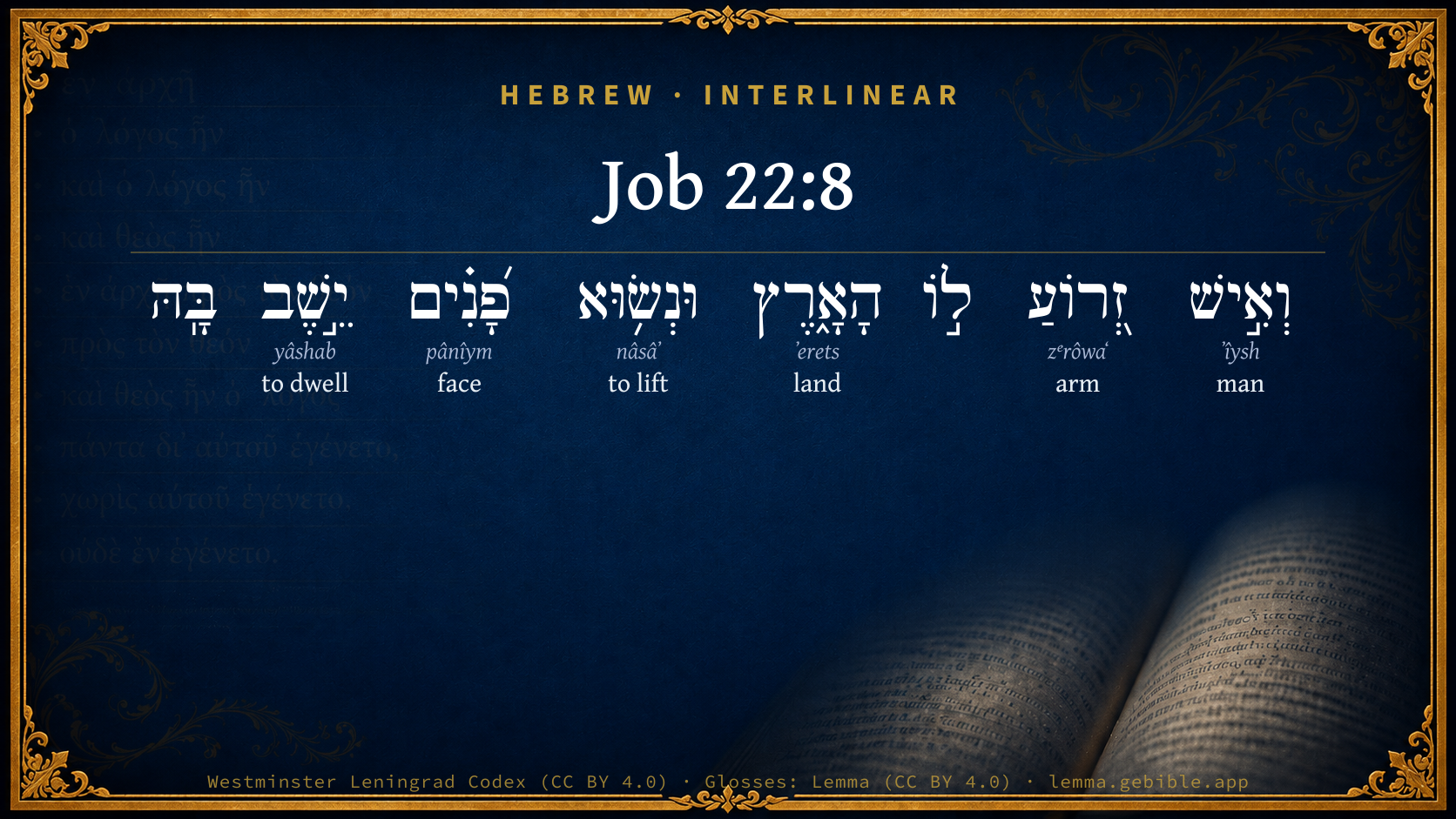
Job 22:8

Hebrew (Westminster Leningrad Codex) Job 22:8 appears in the Hebrew Old Testament. The text above is from the Westminster Leningrad Codex. Each word links to its Strong’s number, a concise gloss, and parsing drawn from the Open Scriptures Hebrew Bible morphology. Click any word for its full Brown-Driver-Briggs (BDB) entry.
Download image
Cite this verse

Job 22:8 (World English Bible). Public Domain. Lemma interlinear Bible study tool, https://lemma.gebible.app/v/job/22/8.

Show BibTeX & RIS
BibTeX
RIS
English Translation
But as for the mighty man, he had the earth. The honorable man, he lived in it.
World English Bible · Public Domain
Download a study sheet

One document with this verse’s original text, its word-by-word gloss line, the meaning frame, cross-references with their text, attributed commentary, and full source and license credits — printable, and it pastes into notes with its structure intact.

This verse Autodidact and up

Study sheet (.html) Plain text (.txt)

A passage Seminary Student

Up to 50 verses in one chapter. A passage sheet keeps up to 6 commentary sources and 12 cross-references per verse, in the order this page ranks them, and says so on the sheet whenever that leaves anything out. Ask for a single verse and you get the Autodidact verse sheet above.

Everything on this page stays free to read, with no account — the sheet is a download of what is already on screen, not access to it.

Want to remove ads? Support Godless Engineer
Compare translations 3

The same verse in 3 English versions, stacked beneath the original-language interlinear above. Click any original word for its lexicon entry.

Each is an independent rendering of the whole verse — the interlinear is not word-aligned to these translations.

Highlighted words mark where these versions differ — a whole-verse word diff, not a word-by-word alignment.

  • World English Bible Public Domain
    But as for the mighty man, he had the earth. The honorable man, he lived in it.
  • King James Version Public Domain
    But as for the mighty man, he had the earth; and the honourable man dwelt in it.
  • unfoldingWord Literal Text CC BY-SA 4.0
    But the man of arm, the earth to him, and the lifted of face dwelt upon it.

unfoldingWord Literal Text — © unfoldingWord, licensed CC BY-SA 4.0. Word-aligned USFM3 via Door43 (git.door43.org/unfoldingWord/en_ult).

Versions to compare (up to 4)

3 of 4 selected

Show all 18 translations

Every available English version of this verse, each an independent rendering of the whole verse.

  • World English Bible Public Domain
    But as for the mighty man, he had the earth. The honorable man, he lived in it.
  • Berean Standard Bible Public Domain
    while the land belonged to a mighty man, and a man of honor lived on it.
  • Majority Standard Bible Public Domain
    while the land belonged to a mighty man, and a man of honor lived on it.
  • King James Version Public Domain
    But as for the mighty man, he had the earth; and the honourable man dwelt in it.
  • American Standard Version (1901) Public Domain
    But as for the mighty man, he had the earth; And the honorable man, he dwelt in it.
  • Revised Version (1885) Public Domain
    But as for the mighty man, he had the earth; and the honourable man, he dwelt in it.
  • Geneva Bible (1599) Public Domain
    But the mightie man had the earth, and he that was in autoritie, dwelt in it.
  • Douay-Rheims (1899) Public Domain
    In the strength of thy arm thou didst possess the land, and being the most mighty thou holdest it.
  • Young's Literal Translation Public Domain
    As to the man of arm -- he hath the earth, And the accepted of face -- he dwelleth in it.
  • Literal Standard Version CC BY-SA 4.0
    As for the man of arm—he has the earth, || And the accepted of face—he dwells in it.
  • Unlocked Literal Bible CC BY-SA 4.0
    although you, a mighty man, possessed the earth, although you, an honored man, lived in it.
  • unfoldingWord Literal Text CC BY-SA 4.0
    But the man of arm, the earth to him, and the lifted of face dwelt upon it.
  • Darby Bible Public Domain
    But the powerful man, he had the land; and the man of high rank dwelt in it.
  • World Messianic Bible Public Domain
    But as for the mighty man, he had the earth. The honorable man, he lived in it.
  • Webster's Bible Public Domain
    But as for the mighty man, he had the earth; and the honorable man dwelt in it.
  • Free Bible Version CC BY-SA 4.0
    Is it because the land belongs to the powerful, and only the privileged have a right to live there?
  • Bible in Basic English Public Domain
    For it was the man with power who had the land, and the man with an honoured name who was living in it.
  • JPS Tanakh (1917) Public Domain
    And as a mighty man, who hath the earth, and as a man of rank, who dwelleth in it,

Literal Standard Version (2020), Covenant Press — licensed CC BY-SA 4.0. Text via the HelloAO Bible API (eBible.org). Unlocked Literal Bible (unfoldingWord) — licensed CC BY-SA 4.0. Text via the HelloAO Bible API (eBible.org). unfoldingWord Literal Text — © unfoldingWord, licensed CC BY-SA 4.0. Word-aligned USFM3 via Door43 (git.door43.org/unfoldingWord/en_ult). Free Bible Version, Dr. Jonathan Gallagher — licensed CC BY-SA 4.0. Text via the HelloAO Bible API (eBible.org).

Word by word

More ways to search: Search by grammar → Find every occurrence → Compare this word →

Practice this passage: Drill this verse → Learn its vocabulary →

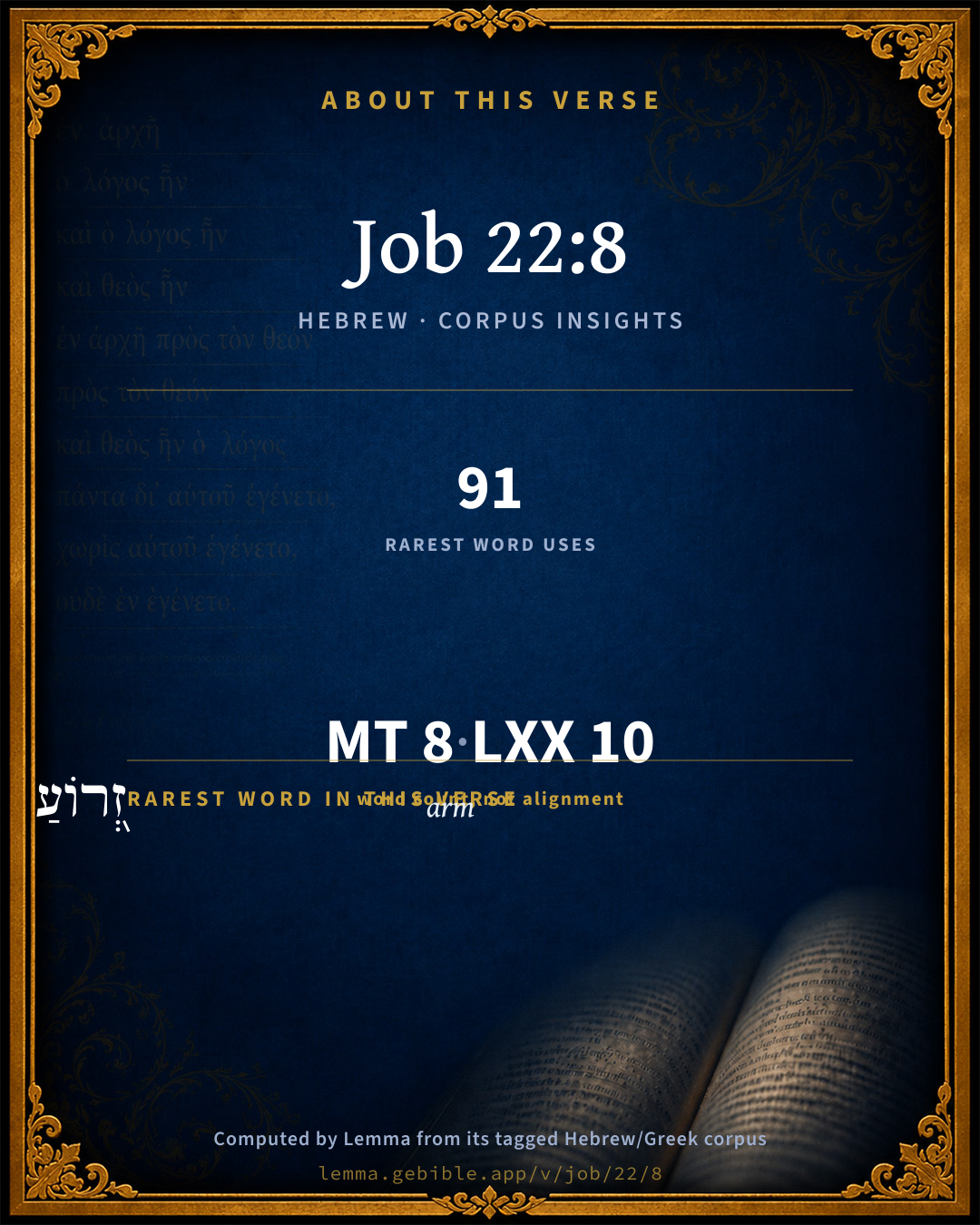
About this verse

These counts appear in no published source. They are computed here, from the morphology-tagged text and Lemma’s own curated glosses. What Lemma adds →

8
words
6
distinct lemmas
Wisdom
section

Grammatical profile

  • 2 verbs
  • 4 nouns
  • 2 prepositions

Verb forms

  • וּנְשׂ֥וּא Qal · Participle Passive
  • יֵ֣שֶׁב Qal · Imperfect

Hebrew & Septuagint length

In English translation the verse runs 17 words from the Hebrew and 20 from the Septuagint (LXX English) — closely comparable.

A rough comparison of the two English renderings, which tokenize alike — not a word-level alignment.

Word counts can differ between the Hebrew and the Greek without any difference in meaning — e.g. the Hebrew direct-object marker אֵת has no separate Greek word, and Greek often adds the article ὁ.

In the original languages it is 8 Hebrew tokens and 10 Greek tokens — but the two are counted differently (Hebrew bundles its prefixes and suffixes into one token; the Greek is in lemma form), so that isn’t a like-for-like length.

Cross-references

8

Topical passages linked to Job 22:8 in the Treasury of Scripture Knowledge — connected by theme and wording, ordered by reader-vote popularity; previews shown in the World English Bible.

  • Isaiah 9:15 The elder and the honorable man, he is the head; and the prophet who teaches lies, he is the tail.
  • 1 Kings 21:11–15 The men of his city, even the elders and the nobles who lived in his city, did as Jezebel had sent to them, according as it was written in the letters which she had sent to them.
  • Job 13:8 Will you show partiality to him? Will you contend for God?
  • Job 29:7–17 When I went forth to the city gate, When I prepared my seat in the street,
  • Job 31:34 Because I feared the great multitude, And the contempt of families terrified me, So that I kept silence, and didn't go out of the door--
  • Psalms 12:8 The wicked walk on every side, When what is vile is exalted among the sons of men.
  • Isaiah 3:3 The captain of fifty, The honorable man, The counselor, The skilled craftsman, And the clever enchanter.
  • Micah 7:3 Their hands are on that which is evil to do it diligently. The ruler and judge ask for a bribe; And the powerful man dictates the evil desire of his soul. Thus they conspire together.

Cross-references courtesy of OpenBible.info (CC BY 4.0).

Hebrew and Greek witnesses Masoretic Hebrew ↔ Greek Septuagint

The same verse in the two great witnesses to the Old Testament, shown verse-for-verse.

These are two independent witnesses, not word-aligned to each other, and the Septuagint is shown in lemma (dictionary) form.

Hebrew Job 22:8 Masoretic · Westminster Leningrad Codex

וְאִ֣ישׁ זְ֭רוֹעַ ל֣וֹ הָאָ֑רֶץ וּנְשׂ֥וּא פָ֝נִ֗ים יֵ֣שֶׁב בָּֽהּ

But as for the mighty man, he had the earth. The honorable man, he lived in it.

World English Bible · Public Domain

Greek LXX Job 22:8 Septuagint · lemma form

θαυμάζω δέ τις πρόσωπον οἰκίζω δέ ὁ ἐπί ὁ γῆ

And you have accepted the persons of some; and you have established those that were already settled on the earth.

LXX2012 (modern English Septuagint) · Public Domain

On this verse, Haydock's Catholic Bible Commentary discusses the Septuagint’s reading. Read the note in Commentary ↓

Hebrew: Westminster Leningrad Codex (CC BY 4.0). Greek: Septuagint (public domain); English from LXX2012 (modern English Septuagint) (Public Domain). How the Septuagint differs from the Hebrew →

Commentary

Notes on Job 22:8 from classic Christian and Jewish commentators (each source and its license shown beneath its notes). The classic Christian expositions comment on the surrounding passage and are grouped to its opening verse, so a note may address several verses; the Jewish commentaries on the Tanakh (Rashi and others) are per-verse, so they appear only where the commentator wrote on this verse.

Lemma curates 59 commentaries, every one of them public domain or Creative Commons licensed, each selected and text-cleaned for this edition rather than reprinted as found. About our sources →

Trapp's Complete Commentary

John Trapp

Job 22:8 But [as for] the mighty man, he had the earth; and the honourable man dwelt in it.

Ver. 8. But as for the mighty man, he had the earth] Heb. But as for the man of arm, he had the land. This the Vulgate applieth to Job; as if by his power he had wrought all others out, and seated himself alone in the land; suffering none to dwell by him but those that he could not overly match. Others by the mighty man understand the strong and wealthy, who are said to be gracious with Job, sharing with him in his possessions, and partaking of his privileges, when the poor were slighted and could not have justice, much less mercy, Pauperes non dignaris pane: at potentibus possessiones tuas offers, &c. (Vatab.). Here then Eliphaz accuseth Job of pride and partiality.

And the honourable man dwelt in it] Heb. Eminent, or accepted for countenance; that is, he who came commended by his wealth, friends, great alliances, honours, &c., was in great request with Job, and might easily carry any cause with him. Haec sunt peccata gravissima, quae non reputant homines, saith Vatablus, These are very great sins, though men little think of it.

John Trapp, A Commentary or Exposition upon All the Books of the Old and New Testament (1647–1656) — public domain. Text from a community e-Sword module.

Joseph Benson's Commentary

Job 22:8. The mighty man had the earth — That is, he had the firm possession, or free enjoyment of it. Which is meant, either, 1st, of Job, of whom he speaks invidiously in the third person: as if he had said, The mighty man Job possessed, enlarged, and enjoyed his estate, without any compassion to the poor. Or, 2d, of other rich and potent men, who had the earth or land by Job’s kindness and courtesy. The rich were always welcome to him; his house was open to them; his land was before them, when the poor were driven away from his house and territories. The honourable man dwelt in it — Either by Job’s sentence or permission, he had a peaceable and sure possession of it, whether he had a right to it or not. Heath renders this verse, But, as for the mighty man, the whole land was for him; and thy particular favourite, he might dwell in it.

Joseph Benson's Commentary on the Old and New Testaments (1811–1818) — public domain. Text from a community e-Sword module.

Geneva Bible (1599)

Geneva Bible translators

When thou wast in power and authority, thou didst not justice but wrong.

Geneva Bible (1599) marginal notes — public domain. Text via Bolls.life.

Jamieson, Fausset & Brown

Robert Jamieson, A. R. Fausset & David Brown

mighty--Hebrew, "man of arm" (Psa 10:15; namely, Job).

honourable--Hebrew, "eminent, or, accepted for countenance" (Isa 3:3; Kg2 5:1); that is, possessing authority. Eliphaz repeats his charge (Job 15:28; so Zophar, Job 20:19), that it was by violence Job wrung houses and lands from the poor, to whom now he refused relief (Job 22:7, Job 22:9) [MICHAELIS].

Jamieson, Fausset & Brown — Commentary Critical and Explanatory on the Whole Bible (1871) — public domain (CC PDM 1.0). Text via the HelloAO Bible API.

Adam Clarke's Commentary

Verse 8. But as for the mighty man, he had the earth] איש זרוע ish zeroa, the man of arm. Finger, hand, and arm, are all emblems of strength and power. The man of arm is not only the strong man, but the man of power and influence, the man of rapine and plunder.

The honourable man] Literally, the man whose face is accepted, the respectable man, the man of wealth. Thou wert an enemy to the poor and needy, but thou didst favour and flatter the rich and great.

Adam Clarke's Commentary on the Bible (1810–1826) — public domain. Text from a community e-Sword/MySword module.

Ellicott's Commentary for English Readers

(8) But as for the mighty man.—By the “mighty and the honourable” man is probably meant Job. Some understand the words from Job_22:5-10 inclusive, as the words spoken by God on entering into judgment with Job (Job_22:4); but this hardly seems probable.

A Bible Commentary for English Readers, edited by Charles John Ellicott (1878–1897) — public domain. Text from a community e-Sword module.

The Cambridge Bible for Schools and Colleges

gen. ed. J. J. S. Perowne

8. The “mighty man,” lit. man of arm, i. e. the powerful (Psa_10:15), and the “honourable,” lit. man of respect, i. e. high in rank (Isa_3:5), is of course Job himself.

he had the earth] Or, his is the land.

dwelt in it] Or, shall dwell in it.

These words describe the feeling that, according to the supposition of Eliphaz, pervaded Job’s conduct—his idea was that the land or earth belonged to him, and under this feeling he oppressed the poor and drove them from it.

The Cambridge Bible for Schools and Colleges (gen. ed. J. J. S. Perowne; Cambridge University Press, 1878–1918) — public domain. Text from a community e-Sword module.

John Gill's Exposition

Thou hast sent widows away empty,.... Either out of their own houses, which he spoiled, and devoured, and stripped, and cleared of all that were in them, as did the Scribes and Pharisees in Christ's time, Mat 23:14; or out of his own house, when they came to him, as a rich man, for charity; as they came to him wanting relief, they went away so; if without food and clothing, they were bid to depart without giving them anything to feed and clothe them with; or if they came to him as a civil magistrate to have justice done them, and to be delivered out of the hands of their oppressors, they could not obtain any, but were dismissed without it; how contrary is this to Job 29:13;

and the arms of the fatherless have been broken; not in a literal sense, as if when refusing to go out, when their mothers, the widows, had their houses spoiled, and they sent empty out of them; these laid hold on something within them, and would not depart, and so, had their arms broken by the mighty man, the man of arms; but, in a metaphorical and figurative sense, their substance, and goods, and possessions, left them by their fathers for their support, these were taken away from them, and so they were as impotent and helpless as if their arms had been broken; or their friends on whom they relied for their sustenance, these were either ruined, and so could not help them; or else their affections were alienated from them, and would not. This indeed is not expressly charged upon Job, but it is intimated that it was done with his knowledge and consent, good will, and approbation; at least that he connived at it, and suffered it to be done when it was in his power to have prevented it, and therefore to be ascribed unto him; but how foreign is all this to Job's true character, Job 29:12?

John Gill's Exposition of the Whole Bible (1746–1763) — public domain (CC PDM 1.0). Text via the HelloAO Bible API.

Albert Barnes' Notes on the Bible

But as for the mighty man - Hebrew as in the margin, “man of arm.” The “arm,” in the Scriptures, is the symbol of power; Psa 10:15, “Break thou the arm of the wicked;” Eze 30:21. “I have broken the arm of Pharaoh;” Psa 89:13, “Thou hast a mighty arm;” Psa 97:1, “His holy arm hath gotten him the victory.” The reason of this is, that the sword and spear were principally used in war, and success depended on the force with which they were wielded by the arm. There can be no doubt that this is intended to be applied to Job, and that the meaning is, that he had driven the poor from their possessions, and he had taken forcible occupancy of what belonged to them. The idea is, that he had done this by power, not by “right.”

Had the earth - Took possession of the land, and drove off from it those to whom it belonged, or who had an equal right to it with him.

And the honorable man - Margin, “eminent,” or “accepted of countenance.” Hebrew: “Lifted up of countenance;” that is, the man whose countenance was elevated either by honor or pride. It may be used to describe either; but, perhaps, there is more force in the former, in saying that it was the great man, the man of rank and office, who had got possession. There is, thus, some sarcasm in the severe charge: “The great man ... the man of rank, and wealth, and office, has got possession, while the humble and poor are banished.” Job had had great possessions; but this charge as to the manner in which he had acquired them seems to be wholly gratuitous. Eliphaz takes it for granted, since he was so severely punished, that it “must have been” in some such way.

Albert Barnes' Notes on the Bible (1834–1885) — public domain. Text from a community e-Sword/MySword module.

Haydock's Catholic Bible Commentary

It. Hebrew and Septuagint intimate that Job accepted persons, and gave sentence in favour of his rich friends. (Haydock)

George Leo Haydock (1774–1849), Haydock's Catholic Family Bible and Commentary, 1859 edition — public domain. Excludes Psalms (Douay-Rheims chapter numbering differs from Protestant) and Deuterocanonical books (Catholic canon only).

Matthew Poole's English Annotations

Heb. And, or but, the man of arm, or strength, or, power, to him was the earth, or the land. i.e. he had the firm possession or free enjoyment of it: which is meant either,

1. Of Job, of whom he speaks invidiously in the third person. The mighty man Job possessed, and enlarged, and enjoyed his estate without any compassion to the poor. Or rather,

2. Of other rich and potent men, who had the earth or land, either.

1. By Job’s judicial sentence, which was generally given in favour of the rich, and against the poor; or,

2. By Job’s kindness and courtesy. The rich were always welcome to him, his house was open to them, his land was before them, when the poor were driven away from his house and territories.

The honourable man dwelt in it; either by thy sentence or permission he had a peaceable and sure possession of it. He repeateth the same thing in other words.

Matthew Poole's English Annotations on the Holy Bible (1683–1685) — public domain. Text from a community e-Sword/MySword module.

Whedon's Commentary on the Bible

Daniel D. Whedon

8. The mighty man — Literally, the man of arm. An idiom common to almost all Asia, even in the present day. (Good.) The arm was the symbol of strength; length of arm expressed power; shortness of arm, impotency. “The Lord’s hand is not shortened, that it cannot save.” (Isa_59:1.)

The honourable man — נשׂוא פנים: that is, men accepted for favour, — favoured on account of wealth and power. Renan renders it, The formidable man; and says, “These misfortunes, in the thought of Eliphaz, took place through the fault of Job. It was the duty of Job, in fact, being judge, to prevent them.” Or it may mean the mighty and the honourable (ironical) prosper, under the emirship of Job, while widows and the fatherless are trampled into the dust; the arm of might excels, and the arm of the orphan is broken.

Daniel D. Whedon (gen. ed.), Commentary on the Old and New Testaments (1874–1909) — public domain. Text from a community e-Sword module.

The Pulpit Commentary

But as for the mighty man, he had the earth; literally, as for the man of arm; i.e. the man strong of arm. Job"s retainers are probably meant, whom Eliphaz supposes to have been allowed by Job to oppress the poor, and have their own way in the world. This charge was doubtless as baseless as the others. (comp. Job_29:16, Job_29:17) And the honourable man dwelt in it; of the accepted man favoured man," i.e. those of whom Job approved and whom he favoured.

The Pulpit Commentary (1880–1919), ed. H.D.M. Spence-Jones & Joseph S. Exell — public domain. Text from a community e-Sword module.

John Wesley's Explanatory Notes

Dwelt - Either by thy sentence or permission, he had a peaceable and sure possession of it, whether he had right to it, or no.

John Wesley, Explanatory Notes Upon the Whole Bible (1754–1765) — public domain. Text via the GEBible commentary corpus.

Rashi

Rabbi Shlomo Yitzchaki (Rashi)

Does a strong man own the earth This is a question. Because you were strong, should you inherit the earth?

remain therein Is he fit to remain in existence?

Rashi on the Tanakh — English translations: “The Judaica Press complete Tanach with Rashi, translated by A. J. Rosenberg” (CC BY 4.0); “Pentateuch with Rashi's commentary by M. Rosenbaum and A.M. Silbermann, 1929-1934” (public domain); “The Metsudah Tanach series, Lakewood, N.J” (CC BY 4.0); and “The Book of Joshua, Metsudah Publications, 1997” (CC BY 4.0). Text via Sefaria.

Lesson kit

Teaching starters — assembled from the data on this page, not authored interpretation. Every prompt links to the verse data it draws on. Edit before teaching.

Job, in the Wisdom, opens this verse with 8 words (6 distinct Hebrew lemmas). Its most distinctive word is zᵉrôwaʻ (“arm”). A historical commentator’s framing appears above. Read the whole chapter for the surrounding context.

Discussion questions

  1. What does “arm” (zᵉrôwaʻ) contribute to the verse as a whole?
  2. How does Isaiah 9:15, which shares this passage’s theme, read alongside this verse?
  3. These translations render this verse differently. What is at stake in choosing one wording over another?
  4. «וּנְשׂ֥וּא» is a Qal Participle Passive verb. How does that grammatical form shape the action described?
  5. Compare how Trapp's Complete Commentary and Joseph Benson's Commentary read this verse. Where do they agree or differ?

Things to notice

Reading settings

Reading text

Shown beneath each verse's original-language words.

Old Testament
Old Testament edition

Read the OT as the Masoretic Hebrew (MT) or the Greek Septuagint (LXX).

English shown for the Greek Septuagint (in the Hebrew ↔ Greek comparison).

Comparing translations? Open the Compare panel on any verse page to stack up to four side by side.