
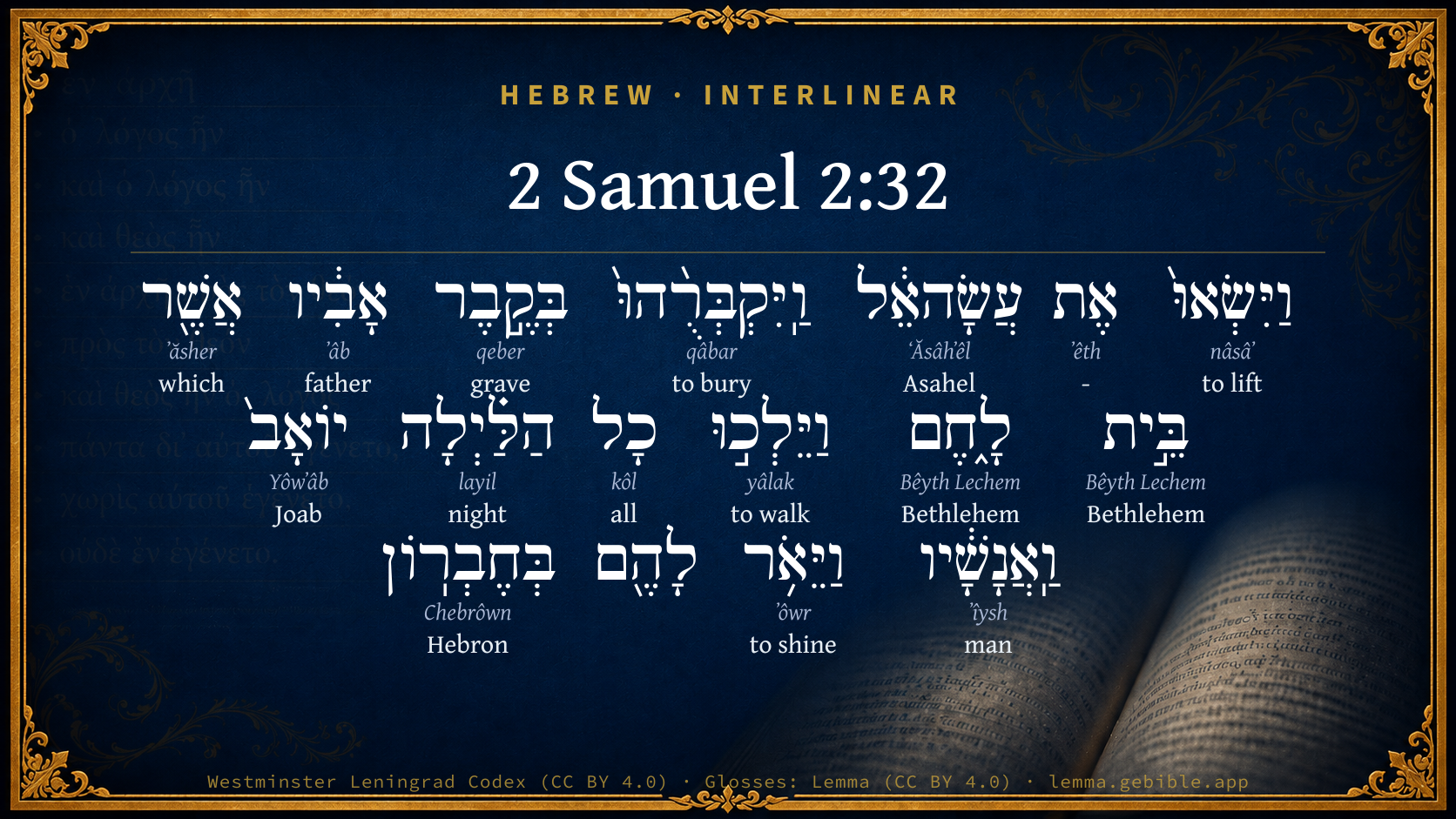
2 Samuel 2:32

Hebrew (Westminster Leningrad Codex) 2 Samuel 2:32 appears in the Hebrew Old Testament. The text above is from the Westminster Leningrad Codex. Each word links to its Strong’s number, a concise gloss, and parsing drawn from the Open Scriptures Hebrew Bible morphology. Click any word for its full Brown-Driver-Briggs (BDB) entry.
Download image
Cite this verse

2 Samuel 2:32 (World English Bible). Public Domain. Lemma interlinear Bible study tool, https://lemma.gebible.app/v/2-samuel/2/32.

Show BibTeX & RIS
BibTeX
RIS
English Translation
They took up Asahel, and buried him in the tomb of his father, which was in Bethlehem. Joab and his men went all night, and the day broke on them at Hebron.
World English Bible · Public Domain
Download a study sheet

One document with this verse’s original text, its word-by-word gloss line, the meaning frame, cross-references with their text, attributed commentary, and full source and license credits — printable, and it pastes into notes with its structure intact.

This verse Autodidact and up

Study sheet (.html) Plain text (.txt)

A passage Seminary Student

Up to 50 verses in one chapter. A passage sheet keeps up to 6 commentary sources and 12 cross-references per verse, in the order this page ranks them, and says so on the sheet whenever that leaves anything out. Ask for a single verse and you get the Autodidact verse sheet above.

Everything on this page stays free to read, with no account — the sheet is a download of what is already on screen, not access to it.

Want to remove ads? Support Godless Engineer
Compare translations 3

The same verse in 3 English versions, stacked beneath the original-language interlinear above. Click any original word for its lexicon entry.

Each is an independent rendering of the whole verse — the interlinear is not word-aligned to these translations.

Highlighted words mark where these versions differ — a whole-verse word diff, not a word-by-word alignment.

  • World English Bible Public Domain
    They took up Asahel, and buried him in the tomb of his father, which was in Bethlehem. Joab and his men went all night, and the day broke on them at Hebron.
  • King James Version Public Domain
    And they took up Asahel, and buried him in the sepulchre of his father, which was in Bethlehem. And Joab and his men went all night, and they came to Hebron at break of day.
  • unfoldingWord Literal Text CC BY-SA 4.0
    And they took up Asahel, and they buried him in the tomb of his father, which Bethlehem. And Joab and his men walked all of the night, and it became light for them at Hebron.

unfoldingWord Literal Text — © unfoldingWord, licensed CC BY-SA 4.0. Word-aligned USFM3 via Door43 (git.door43.org/unfoldingWord/en_ult).

Versions to compare (up to 4)

3 of 4 selected

Show all 18 translations

Every available English version of this verse, each an independent rendering of the whole verse.

  • World English Bible Public Domain
    They took up Asahel, and buried him in the tomb of his father, which was in Bethlehem. Joab and his men went all night, and the day broke on them at Hebron.
  • Berean Standard Bible Public Domain
    Later, they took Asahel and buried him in his father’s tomb in Bethlehem. Then Joab and his men marched all night and reached Hebron at daybreak.
  • Majority Standard Bible Public Domain
    And they took Asahel and buried him in his father’s tomb in Bethlehem. Then Joab and his men marched all night and reached Hebron at daybreak.
  • King James Version Public Domain
    And they took up Asahel, and buried him in the sepulchre of his father, which was in Bethlehem. And Joab and his men went all night, and they came to Hebron at break of day.
  • American Standard Version (1901) Public Domain
    And they took up Asahel, and buried him in the sepulchre of his father, which was in Beth-lehem. And Joab and his men went all night, and the day brake upon them at Hebron.
  • Revised Version (1885) Public Domain
    And they took up Asahel, and buried him in the sepulchre of his father, which was in Beth-lehem. And Joab and his men went all night, and the day brake upon them at Hebron.
  • Geneva Bible (1599) Public Domain
    And they tooke vp Asahel, and buried him in the sepulchre of his father, which was in Bethlehem: and Ioab and his men went all night, and when they came to Hebron, the day arose.
  • Douay-Rheims (1899) Public Domain
    And they took Asael, and buried him in the sepulchre of his father in Bethlehem, and Joab, and the men that were with him, marched all the night, and they came to Hebron at break of day.
  • Young's Literal Translation Public Domain
    And they lift up Asahel, and bury him in the burying-place of his father, which `is' in Beth-Lehem, and they go all the night -- Joab and his men -- and it is light to them in Hebron.
  • Literal Standard Version CC BY-SA 4.0
    And they lift up Asahel, and bury him in the burying-place of his father, which [is] in Beth-Lehem, and they go all the night—Joab and his men—and [dawn’s light] shines on them in Hebron.
  • Unlocked Literal Bible CC BY-SA 4.0
    Then they took up Asahel and buried him in the tomb of his father, which was in Bethlehem. Joab and his men traveled all night, and the day dawned on them at Hebron.
  • unfoldingWord Literal Text CC BY-SA 4.0
    And they took up Asahel, and they buried him in the tomb of his father, which Bethlehem. And Joab and his men walked all of the night, and it became light for them at Hebron.
  • Darby Bible Public Domain
    And they took up Asahel, and buried him in the sepulchre of his father, which was in Bethlehem. And Joab and his men went all night, and they came to Hebron at break of day.
  • World Messianic Bible Public Domain
    They took up Asahel and buried him in the tomb of his father, which was in Bethlehem. Joab and his men went all night, and the day broke on them at Hebron.
  • Webster's Bible Public Domain
    And they took up Asahel, and buried him in the sepulcher of his father, which was in Beth-lehem. And Joab and his men went all night, and they came to Hebron at break of day.
  • Free Bible Version CC BY-SA 4.0
    They took Asahel's body and buried him in his father's tomb in Bethlehem. Then they marched all through the night and reached Hebron at dawn.
  • Bible in Basic English Public Domain
    And they took Asahel's body and put it in the last resting-place of his father in Beth-lehem. And Joab and his men, travelling all night, came to Hebron at dawn.
  • JPS Tanakh (1917) Public Domain
    And they took up Asahel, and buried him in the sepulchre of his father, which was in Beth-lehem. And Joab and his men went all night, and the day broke upon them at Hebron.

Literal Standard Version (2020), Covenant Press — licensed CC BY-SA 4.0. Text via the HelloAO Bible API (eBible.org). Unlocked Literal Bible (unfoldingWord) — licensed CC BY-SA 4.0. Text via the HelloAO Bible API (eBible.org). unfoldingWord Literal Text — © unfoldingWord, licensed CC BY-SA 4.0. Word-aligned USFM3 via Door43 (git.door43.org/unfoldingWord/en_ult). Free Bible Version, Dr. Jonathan Gallagher — licensed CC BY-SA 4.0. Text via the HelloAO Bible API (eBible.org).

Word by word

More ways to search: Search by grammar → Find every occurrence → Compare this word →

Practice this passage: Drill this verse → Learn its vocabulary →

עֲשָׂהאֵ֔ל
ʻĂsâhʼêl
H6214
“Asahel”
Noun, Proper
Part of Speech
Noun
Type
Proper
Full BDB Definition

Origin: from H6213 and H410

TWOT: None

Asahel = "God-made" - nephew of David, son of David's sister Zeruiah, and brother of Joab and Abishai; swift of foot he was killed by Abner when he pursued him in battle and caught him - a Levite in the reign of king Jehoshaphat of Judah who went through the kingdom giving instruction in the law - a Levite in the reign of king Hezekiah of Judah in charge of the tithes and dedicated things in the temple - a priest, father of Jonathan, in the time of Ezra
  1. וַיִּשְׂאוּ֙ nâsâʼ H5375 “and · to lift” Conjunction + Verb, Qal, Sequential Imperfect, 3rd Person, Masculine, Plural
  2. אֶת ʼêth H853 “-” Particle, Direct Object
  3. וַֽיִּקְבְּרֻ֨הוּ֙ qâbar H6912 “and · to bury · him” Conjunction + Verb, Qal, Sequential Imperfect, 3rd Person, Masculine, Plural + Suffix, Personal, 3rd Person, Masculine, Singular
  4. בְּקֶ֣בֶר qeber H6913 “in/at · grave of” Preposition + Noun, Common, Masculine, Singular, Construct
  5. אָבִ֔יו ʼâb H1 “father · his” Noun, Common, Masculine, Singular, Construct + Suffix, Personal, 3rd Person, Masculine, Singular
  6. אֲשֶׁ֖ר ʼăsher H834 “which” Particle, Relative
  7. בֵּ֣ית Bêyth Lechem H1035 “Bethlehem” Noun, Proper
  8. לָ֑חֶם Bêyth Lechem H1035 “Bethlehem” Noun, Proper
  9. וַיֵּלְכ֣וּ yâlak H3212 “and · to walk” Conjunction + Verb, Qal, Sequential Imperfect, 3rd Person, Masculine, Plural
  10. כָל kôl H3605 “all of” Noun, Common, Masculine, Singular, Construct
  11. הַלַּ֗יְלָה layil H3915 “the · night” Particle, Definite Article + Noun, Common, Masculine, Singular, Absolute
  12. יוֹאָב֙ Yôwʼâb H3097 “Joab” Noun, Proper
  13. וַֽאֲנָשָׁ֔יו ʼîysh H376 “and · men · his” Conjunction + Noun, Common, Masculine, Plural, Construct + Suffix, Personal, 3rd Person, Masculine, Singular
  14. וַיֵּאֹ֥ר ʼôwr H215 “and · to shine” Conjunction + Verb, Qal, Sequential Imperfect, 3rd Person, Masculine, Singular
  15. בְּחֶבְרֽוֹן Chebrôwn H2275 “in/at · Hebron” Preposition + Noun, Proper

About this verse

These counts appear in no published source. They are computed here, from the morphology-tagged text and Lemma’s own curated glosses. What Lemma adds →

17
words
15
distinct lemmas
Historical
section

Notable vocabulary

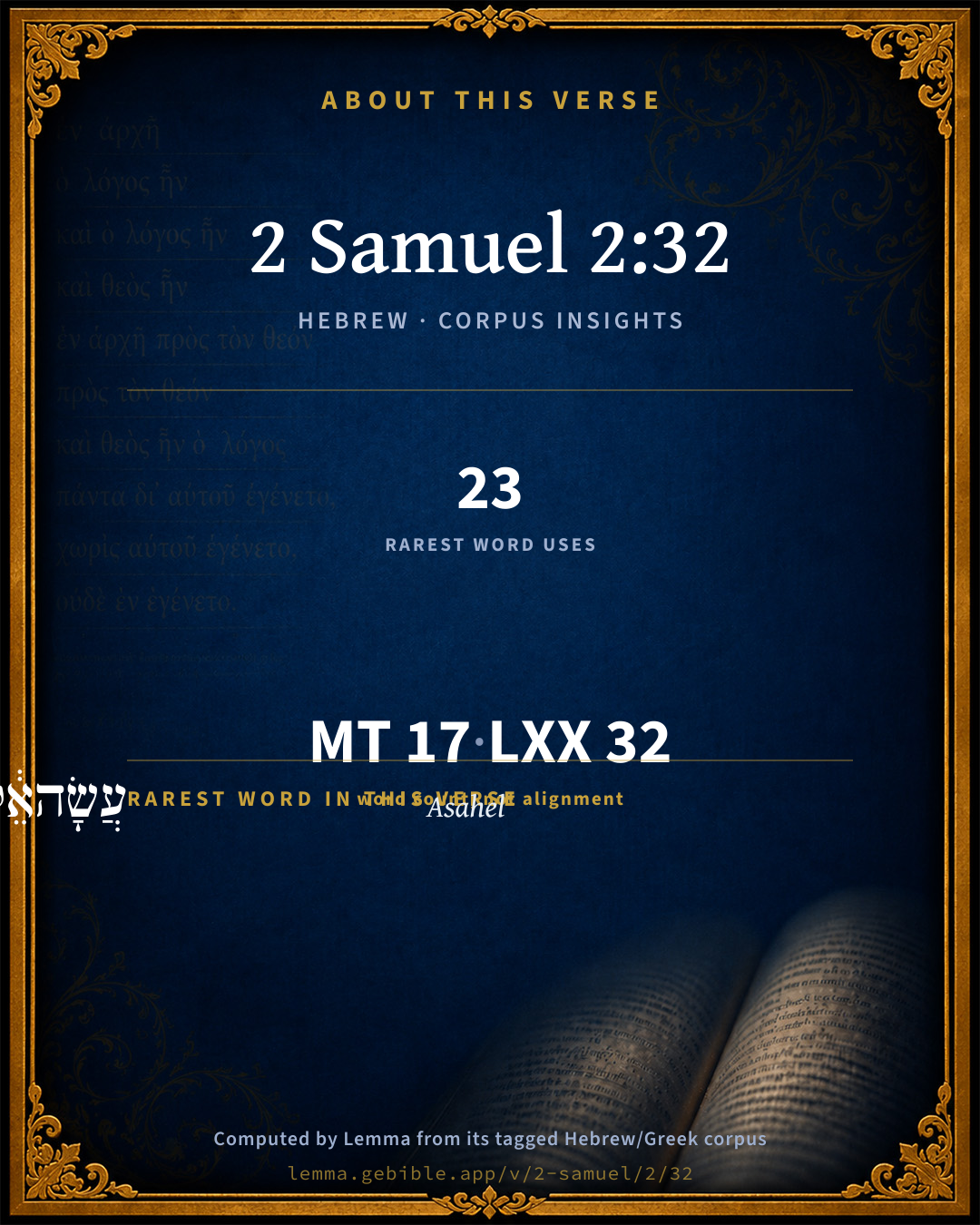
The rarest word here is עֲשָׂהאֵ֔ל Asahel H6214 — appearing just 23 times in the whole Hebrew Bible.

Shared distinctive vocabulary

עֲשָׂהאֵ֔ל Asahel H6214 occurs in 17 verses of the Hebrew Bible. Also found in:

Grammatical profile

  • 4 verbs
  • 10 nouns
  • 1 preposition
  • 2 particles

Verb forms

  • וַיִּשְׂאוּ֙ Qal · Sequential Imperfect
  • וַֽיִּקְבְּרֻ֨הוּ֙ Qal · Sequential Imperfect
  • וַיֵּלְכ֣וּ Qal · Sequential Imperfect
  • וַיֵּאֹ֥ר Qal · Sequential Imperfect

Repetition

A word recurs within this verse — often emphatic in Hebrew:

  • בֵּ֣ית Bethlehem H1035 ×2

Hebrew & Septuagint length

In English translation the verse runs 32 words from the Hebrew and 35 from the Septuagint (LXX English) — closely comparable.

A rough comparison of the two English renderings, which tokenize alike — not a word-level alignment.

Word counts can differ between the Hebrew and the Greek without any difference in meaning — e.g. the Hebrew direct-object marker אֵת has no separate Greek word, and Greek often adds the article ὁ.

In the original languages it is 17 Hebrew tokens and 32 Greek tokens — but the two are counted differently (Hebrew bundles its prefixes and suffixes into one token; the Greek is in lemma form), so that isn’t a like-for-like length.

Cross-references

6

Topical passages linked to 2 Samuel 2:32 in the Treasury of Scripture Knowledge — connected by theme and wording, ordered by reader-vote popularity; previews shown in the World English Bible.

  • 1 Samuel 17:58 Saul said to him, Whose son are you, you young man? David answered, I am the son of your servant Jesse the Bethlehemite.
  • 2 Samuel 5:1 Then came all the tribes of Israel to David to Hebron, and spoke, saying, Behold, we are your bone and your flesh.
  • 1 Chronicles 2:13–16 and Jesse became the father of his firstborn Eliab, and Abinadab the second, and Shimea the third,
  • 2 Chronicles 16:14 They buried him in his own tombs, which he had hewn out for himself in the city of David, and laid him in the bed which was filled with sweet odors and various kinds [of spices] prepared by the perfumers' are: and they made a very great burning for him.
  • 2 Chronicles 21:1 Jehoshaphat slept with his fathers, and was buried with his fathers in the city of David: and Jehoram his son reigned in his place.
  • Proverbs 22:29 Do you see a man skilled in his work? He will serve kings; He won't serve obscure men.

Cross-references courtesy of OpenBible.info (CC BY 4.0).

Hebrew and Greek witnesses Masoretic Hebrew ↔ Greek Septuagint

The same verse in the two great witnesses to the Old Testament, shown verse-for-verse.

These are two independent witnesses, not word-aligned to each other, and the Septuagint is shown in lemma (dictionary) form.

Hebrew 2 Samuel 2:32 Masoretic · Westminster Leningrad Codex

וַיִּשְׂאוּ֙ אֶת עֲשָׂהאֵ֔ל וַֽיִּקְבְּרֻ֨הוּ֙ בְּקֶ֣בֶר אָבִ֔יו אֲשֶׁ֖ר בֵּ֣ית לָ֑חֶם וַיֵּלְכ֣וּ כָל הַלַּ֗יְלָה יוֹאָב֙ וַֽאֲנָשָׁ֔יו וַיֵּאֹ֥ר לָהֶ֖ם בְּחֶבְרֽוֹן

They took up Asahel, and buried him in the tomb of his father, which was in Bethlehem. Joab and his men went all night, and the day broke on them at Hebron.

World English Bible · Public Domain

Greek LXX 2 Samuel 2:32 Septuagint · lemma form

καί αἴρω ὁ ασαηλ καί θάπτω αὐτός ἐν ὁ τάφος ὁ πατήρ αὐτός ἐν βαιθλεεμ καί πορεύομαι ιωαβ καί ὁ ἀνήρ ὁ μετά αὐτός ὅλος ὁ νύξ καί διαφαύσκω αὐτός ἐν χεβρων

And they take up Asael, and bury him in the tomb of his father in Bethleem. And Joab and the men with him went all the night, and the morning rose upon them in Chebron.

LXX2012 (modern English Septuagint) · Public Domain

Hebrew: Westminster Leningrad Codex (CC BY 4.0). Greek: Septuagint (public domain); English from LXX2012 (modern English Septuagint) (Public Domain). How the Septuagint differs from the Hebrew →

Targum (Aramaic paraphrase)

1

The Targum is the ancient Jewish Aramaic paraphrase of the Hebrew Scriptures — an interpretive translation, not the Hebrew text itself. Onkelos (literal) and Pseudo-Jonathan (expansive) render the Torah, and Jonathan the Prophets. Coverage is partial: where no permissively-licensed English translation exists for a verse, only the Aramaic is shown. This is verse-level text, not a word-by-word alignment to the Hebrew.

  1. Targum Jonathan Prophets (Joshua–Malachi)
    וּנְטַלוּ יַת עֲשָׂהאֵל וּקְבָרוּהִי בְּקִבְרָא דַאֲבוּהִי דִי בְּבֵית לֶחֶם וַאֲזַלוּ כָּל לֵילְיָא יוֹאָב וְגַבְרוֹהִי וּנְהַר לְהוֹן בְּחֶבְרוֹן:

    (no public-domain English translation for this verse)

    Targum Jonathan — Aramaic: “Mikraot Gedolot” (public domain). English: “Sefaria Community Translation” (CC0 1.0 (public-domain dedication)); “London "Chaldee Paraphrase," 1871” (public domain). Text via Sefaria.

Commentary

Notes on 2 Samuel 2:32 from classic Christian and Jewish commentators (each source and its license shown beneath its notes). The classic Christian expositions comment on the surrounding passage and are grouped to its opening verse, so a note may address several verses; the Jewish commentaries on the Tanakh (Rashi and others) are per-verse, so they appear only where the commentator wrote on this verse.

Lemma curates 59 commentaries, every one of them public domain or Creative Commons licensed, each selected and text-cleaned for this edition rather than reprinted as found. About our sources →

Trapp's Complete Commentary

John Trapp

2Sa 2:32 And they took up Asahel, and buried him in the sepulchre of his father, which [was in] Bethlehem. And Joab and his men went all night, and they came to Hebron at break of day.

Ver. 32. And buried him in the sepulchre of his father.] This they did, likely, after that they had first been with David at Hebron, to give him an account of that expedition.

John Trapp, A Commentary or Exposition upon All the Books of the Old and New Testament (1647–1656) — public domain. Text from a community e-Sword module.

The Biblical Illustrator

Joseph S. Exell

2Sa_2:32

They came to Hebron at break of day.

The break of day

Joab and his men walking all night towards Hebron, and reaching it at break of day. See in this a symbol of the pilgrimage of our earthly life, in what must be as darkness compared with the wondrous light to which we press, but reaching rest at last, yet not till the break of that golden day.

I. Are we pilgrims of the light, or of the night? Of both. Of the light as we press to reach it, as even now its beams fall on our pathway here, enlightening much that else might perplex. Yet must that light only make the remaining darkness felt. Is it not of the New Jerusalem that it is written, There shall be no night there? Can I say there is no night here--no night of sorrow, no pain, no burden clouding heart and mind? Even when life is brightest with us, the very sense of comfort and joy abides because we know that they have about them a heavenly atmosphere. They are to us God's gifts, and we know that He has in reserve still richer blessings. If we are in sorrow we yearn for God, and in joy we rest still in Him. There is always something before the Christian, a brighter life that is to be. We speak of the night of death. Henry Fawcett used to say that from the great illness which prostrated him for so long, he arose, having learnt, what he had recognised before, that death was not to be feared. Nay, more than this, for we need not speak only of the physical aspects of death: we may learn that in death there is not so much a passing into dark valleys--the valleys of the shadow, at all events, are past when death is reached--as a stepping into wondrous light. Death is an unveiling which lets in light and life to our poor human experience. Let us press on in the pilgrimage, though we walk all the night. There is the appointed path and the allotted time. To few will that time, in God's mercy, seem too long, so full is the night of quiet mercies, so little are we alone. But even if the way seem rough, and the hours dark, the night has its own appointed law and limit. Bear up, press on, and all shall be well.

II. The pilgrim shall reach a place of rest. And Joab and his men went all night, and they came to Hebron. Hebron is one of the most ancient cities of the world still standing. It is now a city of some 5,000 inhabitants. It has had many changes in its political history, and has once and again been in ruins. Abraham is called by the Mohammedans Khulil, the Friend--i.e., of God; and this, we are told by travellers, is the modern name of Hebron itself. It is the city of 'the Friend of God. Among our quiet resting-places God not seldom brings us to the places from which we can look back, marking the goodness and mercy which have followed us since that long past when near to the same spot we built with them some altar to the Lord. The Lord accepted the offering of ourselves; through the pilgrimage He has been with us.

III. For notice, lastly, the rest shall be reached at its appointed time. And Joab and his men went all night, and they came to Hebron at break of day. The eternal morning shall not be missed by any who follow on in the way of the Lord's choosing. Only be brave, be faithful, until the day break, and the shadows flee away. Often the shadows of some trouble or some anxiety pass away even here. New light is on our path; the way of lowly duty is plain. Whenever the day-break is upon us, it is only that we may turn, refreshed by rest, to the duty of the new day. (J. Gasquoine, B. A.)

.

The Biblical Illustrator, edited by Joseph S. Exell (c. 1880s–1900s) — public domain. Text from a community e-Sword module.

Joseph Benson's Commentary

2Sa 2:32. They took up Asahel, and buried him in the sepulchre of his father — The rest they buried in the field of battle. Thus are distinctions made on earth, even between the dust of some and of others! But in the resurrection no difference will be made, except between good and bad, which will remain for ever. Joab and his men went all night — Having carried Asahel to Beth-lehem and buried him there, they marched all the next night toward Hebron, Joab hastening home to give an account of his conduct to David.

Joseph Benson's Commentary on the Old and New Testaments (1811–1818) — public domain. Text from a community e-Sword module.

Ellicott's Commentary for English Readers

(32) They took up Asahel.—The bodies of the ordinary soldiers were probably buried on the spot, but on account of Asahel’s position and near relationship to David, his body was carried to Bethlehem, for burial “in the sepulchre of his father.” It thus appears that Zeruiah’s husband (of whom there is no other mention) was also of Bethlehem. The burial must have taken place on the next day (see Note on 2Sa_2:30), and, with the previous march of ten miles, would have filled up that day. It was, therefore, twenty-four hours after the close of the battle before they were ready to start from Bethlehem. The night may have been chosen for the march to avoid the heat; and the distance from Bethlehem to Hebron was about thirteen miles.

A Bible Commentary for English Readers, edited by Charles John Ellicott (1878–1897) — public domain. Text from a community e-Sword module.

The Cambridge Bible for Schools and Colleges

gen. ed. J. J. S. Perowne

32. in the sepulchre of his father … in Beth-lehem] The only reference to Zeruiah’s husband, who appears from this notice to have been a Bethlehemite. Josephus calls him Suri (Σουρί).

went all night] Clearly the night after Asahel’s burial, not the night after the battle. The fighting was not over till after sunset (2Sa_2:24), and it would have been impossible to collect the army, make necessary arrangements, and march a distance of at least 26 miles from Gibeon to Hebron, burying Asahel on the way. Joab no doubt spent the night at Gibeon, marched to Bethlehem the next day, and after burying his brother, hastened on to report himself to David at Hebron.

The Cambridge Bible for Schools and Colleges (gen. ed. J. J. S. Perowne; Cambridge University Press, 1878–1918) — public domain. Text from a community e-Sword module.

John Gill's Exposition

And they took up Asahel,.... From the place where he fell; that is, Joab and Abishai, his brethren, as Josephus (w) relates; after they had buried the dead in the field of battle, they took up him:

and buried him in the sepulchre of his father, which was in Bethlehem: not in the city of Bethlehem, but without it, on the south side of it; so says Fuller (x),"southward, i.e. of Bethlehem, we find Asahel's sepulchre, who was buried in the grave of his father.''What was his father's name is not known, only his mother's name, Zeruiah, is mentioned in Scripture, a sister of David, and daughter of Jesse the Bethlehemite. Bethlehem was sixteen miles from Gibeon, according to Bunting (y).

And Joab and his men went all night; not the night following the battle, but the night following the next day, after he had been to Bethlehem, and buried his brother there; wherefore, lest David should think it long before he came, he travelled all night:

and they came to Hebron at break of day; where David was, which, according to the same writer (z), was twenty miles from Bethlehem.

(w) Antiqu. l. 7. c. 1. sect. 3. (x) Pisgah-Sight of Palestine, B. 2. c. 14. sect. 21. p. 301. (y) Travels, ut supra. (p. 145, 146.) (z) Travels, ut supra. (p. 145, 146.)

Next: 2 Samuel Chapter 3

John Gill's Exposition of the Whole Bible (1746–1763) — public domain (CC PDM 1.0). Text via the HelloAO Bible API.

Albert Barnes' Notes on the Bible

Joab, having stopped the pursuit, passed the night with his army on the field of battle; the next morning he numbered the missing, and buried the dead; they carried the body of Asahel to Bethlehem and buried him there, and then joined David at Hebron. Hebron would be about 14 miles from Bethlehem, or about five hours’ march.

Albert Barnes' Notes on the Bible (1834–1885) — public domain. Text from a community e-Sword/MySword module.

Haydock's Catholic Bible Commentary

Day, after a march of ten hours. (Adrichomius) (Menochius)

George Leo Haydock (1774–1849), Haydock's Catholic Family Bible and Commentary, 1859 edition — public domain. Excludes Psalms (Douay-Rheims chapter numbering differs from Protestant) and Deuterocanonical books (Catholic canon only).

Whedon's Commentary on the Bible

Daniel D. Whedon

32. Came to Hebron at break of day — Literally, it became light to them, in Hebron. Perhaps the day after the burial of Asahel is meant, as it was sunset when the pursuit ceased. 2Sa_2:24. But it was not impossible for David’s men to have taken Asahel from the wilderness of Gibeon to Beth-lehem, a distance of twelve or fifteen miles, buried him, and gone on to Hebron, fourteen miles further, in the course of a single night. Joab and his hardy companions were used to long marches and rapid movements.

Daniel D. Whedon (gen. ed.), Commentary on the Old and New Testaments (1874–1909) — public domain. Text from a community e-Sword module.

The Pulpit Commentary

The sepulchre of his father, which was in Bethlehem. The Name of Zeruiah"s husband is never mentioned, but he was evidently of the same town as his wife, and at his death, when probably still young, he had received honourable sepulture. As Bethlehem is about eleven miles distant from Gideon, Joab probably marched thither straight from the battlefield, anti spent the next day in paying the last tribute of respect to his brother, and in refreshing his men. At nightfall he resumed his march to Hebron, which was fifteen miles further to the south, and where he would arrive on the morning following that on which Abner reached Mahanaim.

The Pulpit Commentary (1880–1919), ed. H.D.M. Spence-Jones & Joseph S. Exell — public domain. Text from a community e-Sword module.

John Wesley's Explanatory Notes

In Bethlehem - The rest they buried in the field of battle, but Asahel in the sepulchre of his father. Thus are distinctions made upon earth, even between the dust of some and of others! But in the resurrection no difference will be made but between good and bad; which will remain forever.

John Wesley, Explanatory Notes Upon the Whole Bible (1754–1765) — public domain. Text via the GEBible commentary corpus.

Keil & Delitzsch

C. F. Keil & F. Delitzsch

On the way back, David's men took up the body of Asahel, and buried it in his father's grave at Bethlehem. They proceeded thence towards Hebron, marching the whole night, so that they reached Hebron itself at daybreak. "It got light to them (i.e., the day dawned) at Hebron."

Keil & Delitzsch — Biblical Commentary on the Old Testament (1861–1891) — public domain (CC PDM 1.0). Text via the HelloAO Bible API. (Old Testament only.)

Lesson kit

Teaching starters — assembled from the data on this page, not authored interpretation. Every prompt links to the verse data it draws on. Edit before teaching.

2 Samuel, in the Historical, opens this verse with 17 words (15 distinct Hebrew lemmas). Its most distinctive word is ʻĂsâhʼêl (“Asahel”). A historical commentator’s framing appears above. Read the whole chapter for the surrounding context.

Discussion questions

  1. How does “Asahel” (ʻĂsâhʼêl) shape what this verse is saying?
  2. 2 Samuel 2:18 shares the word «Asahel» with this verse. How do the two illuminate each other?
  3. “Bethlehem” occurs 2× in this one verse. What is the effect of the repetition?
  4. These translations render this verse differently. What is at stake in choosing one wording over another?
  5. The verb «וַיִּשְׂאוּ֙» is Qal Sequential Imperfect. How does its form color the action?
  6. Reading how Trapp's Complete Commentary and The Biblical Illustrator read this verse, where do the two commentators agree and where do they part?

Things to notice

Reading settings

Reading text

Shown beneath each verse's original-language words.

Old Testament
Old Testament edition

Read the OT as the Masoretic Hebrew (MT) or the Greek Septuagint (LXX).

English shown for the Greek Septuagint (in the Hebrew ↔ Greek comparison).

Comparing translations? Open the Compare panel on any verse page to stack up to four side by side.