
Ezekiel 10:19

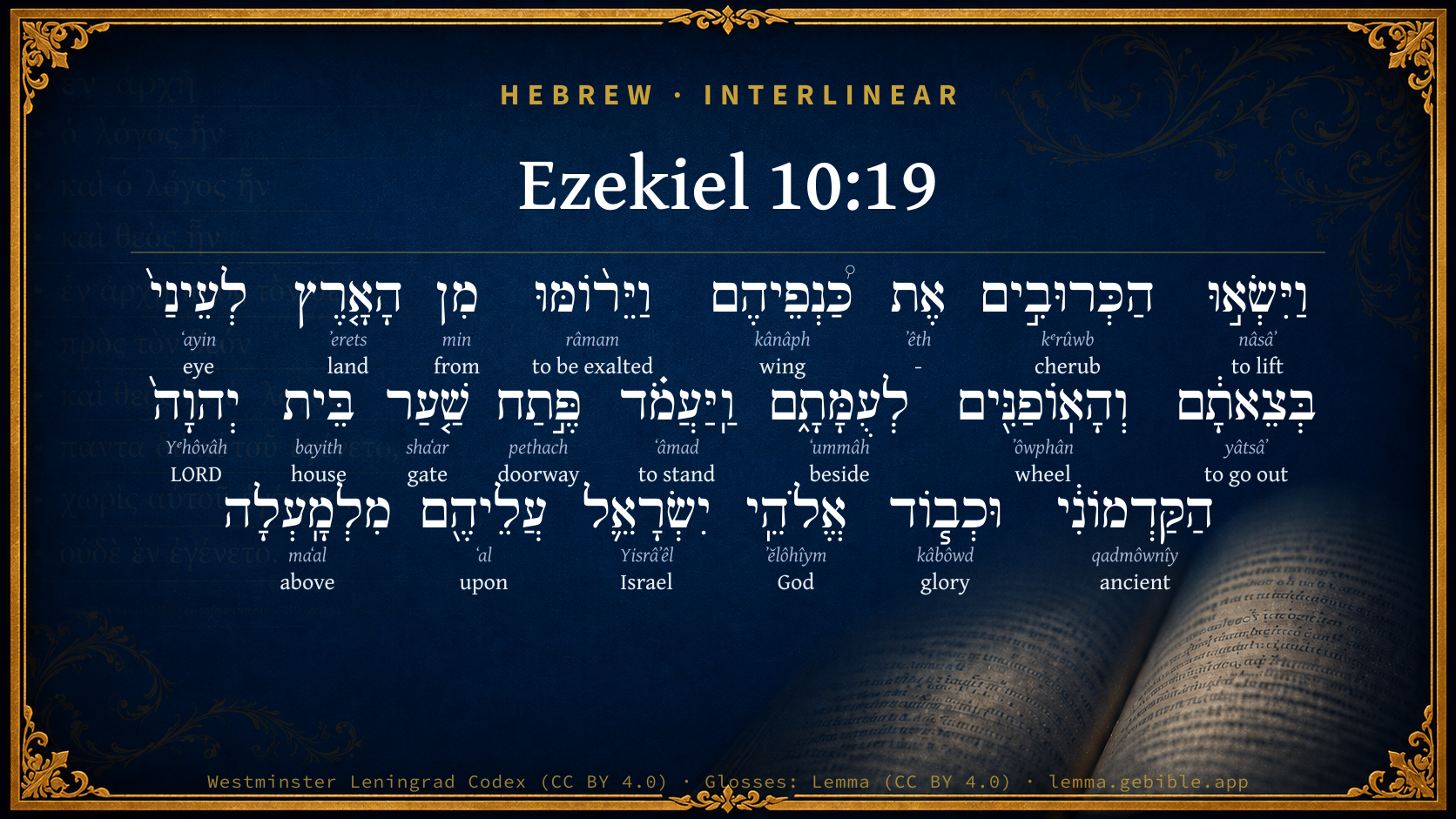
Hebrew (Westminster Leningrad Codex) Ezekiel 10:19 appears in the Hebrew Old Testament. The text above is from the Westminster Leningrad Codex. Each word links to its Strong’s number, a concise gloss, and parsing drawn from the Open Scriptures Hebrew Bible morphology. Click any word for its full Brown-Driver-Briggs (BDB) entry.
Download image
Cite this verse

Ezekiel 10:19 (World English Bible). Public Domain. Lemma interlinear Bible study tool, https://lemma.gebible.app/v/ezekiel/10/19.

Show BibTeX & RIS
BibTeX
RIS
English Translation
The cherubim lifted up their wings, and mounted up from the earth in my sight when they went forth, and the wheels beside them: and they stood at the door of the east gate of Yahweh's house; and the glory of the God of Israel was over them above.
World English Bible · Public Domain
Download a study sheet

One document with this verse’s original text, its word-by-word gloss line, the meaning frame, cross-references with their text, attributed commentary, and full source and license credits — printable, and it pastes into notes with its structure intact.

This verse Autodidact and up

Study sheet (.html) Plain text (.txt)

A passage Seminary Student

Up to 50 verses in one chapter. A passage sheet keeps up to 6 commentary sources and 12 cross-references per verse, in the order this page ranks them, and says so on the sheet whenever that leaves anything out. Ask for a single verse and you get the Autodidact verse sheet above.

Everything on this page stays free to read, with no account — the sheet is a download of what is already on screen, not access to it.

Want to remove ads? Support Godless Engineer
Compare translations 3

The same verse in 3 English versions, stacked beneath the original-language interlinear above. Click any original word for its lexicon entry.

Each is an independent rendering of the whole verse — the interlinear is not word-aligned to these translations.

Highlighted words mark where these versions differ — a whole-verse word diff, not a word-by-word alignment.

  • World English Bible Public Domain
    The cherubim lifted up their wings, and mounted up from the earth in my sight when they went forth, and the wheels beside them: and they stood at the door of the east gate of Yahweh's house; and the glory of the God of Israel was over them above.
  • King James Version Public Domain
    And the cherubims lifted up their wings, and mounted up from the earth in my sight: when they went out, the wheels also were beside them, and every one stood at the door of the east gate of the LORD's house; and the glory of the God of Israel was over them above.
  • unfoldingWord Literal Text CC BY-SA 4.0
    The cherubim lifted up their wings and rose from the earth in my sight when they went out, and the wheels did the same beside them. They stood at the eastern entrance to Yahweh’s house, and the glory of the God of Israel came upon them from above.

unfoldingWord Literal Text — © unfoldingWord, licensed CC BY-SA 4.0. Word-aligned USFM3 via Door43 (git.door43.org/unfoldingWord/en_ult).

Versions to compare (up to 4)

3 of 4 selected

Show all 18 translations

Every available English version of this verse, each an independent rendering of the whole verse.

  • World English Bible Public Domain
    The cherubim lifted up their wings, and mounted up from the earth in my sight when they went forth, and the wheels beside them: and they stood at the door of the east gate of Yahweh's house; and the glory of the God of Israel was over them above.
  • Berean Standard Bible Public Domain
    As I watched, the cherubim lifted their wings and rose up from the ground, with the wheels beside them as they went. And they stopped at the entrance of the east gate of the house of the LORD, with the glory of the God of Israel above them.
  • Majority Standard Bible Public Domain
    As I watched, the cherubim lifted their wings and rose up from the ground, with the wheels beside them as they went. And they stopped at the entrance of the east gate of the house of the LORD, with the glory of the God of Israel above them.
  • King James Version Public Domain
    And the cherubims lifted up their wings, and mounted up from the earth in my sight: when they went out, the wheels also were beside them, and every one stood at the door of the east gate of the LORD's house; and the glory of the God of Israel was over them above.
  • American Standard Version (1901) Public Domain
    And the cherubim lifted up their wings, and mounted up from the earth in my sight when they went forth, and the wheels beside them: and they stood at the door of the east gate of Jehovah's house; and the glory of the God of Israel was over them above.
  • Revised Version (1885) Public Domain
    And the cherubim lifted up their wings, and mounted up from the earth in my sight when they went forth, and the wheels beside them: and they stood at the door of the east gate of the LORD’S house; and the glory of the God of Israel was over them above.
  • Geneva Bible (1599) Public Domain
    And the Cherubims lift vp their wings, and mounted vp from the earth in my sight: when they went out, the wheeles also were besides them: and euery one stoode at the entrie of the gate of the Lordes House at the East side, and the glorie of the God of Israel was vpon them on hie.
  • Douay-Rheims (1899) Public Domain
    And the cherubims lifting up their wings, were raised from the earth before me: and as they went out, the wheels also followed: and it stood in the entry of the east gate of the house of the Lord: and the glory of the God of Israel was over them.
  • Young's Literal Translation Public Domain
    and the cherubs lift up their wings, and are lifted up from the earth before mine eyes; in their going forth, the wheels also `are' over-against them, and he standeth at the opening of the east gate of the house of Jehovah, and the honour of the God of Israel `is' over them from above.
  • Literal Standard Version CC BY-SA 4.0
    and the cherubim lift up their wings, and are lifted up from the earth before my eyes; in their going forth, the wheels [are] also alongside them, and he stands at the opening of the east gate of the house of YHWH, and the glory of the God of Israel [is] over them from above.
  • Unlocked Literal Bible CC BY-SA 4.0
    The cherubim lifted up their wings and rose from the earth in my sight when they went out, and the wheels did the same beside them. They stood at the eastern entrance to Yahweh's house, and the glory of the God of Israel came upon them from above.
  • unfoldingWord Literal Text CC BY-SA 4.0
    The cherubim lifted up their wings and rose from the earth in my sight when they went out, and the wheels did the same beside them. They stood at the eastern entrance to Yahweh’s house, and the glory of the God of Israel came upon them from above.
  • Darby Bible Public Domain
    And the cherubim lifted up their wings, and mounted up from the earth in my sight, when they went out; and the wheels were beside them; and they stood at the door of the east gate of Jehovah's house; and the glory of the God of Israel was over them above.
  • World Messianic Bible Public Domain
    The cherubim lifted up their wings and mounted up from the earth in my sight when they went out, with the wheels beside them. Then they stood at the door of the east gate of the LORD’s house; and the glory of the God of Israel was over them above.
  • Webster's Bible Public Domain
    And the cherubim lifted up their wings, and mounted up from the earth in my sight: when they went out, the wheels also were beside them, and every one stood at the door of the east-gate of the LORD'S house; and the glory of the God of Israel was over them above.
  • Free Bible Version CC BY-SA 4.0
    As I watched, the cherubim lifted their wings and took off, with the wheels alongside them. They stopped at the entrance of the east gate of the Lord's Temple, and the glory of the God of Israel was above them.
  • Bible in Basic English Public Domain
    And the winged ones, lifting up their wings, went up from the earth before my eyes, with the wheels by their side: and they came to rest at the east doorway of the Lord's house; and the glory of the God of Israel was over them on high.
  • JPS Tanakh (1917) Public Domain
    And the cherubim lifted up their wings, and mounted up from the earth in my sight when they went forth, and the wheels beside them; and they stood at the door of the east gate of the LORD'S house; and the glory of the God of Israel was over them above.

Literal Standard Version (2020), Covenant Press — licensed CC BY-SA 4.0. Text via the HelloAO Bible API (eBible.org). Unlocked Literal Bible (unfoldingWord) — licensed CC BY-SA 4.0. Text via the HelloAO Bible API (eBible.org). unfoldingWord Literal Text — © unfoldingWord, licensed CC BY-SA 4.0. Word-aligned USFM3 via Door43 (git.door43.org/unfoldingWord/en_ult). Free Bible Version, Dr. Jonathan Gallagher — licensed CC BY-SA 4.0. Text via the HelloAO Bible API (eBible.org).

Word by word

More ways to search: Search by grammar → Find every occurrence → Compare this word →

Practice this passage: Drill this verse → Learn its vocabulary →

וַיֵּר֨וֹמּוּ
râmam
H7426
“and · to be exalted”
Conjunction + Verb, Niphal, Sequential Imperfect, 3rd Person, Masculine, Plural
Part of Speech
Conjunction + Verb
Stem
Niphal
Form
Sequential Imperfect
Person
3rd Person
Gender
Masculine
Number
Plural
Full BDB Definition

Origin: a primitive root

TWOT: 2174

to be exalted, be lifted up - (Qal) to be exalted - (Niphal) to lift oneself
  1. וַיִּשְׂא֣וּ nâsâʼ H5375 “and · to lift” Conjunction + Verb, Qal, Sequential Imperfect, 3rd Person, Masculine, Plural
  2. הַכְּרוּבִ֣ים kᵉrûwb H3742 “the · cherubim” Particle, Definite Article + Noun, Common, Masculine, Plural, Absolute
  3. אֶת ʼêth H853 “-” Particle, Direct Object
  4. כַּ֠נְפֵיהֶם kânâph H3671 “wings · their” Noun, Common, Feminine, Dual, Construct + Suffix, Personal, 3rd Person, Masculine, Plural
  5. מִן min H4480 “from” Preposition
  6. הָאָ֤רֶץ ʼerets H776 “the · land” Particle, Definite Article + Noun, Common, Both, Singular, Absolute
  7. לְעֵינַי֙ ʻayin H5869 “to/for · eyes · my” Preposition + Noun, Common, Both, Dual, Construct + Suffix, Personal, 1st Person, Common, Singular
  8. בְּצֵאתָ֔ם yâtsâʼ H3318 “in/at · to go out · them” Preposition + Verb, Qal, Infinitive Construct + Suffix, Personal, 3rd Person, Masculine, Plural
  9. וְהָאֽוֹפַנִּ֖ים ʼôwphân H212 “and · the · wheels” Conjunction + Particle, Definite Article + Noun, Common, Masculine, Plural, Absolute
  10. לְעֻמָּתָ֑ם ʻummâh H5980 “to/for · beside · their” Preposition + Noun, Common, Feminine, Singular, Construct + Suffix, Personal, 3rd Person, Masculine, Plural
  11. וַֽיַּעֲמֹ֗ד ʻâmad H5975 “and · to stand” Conjunction + Verb, Qal, Sequential Imperfect, 3rd Person, Masculine, Singular
  12. פֶּ֣תַח pethach H6607 “doorway of” Noun, Common, Masculine, Singular, Construct
  13. שַׁ֤עַר shaʻar H8179 “gate of” Noun, Common, Masculine, Singular, Construct
  14. בֵּית bayith H1004 “house of” Noun, Common, Masculine, Singular, Construct
  15. יְהוָה֙ Yᵉhôvâh H3068 “LORD” Noun, Proper
  16. הַקַּדְמוֹנִ֔י qadmôwnîy H6931 “the · ancient” Particle, Definite Article + Adjective, Adjective, Masculine, Singular, Absolute
  17. וּכְב֧וֹד kâbôwd H3519 “and · glory of” Conjunction + Noun, Common, Both, Singular, Construct
  18. אֱלֹהֵֽי ʼĕlôhîym H430 “God(s) of” Noun, Common, Masculine, Plural, Construct
  19. יִשְׂרָאֵ֛ל Yisrâʼêl H3478 “Israel” Noun, Proper
  20. עֲלֵיהֶ֖ם ʻal H5921 “upon · them” Preposition + Suffix, Personal, 3rd Person, Masculine, Plural
  21. מִלְמָֽעְלָה maʻal H4605 “from · to/for · above · toward” Preposition + Preposition + Adverb + Suffix, Demonstrative

About this verse

These counts appear in no published source. They are computed here, from the morphology-tagged text and Lemma’s own curated glosses. What Lemma adds →

22
words
22
distinct lemmas
Prophets
section

Notable vocabulary

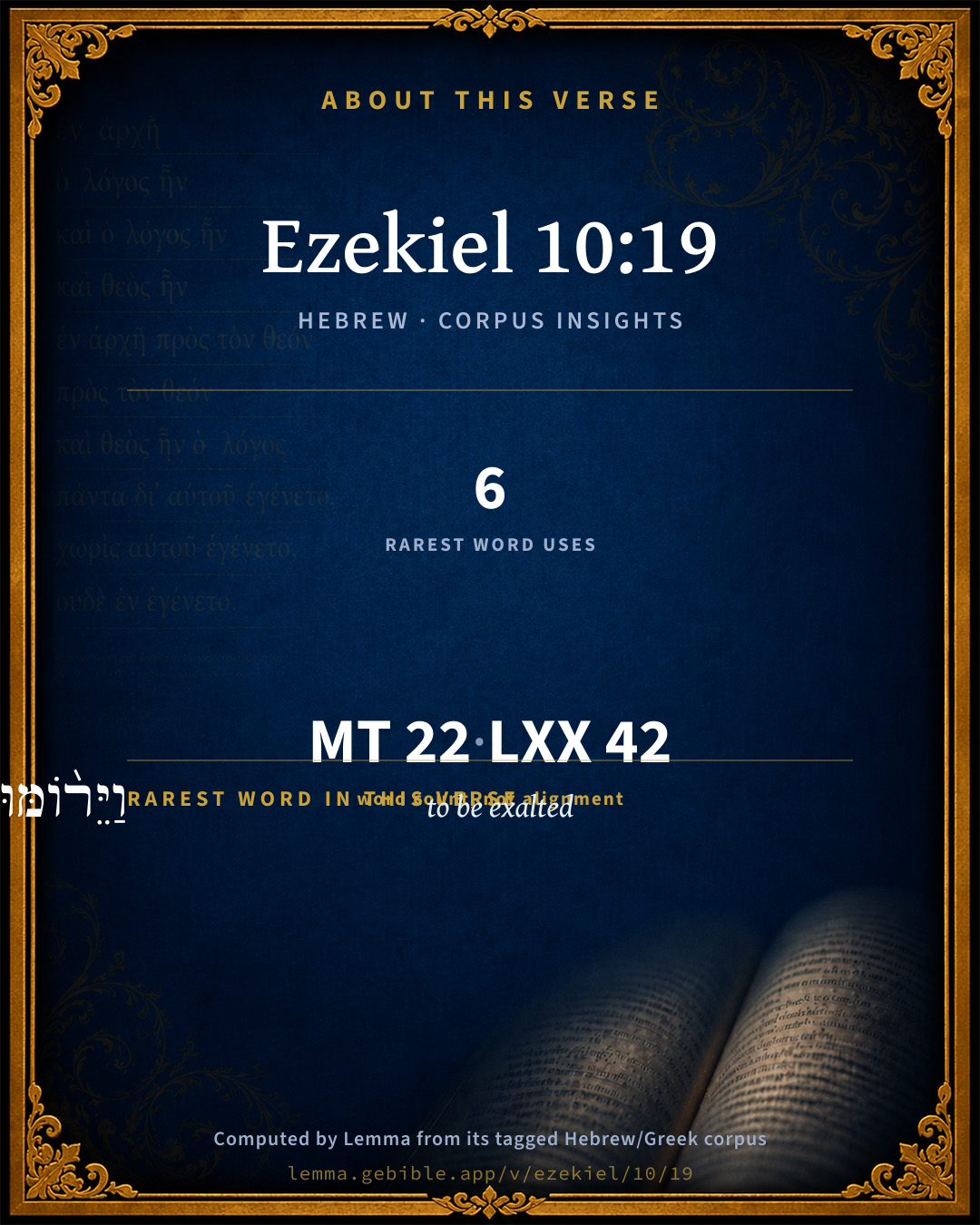
The rarest word here is וַיֵּר֨וֹמּוּ to be exalted H7426 — appearing just 6 times in the whole Hebrew Bible.

Shared distinctive vocabulary

וַיֵּר֨וֹמּוּ to be exalted H7426 occurs in 6 verses of the Hebrew Bible. Also found in:

Grammatical profile

  • 4 verbs
  • 13 nouns
  • 1 adjective
  • 2 prepositions
  • 1 adverb
  • 1 particle

Verb forms

  • וַיִּשְׂא֣וּ Qal · Sequential Imperfect
  • וַיֵּר֨וֹמּוּ Niphal · Sequential Imperfect
  • בְּצֵאתָ֔ם Qal · Infinitive Construct
  • וַֽיַּעֲמֹ֗ד Qal · Sequential Imperfect

Hebrew & Septuagint length

In English translation the verse runs 49 words from the Hebrew and 54 from the Septuagint (LXX English) — closely comparable.

A rough comparison of the two English renderings, which tokenize alike — not a word-level alignment.

Word counts can differ between the Hebrew and the Greek without any difference in meaning — e.g. the Hebrew direct-object marker אֵת has no separate Greek word, and Greek often adds the article ὁ.

In the original languages it is 22 Hebrew tokens and 42 Greek tokens — but the two are counted differently (Hebrew bundles its prefixes and suffixes into one token; the Greek is in lemma form), so that isn’t a like-for-like length.

Cross-references

7

Topical passages linked to Ezekiel 10:19 in the Treasury of Scripture Knowledge — connected by theme and wording, ordered by reader-vote popularity; previews shown in the World English Bible.

  • Ezekiel 1:17–21 When they went, they went in their four directions: they didn't turn when they went.
  • Ezekiel 1:26–28 Above the expanse that was over their heads was the likeness of a throne, as the appearance of a sapphire stone; and on the likeness of the throne was a likeness as the appearance of a man on it above.
  • Ezekiel 8:16 He brought me into the inner court of Yahweh's house; and see, at the door of the temple of Yahweh, between the porch and the altar, were about twenty-five men, with their backs toward the temple of Yahweh, and their faces toward the east; and they were worshipping the sun toward the east.
  • Ezekiel 10:1 Then I looked, and see, in the expanse that was over the head of the cherubim there appeared above them as it were a sapphire stone, as the appearance of the likeness of a throne.
  • Ezekiel 11:1 Moreover the Spirit lifted me up, and brought me to the east gate of Yahweh's house, which looks eastward: and see, at the door of the gate twenty-five men; and I saw in the midst of them Jaazaniah the son of Azzur, and Pelatiah the son of Benaiah, princes of the people.
  • Ezekiel 11:22–23 Then did the cherubim lift up their wings, and the wheels were beside them; and the glory of the God of Israel was over them above.
  • Ezekiel 43:4 The glory of Yahweh came into the house by the way of the gate whose prospect is toward the east.

Cross-references courtesy of OpenBible.info (CC BY 4.0).

Hebrew and Greek witnesses Masoretic Hebrew ↔ Greek Septuagint

The same verse in the two great witnesses to the Old Testament, shown verse-for-verse.

These are two independent witnesses, not word-aligned to each other, and the Septuagint is shown in lemma (dictionary) form.

Hebrew Ezekiel 10:19 Masoretic · Westminster Leningrad Codex

וַיִּשְׂא֣וּ הַכְּרוּבִ֣ים אֶת כַּ֠נְפֵיהֶם וַיֵּר֨וֹמּוּ מִן הָאָ֤רֶץ לְעֵינַי֙ בְּצֵאתָ֔ם וְהָאֽוֹפַנִּ֖ים לְעֻמָּתָ֑ם וַֽיַּעֲמֹ֗ד פֶּ֣תַח שַׁ֤עַר בֵּית יְהוָה֙ הַקַּדְמוֹנִ֔י וּכְב֧וֹד אֱלֹהֵֽי יִשְׂרָאֵ֛ל עֲלֵיהֶ֖ם מִלְמָֽעְלָה

The cherubim lifted up their wings, and mounted up from the earth in my sight when they went forth, and the wheels beside them: and they stood at the door of the east gate of Yahweh's house; and the glory of the God of Israel was over them above.

World English Bible · Public Domain

Greek LXX Ezekiel 10:19 Septuagint · lemma form

καί ἀναλαμβάνω ὁ χερουβείμ ὁ πτέρυξ αὐτός καί μετεωρίζω ἀπό ὁ γῆ ἐνώπιον ἐγώ ἐν ὁ ἐκἔρχομαι αὐτός καί ὁ τροχός ἔχω αὐτός καί ἵστημι ἐπί ὁ πρόθυρον ὁ πύλη οἶκος κύριος ὁ ἀπέναντι καί δόξα θεός ἰσραήλ εἰμί ἐπί αὐτός ὑπεράνω

And the cherubs lifted up their wings, and mounted up from the earth in my sight: when they went forth, the wheels were also beside them, and they stood at the entrance of the front gate of the house of the Lord; and the glory of the God of Israel was upon them above.

LXX2012 (modern English Septuagint) · Public Domain

Hebrew: Westminster Leningrad Codex (CC BY 4.0). Greek: Septuagint (public domain); English from LXX2012 (modern English Septuagint) (Public Domain). How the Septuagint differs from the Hebrew →

Targum (Aramaic paraphrase)

1

The Targum is the ancient Jewish Aramaic paraphrase of the Hebrew Scriptures — an interpretive translation, not the Hebrew text itself. Onkelos (literal) and Pseudo-Jonathan (expansive) render the Torah, and Jonathan the Prophets. Coverage is partial: where no permissively-licensed English translation exists for a verse, only the Aramaic is shown. This is verse-level text, not a word-by-word alignment to the Hebrew.

  1. Targum Jonathan Prophets (Joshua–Malachi)
    וּנְטַלוּ כְּרוּבַיָא יַת גַפֵּיהוֹן וְאִתְרָמוּ כְמִלְרַע לְרוּם שְׁמַיָא וַאֲנָא חָזֵי בְּמִפַקְהוֹן וְגַלְגְלַיָא לְקִבְלֵיהוֹן וְקָם בְּמַעֲלָנָא דִתְרַע בֵּית מַקְדְשָׁא דַייָ מַדִינְחָאָה וִיקָר אֱלָהָא דְיִשְׂרָאֵל עֲלֵיהוֹן מִלְעֵלָא:

    (no public-domain English translation for this verse)

    Targum Jonathan — Aramaic: “Mikraot Gedolot” (public domain). English: “Sefaria Community Translation” (CC0 1.0 (public-domain dedication)); “London "Chaldee Paraphrase," 1871” (public domain). Text via Sefaria.

Commentary

Notes on Ezekiel 10:19 from classic Christian and Jewish commentators (each source and its license shown beneath its notes). The classic Christian expositions comment on the surrounding passage and are grouped to its opening verse, so a note may address several verses; the Jewish commentaries on the Tanakh (Rashi and others) are per-verse, so they appear only where the commentator wrote on this verse.

Lemma curates 59 commentaries, every one of them public domain or Creative Commons licensed, each selected and text-cleaned for this edition rather than reprinted as found. About our sources →

Trapp's Complete Commentary

John Trapp

Eze 10:19 And the cherubims lifted up their wings, and mounted up from the earth in my sight: when they went out, the wheels also [were] beside them, and [every one] stood at the door of the east gate of the LORD’S house; and the glory of the God of Israel [was] over them above.

Ver. 19. Over the east gate.] The gate of the court where the people met, and prayed with their faces westward; here now stood the cherubims, and here stood the glory over them, that all the city might see that God was going from them, and seek by all good means to retain him with them.

John Trapp, A Commentary or Exposition upon All the Books of the Old and New Testament (1647–1656) — public domain. Text from a community e-Sword module.

Whedon's Commentary on the Bible

Daniel D. Whedon

19. They went out — Jehovah returns to his chariot (Eze_10:18) and moves solemnly out of the temple. The prophet notices that the cherubim and wheels still move in absolute harmony. The interaction of the animate and the inanimate is perfect.

Every one stood — Literally, it stood; the chariot paused as for the last time it left the sanctuary. It was Jehovah’s farewell to his ancient and beloved temple. The silence of that impressive moment was a prophecy of the lament uttered six centuries later: “O Jerusalem, Jerusalem!” (Mat_23:37.)

The God of Israel — Here again the tender national name for Jehovah is given. The use of this name by the prophet is always significant (Eze_8:4; Eze_9:3; Eze_10:19-20; Eze_11:22; Eze_40:2; Eze_44:2). This is none other than Israel’s God, and (Eze_10:20) he will remain the God of Israel still, even though his people forsake him and he himself is forced to leave his sanctuary, which has been turned into an idol temple. Yea, and it will be as the God of Israel that he will come to comfort and deliver the faithful remnant in Babylon. He does not cease to be Israel’s God, though the time has come when he must be recognized as also the God of the whole earth.

Daniel D. Whedon (gen. ed.), Commentary on the Old and New Testaments (1874–1909) — public domain. Text from a community e-Sword module.

Tyndale Open Study Notes

Tyndale Open Resources

10:19-22 From this point on, the city was doomed; God, whose threatening judgment appeared in such fearsome majesty in the opening chapter of Ezekiel, had abandoned it.

Tyndale Open Study Notes — © Tyndale Open Resources, licensed CC BY-SA 4.0. Text via the HelloAO Bible API.

Ellicott's Commentary for English Readers

(19) Mounted up from the earth.—In Eze_10:3 the cherubim stood by “the right side of the house,” and in Eze_10:18 “the glory of the Lord” left the threshold, and resumed its place above the waiting cherubim; now the whole mount up from the earth, and go “to the east gate of the Lord’s house”—that is, to the main entrance of the outermost court. The words “every one are not in the original, and should be omitted. “They stood,” or “it stood,” would be better, the vision being regarded as a whole.

A Bible Commentary for English Readers, edited by Charles John Ellicott (1878–1897) — public domain. Text from a community e-Sword module.

The Cambridge Bible for Schools and Colleges

gen. ed. J. J. S. Perowne

19. every one stood at the door] Rather: they stood, lit. it, viz. the whole manifestation.

The Cambridge Bible for Schools and Colleges (gen. ed. J. J. S. Perowne; Cambridge University Press, 1878–1918) — public domain. Text from a community e-Sword module.

John Gill's Exposition

And the cherubim lifted up their wings,.... As birds do, when they are about to remove and fly away; these being upon the motion, ready to depart, as well as the glory of the Lord:

and mounted up from the earth in my sight: the land of Judea, where the Gospel was first preached; but this being slighted and despised, the apostles and first ministers of the Gospel took their flight from thence, and turned to the Gentiles:

when they went out, the wheels also were beside them: wherever they went in the Gentile world, their ministry was successful, souls were converted, and churches formed; when the glory of the God of Israel departed from the temple, and from the city of Jerusalem, and from the land of Judea, the Gospel ministry and the Gospel church state were removed likewise, and carried and fixed elsewhere:

and everyone stood at the door of the east gate of the Lord's house; that is, the glory of the God of Israel, and the cherubim, and the wheels, they stood together in one place, the eastern gate of the temple, one of the outward gates: the gate of the court of the Israelites, or outward court, which looked to the east; which shows that they were just going, and leaving the house or temple desolate, no more to return to it; see Mat 23:38; the next remove was into the city, and then to a mountain on the east side of it; see Eze 11:23; it was in the eastern part of the world that the Gospel was first preached, after it was carried from Judea:

and the glory of the God of Israel was over them above; both over the cherubim and the wheels; great gifts were bestowed upon the ministers, and great grace was upon the churches; and the presence of God was with both, and a glory on them, and on that glory a defence.

John Gill's Exposition of the Whole Bible (1746–1763) — public domain (CC PDM 1.0). Text via the HelloAO Bible API.

Albert Barnes' Notes on the Bible

The cherubim (or chariot) had stood first on the threshold of the temple-door, and there received the glory of the Lord. They then lifted their wings, rose, and left the temple by “the east gate” of the outer court at “the entrance” of which they now for a time stood. It was by the east gate of the outer court that the glory of the Lord returned to the new temple Eze 43:4.

And every one stood - Or, “and” they “stood.” The Cheruibim and wheels are viewed as “one living creature.”

Albert Barnes' Notes on the Bible (1834–1885) — public domain. Text from a community e-Sword/MySword module.

Haydock's Catholic Bible Commentary

East gate, leading from the city to the court of the people. (Calmet) -- How unwilling is this good father to leave his house! (Tirinus)

George Leo Haydock (1774–1849), Haydock's Catholic Family Bible and Commentary, 1859 edition — public domain. Excludes Psalms (Douay-Rheims chapter numbering differs from Protestant) and Deuterocanonical books (Catholic canon only).

Matthew Poole's English Annotations

The glory of the Lord, Eze 10:18, is said to have stood above the cherubims, and here the cherubims mount, get farther from the earth, and by nearer access declare their readiness to attend the Lord of glory.

In my sight; that he might assure the Jews of the danger of their losing God’s presence.

Every one stood; the glory, the cherubims, the wheels all stood, respiting execution, and giving opportunity of preventing the approaching misery.

The door of the east gate; the last court, the court of the people, or laity of Israel.

Matthew Poole's English Annotations on the Holy Bible (1683–1685) — public domain. Text from a community e-Sword/MySword module.

The Pulpit Commentary

The departure has the east gate of the Lord"s house for its starting point. By that gate, in the later vision of the restored temple, the glory of the Lord was to return. (Eze_43:4) For "every one" read "it," sc. the galgal, or complex structure of the chariot. The Hebrew verb is in the singular, but, as the italics show, there is no word answering to "every one."

The Pulpit Commentary (1880–1919), ed. H.D.M. Spence-Jones & Joseph S. Exell — public domain. Text from a community e-Sword module.

John Wesley's Explanatory Notes

And every one - The glory, the cherubim, the wheels, all stood, respiting execution, and giving opportunity of preventing the approaching misery. The east gate - The last court, the court of the people.

John Wesley, Explanatory Notes Upon the Whole Bible (1754–1765) — public domain. Text via the GEBible commentary corpus.

Rashi

Rabbi Shlomo Yitzchaki (Rashi)

at the entrance of the...gate of the House of the Lord The entrance of the heichal.

the eastern Heb. הַקַדְמוֹנִי, that is in the east. This was the second stage of the evacuation, from the threshold of the Holy of Holies to the court.

Rashi on the Tanakh — English translations: “The Judaica Press complete Tanach with Rashi, translated by A. J. Rosenberg” (CC BY 4.0); “Pentateuch with Rashi's commentary by M. Rosenbaum and A.M. Silbermann, 1929-1934” (public domain); “The Metsudah Tanach series, Lakewood, N.J” (CC BY 4.0); and “The Book of Joshua, Metsudah Publications, 1997” (CC BY 4.0). Text via Sefaria.

Lesson kit

Teaching starters — assembled from the data on this page, not authored interpretation. Every prompt links to the verse data it draws on. Edit before teaching.

Ezekiel, in the Prophets, opens this verse with 22 words (22 distinct Hebrew lemmas). Its most distinctive word is râmam (“to be exalted”). A historical commentator’s framing appears above. Read the whole chapter for the surrounding context.

Discussion questions

  1. The word râmam carries the sense “to be exalted.” How does it shape the verse?
  2. Numbers 16:45 shares the word «to be exalted» with this verse. How do the two illuminate each other?
  3. These translations render this verse differently; the difference is in the English rendering, not the original. What questions does that raise?
  4. The verb «וַיִּשְׂא֣וּ» is Qal Sequential Imperfect. How does its form color the action?
  5. Reading how Trapp's Complete Commentary and Whedon's Commentary on the Bible read this verse, where do the two commentators agree and where do they part?

Things to notice

Reading settings

Reading text

Shown beneath each verse's original-language words.

Old Testament
Old Testament edition

Read the OT as the Masoretic Hebrew (MT) or the Greek Septuagint (LXX).

English shown for the Greek Septuagint (in the Hebrew ↔ Greek comparison).

Comparing translations? Open the Compare panel on any verse page to stack up to four side by side.