
1 Kings 13:29

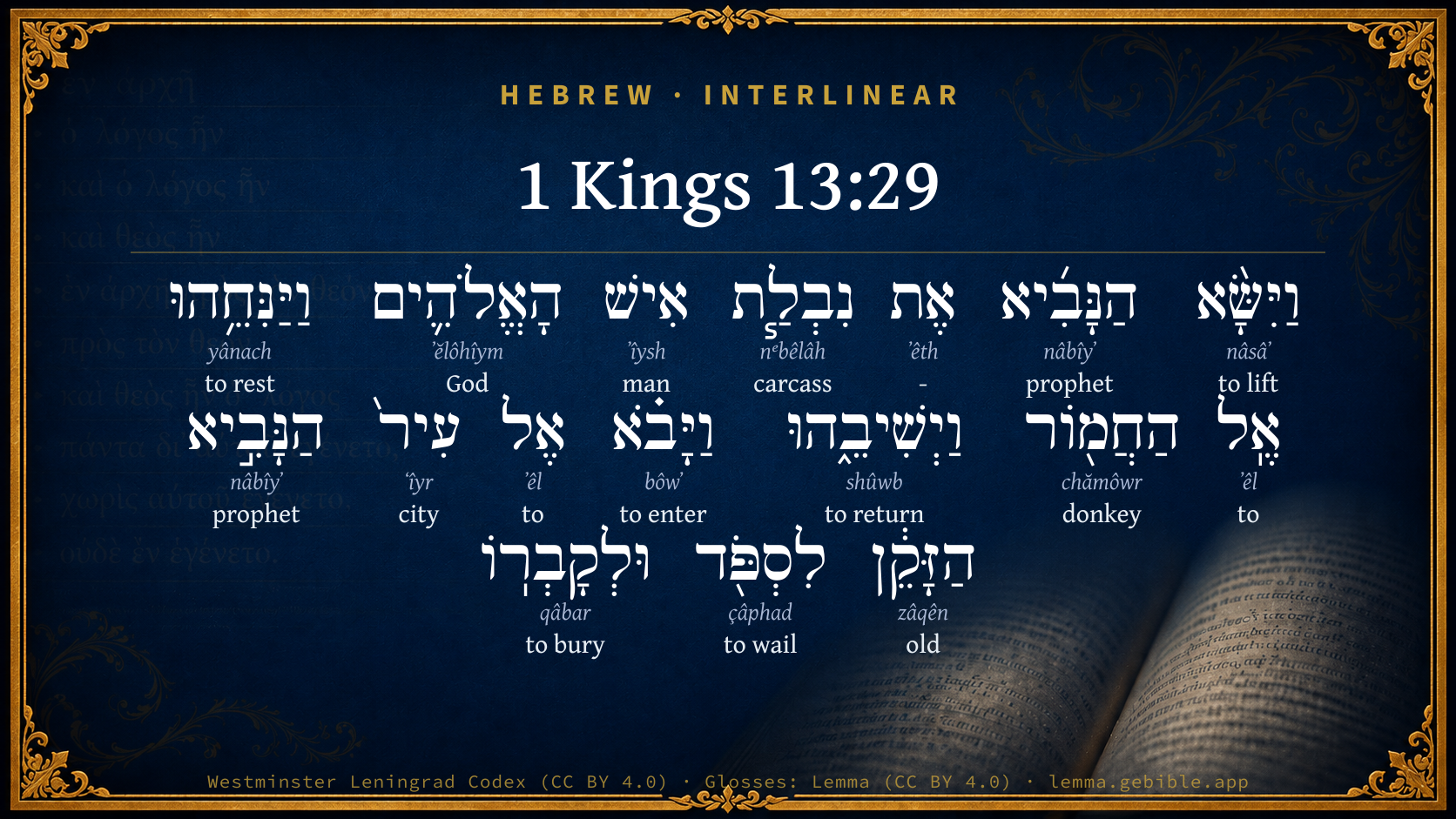
Hebrew (Westminster Leningrad Codex) 1 Kings 13:29 appears in the Hebrew Old Testament. The text above is from the Westminster Leningrad Codex. Each word links to its Strong’s number, a concise gloss, and parsing drawn from the Open Scriptures Hebrew Bible morphology. Click any word for its full Brown-Driver-Briggs (BDB) entry.
Download image
Cite this verse

1 Kings 13:29 (World English Bible). Public Domain. Lemma interlinear Bible study tool, https://lemma.gebible.app/v/1-kings/13/29.

Show BibTeX & RIS
BibTeX
RIS
English Translation
The prophet took up the body of the man of God, and laid it on the donkey, and brought it back; and he came to the city of the old prophet, to mourn, and to bury him.
World English Bible · Public Domain
Download a study sheet

One document with this verse’s original text, its word-by-word gloss line, the meaning frame, cross-references with their text, attributed commentary, and full source and license credits — printable, and it pastes into notes with its structure intact.

This verse Autodidact and up

Study sheet (.html) Plain text (.txt)

A passage Seminary Student

Up to 50 verses in one chapter. A passage sheet keeps up to 6 commentary sources and 12 cross-references per verse, in the order this page ranks them, and says so on the sheet whenever that leaves anything out. Ask for a single verse and you get the Autodidact verse sheet above.

Everything on this page stays free to read, with no account — the sheet is a download of what is already on screen, not access to it.

Want to remove ads? Support Godless Engineer
Compare translations 3

The same verse in 3 English versions, stacked beneath the original-language interlinear above. Click any original word for its lexicon entry.

Each is an independent rendering of the whole verse — the interlinear is not word-aligned to these translations.

Highlighted words mark where these versions differ — a whole-verse word diff, not a word-by-word alignment.

  • World English Bible Public Domain
    The prophet took up the body of the man of God, and laid it on the donkey, and brought it back; and he came to the city of the old prophet, to mourn, and to bury him.
  • King James Version Public Domain
    And the prophet took up the carcass of the man of God, and laid it upon the ass, and brought it back: and the old prophet came to the city, to mourn and to bury him.
  • unfoldingWord Literal Text CC BY-SA 4.0
    And the prophet lifted up the corpse of the man of God, and he laid it on the donkey, and he brought it back. And he entered into the city of the old prophet to mourn and to bury him.

unfoldingWord Literal Text — © unfoldingWord, licensed CC BY-SA 4.0. Word-aligned USFM3 via Door43 (git.door43.org/unfoldingWord/en_ult).

Versions to compare (up to 4)

3 of 4 selected

Show all 18 translations

Every available English version of this verse, each an independent rendering of the whole verse.

  • World English Bible Public Domain
    The prophet took up the body of the man of God, and laid it on the donkey, and brought it back; and he came to the city of the old prophet, to mourn, and to bury him.
  • Berean Standard Bible Public Domain
    So the old prophet lifted up the body of the man of God, laid it on the donkey, and brought it back to his own city to mourn for him and bury him.
  • Majority Standard Bible Public Domain
    So the old prophet lifted up the body of the man of God, laid it on the donkey, and brought it back to his own city to mourn for him and bury him.
  • King James Version Public Domain
    And the prophet took up the carcass of the man of God, and laid it upon the ass, and brought it back: and the old prophet came to the city, to mourn and to bury him.
  • American Standard Version (1901) Public Domain
    And the prophet took up the body of the man of God, and laid it upon the ass, and brought it back; and he came to the city of the old prophet, to mourn, and to bury him.
  • Revised Version (1885) Public Domain
    And the prophet took up the carcase of the man of God, and laid it upon the ass, and brought it back: and he came to the city of the old prophet, to mourn, and to bury him.
  • Geneva Bible (1599) Public Domain
    And the Prophet tooke vp the body of the man of God, and layed it vpon the asse, and brought it againe, and the olde Prophet came to the citie, to lament and burie him.
  • Douay-Rheims (1899) Public Domain
    And the prophet took up the body of the man of God, and laid it upon the ass, and going back brought it into the city of the old prophet, to mourn for him.
  • Young's Literal Translation Public Domain
    And the prophet taketh up the carcase of the man of God, and placeth it on the ass, and bringeth it back, and the old prophet cometh in unto the city to mourn and to bury him,
  • Literal Standard Version CC BY-SA 4.0
    And the prophet takes up the carcass of the man of God, and places it on the donkey, and brings it back, and the old prophet comes to the city to mourn and to bury him,
  • Unlocked Literal Bible CC BY-SA 4.0
    The prophet took up the body of the man of God, laid it on the donkey, and brought it back. He came to his own city to mourn and to bury him.
  • unfoldingWord Literal Text CC BY-SA 4.0
    And the prophet lifted up the corpse of the man of God, and he laid it on the donkey, and he brought it back. And he entered into the city of the old prophet to mourn and to bury him.
  • Darby Bible Public Domain
    And the prophet took up the corpse of the man of God, and laid it upon the ass, and brought it back; and the old prophet came into the city, to mourn and to bury him.
  • World Messianic Bible Public Domain
    The prophet took up the body of the man of God, and laid it on the donkey, and brought it back. He came to the city of the old prophet to mourn, and to bury him.
  • Webster's Bible Public Domain
    And the prophet took up the carcass of the man of God, and laid it upon the ass, and brought it back: and the old prophet came to the city, to mourn and to bury him.
  • Free Bible Version CC BY-SA 4.0
    The prophet picked up the body of the man of God, placed it on the donkey, and brought it back to his own town to mourn over him and bury him.
  • Bible in Basic English Public Domain
    Then the prophet took up the body of the man of God and put it on the ass and took it back; and he came to the town to put the body to rest with weeping.
  • JPS Tanakh (1917) Public Domain
    And the prophet took up the carcass of the man of God, and laid it upon the ass, and brought it back; and he came to the city of the old prophet, to lament, and to bury him.

Literal Standard Version (2020), Covenant Press — licensed CC BY-SA 4.0. Text via the HelloAO Bible API (eBible.org). Unlocked Literal Bible (unfoldingWord) — licensed CC BY-SA 4.0. Text via the HelloAO Bible API (eBible.org). unfoldingWord Literal Text — © unfoldingWord, licensed CC BY-SA 4.0. Word-aligned USFM3 via Door43 (git.door43.org/unfoldingWord/en_ult). Free Bible Version, Dr. Jonathan Gallagher — licensed CC BY-SA 4.0. Text via the HelloAO Bible API (eBible.org).

Word by word

More ways to search: Search by grammar → Find every occurrence → Compare this word →

Practice this passage: Drill this verse → Learn its vocabulary →

לִסְפֹּ֖ד
çâphad
H5594
“to wail”
Preposition + Verb, Qal, Infinitive Construct
Part of Speech
Preposition + Verb
Stem
Qal
Form
Infinitive Construct
Full BDB Definition

Origin: a primitive root

TWOT: 1530

to wail, lament, mourn - (Qal) - to wail, lament - wailers (participle) - (Niphal) to be lamented, be bewailed
  1. וַיִּשָּׂ֨א nâsâʼ H5375 “and · to lift” Conjunction + Verb, Qal, Sequential Imperfect, 3rd Person, Masculine, Singular
  2. הַנָּבִ֜יא nâbîyʼ H5030 “the · prophet” Particle, Definite Article + Noun, Common, Masculine, Singular, Absolute
  3. אֶת ʼêth H853 “-” Particle, Direct Object
  4. נִבְלַ֧ת nᵉbêlâh H5038 “carcass of” Noun, Common, Feminine, Singular, Construct
  5. אִישׁ ʼîysh H376 “man of” Noun, Common, Masculine, Singular, Construct
  6. הָאֱלֹהִ֛ים ʼĕlôhîym H430 “the · God(s)” Particle, Definite Article + Noun, Common, Masculine, Plural, Absolute
  7. וַיַּנִּחֵ֥הוּ yânach H3240 “and · to rest · him” Conjunction + Verb, Hiphil, Sequential Imperfect, 3rd Person, Masculine, Singular + Suffix, Personal, 3rd Person, Masculine, Singular
  8. אֶֽל ʼêl H413 “to” Preposition
  9. הַחֲמ֖וֹר chămôwr H2543 “the · donkey” Particle, Definite Article + Noun, Common, Both, Singular, Absolute
  10. וַיְשִׁיבֵ֑הוּ shûwb H7725 “and · to return · him” Conjunction + Verb, Hiphil, Sequential Imperfect, 3rd Person, Masculine, Singular + Suffix, Personal, 3rd Person, Masculine, Singular
  11. וַיָּבֹ֗א bôwʼ H935 “and · to enter” Conjunction + Verb, Qal, Sequential Imperfect, 3rd Person, Masculine, Singular
  12. אֶל ʼêl H413 “to” Preposition
  13. עִיר֙ ʻîyr H5892 “city of” Noun, Common, Feminine, Singular, Construct
  14. הַנָּבִ֣יא nâbîyʼ H5030 “the · prophet” Particle, Definite Article + Noun, Common, Masculine, Singular, Absolute
  15. הַזָּקֵ֔ן zâqên H2205 “the · old” Particle, Definite Article + Adjective, Adjective, Masculine, Singular, Absolute
  16. וּלְקָבְרֽוֹ qâbar H6912 “and · to bury · him” Conjunction + Preposition + Verb, Qal, Infinitive Construct + Suffix, Personal, 3rd Person, Masculine, Singular

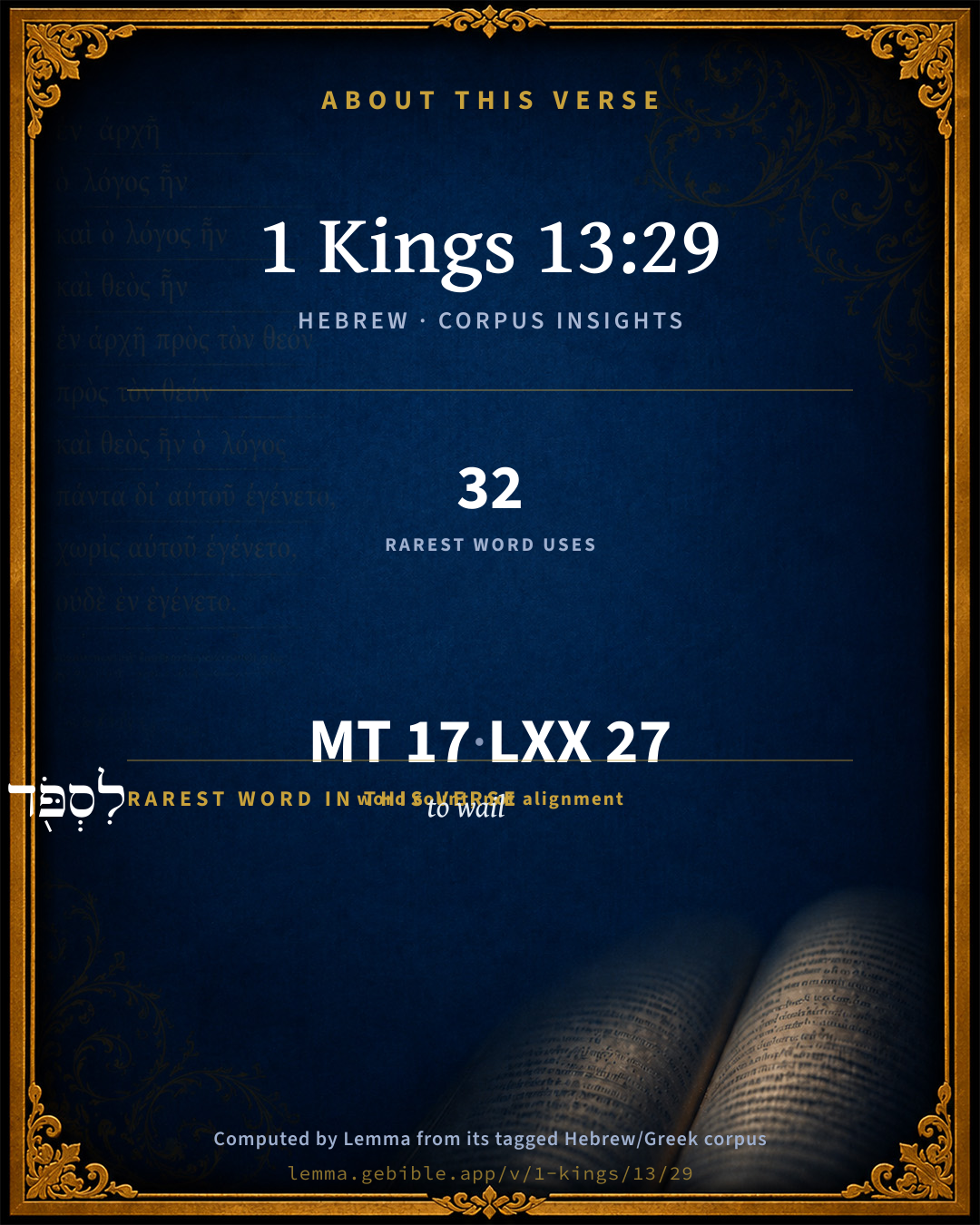
About this verse

These counts appear in no published source. They are computed here, from the morphology-tagged text and Lemma’s own curated glosses. What Lemma adds →

17
words
15
distinct lemmas
Historical
section

Shared distinctive vocabulary

לִסְפֹּ֖ד to wail H5594 occurs in 30 verses of the Hebrew Bible. Also found in:

Grammatical profile

  • 6 verbs
  • 7 nouns
  • 1 adjective
  • 2 prepositions
  • 1 particle

Verb forms

  • וַיִּשָּׂ֨א Qal · Sequential Imperfect
  • וַיַּנִּחֵ֥הוּ Hiphil · Sequential Imperfect
  • וַיְשִׁיבֵ֑הוּ Hiphil · Sequential Imperfect
  • וַיָּבֹ֗א Qal · Sequential Imperfect
  • לִסְפֹּ֖ד Qal · Infinitive Construct
  • וּלְקָבְרֽוֹ Qal · Infinitive Construct

Repetition

Words recur within this verse — often emphatic in Hebrew:

  • הַנָּבִ֜יא prophet H5030 ×2
  • אֶֽל to H413 ×2

Hebrew & Septuagint length

In English translation the verse runs 37 words from the Hebrew and 34 from the Septuagint (LXX English) — closely comparable.

A rough comparison of the two English renderings, which tokenize alike — not a word-level alignment.

Word counts can differ between the Hebrew and the Greek without any difference in meaning — e.g. the Hebrew direct-object marker אֵת has no separate Greek word, and Greek often adds the article ὁ.

In the original languages it is 17 Hebrew tokens and 27 Greek tokens — but the two are counted differently (Hebrew bundles its prefixes and suffixes into one token; the Greek is in lemma form), so that isn’t a like-for-like length.

Hebrew and Greek witnesses Masoretic Hebrew ↔ Greek Septuagint

The same verse in the two great witnesses to the Old Testament, shown verse-for-verse.

These are two independent witnesses, not word-aligned to each other, and the Septuagint is shown in lemma (dictionary) form.

Hebrew 1 Kings 13:29 Masoretic · Westminster Leningrad Codex

וַיִּשָּׂ֨א הַנָּבִ֜יא אֶת נִבְלַ֧ת אִישׁ הָאֱלֹהִ֛ים וַיַּנִּחֵ֥הוּ אֶֽל הַחֲמ֖וֹר וַיְשִׁיבֵ֑הוּ וַיָּבֹ֗א אֶל עִיר֙ הַנָּבִ֣יא הַזָּקֵ֔ן לִסְפֹּ֖ד וּלְקָבְרֽוֹ

The prophet took up the body of the man of God, and laid it on the donkey, and brought it back; and he came to the city of the old prophet, to mourn, and to bury him.

World English Bible · Public Domain

Greek LXX 1 Kings 13:29 Septuagint · lemma form

καί αἴρω ὁ προφήτης ὁ σῶμα ὁ ἄνθρωπος ὁ θεός καί ἐπιτίθημι αὐτός ἐπί ὁ ὄνος καί ἐπιστρέφω αὐτός εἰς ὁ πόλις ὁ προφήτης ὁ θάπτω αὐτός

And the prophet took up the body of the man of God, and laid it on his ass; and the prophet brought him back to his city, to bury him in his own tomb,

LXX2012 (modern English Septuagint) · Public Domain

On this verse, The Cambridge Bible for Schools and Colleges discusses the Septuagint’s reading. Read the note in Commentary ↓

Hebrew: Westminster Leningrad Codex (CC BY 4.0). Greek: Septuagint (public domain); English from LXX2012 (modern English Septuagint) (Public Domain). How the Septuagint differs from the Hebrew →

Targum (Aramaic paraphrase)

1

The Targum is the ancient Jewish Aramaic paraphrase of the Hebrew Scriptures — an interpretive translation, not the Hebrew text itself. Onkelos (literal) and Pseudo-Jonathan (expansive) render the Torah, and Jonathan the Prophets. Coverage is partial: where no permissively-licensed English translation exists for a verse, only the Aramaic is shown. This is verse-level text, not a word-by-word alignment to the Hebrew.

  1. Targum Jonathan Prophets (Joshua–Malachi)
    וּנְטַל נְבִיָא שַׁקָרָא יַת נְבֵלְתָּא דִנְבִיָא דַייָ וְאַחֲתֵיהּ עַל חַמָרָא וַאֲתִיבֵיהּ וַאֲתָא לְקַרְתָּא דִנְבִיָא שַׁקָרָא סָבָא לְמִסְפַּד וּלְמִקְבְּרֵיהּ:

    (no public-domain English translation for this verse)

    Targum Jonathan — Aramaic: “Mikraot Gedolot” (public domain). English: “Sefaria Community Translation” (CC0 1.0 (public-domain dedication)); “London "Chaldee Paraphrase," 1871” (public domain). Text via Sefaria.

Commentary

Notes on 1 Kings 13:29 from classic Christian and Jewish commentators (each source and its license shown beneath its notes). The classic Christian expositions comment on the surrounding passage and are grouped to its opening verse, so a note may address several verses; the Jewish commentaries on the Tanakh (Rashi and others) are per-verse, so they appear only where the commentator wrote on this verse.

Lemma curates 59 commentaries, every one of them public domain or Creative Commons licensed, each selected and text-cleaned for this edition rather than reprinted as found. About our sources →

Trapp's Complete Commentary

John Trapp

1Ki 13:29 And the prophet took up the carcase of the man of God, and laid it upon the ass, and brought it back: and the old prophet came to the city, to mourn and to bury him.

Ver. 29. And the prophet took up the carcass.] Which the lion, belike, left to him, and went away.

And laid it upon the ass.] Which was kept alive for such a purpose.

And the old prophet came to the city to mourn.] As good cause he had, not more for the man of God, who was Dei frumentum leonis dentibus commolitum, as Ignatius said of himself at his death, than for himself, who had seduced him to such an untimely end.

John Trapp, A Commentary or Exposition upon All the Books of the Old and New Testament (1647–1656) — public domain. Text from a community e-Sword module.

Joseph Benson's Commentary

1Ki 13:29-30. The prophet, (namely, the old prophet,) took up the carcass of the man of God — “If there were any truth,” says Henry, “in the vulgar opinion, sure the corpse bled afresh when he touched it; for he was, in effect, the murderer.” He laid his carcass in his own grave — A poor reparation this of the injury done him in deceiving him, and persuading him to disobey the command of God to his ruin. Hereby, however, the divine threatening, (in 1Ki 13:22,) was fulfilled; and withal, the memory of his prophecy was revived from time to time, by the sight of his grave, and preserved among them; and even his carcass, resting there, might be a witness of their madness and desperate wickedness, in continuing to practise their abominable, idolatrous worship, after such an assurance of the dreadful effects of it. They mourned over him — Namely, the old prophet and his sons, and others, whom common humanity taught to lament the untimely death of so worthy a person. Saying, Alas! my brother — Which was a usual form of expression in funeral lamentations. “The case, indeed, was very piteous,” says Henry, “that so good a man, so faithful a prophet, and one so bold in God’s cause, should, for one offence, die as a criminal, while an old, lying prophet lived at ease, and an idolatrous prince in pomp and power. Thy way, O God, is in the sea, and thy path in the great waters! We cannot judge of men by their sufferings, nor of sins by their present punishments. With some the flesh is destroyed, that the spirit may be saved; while, with others, the flesh is pampered, that the soul may ripen for hell.” The reader will be pleased to see a similar reflection by Dr. Dodd. “Upon a review of this narrative, who can fail to admire the unsearchable secrets of the divine justice? Jeroboam revolts from his lawful sovereign, forsakes the worship of the true God, engages the people in gross idolatry, and is himself hardened by the menaces and miracles of the prophet, who wits sent to him; a false prophet deceives an innocent man with a lie, and draws him into an act of disobedience, contrary to his inclination; yet this wicked Jeroboam, and this seducing prophet, escape immediate punishment, while the other, who might mean no ill, perhaps, in turning back, is slain by a lion, and his body deprived of the sepulchre of his fathers! We must acknowledge, indeed, that the depths of the judgments of God are an abyss which our understandings cannot fathom; but nothing certainly can be a more sensible proof of the certainty of another life, and of the eternal recompenses or punishments which attend it, than to see the righteous so rigorously treated here, for slight offences, while, sentence not being speedily executed against evil men, we have an assurance from thence that God will bring every work into judgment, with every secret thing, whether it be good or evil, Ecc 12:14.”

Joseph Benson's Commentary on the Old and New Testaments (1811–1818) — public domain. Text from a community e-Sword module.

The Cambridge Bible for Schools and Colleges

gen. ed. J. J. S. Perowne

29. to mourn and to bury him] These words are also left out in the LXX. (Vat.).

The Cambridge Bible for Schools and Colleges (gen. ed. J. J. S. Perowne; Cambridge University Press, 1878–1918) — public domain. Text from a community e-Sword module.

John Gill's Exposition

For the saying which he cried by the word of the Lord against the altar in Bethel,.... That the priests should be offered on it, and men's bones be burnt upon it; for as for its being rent, and the ashes of it poured out, that had been done already:

and against all the houses of the high places which are in Samaria, shall surely come to pass: by which it appears that there were temples, and high places, and altars built in other parts of the kingdom besides Dan and Bethel, of the destruction of which the man of God prophesied, though not before mentioned; all which the old prophet gave credit to, and firmly believed would be accomplished. The kingdom of Israel, in later times, had the name of Samaria, from the chief city of it, Isa 7:9, here spoken of by anticipation, for as yet it was not in being, see Kg1 16:24 and either it has its name here by way of prophecy, or else given by the writer of this book, as what it went by in his time.

John Gill's Exposition of the Whole Bible (1746–1763) — public domain (CC PDM 1.0). Text via the HelloAO Bible API.

The Pulpit Commentary

And the prophet took up the carcase of the man of God, and laid it upon the ass i.e., the one standing by, and brought it back: and the old prophet came to the city, to mourn and to bury him. The mourning is specially mentioned, because in the East professional wailers were and are employed at funerals. The Jew, no less than the Greek and Roman, esteemed it a great misfortune and disgrace to be deprived of decent burial: (Isa_14:19; Jer_22:19; and especially 2Ki_9:10)

The Pulpit Commentary (1880–1919), ed. H.D.M. Spence-Jones & Joseph S. Exell — public domain. Text from a community e-Sword module.

unfoldingWord translationNotes

Door43 World Missions Community

took up

"lifted up"

the body

"the dead body"

they mourned

Here the word "they" refers to the prophet and his sons.

Woe, my brother!

The word "Woe" here is an expression of great sorrow.

translationWords

prophet

mourn

bury

grave

woe

brother

unfoldingWord translationNotes — © Distant Shores Media and the Door43 World Missions Community, licensed CC BY-SA 4.0. Source: git.door43.org/Door43/en_tn.

Lesson kit

Teaching starters — assembled from the data on this page, not authored interpretation. Every prompt links to the verse data it draws on. Edit before teaching.

1 Kings, in the Historical, opens this verse with 17 words (15 distinct Hebrew lemmas). Its most distinctive word is çâphad (“to wail”). A historical commentator’s framing appears above. Read the whole chapter for the surrounding context.

Discussion questions

  1. The word çâphad carries the sense “to wail.” How does it shape the verse?
  2. Genesis 23:2 shares the word «to wail» with this verse. How do the two illuminate each other?
  3. “prophet” occurs 2× in this one verse. What is the effect of the repetition?
  4. These translations render this verse differently; the difference is in the English rendering, not the original. What questions does that raise?
  5. The verb «וַיִּשָּׂ֨א» is Qal Sequential Imperfect. How does its form color the action?
  6. Reading how Trapp's Complete Commentary and Joseph Benson's Commentary read this verse, where do the two commentators agree and where do they part?

Things to notice

Reading settings

Reading text

Shown beneath each verse's original-language words.

Old Testament
Old Testament edition

Read the OT as the Masoretic Hebrew (MT) or the Greek Septuagint (LXX).

English shown for the Greek Septuagint (in the Hebrew ↔ Greek comparison).

Comparing translations? Open the Compare panel on any verse page to stack up to four side by side.