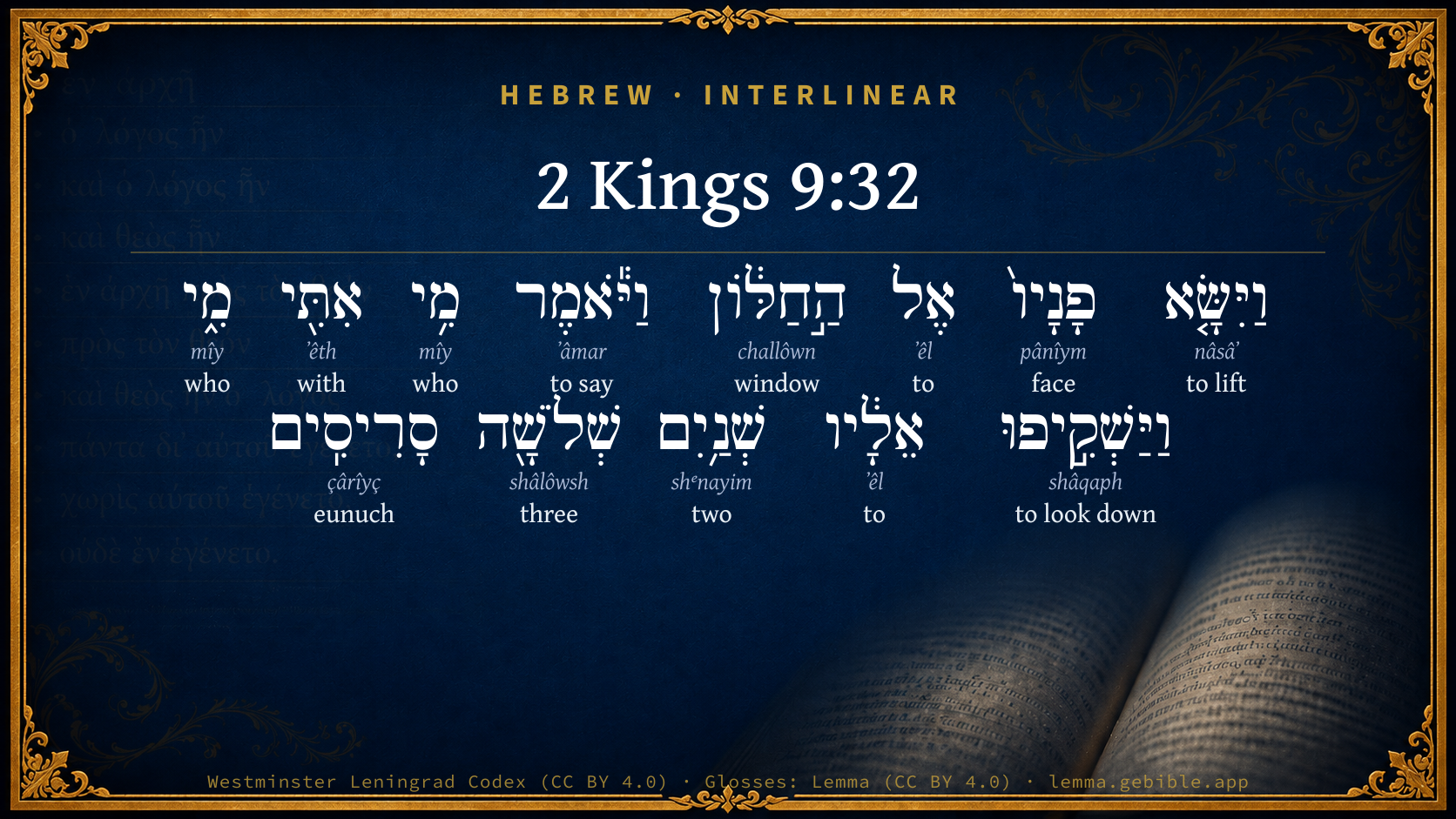
2 Kings 9:32

Hebrew (Westminster Leningrad Codex) 2 Kings 9:32 appears in the Hebrew Old Testament. The text above is from the Westminster Leningrad Codex. Each word links to its Strong’s number, a concise gloss, and parsing drawn from the Open Scriptures Hebrew Bible morphology. Click any word for its full Brown-Driver-Briggs (BDB) entry.
Download image
Cite this verse

2 Kings 9:32 (World English Bible). Public Domain. Lemma interlinear Bible study tool, https://lemma.gebible.app/v/2-kings/9/32.

Show BibTeX & RIS
BibTeX
RIS
English Translation
He lifted up his face to the window, and said, Who is on my side? who? There looked out to him two or three eunuchs.
World English Bible · Public Domain
Download a study sheet

One document with this verse’s original text, its word-by-word gloss line, the meaning frame, cross-references with their text, attributed commentary, and full source and license credits — printable, and it pastes into notes with its structure intact.

This verse Autodidact and up

Study sheet (.html) Plain text (.txt)

A passage Seminary Student

Up to 50 verses in one chapter. A passage sheet keeps up to 6 commentary sources and 12 cross-references per verse, in the order this page ranks them, and says so on the sheet whenever that leaves anything out. Ask for a single verse and you get the Autodidact verse sheet above.

Everything on this page stays free to read, with no account — the sheet is a download of what is already on screen, not access to it.

Want to remove ads? Support Godless Engineer
Compare translations 3

The same verse in 3 English versions, stacked beneath the original-language interlinear above. Click any original word for its lexicon entry.

Each is an independent rendering of the whole verse — the interlinear is not word-aligned to these translations.

Highlighted words mark where these versions differ — a whole-verse word diff, not a word-by-word alignment.

  • World English Bible Public Domain
    He lifted up his face to the window, and said, Who is on my side? who? There looked out to him two or three eunuchs.
  • King James Version Public Domain
    And he lifted up his face to the window, and said, Who is on my side? who? And there looked out to him two or three eunuchs.
  • unfoldingWord Literal Text CC BY-SA 4.0
    And he lifted his face to the window, and he said, “Who with me? Who?” And two, three eunuchs looked down to him.

unfoldingWord Literal Text — © unfoldingWord, licensed CC BY-SA 4.0. Word-aligned USFM3 via Door43 (git.door43.org/unfoldingWord/en_ult).

Versions to compare (up to 4)

3 of 4 selected

Show all 18 translations

Every available English version of this verse, each an independent rendering of the whole verse.

  • World English Bible Public Domain
    He lifted up his face to the window, and said, Who is on my side? who? There looked out to him two or three eunuchs.
  • Berean Standard Bible Public Domain
    He looked up at the window and called out, “Who is on my side? Who?” And two or three eunuchs looked down at him.
  • Majority Standard Bible Public Domain
    He looked up at the window and called out, “Who is on my side? Who?” And two or three eunuchs looked down at him.
  • King James Version Public Domain
    And he lifted up his face to the window, and said, Who is on my side? who? And there looked out to him two or three eunuchs.
  • American Standard Version (1901) Public Domain
    And he lifted up his face to the window, and said, Who is on my side? who? And there looked out to him two or three eunuchs.
  • Revised Version (1885) Public Domain
    And he lifted up his face to the window, and said, Who is on my side? who? And there looked out to him two or three eunuchs.
  • Geneva Bible (1599) Public Domain
    And he lift vp his eyes to the windowe, and sayd, Who is on my side, who? Then two or three of her Eunuches looked vnto him.
  • Douay-Rheims (1899) Public Domain
    And Jehu lifted up his face to the window, and said: Who is this? And two or three eunuchs bowed down to him.
  • Young's Literal Translation Public Domain
    And he lifteth up his face unto the window, and saith, `Who `is' with me? -- who?' and look out unto him do two `or' three eunuchs;
  • Literal Standard Version CC BY-SA 4.0
    And he lifts up his face to the window and says, “Who [is] with me? Who?” And two [or] three eunuchs look out to him;
  • Unlocked Literal Bible CC BY-SA 4.0
    Jehu looked up at the window and said, “Who is on my side? Who?” Then two or three eunuchs looked out.
  • unfoldingWord Literal Text CC BY-SA 4.0
    And he lifted his face to the window, and he said, “Who with me? Who?” And two, three eunuchs looked down to him.
  • Darby Bible Public Domain
    And he lifted up his face to the window, and said, Who is on my side? who? And two or three chamberlains looked out to him.
  • World Messianic Bible Public Domain
    He lifted up his face to the window, and said, “Who is on my side? Who?” Two or three eunuchs looked out at him.
  • Webster's Bible Public Domain
    And he lifted up his face to the window, and said, Who is on my side? who? And there looked out to him two or three eunuchs.
  • Free Bible Version CC BY-SA 4.0
    Jehu looked up at the window and shouted out, “Who is on my side? Anyone?” Two or three eunuchs looked down at him.
  • Bible in Basic English Public Domain
    Then, looking up to the window, he said, Who is on my side, who? and two or three unsexed servants put out their heads.
  • JPS Tanakh (1917) Public Domain
    And he lifted up his face to the window, and said: 'Who is on my side? who?' And there looked out to him two or three officers.

Literal Standard Version (2020), Covenant Press — licensed CC BY-SA 4.0. Text via the HelloAO Bible API (eBible.org). Unlocked Literal Bible (unfoldingWord) — licensed CC BY-SA 4.0. Text via the HelloAO Bible API (eBible.org). unfoldingWord Literal Text — © unfoldingWord, licensed CC BY-SA 4.0. Word-aligned USFM3 via Door43 (git.door43.org/unfoldingWord/en_ult). Free Bible Version, Dr. Jonathan Gallagher — licensed CC BY-SA 4.0. Text via the HelloAO Bible API (eBible.org).

Word by word

More ways to search: Search by grammar → Find every occurrence → Compare this word →

Practice this passage: Drill this verse → Learn its vocabulary →

וַיַּשְׁקִ֣יפוּ
shâqaph
H8259
“and · to look down”
Conjunction + Verb, Hiphil, Sequential Imperfect, 3rd Person, Masculine, Plural
Part of Speech
Conjunction + Verb
Stem
Hiphil
Form
Sequential Imperfect
Person
3rd Person
Gender
Masculine
Number
Plural
Full BDB Definition

Origin: a primitive root

TWOT: 2457

to overlook, look down or out, overhang, look out and down - (Niphal) to lean over (and look), look down - (Hiphil) to look down, look down upon
  1. וַיִּשָּׂ֤א nâsâʼ H5375 “and · to lift” Conjunction + Verb, Qal, Sequential Imperfect, 3rd Person, Masculine, Singular
  2. פָנָיו֙ pânîym H6440 “face(s) · his” Noun, Common, Both, Plural, Construct + Suffix, Personal, 3rd Person, Masculine, Singular
  3. אֶל ʼêl H413 “to” Preposition
  4. הַ֣חַלּ֔וֹן challôwn H2474 “the · window” Particle, Definite Article + Noun, Common, Both, Singular, Absolute
  5. וַיֹּ֕אמֶר ʼâmar H559 “and · to say” Conjunction + Verb, Qal, Sequential Imperfect, 3rd Person, Masculine, Singular
  6. מִ֥י mîy H4310 “who” Particle, Interrogative
  7. אִתִּ֖י ʼêth H854 “with · me” Preposition + Suffix, Personal, 1st Person, Common, Singular
  8. מִ֑י mîy H4310 “who” Particle, Interrogative
  9. אֵלָ֔יו ʼêl H413 “to · him” Preposition + Suffix, Personal, 3rd Person, Masculine, Singular
  10. שְׁנַ֥יִם shᵉnayim H8147 “two” Adjective, Cardinal number, Masculine, Dual, Absolute
  11. שְׁלֹשָׁ֖ה shâlôwsh H7969 “three” Adjective, Cardinal number, Masculine, Singular, Absolute
  12. סָרִיסִֽים çârîyç H5631 “eunuchs” Noun, Common, Masculine, Plural, Absolute

About this verse

These counts appear in no published source. They are computed here, from the morphology-tagged text and Lemma’s own curated glosses. What Lemma adds →

13
words
11
distinct lemmas
Historical
section

Notable vocabulary

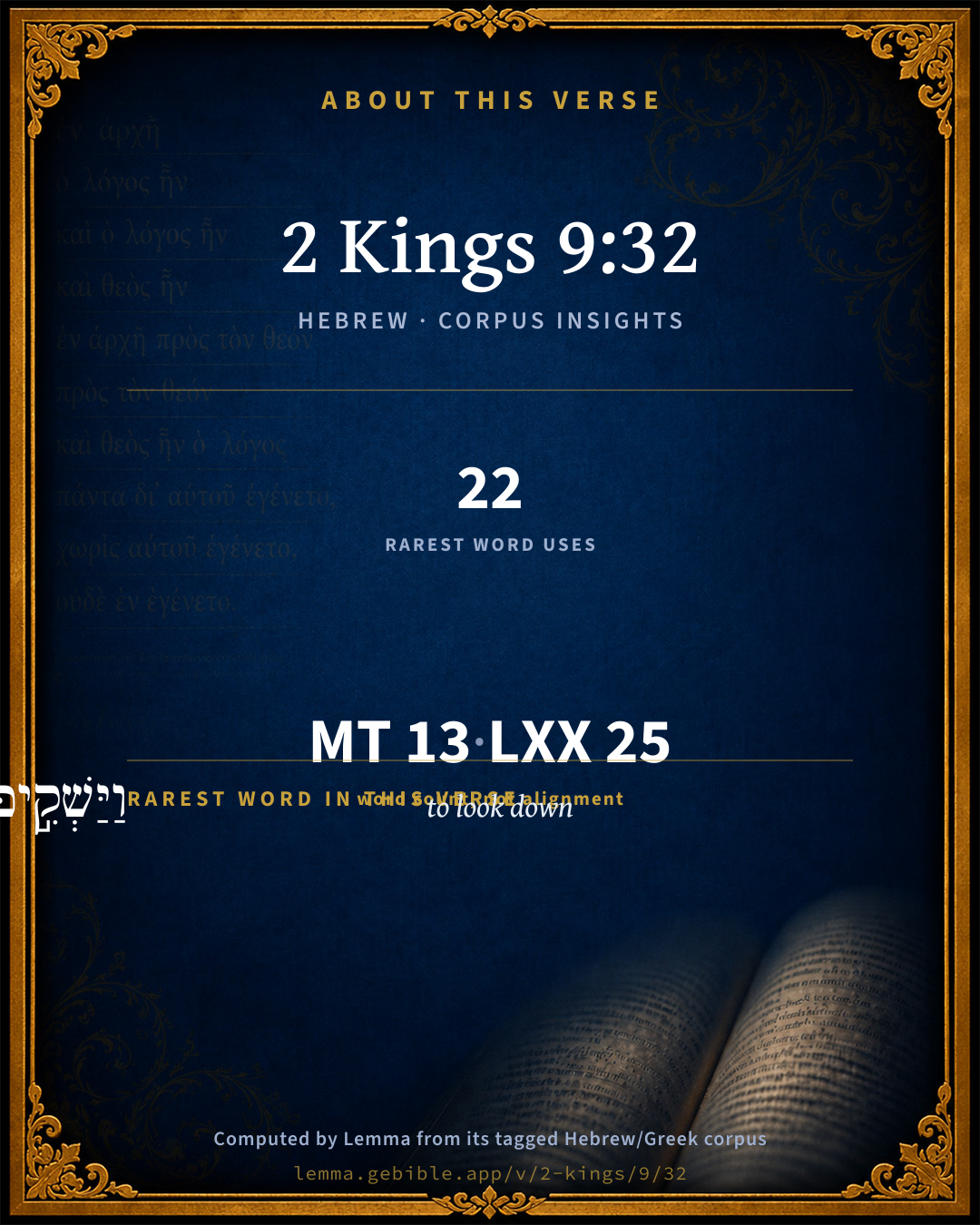
The rarest word here is וַיַּשְׁקִ֣יפוּ to look down H8259 — appearing just 22 times in the whole Hebrew Bible.

Shared distinctive vocabulary

וַיַּשְׁקִ֣יפוּ to look down H8259 occurs in 22 verses of the Hebrew Bible. Also found in:

Grammatical profile

  • 3 verbs
  • 3 nouns
  • 2 adjectives
  • 3 prepositions
  • 2 particles

Verb forms

  • וַיִּשָּׂ֤א Qal · Sequential Imperfect
  • וַיֹּ֕אמֶר Qal · Sequential Imperfect
  • וַיַּשְׁקִ֣יפוּ Hiphil · Sequential Imperfect

Repetition

Words recur within this verse — often emphatic in Hebrew:

Hebrew & Septuagint length

In English translation the verse runs 25 words from the Hebrew and 28 from the Septuagint (LXX English) — closely comparable.

A rough comparison of the two English renderings, which tokenize alike — not a word-level alignment.

Word counts can differ between the Hebrew and the Greek without any difference in meaning — e.g. the Hebrew direct-object marker אֵת has no separate Greek word, and Greek often adds the article ὁ.

In the original languages it is 13 Hebrew tokens and 25 Greek tokens — but the two are counted differently (Hebrew bundles its prefixes and suffixes into one token; the Greek is in lemma form), so that isn’t a like-for-like length.

Cross-references

9

Topical passages linked to 2 Kings 9:32 in the Treasury of Scripture Knowledge — connected by theme and wording, ordered by reader-vote popularity; previews shown in the World English Bible.

  • Exodus 32:26 then Moses stood in the gate of the camp, and said, "Whoever is on Yahweh's side, come to me!" All the sons of Levi gathered themselves together to him.
  • 1 Chronicles 12:18 Then the Spirit came on Amasai, who was chief of the thirty, [and he said], "We are yours, David, and on your side, you son of Jesse: peace, peace be to you, and peace be to your helpers; for your God helps you." Then David received them, and made them captains of the band.
  • 2 Chronicles 11:12 In every city [he put] shields and spears, and made them exceeding strong. Judah and Benjamin belonged to him.
  • Esther 1:10 On the seventh day, when the heart of the king was merry with wine, he commanded Mehuman, Biztha, Harbona, Bigtha, and Abagtha, Zethar, and Carcass, the seven chamberlains who ministered in the presence of Ahasuerus the king,
  • Esther 2:15 Now when the turn of Esther, the daughter of Abihail the uncle of Mordecai, who had taken her for his daughter, was come to go in to the king, she required nothing but what Hegai the king's chamberlain, the keeper of the women, appointed. Esther obtained favor in the sight of all those who looked at her.
  • Esther 2:21 In those days, while Mordecai was sitting in the king's gate, two of the king's chamberlains, Bigthan and Teresh, of those who kept the threshold, were angry, and sought to lay hands on the king Ahasuerus.
  • Psalms 118:6 Yahweh is on my side. I will not be afraid. What can man do to me?
  • Psalms 124:1–2 If it had not been Yahweh who was on our side, Let Israel now say,
  • Acts 12:20 Now Herod was very angry with the people of Tyre and Sidon. They came with one accord to him, and, having made Blastus, the king's chamberlain, their friend, they asked for peace, because their country depended on the king's country for food.

Cross-references courtesy of OpenBible.info (CC BY 4.0).

Hebrew and Greek witnesses Masoretic Hebrew ↔ Greek Septuagint

The same verse in the two great witnesses to the Old Testament, shown verse-for-verse.

These are two independent witnesses, not word-aligned to each other, and the Septuagint is shown in lemma (dictionary) form.

Hebrew 2 Kings 9:32 Masoretic · Westminster Leningrad Codex

וַיִּשָּׂ֤א פָנָיו֙ אֶל הַ֣חַלּ֔וֹן וַיֹּ֕אמֶר מִ֥י אִתִּ֖י מִ֑י וַיַּשְׁקִ֣יפוּ אֵלָ֔יו שְׁנַ֥יִם שְׁלֹשָׁ֖ה סָרִיסִֽים

He lifted up his face to the window, and said, Who is on my side? who? There looked out to him two or three eunuchs.

World English Bible · Public Domain

Greek LXX 2 Kings 9:32 Septuagint · lemma form

καί ἐπιαἴρω ὁ πρόσωπον αὐτός εἰς ὁ θυρίς καί ὁράω αὐτός καί εἶπον τίς εἰμί σύ καταβαίνω μετά ἐγώ καί κατακύπτω πρός αὐτός δύο εὐνοῦχος

And he lifted up his face toward the window, and saw her, and said, Who are you? Come down with me. And two eunuchs looked down towards him.

LXX2012 (modern English Septuagint) · Public Domain

On this verse, Ellicott's Commentary for English Readers discusses the Septuagint’s reading. Read the note in Commentary ↓

Hebrew: Westminster Leningrad Codex (CC BY 4.0). Greek: Septuagint (public domain); English from LXX2012 (modern English Septuagint) (Public Domain). How the Septuagint differs from the Hebrew →

Targum (Aramaic paraphrase)

1

The Targum is the ancient Jewish Aramaic paraphrase of the Hebrew Scriptures — an interpretive translation, not the Hebrew text itself. Onkelos (literal) and Pseudo-Jonathan (expansive) render the Torah, and Jonathan the Prophets. Coverage is partial: where no permissively-licensed English translation exists for a verse, only the Aramaic is shown. This is verse-level text, not a word-by-word alignment to the Hebrew.

  1. Targum Jonathan Prophets (Joshua–Malachi)
    וּזְקַף אַפּוֹהִי לַחֲרַכָּא וַאֲמַר מַן הָכָא מַן וְאִסְתְּכִיאוּ לְוָתֵיהּ תְּרִין תְּלָתָא גַוָזָאִין:

    (no public-domain English translation for this verse)

    Targum Jonathan — Aramaic: “Mikraot Gedolot” (public domain). English: “Sefaria Community Translation” (CC0 1.0 (public-domain dedication)); “London "Chaldee Paraphrase," 1871” (public domain). Text via Sefaria.

Commentary

Notes on 2 Kings 9:32 from classic Christian and Jewish commentators (each source and its license shown beneath its notes). The classic Christian expositions comment on the surrounding passage and are grouped to its opening verse, so a note may address several verses; the Jewish commentaries on the Tanakh (Rashi and others) are per-verse, so they appear only where the commentator wrote on this verse.

Lemma curates 59 commentaries, every one of them public domain or Creative Commons licensed, each selected and text-cleaned for this edition rather than reprinted as found. About our sources →

Trapp's Complete Commentary

John Trapp

2Ki 9:32 And he lifted up his face to the window, and said, Who [is] on my side? who? And there looked out to him two [or] three eunuchs.

Ver. 32. There looked out to him two or three eunuchs.] Those rats of the court, as a certain emperor called them: these were active in their lady’s death, all hope of further advantage by her being taken away.

John Trapp, A Commentary or Exposition upon All the Books of the Old and New Testament (1647–1656) — public domain. Text from a community e-Sword module.

Joseph Benson's Commentary

2Ki 9:32-33. He said, Who is on my side? — He had been called out by God to the work of punishing those who had corrupted the land, and he here calls out for assistance in doing it. And there looked out to him two or three eunuchs — Or chamberlains, for such used to attend upon queens in their chambers. “And by their great fidelity and obsequiousness, they generally gained the esteem, and were admitted to the confidence, of those they served; and so, very often, into places of great trust and profit. It is remarkable, however, of Jezebel’s eunuchs, that they were far from being faithful to her; to let us see how suddenly courtiers are wont to change with the fortune of their masters.” He said, Throw her down. So they threw her down — Being mercenary creatures, they quickly comply with Jehu’s command, sacrificing her life to save their own. “Thus, as she had done, so she suffered. She had commanded Naboth to be stoned, and now she is stoned herself: for there were two ways of stoning among the Hebrews, either by throwing stones at malefactors till they were knocked down and killed, or by throwing them down from a high place, and so dashing them to pieces.” — Dodd, who refers to Patrick and Calmet on the punishments of the Jews. And he trode her under foot — Houbigant renders it, they, that is, the horses, trod her under foot, after she had been dashed against the wall and pavement, which, with the horses, were besmeared with her blood.

Joseph Benson's Commentary on the Old and New Testaments (1811–1818) — public domain. Text from a community e-Sword module.

Tyndale Open Study Notes

Tyndale Open Resources

9:32-33 Jehu showed his violent nature when he trampled Jezebel’s body under his horses’ hooves. • While the Hebrew word translated eunuchs can refer to emasculated males, it can also refer to high officials.

Tyndale Open Study Notes — © Tyndale Open Resources, licensed CC BY-SA 4.0. Text via the HelloAO Bible API.

Geneva Bible (1599)

Geneva Bible translators

Or, chief servants.

Geneva Bible (1599) marginal notes — public domain. Text via Bolls.life.

Ellicott's Commentary for English Readers

(32) Who is on my side? who?—This hardly implies, as Thenius thinks, that Jezebel had made preparations for resistance. Jehu knew that the imperious and cruel queen was well hated by the palace officials. The “two or three eunuchs,” who a moment before had crouched in servile dread before Jezebel, would now be eager to curry favour with the regicide, and, at the same time, wreak their malice upon their former tyrant. (The repetition, “Who is on my side? who?” accords well with Jehu’s character. The LXX. has the strange reading, “he saw her, and said, Who art thou? Come down with me.” Josephus adopts this; but Thenius shows clearly that it has originated in easy corruptions of the present Hebrew text.)

A Bible Commentary for English Readers, edited by Charles John Ellicott (1878–1897) — public domain. Text from a community e-Sword module.

The Cambridge Bible for Schools and Colleges

gen. ed. J. J. S. Perowne

32. to the window] Here the LXX. adds ‘and saw her’. After which it continues, ‘And he said, Who art thou? Come down with me. And there looked out &c.’ Josephus makes Jezebel’s remark to be: ‘A pretty servant you, who have killed your master!’ and then describes Jehu’s reply in much the same way as the LXX. The Hebrew as represented in our version is exactly like the impetuous sentence of such a man as Jehu was.

two or three eunuchs] There is no conjunction in the original, as the italics in A.V. indicate. But in all languages the omission of connecting particles between numerals is common. There have however been several explanations offered; as that at first two looked forth and, soon after, another; or that two looked out at one window and three at another. Most likely the omission is a colloquial form of expression. ‘Twothree’, as one word, is used in some English dialects for ‘several’. See Halliwell’s Glossary s.v.

The Cambridge Bible for Schools and Colleges (gen. ed. J. J. S. Perowne; Cambridge University Press, 1878–1918) — public domain. Text from a community e-Sword module.

John Gill's Exposition

Wherefore they came again, and told him,.... How things were, and what only could be found of Jezebel:

and he said, this is the word of the Lord; or the fulfilment of it:

which he spake by his servant Elijah the Tishbite, saying; as in Kg1 21:23.

John Gill's Exposition of the Whole Bible (1746–1763) — public domain (CC PDM 1.0). Text via the HelloAO Bible API.

Haydock's Catholic Bible Commentary

This. "Who dares address me with such provoking language?" Hebrew, "Who with me, who?" will punish the wretch? The eunuchs, who had hitherto waited upon Jezabel, immediately shewed their readiness to take part with her enemy: so little dependence can be placed on servants in the hour of adversity, when they have long been witnesses of their masters’ crimes. --- Hoofs. Hebrew, "and the horses, and he trod her under foot." (Haydock) --- Jehu shewed the example. (Menochius)

George Leo Haydock (1774–1849), Haydock's Catholic Family Bible and Commentary, 1859 edition — public domain. Excludes Psalms (Douay-Rheims chapter numbering differs from Protestant) and Deuterocanonical books (Catholic canon only).

Matthew Poole's English Annotations

For such used to attend upon queens in their chambers.

Matthew Poole's English Annotations on the Holy Bible (1683–1685) — public domain. Text from a community e-Sword/MySword module.

The Pulpit Commentary

And he lifted up his face to the window, and said, Who is on my side? who? Whatever Jezebel"s intention, Jehu yielded not a jot; he was deaf to her flatteries, blind to her seductions. He had made up his mind for "war to the knife" before he embarked upon his enterprise, and the feeble attempts of a queen whose part was played out, whose age he knew, and whom he no doubt regarded as an old woman, had no power on him. Instead of responding to her blandishments, he took a stern and hard line. He would not see her privately. He summoned to his aid the menials of the palace the eunuchs -those on whom beauty has least influence. "Who is on my side? who?" he exclaimed (literally, "Who is with me? who?"); thus calling on the court servants to desert their masters, the guards to turn their swords against their employers, the menials to consummate an intra-palatial revolution. We cannot deny to Jehu the credit of vigor, promptness, audacity, the talent to seize on the opportunity of the moment, and to make the most of it; but he must ever present himself to us as the rough soldier, with no courtesy, with no chivalry, bent on accomplishing his own ends, and shrinking from no deed of blood, no precedent pessimi exempli, if thereby his ends might be brought about. And there looked out to him two or three eunuchs. Eunuchs had become an integral part both of the Jewish and of the Israelite courts from the time of David. (1Ch_28:1) They are an institution which almost necessarily accompanies polygamy; and they had long held high office in. Egypt, in Babylon, and in Assyria. A position outside nature, at variance with all men"s natural feelings and aspirations, of necessity depraves the character, weakens the moral principle, and ends by debasing the class. In Oriental history, the lowest, vilest part is always played by the eunuchs of the palace, who are ever ready to take part in any intrigues, in any conspiracies, and who seem to be almost wholly devoid of the ordinary feelings of humanity. The eunuchs who "looked out" to Jehu were probably the chief eunuchs of the palace, who had authority over the others, and indeed over the court officials generally.

The Pulpit Commentary (1880–1919), ed. H.D.M. Spence-Jones & Joseph S. Exell — public domain. Text from a community e-Sword module.

Keil & Delitzsch

C. F. Keil & F. Delitzsch

But Jehu did not deign to answer the worthless woman; he simply looked up to the window and inquired: "Who is (holds) with me? who?" Then two, three chamberlains looked out (of the side windows), and by Jehu's command threw the proud queen out of the window, so that some of her blood spirted upon the wall and the horses (of Jehu), and Jehu trampled her down, driving over her with his horses and chariot.

Keil & Delitzsch — Biblical Commentary on the Old Testament (1861–1891) — public domain (CC PDM 1.0). Text via the HelloAO Bible API. (Old Testament only.)

Rashi

Rabbi Shlomo Yitzchaki (Rashi)

“Who is with me?” Who among you will come to help me?

Rashi on the Tanakh — English translations: “The Judaica Press complete Tanach with Rashi, translated by A. J. Rosenberg” (CC BY 4.0); “Pentateuch with Rashi's commentary by M. Rosenbaum and A.M. Silbermann, 1929-1934” (public domain); “The Metsudah Tanach series, Lakewood, N.J” (CC BY 4.0); and “The Book of Joshua, Metsudah Publications, 1997” (CC BY 4.0). Text via Sefaria.

Lesson kit

Teaching starters — assembled from the data on this page, not authored interpretation. Every prompt links to the verse data it draws on. Edit before teaching.

2 Kings, in the Historical, opens this verse with 13 words (11 distinct Hebrew lemmas). Its most distinctive word is shâqaph (“to look down”). A historical commentator’s framing appears above. Read the whole chapter for the surrounding context.

Discussion questions

  1. What does “to look down” (shâqaph) contribute to the verse as a whole?
  2. Genesis 18:16 shares the word «to look down» with this verse. How do the two illuminate each other?
  3. “to” occurs 2× in this one verse. What is the effect of the repetition?
  4. These translations render this verse differently; the difference is in the English rendering, not the original. What questions does that raise?
  5. The verb «וַיִּשָּׂ֤א» is Qal Sequential Imperfect. How does its form color the action?
  6. Reading how Trapp's Complete Commentary and Joseph Benson's Commentary read this verse, where do the two commentators agree and where do they part?

Things to notice

Reading settings

Reading text

Shown beneath each verse's original-language words.

Old Testament
Old Testament edition

Read the OT as the Masoretic Hebrew (MT) or the Greek Septuagint (LXX).

English shown for the Greek Septuagint (in the Hebrew ↔ Greek comparison).

Comparing translations? Open the Compare panel on any verse page to stack up to four side by side.