
2 Chronicles 24:11

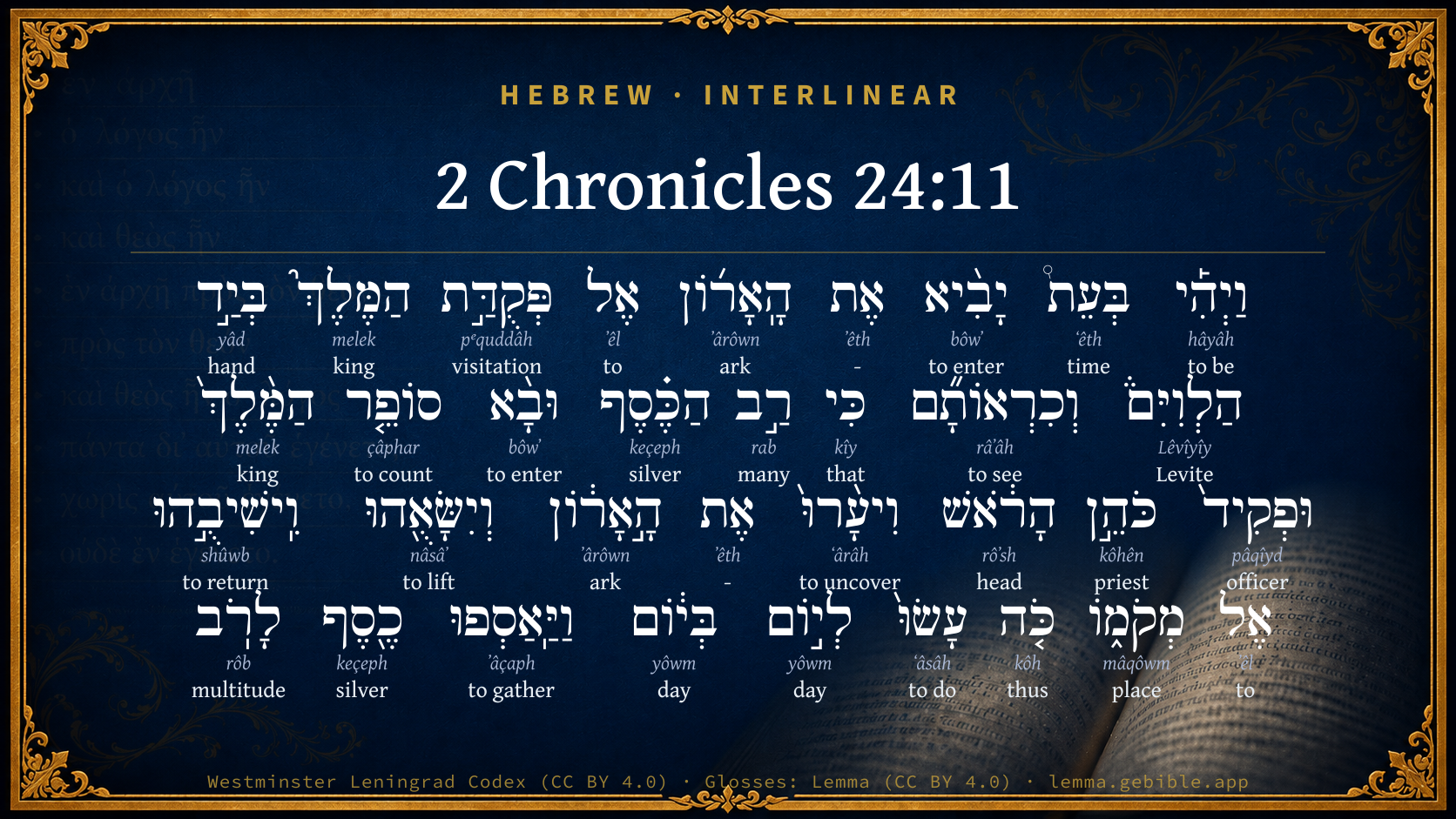
Hebrew (Westminster Leningrad Codex) 2 Chronicles 24:11 appears in the Hebrew Old Testament. The text above is from the Westminster Leningrad Codex. Each word links to its Strong’s number, a concise gloss, and parsing drawn from the Open Scriptures Hebrew Bible morphology. Click any word for its full Brown-Driver-Briggs (BDB) entry.
Download image
Cite this verse

2 Chronicles 24:11 (World English Bible). Public Domain. Lemma interlinear Bible study tool, https://lemma.gebible.app/v/2-chronicles/24/11.

Show BibTeX & RIS
BibTeX
RIS
English Translation
It was so, that whenever the chest was brought to the king's officers by the hand of the Levites, and when they saw that there was much money, the king's scribe and the chief priest's officer came and emptied the chest, and took it, and carried it to its place again. Thus they did day by day, and gathered money in abundance.
World English Bible · Public Domain
Download a study sheet

One document with this verse’s original text, its word-by-word gloss line, the meaning frame, cross-references with their text, attributed commentary, and full source and license credits — printable, and it pastes into notes with its structure intact.

This verse Autodidact and up

Study sheet (.html) Plain text (.txt)

A passage Seminary Student

Up to 50 verses in one chapter. A passage sheet keeps up to 6 commentary sources and 12 cross-references per verse, in the order this page ranks them, and says so on the sheet whenever that leaves anything out. Ask for a single verse and you get the Autodidact verse sheet above.

Everything on this page stays free to read, with no account — the sheet is a download of what is already on screen, not access to it.

Want to remove ads? Support Godless Engineer
Compare translations 3

The same verse in 3 English versions, stacked beneath the original-language interlinear above. Click any original word for its lexicon entry.

Each is an independent rendering of the whole verse — the interlinear is not word-aligned to these translations.

Highlighted words mark where these versions differ — a whole-verse word diff, not a word-by-word alignment.

  • World English Bible Public Domain
    It was so, that whenever the chest was brought to the king's officers by the hand of the Levites, and when they saw that there was much money, the king's scribe and the chief priest's officer came and emptied the chest, and took it, and carried it to its place again. Thus they did day by day, and gathered money in abundance.
  • King James Version Public Domain
    Now it came to pass, that at what time the chest was brought unto the king's office by the hand of the Levites, and when they saw that there was much money, the king's scribe and the high priest's officer came and emptied the chest, and took it, and carried it to his place again. Thus they did day by day, and gathered money in abundance.
  • unfoldingWord Literal Text CC BY-SA 4.0
    And it happened at the time one brings in the chest to the oversight of the king by the hand of the Levites, and when they saw that there was an abundance of money, then a scribe of the king would come, and the officer of the head priest. And they would empty the chest, and they would carry it, and they would return it to its place. Thus they did day by day, and they gathered money in abundance.

unfoldingWord Literal Text — © unfoldingWord, licensed CC BY-SA 4.0. Word-aligned USFM3 via Door43 (git.door43.org/unfoldingWord/en_ult).

Versions to compare (up to 4)

3 of 4 selected

Show all 18 translations

Every available English version of this verse, each an independent rendering of the whole verse.

  • World English Bible Public Domain
    It was so, that whenever the chest was brought to the king's officers by the hand of the Levites, and when they saw that there was much money, the king's scribe and the chief priest's officer came and emptied the chest, and took it, and carried it to its place again. Thus they did day by day, and gathered money in abundance.
  • Berean Standard Bible Public Domain
    Whenever the chest was brought by the Levites to the king’s overseers and they saw that there was a large amount of money, the royal scribe and the officer of the high priest would come and empty the chest and carry it back to its place. They did this daily and gathered the money in abundance.
  • Majority Standard Bible Public Domain
    Whenever the chest was brought by the Levites to the king’s overseers and they saw that there was a large amount of money, the royal scribe and the officer of the high priest would come and empty the chest and carry it back to its place. They did this daily and gathered the money in abundance.
  • King James Version Public Domain
    Now it came to pass, that at what time the chest was brought unto the king's office by the hand of the Levites, and when they saw that there was much money, the king's scribe and the high priest's officer came and emptied the chest, and took it, and carried it to his place again. Thus they did day by day, and gathered money in abundance.
  • American Standard Version (1901) Public Domain
    And it was so, that, at what time the chest was brought unto the king's officers by the hand of the Levites, and when they saw that there was much money, the king's scribe and the chief priest's officer came and emptied the chest, and took it, and carried it to its place again. Thus they did day by day, and gathered money in abundance.
  • Revised Version (1885) Public Domain
    And it was so, that at what time the chest was brought unto the king’s office by the hand of the Levites, and when they saw that there was much money, the king’s scribe and the chief priest’s officer came and emptied the chest, and took it, and carried it to its place again. Thus they did day by day, and gathered money in abundance.
  • Geneva Bible (1599) Public Domain
    And when it was time, they brought the chest vnto the Kings officer by the hand of the Leuites: and when they saw that there was much siluer, then the Kings Scribe (and one appoynted by the hie Priest) came and emptied the chest, and tooke it, and caried it to his place againe: thus they did day by day, and gathered siluer in abundance.
  • Douay-Rheims (1899) Public Domain
    And when it was time to bring the chest before the king by the hands of the Levites, (for they saw there was much money,) the king's scribe, and he whom the high priest had appointed went in: and they poured out the money that was in the chest: and they carried back the chest to its place: and thus they did from day to day, and there was gathered an immense sum of money.
  • Young's Literal Translation Public Domain
    And it cometh to pass, at the time one bringeth in the chest for the inspection of the king by the hand of the Levites, and at their seeing that the money `is' abundant, that a scribe of the king hath come in, and an officer of the head-priest, and they empty the chest, and take it up and turn it back unto its place; thus they have done day by day, and gather money in abundance.
  • Literal Standard Version CC BY-SA 4.0
    And it comes to pass, at the time one brings in the chest for the inspection of the king by the hand of the Levites, and at their seeing that the money [is] abundant, that a scribe of the king has come in, and an officer of the head-priest, and they empty the chest, and take it up and turn it back to its place; thus they have done day by day, and gather money in abundance.
  • Unlocked Literal Bible CC BY-SA 4.0
    It happened that whenever the chest was brought to the king's officials by the hand of the Levites, and whenever they saw that there was much money in it, the king's scribe and the high priest's official would come, empty the chest, and take it and carry it back to its place. They did this day after day, gathering large amounts of money.
  • unfoldingWord Literal Text CC BY-SA 4.0
    And it happened at the time one brings in the chest to the oversight of the king by the hand of the Levites, and when they saw that there was an abundance of money, then a scribe of the king would come, and the officer of the head priest. And they would empty the chest, and they would carry it, and they would return it to its place. Thus they did day by day, and they gathered money in abundance.
  • Darby Bible Public Domain
    And it came to pass at the time the chest was brought for the king's control by the hand of the Levites, and when they saw that there was much money, the king's scribe and high priest's officer came, and they emptied the chest, and took it, and carried it to its place again. Thus they did day by day, and gathered money in abundance.
  • World Messianic Bible Public Domain
    Whenever the chest was brought to the king’s officers by the hand of the Levites, and when they saw that there was much money, the king’s scribe and the chief priest’s officer came and emptied the chest, and took it, and carried it to its place again. Thus they did day by day, and gathered money in abundance.
  • Webster's Bible Public Domain
    Now it came to pass, that at the time the chest was brought to the king's office by the hand of the Levites, and when they saw that there was much money, the king's scribe and the high priest's officer came and emptied the chest, and took it, and carried it to its place again. Thus they did day by day, and collected money in abundance.
  • Free Bible Version CC BY-SA 4.0
    Every so often the Levites took the chest to the king's officials. When they saw that it contained a large amount of money, the king's secretary and the chief officer of the high priest would come and empty the chest. Then they would carry it back to its place. They did this every day and collected a great deal of money.
  • Bible in Basic English Public Domain
    So when the chest was taken to the king's servants by the Levites, and they saw that there was much money in it, the king's scribe and the chief priest's servant took the money out, and put the chest back in its place. They did this day by day, and got together a great amount of money.
  • JPS Tanakh (1917) Public Domain
    And it was so, that at what time the chest was brought unto the king's officers by the hand of the Levites, and when they saw that there was much money, the king's scribe and the chief priest's officer came and emptied the chest, and took it, and carried it back to its place. Thus they did day by day, and gathered money in abundance.

Literal Standard Version (2020), Covenant Press — licensed CC BY-SA 4.0. Text via the HelloAO Bible API (eBible.org). Unlocked Literal Bible (unfoldingWord) — licensed CC BY-SA 4.0. Text via the HelloAO Bible API (eBible.org). unfoldingWord Literal Text — © unfoldingWord, licensed CC BY-SA 4.0. Word-aligned USFM3 via Door43 (git.door43.org/unfoldingWord/en_ult). Free Bible Version, Dr. Jonathan Gallagher — licensed CC BY-SA 4.0. Text via the HelloAO Bible API (eBible.org).

Word by word

More ways to search: Search by grammar → Find every occurrence → Compare this word →

Practice this passage: Drill this verse → Learn its vocabulary →

וּפְקִיד֙
pâqîyd
H6496
“and · officer of”
Conjunction + Noun, Common, Masculine, Singular, Construct
Part of Speech
Conjunction + Noun
Type
Common
Gender
Masculine
Number
Singular
State
Construct
Full BDB Definition

Origin: from H6485

TWOT: 1802c

commissioner, deputy, overseer, officer
  1. וַיְהִ֡י hâyâh H1961 “and · to be” Conjunction + Verb, Qal, Sequential Imperfect, 3rd Person, Masculine, Singular
  2. בְּעֵת֩ ʻêth H6256 “in/at · time of” Preposition + Noun, Common, Both, Singular, Construct
  3. יָבִ֨יא bôwʼ H935 “to enter” Verb, Hiphil, Imperfect, 3rd Person, Masculine, Singular
  4. אֶת ʼêth H853 “-” Particle, Direct Object
  5. הָֽאָר֜וֹן ʼârôwn H727 “the · ark” Particle, Definite Article + Noun, Common, Both, Singular, Absolute
  6. אֶל ʼêl H413 “to” Preposition
  7. פְּקֻדַּ֣ת pᵉquddâh H6486 “visitation of” Noun, Common, Feminine, Singular, Construct
  8. הַמֶּלֶךְ֮ melek H4428 “the · king” Particle, Definite Article + Noun, Common, Masculine, Singular, Absolute
  9. בְּיַ֣ד yâd H3027 “in/at · hand of” Preposition + Noun, Common, Both, Singular, Construct
  10. הַלְוִיִּם֒ Lêvîyîy H3881 “the · Levites” Particle, Definite Article + Noun, Gentilic, Masculine, Plural, Absolute
  11. וְכִרְאוֹתָ֞ם râʼâh H7200 “and · like/as · to see · them” Conjunction + Preposition + Verb, Qal, Infinitive Construct + Suffix, Personal, 3rd Person, Masculine, Plural
  12. כִּי kîy H3588 “that” Conjunction
  13. רַ֣ב rab H7227 “many” Adjective, Adjective, Masculine, Singular, Absolute
  14. הַכֶּ֗סֶף keçeph H3701 “the · silver” Particle, Definite Article + Noun, Common, Masculine, Singular, Absolute
  15. וּבָ֨א bôwʼ H935 “and · to enter” Conjunction + Verb, Qal, Sequential Perfect, 3rd Person, Masculine, Singular
  16. סוֹפֵ֤ר çâphar H5608 “scribe of” Noun, Common, Masculine, Singular, Construct
  17. הַמֶּ֨לֶךְ֙ melek H4428 “the · king” Particle, Definite Article + Noun, Common, Masculine, Singular, Absolute
  18. כֹּהֵ֣ן kôhên H3548 “priest of” Noun, Common, Masculine, Singular, Construct
  19. הָרֹ֔אשׁ rôʼsh H7218 “the · head” Particle, Definite Article + Noun, Common, Masculine, Singular, Absolute
  20. וִיעָ֨רוּ֙ ʻârâh H6168 “and · to uncover” Conjunction + Verb, Piel, Imperfect, 3rd Person, Masculine, Plural
  21. אֶת ʼêth H853 “-” Particle, Direct Object
  22. הָ֣אָר֔וֹן ʼârôwn H727 “the · ark” Particle, Definite Article + Noun, Common, Both, Singular, Absolute
  23. וְיִשָּׂאֻ֖הוּ nâsâʼ H5375 “and · to lift · him” Conjunction + Verb, Qal, Imperfect, 3rd Person, Masculine, Plural + Suffix, Personal, 3rd Person, Masculine, Singular
  24. וִֽישִׁיבֻ֣הוּ shûwb H7725 “and · to return · him” Conjunction + Verb, Hiphil, Imperfect, 3rd Person, Masculine, Plural + Suffix, Personal, 3rd Person, Masculine, Singular
  25. אֶל ʼêl H413 “to” Preposition
  26. מְקֹמ֑וֹ mâqôwm H4725 “place · his” Noun, Common, Masculine, Singular, Construct + Suffix, Personal, 3rd Person, Masculine, Singular
  27. כֹּ֤ה kôh H3541 “thus” Adverb
  28. עָשׂוּ֙ ʻâsâh H6213 “to do” Verb, Qal, Perfect, 3rd Person, Common, Plural
  29. לְי֣וֹם yôwm H3117 “to/for · day” Preposition + Noun, Common, Masculine, Singular, Absolute
  30. בְּי֔וֹם yôwm H3117 “in/at · day” Preposition + Noun, Common, Masculine, Singular, Absolute
  31. וַיַּֽאַסְפוּ ʼâçaph H622 “and · to gather” Conjunction + Verb, Qal, Sequential Imperfect, 3rd Person, Masculine, Plural
  32. כֶ֖סֶף keçeph H3701 “silver” Noun, Common, Masculine, Singular, Absolute
  33. לָרֹֽב rôb H7230 “to/for · multitude” Preposition + Noun, Common, Both, Singular, Absolute

About this verse

These counts appear in no published source. They are computed here, from the morphology-tagged text and Lemma’s own curated glosses. What Lemma adds →

34
words
27
distinct lemmas
Historical
section

Notable vocabulary

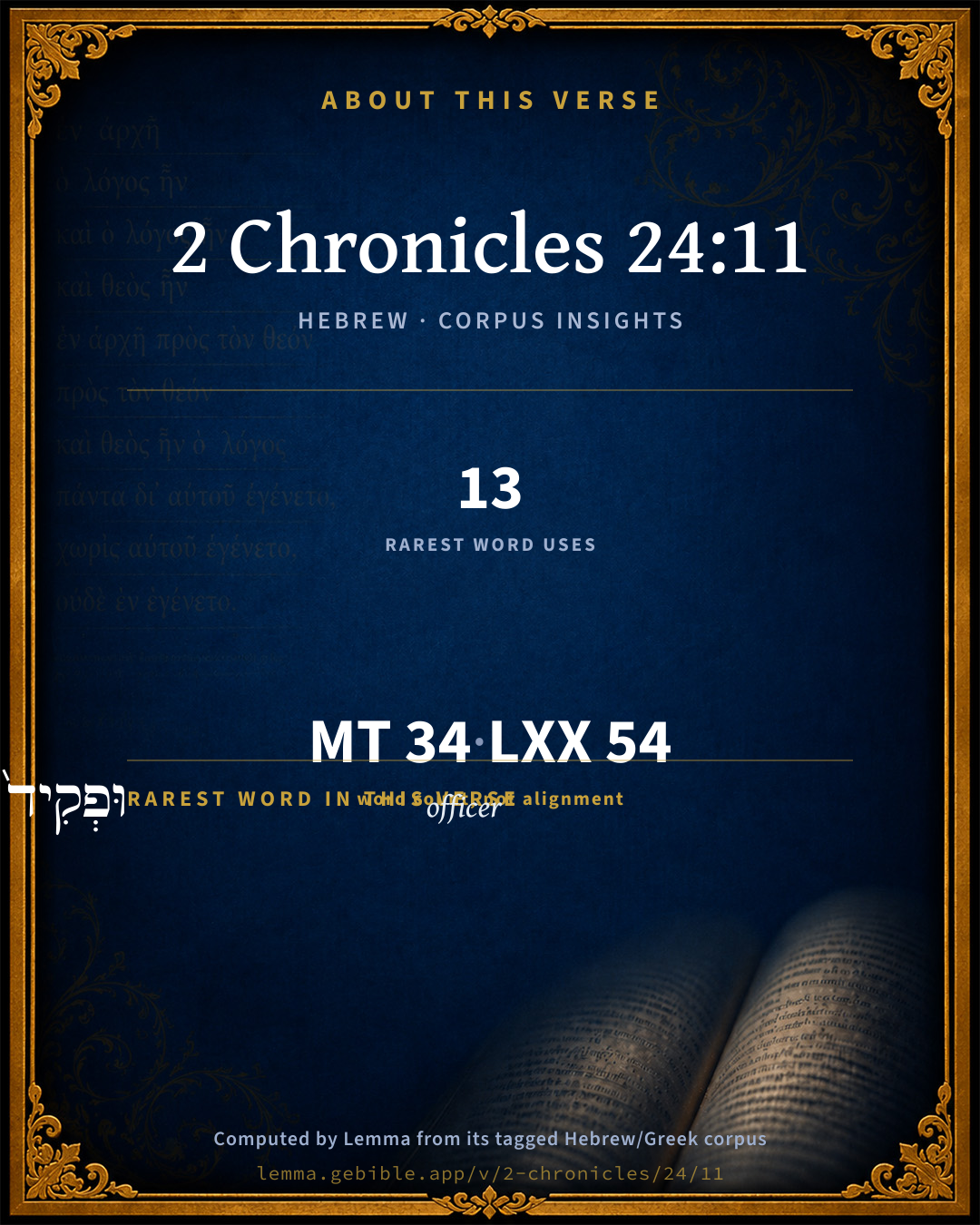
The rarest word here is וּפְקִיד֙ officer H6496 — appearing just 13 times in the whole Hebrew Bible.

Shared distinctive vocabulary

וּפְקִיד֙ officer H6496 occurs in 13 verses of the Hebrew Bible. Also found in:

Grammatical profile

  • 9 verbs
  • 18 nouns
  • 1 adjective
  • 2 prepositions
  • 1 conjunction
  • 1 adverb
  • 2 particles

Verb forms

  • וַיְהִ֡י Qal · Sequential Imperfect
  • יָבִ֨יא Hiphil · Imperfect
  • וְכִרְאוֹתָ֞ם Qal · Infinitive Construct
  • וּבָ֨א Qal · Sequential Perfect
  • וִיעָ֨רוּ֙ Piel · Imperfect
  • וְיִשָּׂאֻ֖הוּ Qal · Imperfect
  • וִֽישִׁיבֻ֣הוּ Hiphil · Imperfect
  • עָשׂוּ֙ Qal · Perfect
  • וַיַּֽאַסְפוּ Qal · Sequential Imperfect

Repetition

Words recur within this verse — often emphatic in Hebrew:

  • יָבִ֨יא to enter H935 ×2
  • הָֽאָר֜וֹן ark H727 ×2
  • הַמֶּלֶךְ֮ king H4428 ×2
  • הַכֶּ֗סֶף silver H3701 ×2
  • לְי֣וֹם day H3117 ×2
  • אֶל to H413 ×2

Hebrew & Septuagint length

In English translation the verse runs 62 words from the Hebrew and 66 from the Septuagint (LXX English) — closely comparable.

A rough comparison of the two English renderings, which tokenize alike — not a word-level alignment.

Word counts can differ between the Hebrew and the Greek without any difference in meaning — e.g. the Hebrew direct-object marker אֵת has no separate Greek word, and Greek often adds the article ὁ.

In the original languages it is 34 Hebrew tokens and 54 Greek tokens — but the two are counted differently (Hebrew bundles its prefixes and suffixes into one token; the Greek is in lemma form), so that isn’t a like-for-like length.

Cross-references

2

Topical passages linked to 2 Chronicles 24:11 in the Treasury of Scripture Knowledge — connected by theme and wording, ordered by reader-vote popularity; previews shown in the World English Bible.

  • 2 Kings 12:10–12 It was so, when they saw that there was much money in the chest, that the king's scribe and the high priest came up, and they put up in bags and counted the money that was found in the house of Yahweh.
  • 1 Corinthians 16:2 On the first day of the week, let each one of you save, as he may prosper, that no collections be made when I come.

Cross-references courtesy of OpenBible.info (CC BY 4.0).

Hebrew and Greek witnesses Masoretic Hebrew ↔ Greek Septuagint

The same verse in the two great witnesses to the Old Testament, shown verse-for-verse.

These are two independent witnesses, not word-aligned to each other, and the Septuagint is shown in lemma (dictionary) form.

Hebrew 2 Chronicles 24:11 Masoretic · Westminster Leningrad Codex

וַיְהִ֡י בְּעֵת֩ יָבִ֨יא אֶת הָֽאָר֜וֹן אֶל פְּקֻדַּ֣ת הַמֶּלֶךְ֮ בְּיַ֣ד הַלְוִיִּם֒ וְכִרְאוֹתָ֞ם כִּי רַ֣ב הַכֶּ֗סֶף וּבָ֨א סוֹפֵ֤ר הַמֶּ֨לֶךְ֙ וּפְקִיד֙ כֹּהֵ֣ן הָרֹ֔אשׁ וִיעָ֨רוּ֙ אֶת הָ֣אָר֔וֹן וְיִשָּׂאֻ֖הוּ וִֽישִׁיבֻ֣הוּ אֶל מְקֹמ֑וֹ כֹּ֤ה עָשׂוּ֙ לְי֣וֹם בְּי֔וֹם וַיַּֽאַסְפוּ כֶ֖סֶף לָרֹֽב

It was so, that whenever the chest was brought to the king's officers by the hand of the Levites, and when they saw that there was much money, the king's scribe and the chief priest's officer came and emptied the chest, and took it, and carried it to its place again. Thus they did day by day, and gathered money in abundance.

World English Bible · Public Domain

Greek LXX 2 Chronicles 24:11 Septuagint · lemma form

καί γίγνομαι ὡς εἰςφέρω ὁ γλωσσόκομον πρός ὁ προστάτης ὁ βασιλεύς διά χείρ ὁ λευείτης καί ὡς ὁράω ὅτι πλεονάζω ὁ ἀργύριον καί ἔρχομαι ὁ γραμματεύς ὁ βασιλεύς καί ὁ προστάτης ὁ ἱερεύς ὁ μέγας καί ἐκκενόω ὁ γλωσσόκομον καί καταἵστημι εἰς ὁ τόπος αὐτός οὕτως ποιέω ἡμέρα ἐκ ἡμέρα καί συνἄγω ἀργύριον πολύς

And it came to pass, when they brought in the box to the officers of the king by the hand of the Levites, and when they saw that the money was more than sufficient, then came the king's scribe, and the officer of the high priest, and emptied the box, and restored it to its place. Thus they did day by day, and collected much money.

LXX2012 (modern English Septuagint) · Public Domain

Hebrew: Westminster Leningrad Codex (CC BY 4.0). Greek: Septuagint (public domain); English from LXX2012 (modern English Septuagint) (Public Domain). How the Septuagint differs from the Hebrew →

Commentary

Notes on 2 Chronicles 24:11 from classic Christian and Jewish commentators (each source and its license shown beneath its notes). The classic Christian expositions comment on the surrounding passage and are grouped to its opening verse, so a note may address several verses; the Jewish commentaries on the Tanakh (Rashi and others) are per-verse, so they appear only where the commentator wrote on this verse.

Lemma curates 59 commentaries, every one of them public domain or Creative Commons licensed, each selected and text-cleaned for this edition rather than reprinted as found. About our sources →

Geneva Bible (1599)

Geneva Bible translators

Such as were faithful men, whom the king had appointed for that matter.

Geneva Bible (1599) marginal notes — public domain. Text via Bolls.life.

Ellicott's Commentary for English Readers

(11) Now.—And.

At what time the chest was brought.—Literally, at the time when one used to bring the chest to the royal inspection (or, to the king’s officers pĕquddâh), by the hand of the Levites; i.e., whenever the chest was brought, &c.

The chronicler, as usual, is careful to record the participation of the Levites in the business.

The king’s scribe and the high priest’s officer came and emptied the chest.—Rather, the king’s scribe (or accountant) and the high priest’s officer would come in and empty the chest; and they (i.e., the Levites) would take it up and restore it to its place.

Kings has: “The king’s scribe and the high priest came up, and bound up and counted the money that was found in the house of the Lord.” The substitution of “the high priest’s officer” for “the high priest” seems to be made in the interest of the high priest’s dignity. In the time of the chronicler the high priesthood was invested with all the greater majesty in that the monarchy was a thing of the distant past.

Day by day.—That is, time after time, as often as the chest seemed full (lĕyôm bĕyôm). The Hebrew phrase only occurs here. (Comp. 1Ch_12:22.)

A Bible Commentary for English Readers, edited by Charles John Ellicott (1878–1897) — public domain. Text from a community e-Sword module.

The Cambridge Bible for Schools and Colleges

gen. ed. J. J. S. Perowne

11. at what time … by the hand of the Levites] This clause is not in Kings.

the chief priest’s officer] According to Kings the high priest was present himself.

The Cambridge Bible for Schools and Colleges (gen. ed. J. J. S. Perowne; Cambridge University Press, 1878–1918) — public domain. Text from a community e-Sword module.

John Gill's Exposition

So the workmen wrought,.... The masons, carpenters, blacksmiths, and brasiers:

and the work was perfected by them; the business of repairs was completely finished:

and they set the house of God in his state; as it was at first:

and strengthened it; so that it seemed as firm and stable as when first built.

John Gill's Exposition of the Whole Bible (1746–1763) — public domain (CC PDM 1.0). Text via the HelloAO Bible API.

Albert Barnes' Notes on the Bible

The king’s scribe ... came and emptied ... - Rather, “the king’s scribe came ... and they emptied” etc. i. e. the Levites who brought the chest from the temple emptied it in the presence of the scribe.

Albert Barnes' Notes on the Bible (1834–1885) — public domain. Text from a community e-Sword/MySword module.

Haydock's Catholic Bible Commentary

From day. Literally, "every day," (H.) when the chest was replenished. M.

George Leo Haydock (1774–1849), Haydock's Catholic Family Bible and Commentary, 1859 edition — public domain. Excludes Psalms (Douay-Rheims chapter numbering differs from Protestant) and Deuterocanonical books (Catholic canon only).

Matthew Poole's English Annotations

The chest was brought unto the king’s office, from the gate of the court into one of the chambers belonging to the temple, which was appointed by the king for this office.

Matthew Poole's English Annotations on the Holy Bible (1683–1685) — public domain. Text from a community e-Sword/MySword module.

The Pulpit Commentary

Unto the king"s office. Not "office" in the modern technical business sense; the meaning is the care, charge, or custody of the king, the Hebrew word being tDqup; nor does this necessitate the supposition of the personal care of the king. The body of this verse leaves it quite open to possibility, in harmony with the usage of the Hebrew language and its idiom, that the process described took place, if necessary, more than once in a day, and, on the other hand, not necessarily every evening. The change of the number of the verb in "they emptied," etc., and the apparent statement that those who emptied also carried back the chest, betoken that while the king"s scribe (1Ki_4:3) and the high priest"s officer stood by, the usual Levite functionaries did the work. The phrase, day by day, is not necessarily equivalent to every evening, but to time after time.

The Pulpit Commentary (1880–1919), ed. H.D.M. Spence-Jones & Joseph S. Exell — public domain. Text from a community e-Sword module.

unfoldingWord translationNotes

Door43 World Missions Community

It happened that whenever

This phrase introduces a new, recurring action. If your language has a way to note this, you may use it here.

take it and carry it back to its place

"take the chest and carry it back to its place"

stonemasons and carpenters

"men who built with stone and men who built with wood"

those who worked in iron and bronze

"men who made things from iron and bronze"

translationWords

king

scribe

works

servant

unfoldingWord translationNotes — © Distant Shores Media and the Door43 World Missions Community, licensed CC BY-SA 4.0. Source: git.door43.org/Door43/en_tn.

Rashi

Rabbi Shlomo Yitzchaki (Rashi)

and when they saw that there was much money then the king’s scribe came.

and the appointee of the head priest The servant appointed under the head priest, who was the assistant to the high priest, together with the king’s scribe. In II Kings (12:11), it is written: “the king’s scribe and the high priest went up.” The meaning is that the king’s scribe went up, and the high priest also sent his appointee, who was the scribe who wrote what the high priest commanded him, because it was unfitting and degrading for the high priest to go with the king’s servants.

empty the chest - Heb. וִיעָרוּ. A similar instance is (Gen. 24:20): “and emptied (וַתְּעַר) her pitcher.”

carry it Every day, when they saw that there was much money in it, they would bring it to the king’s appointee within the forecourt, empty it, carry it, and return it to its place outside the gate of the Lord.

Rashi on the Tanakh — English translations: “The Judaica Press complete Tanach with Rashi, translated by A. J. Rosenberg” (CC BY 4.0); “Pentateuch with Rashi's commentary by M. Rosenbaum and A.M. Silbermann, 1929-1934” (public domain); “The Metsudah Tanach series, Lakewood, N.J” (CC BY 4.0); and “The Book of Joshua, Metsudah Publications, 1997” (CC BY 4.0). Text via Sefaria.

Lesson kit

Teaching starters — assembled from the data on this page, not authored interpretation. Every prompt links to the verse data it draws on. Edit before teaching.

2 Chronicles, in the Historical, opens this verse with 34 words (27 distinct Hebrew lemmas). Its most distinctive word is pâqîyd (“officer”). A historical commentator’s framing appears above. Read the whole chapter for the surrounding context.

Discussion questions

  1. How does “officer” (pâqîyd) shape what this verse is saying?
  2. Genesis 41:34 shares the word «officer» with this verse. How do the two illuminate each other?
  3. “to enter” occurs 2× in this one verse. What is the effect of the repetition?
  4. The translations on this page render this verse differently — a whole-verse word diff, not a word-by-word alignment. What might account for the different wordings?
  5. The verb «וַיְהִ֡י» is Qal Sequential Imperfect. How does its form color the action?
  6. Reading how Geneva Bible (1599) and Ellicott's Commentary for English Readers read this verse, where do the two commentators agree and where do they part?

Things to notice

Reading settings

Reading text

Shown beneath each verse's original-language words.

Old Testament
Old Testament edition

Read the OT as the Masoretic Hebrew (MT) or the Greek Septuagint (LXX).

English shown for the Greek Septuagint (in the Hebrew ↔ Greek comparison).

Comparing translations? Open the Compare panel on any verse page to stack up to four side by side.