
1 Samuel 14:7

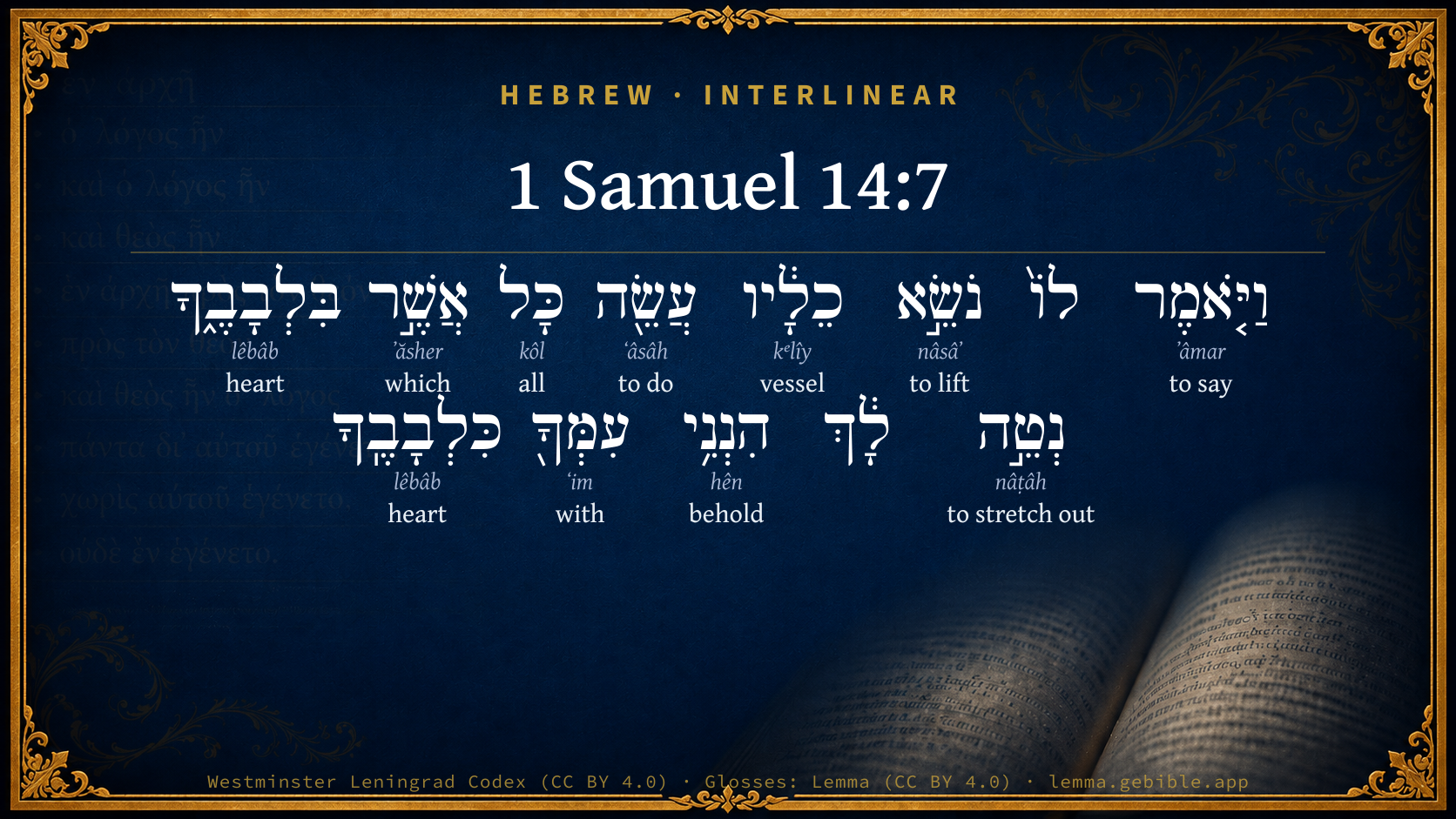
Hebrew (Westminster Leningrad Codex) 1 Samuel 14:7 appears in the Hebrew Old Testament. The text above is from the Westminster Leningrad Codex. Each word links to its Strong’s number, a concise gloss, and parsing drawn from the Open Scriptures Hebrew Bible morphology. Click any word for its full Brown-Driver-Briggs (BDB) entry.
Download image
Cite this verse

1 Samuel 14:7 (World English Bible). Public Domain. Lemma interlinear Bible study tool, https://lemma.gebible.app/v/1-samuel/14/7.

Show BibTeX & RIS
BibTeX
RIS
English Translation
His armor bearer said to him, Do all that is in your heart: turn you, behold, I am with you according to your heart.
World English Bible · Public Domain
Download a study sheet

One document with this verse’s original text, its word-by-word gloss line, the meaning frame, cross-references with their text, attributed commentary, and full source and license credits — printable, and it pastes into notes with its structure intact.

This verse Autodidact and up

Study sheet (.html) Plain text (.txt)

A passage Seminary Student

Up to 50 verses in one chapter. A passage sheet keeps up to 6 commentary sources and 12 cross-references per verse, in the order this page ranks them, and says so on the sheet whenever that leaves anything out. Ask for a single verse and you get the Autodidact verse sheet above.

Everything on this page stays free to read, with no account — the sheet is a download of what is already on screen, not access to it.

Want to remove ads? Support Godless Engineer
Compare translations 3

The same verse in 3 English versions, stacked beneath the original-language interlinear above. Click any original word for its lexicon entry.

Each is an independent rendering of the whole verse — the interlinear is not word-aligned to these translations.

Highlighted words mark where these versions differ — a whole-verse word diff, not a word-by-word alignment.

  • World English Bible Public Domain
    His armor bearer said to him, Do all that is in your heart: turn you, behold, I am with you according to your heart.
  • King James Version Public Domain
    And his armourbearer said unto him, Do all that is in thine heart: turn thee; behold, I am with thee according to thy heart.
  • unfoldingWord Literal Text CC BY-SA 4.0
    And the carrier of his equipment said to him, “Do all that in your heart. Turn yourself; behold me, with you according to your heart.”

unfoldingWord Literal Text — © unfoldingWord, licensed CC BY-SA 4.0. Word-aligned USFM3 via Door43 (git.door43.org/unfoldingWord/en_ult).

Versions to compare (up to 4)

3 of 4 selected

Show all 18 translations

Every available English version of this verse, each an independent rendering of the whole verse.

  • World English Bible Public Domain
    His armor bearer said to him, Do all that is in your heart: turn you, behold, I am with you according to your heart.
  • Berean Standard Bible Public Domain
    His armor-bearer replied, “Do all that is in your heart. Go ahead; I am with you heart and soul.”
  • Majority Standard Bible Public Domain
    His armor-bearer replied, “Do all that is in your heart. Go ahead; I am with you heart and soul.”
  • King James Version Public Domain
    And his armourbearer said unto him, Do all that is in thine heart: turn thee; behold, I am with thee according to thy heart.
  • American Standard Version (1901) Public Domain
    And his armorbearer said unto him, Do all that is in thy heart: turn thee, behold, I am with thee according to thy heart.
  • Revised Version (1885) Public Domain
    And his armourbearer said unto him, Do all that is in thine heart: turn thee, behold I am with thee according to thy heart.
  • Geneva Bible (1599) Public Domain
    And he that bare his armour, saide vnto him, Doe all that is in thine heart: goe where it pleaseth thee: beholde, I am with thee as thine heart desireth.
  • Douay-Rheims (1899) Public Domain
    And his armourbearer said to him: Do all that pleaseth thy mind: go whither thou wilt, and I will be with thee wheresoever thou hast a mind.
  • Young's Literal Translation Public Domain
    And the bearer of his weapons saith to him, `Do all that `is' in thy heart; turn for thee; lo, I `am' with thee, as thine own heart.'
  • Literal Standard Version CC BY-SA 4.0
    And the bearer of his weapons says to him, “Do all that [is] in your heart; turn for yourself; behold, I [am] with you, as your own heart.”
  • Unlocked Literal Bible CC BY-SA 4.0
    His armor bearer replied, “Do everything that is in your heart. Go ahead, see, I am with you, to obey all your commands.”
  • unfoldingWord Literal Text CC BY-SA 4.0
    And the carrier of his equipment said to him, “Do all that in your heart. Turn yourself; behold me, with you according to your heart.”
  • Darby Bible Public Domain
    And his armour-bearer said to him, Do all that is in thy heart; turn thee; behold, I am with thee according to thy heart.
  • World Messianic Bible Public Domain
    His armor bearer said to him, “Do all that is in your heart. Go, and behold, I am with you according to your heart.”
  • Webster's Bible Public Domain
    And his armor-bearer said to him, Do all that is in thy heart: turn thee; behold, I am with thee according to thy heart.
  • Free Bible Version CC BY-SA 4.0
    “You choose what you want to do,” the armor-bearer replied. “I'm with you whatever you decide!”
  • Bible in Basic English Public Domain
    And his servant said to him, Do whatever is in your mind: see, I am with you in every impulse of your heart.
  • JPS Tanakh (1917) Public Domain
    And his armour-bearer said unto him: 'Do all that is in thy heart; turn thee, behold I am with thee according to thy heart.'

Literal Standard Version (2020), Covenant Press — licensed CC BY-SA 4.0. Text via the HelloAO Bible API (eBible.org). Unlocked Literal Bible (unfoldingWord) — licensed CC BY-SA 4.0. Text via the HelloAO Bible API (eBible.org). unfoldingWord Literal Text — © unfoldingWord, licensed CC BY-SA 4.0. Word-aligned USFM3 via Door43 (git.door43.org/unfoldingWord/en_ult). Free Bible Version, Dr. Jonathan Gallagher — licensed CC BY-SA 4.0. Text via the HelloAO Bible API (eBible.org).

Word by word

More ways to search: Search by grammar → Find every occurrence → Compare this word →

Practice this passage: Drill this verse → Learn its vocabulary →

נְטֵ֣ה
nâṭâh
H5186
“stretch out”
Verb, Qal, Imperative, 2nd Person, Masculine, Singular
Part of Speech
Verb
Stem
Qal
Form
Imperative
Person
2nd Person
Gender
Masculine
Number
Singular
Full BDB Definition

Origin: a primitive root

TWOT: 1352

to stretch out, extend, spread out, pitch, turn, pervert, incline, bend, bow - (Qal) - to stretch out, extend, stretch, offer - to spread out, pitch (tent) - to bend, turn, incline - to turn aside, incline, decline, bend down - to bend, bow - to hold out, extend (figuratively) - (Niphal) to be stretched out - (Hiphil) - to stretch out - to spread out - to turn, incline, influence, bend down, hold out, extend, thrust aside, thrust away
  1. וַיֹּ֤אמֶר ʼâmar H559 “and · to say” Conjunction + Verb, Qal, Sequential Imperfect, 3rd Person, Masculine, Singular
  2. נֹשֵׂ֣א nâsâʼ H5375 “lifting” Verb, Qal, Participle Active, Masculine, Singular, Construct
  3. כֵלָ֔יו kᵉlîy H3627 “vessels · his” Noun, Common, Masculine, Plural, Construct + Suffix, Personal, 3rd Person, Masculine, Singular
  4. עֲשֵׂ֖ה ʻâsâh H6213 “do” Verb, Qal, Imperative, 2nd Person, Masculine, Singular
  5. כָּל kôl H3605 “all of” Noun, Common, Masculine, Singular, Construct
  6. אֲשֶׁ֣ר ʼăsher H834 “which” Particle, Relative
  7. בִּלְבָבֶ֑ךָ lêbâb H3824 “in/at · heart · your” Preposition + Noun, Common, Masculine, Singular, Construct + Suffix, Personal, 2nd Person, Masculine, Singular
  8. הִנְנִ֥י hên H2005 “behold · me” Particle, Demonstrative + Suffix, Personal, 1st Person, Common, Singular
  9. עִמְּךָ֖ ʻim H5973 “with · you” Preposition + Suffix, Personal, 2nd Person, Masculine, Singular
  10. כִּלְבָבֶֽךָ lêbâb H3824 “like/as · heart · your” Preposition + Noun, Common, Masculine, Singular, Construct + Suffix, Personal, 2nd Person, Masculine, Singular

About this verse

These counts appear in no published source. They are computed here, from the morphology-tagged text and Lemma’s own curated glosses. What Lemma adds →

13
words
10
distinct lemmas
Historical
section

Grammatical profile

  • 4 verbs
  • 4 nouns
  • 3 prepositions
  • 2 particles

Verb forms

  • וַיֹּ֤אמֶר Qal · Sequential Imperfect
  • נֹשֵׂ֣א Qal · Participle Active
  • עֲשֵׂ֖ה Qal · Imperative
  • נְטֵ֣ה Qal · Imperative

Repetition

A word recurs within this verse — often emphatic in Hebrew:

  • בִּלְבָבֶ֑ךָ heart H3824 ×2

Hebrew & Septuagint length

In English translation the verse runs 24 words from the Hebrew and 24 from the Septuagint (LXX English) — the same length.

A rough comparison of the two English renderings, which tokenize alike — not a word-level alignment.

Word counts can differ between the Hebrew and the Greek without any difference in meaning — e.g. the Hebrew direct-object marker אֵת has no separate Greek word, and Greek often adds the article ὁ.

Cross-references

4

Topical passages linked to 1 Samuel 14:7 in the Treasury of Scripture Knowledge — connected by theme and wording, ordered by reader-vote popularity; previews shown in the World English Bible.

  • 2 Samuel 7:3 Nathan said to the king, Go, do all that is in your heart; for Yahweh is with you.
  • 1 Samuel 10:7 Let it be, when these signs are come to you, that you do as occasion shall serve you; for God is with you.
  • Psalms 46:7 Yahweh of Hosts is with us. The God of Jacob is our refuge. Selah.
  • Zechariah 8:23 Thus says Yahweh of Hosts: "In those days, ten men will take hold, out of all the languages of the nations, they will take hold of the skirt of him who is a Jew, saying, 'We will go with you, for we have heard that God is with you.'"

Cross-references courtesy of OpenBible.info (CC BY 4.0).

Hebrew and Greek witnesses Masoretic Hebrew ↔ Greek Septuagint

The same verse in the two great witnesses to the Old Testament, shown verse-for-verse.

These are two independent witnesses, not word-aligned to each other, and the Septuagint is shown in lemma (dictionary) form.

Hebrew 1 Samuel 14:7 Masoretic · Westminster Leningrad Codex

וַיֹּ֤אמֶר לוֹ֙ נֹשֵׂ֣א כֵלָ֔יו עֲשֵׂ֖ה כָּל אֲשֶׁ֣ר בִּלְבָבֶ֑ךָ נְטֵ֣ה לָ֔ךְ הִנְנִ֥י עִמְּךָ֖ כִּלְבָבֶֽךָ

His armor bearer said to him, Do all that is in your heart: turn you, behold, I am with you according to your heart.

World English Bible · Public Domain

Greek LXX 1 Samuel 14:7 Septuagint · lemma form

καί εἶπον αὐτός ὁ αἴρω ὁ σκεῦος αὐτός ποιέω πᾶς ὅς ἐάν ὁ καρδία σύ ἐκκλίνω ἰδού ἐγώ μετά σύ ὡς ὁ καρδία σύ καρδία ἐγώ

And his armor-bearer said to him, Do all that your heart inclines toward: behold, I am with you, my heart is as your heart.

LXX2012 (modern English Septuagint) · Public Domain

Hebrew: Westminster Leningrad Codex (CC BY 4.0). Greek: Septuagint (public domain); English from LXX2012 (modern English Septuagint) (Public Domain). How the Septuagint differs from the Hebrew →

Targum (Aramaic paraphrase)

1

The Targum is the ancient Jewish Aramaic paraphrase of the Hebrew Scriptures — an interpretive translation, not the Hebrew text itself. Onkelos (literal) and Pseudo-Jonathan (expansive) render the Torah, and Jonathan the Prophets. Coverage is partial: where no permissively-licensed English translation exists for a verse, only the Aramaic is shown. This is verse-level text, not a word-by-word alignment to the Hebrew.

  1. Targum Jonathan Prophets (Joshua–Malachi)
    וַאֲמַר לֵיהּ נָטֵל זְיָנֵיהּ עֲבֵיד כָּל דִי בְּלִבָּךְ אִתְפְּנֵי לָךְ הָא אֲנָא עִמָךְ כִּרְעוּתָךְ:

    (no public-domain English translation for this verse)

    Targum Jonathan — Aramaic: “Mikraot Gedolot” (public domain). English: “Sefaria Community Translation” (CC0 1.0 (public-domain dedication)); “London "Chaldee Paraphrase," 1871” (public domain). Text via Sefaria.

Commentary

Notes on 1 Samuel 14:7 from classic Christian and Jewish commentators (each source and its license shown beneath its notes). The classic Christian expositions comment on the surrounding passage and are grouped to its opening verse, so a note may address several verses; the Jewish commentaries on the Tanakh (Rashi and others) are per-verse, so they appear only where the commentator wrote on this verse.

Lemma curates 59 commentaries, every one of them public domain or Creative Commons licensed, each selected and text-cleaned for this edition rather than reprinted as found. About our sources →

Trapp's Complete Commentary

John Trapp

1Sa 14:7 And his armourbearer said unto him, Do all that [is] in thine heart: turn thee; behold, I [am] with thee according to thy heart.

Ver. 7. Turn thee; behold, I am with thee.] Here we have an example of a faithful servant, who would thus stick to his master, and adventure with him. Doubtless he would have done as much for his master, if there had been occasion, as the Earl of Huntly’s servant did at Musselburgh field in Scotland, who, when the Earl, assaulted by the English, had lost his helmet, took off his own headpiece, and put it on the Earl’s head. The Earl was therewith taken prisoner, but the other, for want thereof, was presently struck down. {a}

{a} Life of Edward VI

John Trapp, A Commentary or Exposition upon All the Books of the Old and New Testament (1647–1656) — public domain. Text from a community e-Sword module.

The Biblical Illustrator

Joseph S. Exell

1Sa_14:7

I am with thee.

The armour bearer who backed Jonathan

Jonathan was a brave and generous leader of men. In the picture we are to study we see Jonathan, tired of inaction, and longing to be against the enemy, suddenly determine to do a little skirmishing on his own account; and yet there was a profoundly religious spirit controlling the impulse which led him to make the attempt. Jonathan devoutly believed that God was able to work by the few as well as by the many. He made known his purpose to his armour bearer and no doubt awaited with interest the attitude which that young man would take in the matter. Then the armour bearer replied with a warm-hearted enthusiasm and fidelity that must have made Jonathans generous blood tingle, Do all that is in thine heart: turn thee; behold, I am with thee according to thy heart. Who could not win victories backed by such armour bearers as that? Go back through history and you will see that the men who have done the greatest work in the world are the men who have been backed by faithful helpers with staunch and loyal hearts. Moses was chosen to lead Israel out of Egypt, but God gave him Miriam and Aaron for armour bearers. Joshua became the great soldier and leader of his nation, but what a splendid armour bearer he had in Caleb. Daniel stands out gloriously against the dark background of wicked Babylon, but the three brave Hebrew boys that went into the fiery furnace rather than betray their faith in God were worthy armour bearers to such a leader. Paul shines forth from Ephesus, and Rome, and Athens, and Corinth as the great leader and evangelist, but who can ever tell how much Silas, and Barnabas, and Timothy meant to the great apostle as armour bearers to encourage and sustain him? Of course God works through leaders. I do not wish for one moment, to shirk my own responsibility or my own duty with reference to a revival. But feeling in this way, I also feel just as certainly that I cannot win in this church and in this city many souls to Christ, unless the men and women of this church shall be loyal and faithful armour bearers. There are many ways in which the individual members of a church may be helpful armour bearers to the pastor in a time like this.

1. The first is in their attitude to God and to their fellow Christians in relation to the meetings. Sincere and earnest prayer which takes possession of the heart and life must help to sustain the pastor in leading a campaign for the saving of souls. Do you think that Peter could have won that victory on the day of Pentecost if the hundred and twenty had been going about criticising him; or bad been making outside engagemants to take away their interest from the meeting. So both your attitude to God and your attitude toward your fellow church members are of the most serious importance. Revivals never come easily. A revival of religion is campaign waged against the world, and the flesh, and the devil. Every liquor saloon in this country is dead set against a revival of religion. Not only are these against it, but the greed for money, and the love of ease and self-indulgence, in church members as well as in outsiders, ere all against a revival of religion. Hence a real, genuine revival of religion always comes hard.

2. If you are to be a real armour bearer you, too, must handle the sword of the Spirit; you must not wait for the pastor to hunt out individuals one by one and win them to Christ. You must be faithful in your own place and with self-denial and earnestness seek to win souls yourself. There are many souls who are waiting for but a touch of influence from the outside to turn the balances on the side of righteousness. And what joy it would bring to you if you were to thus feel yourself a real armour bearer in Christs work. It seems terrible, when the human heart is capable of such marvellous things in the way of loyalty, and zeal, and enthusiasm, that we who profess the name of Jesus Christ, and have been redeemed by His precious blood, should be so lacking here. What glorious deeds have been done through the chivalric earnestness of human souls! (L. A. Banks, D. D.)

The Biblical Illustrator, edited by Joseph S. Exell (c. 1880s–1900s) — public domain. Text from a community e-Sword module.

Geneva Bible (1599)

Geneva Bible translators

I will follow thee whithersoever thou goest.

Geneva Bible (1599) marginal notes — public domain. Text via Bolls.life.

Adam Clarke's Commentary

Verse 7. Behold, I am with thee] I shall accompany thee whithersoever thou goest, and share all thy dangers.

Adam Clarke's Commentary on the Bible (1810–1826) — public domain. Text from a community e-Sword/MySword module.

Ellicott's Commentary for English Readers

(7) Turn thee.—The very words of the prince’s armour-bearer seem to have been preserved; the expression is a colloquial one, and is rendered here literally. It signifies, “Go on; I will follow.”

(8) Behold, we will pass over.—The steep crag upon which the Philistine outpost was entrenched was across a deep ravine, or chasm, which separated the hostile armies.

(9) If they say thus unto us.—He longed for a supernatural sign which should confirm him in his conviction, that the prompting which urged him to this deed of extreme daring was indeed a voice from heaven.

A Bible Commentary for English Readers, edited by Charles John Ellicott (1878–1897) — public domain. Text from a community e-Sword module.

The Cambridge Bible for Schools and Colleges

gen. ed. J. J. S. Perowne

7. turn thee] The reading of the Heb. text is doubtful, and that of the Sept. perhaps to be preferred. “Do all unto which thine heart inclineth: behold I am with thee: my heart is as thy heart.”

The Cambridge Bible for Schools and Colleges (gen. ed. J. J. S. Perowne; Cambridge University Press, 1878–1918) — public domain. Text from a community e-Sword module.

John Gill's Exposition

And his armourbearer said unto him,.... Very readily and cheerfully:

do all that is in thine heart; whatever is thy pleasure, that thou hast a mind to do, that is upon thy heart, and thou art desirous of, and strongly inclined and affected to:

turn thee; which way thou wilt, towards the garrison of the Philistines, or elsewhere:

behold, I am with thee, according to thy heart; I will go with thee wherever thou goest, and do whatsoever thou wouldest have me to do; I am at thy command, and according to thy wish and desire, and in all things subject to thy will; I am as thine own heart.

John Gill's Exposition of the Whole Bible (1746–1763) — public domain (CC PDM 1.0). Text via the HelloAO Bible API.

Matthew Poole's English Annotations

Turn thee; march on to the enemies.

Matthew Poole's English Annotations on the Holy Bible (1683–1685) — public domain. Text from a community e-Sword/MySword module.

The Pulpit Commentary

Turn thee. The Hebrew seems to have preserved the very words of the young man, and the difficulty in rendering this phrase arises from its being a colloquial expression. "Face about" would be our phrase; but the sense is, "On with you; I will follow."

The Pulpit Commentary (1880–1919), ed. H.D.M. Spence-Jones & Joseph S. Exell — public domain. Text from a community e-Sword module.

Lesson kit

Teaching starters — assembled from the data on this page, not authored interpretation. Every prompt links to the verse data it draws on. Edit before teaching.

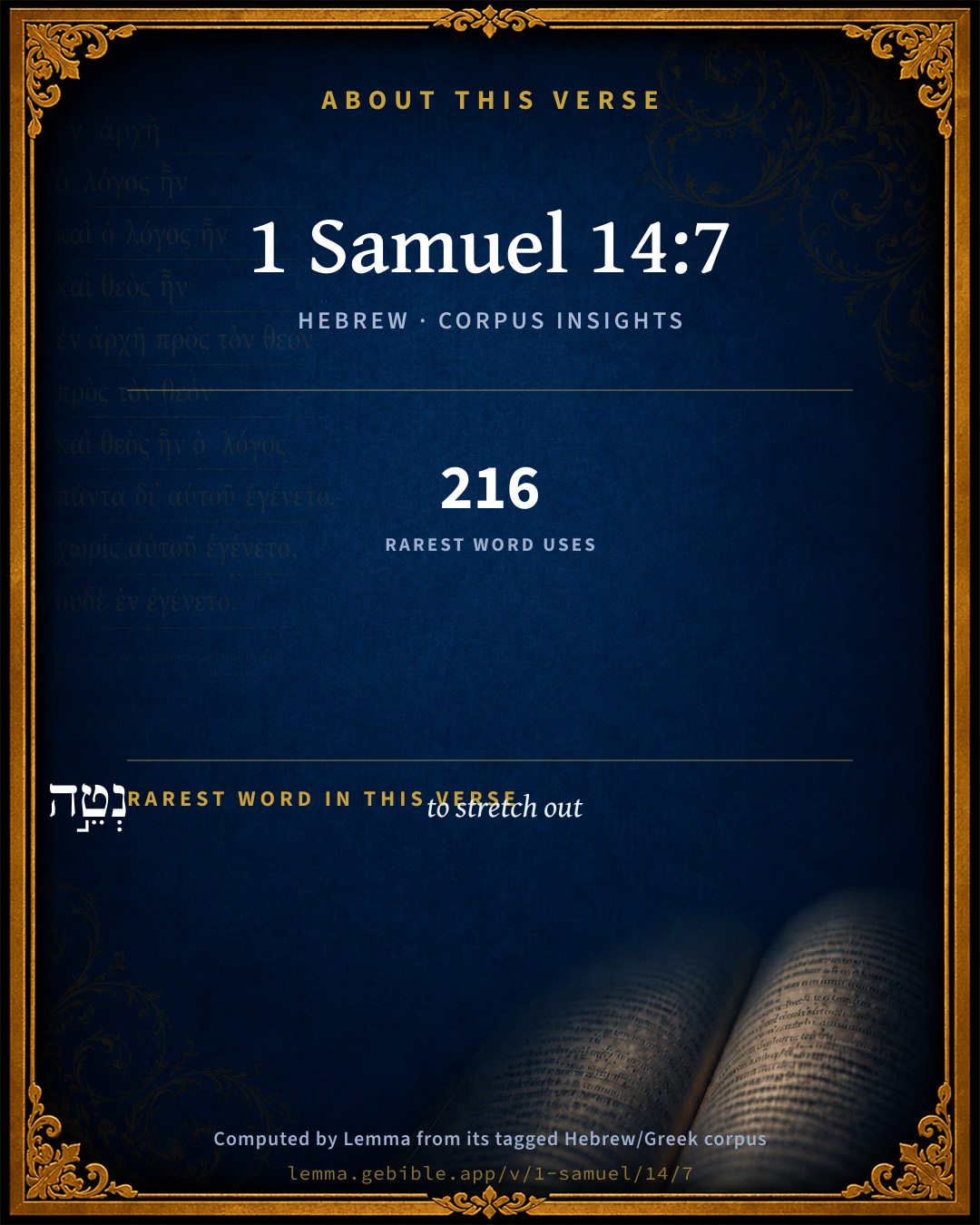
1 Samuel, in the Historical, opens this verse with 13 words (10 distinct Hebrew lemmas). Its most distinctive word is nâṭâh (“to stretch out”). A historical commentator’s framing appears above. Read the whole chapter for the surrounding context.

Discussion questions

  1. The word nâṭâh carries the sense “to stretch out.” How does it shape the verse?
  2. 2 Samuel 7:3 shares this passage’s theme. How do the two illuminate each other?
  3. “heart” occurs 2× in this one verse. What is the effect of the repetition?
  4. The translations on this page render this verse differently — a whole-verse word diff, not a word-by-word alignment. What might account for the different wordings?
  5. The verb «וַיֹּ֤אמֶר» is Qal Sequential Imperfect. How does its form color the action?
  6. Reading how Trapp's Complete Commentary and The Biblical Illustrator read this verse, where do the two commentators agree and where do they part?

Things to notice

Reading settings

Reading text

Shown beneath each verse's original-language words.

Old Testament
Old Testament edition

Read the OT as the Masoretic Hebrew (MT) or the Greek Septuagint (LXX).

English shown for the Greek Septuagint (in the Hebrew ↔ Greek comparison).

Comparing translations? Open the Compare panel on any verse page to stack up to four side by side.