
Psalms 102:10

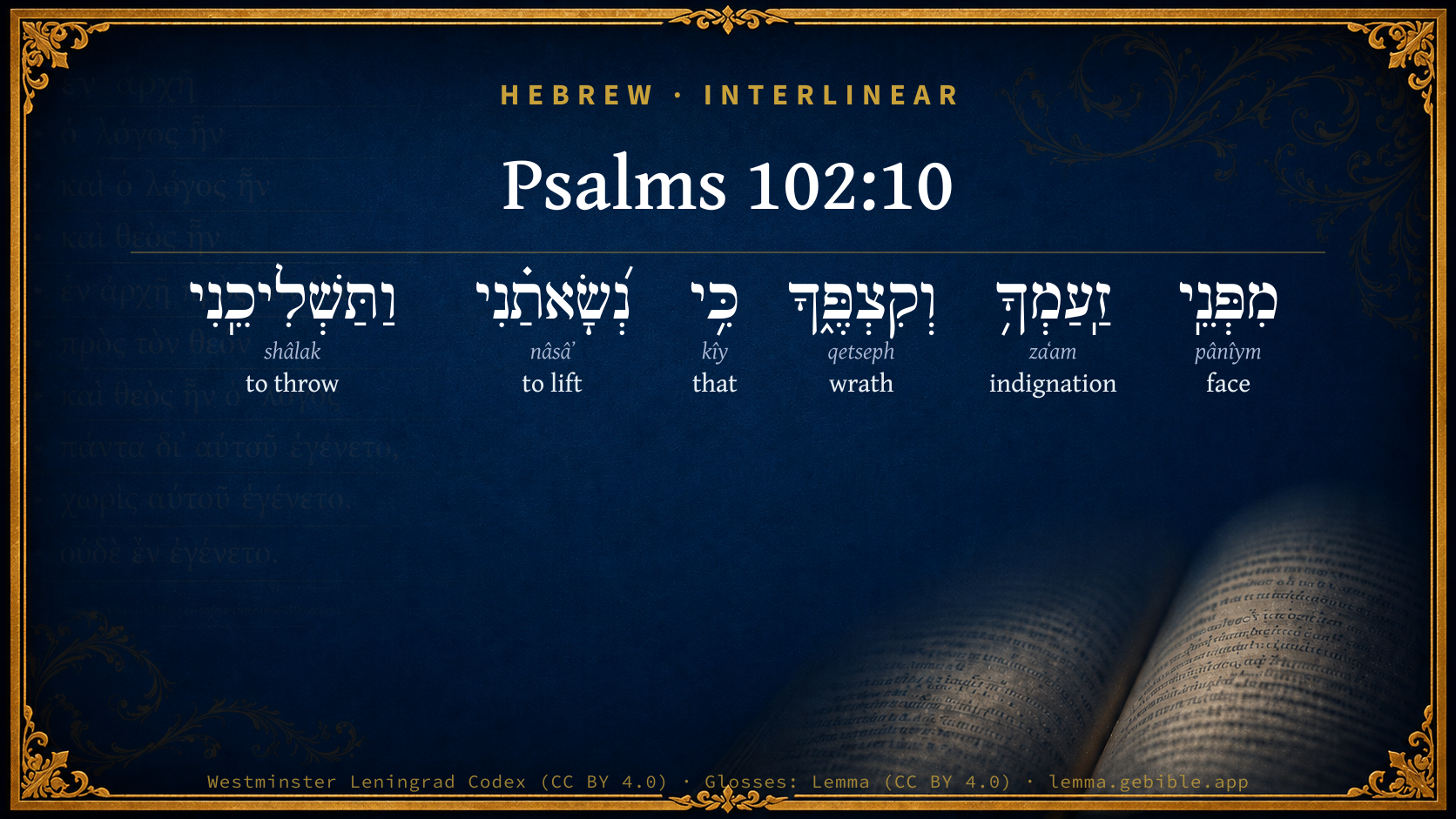
Hebrew (Westminster Leningrad Codex) Psalms 102:10 appears in the Hebrew Old Testament. The text above is from the Westminster Leningrad Codex. Each word links to its Strong’s number, a concise gloss, and parsing drawn from the Open Scriptures Hebrew Bible morphology. Click any word for its full Brown-Driver-Briggs (BDB) entry.
Download image
Cite this verse

Psalms 102:10 (World English Bible). Public Domain. Lemma interlinear Bible study tool, https://lemma.gebible.app/v/psalms/102/10.

Show BibTeX & RIS
BibTeX
RIS
English Translation
Because of your indignation and your wrath, For you have taken me up, and thrown me away.
World English Bible · Public Domain
Download a study sheet

One document with this verse’s original text, its word-by-word gloss line, the meaning frame, cross-references with their text, attributed commentary, and full source and license credits — printable, and it pastes into notes with its structure intact.

This verse Autodidact and up

Study sheet (.html) Plain text (.txt)

A passage Seminary Student

Up to 50 verses in one chapter. A passage sheet keeps up to 6 commentary sources and 12 cross-references per verse, in the order this page ranks them, and says so on the sheet whenever that leaves anything out. Ask for a single verse and you get the Autodidact verse sheet above.

Everything on this page stays free to read, with no account — the sheet is a download of what is already on screen, not access to it.

Want to remove ads? Support Godless Engineer
Compare translations 3

The same verse in 3 English versions, stacked beneath the original-language interlinear above. Click any original word for its lexicon entry.

Each is an independent rendering of the whole verse — the interlinear is not word-aligned to these translations.

Highlighted words mark where these versions differ — a whole-verse word diff, not a word-by-word alignment.

  • World English Bible Public Domain
    Because of your indignation and your wrath, For you have taken me up, and thrown me away.
  • King James Version Public Domain
    Because of thine indignation and thy wrath: for thou hast lifted me up, and cast me down.
  • unfoldingWord Literal Text CC BY-SA 4.0
    from the face of your fury and rage, for you have lifted me up and thrown me.

unfoldingWord Literal Text — © unfoldingWord, licensed CC BY-SA 4.0. Word-aligned USFM3 via Door43 (git.door43.org/unfoldingWord/en_ult).

Versions to compare (up to 4)

3 of 4 selected

Show all 18 translations

Every available English version of this verse, each an independent rendering of the whole verse.

  • World English Bible Public Domain
    Because of your indignation and your wrath, For you have taken me up, and thrown me away.
  • Berean Standard Bible Public Domain
    because of Your indignation and wrath, for You have picked me up and cast me aside.
  • Majority Standard Bible Public Domain
    because of Your indignation and wrath, for You have picked me up and cast me aside.
  • King James Version Public Domain
    Because of thine indignation and thy wrath: for thou hast lifted me up, and cast me down.
  • American Standard Version (1901) Public Domain
    Because of thine indignation and thy wrath: For thou hast taken me up, and cast me away.
  • Revised Version (1885) Public Domain
    Because of thine indignation and thy wrath: for thou hast taken me up, and cast me away.
  • Geneva Bible (1599) Public Domain
    Because of thine indignation and thy wrath: for thou hast heaued me vp, and cast me downe.
  • Douay-Rheims (1899) Public Domain
    For I did eat ashes like bread, and mingled my drink with weeping.
  • Young's Literal Translation Public Domain
    From Thine indignation and Thy wrath, For Thou hast lifted me up, And dost cast me down.
  • Literal Standard Version CC BY-SA 4.0
    From Your indignation and Your wrath, || For You have lifted me up, || And cast me down.
  • Unlocked Literal Bible CC BY-SA 4.0
    Because of your raging anger, you have lifted me up to throw me down.
  • unfoldingWord Literal Text CC BY-SA 4.0
    from the face of your fury and rage, for you have lifted me up and thrown me.
  • Darby Bible Public Domain
    Because of thine indignation and thy wrath; for thou hast lifted me up, and cast me down.
  • World Messianic Bible Public Domain
    because of your indignation and your wrath; for you have taken me up and thrown me away.
  • Webster's Bible Public Domain
    \\102:9\\For I have eaten ashes like bread, and mingled my drink with weeping,
  • Free Bible Version CC BY-SA 4.0
    because of your anger and hostility, for you have picked me up and tossed me away.
  • Bible in Basic English Public Domain
    Because of your passion and your wrath, for I have been lifted up and then made low by you.
  • JPS Tanakh (1917) Public Domain
    (102-11) Because of Thine indignation and Thy wrath; for Thou hast taken me up, and cast me away.

Literal Standard Version (2020), Covenant Press — licensed CC BY-SA 4.0. Text via the HelloAO Bible API (eBible.org). Unlocked Literal Bible (unfoldingWord) — licensed CC BY-SA 4.0. Text via the HelloAO Bible API (eBible.org). unfoldingWord Literal Text — © unfoldingWord, licensed CC BY-SA 4.0. Word-aligned USFM3 via Door43 (git.door43.org/unfoldingWord/en_ult). Free Bible Version, Dr. Jonathan Gallagher — licensed CC BY-SA 4.0. Text via the HelloAO Bible API (eBible.org).

Word by word

More ways to search: Search by grammar → Find every occurrence → Compare this word →

Practice this passage: Drill this verse → Learn its vocabulary →

About this verse

These counts appear in no published source. They are computed here, from the morphology-tagged text and Lemma’s own curated glosses. What Lemma adds →

6
words
6
distinct lemmas
Wisdom
section

Notable vocabulary

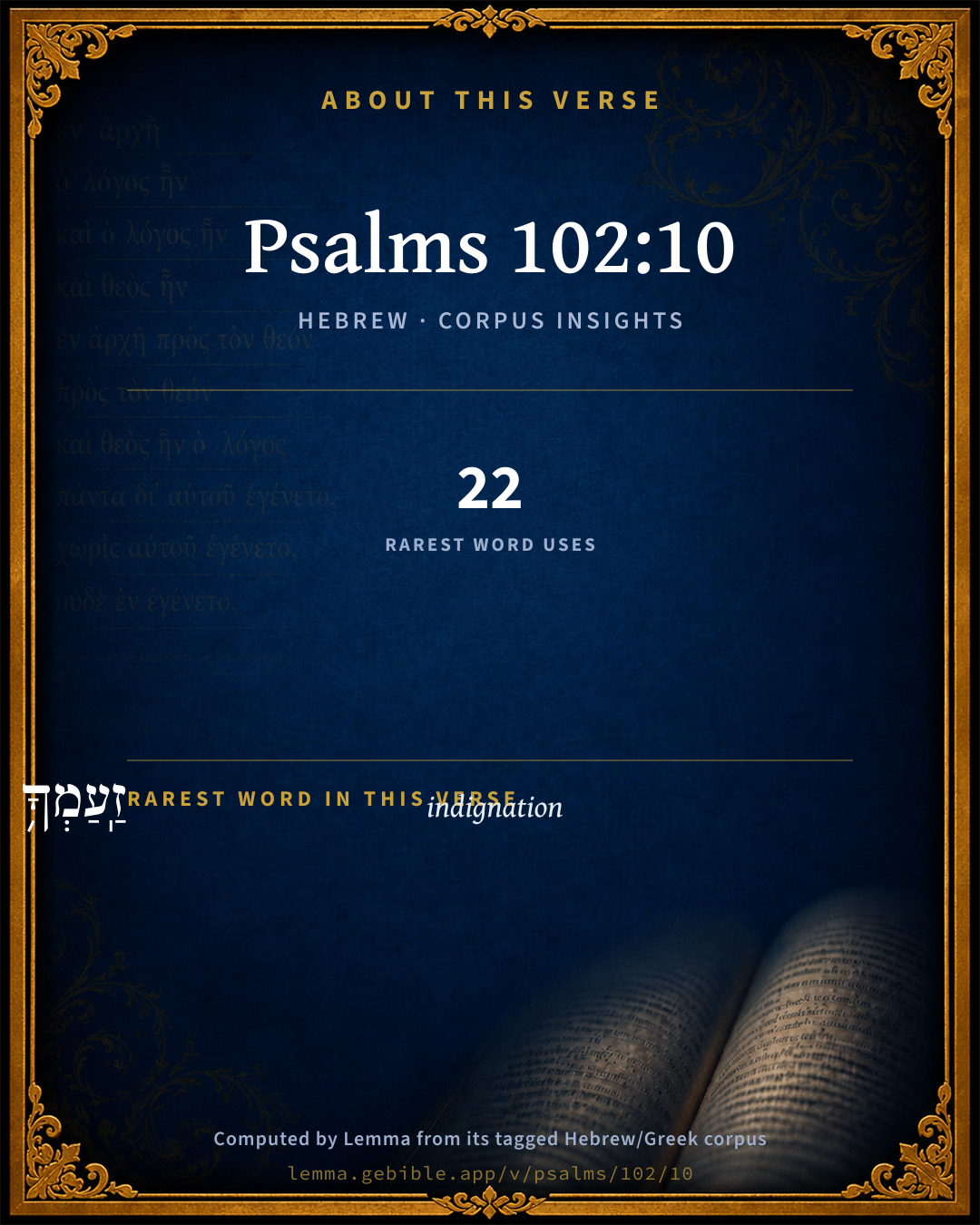
The rarest word here is זַֽעַמְךָ֥ indignation H2195 — appearing just 22 times in the whole Hebrew Bible.

Shared distinctive vocabulary

זַֽעַמְךָ֥ indignation H2195 occurs in 22 verses of the Hebrew Bible. Also found in:

Grammatical profile

  • 2 verbs
  • 3 nouns
  • 1 conjunction

Verb forms

  • נְ֝שָׂאתַ֗נִי Qal · Perfect
  • וַתַּשְׁלִיכֵֽנִי Hiphil · Sequential Imperfect

Hebrew & Septuagint length

In English translation the verse runs 17 words from the Hebrew and 17 from the Septuagint (LXX English) — the same length.

A rough comparison of the two English renderings, which tokenize alike — not a word-level alignment.

Word counts can differ between the Hebrew and the Greek without any difference in meaning — e.g. the Hebrew direct-object marker אֵת has no separate Greek word, and Greek often adds the article ὁ.

Cross-references

15

Topical passages linked to Psalms 102:10 in the Treasury of Scripture Knowledge — connected by theme and wording, ordered by reader-vote popularity; previews shown in the World English Bible.

  • Psalms 38:3 There is no soundness in my flesh because of your indignation, Neither is there any health in my bones because of my sin.
  • 2 Corinthians 4:9 pursued, yet not forsaken; struck down, yet not destroyed;
  • Psalms 90:7–9 For we are consumed in your anger. We are troubled in your wrath.
  • Psalms 147:6 Yahweh upholds the humble. He brings the wicked down to the ground.
  • Lamentations 3:39–42 Why does a living man complain, a man for the punishment of his sins?
  • Romans 3:19 Now we know that whatever things the law says, it speaks to those who are under the law, that every mouth may be closed, and all the world may be brought under the judgment of God.
  • 1 Samuel 2:7–8 Yahweh makes poor, and makes rich: He brings low, he also lifts up.
  • 2 Chronicles 25:8 But if you will go, do [valiantly], be strong for the battle: God will cast you down before the enemy; for God has power to help, and to cast down.
  • Psalms 30:6–7 As for me, I said in my prosperity, "I shall never be moved."
  • Psalms 38:18 For I will declare my iniquity. I will be sorry for my sin.
  • Psalms 39:11 When you rebuke and correct man for iniquity, You consume his wealth like a moth. Surely every man is but a breath." Selah.
  • Psalms 73:18–20 Surely you set them in slippery places. You throw them down to destruction.
  • Lamentations 1:18 Yahweh is righteous; for I have rebelled against his commandment: Please hear all you peoples, and see my sorrow: My virgins and my young men are gone into captivity.
  • Lamentations 5:16 The crown is fallen from our head: Woe to us! for we have sinned.
  • Daniel 9:8–14 Lord, to us belongs confusion of face, to our kings, to our princes, and to our fathers, because we have sinned against you.

Cross-references courtesy of OpenBible.info (CC BY 4.0).

Hebrew and Greek witnesses Masoretic Hebrew ↔ Greek Septuagint

The same verse in the two great witnesses to the Old Testament, shown verse-for-verse.

You’re reading Greek Psalm 101 (Hebrew Psalm 102). The Septuagint counts the superscription, so verse numbers can differ from the Hebrew — chapter-level alignment, not verse-by-verse. Numbering follows Rahlfs.

These are two independent witnesses, not word-aligned to each other, and the Septuagint is shown in lemma (dictionary) form.

Hebrew Psalms 102:10 Masoretic · Westminster Leningrad Codex

מִפְּנֵֽי זַֽעַמְךָ֥ וְקִצְפֶּ֑ךָ כִּ֥י נְ֝שָׂאתַ֗נִי וַתַּשְׁלִיכֵֽנִי

Because of your indignation and your wrath, For you have taken me up, and thrown me away.

World English Bible · Public Domain

Greek LXX Greek Psalm 101:10 Septuagint · lemma form

ὅτι σποδός ὡσεί ἄρτος ἐσθίω καί ὁ πόμα ἐγώ μετά κλαυθμός κιρνάω

because of your anger and your wrath: for you have lifted me up, and dashed me down.

LXX2012 (modern English Septuagint) · Public Domain

Hebrew: Westminster Leningrad Codex (CC BY 4.0). Greek: Septuagint (public domain); English from LXX2012 (modern English Septuagint) (Public Domain). How the Septuagint differs from the Hebrew →

Commentary

Notes on Psalms 102:10 from classic Christian and Jewish commentators (each source and its license shown beneath its notes). The classic Christian expositions comment on the surrounding passage and are grouped to its opening verse, so a note may address several verses; the Jewish commentaries on the Tanakh (Rashi and others) are per-verse, so they appear only where the commentator wrote on this verse.

Lemma curates 59 commentaries, every one of them public domain or Creative Commons licensed, each selected and text-cleaned for this edition rather than reprinted as found. About our sources →

Trapp's Complete Commentary

John Trapp

Psa 102:10 Because of thine indignation and thy wrath: for thou hast lifted me up, and cast me down.

Ver. 10. Because of thine indignation] This lay heavier upon the good man’s heart than all the rest, God was displeased.

For thou hast lifted me up, and cast me down] That is, that I might fall with the greater poise. Significatur gravissima collisio. De coelo in terram (R. Solom.). Here the prophet accuseth not God of cruelty, but bewaileth his own misery. Miserum est fuisse felicem, It is no small unhappiness to have been happy.

John Trapp, A Commentary or Exposition upon All the Books of the Old and New Testament (1647–1656) — public domain. Text from a community e-Sword module.

J. A. Alexander on Psalms

Joseph Addison Alexander

11. (Psa 102:10) Because of thine indignation and thy wrath; for thou hast taken me up and cast me away. The first clause describes his suffering as the fruit of God's displeasure. See above, on Psa 90:7. The antithesis presented in the common version of the last clause (lifted me up and cast me down) does not seem to be the sense of the original, in which there is probably allusion to the figure of a storm or whirlwind catching things up and blowing them away. The Prayer Book version of the first verb (taken me up) is more exact.

Joseph Addison Alexander, The Psalms Translated and Explained (1850) — public domain. Text from a community e-Sword module.

Tyndale Open Study Notes

Tyndale Open Resources

102:10 The psalmist blames the Lord for his troubles.

Tyndale Open Study Notes — © Tyndale Open Resources, licensed CC BY-SA 4.0. Text via the HelloAO Bible API.

Geneva Bible (1599)

Geneva Bible translators

He showeth that the afflictions did not only thus move him, but chiefly the feeling of God’s displeasure.

Geneva Bible (1599) marginal notes — public domain. Text via Bolls.life.

Adam Clarke's Commentary

Verse 10. For thou hast lifted me up, and cast me down.] Thou hast lifted me on high, that thou Lightest dash me down with the greater force. We were exalted in thy favour beyond any people, and now thou hast made us the lowest and most abject of the children of men.

Adam Clarke's Commentary on the Bible (1810–1826) — public domain. Text from a community e-Sword/MySword module.

John Calvin's Commentaries

10. On account of thy anger and thy wrath He now declares that the greatness of his grief proceeded not only from outward troubles and calamities, but from a sense that these were a punishment inflicted upon him by God. And surely there is nothing which ought to wound our hearts more deeply, than when we feel that God is angry with us. The meaning then amounts to this — O Lord! I do not confine my attention to those things which would engage the mind of worldly men; but I rather turn my thoughts to thy wrath; for were it not that thou art angry with us, we would have been still enjoying the inheritance given us by thee, from which we have justly been expelled by thy displeasure. When God then strikes us with his hand, we should not merely groan under the strokes inflicted upon us, as foolish men usually do, but should chiefly look to the cause that we may be truly humbled. This is a lesson which it would be of great advantage to us to learn.

The last clause of the verse, Thou hast lifted me up, and cast me down, may be understood in two ways. As we lift up what we intend to throw down with greater violence against the ground, the sentence may denote a violent method of casting down, as if it had been said, Thou hast crushed me more severely by throwing me down headlong from on high, than if I had merely fallen from the station which I occupied. But this seems to be another amplification of his grief, nothing being more bitter to an individual than to be reduced from a happy condition to extreme misery, the prophet mournfully complains that the chosen people were deprived of the distinguished advantages which God had conferred upon them in time past, so that the very remembrance of his former goodness, which should have afforded consolation to them, embittered their sorrow. Nor was it the effect of ingratitude to turn the consideration of the divine benefits, which they had formerly received, into matter of sadness; since they acknowledged that their being reduced to such a state of wretchedness and degradation was through their own sins. God has no delight in changing, as if, after having given us some taste of his goodness, he intended forthwith to deprive us of it. As his goodness is inexhaustible, so his blessing would flow upon us without intermission, were it not for our sins which break off the course of it. Although, then, the remembrance of God’s benefits ought to assuage our sorrows, yet still it is a great aggravation of our calamity to have fallen from an elevated position, and to find that we have so provoked his anger, as to make him withdraw from us his benignant and bountiful hand. Thus when we consider that the image of God, which distinguished Adam, was the brightness of the celestial glory; and when, on the contrary, we now see the ignominy and degradation to which God has subjected us in token of his wrath, this contrast cannot surely fail of making us feel more deeply the wretchedness of our condition. Whenever, therefore, God, after having stripped us of the blessings which he had conferred upon us, gives us up to reproach, let us learn that we have so much the greater cause to lament, because, through our own fault, we have turned light into darkness.

John Calvin's Commentaries (1540-1563) — public domain. Text from the Calvin Translation Society English edition (1840s-50s) via the Christian Classics Ethereal Library (ccel.org). Calvin's coverage is partial (roughly two-thirds of the Bible); uncommented books and verses are honest gaps, never fabricated. The 19th-century editor's footnotes and remarks are omitted so the notes are faithfully Calvin's own voice.

Ellicott's Commentary for English Readers

(10) Indignation and thy wrath.—Comp. Psa_90:7. The last part of the clause is a figure taken from the action of a whirlwind. (Comp. Job_27:20-21; Job_30:22.)

A Bible Commentary for English Readers, edited by Charles John Ellicott (1878–1897) — public domain. Text from a community e-Sword module.

The Cambridge Bible for Schools and Colleges

gen. ed. J. J. S. Perowne

10. This suffering is the punishment of sin. The storm of God’s wrath has swept Israel away from its own land, and flung it down helpless in the land of exile. Thou hast lifted me up, and cast me down (A.V.) has been taken to mean that the bitterness of Israel’s present humiliation is intensified by the recollection of its past exaltation (cp. Lam_2:1), but it suits the context better to render For thou hast taken me up and flung me away, a metaphor from a hurricane. Cp. Job_27:21; Job_30:22; Isa_64:6. The same word is used of the banishment of Israel in Jer_7:15, &c.

The Cambridge Bible for Schools and Colleges (gen. ed. J. J. S. Perowne; Cambridge University Press, 1878–1918) — public domain. Text from a community e-Sword module.

John Gill's Exposition

My days are like a shadow that declineth,.... Or, "that is stretched out" (s), which, though it may appear long, is soon at an end; as it does appear longer when the sun sets (t), and departs from the earth: he reckons his life not by months and years, but by days; and these he compares to a "shadow", which has no substance in it; his age being as nothing before the Lord, and has much darkness and obscurity in it; his days being days of darkness, affliction, and trouble, and quickly gone, as man's life is; there is no abiding; see Ch1 29:15. Pindar (u) calls man the dream of a shadow:

and I am withered like grass; which in the morning is flourishing, is cut down at noon, and withered at evening: this is the case of all flesh, however beautiful and goodly it may look; it is weak, frail, and mortal; cannot stand before the force of afflictions, which quickly consume strength and beauty, and much less before the scythe of death; see Psa 90:5.

(s) "inclinata", Pagninus, Montanus, Piscator, Musculus, Cocceius; "extensa", Michaelis. (t) "Et sol crescentes decedens duplicat umbras", Virgil. Bacol. Eclog. 2. (u) Pyth. Ode 8.

John Gill's Exposition of the Whole Bible (1746–1763) — public domain (CC PDM 1.0). Text via the HelloAO Bible API.

Albert Barnes' Notes on the Bible

Because of thine indignation and thy wrath - Hebrew, “From the face of thine indignation,” etc. That is - he regarded all his sufferings as proof of the indignation and wrath of God against him. See Psa 90:7-9.

For thou hast lifted me up - In former times. Thou hadst given me prosperity; thou hadst given me an elevated and honorable place among men.

And cast me down - Thou hast brought me into a low condition, and I feel it all the more from the fact that I had enjoyed prosperity. Compare the notes at Psa 30:7. The passage, however, is susceptible of another interpretation: “Thou hast lifted me up, and cast me away.” That is, Thou hast lifted me from the ground as a storm or tempest takes up a light thing, and hast whirled me away. This idea occurs in Isa 22:18. See the notes at that passage. The former, however, seems to me to be the more correct interpretation.

Albert Barnes' Notes on the Bible (1834–1885) — public domain. Text from a community e-Sword/MySword module.

Matthew Poole's English Annotations

Because of thine indignation and thy wrath; because I do not only conflict with men, but with the Almighty God, and with his anger.

For thou hast lifted me up, and cast me down; as a man lifts up a person or thing as high as he can, that he may cast it down to the ground with greater force. Or he aggravates his present reproach and misery by the consideration of that great honour and happiness to which God had formerly advanced him, as Job did, Job 29; Job 30, and the church, Lam 1:7.

Matthew Poole's English Annotations on the Holy Bible (1683–1685) — public domain. Text from a community e-Sword/MySword module.

The Treasury of David

Charles H. Spurgeon

Ver. 10. Because of thine indignation and thy wrath: for thou hast lifted me up and cast me down. A sense of the divine wrath which had been manifested in the overthrow of the chosen nation and their sad captivity led the Psalmist into the greatest distress. He felt like a sere leaf caught up by a hurricane and carried right away, or the spray of the sea which is dashed upwards that it may be scattered and dissolved. Our translation gives the idea of a vessel uplifted in order that it may be dashed to the earth with all the greater violence and the more completely broken in pieces; or to change the figure, it reminds us of a wrestler whom his opponent catches up that he may give him a more desperate fall. The first interpretation which we have given is, however, more fully in accordance with the original, and sets forth the utter helplessness which the writer felt, and the sense of overpowering terror which bore him along in a rush of tumultuous grief which he could not withstand.

Ver. 10. For thou hast lifted me up, and cast me down. Thou hast lifted me up of a great height, in that thou madest me like unto thine image, touching my reasonable soul, and hast given me power, by thy grace, to inherit the everlasting joys of heaven, both body and soul, if I did live here after thy commandments. What greater gift canst thou give me, Lord, than to have the fruition of thee that art all in all things? How canst thou lift me higher than to eternal beatitude? But then, alas, thou hast letten me fall down again, for thou hast joined my noble soul with an earthly, heavy, and a frail body; the weight and burden thereof draweth down my mind and heart from the consideration of thy goodness, and from well doing, unto all kinds of vices, and to the regarding of temporal things according to his nature. The earthly mansion keepeth down the understanding. Thus setting me up, as it were, above the wind, thou hast given me a very great fall (Job 30:22). I am in creation above all other kind of earthly creatures, and almost equal with angels; but being in this estate thou hast knit a knot thereto, that for breaking the least of thy commandments I shall suffer damnation. So that without thy continual mercy and help I am in worse case herein than any brute beast, whose life or soul dieth with the body. Sir Anthony Cope (1551).

Ver. 10. For thou hast lifted me up and cast me down. That is that I might fall with greater poise. Significatur gravissima collisio. Here the prophet accuseth not God of cruelty, but bewaileth his own misery. Miserum est fusisse felicem, it is no small unhappiness to have been happy. John Trapp.

Ver. 10.

1. The trial of trialsthine indignation and thy wrath.

2. The aggravation of that trialformer favour, "thou hast lifted me up, "etc.

3. The best behaviour under it: see Ps 102:9, 12-13.

Ver. l0 (last cause). The prosperity of a church or an individual often followed by declension; worldly aggrandisement frequently succeeded by affliction; great joy in the Lord very generally succeeded by trial.

Psalms 102:11*

Charles H. Spurgeon's The Treasury of David (1869–1885) — public domain. Psalms only. Text from a community e-Sword/MySword module.

Whedon's Commentary on the Bible

Daniel D. Whedon

10. Lifted me up, and cast me down—Both honour and shame, prosperity and adversity, are from God; the one, the reward of obedience; the other, the punishment of sin. This was true of the nation. Compare Psa_30:7; Psa_104:28-29

Daniel D. Whedon (gen. ed.), Commentary on the Old and New Testaments (1874–1909) — public domain. Text from a community e-Sword module.

John Wesley's Explanatory Notes

Lifted me - As a man lifts up a thing as high as he can, that he may cast it to the ground with greater force.

John Wesley, Explanatory Notes Upon the Whole Bible (1754–1765) — public domain. Text via the GEBible commentary corpus.

Rashi

Rabbi Shlomo Yitzchaki (Rashi)

I mixed with weeping. I mixed with tears.

Rashi on the Tanakh — English translations: “The Judaica Press complete Tanach with Rashi, translated by A. J. Rosenberg” (CC BY 4.0); “Pentateuch with Rashi's commentary by M. Rosenbaum and A.M. Silbermann, 1929-1934” (public domain); “The Metsudah Tanach series, Lakewood, N.J” (CC BY 4.0); and “The Book of Joshua, Metsudah Publications, 1997” (CC BY 4.0). Text via Sefaria.

Lesson kit

Teaching starters — assembled from the data on this page, not authored interpretation. Every prompt links to the verse data it draws on. Edit before teaching.

Psalms, in the Wisdom, opens this verse with 6 words (6 distinct Hebrew lemmas). Its most distinctive word is zaʻam (“indignation”). A historical commentator’s framing appears above. Read the whole chapter for the surrounding context.

Discussion questions

  1. The word zaʻam carries the sense “indignation.” How does it shape the verse?
  2. Psalms 38:3 shares the word «indignation» with this verse. How do the two illuminate each other?
  3. The translations on this page render this verse differently — a whole-verse word diff, not a word-by-word alignment. What might account for the different wordings?
  4. The verb «נְ֝שָׂאתַ֗נִי» is Qal Perfect. How does its form color the action?
  5. Reading how Trapp's Complete Commentary and J. A. Alexander on Psalms read this verse, where do the two commentators agree and where do they part?

Things to notice

Reading settings

Reading text

Shown beneath each verse's original-language words.

Old Testament
Old Testament edition

Read the OT as the Masoretic Hebrew (MT) or the Greek Septuagint (LXX).

English shown for the Greek Septuagint (in the Hebrew ↔ Greek comparison).

Comparing translations? Open the Compare panel on any verse page to stack up to four side by side.