Psalms 55:12

Hebrew (Westminster Leningrad Codex) Psalms 55:12 appears in the Hebrew Old Testament. The text above is from the Westminster Leningrad Codex. Each word links to its Strong’s number, a concise gloss, and parsing drawn from the Open Scriptures Hebrew Bible morphology. Click any word for its full Brown-Driver-Briggs (BDB) entry.
Download image
Cite this verse

Psalms 55:12 (World English Bible). Public Domain. Lemma interlinear Bible study tool, https://lemma.gebible.app/v/psalms/55/12.

Show BibTeX & RIS
BibTeX
RIS
English Translation
For it was not an enemy who insulted me, Then I could have endured it. Neither was it he who hated me who raised himself up against me, Then I would have hid myself from him.
World English Bible · Public Domain
Download a study sheet

One document with this verse’s original text, its word-by-word gloss line, the meaning frame, cross-references with their text, attributed commentary, and full source and license credits — printable, and it pastes into notes with its structure intact.

This verse Autodidact and up

Study sheet (.html) Plain text (.txt)

A passage Seminary Student

Up to 50 verses in one chapter. A passage sheet keeps up to 6 commentary sources and 12 cross-references per verse, in the order this page ranks them, and says so on the sheet whenever that leaves anything out. Ask for a single verse and you get the Autodidact verse sheet above.

Everything on this page stays free to read, with no account — the sheet is a download of what is already on screen, not access to it.

Want to remove ads? Support Godless Engineer
Compare translations 3

The same verse in 3 English versions, stacked beneath the original-language interlinear above. Click any original word for its lexicon entry.

Each is an independent rendering of the whole verse — the interlinear is not word-aligned to these translations.

Highlighted words mark where these versions differ — a whole-verse word diff, not a word-by-word alignment.

  • World English Bible Public Domain
    For it was not an enemy who insulted me, Then I could have endured it. Neither was it he who hated me who raised himself up against me, Then I would have hid myself from him.
  • King James Version Public Domain
    For it was not an enemy that reproached me; then I could have borne it: neither was it he that hated me that did magnify himself against me; then I would have hid myself from him:
  • unfoldingWord Literal Text CC BY-SA 4.0
    For an enemy does not reproach me; then I would bear. One hating me has not made great against me; then I would hide myself from him.

unfoldingWord Literal Text — © unfoldingWord, licensed CC BY-SA 4.0. Word-aligned USFM3 via Door43 (git.door43.org/unfoldingWord/en_ult).

Versions to compare (up to 4)

3 of 4 selected

Show all 18 translations

Every available English version of this verse, each an independent rendering of the whole verse.

  • World English Bible Public Domain
    For it was not an enemy who insulted me, Then I could have endured it. Neither was it he who hated me who raised himself up against me, Then I would have hid myself from him.
  • Berean Standard Bible Public Domain
    For it is not an enemy who insults me; that I could endure. It is not a foe who rises against me; from him I could hide.
  • Majority Standard Bible Public Domain
    For it is not an enemy who insults me; that I could endure. It is not a foe who rises against me; from him I could hide.
  • King James Version Public Domain
    For it was not an enemy that reproached me; then I could have borne it: neither was it he that hated me that did magnify himself against me; then I would have hid myself from him:
  • American Standard Version (1901) Public Domain
    For it was not an enemy that reproached me; Then I could have borne it: Neither was it he that hated me that did magnify himself against me; Then I would have hid myself from him:
  • Revised Version (1885) Public Domain
    For it was not an enemy that reproached me; then I could have borne it: neither was it he that hated me that did magnify himself against me; then I would have hid myself from him:
  • Geneva Bible (1599) Public Domain
    Surely mine enemie did not defame mee: for I could haue borne it: neither did mine aduersarie exalt himselfe against mee: for I would haue hid me from him.
  • Douay-Rheims (1899) Public Domain
    Cast down, O Lord, and divide their tongues; for I have seen iniquity and contradiction in the city.
  • Young's Literal Translation Public Domain
    For an enemy reproacheth me not, or I bear `it', He who is hating me Hath not magnified himself against me, Or I hide from him.
  • Literal Standard Version CC BY-SA 4.0
    For an enemy does not reproach me, or I bear [it], || He who is hating me || Has not magnified himself against me, || Or I hide from him.
  • Unlocked Literal Bible CC BY-SA 4.0
    For it was not an enemy who rebuked me, then I could have borne it; neither was it he who hated me who raised himself up against me, then I would have hidden myself from him.
  • unfoldingWord Literal Text CC BY-SA 4.0
    For an enemy does not reproach me; then I would bear. One hating me has not made great against me; then I would hide myself from him.
  • Darby Bible Public Domain
    For it is not an enemy that hath reproached me -- then could I have borne it; neither is it he that hateth me that hath magnified [himself] against me -- then would I have hidden myself from him;
  • World Messianic Bible Public Domain
    For it was not an enemy who insulted me, then I could have endured it. Neither was it he who hated me who raised himself up against me, then I would have hidden myself from him.
  • Webster's Bible Public Domain
    \\55:11\\Wickedness is in the midst of it: deceit and guile depart not from her streets.
  • Free Bible Version CC BY-SA 4.0
    The problem is that it's not an enemy who mocks me—I could stand that. It's not someone who hates me who insults me—I could avoid them.
  • Bible in Basic English Public Domain
    For it was not my hater who said evil of me; that would have been no grief to me; it was not one outside the number of my friends who made himself strong against me, or I would have kept myself from him in a secret place;
  • JPS Tanakh (1917) Public Domain
    (55-13) For it was not an enemy that taunted me, then I could have borne it; neither was it mine adversary that did magnify himself against me, then I would have hid myself from him.

Literal Standard Version (2020), Covenant Press — licensed CC BY-SA 4.0. Text via the HelloAO Bible API (eBible.org). Unlocked Literal Bible (unfoldingWord) — licensed CC BY-SA 4.0. Text via the HelloAO Bible API (eBible.org). unfoldingWord Literal Text — © unfoldingWord, licensed CC BY-SA 4.0. Word-aligned USFM3 via Door43 (git.door43.org/unfoldingWord/en_ult). Free Bible Version, Dr. Jonathan Gallagher — licensed CC BY-SA 4.0. Text via the HelloAO Bible API (eBible.org).

Word by word

More ways to search: Search by grammar → Find every occurrence → Compare this word →

Practice this passage: Drill this verse → Learn its vocabulary →

יְחָֽרְפֵ֗נִי
châraph
H2778
“to reproach · me”
Verb, Piel, Imperfect, 3rd Person, Masculine, Singular + Suffix, Personal, 1st Person, Common, Singular
Part of Speech
Verb
Stem
Piel
Form
Imperfect
Person
3rd Person
Gender
Masculine
Number
Singular
Full BDB Definition

Origin: a primitive root

TWOT: 749 , 750 , 751

to reproach, taunt, blaspheme, defy, jeopardise, rail, upbraid - (Qal) to reproach - (Piel) to reproach, defy, taunt - (Qal) to winter, spend harvest time, remain in harvest time - (Niphal) to acquire, be betrothed
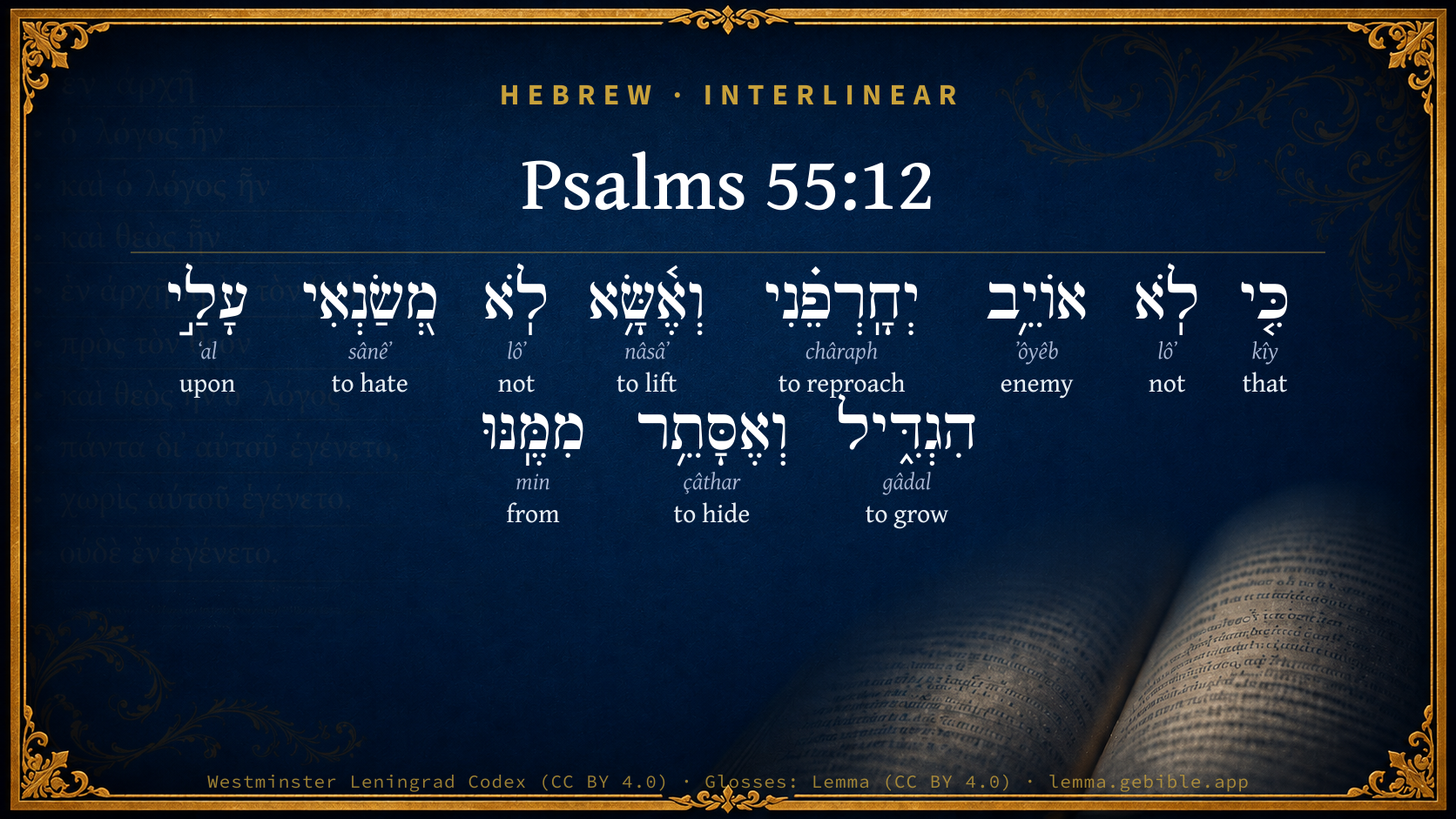
  1. כִּ֤י kîy H3588 “that” Conjunction
  2. לֹֽא lôʼ H3808 “not” Particle, Negative
  3. אוֹיֵ֥ב ʼôyêb H341 “enemy” Verb, Qal, Participle Active, Masculine, Singular, Absolute
  4. וְאֶ֫שָּׂ֥א nâsâʼ H5375 “and · to lift” Conjunction + Verb, Qal, Imperfect, 1st Person, Common, Singular
  5. לֹֽא lôʼ H3808 “not” Particle, Negative
  6. מְ֭שַׂנְאִי sânêʼ H8130 “hating · me” Verb, Piel, Participle Active, Masculine, Singular, Construct + Suffix, Personal, 1st Person, Common, Singular
  7. עָלַ֣י ʻal H5921 “upon · me” Preposition + Suffix, Personal, 1st Person, Common, Singular
  8. הִגְדִּ֑יל gâdal H1431 “to grow” Verb, Hiphil, Perfect, 3rd Person, Masculine, Singular
  9. וְאֶסָּתֵ֥ר çâthar H5641 “and · to hide” Conjunction + Verb, Niphal, Imperfect, 1st Person, Common, Singular
  10. מִמֶּֽנּוּ min H4480 “from · him” Preposition + Suffix, Personal, 3rd Person, Masculine, Singular

About this verse

These counts appear in no published source. They are computed here, from the morphology-tagged text and Lemma’s own curated glosses. What Lemma adds →

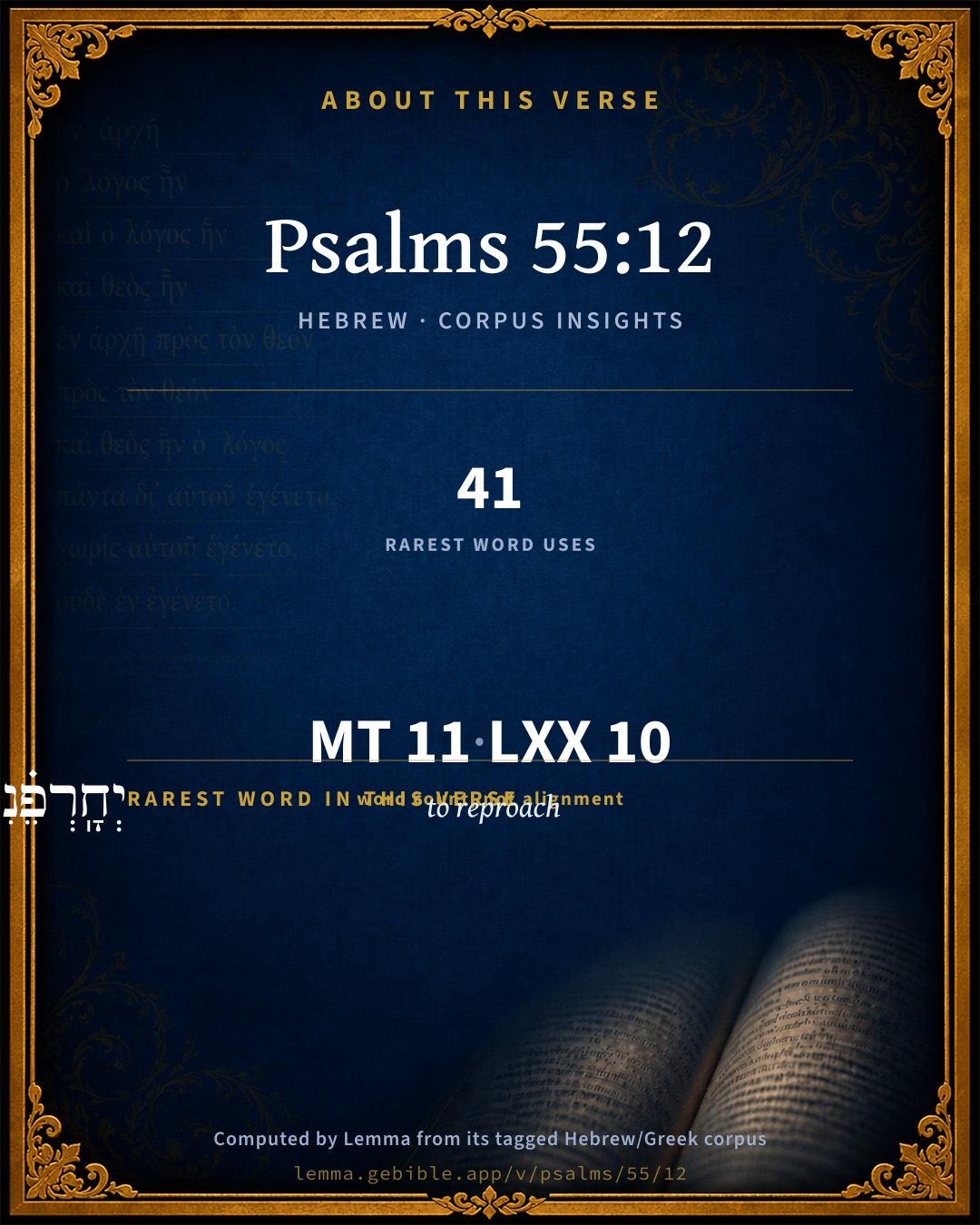
11
words
10
distinct lemmas
Wisdom
section

Shared distinctive vocabulary

יְחָֽרְפֵ֗נִי to reproach H2778 occurs in 40 verses of the Hebrew Bible. Also found in:

Grammatical profile

  • 6 verbs
  • 2 prepositions
  • 1 conjunction
  • 2 particles

Verb forms

  • אוֹיֵ֥ב Qal · Participle Active
  • יְחָֽרְפֵ֗נִי Piel · Imperfect
  • וְאֶ֫שָּׂ֥א Qal · Imperfect
  • מְ֭שַׂנְאִי Piel · Participle Active
  • הִגְדִּ֑יל Hiphil · Perfect
  • וְאֶסָּתֵ֥ר Niphal · Imperfect

Repetition

A word recurs within this verse — often emphatic in Hebrew:

Hebrew & Septuagint length

In English translation the verse runs 36 words from the Hebrew and 30 from the Septuagint (LXX English) — closely comparable.

A rough comparison of the two English renderings, which tokenize alike — not a word-level alignment.

Word counts can differ between the Hebrew and the Greek without any difference in meaning — e.g. the Hebrew direct-object marker אֵת has no separate Greek word, and Greek often adds the article ὁ.

In the original languages it is 11 Hebrew tokens and 10 Greek tokens — but the two are counted differently (Hebrew bundles its prefixes and suffixes into one token; the Greek is in lemma form), so that isn’t a like-for-like length.

Cross-references

7

Topical passages linked to Psalms 55:12 in the Treasury of Scripture Knowledge — connected by theme and wording, ordered by reader-vote popularity; previews shown in the World English Bible.

  • Psalms 41:9 Yes, my own familiar friend, in whom I trusted, Who ate bread with me, Has lifted up his heel against me.
  • John 13:18 I don't speak concerning all of you. I know whom I have chosen. But that the Scripture may be fulfilled, 'He who eats bread with me has lifted up his heel against me.'
  • Matthew 26:21–23 As they were eating, he said, "Most assuredly I tell you that one of you will betray me."
  • Psalms 35:26 Let them be disappointed and confounded together who rejoice at my calamity. Let them be clothed with shame and dishonor who magnify themselves against me.
  • John 18:2–3 Now Judas, who betrayed him, also knew the place, for Jesus often resorted there with his disciples.
  • Psalms 38:16 For I said, "Don't let them gloat over me, Or exalt themselves over me when my foot slips."
  • Isaiah 10:15 Shall the axe boast itself against him who hews therewith? Shall the saw magnify itself against him who wields it? as if a rod should wield those who lift it up, [or] as if a staff should lift up [him who is] not wood.

Cross-references courtesy of OpenBible.info (CC BY 4.0).

Hebrew and Greek witnesses Masoretic Hebrew ↔ Greek Septuagint

The same verse in the two great witnesses to the Old Testament, shown verse-for-verse.

You’re reading Greek Psalm 54 (Hebrew Psalm 55). The Septuagint counts the superscription, so verse numbers can differ from the Hebrew — chapter-level alignment, not verse-by-verse. Numbering follows Rahlfs.

These are two independent witnesses, not word-aligned to each other, and the Septuagint is shown in lemma (dictionary) form.

Hebrew Psalms 55:12 Masoretic · Westminster Leningrad Codex

כִּ֤י לֹֽא אוֹיֵ֥ב יְחָֽרְפֵ֗נִי וְאֶ֫שָּׂ֥א לֹֽא מְ֭שַׂנְאִי עָלַ֣י הִגְדִּ֑יל וְאֶסָּתֵ֥ר מִמֶּֽנּוּ

For it was not an enemy who insulted me, Then I could have endured it. Neither was it he who hated me who raised himself up against me, Then I would have hid myself from him.

World English Bible · Public Domain

Greek LXX Greek Psalm 54:12 Septuagint · lemma form

καί οὐ ἐκλείπω ἐκ ὁ πλατύς αὐτός τόκος καί δόλος

For if an enemy had reproached me, I would have endured it; and if one who hated me had spoken vauntingly against me, I would have hid myself from him.

LXX2012 (modern English Septuagint) · Public Domain

Hebrew: Westminster Leningrad Codex (CC BY 4.0). Greek: Septuagint (public domain); English from LXX2012 (modern English Septuagint) (Public Domain). How the Septuagint differs from the Hebrew →

Commentary

Notes on Psalms 55:12 from classic Christian and Jewish commentators (each source and its license shown beneath its notes). The classic Christian expositions comment on the surrounding passage and are grouped to its opening verse, so a note may address several verses; the Jewish commentaries on the Tanakh (Rashi and others) are per-verse, so they appear only where the commentator wrote on this verse.

Lemma curates 59 commentaries, every one of them public domain or Creative Commons licensed, each selected and text-cleaned for this edition rather than reprinted as found. About our sources →

Trapp's Complete Commentary

John Trapp

Psa 55:12 For [it was] not an enemy [that] reproached me; then I could have borne [it]: neither [was it] he that hated me [that] did magnify [himself] against me; then I would have hid myself from him:

Ver. 12. For it was not an enemy that reproached me] Ahithophel’s perfidy and villany troubled David more than all the rest; there not being any wound worse, as Sophocies saith, than the treachery of a friend, ουδεν μειζον ελκος η φιλος αδικων; he being such a kind of enemy, quem neque fugere, neque fugare possumus, as Bernard hath it, whom we cannot easily prevent. See Psa 41:9.

Then I could have borne it] Though as a burden; but nothing so grievous; I should not have much mattered it.

John Trapp, A Commentary or Exposition upon All the Books of the Old and New Testament (1647–1656) — public domain. Text from a community e-Sword module.

Joseph Benson's Commentary

Psa 55:12-14. It was not an enemy — Not an open and professed enemy, or, not an old and inveterate enemy, (as appears from the following description to be his meaning,) that reproached me — That misrepresented me, and my government, as if I either abused my power, or neglected the proper use of it, and who industriously spread other similar accusations to incense the people against me; then I could have borne it — With more patience, because I could have expected nothing better from such persons. Neither was it he that hated me — With a manifest or old hatred; then I would have hid myself from him — I would have stood upon my guard against him; would have concealed my counsels from him, and have prevented or avoided the effects of his hatred. But it was thou mine equal — Not in power and dignity, which could not be; but in reputation for deep wisdom, and thy great influence upon me, and upon all my people; my guide — Whose counsel I highly prized, and constantly followed. The Chaldee paraphrase names Ahithophel as the person here meant, and certainly the description agrees perfectly well to him, whom David had used as his counsellor and friend, and to whom he had committed his most important secrets; and certainly nothing in the plot of the rebels seems to have discouraged David so much as to hear that Ahithophel was among the conspirators with Absalom. We took sweet counsel together — I imparted my secret counsels and designs to him with great delight and satisfaction. And we walked unto the house of God — We agreed no less in exercises of piety than in matters of state and policy; in company — Hebrew, ברגשׁ, beragesh, in, or with, the numerous congregation. The Seventy, however, render it, εν ομονοια, in concord, consort, or union, or with consent, as the ancients in general interpret the word.

Joseph Benson's Commentary on the Old and New Testaments (1811–1818) — public domain. Text from a community e-Sword module.

Whedon's Commentary on the Bible

Daniel D. Whedon

12. For… not an enemy— “For” indicates the reason of the imprecation, Psa_55:9. From this rapid survey of the general calamity, David turns to the chief supporter of the rebellion, his former chief counsellor, Ahithophel, whom he describes, Psa_55:12-14. Nothing can excel this touching reminiscence of former friendship, or the base ingratitude and perfidy of the chief conspirator. Mr. Blunt, however, (Undesigned Coincidences, pages 144, 145,) offers this explanation, which, if true, relieves somewhat the character of the arch traitor. “Eliam the son of Ahithophel the Gilonite,” and “Uriah the Hittite,” both belonged to David’s guard. 2Sa_23:34-39. In 2Sa_11:3 we learn that Uriah had married “Bathsheba, the daughter of Eliam.” If this latter Eliam is identical with the former, then Bathsheba was the granddaughter of Ahithophel, and the conduct of David in causing Uriah to be slain, and taking Bathsheba to wife, inflicted a wound and an insult upon the family honour, which Ahithophel probably never forgave, and which perhaps led him to join Absalom’s rebellion in revenge of the injury. This may have been; but the sudden popularity of Absalom’s party would naturally attract one like Ahithophel, who seems to have given more attention to politics than to moral principles.

Daniel D. Whedon (gen. ed.), Commentary on the Old and New Testaments (1874–1909) — public domain. Text from a community e-Sword module.

J. A. Alexander on Psalms

Joseph Addison Alexander

13. (Psa 55:12). For (it is) not an enemy (that) will revile me, else would I bear it; (it is) not one hating me (that) has magnified (himself) against me, else would I hide myself from him. The Hebrew word answering to else, is, in both these cases, the usual copulative particle, and the original construction seems to be, and (if it is) I will bear it, and (if it is) I will hide myself. See above, on Psa 51:16. The act of reviling here includes both calumny and insult. The future in the first clause suggests the idea of an indignity or injury about to be endured. As if he had said, "when I go orth among my neighbours, it is not my open enemy that will malign me." But that such treatment had already been experienced, is intimated by the preterite of the last clause. The verb to magnify is here used reflexively or absolutely, as in Ps. xxxv. 26, xxxviii. 15 (16). There is no need therefore of supposing an ellipsis, or identifying this form of expression with the one in Psa 41:9. Hide myself, literally be hidden; but the passive forms in Hebrew not unfrequently imply a reflex act, like the middle voice in Greek. The negation in this verse is of course not absolute but relative, and must be qualified by due regard to the circumstances of the case. That he was reproached and threatened by avowed enemies, is not only a frequent subject of complaint elsewhere, but sufficiently implied in Psa 55:3 above. The true solution of this seeming contradiction is, that he here passes from a general description of the prevalent iniquity to a particular case, in which his feelings were personally interested. In this particular case, it was not an open enemy that slandered or insulted him. It is therefore as if he had said, "But it is not of this open and unblushing wickedness that I especially complain, but rather of the perfidy of false friends." Thus understood, the verse, instead of contradicting Psa 55:3, presupposes what is there affirmed.

Joseph Addison Alexander, The Psalms Translated and Explained (1850) — public domain. Text from a community e-Sword module.

Tyndale Open Study Notes

Tyndale Open Resources

55:12-20 The psalmist’s enemy was once a friend; memories of that close relationship bring him pain (see 31:11).

Tyndale Open Study Notes — © Tyndale Open Resources, licensed CC BY-SA 4.0. Text via the HelloAO Bible API.

Geneva Bible (1599)

Geneva Bible translators

If mine open enemy had sought mine hurt, I could the better have avoided him.

Geneva Bible (1599) marginal notes — public domain. Text via Bolls.life.

Jamieson, Fausset & Brown

Robert Jamieson, A. R. Fausset & David Brown

This description of treachery does not deny, but aggravates, the injury from enemies.

Jamieson, Fausset & Brown — Commentary Critical and Explanatory on the Whole Bible (1871) — public domain (CC PDM 1.0). Text via the HelloAO Bible API.

Adam Clarke's Commentary

Verse 12. It was not an enemy] It is likely that in all these three verses Ahithophel is meant, who, it appears, had been at the bottom of the conspiracy from the beginning; and probably was the first mover of the vain mind of Absalom to do what he did.

Adam Clarke's Commentary on the Bible (1810–1826) — public domain. Text from a community e-Sword/MySword module.

John Calvin's Commentaries

12 Of a truth, it was not an enemy that cast reproach upon me He informs us of one circumstance which added bitterness to the injuries under which he suffered, that they came from the hands not only of his professed enemies, but of such as pretended to be his friends. Those mistake the meaning of נשא, nasa, who interpret it as if David had said, that he could patiently have borne the reproach of an open enemy. What he says is, that had an open enemy reproached him, he could then have met it, as one meets and parries off a blow which is aimed at him. Against a known foe we are on our watch, but the unsuspected stroke of a friend takes us by surprise. By adopting this view of the word, we shall find that the repetition in the verse is more perfect; reading in the one member, I would have met it; and in the other, I would have hidden myself When he speaks of the enemy magnifying himself against him, he does not simply mean that he used insulting language, but in general, that he summoned all his violence to overthrow him. The sum of David’s complaint in this passage is, that he was assailed by treachery of that secret description which rendered self-defense impossible. With regard to the individual whom he had particularly in view, when he preferred this accusation, I do not imagine that it was Ahitophel, for the psalm itself would not appear to have been written upon the persecution of Absalom. Whether it may have been some notorious traitor in the city of Keilah, it is impossible to determine. Not the least probable conjecture is, that it may have been some great man at court, whose intimacy with David was generally known. Possibly he may have had more than one in his eye, courtiers who had sacrificed former friendship to a desire of rising in the royal favor, and lent their influence to destroy him. These, with some more eminent person at their head, may be the parties aimed at. At any rate, we are taught by the experience of David, as here represented to us, that we must expect in this world to meet with the secret treachery of friends, as well as with undisguised persecution. Satan has assaulted the Church with sword and open war, but he has also raised up domestic enemies to injure it with the more secret weapons of stratagem and fraud. This is a species of foe which, as Bernard expresses it, we can neither fly from nor put to flight. Whoever might be the individual referred to, David calls him a man of his own order, for so the term ערך, erach, should, in my opinion, be translated, and not as some, his equal in estimation, or as by others, a man esteemed by him to be his second self. He complains of the violation of the common bond of fraternity, as none needs to be told that there are various bonds, whether of relationship, profession, or office, which ought to be respected and held sacred. He makes mention also of his having been his leader and commander, of their having enjoyed sweet interchange of secret counsel together, and of their having frequented the religious assemblies in company, — all of which he adverts to as circumstances which lent an additional aggravation to his treachery. The term רגש , regesh, does not seem to signify here the stir attending the convention of an assembly, but rather company, intimating, that he was his close companion when they went to the house of God. Thus he would inform us, that he was betrayed by one who had been his intimate associate, and to whom he had looked up as a leader, in matters not only secular but religious. We are taught by the Spirit to reverence all the natural ties which bind us together in society. Besides the common and universal one of humanity, there are others of a more sacred kind, by which we should feel ourselves attached to men in proportion as they are more nearly connected with us than others by neighborhood, relationship, or professional calling, the more as we know that such connections are not the result of chance, but of providential design and arrangement. Need I say that the bond of religious fellowship is the most sacred of all?

John Calvin's Commentaries (1540-1563) — public domain. Text from the Calvin Translation Society English edition (1840s-50s) via the Christian Classics Ethereal Library (ccel.org). Calvin's coverage is partial (roughly two-thirds of the Bible); uncommented books and verses are honest gaps, never fabricated. The 19th-century editor's footnotes and remarks are omitted so the notes are faithfully Calvin's own voice.

Ellicott's Commentary for English Readers

(12) For.—The ellipse must be supplied from Psa_55:9, I invoke destruction for, &c

Then I could . . .—Better, then (or else) I might bear it.

A Bible Commentary for English Readers, edited by Charles John Ellicott (1878–1897) — public domain. Text from a community e-Sword module.

The Cambridge Bible for Schools and Colleges

gen. ed. J. J. S. Perowne

12. Render:

For it is not an enemy that reproacheth me, then I could bear it:

Neither is it one that hated me that hath magnified himself against me, then I would hide myself from him:

But it is thou, a man mine equal,

Mine associate and my familiar friend.

For connects this stanza somewhat loosely with what precedes, giving an additional reason for the prayer of Psa_55:9 in the false-hearted treachery of one who is conspicuous among them,—apparently the leader of the faction. If an open and acknowledged enemy had flung scorn at him (Psa_42:10; Psa_44:16; Psa_57:3) in the hour of defeat and humiliation, he could bear it as one of the common ills of life (cp. 2Sa_16:10 ff): if an old hatred had animated the man who took the lead in procuring his disgrace and degradation, then he might retire into obscurity without repining. But thou! Et tu, Brute! For magnified himself cp. Psa_35:26, or Psa_41:9 (see note).

12–14. Foremost among the Psalmist’s enemies is one who had formerly been one of his most intimate and trusted friends. He interrupts the denunciation, which he resumes at Psa_55:15, to relate what is the bitterest ingredient in his cup of suffering. The burning indignation of the preceding and following verses gives way for a moment to a pathetic tone of sorrowful reproach. There is no need to suppose, with some critics, that these verses are misplaced, and ought to follow or precede Psa_55:6-8. The sudden transition is most true to nature: Psa_55:9-11 describe the general situation; then for the moment the thought of the personal injury which constitutes its most poignant bitterness eclipses every other thought; and in Psa_55:15 indignation against the whole mass of his enemies breaks out again.

The Cambridge Bible for Schools and Colleges (gen. ed. J. J. S. Perowne; Cambridge University Press, 1878–1918) — public domain. Text from a community e-Sword module.

John Gill's Exposition

But it was thou,.... The Targum is, "but thou Ahithophel"; of whom the words are literally to be understood, and so they are in the Talmud (u); and mystically and typically of Judas;

a man mine equal; "a man", and not a beast, nor a devil; but a man, from whom humanity, kindness, and tenderness might have been expected; though both Ahithophel and Judas acted the part of a devil; and the latter is expressly called one, Joh 6:70; "mine equal"; or like unto me; as the Targum. Ahithophel was not equal to David in dignity, as the king of Israel; nor in gifts, as the sweet psalmist of Israel; nor in grace as he; but as a man, a mortal dying man: kings and subjects are of the same blood, equally liable to death, and in the grave will be manifestly on a level: or rather the sense is, that he was in his esteem and affliction as himself; he was his friend that he loved as his own soul: so Judas could not be in every sense equal to Christ who is Jehovah's fellow, and thought it no robbery to be equal with God. Indeed as a man he was like unto him; a frail, mortal man, though not sinless as Christ. The word may be rendered "according to my appointment" (w), ordination, or constitution; Judas being a man appointed and ordained to be an apostle of Christ with the rest: or, "according to my esteem" (x); being had in great esteem and familiarity with Christ: or, "according to my order" (y), rank and class; being taken into his family, admitted to his table, where be sat down and ate with him, as if he was his equal;

my guide: or "governor" (z). Ahithophel was not governor over David; but was made a governor by him: he was one of his dukes or nobles, as the word is rendered in Gen 36:15, was raised to great dignity by him; perhaps was chief minister of state: it is certain he was his counsellor, and his counsel was with him as the oracle of God, Ch1 27:33; he was his guide in civil affairs; he was directed by his advice, and it may be was president of his privy council. Judas was not only the guide of them to Christ who took him, Act 1:16; but when the apostles were sent out two by two before the face of Christ, to preach where he himself should come, Judas was sent also, Mar 6:7;

and mine acquaintance: one well known to him, as Ahithophel was to David, and Judas to Christ, his friend and companion, in whom he confided, and who ate of his bread; and all these characters are so many aggravations of his treachery and wickedness.

(u) T. Bab. Sanhedrin, fol. 106. 2. Pirke Abot, c. 6. s. 3. (w) "Secundum dispositionem, sc. ordinationem et constitutionem meam", Calvinus in Michaelis. (x) "Juxta estimationem meam", Vatablus, Gejerus, Michaelis; "qui par mihi estimatus est", Piscator. (y) "Secundum ordinem meum", Mollerus. (z) "dux meus", Pagninus, Tigurine version, Junius & Tremellius, Piscator; "princeps meus", Cocceius.

John Gill's Exposition of the Whole Bible (1746–1763) — public domain (CC PDM 1.0). Text via the HelloAO Bible API.

Albert Barnes' Notes on the Bible

For it was not an enemy that reproached me - The word “reproached” here refers to slander; calumny; abuse. It is not necessarily implied that it was in his presence, but he was apprized of it. When he says that it is not an enemy that did this, the meaning is that it was not one who had been an avowed and open foe. The severest part of the trial did not arise from the fact that it was done by such an one, for that he could have borne. That which overwhelmed him was the fact that the reproach came from one who had been his friend; or, the reproach which he felt most keenly came from one whom he had regarded as a personal confidant. It is not to be supposed that the psalmist means to say that he was not reproached by his enemies, for the whole structure of the psalm implies that this was so; but his anguish was made complete and unbearable by the discovery that one especially who had been his friend was found among those who reproached and calumniated him. The connection leads us to suppose, if the right view (Introduction) has been taken of the occasion on which the psalm was composed, that the allusion here is to Ahithophel 2Sa 15:31; and the particular distress here referred to was that which David experienced on learning that he was among the conspirators. A case of trouble remarkably resembling this is referred to in Psa 41:9. See the notes at that place.

Then I could have borne it - The affliction would have been such as I could bear. Reproaches from an enemy, being known to be an enemy, we expect; and and we feel them comparatively little. We attribute them to the very fact that such an one is an enemy, and that he feels it necessary to sustain himself by reproaching and calumniating us. We trust also that the world will understand them in that way; and will set them down to the mere fact that he is our enemy. In such a case there is only the testimony against us of one who is avowedly our foe, and who has every inducement to utter malicious words against us in order to sustain his own cause. But the case is different when the accuser and slanderer is one who has been our intimate friend. He is supposed to know all about us. He has been admitted to our counsels. He has known our purposes and plans. He can speak not “slanderously” but “knowingly.” It is supposed that he could have no motive to speak ill of us except his own conviction of truth, and that it could be only the strongest conviction of truth - the existence of facts to which not even a friend could close his eyes - that could induce him to abandon us, and hold us up to repreach and scorn. So Ahithophel - the confidential counselor and friend of David - would be supposed to be acquainted with his secret plans and his true character; and hence, reproaches from such a one became unendurable. “Neither was it he that hated me.” That avowedly and openly hated me. If that had been the case, I should have expected such usage, and it would not injure me.

That did magnify himself a against me - That is, by asserting that I was a bad man, thus exalting himself in character above me, or claiming that he was more pure than I am. Or, it may mean, that exalted himself above me, or sought to reach the eminence of power in my downfall and ruin.

Then I would have hid myself from him - I should have been like one pursued by an enemy who could hide himself in a cave, or in a fastness, or in the mountains, so as to be safe from his attacks. The arrows of malice would fly harmlessly by me, and I should be safe. Not so, when one reproached me who had been an intimate friend; who had known all about me; and whose statements would be believed.

Albert Barnes' Notes on the Bible (1834–1885) — public domain. Text from a community e-Sword/MySword module.

Matthew Poole's English Annotations

Not an enemy; either,

1. Not an open and professed enemy; or rather,

2. Not an old and inveterate enemy, as may be gathered from the following description.

I could have borne it with more patience, because I could expect nothing else from such persons.

Hated me with a manifest or old hatred.

I would have hid myself from him; I could and should easily have prevented or avoided the effects of his hatred.

Matthew Poole's English Annotations on the Holy Bible (1683–1685) — public domain. Text from a community e-Sword/MySword module.

The Treasury of David

Charles H. Spurgeon

Ver. 12. The reader will do well to observe how accurately the psalmist described his own Psalm when he said, "I mourn in my complaint, "or rather "give loose to my thoughts, "for he proceeds from one point of his sorrow to another, wandering on like one in a maze, making few pauses, and giving no distinct intimations that he is changing the subject. Now from the turbulent city his mind turns to the false hearted councillor.

For is was not an enemy that reproached me; then I could have borne it. It was not an open foe, but a pretended friend; he went over to the other camp and tried to prove the reality of his treachery by calumniating his old friend. None are such real enemies as false friends. Reproaches from those who have been intimate with us, and trusted by us, cut us to the quick; and they are usually so well acquainted with our peculiar weaknesses that they know how to touch us where we are most sensitive, and to speak so as to do us most damage. The slanders of an avowed antagonist are seldom so mean and dastardly as those of a traitor, and the absence of the elements of ingratitude and treachery renders them less hard to bear. We can bear from Shimei what we cannot endure from Ahithophel.

Neither was it he that hated me that did magnify himself against me; then I would have hid myself from him. We can find a hiding place from open foes, but who can escape from treachery? If our enemies proudly boast over us we nerve our souls for resistance, but when those who pretended to love us leer at us with contempt, whither shall we go? Our blessed Lord had to endure at its worst the deceit and faithlessness of a favoured disciple; let us not marvel when we are called to tread the road which is marked by his pierced feet.

Ver. 12. Then I could have borne it. It is remarkable that the Lord, who endured the other unspeakable sorrows and agonies of his passion in perfect and marvellous silence, allowed his grief at this one alone to escape him, bewailing himself to his disciples that one of them should betray him, and addressing that one, when he was taken, in these words of reproach--"Judas, betrayest thou the Son of Man with a kiss?" Frau Thome de Jesu, ,1582.

Ver. 12. Then I would have hid myself from him. It is generally easy to get out of the way of an avowed enemy, but how can one be on his guard against a treacherous friend? A. R. Fausset, in "A Commentary, Critical, Experimental, and Practical, "1866.

None.

Psalms 55:13*

Charles H. Spurgeon's The Treasury of David (1869–1885) — public domain. Psalms only. Text from a community e-Sword/MySword module.

The Pulpit Commentary

For it was not an enemy that reproached me; then I could have borne it. The psalmist passes from the general to the particular from the great mass of his opponents to one special individual. Even Professor Cheyne allows this, and suggests that we have here Jeremiah inveighing against Pashur. But the general sentiment of commentators has always been that Ahithophel is intended. And, if we allow the psalm to be David"s, we can scarcely give any other explanation. Ahithophel was known as "David"s counsellor", (2Sa_15:12) i.e. his chief adviser, his "grand vizier," his "prime minister? What he counselled was considered as a sort of "oracle of God". (2Sa_16:23) His defection was the bitterest drop in the cup of the unhappy king. Anything else he "could have borne;" but this was too much. Neither was it he that hated me that did magnify himself against me. It was not one among my professed and open enemies not one of those whose hatred I had long known and reckoned on. Then I would have hid myself from him. Instead of opening all my heart to him, as I have done to Ahithophel.

The Pulpit Commentary (1880–1919), ed. H.D.M. Spence-Jones & Joseph S. Exell — public domain. Text from a community e-Sword module.

John Wesley's Explanatory Notes

Hated - With a manifest or old hatred.

John Wesley, Explanatory Notes Upon the Whole Bible (1754–1765) — public domain. Text via the GEBible commentary corpus.

unfoldingWord translationNotes

Door43 World Missions Community

I could have borne it

Tolerating or enduring a rebuke is spoken of as bearing or carrying it. AT: "I could have tolerated the rebuke" or "I would not be so sad about the rebuke" (See: Metaphor)

raised himself up against me

Being proud of oneself and insulting another is spoken of as raising oneself up against another. AT: "insulted me" or "despised me" (See: Metaphor)

But it was you

The psalmist speaks as though the person who had rebuked and taunted him were there listening to him. (See: Apostrophe)

myself, my companion and my close friend

This can be divided and a new sentence begun. AT: "myself. You were my companion and my close friend"

We

The word "we" refers to the psalmist and his friend.

with the throng

Possible meanings are 1) "together" or 2) "with the crowd."

translationWords

adversary

rebuke

raise

companion

fellowship

walk

house of God

unfoldingWord translationNotes — © Distant Shores Media and the Door43 World Missions Community, licensed CC BY-SA 4.0. Source: git.door43.org/Door43/en_tn.

Rashi

Rabbi Shlomo Yitzchaki (Rashi)

Destruction Heb. הוות.

blows Heb. תוֹךְ.

Rashi on the Tanakh — English translations: “The Judaica Press complete Tanach with Rashi, translated by A. J. Rosenberg” (CC BY 4.0); “Pentateuch with Rashi's commentary by M. Rosenbaum and A.M. Silbermann, 1929-1934” (public domain); “The Metsudah Tanach series, Lakewood, N.J” (CC BY 4.0); and “The Book of Joshua, Metsudah Publications, 1997” (CC BY 4.0). Text via Sefaria.

Lesson kit

Teaching starters — assembled from the data on this page, not authored interpretation. Every prompt links to the verse data it draws on. Edit before teaching.

Psalms, in the Wisdom, opens this verse with 11 words (10 distinct Hebrew lemmas). Its most distinctive word is châraph (“to reproach”). A historical commentator’s framing appears above. Read the whole chapter for the surrounding context.

Discussion questions

  1. How does “to reproach” (châraph) shape what this verse is saying?
  2. How does Leviticus 19:20, which shares the word «to reproach», read alongside this verse?
  3. What does the repetition of “not” (2× in this one verse) do in this verse?
  4. These translations render this verse differently. What is at stake in choosing one wording over another?
  5. «אוֹיֵ֥ב» is a Qal Participle Active verb. How does that grammatical form shape the action described?
  6. Compare how Trapp's Complete Commentary and Joseph Benson's Commentary read this verse. Where do they agree or differ?

Things to notice

Reading settings

Reading text

Shown beneath each verse's original-language words.

Old Testament
Old Testament edition

Read the OT as the Masoretic Hebrew (MT) or the Greek Septuagint (LXX).

English shown for the Greek Septuagint (in the Hebrew ↔ Greek comparison).

Comparing translations? Open the Compare panel on any verse page to stack up to four side by side.