Job 34:19

Hebrew (Westminster Leningrad Codex) Job 34:19 appears in the Hebrew Old Testament. The text above is from the Westminster Leningrad Codex. Each word links to its Strong’s number, a concise gloss, and parsing drawn from the Open Scriptures Hebrew Bible morphology. Click any word for its full Brown-Driver-Briggs (BDB) entry.
Download image
Cite this verse

Job 34:19 (World English Bible). Public Domain. Lemma interlinear Bible study tool, https://lemma.gebible.app/v/job/34/19.

Show BibTeX & RIS
BibTeX
RIS
English Translation
Who doesn't respect the persons of princes, Nor regards the rich more than the poor; For they all are the work of his hands.
World English Bible · Public Domain
Highlights
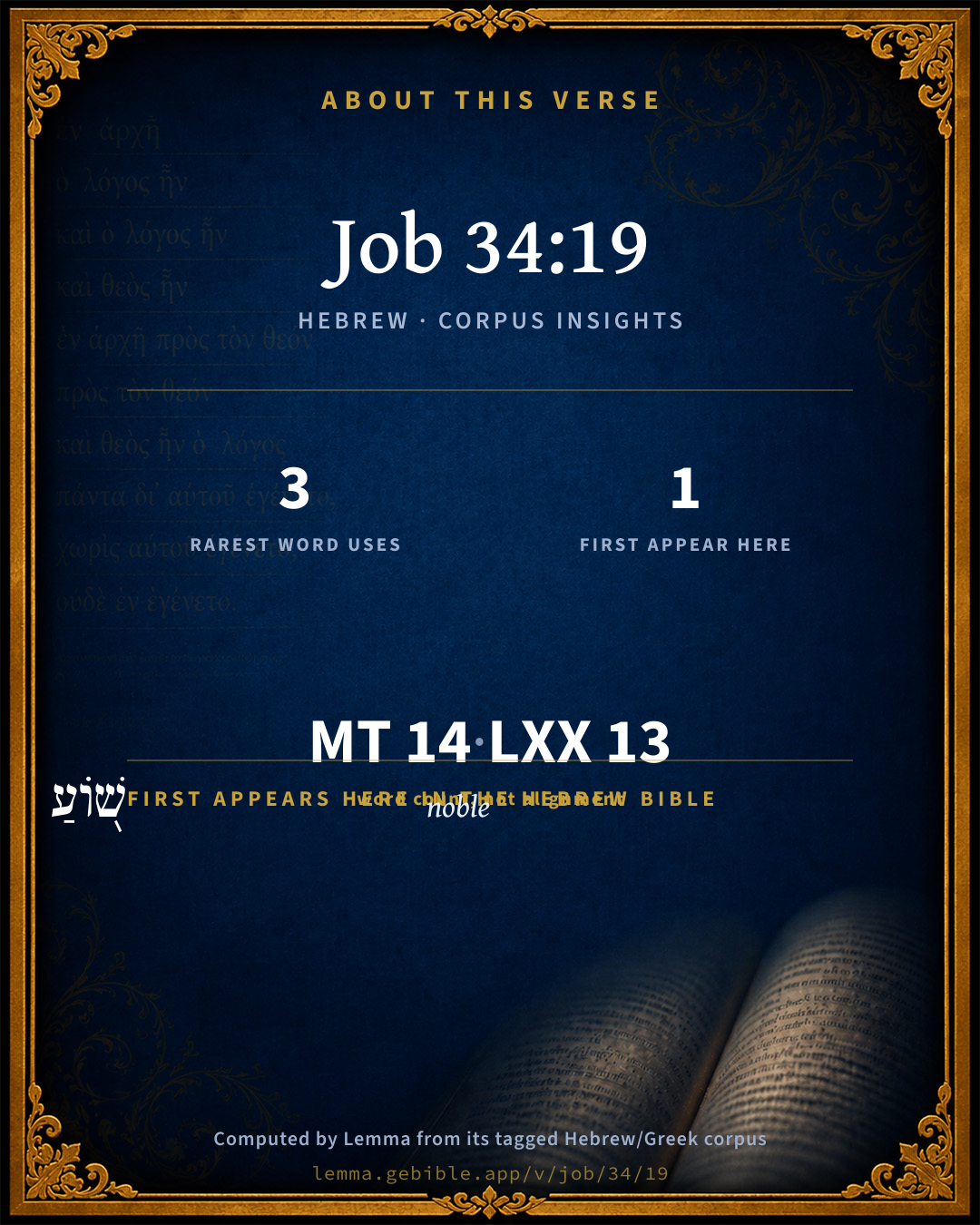
  • 1 first appearance in the Hebrew Bible
Full analysis ↓
Download a study sheet

One document with this verse’s original text, its word-by-word gloss line, the meaning frame, cross-references with their text, attributed commentary, and full source and license credits — printable, and it pastes into notes with its structure intact.

This verse Autodidact and up

Study sheet (.html) Plain text (.txt)

A passage Seminary Student

Up to 50 verses in one chapter. A passage sheet keeps up to 6 commentary sources and 12 cross-references per verse, in the order this page ranks them, and says so on the sheet whenever that leaves anything out. Ask for a single verse and you get the Autodidact verse sheet above.

Everything on this page stays free to read, with no account — the sheet is a download of what is already on screen, not access to it.

Want to remove ads? Support Godless Engineer
Compare translations 3

The same verse in 3 English versions, stacked beneath the original-language interlinear above. Click any original word for its lexicon entry.

Each is an independent rendering of the whole verse — the interlinear is not word-aligned to these translations.

Highlighted words mark where these versions differ — a whole-verse word diff, not a word-by-word alignment.

  • World English Bible Public Domain
    Who doesn't respect the persons of princes, Nor regards the rich more than the poor; For they all are the work of his hands.
  • King James Version Public Domain
    How much less to him that accepteth not the persons of princes, nor regardeth the rich more than the poor? for they all are the work of his hands.
  • unfoldingWord Literal Text CC BY-SA 4.0
    who does not lift the faces of princes and does not acknowledge the rich to the face of the poor, for all of them the work of his hands.

unfoldingWord Literal Text — © unfoldingWord, licensed CC BY-SA 4.0. Word-aligned USFM3 via Door43 (git.door43.org/unfoldingWord/en_ult).

Versions to compare (up to 4)

3 of 4 selected

Show all 18 translations

Every available English version of this verse, each an independent rendering of the whole verse.

  • World English Bible Public Domain
    Who doesn't respect the persons of princes, Nor regards the rich more than the poor; For they all are the work of his hands.
  • Berean Standard Bible Public Domain
    who is not partial to princes and does not favor rich over poor? For they are all the work of His hands.
  • Majority Standard Bible Public Domain
    who is not partial to princes and does not favor rich over poor? For they are all the work of His hands.
  • King James Version Public Domain
    How much less to him that accepteth not the persons of princes, nor regardeth the rich more than the poor? for they all are the work of his hands.
  • American Standard Version (1901) Public Domain
    That respecteth not the persons of princes, Nor regardeth the rich more than the poor; For they all are the work of his hands.
  • Revised Version (1885) Public Domain
    How much less to him that respecteth not the persons of princes, nor regardeth the rich more than the poor? for they all are the work of his hands.
  • Geneva Bible (1599) Public Domain
    How much lesse to him that accepteth not the persons of princes, and regardeth not the rich, more then the poore? for they be all the worke of his handes.
  • Douay-Rheims (1899) Public Domain
    Who accepteth not the persons of princes: nor hath regarded the tyrant, when he contended against the poor man: for all are the work of his hands.
  • Young's Literal Translation Public Domain
    That hath not accepted the person of princes, Nor hath known the rich before the poor, For a work of His hands `are' all of them.
  • Literal Standard Version CC BY-SA 4.0
    That has not accepted the person of princes, || Nor has known the rich before the poor, || For all of them [are] a work of His hands.
  • Unlocked Literal Bible CC BY-SA 4.0
    God, who does not show favoritism to leaders and does not acknowledge rich people more than poor, for they all are the work of his hands.
  • unfoldingWord Literal Text CC BY-SA 4.0
    who does not lift the faces of princes and does not acknowledge the rich to the face of the poor, for all of them the work of his hands.
  • Darby Bible Public Domain
    [How then to him] that accepteth not the persons of princes, nor regardeth the rich man more than the poor? for they are all the work of his hands.
  • World Messianic Bible Public Domain
    He doesn’t respect the persons of princes, nor respect the rich more than the poor, for they all are the work of his hands.
  • Webster's Bible Public Domain
    How much less to him that accepteth not the persons of princes, nor regardeth the rich more than the poor? for they all are the work of his hands.
  • Free Bible Version CC BY-SA 4.0
    He doesn't think more of the rich than the poor, for they are all people he himself made.
  • Bible in Basic English Public Domain
    Who has no respect for rulers, and who gives no more attention to those who have wealth than to the poor, for they are all the work of his hands.
  • JPS Tanakh (1917) Public Domain
    That respecteth not the persons of princes, nor regardeth the rich more than the poor? For they all are the work of His hands.

Literal Standard Version (2020), Covenant Press — licensed CC BY-SA 4.0. Text via the HelloAO Bible API (eBible.org). Unlocked Literal Bible (unfoldingWord) — licensed CC BY-SA 4.0. Text via the HelloAO Bible API (eBible.org). unfoldingWord Literal Text — © unfoldingWord, licensed CC BY-SA 4.0. Word-aligned USFM3 via Door43 (git.door43.org/unfoldingWord/en_ult). Free Bible Version, Dr. Jonathan Gallagher — licensed CC BY-SA 4.0. Text via the HelloAO Bible API (eBible.org).

Word by word

More ways to search: Search by grammar → Find every occurrence → Compare this word →

Practice this passage: Drill this verse → Learn its vocabulary →

שׁ֭וֹעַ
shôwaʻ
H7771
“noble”
Noun, Common, Masculine, Singular, Absolute
Part of Speech
Noun
Type
Common
Gender
Masculine
Number
Singular
State
Absolute
Full BDB Definition

Origin: from H7768 in the original sense of freedom

TWOT: 929c , 2348b

independent, noble, free, rich, generous (adjective) - cry (noun masculine) - perhaps war-cry, cry for help
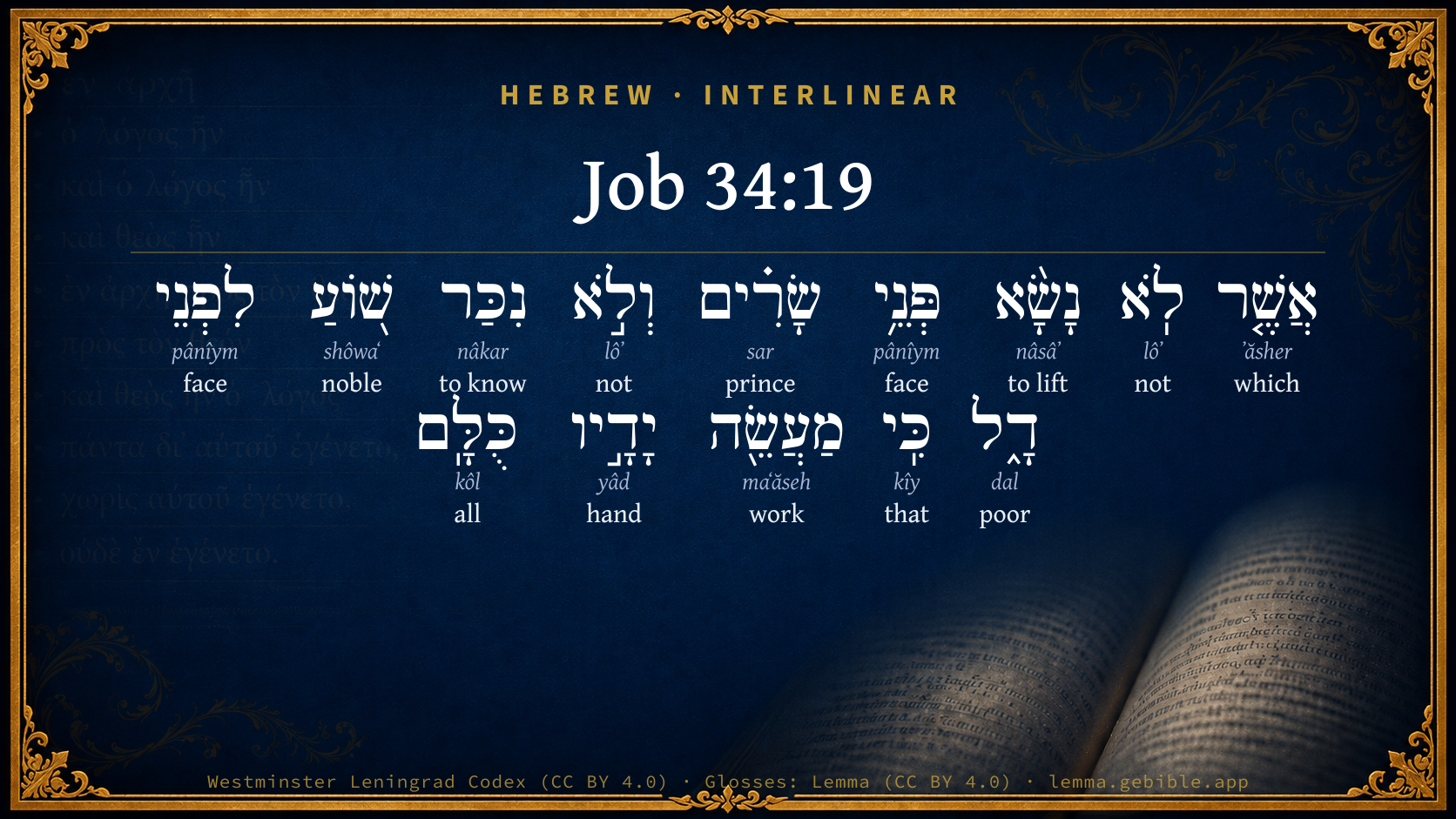
  1. אֲשֶׁ֤ר ʼăsher H834 “which” Particle, Relative
  2. לֹֽא lôʼ H3808 “not” Particle, Negative
  3. נָשָׂ֨א nâsâʼ H5375 “to lift” Verb, Qal, Perfect, 3rd Person, Masculine, Singular
  4. פְּנֵ֥י pânîym H6440 “face(s) of” Noun, Common, Both, Plural, Construct
  5. שָׂרִ֗ים sar H8269 “princes” Noun, Common, Masculine, Plural, Absolute
  6. וְלֹ֣א lôʼ H3808 “and · not” Conjunction + Particle, Negative
  7. נִכַּר nâkar H5234 “to know” Verb, Piel, Perfect, 3rd Person, Masculine, Singular
  8. לִפְנֵי pânîym H6440 “to/for · face(s) of” Preposition + Noun, Common, Both, Plural, Construct
  9. דָ֑ל dal H1800 “poor” Adjective, Adjective, Masculine, Singular, Absolute
  10. כִּֽי kîy H3588 “that” Conjunction
  11. מַעֲשֵׂ֖ה maʻăseh H4639 “work of” Noun, Common, Masculine, Singular, Construct
  12. יָדָ֣יו yâd H3027 “hands · his” Noun, Common, Both, Dual, Construct + Suffix, Personal, 3rd Person, Masculine, Singular
  13. כֻּלָּֽם kôl H3605 “all · their” Noun, Common, Masculine, Singular, Construct + Suffix, Personal, 3rd Person, Masculine, Plural

About this verse

These counts appear in no published source. They are computed here, from the morphology-tagged text and Lemma’s own curated glosses. What Lemma adds →

14
words
12
distinct lemmas
Wisdom
section

Notable vocabulary

The rarest word here is שׁ֭וֹעַ noble H7771 — appearing just 3 times in the whole Hebrew Bible.

First appearance in Scripture

This word makes its first canonical appearance in the Hebrew Bible here:

  • שׁ֭וֹעַ noble H7771

Shared distinctive vocabulary

שׁ֭וֹעַ noble H7771 occurs in 3 verses of the Hebrew Bible. Also found in:

Grammatical profile

  • 2 verbs
  • 7 nouns
  • 1 adjective
  • 1 conjunction
  • 3 particles

Verb forms

  • נָשָׂ֨א Qal · Perfect
  • נִכַּר Piel · Perfect

Repetition

Words recur within this verse — often emphatic in Hebrew:

  • פְּנֵ֥י face H6440 ×2
  • לֹֽא not H3808 ×2

Hebrew & Septuagint length

In English translation the verse runs 24 words from the Hebrew and 30 from the Septuagint (LXX English) — closely comparable.

A rough comparison of the two English renderings, which tokenize alike — not a word-level alignment.

Word counts can differ between the Hebrew and the Greek without any difference in meaning — e.g. the Hebrew direct-object marker אֵת has no separate Greek word, and Greek often adds the article ὁ.

In the original languages it is 14 Hebrew tokens and 13 Greek tokens — but the two are counted differently (Hebrew bundles its prefixes and suffixes into one token; the Greek is in lemma form), so that isn’t a like-for-like length.

Cross-references

23

Topical passages linked to Job 34:19 in the Treasury of Scripture Knowledge — connected by theme and wording, ordered by reader-vote popularity; previews shown in the World English Bible.

  • Deuteronomy 10:17 For Yahweh your God, he is God of gods, and Lord of lords, the great God, the mighty, and the awesome, who doesn't regard persons, nor takes reward.
  • Acts 10:34 Peter opened his mouth and said, "Truly I perceive that God doesn't show favoritism;
  • James 2:5 Listen, my beloved brothers. Didn't God choose those who are poor in this world to be rich in faith, and heirs of the Kingdom which he promised to those who love him?
  • Romans 2:11 For there is no partiality with God.
  • Colossians 3:25 But he who does wrong will receive again for the wrong that he has done, and there is no partiality.
  • Leviticus 19:15 "'You shall do no injustice in judgment: you shall not be partial to the poor, nor show favoritism to the great; but in righteousness shall you judge your neighbor.
  • 2 Chronicles 19:7 Now therefore let the fear of Yahweh be on you; take heed and do it: for there is no iniquity with Yahweh our God, nor respect of persons, nor taking of bribes.
  • Galatians 2:6 But from those who were reputed to be important (whatever they were, it makes no difference to me; God doesn't show partiality to man)--they, I say, who were respected imparted nothing to me,
  • Ephesians 6:9 You masters, do the same things to them, and give up threatening, knowing that he who is both their Master and yours is in heaven, and there is no partiality with him.
  • 1 Peter 1:17 If you call on him as Father, who without respect of persons judges according to each man's work, pass the time of your living as strangers here in reverent fear:
  • Job 31:15 Didn't he who made me in the womb make him? Didn't one fashion us in the womb?
  • Proverbs 14:31 He who oppresses the poor shows contempt for his Maker, But he who is kind to the needy honors him.
  • Proverbs 22:2 The rich and the poor have this in common: Yahweh is the maker of them all.
  • Ecclesiastes 5:8 If you see the oppression of the poor, and the violent taking away of justice and righteousness in a district, don't marvel at the matter: for one official is eyed by a higher one; and there are officials over them.
  • Job 10:3 Is it good to you that you should oppress, That you should despise the work of your hands, And smile on the counsel of the wicked?
  • Job 12:19 He leads priests away stripped, And overthrows the mighty.
  • Job 12:21 He pours contempt on princes, And loosens the belt of the strong.
  • Job 13:8 Will you show partiality to him? Will you contend for God?
  • Job 36:19 Would your wealth sustain you in distress, Or all the might of your strength?
  • Psalms 2:2–4 The kings of the earth take a stand, And the rulers take counsel together, Against Yahweh, and against his anointed, saying,
  • Psalms 49:6–7 Those who trust in their wealth, And boast in the multitude of their riches--
  • Isaiah 3:14 Yahweh will enter into judgment with the elders of his people, And their leaders: "It is you who have eaten up the vineyard. The spoil of the poor is in your houses.
  • Hebrews 12:28 Therefore, receiving a Kingdom that can't be shaken, let us have grace, through which we serve God acceptably, with reverence and awe,

Cross-references courtesy of OpenBible.info (CC BY 4.0).

Hebrew and Greek witnesses Masoretic Hebrew ↔ Greek Septuagint

The same verse in the two great witnesses to the Old Testament, shown verse-for-verse.

These are two independent witnesses, not word-aligned to each other, and the Septuagint is shown in lemma (dictionary) form.

Hebrew Job 34:19 Masoretic · Westminster Leningrad Codex

אֲשֶׁ֤ר לֹֽא נָשָׂ֨א פְּנֵ֥י שָׂרִ֗ים וְלֹ֣א נִכַּר שׁ֭וֹעַ לִפְנֵי דָ֑ל כִּֽי מַעֲשֵׂ֖ה יָדָ֣יו כֻּלָּֽם

Who doesn't respect the persons of princes, Nor regards the rich more than the poor; For they all are the work of his hands.

World English Bible · Public Domain

Greek LXX Job 34:19 Septuagint · lemma form

ὅς οὐ ἐπιαἰσχύνω πρόσωπον ἔντιμος οὐδέ οἶδα τιμή τίθημι ἁδρός θαυμάζω πρόσωπον αὐτός

Such a one as would not reverence the face of an honorable man, neither knows how to give honor to the great, so as that their persons should be respected.

LXX2012 (modern English Septuagint) · Public Domain

Hebrew: Westminster Leningrad Codex (CC BY 4.0). Greek: Septuagint (public domain); English from LXX2012 (modern English Septuagint) (Public Domain). How the Septuagint differs from the Hebrew →

Commentary

Notes on Job 34:19 from classic Christian and Jewish commentators (each source and its license shown beneath its notes). The classic Christian expositions comment on the surrounding passage and are grouped to its opening verse, so a note may address several verses; the Jewish commentaries on the Tanakh (Rashi and others) are per-verse, so they appear only where the commentator wrote on this verse.

Lemma curates 59 commentaries, every one of them public domain or Creative Commons licensed, each selected and text-cleaned for this edition rather than reprinted as found. About our sources →

Trapp's Complete Commentary

John Trapp

Job 34:19 [How much less to him] that accepteth not the persons of princes, nor regardeth the rich more than the poor? for they all [are] the work of his hands.

Ver. 19. How much less to him that accepteth not the person of princes] How much more both dangerous and indecent must it needs be wrongfully to accuse God of injustice and partiality, which is far below him; since he neither doth nor needeth prefer great ones before meaner men in judgment! See on Job 13:7; Job 32:21.

Nor regardeth the rich more than the poor?] The word rendered rich, opulent, or potent, comes either from a root, ישׁע that signifieth to save, because it is in the power of such to save others from hurt and damage; or else from another root, שׁוע that signifieth to cry aloud; because such men use to speak their minds more freely and boldly, as having that which can bear them out. But God acknowledgeth them not as such; only of them to whom much is given much shall be required.

For they are all the work of his hands] Both for their persons, for they are all equally his creatures; and for their conditions, which God also hath cut them out and apportioned. Thus he is said to have made Moses and Aaron, that is, to have advanced them, 1Sa 12:6; and Christ is said to have made the twelve when he ordained them to the apostleship, Mar 3:14.

John Trapp, A Commentary or Exposition upon All the Books of the Old and New Testament (1647–1656) — public domain. Text from a community e-Sword module.

Whedon's Commentary on the Bible

Daniel D. Whedon

19. Omit italics, how much less to, and read:

Him that — אשׁר. God treats all, the rich and the poor, even princes, according to their deserts. In Job_34:19-20 Elihu establishes the impartiality of God. The Wisdom of Solomon (vi, 7) furnishes a good comment on this verse.

Daniel D. Whedon (gen. ed.), Commentary on the Old and New Testaments (1874–1909) — public domain. Text from a community e-Sword module.

Tyndale Open Study Notes

Tyndale Open Resources

34:19 doesn’t care how great a person may be: Impartiality flows from God’s justice (Acts 10:34; Rom 2:11; Gal 2:6; Eph 6:9; Col 3:25; 1 Pet 1:17).

Tyndale Open Study Notes — © Tyndale Open Resources, licensed CC BY-SA 4.0. Text via the HelloAO Bible API.

Jamieson, Fausset & Brown

Robert Jamieson, A. R. Fausset & David Brown

(Act 10:34; Ch2 19:7; Pro 22:2; Job 31:15).

Jamieson, Fausset & Brown — Commentary Critical and Explanatory on the Whole Bible (1871) — public domain (CC PDM 1.0). Text via the HelloAO Bible API.

Adam Clarke's Commentary

Verse 19. That accepteth not] If it be utterly improper to speak against a king or civil governor, how much more so to speak disrespectfully of God, who is not influenced by human caprices or considerations, and who regards the rich and the poor alike, being equally his creatures, and equally dependent on his providence and mercy for their support and salvation.

Adam Clarke's Commentary on the Bible (1810–1826) — public domain. Text from a community e-Sword/MySword module.

The Cambridge Bible for Schools and Colleges

gen. ed. J. J. S. Perowne

19. Partiality or injustice is not to be thought of in God, for all men, rich and poor, are alike the work of His hands. In these words the disputant makes the transition from his principle to the illustration of it in God’s actual rule of men, and this illustration he pursues at length.

The Cambridge Bible for Schools and Colleges (gen. ed. J. J. S. Perowne; Cambridge University Press, 1878–1918) — public domain. Text from a community e-Sword module.

John Gill's Exposition

In a moment shall they die,.... Princes as well as the common people, rich men as well as poor; all must and do die, great and small, high and low, kings and peasants, rich and poor men, and sometimes suddenly; are struck dead at once, and without any previous notice, that night, that hour, that moment their souls are required of them. The Targum interprets this of the men of Sodom. And Mr. Broughton, in his margin, refers to the history of them in Gen 19:1;

and the people shall be troubled at midnight; either the common people, when their kings and governors die; or the relations and friends of persons deceased; and this circumstance "at midnight" is added, which makes the scene more melancholy, awful, and shocking, when it happens at such a time. The above Targum understands it of the Egyptians, when their firstborn were slain, which was in the middle of the night; and Mr. Broughton refers in his margin to the same instance: but it is a question whether this affair ever came to the knowledge of Job and his friends, at least not so early as this controversy;

and pass away; not into another country, being taken and carried away captive; but pass away by death into their graves, and into another world. Sephorno interprets it of the destroying angel's passing over the tents of the Israelites, and not entering into them to smite them when they smote the firstborn of Egypt. But the former sense is best, see Psa 37:36;

and the mighty shall be taken away without hand: without the hand of men, but by the immediate hand of God; not falling in battle, or in a common natural way by diseases, but by some judgment of God upon them: and the whole verse seems to be understood not of a natural death, or in the common way, but of sudden death in a way of judgment, from the immediate hand of God, and that upon the mighty and great men of the earth; which shows that he is no respecter of princes, see Dan 8:25.

John Gill's Exposition of the Whole Bible (1746–1763) — public domain (CC PDM 1.0). Text via the HelloAO Bible API.

Albert Barnes' Notes on the Bible

How much less to him that accepteth not the person of princes - To accept the person of anyone is to treat him with special favor on account of his rank, his wealth, or from favoritism and partiality. This God often disclaims in respect to himself; (compare Gal 2:6; Act 10:34; 2Ch 19:7; Rom 2:11; Eph 6:9; Col 3:25), and solemnly forbids it in others; see Jam 2:1, Jam 2:3,Jam 2:9; Lev 19:15; Deu 1:17; Deu 16:19. The meaning here is, that God is entirely impartial in his administration, and treats all as they ought to be treated. He shows favor to no one on account of wealth, rank, talent, office, or joyous apparel, and he excludes no one from favor on account of poverty, ignorance, or a humble rank in life. This it seems was an admitted sentiment in the time of Elihu, and on the ground of the fact that it was indisputable, he strongly argues the impropriety of calling in question the equity of his administration in language such as that which Job had used.

For they all are the work of his hands - He regards them all as his creatures. No one has any special claim on him on account of rank, talent, or wealth. Every creature that he has made, high and low, rich and poor, bond and free, may expect that impartial justice will be done him, and that his external circumstances will not control or modify the divine determinations in regard to him, or the divine dealings toward him.

Albert Barnes' Notes on the Bible (1834–1885) — public domain. Text from a community e-Sword/MySword module.

Haydock's Catholic Bible Commentary

Tyrant. This title is not always odious. It formerly was given to all princes, and came to be used in a bad sense, on account of the misconduct of some kings of Sicily. Tyrannus a rege distat factis, non nomine. (Sen.[Seneca?] Clem. xii.) --- Hebrew, "the rich more than the poor." (Haydock) --- God fears not to rebuke even the greatest princes, and dost thou dare to arraign his justice? (Calmet)

George Leo Haydock (1774–1849), Haydock's Catholic Family Bible and Commentary, 1859 edition — public domain. Excludes Psalms (Douay-Rheims chapter numbering differs from Protestant) and Deuterocanonical books (Catholic canon only).

Matthew Poole's English Annotations

To him that accepteth not the persons of princes, i.e. to God, who respecteth not the greatest princes, so as to do any unjust thing to gain their favour, or to avoid their anger, to whom princes and peasants are equally subject, and infinitely inferior; who therefore is free from all temptation to injustice, which commonly proceeds from respect of persons, Lev 19:15, and to whom therefore thou didst owe more reverence than thy words have expressed.

They all are the work of his hands; and therefore of equal worth and price with him, and equally subject to his power and pleasure.

Matthew Poole's English Annotations on the Holy Bible (1683–1685) — public domain. Text from a community e-Sword/MySword module.

The Pulpit Commentary

How much less to him that accepteth not the persons of princes! How much less becomingly is such language used of One so far above princes that he regards them as on a level with all other men, and pays them no special respect! Worldly rank is, of course, nothing with God. All mankind are his subjects and servants, whom he differentiates one from another solely by their moral and spiritual qualities. Nor regardeth the rich more than the poor. If earthly rank is of no account with God, much less is abundance of possessions. The parable of the rich man and Lazarus places his complete indifference in a strong light. For they all are the work of his hands. All classes of men, rich and poor, powerful and weak, are equally God"s creatures, brought into the world by him, given by him their several stations, and regarded by him with favour or disfavour, according as they conduct themselves in their various occupations and employments.

The Pulpit Commentary (1880–1919), ed. H.D.M. Spence-Jones & Joseph S. Exell — public domain. Text from a community e-Sword module.

Rashi

Rabbi Shlomo Yitzchaki (Rashi)

Who did not respect princes That is to say, the King of the world, before Whom there is no favoritism.

a prince Heb. שוע, a prince, as in (Isa. 32:5), “nor shall a deceitful person be said to be noble (שוע).”

Rashi on the Tanakh — English translations: “The Judaica Press complete Tanach with Rashi, translated by A. J. Rosenberg” (CC BY 4.0); “Pentateuch with Rashi's commentary by M. Rosenbaum and A.M. Silbermann, 1929-1934” (public domain); “The Metsudah Tanach series, Lakewood, N.J” (CC BY 4.0); and “The Book of Joshua, Metsudah Publications, 1997” (CC BY 4.0). Text via Sefaria.

Lesson kit

Teaching starters — assembled from the data on this page, not authored interpretation. Every prompt links to the verse data it draws on. Edit before teaching.

Job, in the Wisdom, opens this verse with 14 words (12 distinct Hebrew lemmas). Its most distinctive word is shôwaʻ (“noble”). A historical commentator’s framing appears above. Read the whole chapter for the surrounding context.

Discussion questions

  1. What does “noble” (shôwaʻ) contribute to the verse as a whole?
  2. The word “noble” first appears here in Scripture. What is being introduced at this debut?
  3. Isaiah 22:5 shares the word «noble» with this verse. How do the two illuminate each other?
  4. “face” occurs 2× in this one verse. What is the effect of the repetition?
  5. These translations render this verse differently; the difference is in the English rendering, not the original. What questions does that raise?
  6. The verb «נָשָׂ֨א» is Qal Perfect. How does its form color the action?
  7. Reading how Trapp's Complete Commentary and Whedon's Commentary on the Bible read this verse, where do the two commentators agree and where do they part?

Things to notice

Reading settings

Reading text

Shown beneath each verse's original-language words.

Old Testament
Old Testament edition

Read the OT as the Masoretic Hebrew (MT) or the Greek Septuagint (LXX).

English shown for the Greek Septuagint (in the Hebrew ↔ Greek comparison).

Comparing translations? Open the Compare panel on any verse page to stack up to four side by side.