
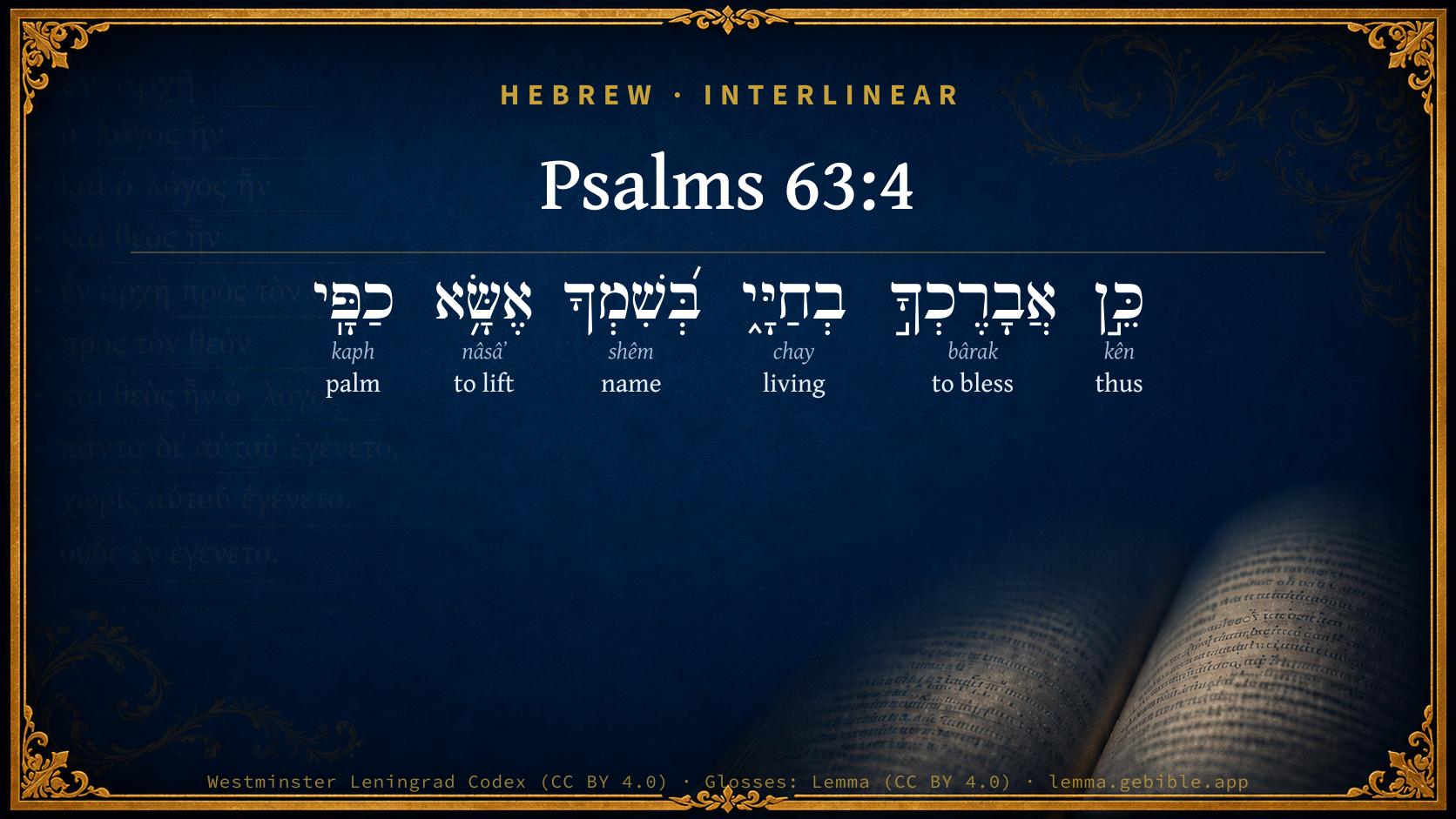
Psalms 63:4

Hebrew (Westminster Leningrad Codex) Psalms 63:4 appears in the Hebrew Old Testament. The text above is from the Westminster Leningrad Codex. Each word links to its Strong’s number, a concise gloss, and parsing drawn from the Open Scriptures Hebrew Bible morphology. Click any word for its full Brown-Driver-Briggs (BDB) entry.
Download image
Cite this verse

Psalms 63:4 (World English Bible). Public Domain. Lemma interlinear Bible study tool, https://lemma.gebible.app/v/psalms/63/4.

Show BibTeX & RIS
BibTeX
RIS
English Translation
So I will bless you while I live. I will lift up my hands in your name.
World English Bible · Public Domain
Download a study sheet

One document with this verse’s original text, its word-by-word gloss line, the meaning frame, cross-references with their text, attributed commentary, and full source and license credits — printable, and it pastes into notes with its structure intact.

This verse Autodidact and up

Study sheet (.html) Plain text (.txt)

A passage Seminary Student

Up to 50 verses in one chapter. A passage sheet keeps up to 6 commentary sources and 12 cross-references per verse, in the order this page ranks them, and says so on the sheet whenever that leaves anything out. Ask for a single verse and you get the Autodidact verse sheet above.

Everything on this page stays free to read, with no account — the sheet is a download of what is already on screen, not access to it.

Want to remove ads? Support Godless Engineer
Compare translations 3

The same verse in 3 English versions, stacked beneath the original-language interlinear above. Click any original word for its lexicon entry.

Each is an independent rendering of the whole verse — the interlinear is not word-aligned to these translations.

Highlighted words mark where these versions differ — a whole-verse word diff, not a word-by-word alignment.

  • World English Bible Public Domain
    So I will bless you while I live. I will lift up my hands in your name.
  • King James Version Public Domain
    Thus will I bless thee while I live: I will lift up my hands in thy name.
  • unfoldingWord Literal Text CC BY-SA 4.0
    Thus I will bless you in my life; I will lift up my palms in your name.

unfoldingWord Literal Text — © unfoldingWord, licensed CC BY-SA 4.0. Word-aligned USFM3 via Door43 (git.door43.org/unfoldingWord/en_ult).

Versions to compare (up to 4)

3 of 4 selected

Show all 18 translations

Every available English version of this verse, each an independent rendering of the whole verse.

  • World English Bible Public Domain
    So I will bless you while I live. I will lift up my hands in your name.
  • Berean Standard Bible Public Domain
    So I will bless You as long as I live; in Your name I will lift my hands.
  • Majority Standard Bible Public Domain
    So I will bless You as long as I live; in Your name I will lift my hands.
  • King James Version Public Domain
    Thus will I bless thee while I live: I will lift up my hands in thy name.
  • American Standard Version (1901) Public Domain
    So will I bless thee while I live: I will lift up my hands in thy name.
  • Revised Version (1885) Public Domain
    So will I bless thee while I live: I will lift up my hands in thy name.
  • Geneva Bible (1599) Public Domain
    Thus will I magnifie thee all my life, and lift vp mine hands in thy name.
  • Douay-Rheims (1899) Public Domain
    For thy mercy is better than lives: thee my lips shall praise.
  • Young's Literal Translation Public Domain
    So I bless Thee in my life, in Thy name I lift up my hands.
  • Literal Standard Version CC BY-SA 4.0
    So I bless You in my life, || I lift up my hands in Your Name.
  • Unlocked Literal Bible CC BY-SA 4.0
    So I will bless you while I live; I will lift up my hands in your name.
  • unfoldingWord Literal Text CC BY-SA 4.0
    Thus I will bless you in my life; I will lift up my palms in your name.
  • Darby Bible Public Domain
    So will I bless thee while I live; I will lift up my hands in thy name.
  • World Messianic Bible Public Domain
    So I will bless you while I live. I will lift up my hands in your name.
  • Webster's Bible Public Domain
    \\63:3\\Because thy loving-kindness is better than life, my lips shall praise thee.
  • Free Bible Version CC BY-SA 4.0
    I will thank you as long as I live; I lift up my hands as I celebrate your wonderful character.
  • Bible in Basic English Public Domain
    So will I go on blessing you all my life, lifting up my hands in your name.
  • JPS Tanakh (1917) Public Domain
    (63-5) So will I bless Thee as long as I live; in Thy name will I lift up my hands.

Literal Standard Version (2020), Covenant Press — licensed CC BY-SA 4.0. Text via the HelloAO Bible API (eBible.org). Unlocked Literal Bible (unfoldingWord) — licensed CC BY-SA 4.0. Text via the HelloAO Bible API (eBible.org). unfoldingWord Literal Text — © unfoldingWord, licensed CC BY-SA 4.0. Word-aligned USFM3 via Door43 (git.door43.org/unfoldingWord/en_ult). Free Bible Version, Dr. Jonathan Gallagher — licensed CC BY-SA 4.0. Text via the HelloAO Bible API (eBible.org).

Word by word

More ways to search: Search by grammar → Find every occurrence → Compare this word →

Practice this passage: Drill this verse → Learn its vocabulary →

כַפָּֽי
kaph
H3709
“palms · my”
Noun, Common, Feminine, Dual, Construct + Suffix, Personal, 1st Person, Common, Singular
Part of Speech
Noun
Type
Common
Gender
Feminine
Number
Dual
State
Construct
Full BDB Definition

Origin: from H3721

TWOT: 1022a

palm, hand, sole, palm of the hand, hollow or flat of the hand - palm, hollow or flat of the hand - power - sole (of the foot) - hollow, objects, bending objects, bent objects - of thigh-joint - pan, vessel (as hollow) - hollow (of sling) - hand-shaped branches or fronds (of palm trees) - handles (as bent)
  1. כֵּ֣ן kên H3651 “thus” Particle, Demonstrative
  2. אֲבָרֶכְךָ֣ bârak H1288 “to bless · you” Verb, Piel, Imperfect, 1st Person, Common, Singular + Suffix, Personal, 2nd Person, Masculine, Singular
  3. בְחַיָּ֑י chay H2416 “in/at · living things · my” Preposition + Noun, Common, Masculine, Plural, Construct + Suffix, Personal, 1st Person, Common, Singular
  4. בְּ֝שִׁמְךָ shêm H8034 “in/at · name · your” Preposition + Noun, Common, Masculine, Singular, Construct + Suffix, Personal, 2nd Person, Masculine, Singular
  5. אֶשָּׂ֥א nâsâʼ H5375 “to lift” Verb, Qal, Imperfect, 1st Person, Common, Singular

About this verse

These counts appear in no published source. They are computed here, from the morphology-tagged text and Lemma’s own curated glosses. What Lemma adds →

6
words
6
distinct lemmas
Wisdom
section

Grammatical profile

  • 2 verbs
  • 3 nouns
  • 1 particle

Verb forms

  • אֲבָרֶכְךָ֣ Piel · Imperfect
  • אֶשָּׂ֥א Qal · Imperfect

Hebrew & Septuagint length

In English translation the verse runs 17 words from the Hebrew and 17 from the Septuagint (LXX English) — the same length.

A rough comparison of the two English renderings, which tokenize alike — not a word-level alignment.

Word counts can differ between the Hebrew and the Greek without any difference in meaning — e.g. the Hebrew direct-object marker אֵת has no separate Greek word, and Greek often adds the article ὁ.

Cross-references

7

Topical passages linked to Psalms 63:4 in the Treasury of Scripture Knowledge — connected by theme and wording, ordered by reader-vote popularity; previews shown in the World English Bible.

  • Psalms 104:33 I will sing to Yahweh as long as I live. I will sing praise to my God while I have any being.
  • Psalms 134:2 Lift up your hands in the sanctuary. Praise Yahweh!
  • Psalms 28:2 Hear the voice of my petitions, when I cry to you, When I lift up my hands toward your Most Holy Place.
  • 1 Kings 8:22–66 Solomon stood before the altar of Yahweh in the presence of all the assembly of Israel, and spread forth his hands toward heaven;
  • Psalms 145:1–3 I will exalt you, my God, the King. I will praise your name forever and ever.
  • Psalms 146:1–2 Praise Yah! Praise Yahweh, my soul.
  • Habakkuk 3:10 The mountains saw you, and were afraid. The tempest of waters passed by. The deep roared and lifted up its hands on high.

Cross-references courtesy of OpenBible.info (CC BY 4.0).

Hebrew and Greek witnesses Masoretic Hebrew ↔ Greek Septuagint

The same verse in the two great witnesses to the Old Testament, shown verse-for-verse.

You’re reading Greek Psalm 62 (Hebrew Psalm 63). The Septuagint counts the superscription, so verse numbers can differ from the Hebrew — chapter-level alignment, not verse-by-verse. Numbering follows Rahlfs.

These are two independent witnesses, not word-aligned to each other, and the Septuagint is shown in lemma (dictionary) form.

Hebrew Psalms 63:4 Masoretic · Westminster Leningrad Codex

כֵּ֣ן אֲבָרֶכְךָ֣ בְחַיָּ֑י בְּ֝שִׁמְךָ אֶשָּׂ֥א כַפָּֽי

So I will bless you while I live. I will lift up my hands in your name.

World English Bible · Public Domain

Greek LXX Greek Psalm 62:4 Septuagint · lemma form

ὅτι κρείσσων ὁ ἔλεος σύ ὑπέρ ζωή ὁ χεῖλος ἐγώ ἐπιαἰνέω σύ

Thus will I bless you during my life: I will lift up my hands in your name.

LXX2012 (modern English Septuagint) · Public Domain

Hebrew: Westminster Leningrad Codex (CC BY 4.0). Greek: Septuagint (public domain); English from LXX2012 (modern English Septuagint) (Public Domain). How the Septuagint differs from the Hebrew →

Commentary

Notes on Psalms 63:4 from classic Christian and Jewish commentators (each source and its license shown beneath its notes). The classic Christian expositions comment on the surrounding passage and are grouped to its opening verse, so a note may address several verses; the Jewish commentaries on the Tanakh (Rashi and others) are per-verse, so they appear only where the commentator wrote on this verse.

Lemma curates 59 commentaries, every one of them public domain or Creative Commons licensed, each selected and text-cleaned for this edition rather than reprinted as found. About our sources →

Trapp's Complete Commentary

John Trapp

Psa 63:4 Thus will I bless thee while I live: I will lift up my hands in thy name.

Ver. 4. Thus will I bless thee while I live] I will divide my time between praises and prayers, and so drive a holy trade between heaven and earth. See Psa 18:3.

I will lift up my hands] i.e. Pray, as Psa 141:2 1Ti 2:8.

In thy name] i.e. Cleaving to thy goodness and mercy. Fretus tuo auxilio.

John Trapp, A Commentary or Exposition upon All the Books of the Old and New Testament (1647–1656) — public domain. Text from a community e-Sword module.

The Biblical Illustrator

Joseph S. Exell

Psa_63:4-7

Thus will I bless Thee while I live; I will lift up mine hand in Thy Name.

David blessing God and praying to Him

In this verse we have David engaging himself to God in two particulars. First, to the blessing of God, Thus will I bless Thee while I live. And secondly, to praying to Him, I will lift up my hands, etc.

I. Davids engaging himself to blessing, Thus will I bless Thee, etc.

1. The thing itself promised is blessing; David promises to bless God. This at the first hearing may seem to carry some kind of difficulty in it. The apostles rule (Heb_7:7) is, that without contradiction the less is blessed of the greater; if so, how can we be said to be blessers of God, who is so infinitely superior to us? For this we must, therefore, know that there is a double kind of blessing; the one imperative, or by way of authority; the other declarative, end by way of publication. According to the first sense, so God blesses man, namely by making him blessed. According to the second sense, so man blesses God, namely, by declaring Him blessed, and by acknowledging that blessedness which is in Him. This is that which ties upon us all as a duty to be performed by us, and accordingly we shall find often mention made of it in Scripture, in sundry places--as for instance Psa_103:1,

2. It is exquisite upon a twofold ground. First, the goodness which is in Himself. And secondly, the overflowing and communications of this goodness to us; each of these call for this our blessing, and do engage us thereunto. There are two ways especially in which God is blest of His creatures. The one is objectively by way of representation; and the other is significatively by way of publication. According to the first sense, so all His creatures bless Him (Psa_19:1; Psa_147:3). But according to the second sense, so He is blest only by angels and men, who are, therefore, to do it with so much the greater intention.

2. What is it to bless God thus? We may take it in these explications.

(1) Sincerely, in the uprightness and integrity of our hearts.

(2) Affectionately, as having our hearts much enlarged in us. As God loves a cheerful giver, so He loves a cheerful thanksgiver; that is, such an one as is thoroughly apprehensive of the greatness of the mercy itself, and which accordingly has his spirit much advanced and enlarged about it.

(3) Spiritually. This is another thing which belongs to this thus; when we bless God by the assistance of His Spirit, and in the name of His Son, that is, to bless Him as we should do for the mariner of it.

3. The extent, and that is in these words, While I live; whereby he signifies that it was not only a sudden fit or mood in him, but an habitual frame and disposition of spirit. This is thanksgiving in those which are Gods servants, it is a constant and settled thing in them; that mercy which they receive but once, yet they are thankful for always, and they do more or less remember it all their lives long. This there is very good ground and reason for, if we examine it, and search into it.

(1) Gods dealing with us In regard of His mercies, which He does extend unto us all our lives long. His goodness runs through the whole course of our lives, and every moment of them we have some touch and sprinkling of it; therefore it is but requisite that our praises should be so likewise.

(2) If we consider the nature of Gods mercies in themselves, not only for the continuance, but the quality, they are such as nothing less than a life is sufficient for the celebrating of them; a few days, or years, are too little and scanty for such a performance; especially if we speak of the great mercies of all, which is the love of God in Christ, and those spiritual blessings in heavenly places in Him; they are such as call for a life indeed for the publishing of them.

(3) Do but consider how much we provoke God by our sins. We offend Him while we live, and therefore while we live we should praise Him, that so we may in some measure make amends for those offences. So, then, every day will I praise Thee, because every day I sin against Thee.

II. Davids engaging himself to prayer. I will lift up my hands, etc.

1. The duty itself.

(1) An expression of homage and obedience to God. They hereby signify that they are at His disposing, and stand in need of His owning of them.

(2) An opportunity of converse and communion with Him.

(3) A means for the diverting of evils from us, and the obtaining of blessings.

2. The manner or carriage of it. In Thy Name. This does include divers things in it.

(1) The Person to whom the prayer is made, and that is God, and He alone.

(2) It shows the manner in which it is done, and that is according to the will of God, with His allowance and approbation of us; we must not ask anything of God loosely and carelessly, we do not care how, but with reverence and awfulness, and humility, and submission to His good pleasure.

(3) By Thy assistance, by Thy Spirit helping of me (Jud_1:20; Rom_8:26-27). It must be the voice of Gods Spirit in us, this is to pray in His Name. (T. Horton, D. D.)

Praising God while we can

I went one day with Billy Bray, says the Rev. F.W. Bourne, to see a dying saint whose character had been unblemished for many years, but whose natural disposition was modest and retiring almost to a fault. His face wore a look of ineffable dignity and repose, lit up with a strange unearthly radiance and glory. He was just on the verge of heaven. He could only speak in a whisper. He said, I wish I had a voice, so that I might praise the Lord. You should have praised Him, my brother, when you had one, was Billys quiet but slightly satirical comment.

The Biblical Illustrator, edited by Joseph S. Exell (c. 1880s–1900s) — public domain. Text from a community e-Sword module.

Joseph Benson's Commentary

Psa 63:4. Thus will I bless thee — That is, so as I have done, and have now said. As I have begun, I will go on: the present devout affections shall not pass away like the morning cloud, but shine more and more like the morning sun. Or, for this reason, being so sensible of the sweetness of thy favour; or, certainly, as the particle כן, cheen, is sometimes used. While I live — I will persevere in this work of blessing and praising thee: it shall be an important part of the business of my whole life. Through thy grace I will retain a sense of thy former favours, and repeat my thanksgivings for them; and every day give thanks for the benefits with which I am daily loaded. I will lift up my hands — Toward thee, in heaven, in prayers and praises, to my duty, and against my enemies; in thy name — According to thy command, with confidence in thy name, or thy nature and attributes, and in the strength of thy Spirit and grace.

Joseph Benson's Commentary on the Old and New Testaments (1811–1818) — public domain. Text from a community e-Sword module.

J. A. Alexander on Psalms

Joseph Addison Alexander

5. (Psa 63:4). So will I bless thee in my life, in thy name will I raise my hands. So, that is, according to the gift bestowed. Bless, i.e. praise and thank thee. See above, on Psa 16:7; Psa 34:1. In my life may either mean as long as I live, which is the obvious and usual interpretation, or when restored to life, from this state of living death, which is the sense preferred by sonic of the best interpreters, on account of the supposed allusion to better than life in the preceding verse; but it is far from being the most natural construction. In thy name, invoking thee as the object being my worship, and particularly of my thankful praise. Lift up my hands in prayer, and more specifically here, in thanksgiving. See above, on Psa 28:2.

Joseph Addison Alexander, The Psalms Translated and Explained (1850) — public domain. Text from a community e-Sword module.

Jamieson, Fausset & Brown

Robert Jamieson, A. R. Fausset & David Brown

Thus--literally, "Truly."

will I bless--praise Thee (Psa 34:1).

lift up my hands--in worship (compare Psa 28:2).

in thy name--in praise of Thy perfections.

Jamieson, Fausset & Brown — Commentary Critical and Explanatory on the Whole Bible (1871) — public domain (CC PDM 1.0). Text via the HelloAO Bible API.

Adam Clarke's Commentary

Verse 4. I will lift up my hands in thy name.] I will take God for my portion. I will dedicate myself to him, and will take him to witness that I am upright in what I profess and do. Pious Jews, in every place of their dispersion, in all their prayers, praises, contracts, &c., stretched out their hands towards Jerusalem, where the true God had his temple, and where he manifested his presence.

Adam Clarke's Commentary on the Bible (1810–1826) — public domain. Text from a community e-Sword/MySword module.

John Calvin's Commentaries

In the words which follow, David expresses his consequent resolution to praise God. When we experience his goodness, we are led to open our lips in thanksgiving. His intention is intimated still more clearly in the succeeding verse, where he says that he will bless God in his life There is some difficulty, however, in ascertaining the exact sense of the words. When it is said, So will I bless thee, etc., the so may refer to the good reason which he had, as just stated, to praise God, from having felt how much better it is to live by life communicated from God, than to live of and from ourselves. Or the sense may be, so, that is, even in this calamitous and afflicted condition: for he had already intimated that, amidst the solitude of the wilderness, where he wandered, he would still direct his eye to God. The word life, again, may refer to his life as having been preserved by divine interposition; or the sense of the passage may be, that he would bless God through the course of his life. The former meaning conveys the fullest matter of instruction, and agrees with the context; he would bless God, because, by his goodness, he had been kept alive and in safety. The sentiment is similar to that which we find elsewhere,

“I shall not die, but live, and declare the works of the Lord;” — (Psalm 118:17)

and again; —

“The dead shall not praise the Lord, neither any that go down into silence, but we who live will bless the Lord,” (Psalm 115:17, 18.)

In the lifting up of hands, in the second clause of the verse, allusion is made to praying and vowing; and he intimates, that besides giving thanks to God, he would acquire additional confidence in supplication, and be diligent in the exercise of it. Any experience we may have of the divine goodness, while it stirs us up to gratitude, should, at the same time, strengthen our hopes of the future, and lead us confidently to expect that God will perfect the grace which he has begun. Some understand by the lifting up of his hands, that he refers to praising the Lord. Others, that he speaks of encouraging himself from the divine assistance, and boldly encountering his enemies. But I prefer the interpretation which has been already given.

John Calvin's Commentaries (1540-1563) — public domain. Text from the Calvin Translation Society English edition (1840s-50s) via the Christian Classics Ethereal Library (ccel.org). Calvin's coverage is partial (roughly two-thirds of the Bible); uncommented books and verses are honest gaps, never fabricated. The 19th-century editor's footnotes and remarks are omitted so the notes are faithfully Calvin's own voice.

The Cambridge Bible for Schools and Colleges

gen. ed. J. J. S. Perowne

4. Thus] So, as in Psa_63:2 : cp. Psa_61:8 : so fervently; in such a spirit of loving gratitude.

while I live] Cp. Psa_104:33; Psa_146:2.

I will lift up my hands] The attitude of prayer (Psa_28:2; Psa_141:2; 1Ti_2:8), the outward symbol of an uplifted heart (Psa_25:1).

in thy name] Relying upon all that Thou hast revealed Thyself to be. Cp. Psa_44:5; Joh_14:13, &c.

The Cambridge Bible for Schools and Colleges (gen. ed. J. J. S. Perowne; Cambridge University Press, 1878–1918) — public domain. Text from a community e-Sword module.

John Gill's Exposition

Thus will I bless thee while I live,.... With his whole heart and soul, as he had sought after him, and as under a sense of his lovingkindness; and as he now praised him with his lips, so he determined to do as long as he had life and being; by proclaiming his blessedness, by ascribing blessing and honour to him, and by giving him the glory of all mercies temporal and spiritual;

I will lift up my hands in thy name; not against his enemies, against those that fought against him, as Kimchi and Ben Melech interpret it, but unto God in heaven; and that not as a gesture used in swearing, but either in blessing, as Aben Ezra observes; so the high priest lifted up his hands when he blessed the people; or in prayer, or in both, so Jarchi's note is, to pray and to praise; See Gill on Psa 28:2. The Targum is,

"in the name of thy Word I will spread out my hands in prayer for the world to come;''

that is, in the name of the Messiah, the essential Word, in whose name prayer is to be made, and whereby it becomes prevalent and successful; see Joh 14:13. This is a prayer gesture; See Gill on Psa 28:2.

John Gill's Exposition of the Whole Bible (1746–1763) — public domain (CC PDM 1.0). Text via the HelloAO Bible API.

Albert Barnes' Notes on the Bible

Thus will I bless thee while I live - In my life; or, as long as life lasts, will I praise thee. The word “thus” refers to the sentiment in the previous verse, meaning that as the result of his deep sense of the value of the loving kindness of God, he would praise him through all the remainder of his life, or would never cease to praise him. A true purpose of serving God embraces the whole of this life, and the whole of eternity. He who loves God, and who has any proper sense of his mercy, does not anticipate a time when he will cease to praise and bless him, or when he will have any desire or wish not to be engaged in his service.

I will lift up my hands in thy name - In solemn prayer and praise. See the notes at Psa 28:2.

Albert Barnes' Notes on the Bible (1834–1885) — public domain. Text from a community e-Sword/MySword module.

Matthew Poole's English Annotations

Thus, i.e. so as I have done and now do. Or, upon that occasion, when I shall be restored. Or, for this reason, being so sensible of the sweetness of thy favour. Or, certainly; for this particle is sometimes used as a note of asseveration, as it is Psa 127:2; Isa 16:6.

I will lift up my hands towards thee in heaven, in prayers and praises.

In thy name; according to thy command. Or, with confidence in thy name.

Matthew Poole's English Annotations on the Holy Bible (1683–1685) — public domain. Text from a community e-Sword/MySword module.

The Treasury of David

Charles H. Spurgeon

Ver. 4. Thus will I bless thee while I live. As I now bless thee so will I ever do; or rather, so as thou shalt reveal thy lovingkindness to me, I will in return continue to extol thee. While we live we will love. If we see no cause to rejoice in our estate, we shall always have reason for rejoicing in the Lord. If none others bless God, yet his people will; his very nature, as being the infinitely good God, is a sufficient argument for our praising him as long as we exist.

I will lift up my hands in thy name. For worship the hands were uplifted, as also in joy, in thanksgiving, in labour, in confidence; in all these senses we would lift up our hands in Jehovah's name alone. No hands need hang down when God draws near in love. The name of Jesus has often made lame men leap as a hart, and it has made sad men clap their hands for joy.

Ver. 4. Thus will I bless thee. There are two ways especially in which God is blest of his creatures. The one is objectively, by way of representation; and the other is significatively, by way of publication. According to the first sense, so all the creatures bless him: "The heavens declare the glory of God; and the firmament showeth his handiwork." Ps 19:1. "Sun and moon, and fire and hail, and snow and vapours." Ps 148:3, 7-8. All these they so bless him thus. But according to the second sense, so he is blest only by angels and men, who are therefore to do it with so much the greater intension. "All thy works shall praise thee, O Lord; and thy saints shall bless thee. They shall speak of the glory of thy kingdom, and talk of thy power, "etc. Ps 145:10-11. Thomas Horton.

Ver. 4. I will lift up my hands. The practice of lifting up the hands in prayer towards heaven, the supposed residence of the object to which prayer is addressed, was anciently used both by believers, as appears from various passages in the Old Testament; and by the heathen, agreeably to numerous instances in the classical writers. Parkhurst, considering the "hand" to be the chief organ or instrument of man's power and operations, and properly supposing the word to be thence used very extensively by the Hebrews for power, agency, dominion, assistance, and the like, regards the lifting up of men's hands in prayer, as an emblematical acknowledging of the power, and imploring of the assistance, of their respective gods. Is it not, however, the natural and unstudied gesture of earnest supplication? Richard Mant.

None.

Psalms 63:5*

Charles H. Spurgeon's The Treasury of David (1869–1885) — public domain. Psalms only. Text from a community e-Sword/MySword module.

Whedon's Commentary on the Bible

Daniel D. Whedon

4. I will lift up my hands—In solemn posture of prayer. In thy name— Depending only on thee for such deliverance as thou canst sanction.

Daniel D. Whedon (gen. ed.), Commentary on the Old and New Testaments (1874–1909) — public domain. Text from a community e-Sword module.

The Pulpit Commentary

Thus will I bless thee while I live: I will lift up my hands in thy Name. (comp. Psa_104:33 Psa_146:2) The purpose of man"s creation, the end of his being, his main employment throughout eternity, is the praise of God.

The Pulpit Commentary (1880–1919), ed. H.D.M. Spence-Jones & Joseph S. Exell — public domain. Text from a community e-Sword module.

Keil & Delitzsch

C. F. Keil & F. Delitzsch

This strophe again takes up the כּן (Psa 63:3): thus ardently longing, for all time to come also, is he set towards God, with such fervent longing after God will he bless Him in his life, i.e., entirely filling up his life therewith (בּחיּי as in Psa 104:33; Psa 146:2; cf. Baruch 4:20, ἐν ταῖς ἡμέραις μου), and in His name, i.e., invoking it and appealing to it, will he lift up his hands in prayer. The being occupied with God makes him, even though as now in the desert he is obliged to suffer bodily hunger, satisfied and cheerful like the fattest and most marrowy food: velut adipe et pinguedine satiatur anima mea. From Lev 3:17; Lev 7:25, Grussetius and Frisch infer that spiritualies epulae are meant. And certainly the poet cannot have had the sacrificial feasts (Hupfeld) in his mind; for the חלב of the shelamim is put upon the altar, and is removed from the part to be eaten. Moreover, however, even the Tra does not bind itself in its expression to the letter of that prohibition of the fat of animals, vid., Deu 32:14, cf. Jer 31:14. So here also the expression "with marrow and fat" is the designation of a feast prepared from well-fed, noble beasts. He feels himself satisfied in his inmost nature just as after a feast of the most nourishing and dainty meats, and with lips of jubilant songs (accus. instrum. according to Ges. 138, rem. 3), i.e., with lips jubilant and attuned to song, shall his mouth sing praise. What now follows in Psa 63:7 we no longer, as formerly, take as a protasis subsequently introduced (like Isa 5:4.): "when I remembered...meditated upon Thee," but so that Psa 63:7 is the protasis and Psa 63:7 the apodosis, cf. Psa 21:12; Job 9:16 (Hitzig): When I remember Thee (meminerim, Ew. 355, b) upon my bed (stratis meis, as in Psa 132:3; Gen 49:4, cf. Ch1 5:1) - says he now as the twilight watch is passing gradually into the morning - I meditate upon Thee in the night-watches (Symmachus, καθ ̓ ἑκάστην φυλακήν), or during, throughout the night-watches (like בּחיּי in Psa 63:5); i.e., it is no passing remembrance, but it so holds me that I pass a great part of the night absorbed in meditation on Thee. He has no lack of matter for his meditation; for God has become a help (auxilio, vid., on Psa 3:3) to him: He has rescued him in this wilderness, and, well concealed under the shadow of His wings (vid., on Psa 17:8; Psa 36:8; Psa 57:2), which affords him a cool retreat in the heat of conflict and protection against his persecutors, he is able to exult (ארנּן, the potential). Between himself and God there subsists a reciprocal relationship of active love. According to the schema of the crosswise position of words (Chiasmus), אחריך and בּי intentionally jostle close against one another: he depends upon God, following close behind Him, i.e., following Him everywhere and not leaving Him when He wishes to avoid him; and on the other side God's right hand holds him fast, not letting him go, not abandoning him to his foes.

Keil & Delitzsch — Biblical Commentary on the Old Testament (1861–1891) — public domain (CC PDM 1.0). Text via the HelloAO Bible API. (Old Testament only.)

Lesson kit

Teaching starters — assembled from the data on this page, not authored interpretation. Every prompt links to the verse data it draws on. Edit before teaching.

Psalms, in the Wisdom, opens this verse with 6 words (6 distinct Hebrew lemmas). Its most distinctive word is kaph (“palm”). A historical commentator’s framing appears above. Read the whole chapter for the surrounding context.

Discussion questions

  1. The word kaph carries the sense “palm.” How does it shape the verse?
  2. How does Psalms 104:33, which shares this passage’s theme, read alongside this verse?
  3. The translations on this page render this verse differently — a whole-verse word diff, not a word-by-word alignment. What might account for the different wordings?
  4. «אֲבָרֶכְךָ֣» is a Piel Imperfect verb. How does that grammatical form shape the action described?
  5. Compare how Trapp's Complete Commentary and The Biblical Illustrator read this verse. Where do they agree or differ?

Things to notice

Reading settings

Reading text

Shown beneath each verse's original-language words.

Old Testament
Old Testament edition

Read the OT as the Masoretic Hebrew (MT) or the Greek Septuagint (LXX).

English shown for the Greek Septuagint (in the Hebrew ↔ Greek comparison).

Comparing translations? Open the Compare panel on any verse page to stack up to four side by side.