
Genesis 33:5

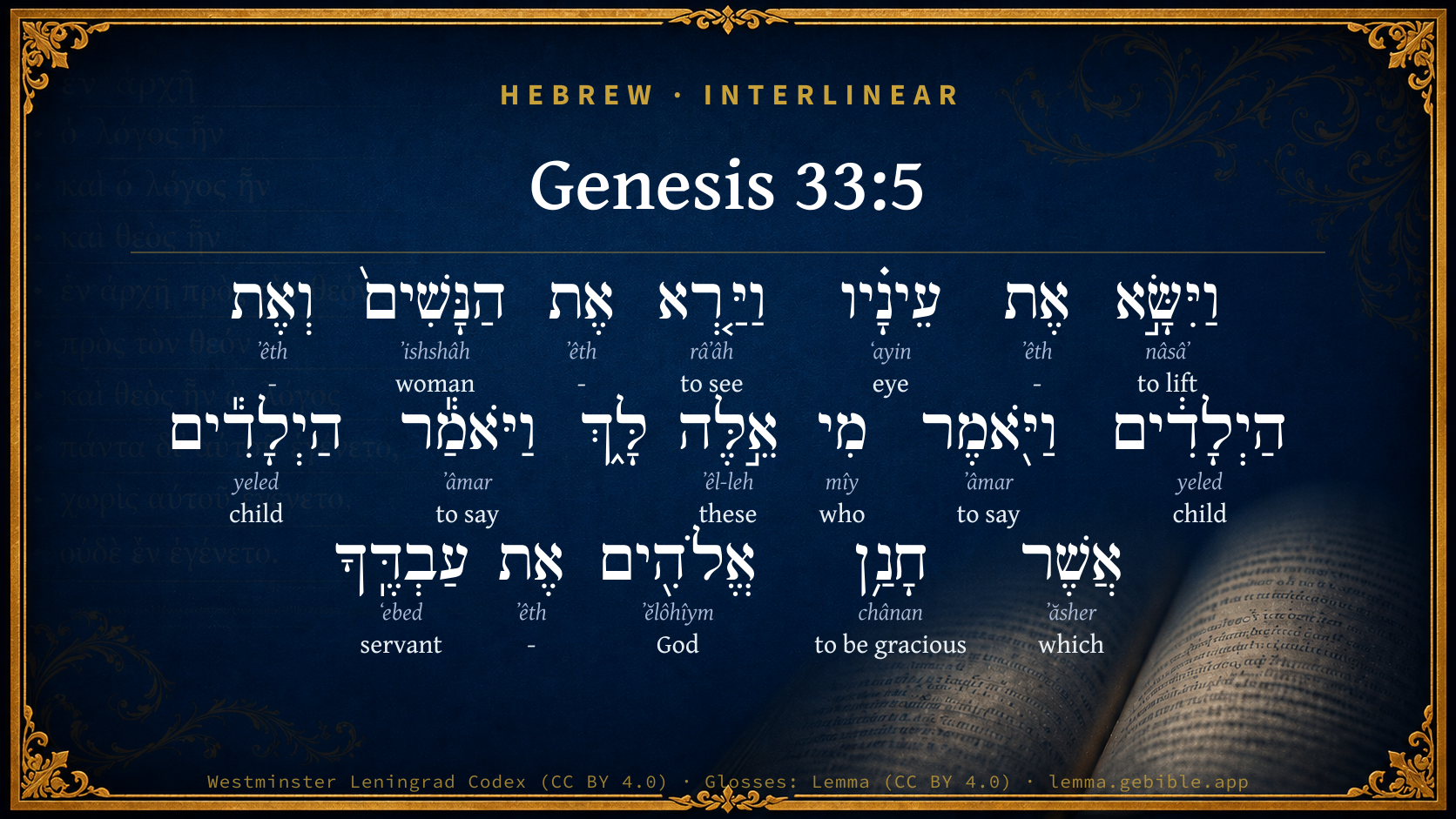
Hebrew (Westminster Leningrad Codex) Genesis 33:5 appears in the Hebrew Old Testament. The text above is from the Westminster Leningrad Codex. Each word links to its Strong’s number, a concise gloss, and parsing drawn from the Open Scriptures Hebrew Bible morphology. Click any word for its full Brown-Driver-Briggs (BDB) entry.
Download image
Cite this verse

Genesis 33:5 (World English Bible). Public Domain. Lemma interlinear Bible study tool, https://lemma.gebible.app/v/genesis/33/5.

Show BibTeX & RIS
BibTeX
RIS
English Translation
He lifted up his eyes, and saw the women and the children; and said, "Who are these with you?" He said, "The children whom God has graciously given your servant."
World English Bible · Public Domain
Highlights
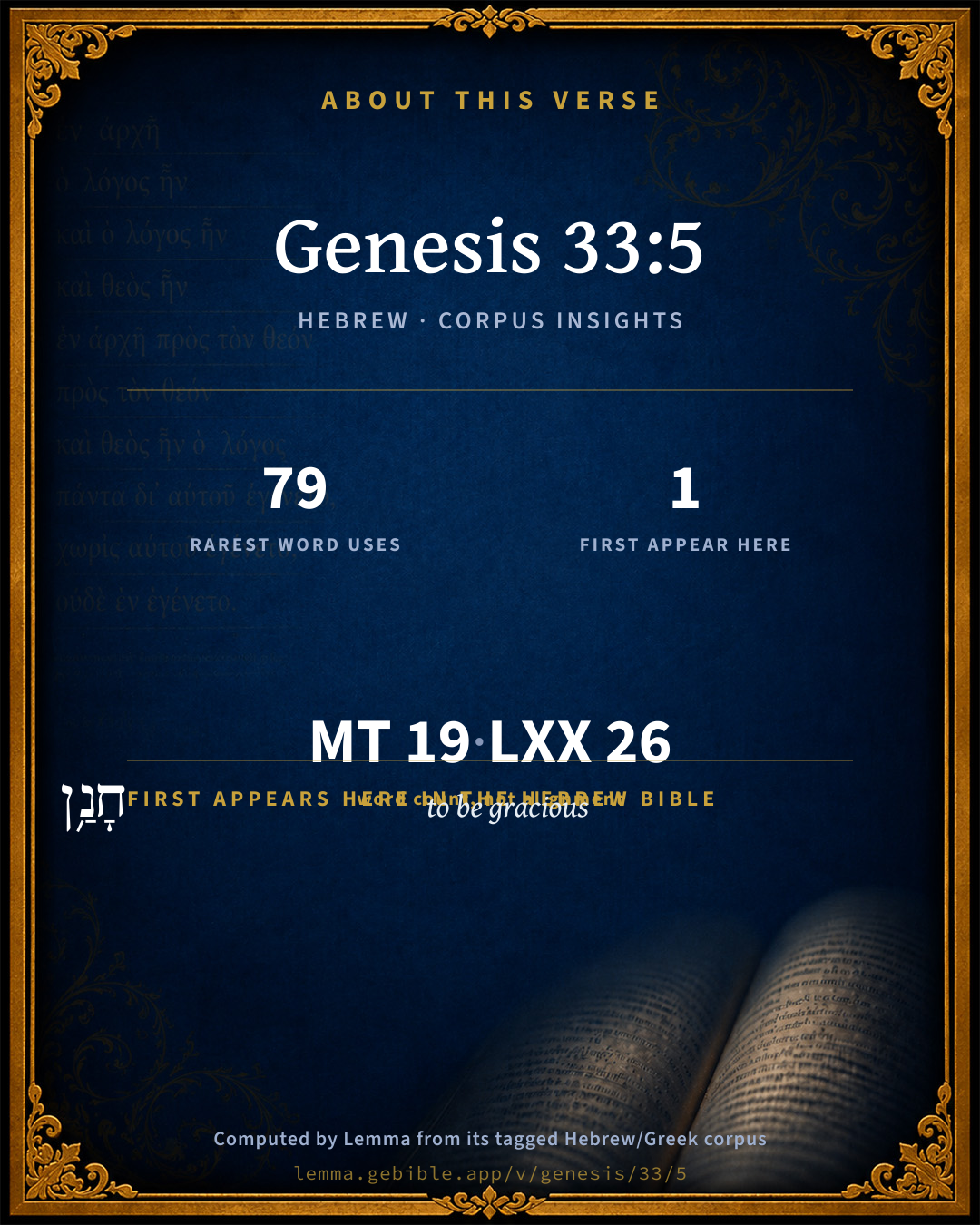
  • 1 first appearance in the Hebrew Bible
Full analysis ↓
Download a study sheet

One document with this verse’s original text, its word-by-word gloss line, the meaning frame, cross-references with their text, attributed commentary, and full source and license credits — printable, and it pastes into notes with its structure intact.

This verse Autodidact and up

Study sheet (.html) Plain text (.txt)

A passage Seminary Student

Up to 50 verses in one chapter. A passage sheet keeps up to 6 commentary sources and 12 cross-references per verse, in the order this page ranks them, and says so on the sheet whenever that leaves anything out. Ask for a single verse and you get the Autodidact verse sheet above.

Everything on this page stays free to read, with no account — the sheet is a download of what is already on screen, not access to it.

Want to remove ads? Support Godless Engineer
Compare translations 3

The same verse in 3 English versions, stacked beneath the original-language interlinear above. Click any original word for its lexicon entry.

Each is an independent rendering of the whole verse — the interlinear is not word-aligned to these translations.

Highlighted words mark where these versions differ — a whole-verse word diff, not a word-by-word alignment.

  • World English Bible Public Domain
    He lifted up his eyes, and saw the women and the children; and said, "Who are these with you?" He said, "The children whom God has graciously given your servant."
  • King James Version Public Domain
    And he lifted up his eyes, and saw the women and the children; and said, Who are those with thee? And he said, The children which God hath graciously given thy servant.
  • unfoldingWord Literal Text CC BY-SA 4.0
    Then he lifted his eyes and saw the women and the children, and he said, “Who these with you?” And he said, “The children whom God has graciously given to your servant.”

unfoldingWord Literal Text — © unfoldingWord, licensed CC BY-SA 4.0. Word-aligned USFM3 via Door43 (git.door43.org/unfoldingWord/en_ult).

Versions to compare (up to 4)

3 of 4 selected

Show all 18 translations

Every available English version of this verse, each an independent rendering of the whole verse.

  • World English Bible Public Domain
    He lifted up his eyes, and saw the women and the children; and said, "Who are these with you?" He said, "The children whom God has graciously given your servant."
  • Berean Standard Bible Public Domain
    When Esau looked up and saw the women and children, he asked, “Who are these with you?” Jacob answered, “These are the children God has graciously given your servant.”
  • Majority Standard Bible Public Domain
    When Esau looked up and saw the women and children, he asked, “Who are these with you?” Jacob answered, “These are the children God has graciously given your servant.”
  • King James Version Public Domain
    And he lifted up his eyes, and saw the women and the children; and said, Who are those with thee? And he said, The children which God hath graciously given thy servant.
  • American Standard Version (1901) Public Domain
    And he lifted up his eyes, and saw the women and the children; and said, Who are these with thee? And he said, The children whom God hath graciously given thy servant.
  • Revised Version (1885) Public Domain
    And he lifted up his eyes, and saw the women and the children; and said, Who are these with thee? And he said, The children which God hath graciously given thy servant.
  • Geneva Bible (1599) Public Domain
    And he lift vp his eyes, and sawe the women, and the children, and saide, Who are these with thee? And he answered, They are ye childre whome God of his grace hath giuen thy seruant.
  • Douay-Rheims (1899) Public Domain
    And lifting up his eyes, he saw the women and their children, and said: What mean these? And do they belong to thee? He answered: They are the children which God hath given to me thy servant.
  • Young's Literal Translation Public Domain
    and he lifteth up his eyes, and seeth the women and the children, and saith, `What `are' these to thee?' And he saith, `The children with whom God hath favoured thy servant.'
  • Literal Standard Version CC BY-SA 4.0
    and he lifts up his eyes, and sees the women and the children, and says, “What [are] these to you?” And he says, “The children with whom God has favored your servant.”
  • Unlocked Literal Bible CC BY-SA 4.0
    When Esau looked up, he saw the women and the children. He said, “Who are these people with you?” Jacob said, “The children whom God has graciously given your servant.”
  • unfoldingWord Literal Text CC BY-SA 4.0
    Then he lifted his eyes and saw the women and the children, and he said, “Who these with you?” And he said, “The children whom God has graciously given to your servant.”
  • Darby Bible Public Domain
    And he lifted up his eyes and saw the women and the children, and said, Who are these with thee? And he said, The children that God has graciously given thy servant.
  • World Messianic Bible Public Domain
    He lifted up his eyes, and saw the women and the children; and said, “Who are these with you?” He said, “The children whom God has graciously given your servant.”
  • Webster's Bible Public Domain
    And he lifted up his eyes, and saw the women and the children, and said, Who are those with thee? And he said, The children which God hath graciously given to thy servant.
  • Free Bible Version CC BY-SA 4.0
    Then Esau looked around at the women and children. “Who are these people with you?” he asked. “They are the children God graciously gave your servant,” Jacob replied.
  • Bible in Basic English Public Domain
    Then Esau, lifting up his eyes, saw the women and the children, and said, Who are these with you? And he said, The children whom God in his mercy has given to your servant.
  • JPS Tanakh (1917) Public Domain
    And he lifted up his eyes, and saw the women and the children; and said: 'Who are these with thee?' And he said: 'The children whom God hath graciously given thy servant.'

Literal Standard Version (2020), Covenant Press — licensed CC BY-SA 4.0. Text via the HelloAO Bible API (eBible.org). Unlocked Literal Bible (unfoldingWord) — licensed CC BY-SA 4.0. Text via the HelloAO Bible API (eBible.org). unfoldingWord Literal Text — © unfoldingWord, licensed CC BY-SA 4.0. Word-aligned USFM3 via Door43 (git.door43.org/unfoldingWord/en_ult). Free Bible Version, Dr. Jonathan Gallagher — licensed CC BY-SA 4.0. Text via the HelloAO Bible API (eBible.org).

Word by word

More ways to search: Search by grammar → Find every occurrence → Compare this word →

Practice this passage: Drill this verse → Learn its vocabulary →

חָנַ֥ן
chânan
H2603
“to be gracious”
Verb, Qal, Perfect, 3rd Person, Masculine, Singular
Part of Speech
Verb
Stem
Qal
Form
Perfect
Person
3rd Person
Gender
Masculine
Number
Singular
Full BDB Definition

Origin: a primitive root [compare H2583 ]

TWOT: 694 , 695

to be gracious, show favour, pity - (Qal) to show favour, be gracious - (Niphal) to be pitied - (Piel) to make gracious, make favourable, be gracious - (Poel) to direct favour to, have mercy on - (Hophal) to be shown favour, be shown consideration - (Hithpael) to seek favour, implore favour - to be loathsome
  1. וַיִּשָּׂ֣א nâsâʼ H5375 “and · to lift” Conjunction + Verb, Qal, Sequential Imperfect, 3rd Person, Masculine, Singular
  2. אֶת ʼêth H853 “-” Particle, Direct Object
  3. עֵינָ֗יו ʻayin H5869 “eyes · his” Noun, Common, Both, Dual, Construct + Suffix, Personal, 3rd Person, Masculine, Singular
  4. וַיַּ֤רְא râʼâh H7200 “and · to see” Conjunction + Verb, Qal, Sequential Imperfect, 3rd Person, Masculine, Singular
  5. אֶת ʼêth H853 “-” Particle, Direct Object
  6. הַנָּשִׁים֙ ʼishshâh H802 “the · women” Particle, Definite Article + Noun, Common, Feminine, Plural, Absolute
  7. וְאֶת ʼêth H853 “and · -” Conjunction + Particle, Direct Object
  8. הַיְלָדִ֔ים yeled H3206 “the · children” Particle, Definite Article + Noun, Common, Masculine, Plural, Absolute
  9. וַיֹּ֖אמֶר ʼâmar H559 “and · to say” Conjunction + Verb, Qal, Sequential Imperfect, 3rd Person, Masculine, Singular
  10. מִי mîy H4310 “who” Particle, Interrogative
  11. אֵ֣לֶּה ʼêl-leh H428 “these” Pronoun, Demonstrative, Common, Plural
  12. וַיֹּאמַ֕ר ʼâmar H559 “and · to say” Conjunction + Verb, Qal, Sequential Imperfect, 3rd Person, Masculine, Singular
  13. הַיְלָדִ֕ים yeled H3206 “the · children” Particle, Definite Article + Noun, Common, Masculine, Plural, Absolute
  14. אֲשֶׁר ʼăsher H834 “which” Particle, Relative
  15. אֱלֹהִ֖ים ʼĕlôhîym H430 “God(s)” Noun, Common, Masculine, Plural, Absolute
  16. אֶת ʼêth H853 “-” Particle, Direct Object
  17. עַבְדֶּֽךָ ʻebed H5650 “servant · your” Noun, Common, Masculine, Singular, Construct + Suffix, Personal, 2nd Person, Masculine, Singular

About this verse

These counts appear in no published source. They are computed here, from the morphology-tagged text and Lemma’s own curated glosses. What Lemma adds →

19
words
13
distinct lemmas
Pentateuch
section

First appearance in Scripture

This word makes its first canonical appearance in the Hebrew Bible here:

  • חָנַ֥ן to be gracious H2603

Grammatical profile

  • 5 verbs
  • 6 nouns
  • 1 pronoun
  • 1 preposition
  • 6 particles

Verb forms

  • וַיִּשָּׂ֣א Qal · Sequential Imperfect
  • וַיַּ֤רְא Qal · Sequential Imperfect
  • וַיֹּ֖אמֶר Qal · Sequential Imperfect
  • וַיֹּאמַ֕ר Qal · Sequential Imperfect
  • חָנַ֥ן Qal · Perfect

Repetition

Words recur within this verse — often emphatic in Hebrew:

  • הַיְלָדִ֔ים child H3206 ×2
  • וַיֹּ֖אמֶר to say H559 ×2

Hebrew & Septuagint length

In English translation the verse runs 30 words from the Hebrew and 31 from the Septuagint (LXX English) — closely comparable.

A rough comparison of the two English renderings, which tokenize alike — not a word-level alignment.

Word counts can differ between the Hebrew and the Greek without any difference in meaning — e.g. the Hebrew direct-object marker אֵת has no separate Greek word, and Greek often adds the article ὁ.

In the original languages it is 19 Hebrew tokens and 26 Greek tokens — but the two are counted differently (Hebrew bundles its prefixes and suffixes into one token; the Greek is in lemma form), so that isn’t a like-for-like length.

Cross-references

8

Topical passages linked to Genesis 33:5 in the Treasury of Scripture Knowledge — connected by theme and wording, ordered by reader-vote popularity; previews shown in the World English Bible.

  • Psalms 127:3 Behold, children are a heritage of Yahweh. The fruit of the womb is his reward.
  • Isaiah 8:18 Behold, I and the children whom Yahweh has given me are for signs and for wonders in Israel from Yahweh of Hosts, who dwells in Mount Zion.
  • Genesis 48:9 Joseph said to his father, "They are my sons, whom God has given me here." He said, "Please bring them to me, and I will bless them."
  • Genesis 30:2 Jacob's anger was kindled against Rachel, and he said, "Am I in God's place, who has withheld from you the fruit of the womb?"
  • Ruth 4:13 So Boaz took Ruth, and she became his wife; and he went in to her, and Yahweh gave her conception, and she bore a son.
  • 1 Samuel 1:27 For this child I prayed; and Yahweh has given me my petition which I asked of him:
  • 1 Chronicles 28:5 Of all my sons (for Yahweh has given me many sons), he has chosen Solomon my son to sit on the throne of the kingdom of Yahweh over Israel.
  • Hebrews 2:13 Again, "I will put my trust in him." Again, "Behold, here am I and the children whom God has given me."

Cross-references courtesy of OpenBible.info (CC BY 4.0).

Hebrew and Greek witnesses Masoretic Hebrew ↔ Greek Septuagint

The same verse in the two great witnesses to the Old Testament, shown verse-for-verse.

These are two independent witnesses, not word-aligned to each other, and the Septuagint is shown in lemma (dictionary) form.

Hebrew Genesis 33:5 Masoretic · Westminster Leningrad Codex

וַיִּשָּׂ֣א אֶת עֵינָ֗יו וַיַּ֤רְא אֶת הַנָּשִׁים֙ וְאֶת הַיְלָדִ֔ים וַיֹּ֖אמֶר מִי אֵ֣לֶּה לָּ֑ךְ וַיֹּאמַ֕ר הַיְלָדִ֕ים אֲשֶׁר חָנַ֥ן אֱלֹהִ֖ים אֶת עַבְדֶּֽךָ

He lifted up his eyes, and saw the women and the children; and said, "Who are these with you?" He said, "The children whom God has graciously given your servant."

World English Bible · Public Domain

Greek LXX Genesis 33:5 Septuagint · lemma form

καί ἀναβλέπω ὁράω ὁ γυνή καί ὁ παιδίον καί εἶπον τίς οὗτος σύ εἰμί ὁ δέ εἶπον ὁ παιδίον ὅς ἐλεέω ὁ θεός ὁ παῖς σύ

And Esau looked up and saw the women and the children, and said, What are these to you? And he said, The children with which God has mercifully blessed your servant.

LXX2012 (modern English Septuagint) · Public Domain

Hebrew: Westminster Leningrad Codex (CC BY 4.0). Greek: Septuagint (public domain); English from LXX2012 (modern English Septuagint) (Public Domain). How the Septuagint differs from the Hebrew →

Targum (Aramaic paraphrase)

2

The Targum is the ancient Jewish Aramaic paraphrase of the Hebrew Scriptures — an interpretive translation, not the Hebrew text itself. Onkelos (literal) and Pseudo-Jonathan (expansive) render the Torah, and Jonathan the Prophets. Coverage is partial: where no permissively-licensed English translation exists for a verse, only the Aramaic is shown. This is verse-level text, not a word-by-word alignment to the Hebrew.

  1. Targum Onkelos Torah (Genesis–Deuteronomy)
    וּזְקַף יָת עֵינוֹהִי וַחֲזָא יָת נְשַׁיָּא וְיָת בְּנַיָּא וַאֲמַר מָן אִלֵּין לָךְ וַאֲמַר בְּנַיָּא דִּי חַן יְיָ יָת עַבְדָּךְ

    (no public-domain English translation for this verse)

    Targum Onkelos — Aramaic: “Onkelos Genesis” (public domain); “Onkelos Exodus” (public domain); “Onkelos Leviticus” (public domain); “Onkelos Numbers” (public domain); “Onkelos Deuteronomy” (public domain). English: “Sefaria Community Translation” (CC0 1.0 (public-domain dedication)); “J.W. Etheridge. The Targums of Onkelos and Jonathan Ben Uzziel on the Pentateuch. London: Longmans, Green, 1862” (public domain). Text via Sefaria.

  2. Targum Pseudo-Jonathan Torah (Genesis–Deuteronomy)
    וּזְקַף יַת עֵינוֹי וַחֲמָא יַת נְשַׁיָא וְיַת רַבְיָא וְאָמַר מַאן אִלֵין לָךְ וְאָמַר בְּנַי הִינוּן דְאִתְיְהִיבוּ לִי בְּמֵיחוּס מִן קֳדָם יְיָ עַל עַבְדָךְ

    And he lifted up his eyes and saw the wives and the children, and said, Who are these with thee? And he said, They are the souls which have been given to me through mercy from before the Lord upon thy servant.

    Targum Pseudo-Jonathan — Aramaic: “Targum Jonathan on Genesis” (public domain); “Targum Jonathan on Exodus” (public domain); “Targum Jonathan on Leviticus” (public domain); “Targum Jonathan on Numbers” (public domain); “Targum Jonathan on Deuteronomy” (public domain). English: “The Targum of Jonathan ben Uzziel, trans. J. W. Etheridge, London, 1862” (public domain). Text via Sefaria.

Commentary

Notes on Genesis 33:5 from classic Christian and Jewish commentators (each source and its license shown beneath its notes). The classic Christian expositions comment on the surrounding passage and are grouped to its opening verse, so a note may address several verses; the Jewish commentaries on the Tanakh (Rashi and others) are per-verse, so they appear only where the commentator wrote on this verse.

Lemma curates 59 commentaries, every one of them public domain or Creative Commons licensed, each selected and text-cleaned for this edition rather than reprinted as found. About our sources →

Matthew Henry's Commentary

We have here the discourse between the two brothers at their meeting, which is very free and friendly, without the least intimation of the old quarrel. It was the best way to say nothing of it. They converse,

I. About Jacob's retinue, Gen 33:5-7. Eleven or twelve little ones, the eldest of them no fourteen years old, followed Jacob closely: Who are these? says Esau. Jacob had sent him an account of the increase of his estate (Gen 32:5), but made no mention of his children; perhaps because he would not expose them to his rage if he should meet him as an enemy, or would please him with the unexpected sight if he should meet him as a friend: Esau therefore had reason to ask, Who are those with thee? to which common question Jacob returns a serious answer, such as became his character: They are the children which God hath graciously given they servant. It had been a sufficient answer to the question, and fit enough to be given to profane Esau, if he had only said, "They are my children;" but then Jacob would not have spoken like himself, like a man whose eyes were ever towards the Lord. Note, It becomes us not only to do common actions, but to speak of them, after a godly sort, Jo3 1:6. Jacob speaks of his children, 1. As God's gifts; they are a heritage of the Lord, Psa 128:3; Psa 112:9; Psa 107:41. 2. As choice gifts; he hath graciously given them. Though they were many, and now much his care, and as yet but slenderly provided for, yet he accounts them great blessings. His wives and children, hereupon, come up in order, and pay their duty to Esau, as he had done before them (Gen 33:6, Gen 33:7); for it becomes the family to show respect to those to whom the master of the family shows respect.

II. About the present he had sent him.

1. Esau modestly refused it because he had enough, and did not need it, Gen 33:9. Note, Those who wish to be considered men of honour will not seem to be mercenary in their friendship: whatever influence Jacob's present had upon Esau to pacify him, he would not have it thought that it had any, and therefore he refused it. His reason is I have enough, I have much (so the word is), so much that he was not willing to take any thing that was his brother's. Note, (1.) Many that come short of spiritual blessings, and are out of covenant, yet have much of this world's wealth. Esau had what was promised him, the fatness of the earth and a livelihood by his sword. (2.) It is a good thing for those that have much to know that they have enough, though they have not so much as some others have. Even Esau can say, I have enough. (3.) Those that are content with what they have must show it by not coveting what others have. Esau, for his part, needs it not, either to supply him, for he was rich, or to pacify him, for he was reconciled: we should take heed lest at any time our covetousness impose upon the courtesy of others, and meanly take advantage of their generosity.

2. Jacob affectionately urges him to accept it, and prevails, Gen 33:10, Gen 33:11. Jacob sent it, through fear (Gen 32:20), but, the fear being over, he now importunes his acceptance of it for love, to show that he desired his brother's friendship, and did not merely dread his wrath; two things he urges: - (1.) The satisfaction he had in his brother's favour, of which he thought himself bound to make this thankful acknowledgment. It is a very high compliment that he passes upon him: I have seen thy face, as though I had seen the face of God, that is, "I have seen thee reconciled to me, and at peace with me, as I desire to see God reconciled." Or the meaning is that Jacob saw God's favour to him in Esau's: it was a token for good to him that God had accepted his prayers. Note, Creature-comforts are comforts indeed to us when they are granted as answers to prayer, and are tokens of our acceptance with God. Again, It is matter of great joy to those that are of a peaceable and affectionate disposition to recover the friendship of those relations with whom they have been at variance. (2.) The competency he had of this world's goods: God has dealt graciously with me. Note, If what we have in this world increase under our hands, we must take notice of it with thankfulness, to the glory of God, and own that therein he has dealt graciously with us, better than we deserve. It is he that gives power to get wealth, Deu 8:18. He adds, "And I have enough; I have all," so the word is. Esau's enough was much, but Jacob's enough was all. Note, a godly man, though he have but little in the world, yet may truly say, "I have all," [1.] Because he has the God of all, and has all in him; all is yours if you be Christ's, Co1 3:22. [2.] Because he has the comfort of all. I have all, and abound, Phi 4:18. He that thinks he has all is sure he has enough. He has all in prospect; he will have all shortly, when he comes to heaven: upon this principle Jacob urged Esau, and he took his present. Note, It is an excellent thing when men's religion makes them generous, free-hearted, and open-handed, scorning to do a thing that is paltry and sneaking.

III. About the progress of their journey. 1. Esau offers himself to be his guide and companion, in token of sincere reconciliation, Gen 33:12. We never find that Jacob and Esau were so sociable with one another, and so affectionate, as they were now. Note, As for God his work is perfect. He made Esau, not only not an enemy, but a friend. This bone that had been broken, being well set, became stronger than ever. Esau has become fond of Jacob's company, courts him to Mount Seir: let us never despair of any, nor distrust God in whose hand all hearts are. Yet Jacob saw cause modestly to refuse this offer (Gen 33:13, Gen 33:14), wherein he shows a tender concern for his own family and flocks, like a good shepherd and a good father. He must consider the children, and the flocks, with young, and not lead the one, nor drive the other, too fast. This prudence and tenderness of Jacob ought to be imitated by those that have the care and charge of young people in the things of God. They must not be over-driven, at first, by heavy tasks in religious services, but led, as they can bear, having their work made as easy to them as possible. Christ, the good Shepherd, does so, Isa 40:11. Now Jacob will not desire Esau to slacken his pace, nor force his family to quicken theirs, nor leave them, to keep company with his brother, as many would have done, that love any society better than their own house; but he desires Esau to march before, and promises to follow him leisurely, as he could get forward. Note, It is an unreasonable thing to tie others to our rate; we may come with comfort, at last, to the same journey's end, though we do not journey together, either in the same path or with the same pace. There may be those with whom we cannot fall in and yet with whom we need not fall out by the way. Jacob intimates to him that it was his present design to come to him to Mount Seir; and we may presume he did so, after he had settled his family and concerns elsewhere, though that visit is not recorded. Note, When we have happily recovered peace with our friends we must take care to cultivate it, and not to be behind-hand with them in civilities. 2. Esau offers some of his men to be his guard and convoy, Gen 33:15. He saw Jacob but poorly attended, no servants but his husbandmen and shepherds, no pages or footmen; and therefore, thinking he was as desirous as himself (if he could afford it) to take state upon him, and look great, he would needs lend him some of his retinue, to attend upon him, that he might appear like Esau's brother; but Jacob humbly refuses his offer, only desiring he would not take it amiss that he did not accept it: What needeth it? (1.) Jacob is humble, and needs it not for state; he desires not to make a fair show in the flesh, by encumbering himself with a needless retinue. Note, It is the vanity of pomp and grandeur that they are attended with a great deal of which it may be said, What needeth it? (2.) Jacob is under the divine protection, and needs it not for safety. Note, Those are sufficiently guarded that have God for their guard and are under a convoy of his hosts, as Jacob was. Those need not be beholden to an arm of flesh that have God for their arm every morning. Jacob adds, "Only let me find grace in the sight of my lord; having thy favour, I have all I need, all I desire from thee." If Jacob thus valued the good-will of a brother, much more reason have we to reckon that we have enough if we have the good-will of our God.

Matthew Henry's Commentary on the Whole Bible (1708–1710) — public domain (CC PDM 1.0). Text via the HelloAO Bible API.

Trapp's Complete Commentary

John Trapp

Gen 33:5 And he lifted up his eyes, and saw the women and the children; and said, Who [are] those with thee? And he said, The children which God hath graciously given thy servant.

Ver. 5. The children which God hath graciously given.] Sept., Eχαριτατο. For children are God’s gifts, as David taught Solomon. {Psa 127:3} It is well observed, that good Jacob before a bad man, speaks religiously, "God of his grace," &c.; and Esau, as bad as he was, makes no jest of it. There is no surer sign of a profane heart, than to jeer at good expressions; than which, nothing now-a-days is more familiar. Carnal spirits cannot hear savoury words, but they turn them off with a scorn, as Pilate did our Saviour, speaking of the truth, with that scornful profane question, "What is truth?" Shall these scoffers be counted Christians? Could any that heard Elijah mocking the service and servants of Baal, believe that Baal was God in his esteem? Shall not Esau rise up in judgment against such profane persons? And shall not Jacob disclaim all such profligate professors for having any relation to him, that dare not speak religiously, for fear of some Esau in company? that are ashamed to seem what they are, with Zedekiah, lest they that are fallen to the Chaldeans should mock them?

John Trapp, A Commentary or Exposition upon All the Books of the Old and New Testament (1647–1656) — public domain. Text from a community e-Sword module.

Joseph Benson's Commentary

Gen 33:5. Who are these with thee? — Jacob had sent Esau an account of the increase of his estate, but had made no mention of his children, perhaps because he would not expose them to his rage if he should meet him as an enemy. Esau, therefore, had reason to make this inquiry: to which Jacob returned a serious answer: They are the children which God hath graciously given thy servant — He speaks of his children as God’s gifts; a heritage of the Lord, and as choice gifts, graciously given him. Though they were many, and but slenderly provided for, yet he accounts them great blessings.

Joseph Benson's Commentary on the Old and New Testaments (1811–1818) — public domain. Text from a community e-Sword module.

Tyndale Open Study Notes

Tyndale Open Resources

33:5 your servant: In talking with his brother, Jacob continued to refer to himself as Esau’s servant (also 33:14) and to Esau as his lord (33:8, 13-15); Esau called Jacob “my brother” (33:9). Jacob was cautiously warding off any possible retaliation by reversing the words of the oracle (25:23).

Tyndale Open Study Notes — © Tyndale Open Resources, licensed CC BY-SA 4.0. Text via the HelloAO Bible API.

Jamieson, Fausset & Brown

Robert Jamieson, A. R. Fausset & David Brown

Who are those with thee?--It might have been enough to say, They are my children; but Jacob was a pious man, and he could not give even a common answer but in the language of piety (Psa 127:3; Psa 113:9; Psa 107:41).

Jamieson, Fausset & Brown — Commentary Critical and Explanatory on the Whole Bible (1871) — public domain (CC PDM 1.0). Text via the HelloAO Bible API.

John Calvin's Commentaries

5. And he lifted up his eyes. Moses relates the conversation held between the brothers. And as Esau had testified his fraternal affection by tears and embraces, there is no doubt that he inquires after the children in a spirit of congratulation. The answer of Jacob breathes piety as well as modesty; for when he replies, that his numerous seed had been given him by God, he acknowledges and confesses that children are not so produced by nature as to subvert the truth of the declaration, that the fruit of the womb is a reward and gift of God. And truly, since the fecundity of brute animals is the gift of God, how much more is this the case with men, who are created after his own image. Let parents then learn to consider, and to celebrate the singular kindness of God, in their offspring. It is the language of modesty, when Jacob calls himself the servant of his brother. Here again it is proper to recall to memory what I have lately touched upon, that the holy man caught at nothing either of earthly advantage or honor in the birthright; because the hidden grace of God was abundantly sufficient for him, until the appointed time of manifestation. And it becomes us also, according to his example, while we sojourn in this world, to depend upon the word of the Lord; that we may not deem it wearisome, to be held wrapped in the shadow of death, until our real life be manifested. For although apparently our condition is miserable and accursed, yet the Lord blesses us with his word; and, on this account only, pronounces us happy, because he owns us as sons.

John Calvin's Commentaries (1540-1563) — public domain. Text from the Calvin Translation Society English edition (1840s-50s) via the Christian Classics Ethereal Library (ccel.org). Calvin's coverage is partial (roughly two-thirds of the Bible); uncommented books and verses are honest gaps, never fabricated. The 19th-century editor's footnotes and remarks are omitted so the notes are faithfully Calvin's own voice.

Ellicott's Commentary for English Readers

(5) Who are those with thee?—Heb., to thee, that is, Who are these belonging to thee? Esau noticed that they were Jacob’s family, and asked for fuller information concerning them.

A Bible Commentary for English Readers, edited by Charles John Ellicott (1878–1897) — public domain. Text from a community e-Sword module.

John Gill's Exposition

And he lift up his eyes, and saw the women and children,.... After the salutation had passed between him and his brother Jacob, he looked, and saw behind him women and children, Jacob's two wives and his two handmaids, and twelve children he had by them:

and said, who are those with thee? who do those women and children belong to that follow thee? for Jacob had made no mention of his wives and children, when he sent his messengers to him, Gen 32:5; and therefore Esau might very well ask this question, which Jacob replied to:

and he said, the children which God hath graciously given thy servant; he speaks of his children as gifts of God, and as instances and pledges of his favour and good will to him, which he thankfully acknowledges; and at the same time speaks very respectfully to his brother, and in great condescension and humility owns himself his servant, but says nothing of his wives; not that he was ashamed, as Abarbinel suggests, that he should have four wives, when his brother, who had less regard for religion, had but three; but he mentions his children as being near kin to Esau, and by whom he might conclude who the women were, and of whom also he might give a particular account, though the Scripture is silent about it; since Leah and Rachel were his own first cousins, Gen 29:10; and who they were no doubt he told him, as they came to pay their respects to him, as follows.

John Gill's Exposition of the Whole Bible (1746–1763) — public domain (CC PDM 1.0). Text via the HelloAO Bible API.

The Pulpit Commentary

And he (i.e. Esau) lifted up his eyes, corresponding to the act of Jacob (ver. 1), and expressive of surpriseand saw the women and the children; and said, Who art those with thee? (literally, to thee, i.e. whom thou hast). And he (Jacob) said, The children which God (Elohim; vide infra on ver. 10) hath graciously given the verb nj; being construed with a double accusative, as in Jud_1:21:22; Psa_19:2-9thy servant.

The Pulpit Commentary (1880–1919), ed. H.D.M. Spence-Jones & Joseph S. Exell — public domain. Text from a community e-Sword module.

John Wesley's Explanatory Notes

Eleven or twelve little ones followed Jacob, the eldest of them not fourteen years old: Who are these? saith Esau. Jacob had sent him an account of the increase of his estate, but made no mention of his children, perhaps because he would not expose them to his rage, if he should meet him as an enemy. Esau therefore had reason to ask who are those with thee? To which Jacob returns a serious answer; they are the children which God hath graciously given thy servant. Jacob speaks of his children,

1. As God's gifts; they are a heritage of the Lord.

2. As choice gifts; he hath graciously given them. Though they were many, and but slenderly provided for, yet he accounts them great blessings.

John Wesley, Explanatory Notes Upon the Whole Bible (1754–1765) — public domain. Text via the GEBible commentary corpus.

Keil & Delitzsch

C. F. Keil & F. Delitzsch

When his eyes fell upon the women and children, he inquired respecting them, "Whom hast thou here?" And Jacob replied, "The children with whom Elohim hath favoured me." Upon this, the mothers and their children approached in order, making reverential obeisance. חנן with double acc. "graciously to present." Elohim: "to avoid reminding Esau of the blessing of Jehovah, which had occasioned his absence" (Del.).

Keil & Delitzsch — Biblical Commentary on the Old Testament (1861–1891) — public domain (CC PDM 1.0). Text via the HelloAO Bible API. (Old Testament only.)

Rashi

Rabbi Shlomo Yitzchaki (Rashi)

מי אלה לך WHO ARE THESE WITH THEE? (literally, to thee)? — Who are these that they should be yours (are they your children or your servants)?

Rashi on the Tanakh — English translations: “The Judaica Press complete Tanach with Rashi, translated by A. J. Rosenberg” (CC BY 4.0); “Pentateuch with Rashi's commentary by M. Rosenbaum and A.M. Silbermann, 1929-1934” (public domain); “The Metsudah Tanach series, Lakewood, N.J” (CC BY 4.0); and “The Book of Joshua, Metsudah Publications, 1997” (CC BY 4.0). Text via Sefaria.

Ramban (Nachmanides)

Rabbi Moshe ben Nachman (Ramban / Nachmanides)

WHO ARE THESE WITH THEE? Esau inquired about the women and children, and Jacob modestly answered, The children whom G-d hath graciously given thy servant, as he did not want to say that they were his wives. Esau thereby understood that they were the mothers of the children.

Ramban (Nachmanides) on the Tanakh — English translation: “Commentary on the Torah by Ramban (Nachmanides). Translated and annotated by Charles B. Chavel. New York, Shilo Pub. House, 1971-1976” (CC BY 4.0). Text via Sefaria.

Sforno

Rabbi Ovadia Sforno

Who are these to you. Are they your children or your servants?.

Sforno on the Tanakh — English translation: “Yalkut, Sifsei Chachomim Chumash, Metsudah Publications, 2009” (CC BY 4.0). Text via Sefaria.

Radak

Rabbi David Kimhi (Radak)

וישא...מי אלה לך, these women and children whom I see, as well as all the numerous servants, who are they? Yaakov answered him concerning the children, and Esau deduced that the women next to them were their mothers.

Radak on the Tanakh — English translations: “Sefaria Community Translation” (CC0 1.0 (public-domain dedication)); “Eliyahu Munk, HaChut Hameshulash” (CC BY 4.0); “Rabbi Mike Feuer, Jerusalem Anthology” (CC BY 4.0); and “R. David Kimhi on the first book of Psalms, Translated by R.G. Finch, London, 1919” (public domain). Text via Sefaria.

Lesson kit

Teaching starters — assembled from the data on this page, not authored interpretation. Every prompt links to the verse data it draws on. Edit before teaching.

Genesis, in the Pentateuch, opens this verse with 19 words (13 distinct Hebrew lemmas). Its most distinctive word is chânan (“to be gracious”). A historical commentator’s framing appears above. Read the whole chapter for the surrounding context.

Discussion questions

  1. How does “to be gracious” (chânan) shape what this verse is saying?
  2. This is the first place “to be gracious” appears in Scripture (first appears here). What does its debut here establish?
  3. How does Psalms 127:3, which shares this passage’s theme, read alongside this verse?
  4. What does the repetition of “child” (2× in this one verse) do in this verse?
  5. These translations render this verse differently. What is at stake in choosing one wording over another?
  6. «וַיִּשָּׂ֣א» is a Qal Sequential Imperfect verb. How does that grammatical form shape the action described?
  7. Compare how Matthew Henry's Commentary and Trapp's Complete Commentary read this verse. Where do they agree or differ?

Things to notice

Reading settings

Reading text

Shown beneath each verse's original-language words.

Old Testament
Old Testament edition

Read the OT as the Masoretic Hebrew (MT) or the Greek Septuagint (LXX).

English shown for the Greek Septuagint (in the Hebrew ↔ Greek comparison).

Comparing translations? Open the Compare panel on any verse page to stack up to four side by side.