
2 Kings 2:16

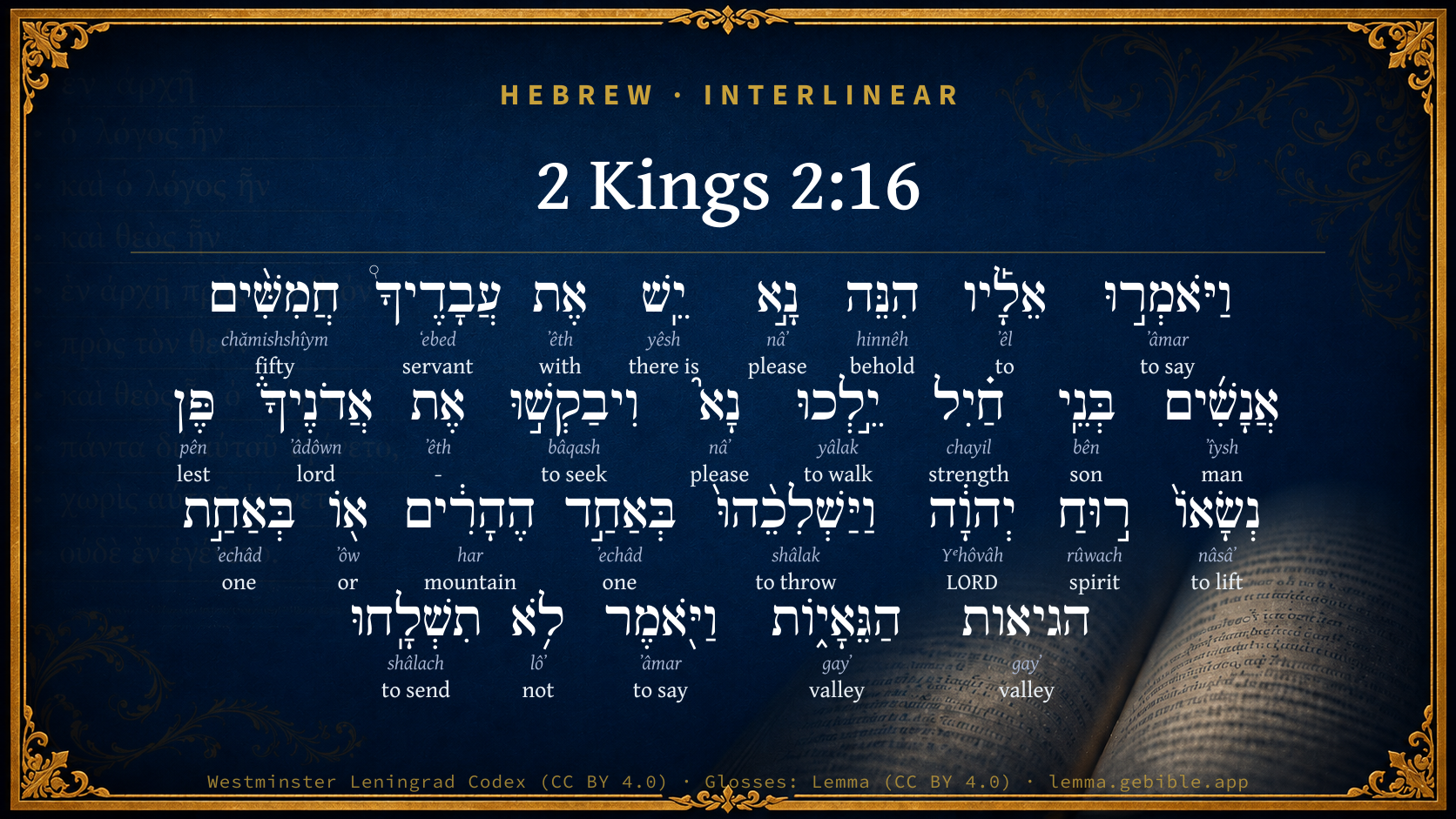
Hebrew (Westminster Leningrad Codex) 2 Kings 2:16 appears in the Hebrew Old Testament. The text above is from the Westminster Leningrad Codex. Each word links to its Strong’s number, a concise gloss, and parsing drawn from the Open Scriptures Hebrew Bible morphology. Click any word for its full Brown-Driver-Briggs (BDB) entry.
Download image
Cite this verse

2 Kings 2:16 (World English Bible). Public Domain. Lemma interlinear Bible study tool, https://lemma.gebible.app/v/2-kings/2/16.

Show BibTeX & RIS
BibTeX
RIS
English Translation
They said to him, See now, there are with your servants fifty strong men; let them go, we pray you, and seek your master, lest the Spirit of Yahweh has taken him up, and cast him on some mountain, or into some valley. He said, You shall not send.
World English Bible · Public Domain
Download a study sheet

One document with this verse’s original text, its word-by-word gloss line, the meaning frame, cross-references with their text, attributed commentary, and full source and license credits — printable, and it pastes into notes with its structure intact.

This verse Autodidact and up

Study sheet (.html) Plain text (.txt)

A passage Seminary Student

Up to 50 verses in one chapter. A passage sheet keeps up to 6 commentary sources and 12 cross-references per verse, in the order this page ranks them, and says so on the sheet whenever that leaves anything out. Ask for a single verse and you get the Autodidact verse sheet above.

Everything on this page stays free to read, with no account — the sheet is a download of what is already on screen, not access to it.

Want to remove ads? Support Godless Engineer
Compare translations 3

The same verse in 3 English versions, stacked beneath the original-language interlinear above. Click any original word for its lexicon entry.

Each is an independent rendering of the whole verse — the interlinear is not word-aligned to these translations.

Highlighted words mark where these versions differ — a whole-verse word diff, not a word-by-word alignment.

  • World English Bible Public Domain
    They said to him, See now, there are with your servants fifty strong men; let them go, we pray you, and seek your master, lest the Spirit of Yahweh has taken him up, and cast him on some mountain, or into some valley. He said, You shall not send.
  • King James Version Public Domain
    And they said unto him, Behold now, there be with thy servants fifty strong men; let them go, we pray thee, and seek thy master: lest peradventure the Spirit of the LORD hath taken him up, and cast him upon some mountain, or into some valley. And he said, Ye shall not send.
  • unfoldingWord Literal Text CC BY-SA 4.0
    And they said to him, “Behold, please, there are with your servants fifty men, sons of valor. Please, let them go, and let them seek your master, lest the Spirit of Yahweh has lifted him up and thrown him onto one of the mountains or into one of the valleys.” And he said, “Do not send.”

unfoldingWord Literal Text — © unfoldingWord, licensed CC BY-SA 4.0. Word-aligned USFM3 via Door43 (git.door43.org/unfoldingWord/en_ult).

Versions to compare (up to 4)

3 of 4 selected

Show all 18 translations

Every available English version of this verse, each an independent rendering of the whole verse.

  • World English Bible Public Domain
    They said to him, See now, there are with your servants fifty strong men; let them go, we pray you, and seek your master, lest the Spirit of Yahweh has taken him up, and cast him on some mountain, or into some valley. He said, You shall not send.
  • Berean Standard Bible Public Domain
    “Look now,” they said to Elisha, “we your servants have fifty valiant men. Please let them go and search for your master. Perhaps the Spirit of the LORD has taken him up and put him on one of the mountains or in one of the valleys.” “Do not send them,” Elisha replied.
  • Majority Standard Bible Public Domain
    “Look now,” they said to Elisha, “we your servants have fifty valiant men. Please let them go and search for your master. Perhaps the Spirit of the LORD has taken him up and put him on one of the mountains or in one of the valleys.” “Do not send them,” Elisha replied.
  • King James Version Public Domain
    And they said unto him, Behold now, there be with thy servants fifty strong men; let them go, we pray thee, and seek thy master: lest peradventure the Spirit of the LORD hath taken him up, and cast him upon some mountain, or into some valley. And he said, Ye shall not send.
  • American Standard Version (1901) Public Domain
    And they said unto him, Behold now, there are with thy servants fifty strong men; let them go, we pray thee, and seek thy master, lest the Spirit of Jehovah hath taken him up, and cast him upon some mountain, or into some valley. And he said, Ye shall not send.
  • Revised Version (1885) Public Domain
    And they said unto him, Behold now, there be with thy servants fifty strong men; let them go, we pray thee, and seek thy master: lest peradventure the spirit of the LORD hath taken him up, and cast him upon some mountain, or into some valley. And he said, Ye shall not send.
  • Geneva Bible (1599) Public Domain
    And said vnto him, Beholde nowe, there be with thy seruants fiftie strong men: let them go, we pray thee, and seeke thy master, if so be the Spirite of the Lord hath taken him vp, and cast him vpon some mountaine, or into some valley. But he said, Ye shall not sende.
  • Douay-Rheims (1899) Public Domain
    And they said to him: Behold, there are with thy servants fifty strong men, that can go, and seek thy master, lest perhaps the spirit of the Lord hath taken him up and cast him upon some mountain or into some valley. And he said: Do not send.
  • Young's Literal Translation Public Domain
    and say unto him, `Lo, we pray thee, there are with thy servants fifty men, sons of valour: let them go, we pray thee, and they seek thy lord, lest the Spirit of Jehovah hath taken him up, and doth cast him on one of the hills, or into one of the valleys;' and he saith, `Ye do not send.'
  • Literal Standard Version CC BY-SA 4.0
    and say to him, “Now behold, there are fifty men with your servants, sons of valor: please let them go, and they seek your lord, lest the Spirit of YHWH has taken him up, and casts him on one of the hills or into one of the valleys”; and he says, “You do not send.”
  • Unlocked Literal Bible CC BY-SA 4.0
    They said to him, “See now, among your servants there are fifty strong men. Let them go, we ask, and look for your master, in case the Spirit of Yahweh has taken him up and thrown him onto some mountain or into some valley.” Elisha answered, “No, do not send them.”
  • unfoldingWord Literal Text CC BY-SA 4.0
    And they said to him, “Behold, please, there are with your servants fifty men, sons of valor. Please, let them go, and let them seek your master, lest the Spirit of Yahweh has lifted him up and thrown him onto one of the mountains or into one of the valleys.” And he said, “Do not send.”
  • Darby Bible Public Domain
    and said to him, Behold now, there are with thy servants fifty valiant men; let them go, we pray thee, and seek thy master, lest perhaps the Spirit of Jehovah have taken him up, and cast him upon some mountain, or into some ravine. And he said, Ye shall not send.
  • World Messianic Bible Public Domain
    They said to him, “See now, there are with your servants fifty strong men. Please let them go and seek your master. Perhaps the LORD’s Spirit has taken him up, and put him on some mountain or into some valley.” He said, “Don’t send them.”
  • Webster's Bible Public Domain
    And they said to him, Behold now, there are with thy servants fifty strong men; let them go, we pray thee, and seek thy master: lest perhaps the Spirit of the LORD hath taken him up, and cast him upon some mountain, or into some valley. And he said, Ye shall not send.
  • Free Bible Version CC BY-SA 4.0
    “Look,” they said to Elisha, “we your servants have fifty good men here. Please allow them to go and search for your master. Maybe the Spirit of the Lord has taken him and put him down on a mountain or in a valley somewhere.” “Don't bother sending them,” Elisha replied.
  • Bible in Basic English Public Domain
    And they said, Your servants have with us here fifty strong men; be pleased to let them go in search of Elijah; for it may be that the spirit of the Lord has taken him up and put him down on some mountain or in some valley. But he said, Do not send them.
  • JPS Tanakh (1917) Public Domain
    And they said unto him: 'Behold now, there are with thy servants fifty strong men; let them go, we pray thee, and seek thy master; lest peradventure the spirit of the LORD hath taken him up, and cast him upon some mountain, or into some valley.' And he said: 'Ye shall not send.'

Literal Standard Version (2020), Covenant Press — licensed CC BY-SA 4.0. Text via the HelloAO Bible API (eBible.org). Unlocked Literal Bible (unfoldingWord) — licensed CC BY-SA 4.0. Text via the HelloAO Bible API (eBible.org). unfoldingWord Literal Text — © unfoldingWord, licensed CC BY-SA 4.0. Word-aligned USFM3 via Door43 (git.door43.org/unfoldingWord/en_ult). Free Bible Version, Dr. Jonathan Gallagher — licensed CC BY-SA 4.0. Text via the HelloAO Bible API (eBible.org).

Word by word

More ways to search: Search by grammar → Find every occurrence → Compare this word →

Practice this passage: Drill this verse → Learn its vocabulary →

הגיאות
gayʼ
H1516
“the · valleys”
Particle, Definite Article + Noun, Common, Both, Plural, Absolute
Part of Speech
Particle + Noun
Type
Common
Gender
Both
Number
Plural
State
Absolute
Full BDB Definition

Origin: probably from the same root as H1466 (abbreviated)

TWOT: 343

valley, a steep valley, narrow gorge
  1. וַיֹּאמְר֣וּ ʼâmar H559 “and · to say” Conjunction + Verb, Qal, Sequential Imperfect, 3rd Person, Masculine, Plural
  2. אֵלָ֡יו ʼêl H413 “to · him” Preposition + Suffix, Personal, 3rd Person, Masculine, Singular
  3. הִנֵּה hinnêh H2009 “behold” Particle, Demonstrative
  4. נָ֣א nâʼ H4994 “please” Particle, Exhortation
  5. יֵֽשׁ yêsh H3426 “there is” Particle, Demonstrative
  6. אֶת ʼêth H854 “with” Preposition
  7. עֲבָדֶיךָ֩ ʻebed H5650 “servants · your” Noun, Common, Masculine, Plural, Construct + Suffix, Personal, 2nd Person, Masculine, Singular
  8. חֲמִשִּׁ֨ים chămishshîym H2572 “fifty” Adjective, Cardinal number, Both, Plural, Absolute
  9. אֲנָשִׁ֜ים ʼîysh H376 “men” Noun, Common, Masculine, Plural, Absolute
  10. בְּנֵֽי bên H1121 “sons of” Noun, Common, Masculine, Plural, Construct
  11. חַ֗יִל chayil H2428 “strength” Noun, Common, Masculine, Singular, Absolute
  12. יֵ֣לְכוּ yâlak H3212 “to walk” Verb, Qal, Jussive, 3rd Person, Masculine, Plural
  13. נָא֮ nâʼ H4994 “please” Particle, Exhortation
  14. וִיבַקְשׁ֣וּ bâqash H1245 “and · to seek” Conjunction + Verb, Piel, Jussive, 3rd Person, Masculine, Plural
  15. אֶת ʼêth H853 “-” Particle, Direct Object
  16. אֲדֹנֶיךָ֒ ʼâdôwn H113 “lords · your” Noun, Common, Masculine, Plural, Construct + Suffix, Personal, 2nd Person, Masculine, Singular
  17. פֶּן pên H6435 “lest” Conjunction
  18. נְשָׂאוֹ֙ nâsâʼ H5375 “to lift · him” Verb, Qal, Perfect, 3rd Person, Masculine, Singular + Suffix, Personal, 3rd Person, Masculine, Singular
  19. ר֣וּחַ rûwach H7307 “spirit of” Noun, Common, Both, Singular, Construct
  20. יְהוָ֔ה Yᵉhôvâh H3068 “LORD” Noun, Proper
  21. וַיַּשְׁלִכֵ֨הוּ֙ shâlak H7993 “and · to throw · him” Conjunction + Verb, Hiphil, Sequential Imperfect, 3rd Person, Masculine, Singular + Suffix, Personal, 3rd Person, Masculine, Singular
  22. בְּאַחַ֣ד ʼechâd H259 “in/at · one” Preposition + Adjective, Cardinal number, Masculine, Singular, Construct
  23. הֶהָרִ֔ים har H2022 “the · mountains” Particle, Definite Article + Noun, Common, Masculine, Plural, Absolute
  24. א֖וֹ ʼôw H176 “or” Conjunction
  25. בְּאַחַ֣ת ʼechâd H259 “in/at · one” Preposition + Adjective, Cardinal number, Feminine, Singular, Construct
  26. הַגֵּאָי֑וֹת gayʼ H1516 “the · valleys” Particle, Definite Article + Noun, Common, Both, Plural, Absolute
  27. וַיֹּ֖אמֶר ʼâmar H559 “and · to say” Conjunction + Verb, Qal, Sequential Imperfect, 3rd Person, Masculine, Singular
  28. לֹ֥א lôʼ H3808 “not” Particle, Negative
  29. תִשְׁלָֽחוּ shâlach H7971 “to send” Verb, Qal, Imperfect, 2nd Person, Masculine, Plural

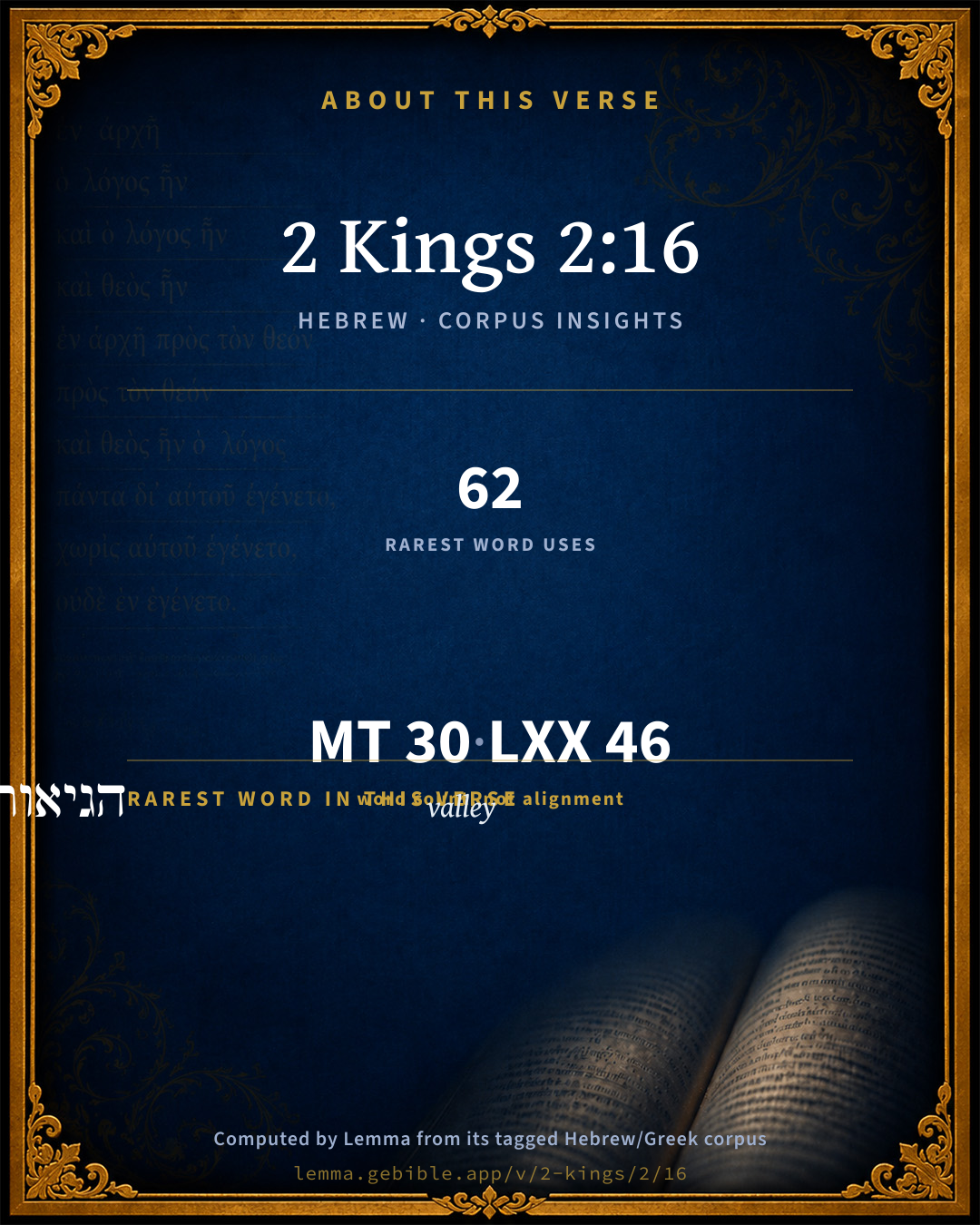
About this verse

These counts appear in no published source. They are computed here, from the morphology-tagged text and Lemma’s own curated glosses. What Lemma adds →

30
words
26
distinct lemmas
Historical
section

Grammatical profile

  • 7 verbs
  • 10 nouns
  • 3 adjectives
  • 2 prepositions
  • 2 conjunctions
  • 6 particles

Verb forms

  • וַיֹּאמְר֣וּ Qal · Sequential Imperfect
  • יֵ֣לְכוּ Qal · Jussive
  • וִיבַקְשׁ֣וּ Piel · Jussive
  • נְשָׂאוֹ֙ Qal · Perfect
  • וַיַּשְׁלִכֵ֨הוּ֙ Hiphil · Sequential Imperfect
  • וַיֹּ֖אמֶר Qal · Sequential Imperfect
  • תִשְׁלָֽחוּ Qal · Imperfect

Repetition

Words recur within this verse — often emphatic in Hebrew:

  • וַיֹּאמְר֣וּ to say H559 ×2
  • נָ֣א please H4994 ×2
  • בְּאַחַ֣ד one H259 ×2
  • הגיאות valley H1516 ×2

Hebrew & Septuagint length

In English translation the verse runs 49 words from the Hebrew and 58 from the Septuagint (LXX English) — closely comparable.

A rough comparison of the two English renderings, which tokenize alike — not a word-level alignment.

Word counts can differ between the Hebrew and the Greek without any difference in meaning — e.g. the Hebrew direct-object marker אֵת has no separate Greek word, and Greek often adds the article ὁ.

In the original languages it is 30 Hebrew tokens and 46 Greek tokens — but the two are counted differently (Hebrew bundles its prefixes and suffixes into one token; the Greek is in lemma form), so that isn’t a like-for-like length.

Cross-references

7

Topical passages linked to 2 Kings 2:16 in the Treasury of Scripture Knowledge — connected by theme and wording, ordered by reader-vote popularity; previews shown in the World English Bible.

  • 1 Kings 18:12 It will happen, as soon as I am gone from you, that the Spirit of Yahweh will carry you I don't know where; and so when I come and tell Ahab, and he can't find you, he will kill me: but I your servant fear Yahweh from my youth.
  • Acts 8:39 When they came up out of the water, the Spirit of the Lord caught Philip away, and the eunuch didn't see him any more, for he went on his way rejoicing.
  • Ezekiel 3:14 So the Spirit lifted me up, and took me away; and I went in bitterness, in the heat of my spirit; and the hand of Yahweh was strong on me.
  • Ezekiel 8:3 He put forth the form of a hand, and took me by a lock of my head; and the Spirit lifted me up between earth and the sky, and brought me in the visions of God to Jerusalem, to the door of the gate of the inner [court] that looks toward the north; where was the seat of the image of jealousy, which provokes to jealousy.
  • Ezekiel 11:24 The Spirit lifted me up, and brought me in the vision by the Spirit of God into Chaldea, to them of the captivity. So the vision that I had seen went up from me.
  • Ezekiel 40:2 In the visions of God brought he me into the land of Israel, and set me down on a very high mountain, whereon was as it were the frame of a city on the south.
  • 2 Corinthians 12:2–3 I know a man in Christ, fourteen years ago (whether in the body, I don't know, or whether out of the body, I don't know; God knows), such a one caught up into the third heaven.

Cross-references courtesy of OpenBible.info (CC BY 4.0).

Hebrew and Greek witnesses Masoretic Hebrew ↔ Greek Septuagint

The same verse in the two great witnesses to the Old Testament, shown verse-for-verse.

These are two independent witnesses, not word-aligned to each other, and the Septuagint is shown in lemma (dictionary) form.

Hebrew 2 Kings 2:16 Masoretic · Westminster Leningrad Codex

וַיֹּאמְר֣וּ אֵלָ֡יו הִנֵּה נָ֣א יֵֽשׁ אֶת עֲבָדֶיךָ֩ חֲמִשִּׁ֨ים אֲנָשִׁ֜ים בְּנֵֽי חַ֗יִל יֵ֣לְכוּ נָא֮ וִיבַקְשׁ֣וּ אֶת אֲדֹנֶיךָ֒ פֶּן נְשָׂאוֹ֙ ר֣וּחַ יְהוָ֔ה וַיַּשְׁלִכֵ֨הוּ֙ בְּאַחַ֣ד הֶהָרִ֔ים א֖וֹ בְּאַחַ֣ת הגיאות הַגֵּאָי֑וֹת וַיֹּ֖אמֶר לֹ֥א תִשְׁלָֽחוּ

They said to him, See now, there are with your servants fifty strong men; let them go, we pray you, and seek your master, lest the Spirit of Yahweh has taken him up, and cast him on some mountain, or into some valley. He said, You shall not send.

World English Bible · Public Domain

Greek LXX 2 Kings 2:16 Septuagint · lemma form

καί εἶπον πρός αὐτός ἰδού δή μετά ὁ παῖς σύ πεντήκοντα ἀνήρ υἱός δύναμις πορεύομαι δή ζητέω ὁ κύριος σύ μήποτε αἴρω αὐτός πνεῦμα κύριος καί ῥίπτω αὐτός ἐν ὁ ἰορδάνης ἤ ἐπί εἷς ὁ ὄρος ἤ ἐπί εἷς ὁ βουνός καί εἶπον ελισαιε οὐ ἀποστέλλω

And they said to him, Behold now, there are with your servants fifty men of strength: let them go now, and seek your lord: perhaps the Spirit of the Lord has taken him up, and cast him into Jordan, or on one of the mountains, or on one of the hills. And Elisaie said, You⌃ shall not send.

LXX2012 (modern English Septuagint) · Public Domain

On this verse, Ellicott's Commentary for English Readers discusses the Septuagint’s reading. Read the note in Commentary ↓

Hebrew: Westminster Leningrad Codex (CC BY 4.0). Greek: Septuagint (public domain); English from LXX2012 (modern English Septuagint) (Public Domain). How the Septuagint differs from the Hebrew →

Targum (Aramaic paraphrase)

1

The Targum is the ancient Jewish Aramaic paraphrase of the Hebrew Scriptures — an interpretive translation, not the Hebrew text itself. Onkelos (literal) and Pseudo-Jonathan (expansive) render the Torah, and Jonathan the Prophets. Coverage is partial: where no permissively-licensed English translation exists for a verse, only the Aramaic is shown. This is verse-level text, not a word-by-word alignment to the Hebrew.

  1. Targum Jonathan Prophets (Joshua–Malachi)
    וַאֲמַרוּ לֵיהּ הָא כְעַן אִית עִם עַבְדָךְ חַמְשִׁין גַבְרִין בְּנֵי חֵילָא יֵיזְלוּן כְּעַן וְיִבְעוּן יַת רִבּוֹנָךְ דִלְמָא נַטְלֵיהּ רוּחַ מִן קֳדָם יְיָ וּרְמָהִי בְּחַד מִן טוּרַיָא אוֹ בְּחַד מִן חֵילַיָא וַאֲמַר לָא תִשְׁלְחוּן:

    (no public-domain English translation for this verse)

    Targum Jonathan — Aramaic: “Mikraot Gedolot” (public domain). English: “Sefaria Community Translation” (CC0 1.0 (public-domain dedication)); “London "Chaldee Paraphrase," 1871” (public domain). Text via Sefaria.

Commentary

Notes on 2 Kings 2:16 from classic Christian and Jewish commentators (each source and its license shown beneath its notes). The classic Christian expositions comment on the surrounding passage and are grouped to its opening verse, so a note may address several verses; the Jewish commentaries on the Tanakh (Rashi and others) are per-verse, so they appear only where the commentator wrote on this verse.

Lemma curates 59 commentaries, every one of them public domain or Creative Commons licensed, each selected and text-cleaned for this edition rather than reprinted as found. About our sources →

Trapp's Complete Commentary

John Trapp

2Ki 2:16 And they said unto him, Behold now, there be with thy servants fifty strong men; let them go, we pray thee, and seek thy master: lest peradventure the Spirit of the LORD hath taken him up, and cast him upon some mountain, or into some valley. And he said, Ye shall not send.

Ver. 16. And they said unto him, Behold now, &c.] They would do nothing without Elisha’s consent, whom now they looked upon as their new master. The Popish padres require blind obedience of their novices; telling them that if an angel or the blessed Virgin were talking with them, and their superior meanwhile call them off, they must presently obey. To argue or debate in their case, they say, were presumption: to require a reason, proud curiosity: to detract or disobey, breach of vow equal to sacrilege. This is the doctrine of Ignatius. But Elisha gave his pupils more liberty: as to propound and press their motion till he was ashamed. {2Ki 2:17}

John Trapp, A Commentary or Exposition upon All the Books of the Old and New Testament (1647–1656) — public domain. Text from a community e-Sword module.

Joseph Benson's Commentary

2Ki 2:16-17. Behold, there be with thy servants fifty strong men — Able to take such a journey. Let them go, we pray thee, and seek thy master — They had received but an imperfect revelation of God’s design, with respect to Elijah, when they asked Elisha if he knew that the Lord would take away his master: for they seem to have supposed that the Spirit of God might have taken him up and cast him, either dead or alive, upon some mountain, or in some valley at a distance; see on 1Ki 18:12; and if alive, they wished to find him, that they might minister to his necessities; and if dead, that they might give his body an honourable burial. And he said, Ye shall not send — For he knew it would be to no purpose. They urged him till he was ashamed — That is, to deny them any longer, lest they should think his denial proceeded from a neglect of his master, or a contempt of them. Or, as the Hebrew, עד בשׁ, gnad bosh, may with equal propriety be rendered, till they were ashamed, namely, because he so often and so obstinately denied their request. And they sought him three days — Searching every place where they thought it likely he might be cast. But found him not — Thus still further evidence was given of his translation, and they, having lost their labour, and tired themselves with their fruitless search, would be more ready to submit to Elisha’s authority, and acquiesce in his judgment another time.

Joseph Benson's Commentary on the Old and New Testaments (1811–1818) — public domain. Text from a community e-Sword module.

The Preacher's Complete Homiletical Commentary

Joseph S. Exell (gen. ed.)

CRITICAL AND EXPLANATORY NOTES.—

2Ki_2:16. Lest peradventure, &c.—They had seen Elijah pass miraculously over Jordan, but did not witness his ascension. Even if he had been taken up to heaven, they imagined that his body would be remaining somewhere on earth.

HOMILETICS OF 2Ki_2:16-18

THE MYSTERIOUSNESS OF THE DIVINE ACTIONS

I. A severe trial of faith. The sons of the prophets were slow to believe that Elijah had so utterly vanished as to return no more. It is true that one moment they saw him in company with Elisha; the next Elisha was alone, and their great leader was nowhere to be seen. Still it might be only another of the many sudden, abrupt disappearances which had marked Elijah’s erratic career. Besides, if the spirit had ascended to heaven, his body might have been dropped on some mountain side, or into the depths of some valley; and this should, if possible, be recovered, and reverently buried. Elisha’s account of the great prophet’s exit only increased the mystery, and they wearied him with speculations and suggestions. Faith must be prepared to take much on trust. Where there is no mystery, there is no faith. “Trials,” says F. W. Robertson, “bring man face to face with God—God and he touch; and the flimsy veil of bright cloud that hung between him and the sky is blown away; he feels that he is standing outside the earth, with nothing between him and the Eternal Infinite.”

II. Provokes diligent inquiry. The commonplaces of to-day were the mysteries of yesterday. The phenomena of nature, which to our fore-fathers were occasions of superstitious dread, are to us familiar friends, and our most valuable servants. Discoveries have been made by the diligent investigator which would have remained unknown secrets, and are secrets still, to the indolent and indifferent. Mystery piques curiosity, and curiosity keeps alive the investigating faculty. The more mystery there is surrounding a subject, the more eager is the earnest student to solve it.

III. Not always fathomed by the most laborious human endeavours. The search of the fifty strong men among the mountains of Gilead was fruitless: they found no trace of the missing Elijah, and they were compelled to accept the testimony of Elisha without further question. Much has been revealed to the diligent seeker after truth, there is much that is yet wrapped in mystery. We cannot know everything about every truth. Revelation is necessarily limited by two things: by the Divine will—there is nothing to impel the Divine Being to reveal Himself beyond what He wills to do—and by our human capacity. However effulgent the revelation on God’s part, its comprehension is necessarily limited on our part. We soon come to the extreme boundary of the known, and vainly we wave our hand in the darkness of the unknown. Much as we may discover by persevering study, more yet remains undiscovered. The pleasures of inquiry and discovery are endless. The investigation of all truth is ennobling, but none more so than the contemplation of those redemptive truths which, like the stars, their fittest emblems, fix the eye above in the very act of vision; a countless procession of brightness and wonder, lights visible to the humblest eye, yet fit to exercise the thoughts of angels: their full grandeur to be approached only when we shall have passed the grave, and, not less than sons of God, shall be free to enter into the mystery and magnificence of heaven.

LESSONS:—

1. The mystery of Divine truth is no sufficient reason for rejecting it.

2. The truth essential to salvation is plainly revealed.

3. More mysteries are solved by faith than by the most daring unbelief.

GERM NOTES ON THE VERSES

2Ki_2:16-18. An obstinate incredulity. I. Is dissatisfied with the most reliable testimony. II. Constructs theories of its own (2Ki_2:16). III. Persists in having its own way, notwithstanding repeated efforts to persuade to the contrary (2Ki_2:17). IV. Suffers ignominious defeat (2Ki_2:18).

—How many, especially young and inexperienced persons, will not be dissuaded from their opinions, views, and doubts, and will not heed the words of their teachers and parents, who have the best intentions towards them, and far more experience. They must become wise by bitter experience, and then hear to their shame, “Did I not say unto you, Go not?”

2Ki_2:18. Some men are best satisfied when they have wearied themselves in their own ways Nothing will teach them wit but disappointment. Their painful error leads them to a right conceit of Elijah’s happier transportation. Those that would find Elijah, let them aspire to the heavenly paradise. Let them follow the high steps of his sincere faithfulness, strong patience, undaunted courage, fervent zeal, and constant obedience. Then God shall send the fiery chariot of death to fetch them up to that heaven of heavens where they shall triumph in everlasting joys.—Bp. Hall.

The Preacher's Complete Homiletical Commentary (gen. ed. Joseph S. Exell; Funk & Wagnalls, c. 1892) — public domain (pre-1929). A full-Bible homiletical/sermon-outline anthology covering 65 of 66 books (2 John is absent from the source module). Text from a community e-Sword module.

Tyndale Open Study Notes

Tyndale Open Resources

2:16-18 The prophets searched the wilderness, perhaps to be certain that Elijah had not temporarily disappeared (cp. 1 Kgs 18:12). Elisha already knew that the search was pointless.

Tyndale Open Study Notes — © Tyndale Open Resources, licensed CC BY-SA 4.0. Text via the HelloAO Bible API.

Geneva Bible (1599)

Geneva Bible translators

Meaning, Elijah: for they thought his body had been cast in some mountain.

Because the fact was extraordinary, they doubted where he was become, but Elisha was assured that he was taken up to God.

Geneva Bible (1599) marginal notes — public domain. Text via Bolls.life.

Jamieson, Fausset & Brown

Robert Jamieson, A. R. Fausset & David Brown

fifty strong men, let them go, we pray thee, and seek thy master--Though the young prophets from Jericho had seen Elijah's miraculous passage of the Jordan, they had not witnessed the ascension. They imagined that he might have been cast by the whirlwind on some mountain or valley; or, if he had actually been admitted into heaven, they expected that his body would still be remaining somewhere on earth. In compliance with their importunity, he gave them permission, but told them what the result would be.

Jamieson, Fausset & Brown — Commentary Critical and Explanatory on the Whole Bible (1871) — public domain (CC PDM 1.0). Text via the HelloAO Bible API.

Adam Clarke's Commentary

Verse 16. Fifty strong men] Probably the same fifty who are mentioned 2Kg 2:7, and who saw Elijah taken up in the whirlwind.

Cast him upon some mountain] Though they saw him taken up towards heaven, yet they thought it possible that the Spirit of the Lord might have descended with him, and left him on some remote mountain or valley.

Ye shall not send.] He knew that he was translated to heaven, and that therefore it would be useless.

Adam Clarke's Commentary on the Bible (1810–1826) — public domain. Text from a community e-Sword/MySword module.

Ellicott's Commentary for English Readers

(16) And they said unto him.—After he had told them of the Assumption of Elijah (Thenius).

Fifty strong men.—See margin. Perhaps these were attendants on the members of the prophetic guild. (Comp. Elisha’s servant Gehazi, and the fifty sons of the prophets, in 2Ki_2:7.) Their being “sons of valour” was important, as the search in the mountains would involve danger.

The Spirit of the Lord hath taken him up.—Comp. 1Ki_18:12; Act_8:39-40. This suggestion of the sons of the prophets is a good comment on 2Ki_2:11-12. It shows that what is there told is certainly not that Elijah ascended a fiery chariot and rode visibly into heaven, as the popular notion is.

Upon some mountain, or into some valley.—Literally, on to one of the mountains, or into one of the valleys, of the land of Gilead. The motive of the disciples was not a desire to pay the last honours to the body of the departed master, as Keil suggests; for they rather expected to find Elijah alive. After the words “cast him,” the LXX. has “into the Jordan,” which may be authentic. In that case, the disciples may have thought the prophet was hidden somewhere among the reeds and rushes of the river bank, in order to escape some threatened danger.

Ye shall not send.—Or, Ye must not, ye should not, or ought not, to send.

A Bible Commentary for English Readers, edited by Charles John Ellicott (1878–1897) — public domain. Text from a community e-Sword module.

The Cambridge Bible for Schools and Colleges

gen. ed. J. J. S. Perowne

16. there be with thy servants fifty strong men] Doubtless some from among the company of the prophets are meant. In chapter 2Ki_4:1-4 they are described as men equal to the labour of telling trees, and doing the work of building. We cannot suppose that in such a society there were many persons retained for the service of the college. As Elisha served Elijah, so they did all that was needful for themselves.

seek thy master] Throughout the narrative there is implied a much closer connexion between Elijah and Elisha than between Elijah and the rest. He is ‘thy master’ not ‘our master’.

the spirit of the Lord hath taken him up] Compare 1Ki_18:12, where Obadiah speaks of the spirit of the Lord carrying Elijah away to some unknown spot. A like expression is found in the introduction to Ezekiel’s vision (Eze_37:1) of the dry bones. ‘The hand of the Lord was upon me and carried me out in the spirit of the Lord.’ The ‘sons of the prophets’ appear to have thought that the body of Elijah might be discovered somewhere, though God had taken away his soul. They had knowledge, as is seen from the previous part of the narrative, that the prophet was to be taken away from life, but seem to have expected his body would be left lifeless near the spot where he was separated from Elisha. It cannot be supposed after what they had before said to Elisha, that the Lord would take away his master from him on that day, that they expected to find Elijah somewhere alive. ‘Could they think that God would send such a chariot and horses, for a less voyage than heaven?’ (Bp Hall).

and cast him] Here the LXX. adds ‘in the Jordan or’, an addition which seems due to a desire to express every possible place into which the body could have been thrown. If it were not on a hill or in a valley, it might perhaps be in the river. The use of the word ‘cast’ seems to indicate that they thought of the body of the prophet as merely the wrapping of that better part which God had taken to Himself, and that the body was of small account when the spirit had been taken from it.

Ye shall not send] There could be no doubt in Elisha’s mind about the taking up of the body of his master. The garment left as a symbol of the granted petition was all that had fallen to the ground. But though he described, as no doubt he did, the glory which he had beheld and the way in which his master was translated, the sons of the prophets could not be moved from their notion that the body of Elijah might somewhere be discovered, and it is easy to understand how they would desire to give it reverent burial, if it were to be found.

The Cambridge Bible for Schools and Colleges (gen. ed. J. J. S. Perowne; Cambridge University Press, 1878–1918) — public domain. Text from a community e-Sword module.

John Gill's Exposition

And when they urged him until he was ashamed,.... To deny them any longer, being so very pressing and importunate:

he said, send; lest they should think he had not the respect for his master he should have had; or was so fond of his office, that he did not choose he should be found alive if he could, and return and reassume it:

they sent therefore fifty men; some one way, and some another:

and they sought three days, but found him not; and then returned.

John Gill's Exposition of the Whole Bible (1746–1763) — public domain (CC PDM 1.0). Text via the HelloAO Bible API.

Albert Barnes' Notes on the Bible

Compare the marginal references. The words “cast him upon some mountain,” rather imply that they expected to find the prophet alive.

Albert Barnes' Notes on the Bible (1834–1885) — public domain. Text from a community e-Sword/MySword module.

Haydock's Catholic Bible Commentary

Valley. It seems such translations were not uncommon, 3 Kings xviii. 12. (Calmet)

George Leo Haydock (1774–1849), Haydock's Catholic Family Bible and Commentary, 1859 edition — public domain. Excludes Psalms (Douay-Rheims chapter numbering differs from Protestant) and Deuterocanonical books (Catholic canon only).

Matthew Poole's English Annotations

Strong men; able to take such a journey. They thought, either,

1. That God had not finally taken him away from them, but only for a time; compare 1Ki 18:12; which they heartily desired, and therefore easily believed; or

2. that God had only taken away his soul, and that his body was cast down into some place, which they desired to seek, that they might give it an honourable burial.

Matthew Poole's English Annotations on the Holy Bible (1683–1685) — public domain. Text from a community e-Sword/MySword module.

Whedon's Commentary on the Bible

Daniel D. Whedon

16. Cast him upon some mountain — The fifty men that stood afar off to view, (2Ki_2:7,) had perhaps seen that Elijah was suddenly snatched away from view, or else Elisha at once told them how his master had departed; but they could not fully believe that he had gone bodily to heaven. Their search to find him, however, was as fruitless and idle as the attempt of some moderns to explain away the idea of a bodily ascension into heaven.

Daniel D. Whedon (gen. ed.), Commentary on the Old and New Testaments (1874–1909) — public domain. Text from a community e-Sword module.

The Pulpit Commentary

And they said unto him. Thenius suggests that Elisha first related to them what had befallen his master; but the impression left by the narrative is rather that they began the conversation, being aware of Elijah"s disappearance, which in that clear atmosphere they may have distinctly perceived, though the ascension may not have been visible to them. Keil thinks that they saw the ascension, but supposed that the body, after being taken up a certain height into the air, would necessarily fall to earth, and that they wished to find it and bury it. But the natural interpretation is that they thought the prophet had been "caught away" by a Divine influence, as Philip the evangelist was in later times, (Act_8:39) and would be found somewhere alive, as Philip "was found at Azotus." Behold now, there be with thy servants fifty strong men; literally, sons of strength; i.e. stout, active persons, capable of climbing the rough and precipitous rocks among which they thought that Elijah might be east. Let them go, we pray thee, and seek thy master: lest peradventure the Spirit of the Lord hath taken him up, and cast him upon some mountain, or into some valley.

On either side of the ciccar, or Jordan plain, are rugged districts, consisting of alternate rocky mountain slopes and narrow gulleys, or water-courses, dry during the greater part of the year. The sons of the prophets think that Elijah has been carried by the Spirit of God into one or other of these mountain tracts, and wish to search them. And he said, Ye shall not send; or, do not send; meaning, "it will be useless you will find nothing it is not as you suppose.

Vers. 16-18.

Seeking the translated.

It is plain from this passage that, while the prophets of Jericho knew from Divine intimations that Elijah was to be parted from them, they did not understand the full meaning of their own revelations. They still clung to the belief that the parting might only be temporary that, as on other occasions, the Spirit of God had caught him up, and carried him away to some place, where, by searching, he might be found (cf. 1Ki_18:10-12) They desired, therefore, permission to send out fifty strong men to look for him among the mountains and valleys. Elisha knew better, but, as they persisted, he allowed them, for the satisfaction of their minds, to send. When they had sought for three days, and found him not, they returned, and Elisha said, "Did I not say unto you, Go not?" One result of the search, in any case, would be to set doubts at rest and confirm Elisha in his position of authority.

I IT IS THE MARK OF A GREAT MIND THAT IT DISTINGUISHES BETWEEN THE TEMPORARY AND ACCIDENTAL, AND THE PERMANENT AND FINAL. In this Elisha"s superiority is seen to the "sons of the prophets." He took in at once the essence of the situation. He know that it was useless to seek further for Elijah that he was parted from them forever. They dwelt on formal resemblances to previous disappearances on the accidents of the event; Elisha penetrated to its real meaning. The same mark of distinction between superior and inferior minds appears in all departments. Paul was a notable example of this power to distinguish between substance and accident-between what was temporary and what was final; while his opponents in the Christian Church exhibited the opposite defect. Apply to creed, ritual, Church-government, etc.

II THIS DEFECT IN INSIGHT OFTEN LEADS TO MUCH NEEDLESS TROUBLE. It caused, in this case, three days of needless search. It is often the occasion of dispute, division, delay in executing reforms, fruitless experiments to attain impossible ends. All are not like the children of Issachar, "men of understanding of the times, to know what Israel ought to do". (1Ch_12:32) Men go about, holding on by, or seeking the revival of, that which has served its day, and is being left behind.

III A CIRCUITOUS WAY OF ATTAINING TO CERTAINTY IS BETTER THAN NO WAY AT ALL. These sons of the prophets satisfied themselves at length, though after much useless trouble. It was welt they did so, since they could not otherwise be assured. There are direct ways to certainty which the better class of minds perceive, but which are like roads shut to others. These must take a more laborious and circuitous route. We see this, e.g., in Christian evidences. The other apostles were satisfied, but Thomas had to put his fingers in the print of the nails, etc. (Joh_20:24-29) The need of bearing with man"s weaknesses and imperfections, and of allowing him to reach conviction by the way he is capable of, explains much that seems circuitous in God"s government of the world. J.O.

The Pulpit Commentary (1880–1919), ed. H.D.M. Spence-Jones & Joseph S. Exell — public domain. Text from a community e-Sword module.

John Wesley's Explanatory Notes

Strong men - Able to take such a journey. Lest, &c. - They thought, either that God had not finally taken him away from them, but only for a time; or that God had only taken away his soul, and that his body was cast down into some place, which they desired to seek, that they might give it an honourable burial.

John Wesley, Explanatory Notes Upon the Whole Bible (1754–1765) — public domain. Text via the GEBible commentary corpus.

Keil & Delitzsch

C. F. Keil & F. Delitzsch

But the disciples of the prophets at Jericho were so unable to realize the fact of Elijah's translation, although it had been previously revealed to them, that they begged permission of Elisha to send out fifty brave men to seek for Elijah. פּן־נשׂאו: whether the Spirit of the Lord has not taken him and cast him upon one of the mountains, or into one of the valleys. פּן with the perfect is used "where there is fear of a fact, which as is conjectured almost with certainty has already happened," like μὴ in the sense of "whether not" (vid., Ewald, 337, b.). יהוה רוּח is not a wind sent by Jehovah (Ges.), but the Spirit of Jehovah, as in Kg1 18:12. The Chethb גּיאות is the regular formation from גּיא or גּיא (Zac 14:4); the Keri with the transposition of א and ,י the later form: גּאיות, Eze 7:16; Eze 31:12, etc. The belief expressed by the disciples of the prophets, that Elijah might have been miraculously carried away, was a popular belief, according to Kg1 18:12, which the disciples of the prophets were probably led to share, more especially in the present case, by the fact that they could not imagine a translation to heaven as a possible thing, and with the indefiniteness of the expression ראשׁך מעל לקח could only understand the divine revelation which they had received as referring to removal by death. So that even if Elisha told them how miraculously Elijah had been taken from him, which he no doubt did, they might still believe that by the appearance in the storm the Lord had taken away His servant from this life, that is to say, had received his soul into heaven, and had left his earthly tabernacle somewhere on the earth, for which they would like to go in search, that they might pay the last honours to their departed master. Elisha yielded to their continued urgency and granted their request; whereupon fifty men sought for three days for Elijah's body, and after three days' vain search returned to Jericho. עד־בּשׁ, to being ashamed, i.e., till he was ashamed to refuse their request any longer (see at Jdg 3:25).

The two following miracles of Elisha (Kg2 2:19-25) were also intended to accredit him in the eyes of the people as a man endowed with the Spirit and power of God, as Elijah had been. Kg2 2:19-22. Elisha makes the water at Jericho wholesome. - During his stay at Jericho (Kg2 2:18) the people of the city complained, that whilst the situation of the place was good in other respects, the water was bad and the land produced miscarriages. הארץ, the land, i.e., the soil, on account of the badness of the water; not "the inhabitants, both man and beast" (Thenius). Elisha then told them to bring a new dish with salt, and poured the salt into the spring with these words: "Thus saith the Lord, I have made this water sound; there will not more be death and miscarriage thence" (משּׁם). משׁלּכת is a substantive here (vid., Ewald, 160, e.). המּים מוצא is no doubt the present spring Ain es Sultn, the only spring near to Jericho, the waters of which spread over the plain of Jericho, thirty-five minutes' distance from the present village and castle, taking its rise in a group of elevations not far from the foot of the mount Quarantana (Kuruntul); a large and beautiful spring, the water of which is neither cold nor warm, and has an agreeable and sweet (according to Steph. Schultz, "somewhat salt") taste. It was formerly enclosed by a kind of reservoir or semicircular wall of hewn stones, from which the water was conducted in different directions to the plain (vid., Rob. Pal. ii. p. 283ff.). With regard to the miracle, a spring which supplied the whole of the city and district with water could not be so greatly improved by pouring in a dish of salt, that the water lost its injurious qualities for ever, even if salt does possess the power of depriving bad water of its unpleasant taste and injurious effects. The use of these natural means does not remove the miracle. Salt, according to its power of preserving from corruption and decomposition, is a symbol of incorruptibility and of the power of life which destroys death (see Bhr, Symbolik, ii. pp. 325,326). As such it formed the earthly substratum for the spiritual power of the divine word, through which the spring was made for ever sound. A new dish was taken for the purpose, not ob munditiem (Seb. Schm.), but as a symbol of the renewing power of the word of God. - But if this miracle was adapted to show to the people the beneficent character of the prophet's ministry, the following occurrence was intended to prove to the despisers of God that the Lord does not allow His servants to be ridiculed with impunity.

Keil & Delitzsch — Biblical Commentary on the Old Testament (1861–1891) — public domain (CC PDM 1.0). Text via the HelloAO Bible API. (Old Testament only.)

Rashi

Rabbi Shlomo Yitzchaki (Rashi)

Perhaps the wind of Adonoy carried him up. Is it possible that yesterday they said to him, “Do you know that today Adonoy is taking your master?” and now they did not know where he was? This teaches [us] that since the day when Eliyahu was hidden, the Holy Spirit departed from the prophets, and the Holy Spirit was no longer widespread throughout Yisroel.

Rashi on the Tanakh — English translations: “The Judaica Press complete Tanach with Rashi, translated by A. J. Rosenberg” (CC BY 4.0); “Pentateuch with Rashi's commentary by M. Rosenbaum and A.M. Silbermann, 1929-1934” (public domain); “The Metsudah Tanach series, Lakewood, N.J” (CC BY 4.0); and “The Book of Joshua, Metsudah Publications, 1997” (CC BY 4.0). Text via Sefaria.

Lesson kit

Teaching starters — assembled from the data on this page, not authored interpretation. Every prompt links to the verse data it draws on. Edit before teaching.

2 Kings, in the Historical, opens this verse with 30 words (26 distinct Hebrew lemmas). Its most distinctive word is gayʼ (“valley”). A historical commentator’s framing appears above. Read the whole chapter for the surrounding context.

Discussion questions

  1. What does “valley” (gayʼ) contribute to the verse as a whole?
  2. How does 1 Kings 18:12, which shares this passage’s theme, read alongside this verse?
  3. What does the repetition of “to say” (2× in this one verse) do in this verse?
  4. These translations render this verse differently; the difference is in the English rendering, not the original. What questions does that raise?
  5. «וַיֹּאמְר֣וּ» is a Qal Sequential Imperfect verb. How does that grammatical form shape the action described?
  6. Compare how Trapp's Complete Commentary and Joseph Benson's Commentary read this verse. Where do they agree or differ?

Things to notice

Reading settings

Reading text

Shown beneath each verse's original-language words.

Old Testament
Old Testament edition

Read the OT as the Masoretic Hebrew (MT) or the Greek Septuagint (LXX).

English shown for the Greek Septuagint (in the Hebrew ↔ Greek comparison).

Comparing translations? Open the Compare panel on any verse page to stack up to four side by side.