
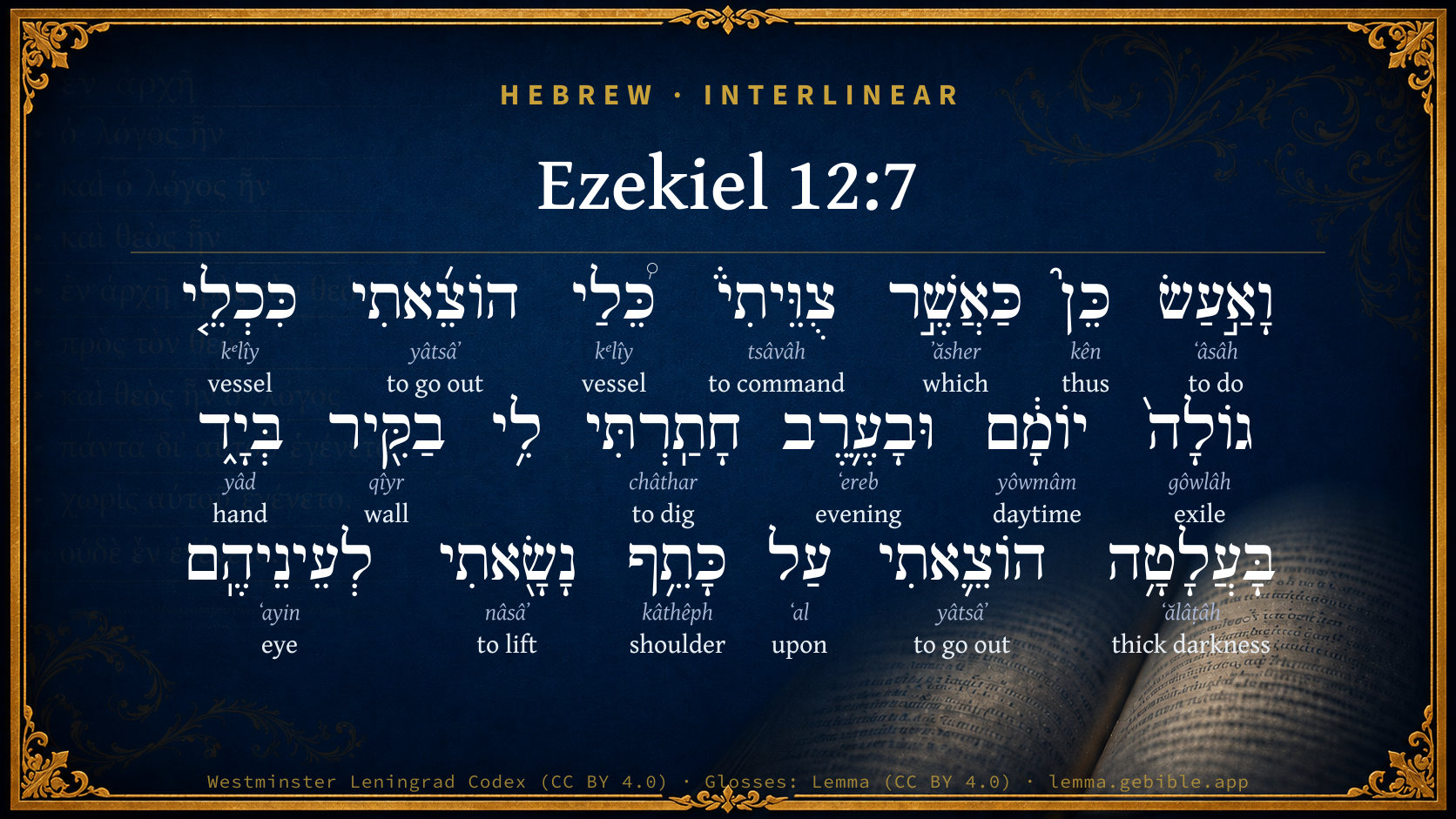
Ezekiel 12:7

Hebrew (Westminster Leningrad Codex) Ezekiel 12:7 appears in the Hebrew Old Testament. The text above is from the Westminster Leningrad Codex. Each word links to its Strong’s number, a concise gloss, and parsing drawn from the Open Scriptures Hebrew Bible morphology. Click any word for its full Brown-Driver-Briggs (BDB) entry.
Download image
Cite this verse

Ezekiel 12:7 (World English Bible). Public Domain. Lemma interlinear Bible study tool, https://lemma.gebible.app/v/ezekiel/12/7.

Show BibTeX & RIS
BibTeX
RIS
English Translation
I did so as I was commanded: I brought forth my stuff by day, as stuff for removing, and in the even I dug through the wall with my hand; I brought it forth in the dark, and bore it on my shoulder in their sight.
World English Bible · Public Domain
Download a study sheet

One document with this verse’s original text, its word-by-word gloss line, the meaning frame, cross-references with their text, attributed commentary, and full source and license credits — printable, and it pastes into notes with its structure intact.

This verse Autodidact and up

Study sheet (.html) Plain text (.txt)

A passage Seminary Student

Up to 50 verses in one chapter. A passage sheet keeps up to 6 commentary sources and 12 cross-references per verse, in the order this page ranks them, and says so on the sheet whenever that leaves anything out. Ask for a single verse and you get the Autodidact verse sheet above.

Everything on this page stays free to read, with no account — the sheet is a download of what is already on screen, not access to it.

Want to remove ads? Support Godless Engineer
Compare translations 3

The same verse in 3 English versions, stacked beneath the original-language interlinear above. Click any original word for its lexicon entry.

Each is an independent rendering of the whole verse — the interlinear is not word-aligned to these translations.

Highlighted words mark where these versions differ — a whole-verse word diff, not a word-by-word alignment.

  • World English Bible Public Domain
    I did so as I was commanded: I brought forth my stuff by day, as stuff for removing, and in the even I dug through the wall with my hand; I brought it forth in the dark, and bore it on my shoulder in their sight.
  • King James Version Public Domain
    And I did so as I was commanded: I brought forth my stuff by day, as stuff for captivity, and in the even I digged through the wall with mine hand; I brought it forth in the twilight, and I bare it upon my shoulder in their sight.
  • unfoldingWord Literal Text CC BY-SA 4.0
    So I did this, just as I was commanded. I brought out my things of exile in the daytime, and in the evening I dug a hole through the wall by hand. I brought my things out in the dark, and lifted them up on my shoulder in their sight.

unfoldingWord Literal Text — © unfoldingWord, licensed CC BY-SA 4.0. Word-aligned USFM3 via Door43 (git.door43.org/unfoldingWord/en_ult).

Versions to compare (up to 4)

3 of 4 selected

Show all 18 translations

Every available English version of this verse, each an independent rendering of the whole verse.

  • World English Bible Public Domain
    I did so as I was commanded: I brought forth my stuff by day, as stuff for removing, and in the even I dug through the wall with my hand; I brought it forth in the dark, and bore it on my shoulder in their sight.
  • Berean Standard Bible Public Domain
    So I did as I was commanded. I brought out my bags for exile by day, and in the evening I dug through the wall by hand. I took my belongings out at dusk, carrying them on my shoulder as they watched.
  • Majority Standard Bible Public Domain
    So I did as I was commanded. I brought out my bags for exile by day, and in the evening I dug through the wall by hand. I took my belongings out at dusk, carrying them on my shoulder as they watched.
  • King James Version Public Domain
    And I did so as I was commanded: I brought forth my stuff by day, as stuff for captivity, and in the even I digged through the wall with mine hand; I brought it forth in the twilight, and I bare it upon my shoulder in their sight.
  • American Standard Version (1901) Public Domain
    And I did so as I was commanded: I brought forth my stuff by day, as stuff for removing, and in the even I digged through the wall with my hand; I brought it forth in the dark, and bare it upon my shoulder in their sight.
  • Revised Version (1885) Public Domain
    And I did so as I was commanded: I brought forth my stuff by day, as stuff for removing, and in the even I digged through the wall with mine hand; I brought it forth in the dark, and bare it upon my shoulder in their sight.
  • Geneva Bible (1599) Public Domain
    And as I was commanded, so I brought forth my stuffe by day, as ye stuffe of one that goeth into captiuitie: and by night I digged through the wall with mine hand, and brought it forth in ye darke, and I bare it vpon my shoulder in their sight.
  • Douay-Rheims (1899) Public Domain
    I did therefore as he had commanded me: I brought forth my goods by day, as the goods of one that removeth: and in the evening I digged through the wall with my hand: and I went forth in the dark, and was carried on men's shoulders in their sight.
  • Young's Literal Translation Public Domain
    And I do so, as I have been commanded; my vessels I have brought forth as vessels of removal by day, and at even I have dug for me through the wall with the hand; in the darkness I have brought forth, on the shoulder I have borne away, before their eyes.
  • Literal Standard Version CC BY-SA 4.0
    And I do so, as I have been commanded; I have brought forth my vessels as vessels of removal by day, and I have dug through the wall with my hand in the evening; I have brought forth in the darkness, I have carried away on the shoulder, before their eyes.
  • Unlocked Literal Bible CC BY-SA 4.0
    So I did this, just as I was commanded. I brought out my things of exile in the daytime, and in the evening I dug a hole through the wall by hand. I brought my things out in the dark, and lifted them up on my shoulder in their sight.
  • unfoldingWord Literal Text CC BY-SA 4.0
    So I did this, just as I was commanded. I brought out my things of exile in the daytime, and in the evening I dug a hole through the wall by hand. I brought my things out in the dark, and lifted them up on my shoulder in their sight.
  • Darby Bible Public Domain
    And I did so as I was commanded: I brought forth my baggage by day, as a captive's baggage, and in the even I digged through the wall with my hand; I brought it forth in the dark, [and] bore it upon [my] shoulder, in their sight.
  • World Messianic Bible Public Domain
    I did so as I was commanded. I brought out my baggage by day, as baggage for moving, and in the evening I dug through the wall with my hand. I brought it out in the dark, and bore it on my shoulder in their sight.
  • Webster's Bible Public Domain
    And I did so as I was commanded: I brought forth my stuff by day, as stuff for captivity, and in the evening I digged through the wall with my hand; I brought it forth in the twilight, and I bore it upon my shoulder in their sight.
  • Free Bible Version CC BY-SA 4.0
    So I did as I was told. I took my bags out to go into exile during the day, and in the evening I knocked down part of the wall of my house with my bare hands. I took my belongings out when it got dark, carrying them on my shoulder while they watched.
  • Bible in Basic English Public Domain
    And I did as I was ordered: I took out my vessels by day, like those of one who is taken away, and in the evening I made a hole through the wall with a tent-pin; and in the dark I went out, taking my things on my back before their eyes.
  • JPS Tanakh (1917) Public Domain
    And I did so as I was commanded: I brought forth my stuff by day, as stuff for exile, and in the even I digged through the wall with my hand; I carried out in the darkness, and bore it upon my shoulder in their sight.

Literal Standard Version (2020), Covenant Press — licensed CC BY-SA 4.0. Text via the HelloAO Bible API (eBible.org). Unlocked Literal Bible (unfoldingWord) — licensed CC BY-SA 4.0. Text via the HelloAO Bible API (eBible.org). unfoldingWord Literal Text — © unfoldingWord, licensed CC BY-SA 4.0. Word-aligned USFM3 via Door43 (git.door43.org/unfoldingWord/en_ult). Free Bible Version, Dr. Jonathan Gallagher — licensed CC BY-SA 4.0. Text via the HelloAO Bible API (eBible.org).

Word by word

More ways to search: Search by grammar → Find every occurrence → Compare this word →

Practice this passage: Drill this verse → Learn its vocabulary →

בָּעֲלָטָ֥ה
ʻălâṭâh
H5939
“in/at the · thick darkness”
Preposition, Determined + Noun, Common, Feminine, Singular, Absolute
Part of Speech
Preposition + Noun
Type
Common
Gender
Feminine
Number
Singular
State
Absolute
Full BDB Definition

Origin: from an unused root meaning to cover

TWOT: 1626

thick darkness
  1. וָאַ֣עַשׂ ʻâsâh H6213 “and · to do” Conjunction + Verb, Qal, Sequential Imperfect, 1st Person, Common, Singular
  2. כֵּן֮ kên H3651 “thus” Particle, Demonstrative
  3. כַּאֲשֶׁ֣ר ʼăsher H834 “like/as · which” Preposition + Particle, Relative
  4. צֻוֵּיתִי֒ tsâvâh H6680 “to command” Verb, Pual, Perfect, 1st Person, Common, Singular
  5. כֵּ֠לַי kᵉlîy H3627 “vessels · my” Noun, Common, Masculine, Plural, Construct + Suffix, Personal, 1st Person, Common, Singular
  6. הוֹצֵ֜אתִי yâtsâʼ H3318 “to go out” Verb, Hiphil, Perfect, 1st Person, Common, Singular
  7. כִּכְלֵ֤י kᵉlîy H3627 “like/as · vessels of” Preposition + Noun, Common, Masculine, Plural, Construct
  8. גוֹלָה֙ gôwlâh H1473 “exile” Noun, Common, Feminine, Singular, Absolute
  9. יוֹמָ֔ם yôwmâm H3119 “daytime” Adverb
  10. וּבָעֶ֛רֶב ʻereb H6153 “and · in/at the · evening” Conjunction + Preposition, Determined + Noun, Common, Masculine, Singular, Absolute
  11. חָתַֽרְתִּי châthar H2864 “to dig” Verb, Qal, Perfect, 1st Person, Common, Singular
  12. בַקִּ֖יר qîyr H7023 “in/at the · wall” Preposition, Determined + Noun, Common, Masculine, Singular, Absolute
  13. בְּיָ֑ד yâd H3027 “in/at · hand” Preposition + Noun, Common, Both, Singular, Absolute
  14. הוֹצֵ֛אתִי yâtsâʼ H3318 “to go out” Verb, Hiphil, Perfect, 1st Person, Common, Singular
  15. עַל ʻal H5921 “upon” Preposition
  16. כָּתֵ֥ף kâthêph H3802 “shoulder” Noun, Common, Feminine, Singular, Absolute
  17. נָשָׂ֖אתִי nâsâʼ H5375 “to lift” Verb, Qal, Perfect, 1st Person, Common, Singular
  18. לְעֵינֵיהֶֽם ʻayin H5869 “to/for · eyes · their” Preposition + Noun, Common, Both, Dual, Construct + Suffix, Personal, 3rd Person, Masculine, Plural

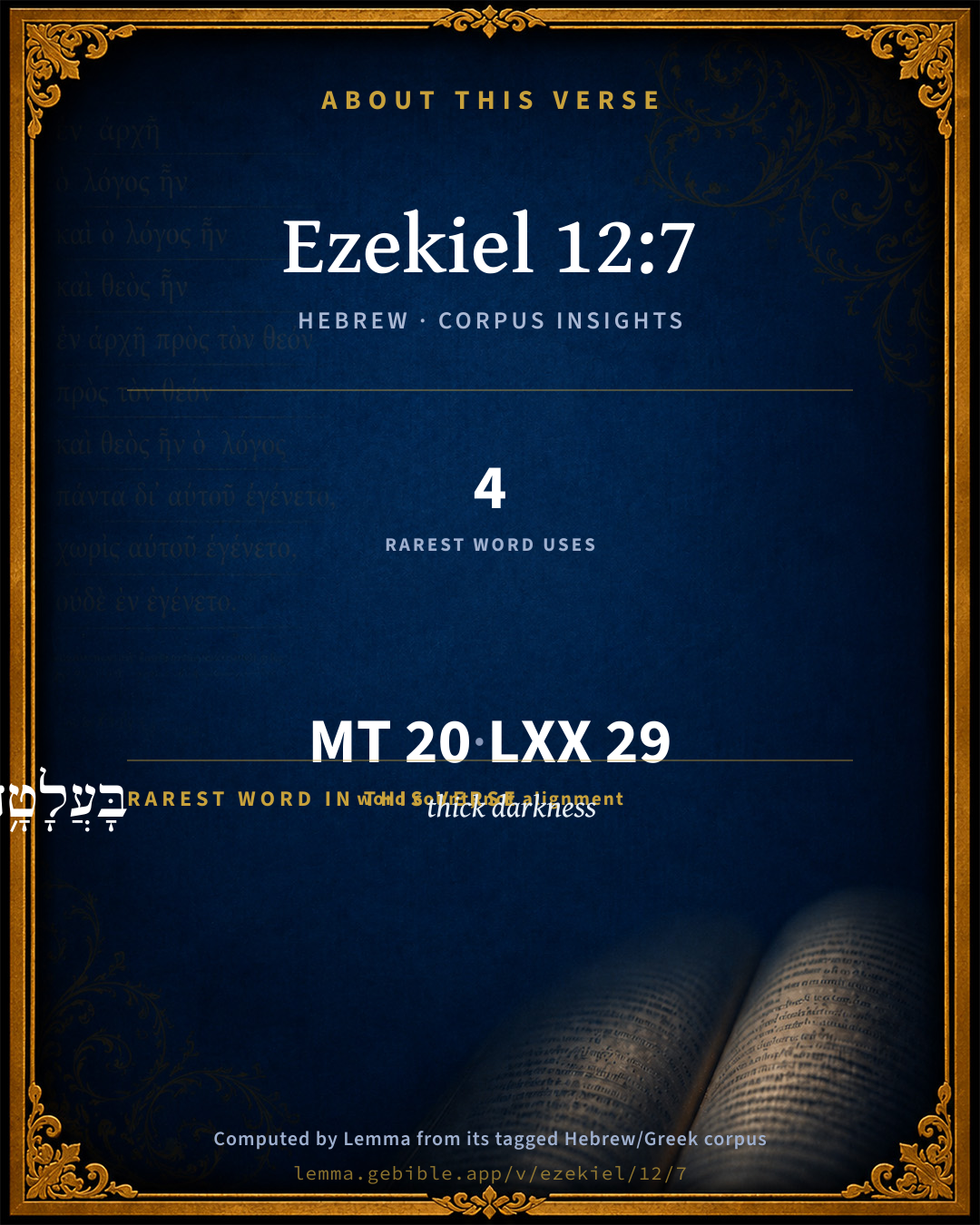
About this verse

These counts appear in no published source. They are computed here, from the morphology-tagged text and Lemma’s own curated glosses. What Lemma adds →

20
words
17
distinct lemmas
Prophets
section

Notable vocabulary

The rarest word here is בָּעֲלָטָ֥ה thick darkness H5939 — appearing just 4 times in the whole Hebrew Bible.

Shared distinctive vocabulary

בָּעֲלָטָ֥ה thick darkness H5939 occurs in 4 verses of the Hebrew Bible. Also found in:

Grammatical profile

  • 6 verbs
  • 9 nouns
  • 2 prepositions
  • 1 adverb
  • 2 particles

Verb forms

  • וָאַ֣עַשׂ Qal · Sequential Imperfect
  • צֻוֵּיתִי֒ Pual · Perfect
  • הוֹצֵ֜אתִי Hiphil · Perfect
  • חָתַֽרְתִּי Qal · Perfect
  • הוֹצֵ֛אתִי Hiphil · Perfect
  • נָשָׂ֖אתִי Qal · Perfect

Repetition

Words recur within this verse — often emphatic in Hebrew:

  • כֵּ֠לַי vessel H3627 ×2
  • הוֹצֵ֜אתִי to go out H3318 ×2

Hebrew & Septuagint length

In English translation the verse runs 46 words from the Hebrew and 45 from the Septuagint (LXX English) — closely comparable.

A rough comparison of the two English renderings, which tokenize alike — not a word-level alignment.

Word counts can differ between the Hebrew and the Greek without any difference in meaning — e.g. the Hebrew direct-object marker אֵת has no separate Greek word, and Greek often adds the article ὁ.

In the original languages it is 20 Hebrew tokens and 29 Greek tokens — but the two are counted differently (Hebrew bundles its prefixes and suffixes into one token; the Greek is in lemma form), so that isn’t a like-for-like length.

Cross-references

11

Topical passages linked to Ezekiel 12:7 in the Treasury of Scripture Knowledge — connected by theme and wording, ordered by reader-vote popularity; previews shown in the World English Bible.

  • Ezekiel 24:18 So I spoke to the people in the morning; and at even my wife died; and I did in the morning as I was commanded.
  • Ezekiel 37:7 So I prophesied as I was commanded: and as I prophesied, there was a noise, and, behold, an earthquake; and the bones came together, bone to its bone.
  • Ezekiel 37:10 So I prophesied as he commanded me, and the breath came into them, and they lived, and stood up on their feet, an exceeding great army.
  • Jeremiah 32:8–12 So Hanamel my uncle's son came to me in the court of the guard according to the word of Yahweh, and said to me, Please buy my field that is in Anathoth, which is in the land of Benjamin; for the right of inheritance is yours, and the redemption is yours; buy it for yourself. Then I knew that this was the word of Yahweh.
  • Ezekiel 2:8 But you, son of man, hear what I tell you; don't be you rebellious like that rebellious house: open your mouth, and eat that which I give you.
  • Ezekiel 12:3 Therefore, you son of man, prepare you stuff for removing, and remove by day in their sight; and you shall remove from your place to another place in their sight: it may be they will consider, though they are a rebellious house.
  • Matthew 21:6–7 The disciples went, and did just as Jesus commanded them,
  • Mark 14:16 His disciples went out, and came into the city, and found things as he had said to them, and they prepared the Passover.
  • John 2:5–8 His mother said to the servants, "Whatever he says to you, do it."
  • John 15:14 You are my friends, if you do whatever I command you.
  • Acts 26:19 "Therefore, King Agrippa, I was not disobedient to the heavenly vision,

Cross-references courtesy of OpenBible.info (CC BY 4.0).

Hebrew and Greek witnesses Masoretic Hebrew ↔ Greek Septuagint

The same verse in the two great witnesses to the Old Testament, shown verse-for-verse.

These are two independent witnesses, not word-aligned to each other, and the Septuagint is shown in lemma (dictionary) form.

Hebrew Ezekiel 12:7 Masoretic · Westminster Leningrad Codex

וָאַ֣עַשׂ כֵּן֮ כַּאֲשֶׁ֣ר צֻוֵּיתִי֒ כֵּ֠לַי הוֹצֵ֜אתִי כִּכְלֵ֤י גוֹלָה֙ יוֹמָ֔ם וּבָעֶ֛רֶב חָתַֽרְתִּי לִ֥י בַקִּ֖יר בְּיָ֑ד בָּעֲלָטָ֥ה הוֹצֵ֛אתִי עַל כָּתֵ֥ף נָשָׂ֖אתִי לְעֵינֵיהֶֽם

I did so as I was commanded: I brought forth my stuff by day, as stuff for removing, and in the even I dug through the wall with my hand; I brought it forth in the dark, and bore it on my shoulder in their sight.

World English Bible · Public Domain

Greek LXX Ezekiel 12:7 Septuagint · lemma form

καί ποιέω οὕτως κατά πᾶς ὅσος ἐντέλλομαι ἐγώ καί σκεῦος ἐκφέρω ὡς σκεῦος αἰχμαλωσία ἡμέρα καί ἑσπέρα διαὀρύσσω ἐμαυτοῦ ὁ τοῖχος καί κρύπτω ἐκἔρχομαι ἐπί ὦμος ἀναλαμβάνω ἐνώπιον αὐτός

And I did thus according to all that he commanded me; and I carried forth my baggage for captivity by day, and in the evening I dug through the wall for myself, and went out secretly; I was taken up on men's shoulders before them.

LXX2012 (modern English Septuagint) · Public Domain

On this verse, The Cambridge Bible for Schools and Colleges discusses the Septuagint’s reading. Read the note in Commentary ↓

Hebrew: Westminster Leningrad Codex (CC BY 4.0). Greek: Septuagint (public domain); English from LXX2012 (modern English Septuagint) (Public Domain). How the Septuagint differs from the Hebrew →

Targum (Aramaic paraphrase)

1

The Targum is the ancient Jewish Aramaic paraphrase of the Hebrew Scriptures — an interpretive translation, not the Hebrew text itself. Onkelos (literal) and Pseudo-Jonathan (expansive) render the Torah, and Jonathan the Prophets. Coverage is partial: where no permissively-licensed English translation exists for a verse, only the Aramaic is shown. This is verse-level text, not a word-by-word alignment to the Hebrew.

  1. Targum Jonathan Prophets (Joshua–Malachi)
    וַעֲבָדִית כֵּן כְּמָא דְאִתְפַקֵדִית מָנֵי אַפְקֵית כְּמָנֵי גָלוּתָא בִּימָם וּבְרַמְשָׁא אִתְחַתְּרֵית לִי בְּכִתְלָא בְּיַד בְּקִבְלָא נַפְקֵית עַל כַּתְפָא נְטָלֵית לְעֵינֵיהוֹן:

    (no public-domain English translation for this verse)

    Targum Jonathan — Aramaic: “Mikraot Gedolot” (public domain). English: “Sefaria Community Translation” (CC0 1.0 (public-domain dedication)); “London "Chaldee Paraphrase," 1871” (public domain). Text via Sefaria.

Commentary

Notes on Ezekiel 12:7 from classic Christian and Jewish commentators (each source and its license shown beneath its notes). The classic Christian expositions comment on the surrounding passage and are grouped to its opening verse, so a note may address several verses; the Jewish commentaries on the Tanakh (Rashi and others) are per-verse, so they appear only where the commentator wrote on this verse.

Lemma curates 59 commentaries, every one of them public domain or Creative Commons licensed, each selected and text-cleaned for this edition rather than reprinted as found. About our sources →

Trapp's Complete Commentary

John Trapp

Eze 12:7 And I did so as I was commanded: I brought forth my stuff by day, as stuff for captivity, and in the even I digged through the wall with mine hand; I brought [it] forth in the twilight, [and] I bare [it] upon [my] shoulder in their sight.

Ver. 7. And [did as I was commanded.] Though well laughed at for my labour by the mad world, ever beside itself in point of salvation, and looking upon God’s Jordans as Naaman did, with Syrian eyes. The outward signs in our sacraments are in themselves mean and ordinary matters; yet the minister is to make use of them, and the people to climb up to heaven by them as ladders of life Hence even in the ancient church liturgy they had their Sursum corda, Lift up your hearts. Rideant athei et ringantur.

John Trapp, A Commentary or Exposition upon All the Books of the Old and New Testament (1647–1656) — public domain. Text from a community e-Sword module.

John Calvin's Commentaries

Here the Prophet relates that he had executed what God had commanded: nor did it escape him that this action would be exposed to many jeers and reproaches. But he esteemed nothing of equal moment with pleasing God: hence we must remark the Prophet’s alacrity in executing God’s commands. For since to ingenuous natures nothing is more distasteful than reproach, he might reject the burden imposed upon him, because it provoked the laughter of all men. But because God was otherwise pleased he did as he was ordered. He says, therefore, that he carried away his vessels, as it were vessels of captivity, or of migration, and that in the day-time: as if he said that he had prepared whatever was necessary for the journey, as if he saw that a long march, even exile was before him. This then was the reason why he prepared his goods in the day-time. Now it follows, at evening he dug through the wall This belongs to the second clause, that the Israelites might understand that all egress was blocked up to the Jews, so that no safety remained but in concealed flight. He says also, by the hand, whence it appears to be done suddenly and tumultuously. He says, that he went out in darkness, and carried things on his shoulder — namely, that he may confirm what we have so often said, that the Jews had no hope of safety except under cover of the night: because they were besieged on every side, and could not move on one side or the other, lest the enemy should seize them. This is the reason why the Prophet says, that he went out in darkness through the wall which had been dug through

John Calvin's Commentaries (1540-1563) — public domain. Text from the Calvin Translation Society English edition (1840s-50s) via the Christian Classics Ethereal Library (ccel.org). Calvin's coverage is partial (roughly two-thirds of the Bible); uncommented books and verses are honest gaps, never fabricated. The 19th-century editor's footnotes and remarks are omitted so the notes are faithfully Calvin's own voice.

The Cambridge Bible for Schools and Colleges

gen. ed. J. J. S. Perowne

7. with mine hand] lit. with hand, i.e. by force, Isa_28:2. LXX. omits.

in the twilight] the darkness, as Eze_12:6, so Eze_12:12.

Eze_12:8-16. Exposition of the symbol.

The action of the prophet is a representation of what shall happen in the last days of the siege. The king and those about him shall prepare for flight; they shall go out secretly through the walls, but shall be captured and brought to Babylon.

The Cambridge Bible for Schools and Colleges (gen. ed. J. J. S. Perowne; Cambridge University Press, 1878–1918) — public domain. Text from a community e-Sword module.

John Gill's Exposition

And in the morning came the word of the Lord unto me, saying. That is, in the morning after he had done all the above things commanded him; explaining the meaning of them, and showing to whom they belonged.

And in the morning came the word of the Lord unto me, saying. That is, in the morning after he had done all the above things commanded him; explaining the meaning of them, and showing to whom they belonged.

Ezekiel 12:9

eze 12:9

eze 12:9

eze 12:9Son of man, hath not the house of Israel, the rebellious house,

said unto thee,.... The Jews that were in captivity; for with these the prophet was, and before their eyes he had done the above things; and they only could put the following question to him, who were "the rebellious house"; Eze 12:2;

what dost thou? this they put not seriously, as desirous of being informed what was meant by all this; but as deriding the prophet for acting such a weak and silly part: this the Lord knew they had done, and therefore directs the prophet to make a proper answer; though some think the sense is, "hath not the house of Israel said unto thee, what dost thou?" no, they have not; they take no notice of it; never say one word about it, or inquire into the meaning of it; quite careless, thoughtless, and stupid; wherefore, though they will not ask anything concerning it, yet begin with them, and show them the design of it.

John Gill's Exposition of the Whole Bible (1746–1763) — public domain (CC PDM 1.0). Text via the HelloAO Bible API.

Albert Barnes' Notes on the Bible

In the evening the prophet was to return to the wall, break through it, and transport the goods from the inside to the outside of the city.

Albert Barnes' Notes on the Bible (1834–1885) — public domain. Text from a community e-Sword/MySword module.

Matthew Poole's English Annotations

Forth; either out of the house into some court or yard, through the wall whereof he digged; or else here is a transposing of his actions, and rehearsal of that in the first place which was acted in the second place.

Digged through the wall: see Eze 12:5.

Matthew Poole's English Annotations on the Holy Bible (1683–1685) — public domain. Text from a community e-Sword/MySword module.

Whedon's Commentary on the Bible

Daniel D. Whedon

7. I did so as I was commanded — Whether Ezekiel actually dug through the walls of Tel-abib or through the walls which surrounded the mimic city prepared within his own house (Eze_4:1) is not said, but the latter is far more probable. It was the tile, and not Tel-abib, which the exiles had learned to think of as the besieged city.

Daniel D. Whedon (gen. ed.), Commentary on the Old and New Testaments (1874–1909) — public domain. Text from a community e-Sword module.

John Wesley's Explanatory Notes

I brought forth - Here is a transposing of his actions, and rehearsal of that in the first place, which was acted in the second place.

John Wesley, Explanatory Notes Upon the Whole Bible (1754–1765) — public domain. Text via the GEBible commentary corpus.

unfoldingWord translationNotes

Door43 World Missions Community

General Information:

Ezekiel shows the people of Israel they will soon be forced into exile.

just as I was commanded

This can be stated in active form. AT: "just as Yahweh commanded me" (See: Active or Passive)

dug a hole through the wall by hand

"dug a hole through the wall with my hands"

in the dark

"at night"

translationWords

command

exile

darkness

unfoldingWord translationNotes — © Distant Shores Media and the Door43 World Missions Community, licensed CC BY-SA 4.0. Source: git.door43.org/Door43/en_tn.

Rashi

Rabbi Shlomo Yitzchaki (Rashi)

I brought out my implements as implements for exile, from day to day Every day, I would show them that I was preparing for myself implements for exile.

Rashi on the Tanakh — English translations: “The Judaica Press complete Tanach with Rashi, translated by A. J. Rosenberg” (CC BY 4.0); “Pentateuch with Rashi's commentary by M. Rosenbaum and A.M. Silbermann, 1929-1934” (public domain); “The Metsudah Tanach series, Lakewood, N.J” (CC BY 4.0); and “The Book of Joshua, Metsudah Publications, 1997” (CC BY 4.0). Text via Sefaria.

Lesson kit

Teaching starters — assembled from the data on this page, not authored interpretation. Every prompt links to the verse data it draws on. Edit before teaching.

Ezekiel, in the Prophets, opens this verse with 20 words (17 distinct Hebrew lemmas). Its most distinctive word is ʻălâṭâh (“thick darkness”). A historical commentator’s framing appears above. Read the whole chapter for the surrounding context.

Discussion questions

  1. How does “thick darkness” (ʻălâṭâh) shape what this verse is saying?
  2. How does Genesis 15:17, which shares the word «thick darkness», read alongside this verse?
  3. What does the repetition of “vessel” (2× in this one verse) do in this verse?
  4. The translations on this page render this verse differently — a whole-verse word diff, not a word-by-word alignment. What might account for the different wordings?
  5. «וָאַ֣עַשׂ» is a Qal Sequential Imperfect verb. How does that grammatical form shape the action described?
  6. Compare how Trapp's Complete Commentary and John Calvin's Commentaries read this verse. Where do they agree or differ?

Things to notice

Reading settings

Reading text

Shown beneath each verse's original-language words.

Old Testament
Old Testament edition

Read the OT as the Masoretic Hebrew (MT) or the Greek Septuagint (LXX).

English shown for the Greek Septuagint (in the Hebrew ↔ Greek comparison).

Comparing translations? Open the Compare panel on any verse page to stack up to four side by side.