
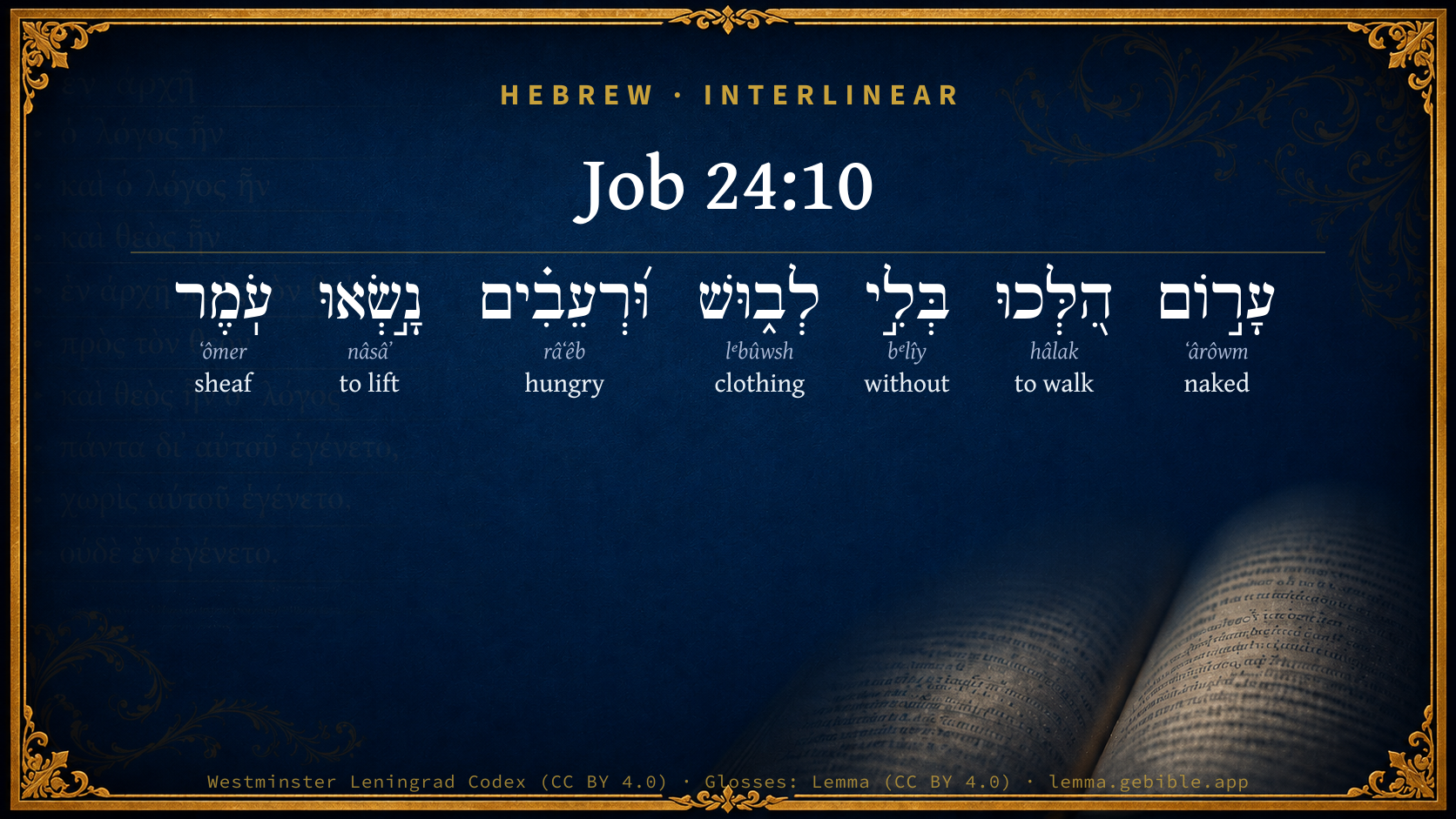
Job 24:10

Hebrew (Westminster Leningrad Codex) Job 24:10 appears in the Hebrew Old Testament. The text above is from the Westminster Leningrad Codex. Each word links to its Strong’s number, a concise gloss, and parsing drawn from the Open Scriptures Hebrew Bible morphology. Click any word for its full Brown-Driver-Briggs (BDB) entry.
Download image
Cite this verse

Job 24:10 (World English Bible). Public Domain. Lemma interlinear Bible study tool, https://lemma.gebible.app/v/job/24/10.

Show BibTeX & RIS
BibTeX
RIS
English Translation
So that they go around naked without clothing. Being hungry, they carry the sheaves.
World English Bible · Public Domain
Download a study sheet

One document with this verse’s original text, its word-by-word gloss line, the meaning frame, cross-references with their text, attributed commentary, and full source and license credits — printable, and it pastes into notes with its structure intact.

This verse Autodidact and up

Study sheet (.html) Plain text (.txt)

A passage Seminary Student

Up to 50 verses in one chapter. A passage sheet keeps up to 6 commentary sources and 12 cross-references per verse, in the order this page ranks them, and says so on the sheet whenever that leaves anything out. Ask for a single verse and you get the Autodidact verse sheet above.

Everything on this page stays free to read, with no account — the sheet is a download of what is already on screen, not access to it.

Want to remove ads? Support Godless Engineer
Compare translations 3

The same verse in 3 English versions, stacked beneath the original-language interlinear above. Click any original word for its lexicon entry.

Each is an independent rendering of the whole verse — the interlinear is not word-aligned to these translations.

Highlighted words mark where these versions differ — a whole-verse word diff, not a word-by-word alignment.

  • World English Bible Public Domain
    So that they go around naked without clothing. Being hungry, they carry the sheaves.
  • King James Version Public Domain
    They cause him to go naked without clothing, and they take away the sheaf from the hungry;
  • unfoldingWord Literal Text CC BY-SA 4.0
    They go about naked, without clothing, and, hungry, they carry a sheaf.

unfoldingWord Literal Text — © unfoldingWord, licensed CC BY-SA 4.0. Word-aligned USFM3 via Door43 (git.door43.org/unfoldingWord/en_ult).

Versions to compare (up to 4)

3 of 4 selected

Show all 18 translations

Every available English version of this verse, each an independent rendering of the whole verse.

  • World English Bible Public Domain
    So that they go around naked without clothing. Being hungry, they carry the sheaves.
  • Berean Standard Bible Public Domain
    Without clothing, they wander about naked. They carry the sheaves, but still go hungry.
  • Majority Standard Bible Public Domain
    Without clothing, they wander about naked. They carry the sheaves, but still go hungry.
  • King James Version Public Domain
    They cause him to go naked without clothing, and they take away the sheaf from the hungry;
  • American Standard Version (1901) Public Domain
    `So that' they go about naked without clothing, And being hungry they carry the sheaves.
  • Revised Version (1885) Public Domain
    So that they go about naked without clothing, and being an-hungred they carry the sheaves;
  • Geneva Bible (1599) Public Domain
    They cause him to go naked without clothing, and take the glening from the hungrie.
  • Douay-Rheims (1899) Public Domain
    From the naked and them that go without clothing, and from the hungry they have taken away the ears of corn.
  • Young's Literal Translation Public Domain
    Naked, they have gone without clothing, And hungry -- have taken away a sheaf.
  • Literal Standard Version CC BY-SA 4.0
    Naked, they have gone without clothing, || And hungry—have taken away a sheaf.
  • Unlocked Literal Bible CC BY-SA 4.0
    But the poor people go about naked without clothing; although they go hungry, they carry bundles of grain belonging to other people.
  • unfoldingWord Literal Text CC BY-SA 4.0
    They go about naked, without clothing, and, hungry, they carry a sheaf.
  • Darby Bible Public Domain
    These go naked without clothing, and, hungry, they bear the sheaf;
  • World Messianic Bible Public Domain
    so that they go around naked without clothing. Being hungry, they carry the sheaves.
  • Webster's Bible Public Domain
    They cause him to go naked without clothing, and they take away the sheaf from the hungry;
  • Free Bible Version CC BY-SA 4.0
    Because they have no clothes to wear they have to go naked, harvesting sheaves of grain while they themselves are hungry.
  • Bible in Basic English Public Domain
    Others go about without clothing, and though they have no food, they get in the grain from the fields.
  • JPS Tanakh (1917) Public Domain
    So that they go about naked without clothing, and being hungry they carry the sheaves;

Literal Standard Version (2020), Covenant Press — licensed CC BY-SA 4.0. Text via the HelloAO Bible API (eBible.org). Unlocked Literal Bible (unfoldingWord) — licensed CC BY-SA 4.0. Text via the HelloAO Bible API (eBible.org). unfoldingWord Literal Text — © unfoldingWord, licensed CC BY-SA 4.0. Word-aligned USFM3 via Door43 (git.door43.org/unfoldingWord/en_ult). Free Bible Version, Dr. Jonathan Gallagher — licensed CC BY-SA 4.0. Text via the HelloAO Bible API (eBible.org).

Word by word

More ways to search: Search by grammar → Find every occurrence → Compare this word →

Practice this passage: Drill this verse → Learn its vocabulary →

About this verse

These counts appear in no published source. They are computed here, from the morphology-tagged text and Lemma’s own curated glosses. What Lemma adds →

7
words
7
distinct lemmas
Wisdom
section

Notable vocabulary

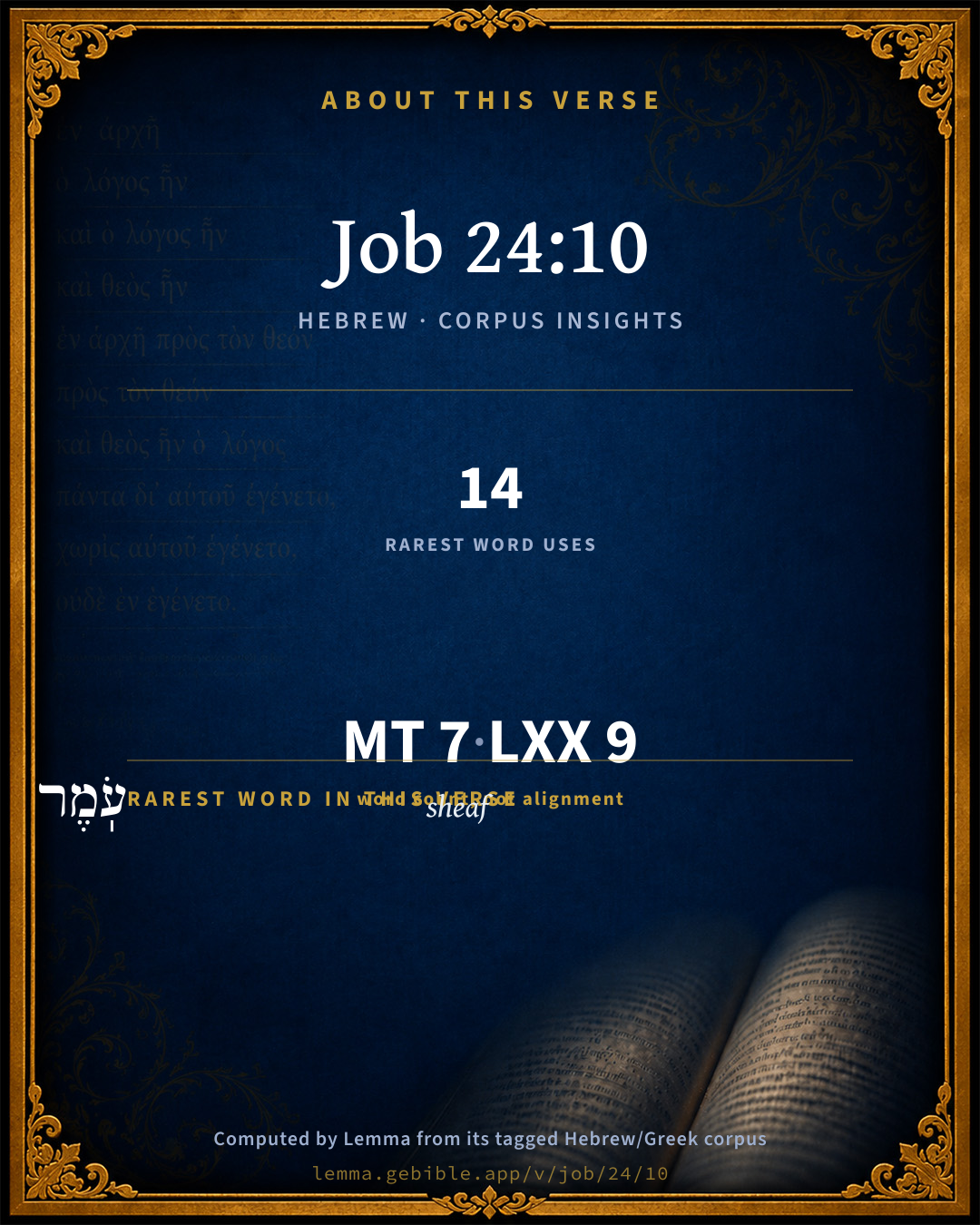
The rarest word here is עֹֽמֶר sheaf H6016 — appearing just 14 times in the whole Hebrew Bible.

Shared distinctive vocabulary

עֹֽמֶר sheaf H6016 occurs in 14 verses of the Hebrew Bible. Also found in:

Grammatical profile

  • 2 verbs
  • 2 nouns
  • 2 adjectives
  • 1 particle

Verb forms

  • הִ֭לְּכוּ Piel · Perfect
  • נָ֣שְׂאוּ Qal · Perfect

Hebrew & Septuagint length

In English translation the verse runs 14 words from the Hebrew and 18 from the Septuagint (LXX English) — closely comparable.

A rough comparison of the two English renderings, which tokenize alike — not a word-level alignment.

Word counts can differ between the Hebrew and the Greek without any difference in meaning — e.g. the Hebrew direct-object marker אֵת has no separate Greek word, and Greek often adds the article ὁ.

In the original languages it is 7 Hebrew tokens and 9 Greek tokens — but the two are counted differently (Hebrew bundles its prefixes and suffixes into one token; the Greek is in lemma form), so that isn’t a like-for-like length.

Cross-references

3

Topical passages linked to Job 24:10 in the Treasury of Scripture Knowledge — connected by theme and wording, ordered by reader-vote popularity; previews shown in the World English Bible.

  • Amos 2:7–8 They trample on the dust of the earth on the head of the poor, And deny justice to the oppressed; And a man and his father use the same maiden, to profane my holy name;
  • Deuteronomy 24:19 When you reap your harvest in your field, and have forgot a sheaf in the field, you shall not go again to get it: it shall be for the foreigner, for the fatherless, and for the widow; that Yahweh your God may bless you in all the work of your hands.
  • Amos 5:11–12 Forasmuch therefore as you trample on the poor, And take taxes from him of wheat: You have built houses of hewn stone, But you will not dwell in them. You have planted pleasant vineyards, But you shall not drink their wine.

Cross-references courtesy of OpenBible.info (CC BY 4.0).

Hebrew and Greek witnesses Masoretic Hebrew ↔ Greek Septuagint

The same verse in the two great witnesses to the Old Testament, shown verse-for-verse.

These are two independent witnesses, not word-aligned to each other, and the Septuagint is shown in lemma (dictionary) form.

Hebrew Job 24:10 Masoretic · Westminster Leningrad Codex

עָר֣וֹם הִ֭לְּכוּ בְּלִ֣י לְב֑וּשׁ וּ֝רְעֵבִ֗ים נָ֣שְׂאוּ עֹֽמֶר

So that they go around naked without clothing. Being hungry, they carry the sheaves.

World English Bible · Public Domain

Greek LXX Job 24:10 Septuagint · lemma form

γυμνός δέ κοιμίζω ἀδίκως πεινάω δέ ὁ ψωμός ἀποαἱρέω

And they have wrongfully caused others to sleep without clothing, and taken away the morsel of the hungry.

LXX2012 (modern English Septuagint) · Public Domain

Hebrew: Westminster Leningrad Codex (CC BY 4.0). Greek: Septuagint (public domain); English from LXX2012 (modern English Septuagint) (Public Domain). How the Septuagint differs from the Hebrew →

Commentary

Notes on Job 24:10 from classic Christian and Jewish commentators (each source and its license shown beneath its notes). The classic Christian expositions comment on the surrounding passage and are grouped to its opening verse, so a note may address several verses; the Jewish commentaries on the Tanakh (Rashi and others) are per-verse, so they appear only where the commentator wrote on this verse.

Lemma curates 59 commentaries, every one of them public domain or Creative Commons licensed, each selected and text-cleaned for this edition rather than reprinted as found. About our sources →

Trapp's Complete Commentary

John Trapp

Job 24:10 They cause [him] to go naked without clothing, and they take away the sheaf [from] the hungry;

Ver. 10. They cause him to go naked without clothing] Naked and barefoot, even with their buttocks uncovered, to their shame and danger, as Isa 20:4. So dealt the Popish bishops with the poor Protestant Albigenses, at the rendition of Carcasson, in France; they let them have their lives upon the condition that both men and women should go thence stark naked; those parts that cannot well be named being laid open to the view of those pope-holy cruciates (Rivet. Jesuit).

And they take away the sheaf from the hungry] Or, the handful; that little that they had leazed; snatching the ears of corn out of their hands, and condemning them, thus denuded and despoiled, to a death which is so much the more cruel as it is tedious and languishing. Some read it thus, And those that carried their sheaves they made to go away hungry; either not feeding or not paying their harvest labourers and other servants. It is noted in history as a cruelty in the Athenians, that they put an engine about their servants’ necks called παυσικοπη, and it reached down to their hands, that they might not so much as lick of the meal when they were sifting it.

John Trapp, A Commentary or Exposition upon All the Books of the Old and New Testament (1647–1656) — public domain. Text from a community e-Sword module.

Jamieson, Fausset & Brown

Robert Jamieson, A. R. Fausset & David Brown

(See on Job 22:6). In Job 24:7 a like sin is alluded to: but there he implies open robbery of garments in the desert; here, the more refined robbery in civilized life, under the name of a "pledge." Having stripped the poor, they make them besides labor in their harvest-fields and do not allow them to satisfy their hunger with any of the very corn which they carry to the heap. Worse treatment than that of the ox, according to Deu 25:4. Translate: "they (the poor laborers) hungering carry the sheaves" [UMBREIT].

Jamieson, Fausset & Brown — Commentary Critical and Explanatory on the Whole Bible (1871) — public domain (CC PDM 1.0). Text via the HelloAO Bible API.

Adam Clarke's Commentary

Verse 10. They cause him to go naked] These cruel, hard-hearted oppressors seize the cloth made for the family wear, or the wool and flax out of which such clothes should be made.

And they take away the sheaf] Seize the grain as soon as it is reaped, that they may pay themselves the exorbitant rent at which they have leased out their land: and thus the sheaf - the thraves and ricks, by which they should have been supported, are taken away from the hungry.

Adam Clarke's Commentary on the Bible (1810–1826) — public domain. Text from a community e-Sword/MySword module.

Ellicott's Commentary for English Readers

(10) They cause him to go naked without clothing.—Rather, they go about, or, so that they go about, naked without clothing (the tautology is expressive in Hebrew, though meaningless in English), and an hungered they carry the sheaves.

A Bible Commentary for English Readers, edited by Charles John Ellicott (1878–1897) — public domain. Text from a community e-Sword module.

The Cambridge Bible for Schools and Colleges

gen. ed. J. J. S. Perowne

10. The verse carries on the idea expressed by “the poor” (Job_24:9)—the poor

Which go naked without clothing;

And hungry they carry sheaves.

The point lies in the antithesis between “hungry” and “carry sheaves”; though labouring amidst the abundant harvest of their masters they are faint with hunger themselves.

The Cambridge Bible for Schools and Colleges (gen. ed. J. J. S. Perowne; Cambridge University Press, 1878–1918) — public domain. Text from a community e-Sword module.

John Gill's Exposition

They cause him to go naked without clothing,.... Having taken his raiment from him for a pledge, or refusing to give him his wages for his work, whereby he might procure clothes to cover him, but that being withheld, is obliged to go naked, or next to it:

and they take away the sheaf from the hungry; the Vulgate Latin version renders it, "ears of corn", such as the poor man plucked as he walked through a corn field, in order to rub them in his hand, and eat of, as the disciples of Christ, with which the Pharisees were offended, Luk 6:1; and which, according to a law in Israel, was allowed to be done, Deu 23:25; but now so severe were these wicked men to these poor persons, that they took away from them such ears of corn: but it is more likely that this sheaf was what the poor had gleaned, and what they had been picking up ear by ear, and had bound up into a sheaf, in order to carry home and beat it out, and then grind the corn of it, and make a loaf of it to satisfy their hunger; but so cruel and hardhearted were these men, that they took it away from them, which they had been all, or the greatest part of the day, picking up; unless it can be thought there was a custom in Job's country, which was afterwards a law among the Jews, that if a sheaf was forgotten by the owner, and left in the field when he gathered in his corn, he was not to go back for it, and fetch it, but leave it to the poor, Deu 24:19; but these men would not suffer them to have it, but took it away from them; or the words may be rendered, as they are by some, "the hungry carry the sheaf" (p) that is, of their rich oppressive masters, who having reaped their fields for them, and bound up the corn in sheaves, carry it home for them; and yet they do not so much as give them food for their labour, or wages to purchase food to satisfy their; hunger, and so dealt with them worse than the oxen were, according to the Jewish law, which were not to be muzzled when they trod out the corn, but might eat of it, Deu 25:4.

(p) "et famelici gestant manipulum", Tigurine version, Mercerus; so Schultens, Michaelis.

John Gill's Exposition of the Whole Bible (1746–1763) — public domain (CC PDM 1.0). Text via the HelloAO Bible API.

Albert Barnes' Notes on the Bible

And they take away the sheaf from the hungry - The meaning of this is, that the hungry are compelled to bear the sheaf for the rich without being allowed to satisfy their hunger from it. Moses commanded that even the ox should not be muzzled that trod out the grain Deu 25:4; but here was more aggravated cruelty than that would be, in compelling men to bear the sheaf of the harvest without allowing them even to satisfy their hunger. This is an instance of the cruelty which Job says was actually practiced on the earth, and yet God did not interpose to punish it.

Albert Barnes' Notes on the Bible (1834–1885) — public domain. Text from a community e-Sword/MySword module.

Haydock's Catholic Bible Commentary

Corn, which they had gleaned for their daily sustenance. Hebrew also, "the poor, perishing through hunger, carry the sheaf" of the rich.

George Leo Haydock (1774–1849), Haydock's Catholic Family Bible and Commentary, 1859 edition — public domain. Excludes Psalms (Douay-Rheims chapter numbering differs from Protestant) and Deuterocanonical books (Catholic canon only).

Matthew Poole's English Annotations

They cause him, the poor oppressed person, to go naked without clothing; leaving him nothing, or next to nothing, to cover him in the day-time, when he should go abroad to his labour to get his living, but cannot for want of clothes to cover his nakedness.

The sheaf from the hungry; that single sheaf which the poor man had got with the sweat of his brows to satisfy his hunger, they inhumanly take away, and add it to their own stores and full barns. Or, they are hungry; or they sent them away hungry; those words being repeated out of the former clause of the verse (as is most usual); which took or carried the sheaf, or their sheaves, i.e. which reaped and gathered in the rich man’s corn, for which they received injuries instead of a just recompence for their labour; and that when God’s liberality, and the bounty of the earth to them, invited and obliged them to kind and generous actions to others.

Matthew Poole's English Annotations on the Holy Bible (1683–1685) — public domain. Text from a community e-Sword/MySword module.

Whedon's Commentary on the Bible

Daniel D. Whedon

10. They cause — הלכוis used, not in a causative but frequentative sense. (Which) go naked without clothing, and hungry they bear the sheaf. God’s care for oxen forbade that they should be muzzled while they trod the corn, Deu_25:4. Man’s cruelty degrades man to a beast of burden, and forbids him to eat of the sheaves he bears.

Daniel D. Whedon (gen. ed.), Commentary on the Old and New Testaments (1874–1909) — public domain. Text from a community e-Sword module.

The Pulpit Commentary

They cause him to go naked without clothing; rather, they go naked without clothing. The effects of the oppression on its victims are now traced. First of all, the poor man, whose only wrap or cloak has been taken in pledge, is com-polled to go naked, or almost naked, both day and night, exposed alike to extremes of heat and cold. Secondly, he is compelled to reap and bind and carry home the sheaves of his oppressor, while he himself is half famished with hunger. The second clause of the verse is wrongly translated in the Authorized Version, where we read, and they take away the sheaf from the hungry; the real meaning being, "and they who are a hungered, carry the sheaves" (compare the Revised Version).

The Pulpit Commentary (1880–1919), ed. H.D.M. Spence-Jones & Joseph S. Exell — public domain. Text from a community e-Sword module.

John Wesley's Explanatory Notes

The sheaf - That single sheaf which the poor man had got with the sweat of his brow to satisfy his hunger.

John Wesley, Explanatory Notes Upon the Whole Bible (1754–1765) — public domain. Text via the GEBible commentary corpus.

Rashi

Rabbi Shlomo Yitzchaki (Rashi)

They made go They made him go without clothing.

and [from] the hungry they carried off the sheaves And from the hungry they took the sheaves of gleaning [which are left for the poor]. It may also be interpreted thus: And those who were carrying the sheaves are hungry, because they were robbed of them and so they remain hungry.

Rashi on the Tanakh — English translations: “The Judaica Press complete Tanach with Rashi, translated by A. J. Rosenberg” (CC BY 4.0); “Pentateuch with Rashi's commentary by M. Rosenbaum and A.M. Silbermann, 1929-1934” (public domain); “The Metsudah Tanach series, Lakewood, N.J” (CC BY 4.0); and “The Book of Joshua, Metsudah Publications, 1997” (CC BY 4.0). Text via Sefaria.

Lesson kit

Teaching starters — assembled from the data on this page, not authored interpretation. Every prompt links to the verse data it draws on. Edit before teaching.

Job, in the Wisdom, opens this verse with 7 words (7 distinct Hebrew lemmas). Its most distinctive word is ʻômer (“sheaf”). A historical commentator’s framing appears above. Read the whole chapter for the surrounding context.

Discussion questions

  1. The word ʻômer carries the sense “sheaf.” How does it shape the verse?
  2. Exodus 16:16 shares the word «sheaf» with this verse. How do the two illuminate each other?
  3. The translations on this page render this verse differently — a whole-verse word diff, not a word-by-word alignment. What might account for the different wordings?
  4. The verb «הִ֭לְּכוּ» is Piel Perfect. How does its form color the action?
  5. Reading how Trapp's Complete Commentary and Jamieson, Fausset & Brown read this verse, where do the two commentators agree and where do they part?

Things to notice

Reading settings

Reading text

Shown beneath each verse's original-language words.

Old Testament
Old Testament edition

Read the OT as the Masoretic Hebrew (MT) or the Greek Septuagint (LXX).

English shown for the Greek Septuagint (in the Hebrew ↔ Greek comparison).

Comparing translations? Open the Compare panel on any verse page to stack up to four side by side.