Ezekiel 36:7

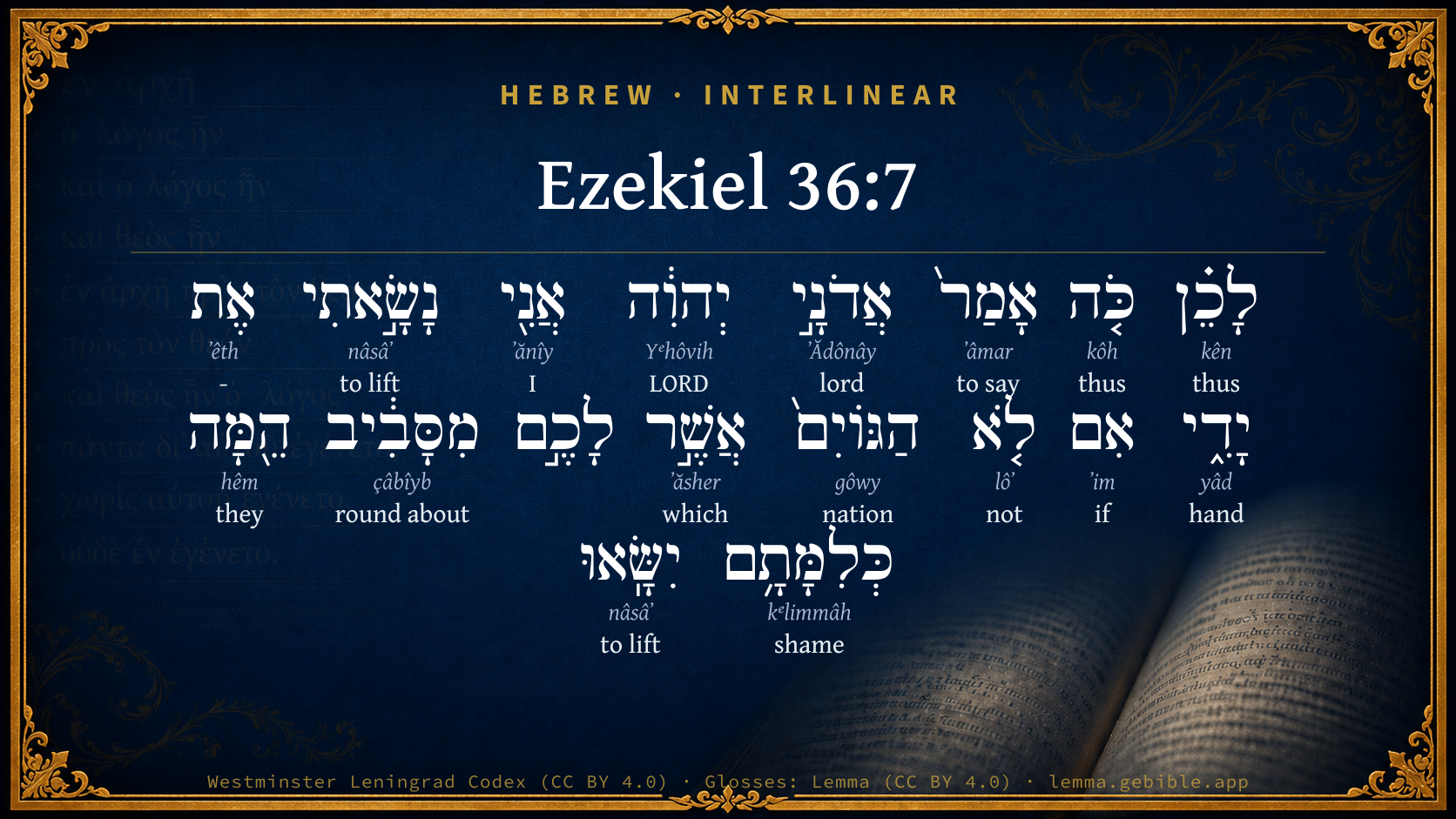
Hebrew (Westminster Leningrad Codex) Ezekiel 36:7 appears in the Hebrew Old Testament. The text above is from the Westminster Leningrad Codex. Each word links to its Strong’s number, a concise gloss, and parsing drawn from the Open Scriptures Hebrew Bible morphology. Click any word for its full Brown-Driver-Briggs (BDB) entry.
Download image
Cite this verse

Ezekiel 36:7 (World English Bible). Public Domain. Lemma interlinear Bible study tool, https://lemma.gebible.app/v/ezekiel/36/7.

Show BibTeX & RIS
BibTeX
RIS
English Translation
therefore thus says the Lord Yahweh: I have sworn, [saying], Surely the nations that are round about you, they shall bear their shame.
World English Bible · Public Domain
Download a study sheet

One document with this verse’s original text, its word-by-word gloss line, the meaning frame, cross-references with their text, attributed commentary, and full source and license credits — printable, and it pastes into notes with its structure intact.

This verse Autodidact and up

Study sheet (.html) Plain text (.txt)

A passage Seminary Student

Up to 50 verses in one chapter. A passage sheet keeps up to 6 commentary sources and 12 cross-references per verse, in the order this page ranks them, and says so on the sheet whenever that leaves anything out. Ask for a single verse and you get the Autodidact verse sheet above.

Everything on this page stays free to read, with no account — the sheet is a download of what is already on screen, not access to it.

Want to remove ads? Support Godless Engineer
Compare translations 3

The same verse in 3 English versions, stacked beneath the original-language interlinear above. Click any original word for its lexicon entry.

Each is an independent rendering of the whole verse — the interlinear is not word-aligned to these translations.

Highlighted words mark where these versions differ — a whole-verse word diff, not a word-by-word alignment.

  • World English Bible Public Domain
    therefore thus says the Lord Yahweh: I have sworn, [saying], Surely the nations that are round about you, they shall bear their shame.
  • King James Version Public Domain
    Therefore thus saith the Lord GOD; I have lifted up mine hand, Surely the heathen that are about you, they shall bear their shame.
  • unfoldingWord Literal Text CC BY-SA 4.0
    Therefore, the Lord Yahweh says this: I myself will lift up my hand to swear that the nations that surround you will certainly carry their own shame.

unfoldingWord Literal Text — © unfoldingWord, licensed CC BY-SA 4.0. Word-aligned USFM3 via Door43 (git.door43.org/unfoldingWord/en_ult).

Versions to compare (up to 4)

3 of 4 selected

Show all 18 translations

Every available English version of this verse, each an independent rendering of the whole verse.

  • World English Bible Public Domain
    therefore thus says the Lord Yahweh: I have sworn, [saying], Surely the nations that are round about you, they shall bear their shame.
  • Berean Standard Bible Public Domain
    Therefore this is what the Lord GOD says: I have sworn with an uplifted hand that surely the nations around you will endure reproach of their own.
  • Majority Standard Bible Public Domain
    Therefore this is what the Lord GOD says: I have sworn with an uplifted hand that surely the nations around you will endure reproach of their own.
  • King James Version Public Domain
    Therefore thus saith the Lord GOD; I have lifted up mine hand, Surely the heathen that are about you, they shall bear their shame.
  • American Standard Version (1901) Public Domain
    therefore thus saith the Lord Jehovah: I have sworn, `saying', Surely the nations that are round about you, they shall bear their shame.
  • Revised Version (1885) Public Domain
    therefore thus saith the Lord GOD: I have lifted up mine hand, saying, Surely the heathen that are round about you, they shall bear their shame.
  • Geneva Bible (1599) Public Domain
    Therefore thus saith the Lord God, I haue lifted vp mine hand, surely the heathen that are about you, shall beare their shame.
  • Douay-Rheims (1899) Public Domain
    Therefore thus saith the Lord God: I have lifted up my hand, that the Gentiles who are round about you, shall themselves bear their shame.
  • Young's Literal Translation Public Domain
    Therefore, thus said the Lord Jehovah: I -- I have lifted up My hand, Do not -- the nations who `are' with you from round about -- they their own shame bear?
  • Literal Standard Version CC BY-SA 4.0
    Therefore, thus said Lord YHWH: I have lifted up My hand, || Do the nations who [are] surrounding you not bear their own shame?
  • Unlocked Literal Bible CC BY-SA 4.0
    Therefore, the Lord Yahweh says this: I myself will lift up my hand to swear that the nations that surround you will certainly carry their own shame.
  • unfoldingWord Literal Text CC BY-SA 4.0
    Therefore, the Lord Yahweh says this: I myself will lift up my hand to swear that the nations that surround you will certainly carry their own shame.
  • Darby Bible Public Domain
    therefore thus saith the Lord Jehovah: I have lifted up my hand, [saying,] Verily the nations that are about you, they shall bear their shame.
  • World Messianic Bible Public Domain
    Therefore the Lord GOD says: “I have sworn, ‘Surely the nations that are around you will bear their shame.’
  • Webster's Bible Public Domain
    Therefore thus saith the Lord GOD; I have lifted up my hand, Surely the heathen that are about you, they shall bear their shame.
  • Free Bible Version CC BY-SA 4.0
    This is what the Lord God says: I hold up my hand and swear that the other nations around you will suffer their own shame.
  • Bible in Basic English Public Domain
    For this cause the Lord has said, See, I have taken an oath that the nations which are round about you are themselves to undergo the shame which they have put on you.
  • JPS Tanakh (1917) Public Domain
    therefore thus saith the Lord GOD: I have lifted up My hand: Surely the nations that are round about you, they shall bear their shame.

Literal Standard Version (2020), Covenant Press — licensed CC BY-SA 4.0. Text via the HelloAO Bible API (eBible.org). Unlocked Literal Bible (unfoldingWord) — licensed CC BY-SA 4.0. Text via the HelloAO Bible API (eBible.org). unfoldingWord Literal Text — © unfoldingWord, licensed CC BY-SA 4.0. Word-aligned USFM3 via Door43 (git.door43.org/unfoldingWord/en_ult). Free Bible Version, Dr. Jonathan Gallagher — licensed CC BY-SA 4.0. Text via the HelloAO Bible API (eBible.org).

Word by word

More ways to search: Search by grammar → Find every occurrence → Compare this word →

Practice this passage: Drill this verse → Learn its vocabulary →

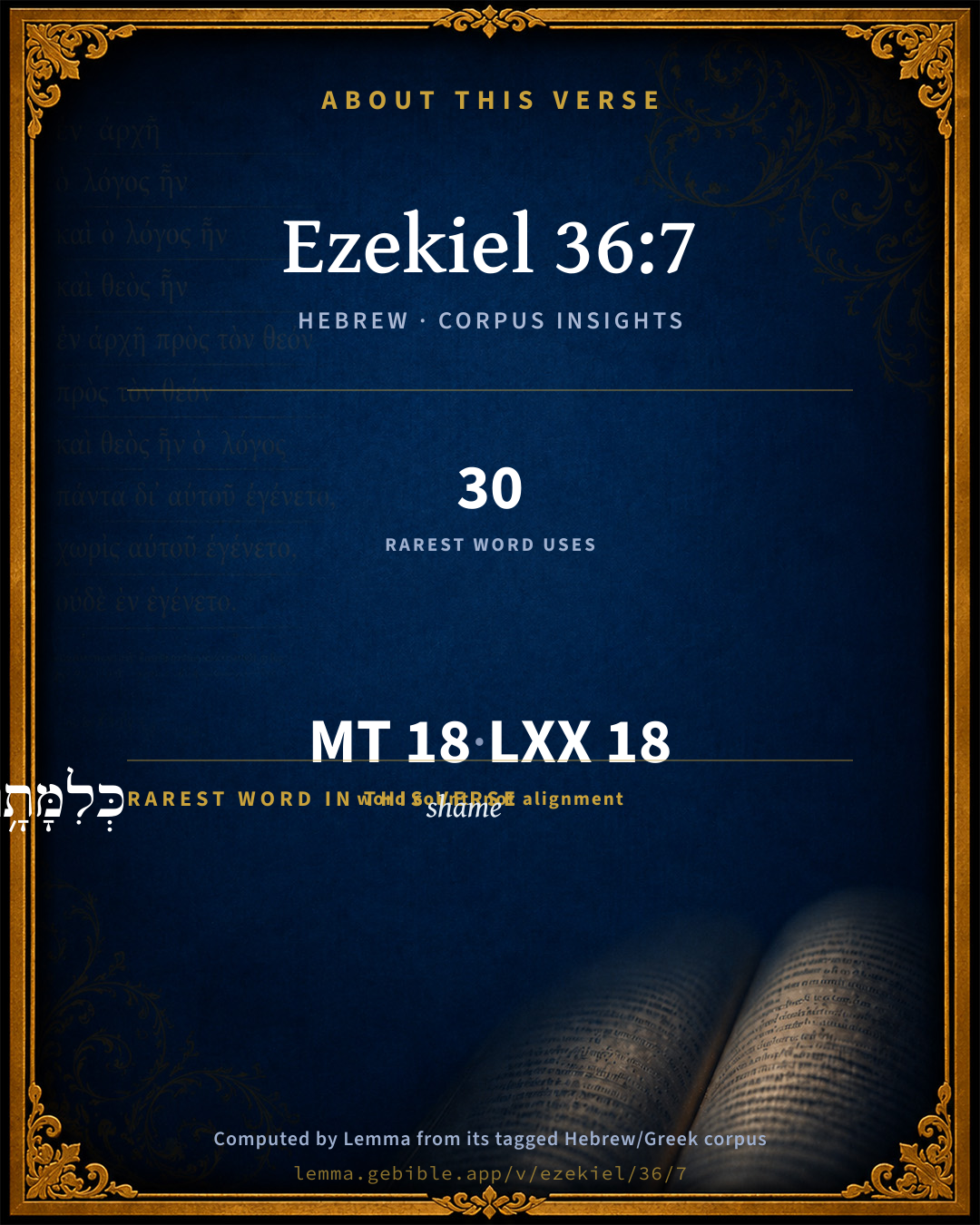
כְּלִמָּתָ֥ם
kᵉlimmâh
H3639
“shame · their”
Noun, Common, Feminine, Singular, Construct + Suffix, Personal, 3rd Person, Masculine, Plural
Part of Speech
Noun
Type
Common
Gender
Feminine
Number
Singular
State
Construct
Full BDB Definition

Origin: from H3637

TWOT: 987a

disgrace, reproach, shame, confusion, dishonour, insult, ignominy - insult, reproach - reproach, ignominy
  1. לָכֵ֗ן kên H3651 “to/for · thus” Preposition + Adverb
  2. כֹּ֤ה kôh H3541 “thus” Adverb
  3. אָמַר֙ ʼâmar H559 “to say” Verb, Qal, Perfect, 3rd Person, Masculine, Singular
  4. אֲדֹנָ֣י ʼĂdônây H136 “Lord · my” Noun, Common, Masculine, Plural, Construct + Suffix, Personal, 1st Person, Common, Singular
  5. יְהוִ֔ה Yᵉhôvih H3069 “LORD” Noun, Proper
  6. אֲנִ֖י ʼănîy H589 “I” Pronoun, Personal, 1st Person, Common, Singular
  7. נָשָׂ֣אתִי nâsâʼ H5375 “to lift” Verb, Qal, Perfect, 1st Person, Common, Singular
  8. אֶת ʼêth H853 “-” Particle, Direct Object
  9. יָדִ֑י yâd H3027 “hand · my” Noun, Common, Both, Singular, Construct + Suffix, Personal, 1st Person, Common, Singular
  10. אִם ʼim H518 “if” Conjunction
  11. לֹ֤א lôʼ H3808 “not” Particle, Negative
  12. הַגּוֹיִם֙ gôwy H1471 “the · nations” Particle, Definite Article + Noun, Common, Masculine, Plural, Absolute
  13. אֲשֶׁ֣ר ʼăsher H834 “which” Particle, Relative
  14. מִסָּבִ֔יב çâbîyb H5439 “from · round about” Preposition + Noun, Common, Both, Singular, Absolute
  15. הֵ֖מָּה hêm H1992 “they” Pronoun, Personal, 3rd Person, Masculine, Plural
  16. יִשָּֽׂאוּ nâsâʼ H5375 “to lift” Verb, Qal, Imperfect, 3rd Person, Masculine, Plural

About this verse

These counts appear in no published source. They are computed here, from the morphology-tagged text and Lemma’s own curated glosses. What Lemma adds →

18
words
16
distinct lemmas
Prophets
section

Shared distinctive vocabulary

כְּלִמָּתָ֥ם shame H3639 occurs in 29 verses of the Hebrew Bible. Also found in:

Grammatical profile

  • 3 verbs
  • 6 nouns
  • 2 pronouns
  • 1 preposition
  • 1 conjunction
  • 2 adverbs
  • 3 particles

Verb forms

  • אָמַר֙ Qal · Perfect
  • נָשָׂ֣אתִי Qal · Perfect
  • יִשָּֽׂאוּ Qal · Imperfect

Repetition

A word recurs within this verse — often emphatic in Hebrew:

  • נָשָׂ֣אתִי to lift H5375 ×2

Hebrew & Septuagint length

In English translation the verse runs 23 words from the Hebrew and 20 from the Septuagint (LXX English) — closely comparable.

A rough comparison of the two English renderings, which tokenize alike — not a word-level alignment.

Word counts can differ between the Hebrew and the Greek without any difference in meaning — e.g. the Hebrew direct-object marker אֵת has no separate Greek word, and Greek often adds the article ὁ.

In the original languages it is 18 Hebrew tokens and 18 Greek tokens — but the two are counted differently (Hebrew bundles its prefixes and suffixes into one token; the Greek is in lemma form), so that isn’t a like-for-like length.

Cross-references

10

Topical passages linked to Ezekiel 36:7 in the Treasury of Scripture Knowledge — connected by theme and wording, ordered by reader-vote popularity; previews shown in the World English Bible.

  • Ezekiel 20:5 and tell them, Thus says the Lord Yahweh: In the day when I chose Israel, and swore to the seed of the house of Jacob, and made myself known to them in the land of Egypt, when I swore to them, saying, I am Yahweh your God;
  • Deuteronomy 32:40 For I lift up my hand to heaven, And say, As I live forever,
  • Jeremiah 25:9 behold, I will send and take all the families of the north, says Yahweh, and [I will send] to Nebuchadrezzar the king of Babylon, my servant, and will bring them against this land, and against the inhabitants of it, and against all these nations round about; and I will utterly destroy them, and make them an astonishment, and a hissing, and perpetual desolations.
  • Jeremiah 25:15–29 For thus says Yahweh, the God of Israel, to me: take this cup of the wine of wrath at my hand, and cause all the nations, to whom I send you, to drink it.
  • Jeremiah 47:1–7 The word of Yahweh that came to Jeremiah the prophet concerning the Philistines, before that Pharaoh struck Gaza.
  • Ezekiel 20:15 Moreover also I swore to them in the wilderness, that I would not bring them into the land which I had given them, flowing with milk and honey, which is the glory of all lands;
  • Ezekiel 25:1–17 The word of Yahweh came to me, saying,
  • Amos 1:1–15 The words of Amos, who was among the herdsmen of Tekoa, which he saw concerning Israel in the days of Uzziah king of Judah, and in the days of Jeroboam the son of Joash king of Israel, two years before the earthquake.
  • Zephaniah 2:1–15 Gather yourselves together, yes, gather together, you nation that has no shame,
  • Revelation 10:5–6 The angel who I saw standing on the sea and on the land lifted up his right hand to the sky,

Cross-references courtesy of OpenBible.info (CC BY 4.0).

Hebrew and Greek witnesses Masoretic Hebrew ↔ Greek Septuagint

The same verse in the two great witnesses to the Old Testament, shown verse-for-verse.

These are two independent witnesses, not word-aligned to each other, and the Septuagint is shown in lemma (dictionary) form.

Hebrew Ezekiel 36:7 Masoretic · Westminster Leningrad Codex

לָכֵ֗ן כֹּ֤ה אָמַר֙ אֲדֹנָ֣י יְהוִ֔ה אֲנִ֖י נָשָׂ֣אתִי אֶת יָדִ֑י אִם לֹ֤א הַגּוֹיִם֙ אֲשֶׁ֣ר לָכֶ֣ם מִסָּבִ֔יב הֵ֖מָּה כְּלִמָּתָ֥ם יִשָּֽׂאוּ

therefore thus says the Lord Yahweh: I have sworn, [saying], Surely the nations that are round about you, they shall bear their shame.

World English Bible · Public Domain

Greek LXX Ezekiel 36:7 Septuagint · lemma form

διά οὗτος ἐγώ αἴρω ὁ χείρ ἐγώ ἐπί ὁ ἔθνος ὁ περικύκλῳ σύ οὗτος ὁ ἀτιμία αὐτός λαμβάνω

therefore I will lift up my hand against the nations that are round about you; they shall bear their reproach.

LXX2012 (modern English Septuagint) · Public Domain

Hebrew: Westminster Leningrad Codex (CC BY 4.0). Greek: Septuagint (public domain); English from LXX2012 (modern English Septuagint) (Public Domain). How the Septuagint differs from the Hebrew →

Targum (Aramaic paraphrase)

1

The Targum is the ancient Jewish Aramaic paraphrase of the Hebrew Scriptures — an interpretive translation, not the Hebrew text itself. Onkelos (literal) and Pseudo-Jonathan (expansive) render the Torah, and Jonathan the Prophets. Coverage is partial: where no permissively-licensed English translation exists for a verse, only the Aramaic is shown. This is verse-level text, not a word-by-word alignment to the Hebrew.

  1. Targum Jonathan Prophets (Joshua–Malachi)
    בְּכֵן כִּדְנַן אֲמַר יְיָ אֱלֹהִים אֲנָא קַיְמֵית בְּמֵימְרִי אִם לָא עַמְמַיָא דִי בָזוּ יַתְכוֹן מִסְחוֹר סְחוֹר אִינוּן אִתְכְּנָעוּתְהוֹן יְקַבְּלוּן:

    (no public-domain English translation for this verse)

    Targum Jonathan — Aramaic: “Mikraot Gedolot” (public domain). English: “Sefaria Community Translation” (CC0 1.0 (public-domain dedication)); “London "Chaldee Paraphrase," 1871” (public domain). Text via Sefaria.

Commentary

Notes on Ezekiel 36:7 from classic Christian and Jewish commentators (each source and its license shown beneath its notes). The classic Christian expositions comment on the surrounding passage and are grouped to its opening verse, so a note may address several verses; the Jewish commentaries on the Tanakh (Rashi and others) are per-verse, so they appear only where the commentator wrote on this verse.

Lemma curates 59 commentaries, every one of them public domain or Creative Commons licensed, each selected and text-cleaned for this edition rather than reprinted as found. About our sources →

Trapp's Complete Commentary

John Trapp

Eze 36:7 Therefore thus saith the Lord GOD; I have lifted up mine hand, Surely the heathen that [are] about you, they shall bear their shame.

Ver. 7. I have lifted up mine hand.] Sworn solemnly. Men, when they swear, do so as taking God to witness. Three fingers they do often lift up, and hold down two, to signify, saith Lavater, that God, who is three in one, hath prepared a place in heaven for such as swear rightly, but will thrust down to hell those that forswear themselves.

They shall bear their shame.] They shall be paid home in their own coin, be overshot in their own bow, be covered with their own confusion.

John Trapp, A Commentary or Exposition upon All the Books of the Old and New Testament (1647–1656) — public domain. Text from a community e-Sword module.

Geneva Bible (1599)

Geneva Bible translators

By making a solemn oath, read Ezek. 20:5.

Geneva Bible (1599) marginal notes — public domain. Text via Bolls.life.

Jamieson, Fausset & Brown

Robert Jamieson, A. R. Fausset & David Brown

lifted . . . mine hand--in token of an oath (Eze 20:5; Gen 14:22).

they shall bear their shame--a perpetual shame; whereas the "shame" which Israel bore from these heathen was only for a time.

Jamieson, Fausset & Brown — Commentary Critical and Explanatory on the Whole Bible (1871) — public domain (CC PDM 1.0). Text via the HelloAO Bible API.

Ellicott's Commentary for English Readers

(7) Lifted up mine hand.—As in Eze_20:6 = “I have sworn.”

Shall bear their shame.—Comp. Eze_36:6. The Israelites have been compelled to bear the reproaches of the heathen, but these now return upon themselves.

A Bible Commentary for English Readers, edited by Charles John Ellicott (1878–1897) — public domain. Text from a community e-Sword module.

The Cambridge Bible for Schools and Colleges

gen. ed. J. J. S. Perowne

7. lifted up mine hand] The gesture of taking an oath, Eze_20:5. Strictly the rendering is I lift up, so I speak, Eze_36:5-6.

bear their shame] As Israel has borne the shame of the reproaches and taunts of the heathen, so they, when their destruction cometh (as it is near), shall bear the shame of it.

The Cambridge Bible for Schools and Colleges (gen. ed. J. J. S. Perowne; Cambridge University Press, 1878–1918) — public domain. Text from a community e-Sword module.

John Gill's Exposition

Therefore thus saith the Lord God,.... This being the case, the people of God being in distress, and under shame and disgrace, and the enemy insulting them, and triumphing over them:

I have lifted up mine hand; solemnly swore; lifting up of the hand being a rite used by men when they swore, Gen 14:22,

surely the Heathen that are about you, they shall bear their shame; the punishment of their shame; that which is justly due to them for reproaching and putting to shame the people of God: or they shall be a laughing stock to others, and be reproached and derided themselves, and so be paid in their own coin; a just retaliation this for their treatment of the Jews.

John Gill's Exposition of the Whole Bible (1746–1763) — public domain (CC PDM 1.0). Text via the HelloAO Bible API.

Albert Barnes' Notes on the Bible

I have lifted up mine hand - i. e., I have sworn. Compare marginal reference.

Their shame - They shall find their taunts come home to themselves.

Albert Barnes' Notes on the Bible (1834–1885) — public domain. Text from a community e-Sword/MySword module.

Matthew Poole's English Annotations

Lifted up mine hand; sworn in my wrath, but in my truth also, Deu 32:40; and when men did swear solemnly, they did heretofore use this rite, Gen 14:22.

The heathen that are about you; Moabites, Ammonites, and Idumeans shall be repaid in their own coin; I will, as sure as I am God, as sure as I can, so surely make them a taunt, a proverb, and a curse among men.

Matthew Poole's English Annotations on the Holy Bible (1683–1685) — public domain. Text from a community e-Sword/MySword module.

John Wesley's Explanatory Notes

Lifted up mine hand - Sworn in my wrath. The heathen - The Moabites, Ammonites, and Idumeans.

John Wesley, Explanatory Notes Upon the Whole Bible (1754–1765) — public domain. Text via the GEBible commentary corpus.

unfoldingWord translationNotes

Door43 World Missions Community

General Information:

This continues Yahweh's message to the mountains of Israel. The message is intended for the people of Israel.

I myself will lift up my hand to swear

Here "lift up my hand" is a symbolic action that shows he will truly do what he has sworn to do. AT: "I solemnly swear" (See: Symbolic Action)

that the nations that surround you will certainly carry their own shame

The people experiencing shame are spoken of as if they will carry their shame. AT: "that people will certainly mock the nations that surround you" (See: Metaphor)

surround you

The word "you" refers to the mountains of Israel.

translationWords

oath

nation

shame

unfoldingWord translationNotes — © Distant Shores Media and the Door43 World Missions Community, licensed CC BY-SA 4.0. Source: git.door43.org/Door43/en_tn.

Lesson kit

Teaching starters — assembled from the data on this page, not authored interpretation. Every prompt links to the verse data it draws on. Edit before teaching.

Ezekiel, in the Prophets, opens this verse with 18 words (16 distinct Hebrew lemmas). Its most distinctive word is kᵉlimmâh (“shame”). A historical commentator’s framing appears above. Read the whole chapter for the surrounding context.

Discussion questions

  1. The word kᵉlimmâh carries the sense “shame.” How does it shape the verse?
  2. How does Job 20:3, which shares the word «shame», read alongside this verse?
  3. What does the repetition of “to lift” (2× in this one verse) do in this verse?
  4. These translations render this verse differently. What is at stake in choosing one wording over another?
  5. «אָמַר֙» is a Qal Perfect verb. How does that grammatical form shape the action described?
  6. Compare how Trapp's Complete Commentary and Geneva Bible (1599) read this verse. Where do they agree or differ?

Things to notice

Reading settings

Reading text

Shown beneath each verse's original-language words.

Old Testament
Old Testament edition

Read the OT as the Masoretic Hebrew (MT) or the Greek Septuagint (LXX).

English shown for the Greek Septuagint (in the Hebrew ↔ Greek comparison).

Comparing translations? Open the Compare panel on any verse page to stack up to four side by side.