
1 Chronicles 11:18

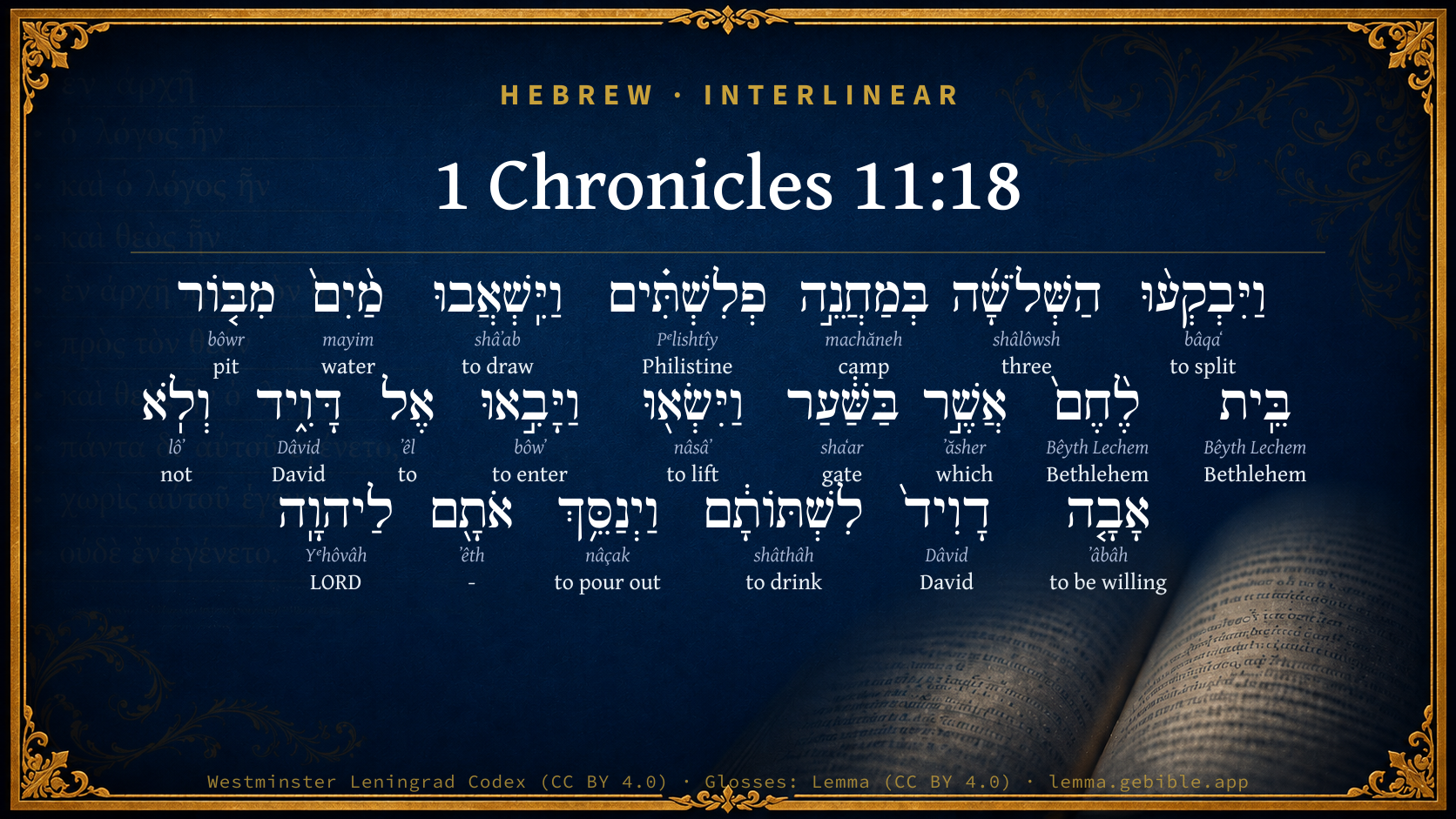
Hebrew (Westminster Leningrad Codex) 1 Chronicles 11:18 appears in the Hebrew Old Testament. The text above is from the Westminster Leningrad Codex. Each word links to its Strong’s number, a concise gloss, and parsing drawn from the Open Scriptures Hebrew Bible morphology. Click any word for its full Brown-Driver-Briggs (BDB) entry.
Download image
Cite this verse

1 Chronicles 11:18 (World English Bible). Public Domain. Lemma interlinear Bible study tool, https://lemma.gebible.app/v/1-chronicles/11/18.

Show BibTeX & RIS
BibTeX
RIS
English Translation
The three broke through the host of the Philistines, and drew water out of the well of Bethlehem, that was by the gate, and took it, and brought it to David: but David would not drink of it, but poured it out to Yahweh,
World English Bible · Public Domain
Download a study sheet

One document with this verse’s original text, its word-by-word gloss line, the meaning frame, cross-references with their text, attributed commentary, and full source and license credits — printable, and it pastes into notes with its structure intact.

This verse Autodidact and up

Study sheet (.html) Plain text (.txt)

A passage Seminary Student

Up to 50 verses in one chapter. A passage sheet keeps up to 6 commentary sources and 12 cross-references per verse, in the order this page ranks them, and says so on the sheet whenever that leaves anything out. Ask for a single verse and you get the Autodidact verse sheet above.

Everything on this page stays free to read, with no account — the sheet is a download of what is already on screen, not access to it.

Want to remove ads? Support Godless Engineer
Compare translations 3

The same verse in 3 English versions, stacked beneath the original-language interlinear above. Click any original word for its lexicon entry.

Each is an independent rendering of the whole verse — the interlinear is not word-aligned to these translations.

Highlighted words mark where these versions differ — a whole-verse word diff, not a word-by-word alignment.

  • World English Bible Public Domain
    The three broke through the host of the Philistines, and drew water out of the well of Bethlehem, that was by the gate, and took it, and brought it to David: but David would not drink of it, but poured it out to Yahweh,
  • King James Version Public Domain
    And the three brake through the host of the Philistines, and drew water out of the well of Bethlehem, that was by the gate, and took it, and brought it to David: but David would not drink of it, but poured it out to the LORD.
  • unfoldingWord Literal Text CC BY-SA 4.0
    And the three broke through the camp of the Philistines, and they drew waters from the well of Bethlehem that at the gate. And they carried away and brought to David. But David was not willing to drink them, and he poured them out to Yahweh.

unfoldingWord Literal Text — © unfoldingWord, licensed CC BY-SA 4.0. Word-aligned USFM3 via Door43 (git.door43.org/unfoldingWord/en_ult).

Versions to compare (up to 4)

3 of 4 selected

Show all 18 translations

Every available English version of this verse, each an independent rendering of the whole verse.

  • World English Bible Public Domain
    The three broke through the host of the Philistines, and drew water out of the well of Bethlehem, that was by the gate, and took it, and brought it to David: but David would not drink of it, but poured it out to Yahweh,
  • Berean Standard Bible Public Domain
    So the Three broke through the Philistine camp, drew water from the well at the gate of Bethlehem, and brought it back to David. But he refused to drink it; instead, he poured it out to the LORD,
  • Majority Standard Bible Public Domain
    So the Three broke through the Philistine camp, drew water from the well at the gate of Bethlehem, and brought it back to David. But he refused to drink it; instead, he poured it out to the LORD,
  • King James Version Public Domain
    And the three brake through the host of the Philistines, and drew water out of the well of Bethlehem, that was by the gate, and took it, and brought it to David: but David would not drink of it, but poured it out to the LORD.
  • American Standard Version (1901) Public Domain
    And the three brake through the host of the Philistines, and drew water out of the well of Beth-lehem, that was by the gate, and took it, and brought it to David: but David would not drink thereof, but poured it out unto Jehovah,
  • Revised Version (1885) Public Domain
    And the three brake through the host of the Philistines, and drew water out of the well of Beth-lehem, that was by the gate, and took it, and brought it to David: but David would not drink thereof, but poured it out unto the LORD,
  • Geneva Bible (1599) Public Domain
    Then these three brake thorowe the hoste of the Philistims, and drewe water out of the well of Beth-lehem that was by the gate, and tooke it and brought it to Dauid: but Dauid would not drinke of it, but powred it for an oblation to the Lord,
  • Douay-Rheims (1899) Public Domain
    And these three broke through the midst of the camp of the Philistines, and drew water out of the cistern of Bethlehem, which was in the gate, and brought it to David to drink: and he would not drink of it, but rather offered it to the Lord,
  • Young's Literal Translation Public Domain
    And the three break through the camp of the Philistines, and draw water from the well of Beth-Lehem, that `is' at the gate, and bear and bring in unto David, and David hath not been willing to drink it, and poureth it out to Jehovah,
  • Literal Standard Version CC BY-SA 4.0
    And the three break through the camp of the Philistines, and draw water from the well of Beth-Lehem that [is] at the gate, and carry and bring [it] to David, and David has not been willing to drink it, and pours it out to YHWH,
  • Unlocked Literal Bible CC BY-SA 4.0
    So these three mighty men broke through the army of the Philistines and drew water out of the well of Bethlehem, the well at the gate. They took the water and brought it to David, but he refused to drink it. Instead, he poured it out to Yahweh.
  • unfoldingWord Literal Text CC BY-SA 4.0
    And the three broke through the camp of the Philistines, and they drew waters from the well of Bethlehem that at the gate. And they carried away and brought to David. But David was not willing to drink them, and he poured them out to Yahweh.
  • Darby Bible Public Domain
    And the three broke through the camp of the Philistines, and drew water out of the well of Bethlehem, which is in the gate, and took it, and brought it to David; David however would not drink of it, but poured it out to Jehovah.
  • World Messianic Bible Public Domain
    The three broke through the army of the Philistines, and drew water out of the well of Bethlehem that was by the gate, took it, and brought it to David; but David would not drink any of it, but poured it out to the LORD,
  • Webster's Bible Public Domain
    And the three broke through the host of the Philistines, and drew water out of the well of Beth-lehem, that was by the gate, and took it, and brought it to David: but David would not drink of it, but poured it out to the LORD,
  • Free Bible Version CC BY-SA 4.0
    The Three broke through the Philistine defenses, took some water from the well at Bethelehem's gate, and brought it back to David. But David refused to drink it, and poured it out as an offering to the Lord.
  • Bible in Basic English Public Domain
    So the three, forcing a way through the Philistine army, got water from the water-hole of Beth-lehem, by the doorway into the town, and took it back to David; but David would not take it, but made an offering of it, draining it out to the Lord,
  • JPS Tanakh (1917) Public Domain
    And the three broke through the host of the Philistines, and drew water out of the well of Beth-lehem, that was by the gate, and took it, and brought it to David; but David would not drink thereof, but poured it out unto the LORD,

Literal Standard Version (2020), Covenant Press — licensed CC BY-SA 4.0. Text via the HelloAO Bible API (eBible.org). Unlocked Literal Bible (unfoldingWord) — licensed CC BY-SA 4.0. Text via the HelloAO Bible API (eBible.org). unfoldingWord Literal Text — © unfoldingWord, licensed CC BY-SA 4.0. Word-aligned USFM3 via Door43 (git.door43.org/unfoldingWord/en_ult). Free Bible Version, Dr. Jonathan Gallagher — licensed CC BY-SA 4.0. Text via the HelloAO Bible API (eBible.org).

Word by word

More ways to search: Search by grammar → Find every occurrence → Compare this word →

Practice this passage: Drill this verse → Learn its vocabulary →

וַיִּֽשְׁאֲבוּ
shâʼab
H7579
“and · to draw”
Conjunction + Verb, Qal, Sequential Imperfect, 3rd Person, Masculine, Plural
Part of Speech
Conjunction + Verb
Stem
Qal
Form
Sequential Imperfect
Person
3rd Person
Gender
Masculine
Number
Plural
Full BDB Definition

Origin: a primitive root

TWOT: 2299 . 1

to draw (water) - (Qal) - to draw (water) - water-drawing women (participle)
  1. וַיִּבְקְע֨וּ bâqaʻ H1234 “and · to split” Conjunction + Verb, Qal, Sequential Imperfect, 3rd Person, Masculine, Plural
  2. הַשְּׁלֹשָׁ֜ה shâlôwsh H7969 “the · three” Particle, Definite Article + Adjective, Cardinal number, Masculine, Singular, Absolute
  3. בְּמַחֲנֵ֣ה machăneh H4264 “in/at · camp of” Preposition + Noun, Common, Both, Singular, Construct
  4. פְלִשְׁתִּ֗ים Pᵉlishtîy H6430 “Philistines” Noun, Gentilic, Masculine, Plural, Absolute
  5. מַ֨יִם֙ mayim H4325 “water(s)” Noun, Common, Masculine, Plural, Absolute
  6. מִבּ֤וֹר bôwr H953 “from · pit of” Preposition + Noun, Common, Masculine, Singular, Construct
  7. בֵּֽית Bêyth Lechem H1035 “Bethlehem” Noun, Proper
  8. לֶ֨חֶם֙ Bêyth Lechem H1035 “Bethlehem” Noun, Proper
  9. אֲשֶׁ֣ר ʼăsher H834 “which” Particle, Relative
  10. בַּשַּׁ֔עַר shaʻar H8179 “in/at the · gate” Preposition, Determined + Noun, Common, Masculine, Singular, Absolute
  11. וַיִּשְׂא֖וּ nâsâʼ H5375 “and · to lift” Conjunction + Verb, Qal, Sequential Imperfect, 3rd Person, Masculine, Plural
  12. וַיָּבִ֣אוּ bôwʼ H935 “and · to enter” Conjunction + Verb, Hiphil, Sequential Imperfect, 3rd Person, Masculine, Plural
  13. אֶל ʼêl H413 “to” Preposition
  14. דָּוִ֑יד Dâvid H1732 “David” Noun, Proper
  15. וְלֹֽא lôʼ H3808 “and · not” Conjunction + Particle, Negative
  16. אָבָ֤ה ʼâbâh H14 “to be willing” Verb, Qal, Perfect, 3rd Person, Masculine, Singular
  17. דָוִיד֙ Dâvid H1732 “David” Noun, Proper
  18. לִשְׁתּוֹתָ֔ם shâthâh H8354 “to drink · them” Preposition + Verb, Qal, Infinitive Construct + Suffix, Personal, 3rd Person, Masculine, Plural
  19. וַיְנַסֵּ֥ךְ nâçak H5258 “and · to pour out” Conjunction + Verb, Piel, Sequential Imperfect, 3rd Person, Masculine, Singular
  20. אֹתָ֖ם ʼêth H853 “- · them” Particle, Direct Object + Suffix, Personal, 3rd Person, Masculine, Plural
  21. לַיהוָֽה Yᵉhôvâh H3068 “to/for · LORD” Preposition + Noun, Proper

About this verse

These counts appear in no published source. They are computed here, from the morphology-tagged text and Lemma’s own curated glosses. What Lemma adds →

22
words
20
distinct lemmas
Historical
section

Notable vocabulary

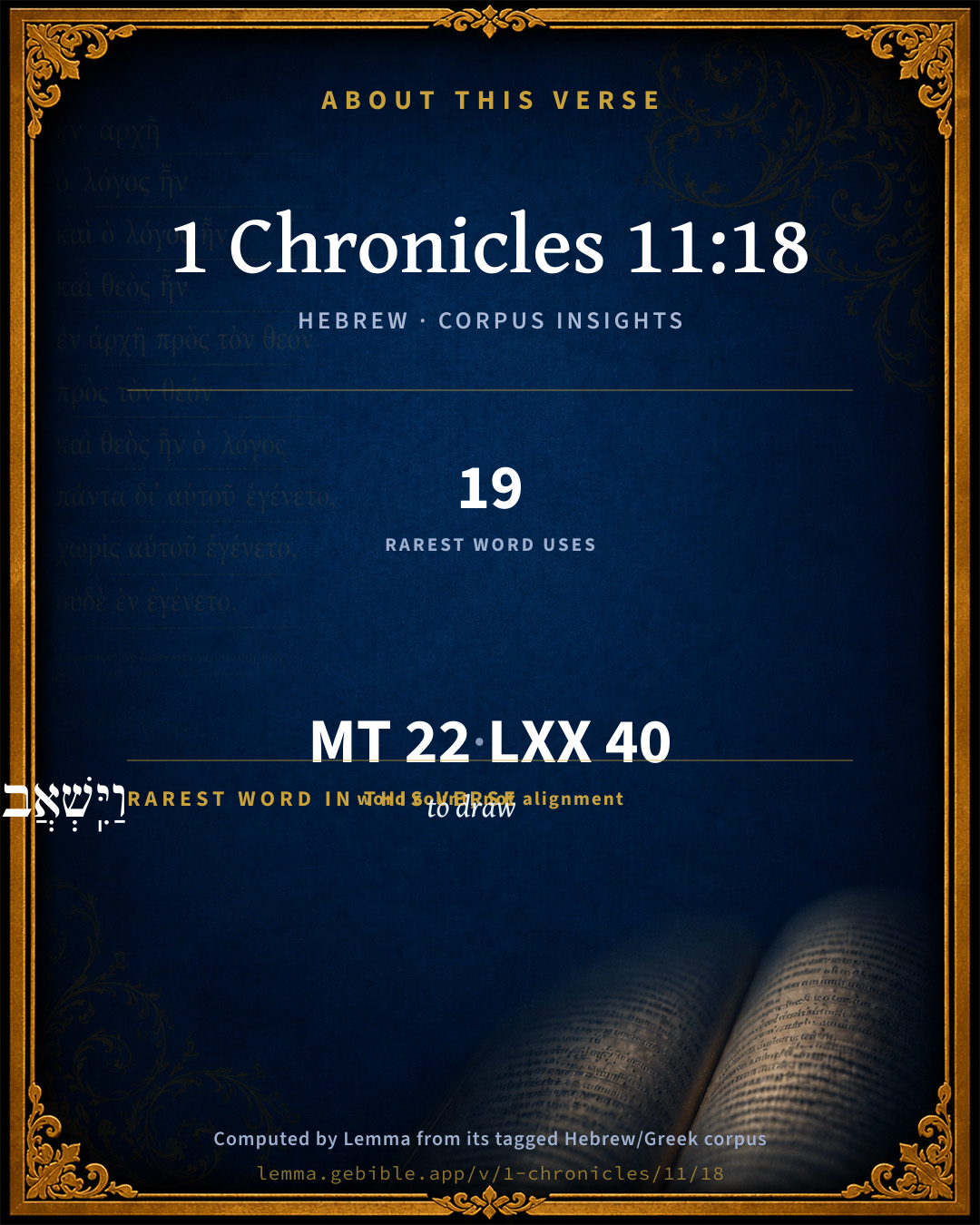
The rarest word here is וַיִּֽשְׁאֲבוּ to draw H7579 — appearing just 19 times in the whole Hebrew Bible.

Shared distinctive vocabulary

וַיִּֽשְׁאֲבוּ to draw H7579 occurs in 18 verses of the Hebrew Bible. Also found in:

Grammatical profile

  • 7 verbs
  • 10 nouns
  • 1 adjective
  • 1 preposition
  • 3 particles

Verb forms

  • וַיִּבְקְע֨וּ Qal · Sequential Imperfect
  • וַיִּֽשְׁאֲבוּ Qal · Sequential Imperfect
  • וַיִּשְׂא֖וּ Qal · Sequential Imperfect
  • וַיָּבִ֣אוּ Hiphil · Sequential Imperfect
  • אָבָ֤ה Qal · Perfect
  • לִשְׁתּוֹתָ֔ם Qal · Infinitive Construct
  • וַיְנַסֵּ֥ךְ Piel · Sequential Imperfect

Repetition

Words recur within this verse — often emphatic in Hebrew:

  • בֵּֽית Bethlehem H1035 ×2
  • דָּוִ֑יד David H1732 ×2

Hebrew & Septuagint length

In English translation the verse runs 44 words from the Hebrew and 50 from the Septuagint (LXX English) — closely comparable.

A rough comparison of the two English renderings, which tokenize alike — not a word-level alignment.

Word counts can differ between the Hebrew and the Greek without any difference in meaning — e.g. the Hebrew direct-object marker אֵת has no separate Greek word, and Greek often adds the article ὁ.

In the original languages it is 22 Hebrew tokens and 40 Greek tokens — but the two are counted differently (Hebrew bundles its prefixes and suffixes into one token; the Greek is in lemma form), so that isn’t a like-for-like length.

Cross-references

6

Topical passages linked to 1 Chronicles 11:18 in the Treasury of Scripture Knowledge — connected by theme and wording, ordered by reader-vote popularity; previews shown in the World English Bible.

  • Acts 21:13 Then Paul answered, "What are you doing, weeping and breaking my heart? For I am ready not only to be bound, but also to die at Jerusalem for the name of the Lord Jesus."
  • 1 Samuel 7:6 They gathered together to Mizpah, and drew water, and poured it out before Yahweh, and fasted on that day, and said there, We have sinned against Yahweh. Samuel judged the children of Israel in Mizpah.
  • 1 Samuel 19:5 for he put his life in his hand, and struck the Philistine, and Yahweh worked a great victory for all Israel: you saw it, and did rejoice; why then will you sin against innocent blood, to kill David without a cause?
  • Song of Solomon 8:6 Set me as a seal on your heart, As a seal on your arm; For love is strong as death. Jealousy is as cruel as Sheol; Its flashes are flashes of fire, A very flame of Yahweh.
  • Acts 20:24 But these things don't count; nor do I hold my life dear to myself, so that I may finish my race with joy, and the ministry which I received from the Lord Jesus, to fully testify to the Gospel of the grace of God.
  • 2 Corinthians 5:14–15 For the love of Christ constrains us; because we judge thus, that one died for all, therefore all died.

Cross-references courtesy of OpenBible.info (CC BY 4.0).

Hebrew and Greek witnesses Masoretic Hebrew ↔ Greek Septuagint

The same verse in the two great witnesses to the Old Testament, shown verse-for-verse.

These are two independent witnesses, not word-aligned to each other, and the Septuagint is shown in lemma (dictionary) form.

Hebrew 1 Chronicles 11:18 Masoretic · Westminster Leningrad Codex

וַיִּבְקְע֨וּ הַשְּׁלֹשָׁ֜ה בְּמַחֲנֵ֣ה פְלִשְׁתִּ֗ים וַיִּֽשְׁאֲבוּ מַ֨יִם֙ מִבּ֤וֹר בֵּֽית לֶ֨חֶם֙ אֲשֶׁ֣ר בַּשַּׁ֔עַר וַיִּשְׂא֖וּ וַיָּבִ֣אוּ אֶל דָּוִ֑יד וְלֹֽא אָבָ֤ה דָוִיד֙ לִשְׁתּוֹתָ֔ם וַיְנַסֵּ֥ךְ אֹתָ֖ם לַיהוָֽה

The three broke through the host of the Philistines, and drew water out of the well of Bethlehem, that was by the gate, and took it, and brought it to David: but David would not drink of it, but poured it out to Yahweh,

World English Bible · Public Domain

Greek LXX 1 Chronicles 11:18 Septuagint · lemma form

καί διαῥήγνυμι ὁ τρεῖς ὁ παρεμβολή ὁ ἀλλόφυλος καί ὑδρεύω ὕδωρ ἐκ ὁ λάκκος ὁ ἐν βαιθλεεμ ὅς εἰμί ἐν ὁ πύλη καί λαμβάνω καί ἔρχομαι πρός δαυίδ καί οὐ θέλω δαυίδ ὁ πίνω αὐτός καί σπένδω αὐτός ὁ κύριος

And the three broke through the camp of the Philistines, and they drew water out of the well that was in Bethleem, which was in the gate, and they took it, and came to David: but David would not drink it, and poured it out to the Lord, and said,

LXX2012 (modern English Septuagint) · Public Domain

Hebrew: Westminster Leningrad Codex (CC BY 4.0). Greek: Septuagint (public domain); English from LXX2012 (modern English Septuagint) (Public Domain). How the Septuagint differs from the Hebrew →

Commentary

Notes on 1 Chronicles 11:18 from classic Christian and Jewish commentators (each source and its license shown beneath its notes). The classic Christian expositions comment on the surrounding passage and are grouped to its opening verse, so a note may address several verses; the Jewish commentaries on the Tanakh (Rashi and others) are per-verse, so they appear only where the commentator wrote on this verse.

Lemma curates 59 commentaries, every one of them public domain or Creative Commons licensed, each selected and text-cleaned for this edition rather than reprinted as found. About our sources →

Trapp's Complete Commentary

John Trapp

1Ch 11:18 And the three brake through the host of the Philistines, and drew water out of the well of Bethlehem, that [was] by the gate, and took [it], and brought [it] to David: but David would not drink [of] it, but poured it out to the LORD,

Ver. 18. But David would not drink of it.] No more would Alexander the Great drink of the water that in a great drought was brought him in the country of the Gedrosi, but poured it out on the ground before his commanders and soldiers, though upon another account than David here did, viz., to stir them up, by his example, to suffer hardship. {a}

But poured it out to the lord.] As a drink offerng, in thankfulness that his captains came off so safe and well.

{a} Arrian, lib. vi.

John Trapp, A Commentary or Exposition upon All the Books of the Old and New Testament (1647–1656) — public domain. Text from a community e-Sword module.

Joseph Benson's Commentary

1Ch 11:18-19. David would not drink of it — That water which he thought too precious for his own drinking, he poured out to the Lord — For a drink-offering. If we have any thing better than other, let God be honoured with it, who is the best, and should have the best. Shall I drink the blood, &c. — It put him into the utmost confusion, to think three brave men should hazard their lives to fetch water for him. In his account it turns the water into blood. It is to the honour of great men, not to be prodigal of the blood of those they employ.

Joseph Benson's Commentary on the Old and New Testaments (1811–1818) — public domain. Text from a community e-Sword module.

Ellicott's Commentary for English Readers

(18) Brake through the host.—Not the main army, but the outpost in front of Bethlehem. There were heroes before Agamemnon, and there was chivalry before the Crusades.

By the gate.—Heb., in.

Poured it out.—As a libation or drink-offering. The technical term is used, as in Gen_35:14. An act of free sacrifice, done under a sudden impulse of thankfulness, and not according to any formal prescription of the Law.

A Bible Commentary for English Readers, edited by Charles John Ellicott (1878–1897) — public domain. Text from a community e-Sword module.

The Cambridge Bible for Schools and Colleges

gen. ed. J. J. S. Perowne

18. brake through the host] The word “host” in the Hebrew means a host encamped, not a host embattled. Perhaps this exploit took place by night; compare the deed of David and Abishai (1Sa_26:6-12).

The Cambridge Bible for Schools and Colleges (gen. ed. J. J. S. Perowne; Cambridge University Press, 1878–1918) — public domain. Text from a community e-Sword module.

Haydock's Catholic Bible Commentary

These. Hebrew, "The three (or perhaps, three of the mighty men) brake through the host of the Philistines....by the gate, and took, and brought it to David. But David would not drink it; and he poured it out unto the Lord," by way of prayer, (Kennicott) or of thanksgiving. (Josephus)

George Leo Haydock (1774–1849), Haydock's Catholic Family Bible and Commentary, 1859 edition — public domain. Excludes Psalms (Douay-Rheims chapter numbering differs from Protestant) and Deuterocanonical books (Catholic canon only).

The Pulpit Commentary

David poured it out to the Lord. This was done after the nature of a libation (1Sa_7:6; Jud_1:6:20; Exo_30:9; Gen_35:14)

The Pulpit Commentary (1880–1919), ed. H.D.M. Spence-Jones & Joseph S. Exell — public domain. Text from a community e-Sword module.

John Wesley's Explanatory Notes

Would not drink of it - That water which he thought too precious for his own drinking, he poured out to the Lord for a drink-offering. If we have any thing better than other, let God be honoured with it, who is the best and should have the best.

John Wesley, Explanatory Notes Upon the Whole Bible (1754–1765) — public domain. Text via the GEBible commentary corpus.

unfoldingWord translationNotes

Door43 World Missions Community

three mighty men

"3 mighty men" (See: Numbers)

broke through the army of the Philistines

"fought their way through the army of the Philistines"

the well of Bethlehem, the well at the gate

These two phrases refer to the same well. The second specifies which well in Bethlehem. See how you translated a similar phrase in 1 Chronicles 11:17. (See: Doublet)

he poured it out to Yahweh

This means that he poured out the water as an offering to Yahweh. (See: Assumed Knowledge and Implicit Information)

May it be that I should never do this!

"May I never do something like this!" or "This is something I should never do!"

Should I drink the blood of these men who have risked their lives?

David speaks of the water as if it were blood because the men risked their lives to bring the water to him. He uses a question to emphasize this. This rhetorical question can be translated as a statement. AT: "I should not drink this water, which would be like drinking the blood of these men who have risked their lives to bring it to me." (See: Metaphor and Rhetorical Question)

translationWords

blood

life

unfoldingWord translationNotes — © Distant Shores Media and the Door43 World Missions Community, licensed CC BY-SA 4.0. Source: git.door43.org/Door43/en_tn.

Rashi

Rabbi Shlomo Yitzchaki (Rashi)

And the three broke through the Philistine camp (In German, durchbrechen die schare)

drew When the Philistines were standing before the cistern, the three mighty men of Israel broke through between them and drew [water] against their will.

and he poured it out as a libation to the Lord Bar Kappara says: It was the festival of Succoth, and he poured them [the waters] out for a libation on the altar.

Rashi on the Tanakh — English translations: “The Judaica Press complete Tanach with Rashi, translated by A. J. Rosenberg” (CC BY 4.0); “Pentateuch with Rashi's commentary by M. Rosenbaum and A.M. Silbermann, 1929-1934” (public domain); “The Metsudah Tanach series, Lakewood, N.J” (CC BY 4.0); and “The Book of Joshua, Metsudah Publications, 1997” (CC BY 4.0). Text via Sefaria.

Lesson kit

Teaching starters — assembled from the data on this page, not authored interpretation. Every prompt links to the verse data it draws on. Edit before teaching.

1 Chronicles, in the Historical, opens this verse with 22 words (20 distinct Hebrew lemmas). Its most distinctive word is shâʼab (“to draw”). A historical commentator’s framing appears above. Read the whole chapter for the surrounding context.

Discussion questions

  1. What does “to draw” (shâʼab) contribute to the verse as a whole?
  2. Genesis 24:11 shares the word «to draw» with this verse. How do the two illuminate each other?
  3. “Bethlehem” occurs 2× in this one verse. What is the effect of the repetition?
  4. The translations on this page render this verse differently — a whole-verse word diff, not a word-by-word alignment. What might account for the different wordings?
  5. The verb «וַיִּבְקְע֨וּ» is Qal Sequential Imperfect. How does its form color the action?
  6. Reading how Trapp's Complete Commentary and Joseph Benson's Commentary read this verse, where do the two commentators agree and where do they part?

Things to notice

Reading settings

Reading text

Shown beneath each verse's original-language words.

Old Testament
Old Testament edition

Read the OT as the Masoretic Hebrew (MT) or the Greek Septuagint (LXX).

English shown for the Greek Septuagint (in the Hebrew ↔ Greek comparison).

Comparing translations? Open the Compare panel on any verse page to stack up to four side by side.