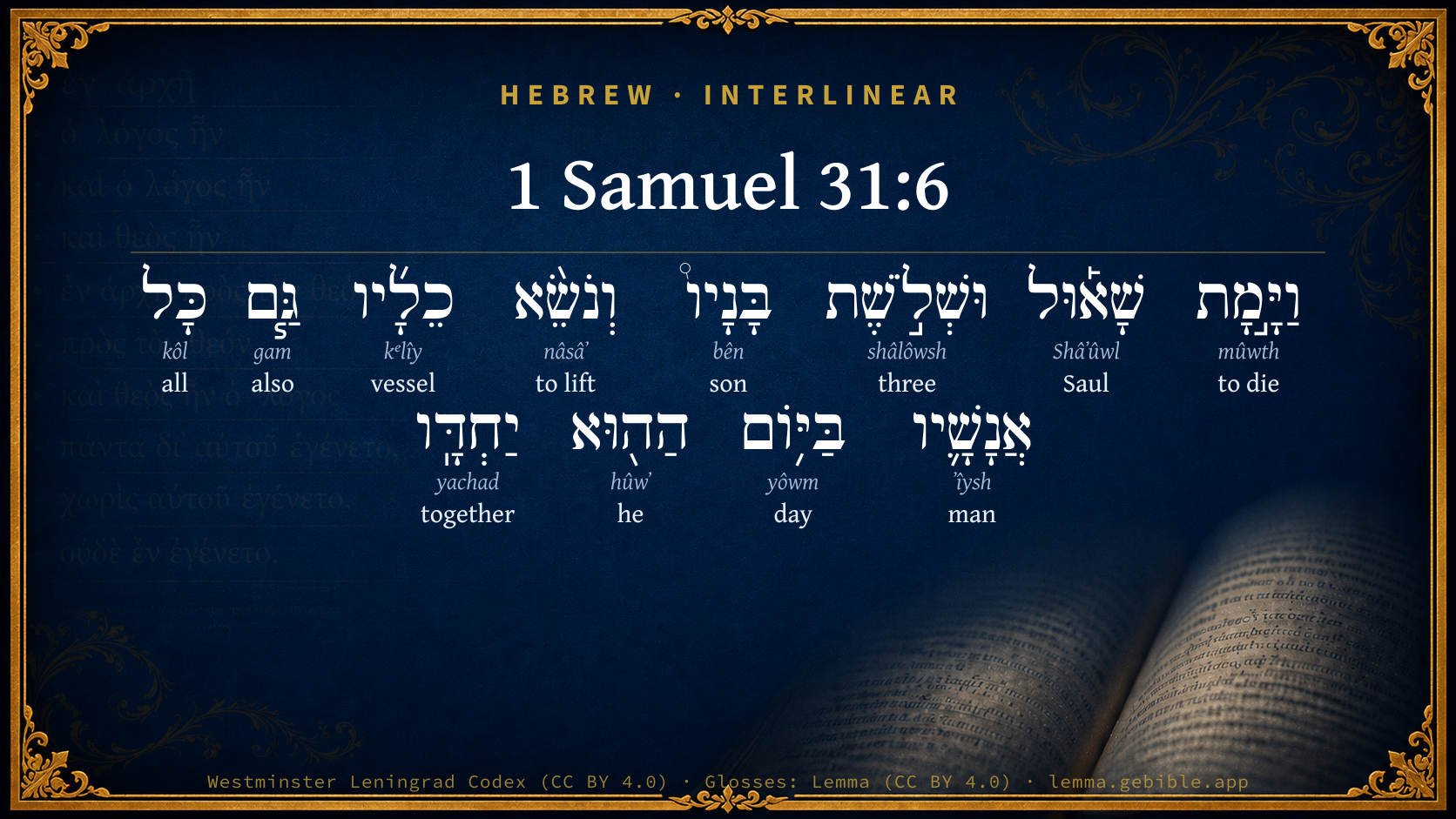
1 Samuel 31:6

Hebrew (Westminster Leningrad Codex) 1 Samuel 31:6 appears in the Hebrew Old Testament. The text above is from the Westminster Leningrad Codex. Each word links to its Strong’s number, a concise gloss, and parsing drawn from the Open Scriptures Hebrew Bible morphology. Click any word for its full Brown-Driver-Briggs (BDB) entry.
Download image
Cite this verse

1 Samuel 31:6 (World English Bible). Public Domain. Lemma interlinear Bible study tool, https://lemma.gebible.app/v/1-samuel/31/6.

Show BibTeX & RIS
BibTeX
RIS
English Translation
So Saul died, and his three sons, and his armor bearer, and all his men, that same day together.
World English Bible · Public Domain
Download a study sheet

One document with this verse’s original text, its word-by-word gloss line, the meaning frame, cross-references with their text, attributed commentary, and full source and license credits — printable, and it pastes into notes with its structure intact.

This verse Autodidact and up

Study sheet (.html) Plain text (.txt)

A passage Seminary Student

Up to 50 verses in one chapter. A passage sheet keeps up to 6 commentary sources and 12 cross-references per verse, in the order this page ranks them, and says so on the sheet whenever that leaves anything out. Ask for a single verse and you get the Autodidact verse sheet above.

Everything on this page stays free to read, with no account — the sheet is a download of what is already on screen, not access to it.

Want to remove ads? Support Godless Engineer
Compare translations 3

The same verse in 3 English versions, stacked beneath the original-language interlinear above. Click any original word for its lexicon entry.

Each is an independent rendering of the whole verse — the interlinear is not word-aligned to these translations.

Highlighted words mark where these versions differ — a whole-verse word diff, not a word-by-word alignment.

  • World English Bible Public Domain
    So Saul died, and his three sons, and his armor bearer, and all his men, that same day together.
  • King James Version Public Domain
    So Saul died, and his three sons, and his armourbearer, and all his men, that same day together.
  • unfoldingWord Literal Text CC BY-SA 4.0
    So Saul and three of his sons and the carrier of his equipment, even all of his men, died together on that day.

unfoldingWord Literal Text — © unfoldingWord, licensed CC BY-SA 4.0. Word-aligned USFM3 via Door43 (git.door43.org/unfoldingWord/en_ult).

Versions to compare (up to 4)

3 of 4 selected

Show all 18 translations

Every available English version of this verse, each an independent rendering of the whole verse.

  • World English Bible Public Domain
    So Saul died, and his three sons, and his armor bearer, and all his men, that same day together.
  • Berean Standard Bible Public Domain
    So Saul, his three sons, his armor-bearer, and all his men died together that same day.
  • Majority Standard Bible Public Domain
    So Saul, his three sons, his armor-bearer, and all his men died together that same day.
  • King James Version Public Domain
    So Saul died, and his three sons, and his armourbearer, and all his men, that same day together.
  • American Standard Version (1901) Public Domain
    So Saul died, and his three sons, and his armorbearer, and all his men, that same day together.
  • Revised Version (1885) Public Domain
    So Saul died, and his three sons, and his armourbearer, and all his men, that same day together.
  • Geneva Bible (1599) Public Domain
    So Saul dyed, and his three sonnes, and his armour bearer, and all his men that same day together.
  • Douay-Rheims (1899) Public Domain
    So Saul died, and his three sons, and his armourbearer, and all his men that same day together.
  • Young's Literal Translation Public Domain
    and Saul dieth, and three of his sons, and the bearer of his weapons, also all his men, on that day together.
  • Literal Standard Version CC BY-SA 4.0
    and Saul dies, and three of his sons, and the bearer of his weapons, also all his men, together on that day.
  • Unlocked Literal Bible CC BY-SA 4.0
    So Saul died, his three sons, and his armor bearer—these men all died together that same day.
  • unfoldingWord Literal Text CC BY-SA 4.0
    So Saul and three of his sons and the carrier of his equipment, even all of his men, died together on that day.
  • Darby Bible Public Domain
    So Saul died, and his three sons, and his armour-bearer, and all his men, that same day together.
  • World Messianic Bible Public Domain
    So Saul died with his three sons, his armor bearer, and all his men that same day together.
  • Webster's Bible Public Domain
    So Saul died, and his three sons, and his armor-bearer, and all his men, that same day together.
  • Free Bible Version CC BY-SA 4.0
    Saul, his three sons, his armor-bearer, and all the men with him, died the same day.
  • Bible in Basic English Public Domain
    So death overtook Saul and his three sons and his servant on the same day.
  • JPS Tanakh (1917) Public Domain
    So Saul died, and his three sons, and his armour-bearer, and all his men, that same day together.

Literal Standard Version (2020), Covenant Press — licensed CC BY-SA 4.0. Text via the HelloAO Bible API (eBible.org). Unlocked Literal Bible (unfoldingWord) — licensed CC BY-SA 4.0. Text via the HelloAO Bible API (eBible.org). unfoldingWord Literal Text — © unfoldingWord, licensed CC BY-SA 4.0. Word-aligned USFM3 via Door43 (git.door43.org/unfoldingWord/en_ult). Free Bible Version, Dr. Jonathan Gallagher — licensed CC BY-SA 4.0. Text via the HelloAO Bible API (eBible.org).

Word by word

More ways to search: Search by grammar → Find every occurrence → Compare this word →

Practice this passage: Drill this verse → Learn its vocabulary →

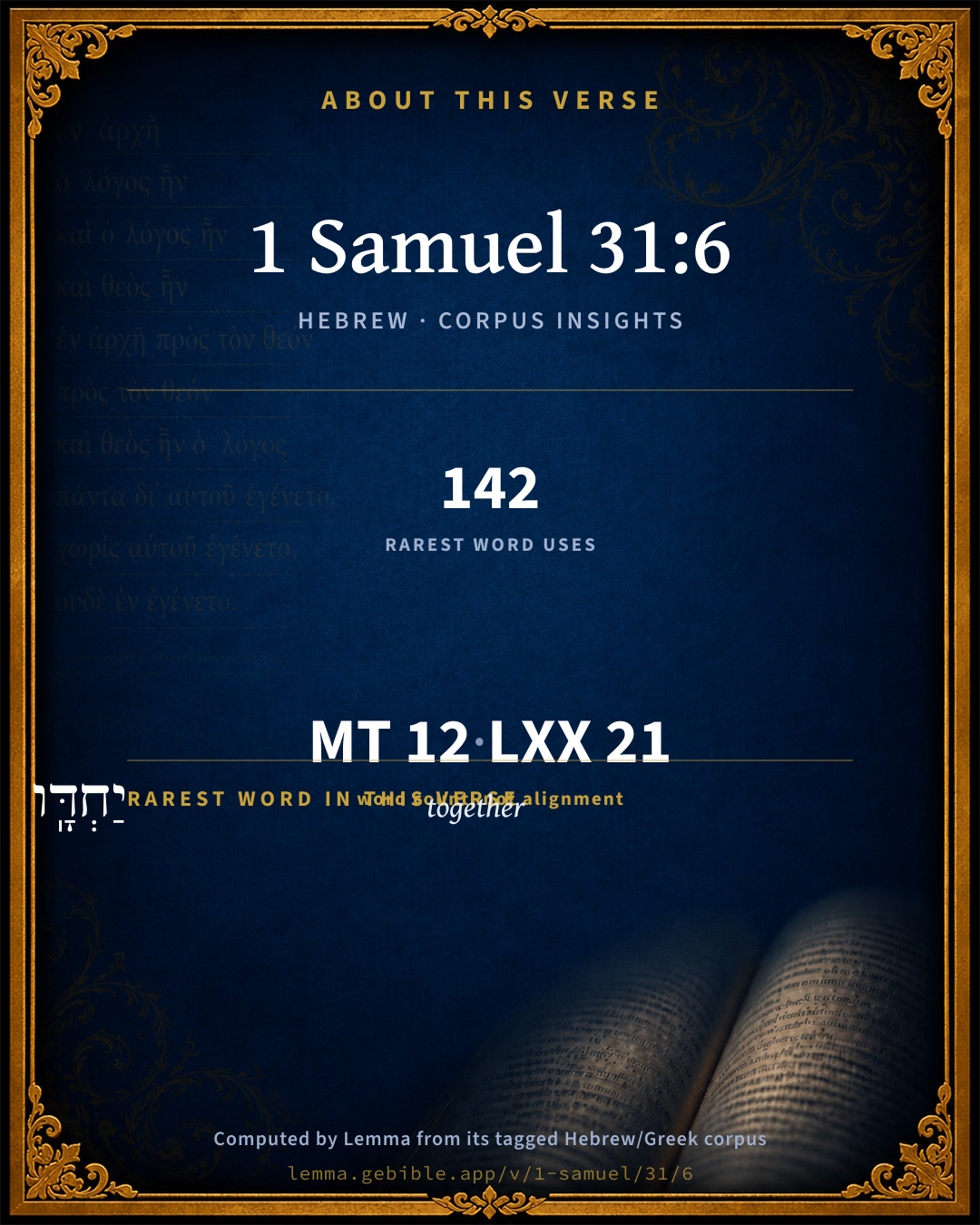
יַחְדָּֽו
yachad
H3162
“together”
Adverb
Part of Speech
Adverb
Full BDB Definition

Origin: from H3161

TWOT: 858b

union, unitedness (noun masculine) - together, altogether, all together, alike (adverb)
  1. וַיָּ֣מָת mûwth H4191 “and · to die” Conjunction + Verb, Qal, Sequential Imperfect, 3rd Person, Masculine, Singular
  2. שָׁא֡וּל Shâʼûwl H7586 “Saul” Noun, Proper
  3. וּשְׁלֹ֣שֶׁת shâlôwsh H7969 “and · three” Conjunction + Adjective, Cardinal number, Masculine, Singular, Construct
  4. בָּנָיו֩ bên H1121 “sons · his” Noun, Common, Masculine, Plural, Construct + Suffix, Personal, 3rd Person, Masculine, Singular
  5. וְנֹשֵׂ֨א nâsâʼ H5375 “and · lifting” Conjunction + Verb, Qal, Participle Active, Masculine, Singular, Construct
  6. כֵלָ֜יו kᵉlîy H3627 “vessels · his” Noun, Common, Masculine, Plural, Construct + Suffix, Personal, 3rd Person, Masculine, Singular
  7. גַּ֧ם gam H1571 “also” Particle, Accusative
  8. כָּל kôl H3605 “all of” Noun, Common, Masculine, Singular, Construct
  9. אֲנָשָׁ֛יו ʼîysh H376 “men · his” Noun, Common, Masculine, Plural, Construct + Suffix, Personal, 3rd Person, Masculine, Singular
  10. בַּיּ֥וֹם yôwm H3117 “in/at the · day” Preposition, Determined + Noun, Common, Masculine, Singular, Absolute
  11. הַה֖וּא hûwʼ H1931 “the · he” Particle, Definite Article + Pronoun, Personal, 3rd Person, Masculine, Singular

About this verse

These counts appear in no published source. They are computed here, from the morphology-tagged text and Lemma’s own curated glosses. What Lemma adds →

12
words
12
distinct lemmas
Historical
section

Grammatical profile

  • 2 verbs
  • 6 nouns
  • 1 adjective
  • 1 pronoun
  • 1 adverb
  • 1 particle

Verb forms

  • וַיָּ֣מָת Qal · Sequential Imperfect
  • וְנֹשֵׂ֨א Qal · Participle Active

Hebrew & Septuagint length

In English translation the verse runs 19 words from the Hebrew and 14 from the Septuagint (LXX English) — closely comparable.

A rough comparison of the two English renderings, which tokenize alike — not a word-level alignment.

Word counts can differ between the Hebrew and the Greek without any difference in meaning — e.g. the Hebrew direct-object marker אֵת has no separate Greek word, and Greek often adds the article ὁ.

In the original languages it is 12 Hebrew tokens and 21 Greek tokens — but the two are counted differently (Hebrew bundles its prefixes and suffixes into one token; the Greek is in lemma form), so that isn’t a like-for-like length.

Cross-references

8

Topical passages linked to 1 Samuel 31:6 in the Treasury of Scripture Knowledge — connected by theme and wording, ordered by reader-vote popularity; previews shown in the World English Bible.

  • 1 Samuel 4:10–11 The Philistines fought, and Israel was struck, and they fled every man to his tent: and there was a very great slaughter; for there fell of Israel thirty thousand footmen.
  • 1 Samuel 11:15 All the people went to Gilgal; and there they made Saul king before Yahweh in Gilgal; and there they offered sacrifices of peace-offerings before Yahweh; and there Saul and all the men of Israel rejoiced greatly.
  • 1 Samuel 12:17 Isn't it wheat harvest today? I will call to Yahweh, that he may send thunder and rain; and you shall know and see that your wickedness is great, which you have done in the sight of Yahweh, in asking you a king.
  • 1 Samuel 12:25 But if you shall still do wickedly, you shall be consumed, both you and your king."
  • 1 Samuel 28:19 Moreover Yahweh will deliver Israel also with you into the hand of the Philistines; and tomorrow shall you and your sons be with me: Yahweh will deliver the host of Israel also into the hand of the Philistines.
  • 1 Chronicles 10:6 So Saul died, and his three sons; and all his house died together.
  • Ecclesiastes 9:1–2 For all this I laid to my heart, even to explore all this: that the righteous, and the wise, and their works, are in the hand of God; whether it is love or hatred, man doesn't know it; all is before them.
  • Hosea 13:10–11 Where is your king now, that he may save you in all your cities? And your judges, of whom you said, 'Give me a king and princes?'

Cross-references courtesy of OpenBible.info (CC BY 4.0).

Hebrew and Greek witnesses Masoretic Hebrew ↔ Greek Septuagint

The same verse in the two great witnesses to the Old Testament, shown verse-for-verse.

These are two independent witnesses, not word-aligned to each other, and the Septuagint is shown in lemma (dictionary) form.

Hebrew 1 Samuel 31:6 Masoretic · Westminster Leningrad Codex

וַיָּ֣מָת שָׁא֡וּל וּשְׁלֹ֣שֶׁת בָּנָיו֩ וְנֹשֵׂ֨א כֵלָ֜יו גַּ֧ם כָּל אֲנָשָׁ֛יו בַּיּ֥וֹם הַה֖וּא יַחְדָּֽו

So Saul died, and his three sons, and his armor bearer, and all his men, that same day together.

World English Bible · Public Domain

Greek LXX 1 Samuel 31:6 Septuagint · lemma form

καί ἀποθνήσκω σαούλ καί ὁ τρεῖς υἱός αὐτός καί ὁ αἴρω ὁ σκεῦος αὐτός ἐν ὁ ἡμέρα ἐκεῖνος κατά ὁ αὐτός

So Saul died, and his three sons, and his armor-bearer, in that day together.

LXX2012 (modern English Septuagint) · Public Domain

Hebrew: Westminster Leningrad Codex (CC BY 4.0). Greek: Septuagint (public domain); English from LXX2012 (modern English Septuagint) (Public Domain). How the Septuagint differs from the Hebrew →

Targum (Aramaic paraphrase)

1

The Targum is the ancient Jewish Aramaic paraphrase of the Hebrew Scriptures — an interpretive translation, not the Hebrew text itself. Onkelos (literal) and Pseudo-Jonathan (expansive) render the Torah, and Jonathan the Prophets. Coverage is partial: where no permissively-licensed English translation exists for a verse, only the Aramaic is shown. This is verse-level text, not a word-by-word alignment to the Hebrew.

  1. Targum Jonathan Prophets (Joshua–Malachi)
    וּמִית שָׁאוּל וּתְלָתָא בְּנוֹהִי וְנָטֵל זְיָנֵיהּ אַף כָּל גַבְרוֹהִי בְּיוֹמָא הַהוּא כַּחֲדָא:

    (no public-domain English translation for this verse)

    Targum Jonathan — Aramaic: “Mikraot Gedolot” (public domain). English: “Sefaria Community Translation” (CC0 1.0 (public-domain dedication)); “London "Chaldee Paraphrase," 1871” (public domain). Text via Sefaria.

Commentary

Notes on 1 Samuel 31:6 from classic Christian and Jewish commentators (each source and its license shown beneath its notes). The classic Christian expositions comment on the surrounding passage and are grouped to its opening verse, so a note may address several verses; the Jewish commentaries on the Tanakh (Rashi and others) are per-verse, so they appear only where the commentator wrote on this verse.

Lemma curates 59 commentaries, every one of them public domain or Creative Commons licensed, each selected and text-cleaned for this edition rather than reprinted as found. About our sources →

Trapp's Complete Commentary

John Trapp

1Sa 31:6 So Saul died, and his three sons, and his armourbearer, and all his men, that same day together.

Ver. 6. And all his men, that same day together,] i.e., His household servants, his bodyguard, allies, and a great part of his army; so that of him might be sung that of Virgil concerning Priamus,

“ Hic finis Priami fatorum, hic exitus illum

Sorte tulit Troiam incensam et prolapsa videntem

Pergama, tot quondam populis terrisque superbum

Regnatorem Aside: iacet ingens littore truncus,

Avulsumque humeris caput, et sine nomine corpus. ”

John Trapp, A Commentary or Exposition upon All the Books of the Old and New Testament (1647–1656) — public domain. Text from a community e-Sword module.

The Biblical Illustrator

Joseph S. Exell

1Sa_31:6

So Saul died and his three sons.

Death of Saul and Jonathan

There is a proverb of the ancients, Whom the gods wish to destroy they first make mad. Or, to express the same idea in the language of the Bible, Be sure your sins will find you out. This was the truth brought out so forcibly in the last days, and especially in this death scene, of Saul.

1. Saul was what the Bible calls a reprobate. By that we do not mean that he was a man hurried forward to his doom by a blind fate, or lashed to such a doom against his will by the scourge of relentless furies. There is no such case in all the Bible. Yes, Saul was a sinner, and a persistent sinner--a sinner who sinned against light and knowledge, against providence and grace, against mercy and judgment. God gave him over to strong delusions, to believe a lie. God will not force men to obey him--will not compel them to repent when they have done wrong.

2. Gods retributions are slow but sure. It had been a long time since Saul committed that first grievous offence against God. There were years of apparent peace and prosperity, when God seemed to have forgotten his old curse, and when Saul might have thought that God had changed his mind and purpose.

3. To forsake God is to be lost. That was the fatal turning point in Sauls history, both as a man and as the first king of Israel. There was everything to make him loyal to God. It was not the want of knowledge or the want of counsel that led him to stumble. It was a want of reverence for God as King of kings. It was a want of will to do Gods will, and a desire to follow the bent of his own heart in spite of all that God told him was right and wrong. So he forsook God. And what could God do, as a lover of truth and a lover of Israel, but forsake him. (T. W. Hooper, D. D.)

The dead march of Saul

1.We begin with this: Sin, when it is finished, bringing forth death. The career of the first monarch Israel ever had is now actually completed: his life is a failure; the wrong beginning has reached the fetal end. The parallel has more than once been drawn between the rejected Saul and the Roman Brutus at Philippi. They seem to have had a warning in very similar terms the night before they died. And the terrible destruction of their respective forces, the entire rout and ruin of their cause, worked the same maddening result. Each fell on his own sword, and so sealed his guilt with suicide. One thinks of the story which naturalists tell concerning the scorpion, which, girded by the circle of fire, coils up on itself into narrower and narrower folds, till, when it can endure the heat no longer, it turns its deadly venom against itself and buries the sting of destruction in its own brain. Saul knew he must die before nightfall that day; it was not necessary he should let himself be tortured.

2. So there is a second text of Gods Word illustrated here in the incident: None of us liveth to himself, and no man dieth to himself. The lines and links of connection with bind us to our fellow men are often very subtle, and sometimes unexpected; but they are certainly always very strong. We do not know that Saul cared much about others interests, but his guilt was visited on many innocent, souls. By a tradition of the Rabbins we are told that the armour bearer mentioned here was named Doeg, and the tale adds that both of these men were slain by the same weapon, that was indeed the one with which the Lords servants had been massacred at Nob.

3. Notice, therefore, closely in this connection that another of the Bible texts phrases for us a new lesson: One sinner destroyeth much good. There was more in this tremendous catastrophe at Gilboa than an individual wreck. Great public interests were shaken almost as if the nation had been rocked by the force of an earthquake. Saul reaped the wind before he died, and when he died too; but it was his people that, with sickles of humiliation and loss and shame unutterable, reaped the whirlwind in his stead.

4. Happily there is another side even to this. We choose again from the utterances of inspiration, and we read, The triumphing of the wicked is short, and the joy of the hypocrite but for a moment. It has been noticeable in human history that the Almighty deals somewhat surprisingly with remnants; even in great devastations there is often left a seed that tries to serve him and retrieve the disasters. It does our hearts good just now to learn that Jabesh-Gilead was aroused: somebody after all was alive in the land. A good turn often comes back again. Years before this Saul had saved the inhabitants of that town from losing their eyes at the hands of some brutal enemies; now they sent a faithful band to take reverently down from the spikes the bodies of the royal victims and give them decent burial at last. It is wiser always to side with the Lord of hosts, no matter how discouraging the present prospect may be.

5. Once more, we find an illustration also here of the text that has grown so familiar in our times: In the place where the tree falleth, there it shall be.

(1) He lost his chance through his sinning against God.

(2) He lost his chance: but ours remains to us yet; and this is of vast importance and demands our notice as living men. While the hours linger salvation is possible anyone who will come with patience seeking it, and even a great bad record may be blotted from the book of Gods remembrance by the blood of Christ. (C. S. Robinson, D. D.)

Sauls character and end

I. The character of Saul.

1. Proud preference of his own will to Gods, carried out boldly in the life; deadly jealousy, that coloured and distorted his view of things, determined the special mould of his character and destiny, and threw over both deep shades of darkness; cruelty, that was causeless as against an innocent man, unnatural as against a son-in-law, sacrilegious, in smiting without scruple a whole city of priests with their families; impiety, that dared to stand up against God. Potentially the tyrant lurked in the king, the monster in the man. Circumstances alone would not, could not, make him such as he became. They helped to mould and colour his character, and gave it its peculiarity of aspect. But the regulating power lay within. From the same circumstances a different character would have been fabricated by a different disposition. Does not the same sunlight nourish Hemlock and All-heal, the Nettle and the Lily, the Thistle and the foodful Grain? Do not all flowers drink their own colours from the same flood of sunbeams? Even so, the plastic power of evil within employed for deadly harm the very circumstance which another would have turned to good and holy purposes.

2. His careless naturalism of heart. Let us call it by its Scripture name: carnal mindedness. This was the warp on which were woven all the glaring designs of his life. His heart was never broken by a sense of sin, or melted with the love of God, or touched by the marvellous grace that shone in the economy of type and shadow.

II. The moral purposes of his reign.

1. Punitive. His whole reign was a judgment. Disaffection, despondency, internal strife, and enfeebled power, were but different aspects of the same black cloud. It was throughout a ministry of retribution.

2. Disciplinary. These terrible years had a forward as well as a backward look. The harvest of the past they were also the seed time of the future.

(1) The Divine holiness was solemnly held forth. Every new infliction of judgment was a new demonstration of Gods hatred of sin.

(2) Conviction of sin. This would be the very result of an impression of Divine purity. The inference in a quickened conscience, would be immediate and pressing. Instinctively the contrast would be felt. The conviction of impurity would be the dark dreadful shadow of Divine intolerance of it.

(3) Turning to God again. Left, for this dark series of years, to follow their own ways, with a king as they desired and such as hey would have chosen, it was proved to them how foolish they were to separate themselves in the smallest measure from the God whose love had guarded them. They could not direct their own steps. It was suicidal weakness to think of walking alone. Their weary hearts looked wistfully back from the gloom that had settled on the land to that happier sunshine which now seemed gleaming on those vanished years of closer allegiance to God.

3. Instructive.

(1) The meeting of two lines of providential agency in the accomplishment of a certain intended result--a principle which finds frequent illustration in the early history of the New Testament Church, as when Simeon and the Infant Saviour, Peter and Cornelius, Paul and Ananias, from different points, were borne divinely to a meeting.

(2) The judicial arranging of events and circumstances so as to make the sources of perplexity, temptation, and ruin, to the wilful soul--an awful truth which has been repeating itself in actual life ever since Pharaoh, in his infatuation, hastened after Israel because the wilderness had shut them in. But these truths, and many like them, were developed by particular occurrences in the life of Saul. When that life is looked at as a whole, it yields most useful lessons for men of every age.

1. No change of circumstance can slacken Gods hold of His creatures. Convincing proof of this might have been given by a character and history directly the opposite of Sauls. But doubly impressive is the demonstration made by a life like his.

2. No human institution can of itself bring real blessings to a people. The Hebrews fondly dreamed that royalty would bring with it healing for all social ills. In their case the dream was not only baseless, but signally dishonouring to God. In every case it is really so. The folly of it is written conspicuously on all history. It is taught clearly by our common sense. With multitudes, a bright vision of happiness seems hovering over some great political amelioration yet to come. And it is to be feared that the noble instinct of our nature, which craves for true enjoyment, is bidden fill itself here. Deluded multitudes, to set down an immortal nature to these husks of the prodigal! True happiness is a heavenly gift. It is madness to seek it growing among the political improvements or social amenities of earth.

3. No combination of outward advantages can save or sanctify the soul of man. We cannot well conceive a human being surrounded by greater and more powerful means of improvement than was the first king of Israel.

4. There is in human nature a tendency to growth in evil. Here, again, Saul stands for the race. And in him this growth is terribly conspicuous. The modest man has come to stand without shame in the light of a public exposure; and he who had been so winningly regardful of the life of rebels now pants for the blood of the righteous, and barbarously sacrifices to the Moloch of his passion the whole innocent population of a city. Keeping pace with the monstrous growth of evil, and probably accounting for it, we observe in him the gradual consolidation of infernal agency. The human nature refused to admit its full operation all at once. At first the dark influence came in pulses over him, like the sullen ripples of the sea of death on a boats resisting sides. But soon that influence gained so thorough a mastery that all sounds of resistance ceased. With terrible facility the infernal power abated the reluctancy of his nature, and at last identified itself so completely with him that all trace of a struggle vanished, and the occasional impulses of its first contact changed eventually to a steady and uniform influence. It would be comforting to believe that this appalling progressiveness was peculiar to Saul. But this consolation we dare not take. While differing from him in the line of descent, and in the circumstances, enormity, and visible effects of our growth in evil, that growth itself is beyond question. The heart gravitates to sin. A malign influence has breathed upon our race. As surely as the body of the newborn babe tends earthwards unsupported, its moral nature tends to corruption. Deeper and deeper it sinks into sin. Habit adds new strength to nature. Surrounding temptations hasten the speed of the souls departure from God and holiness. How dreadful this downward pressure! What miracle has preserved the world from perishing by the excess of its own vices? A kindly Providence has done it. (P. Richardson, B. A.)

The Biblical Illustrator, edited by Joseph S. Exell (c. 1880s–1900s) — public domain. Text from a community e-Sword module.

Jamieson, Fausset & Brown

Robert Jamieson, A. R. Fausset & David Brown

So Saul died--(see on Ch1 10:13; Hos 13:11).

and his three sons--The influence of a directing Providence is evidently to be traced in permitting the death of Saul's three eldest and most energetic sons, particularly that of Jonathan, for whom, had he survived his father, a strong party would undoubtedly have risen and thus obstructed the path of David to the throne.

and all his men, that same day together--his servants or bodyguard (Ch1 10:6).

Jamieson, Fausset & Brown — Commentary Critical and Explanatory on the Whole Bible (1871) — public domain (CC PDM 1.0). Text via the HelloAO Bible API.

Adam Clarke's Commentary

Verse 6. And all his men] Probably meaning those of his troops which were his life or body guards: as to the bulk of the army, it fled at the commencement of the battle, 1Sa 31:1.

Adam Clarke's Commentary on the Bible (1810–1826) — public domain. Text from a community e-Sword/MySword module.

Ellicott's Commentary for English Readers

(6) And all his men.—We must not interpret this statement quite literally; 1Ch_10:6 explains it by “all his house.” Ishbosheth, his son, for instance, and Abner, the captain of the host, we know were not among the slain on that fatal day. The meaning is that all his “fideles,” his personal staff, as we should say, with his three sons fell fighting round him. The lines of the chivalrous Scottish ballad writer who with rare skill describes the devoted followers of King James V. falling round him at Flodden, well paints what took place on the stricken field of Gilboa round the hero king Saul:—

“No one failed him! He is keeping

Royal state and semblance still,

Knight and noble lie around him,

Cold, on Flodden’s fatal hill.

“Of the brave and gallant-hearted

Whom you sent with prayers away,

Not a single man departed

From his monarch yesterday.” AYTOUN.

A Bible Commentary for English Readers, edited by Charles John Ellicott (1878–1897) — public domain. Text from a community e-Sword module.

The Cambridge Bible for Schools and Colleges

gen. ed. J. J. S. Perowne

6. and all his men] The Sept. (B) omits these words. 1Ch_10:6 reads “all his house.” Probably the soldiers of the royal body guard are meant, who fell fighting round him like Harold’s hus-carls at the battle of Hastings. If so, there is no difficulty in the escape of Ishbosheth, who probably was not on the field, and of Abner, who as general would not be in attendance on the king’s person.

The Cambridge Bible for Schools and Colleges (gen. ed. J. J. S. Perowne; Cambridge University Press, 1878–1918) — public domain. Text from a community e-Sword module.

John Gill's Exposition

So Saul died, and his three sons, and his armourbearer,.... Only with this difference, his three sons died honourably in the field of battle, but he and his armourbearer destroyed themselves. Josephus says (e) he reigned eighteen years in the life of Samuel, and after his death twenty two years, which make the forty years the apostle ascribes to him, Act 13:21; Eupolemus (f), an Heathen writer, makes him to reign twenty one years; but of the years of his reign, both before and after the death of Samuel, chronologers are not agreed, see Sa1 25:1; and See Gill on Act 13:21,

and all his men that same day together; not all the soldiers in his army; for many of them fled and escaped, and even Abner the general of the army, but his household servants, or those that were near his person, his bodyguards.

(e) Antiqu. l. 6. c. 14. sect. 9. (f) Apud Euseb. Praepar. Evangel. l. 9. c. 3. p. 447.

John Gill's Exposition of the Whole Bible (1746–1763) — public domain (CC PDM 1.0). Text via the HelloAO Bible API.

Albert Barnes' Notes on the Bible

All his men - This and similar expressions must not be taken too literally (compare 1Ch 10:6). We know that Abner, and Ish-bosheth, and manymore survived the day of Gilboa.

Albert Barnes' Notes on the Bible (1834–1885) — public domain. Text from a community e-Sword/MySword module.

Haydock's Catholic Bible Commentary

His men. 1 Paralipomenon x. 6., his house fell together. The hopes of his family were at an end, (Haydock) though Isboseth, Abner, and some few survived him, (Menochius) who had fled, (Calmet) or had not been in the engagement. (Haydock)

George Leo Haydock (1774–1849), Haydock's Catholic Family Bible and Commentary, 1859 edition — public domain. Excludes Psalms (Douay-Rheims chapter numbering differs from Protestant) and Deuterocanonical books (Catholic canon only).

Whedon's Commentary on the Bible

Daniel D. Whedon

6. All his men — All his household, (compare 1Ch_10:6,) who went with him to the war, and on whom his hopes for the future hung.

“The end of the unhappy king corresponded to his life ever since the day of his rejection as king. When he had lost the battle, and saw his three sons fall at his side, and the archers of the enemy pressing hard upon him, without either repentance or remorse he put an end to his life by suicide, to escape the disgrace of being wounded and abused by the foe.” — Keil.

Daniel D. Whedon (gen. ed.), Commentary on the Old and New Testaments (1874–1909) — public domain. Text from a community e-Sword module.

Lesson kit

Teaching starters — assembled from the data on this page, not authored interpretation. Every prompt links to the verse data it draws on. Edit before teaching.

1 Samuel, in the Historical, opens this verse with 12 words (12 distinct Hebrew lemmas). Its most distinctive word is yachad (“together”). A historical commentator’s framing appears above. Read the whole chapter for the surrounding context.

Discussion questions

  1. The word yachad carries the sense “together.” How does it shape the verse?
  2. 1 Samuel 4:10–11 shares this passage’s theme. How do the two illuminate each other?
  3. These translations render this verse differently. What is at stake in choosing one wording over another?
  4. The verb «וַיָּ֣מָת» is Qal Sequential Imperfect. How does its form color the action?
  5. Reading how Trapp's Complete Commentary and The Biblical Illustrator read this verse, where do the two commentators agree and where do they part?

Things to notice

Reading settings

Reading text

Shown beneath each verse's original-language words.

Old Testament
Old Testament edition

Read the OT as the Masoretic Hebrew (MT) or the Greek Septuagint (LXX).

English shown for the Greek Septuagint (in the Hebrew ↔ Greek comparison).

Comparing translations? Open the Compare panel on any verse page to stack up to four side by side.