
2 Kings 20:17

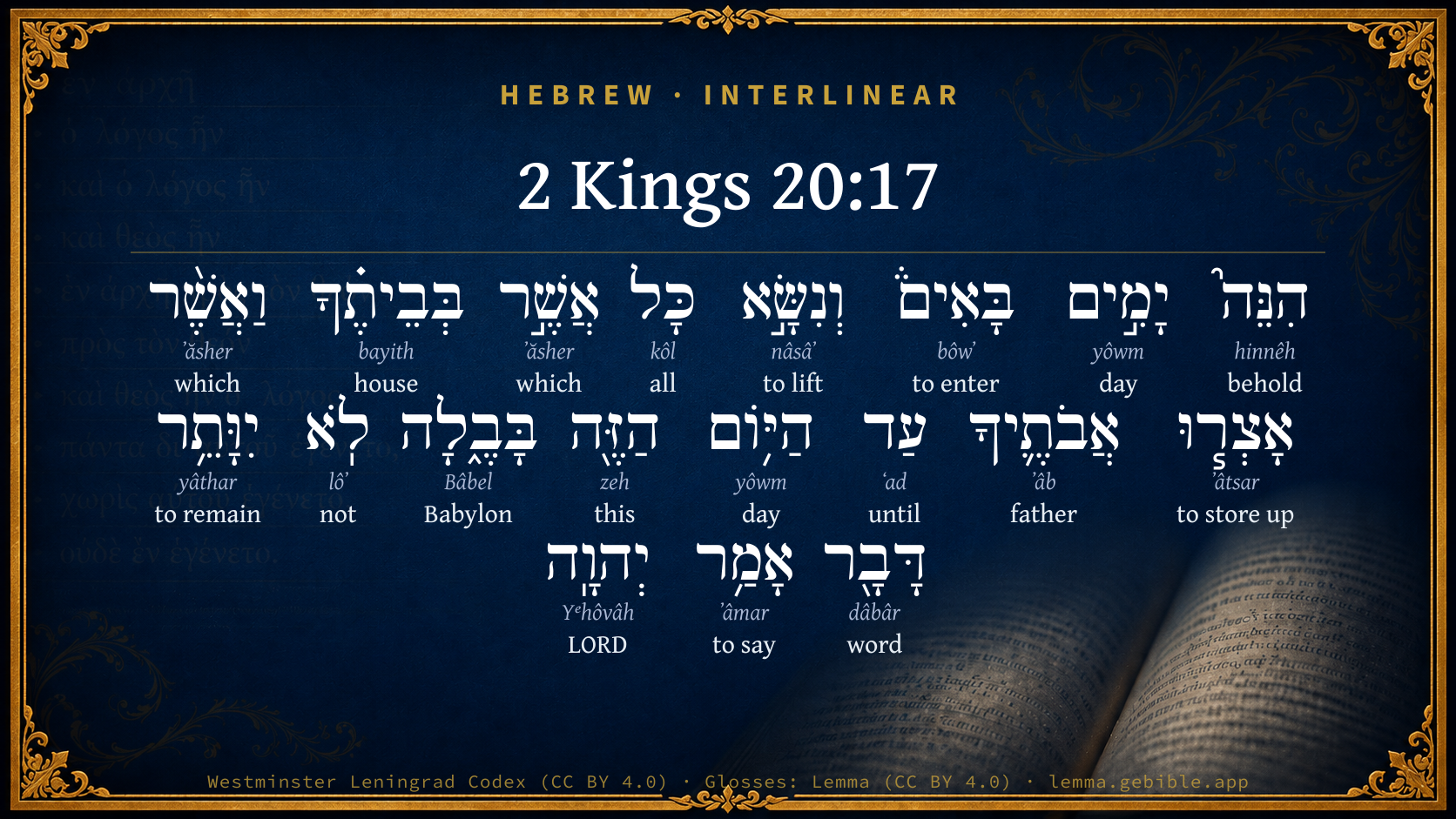
Hebrew (Westminster Leningrad Codex) 2 Kings 20:17 appears in the Hebrew Old Testament. The text above is from the Westminster Leningrad Codex. Each word links to its Strong’s number, a concise gloss, and parsing drawn from the Open Scriptures Hebrew Bible morphology. Click any word for its full Brown-Driver-Briggs (BDB) entry.
Download image
Cite this verse

2 Kings 20:17 (World English Bible). Public Domain. Lemma interlinear Bible study tool, https://lemma.gebible.app/v/2-kings/20/17.

Show BibTeX & RIS
BibTeX
RIS
English Translation
Behold, the days come, that all that is in your house, and that which your fathers have laid up in store to this day, shall be carried to Babylon: nothing shall be left, says Yahweh.
World English Bible · Public Domain
Highlights
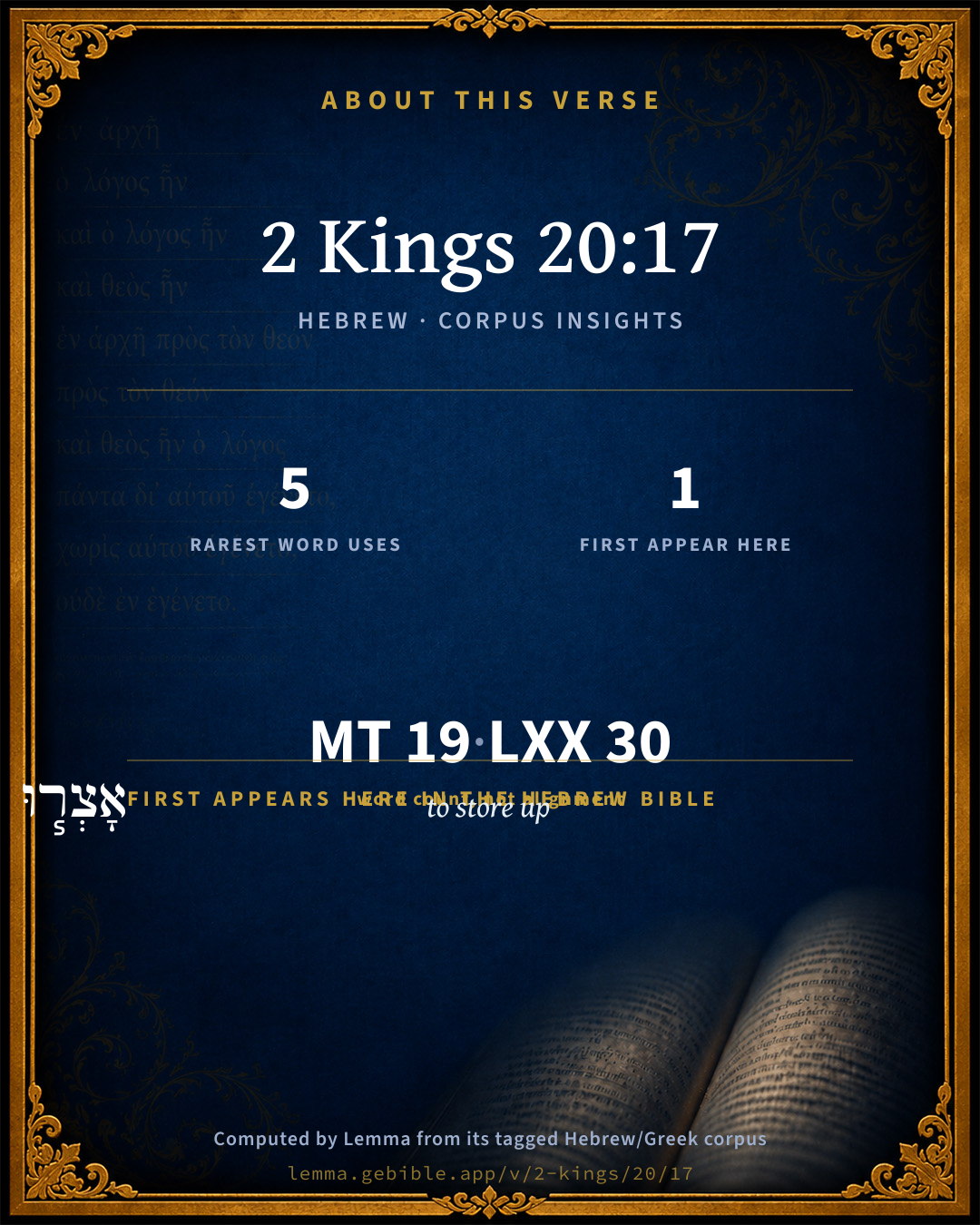
  • 1 first appearance in the Hebrew Bible
Full analysis ↓
Download a study sheet

One document with this verse’s original text, its word-by-word gloss line, the meaning frame, cross-references with their text, attributed commentary, and full source and license credits — printable, and it pastes into notes with its structure intact.

This verse Autodidact and up

Study sheet (.html) Plain text (.txt)

A passage Seminary Student

Up to 50 verses in one chapter. A passage sheet keeps up to 6 commentary sources and 12 cross-references per verse, in the order this page ranks them, and says so on the sheet whenever that leaves anything out. Ask for a single verse and you get the Autodidact verse sheet above.

Everything on this page stays free to read, with no account — the sheet is a download of what is already on screen, not access to it.

Want to remove ads? Support Godless Engineer
Compare translations 3

The same verse in 3 English versions, stacked beneath the original-language interlinear above. Click any original word for its lexicon entry.

Each is an independent rendering of the whole verse — the interlinear is not word-aligned to these translations.

Highlighted words mark where these versions differ — a whole-verse word diff, not a word-by-word alignment.

  • World English Bible Public Domain
    Behold, the days come, that all that is in your house, and that which your fathers have laid up in store to this day, shall be carried to Babylon: nothing shall be left, says Yahweh.
  • King James Version Public Domain
    Behold, the days come, that all that is in thine house, and that which thy fathers have laid up in store unto this day, shall be carried into Babylon: nothing shall be left, saith the LORD.
  • unfoldingWord Literal Text CC BY-SA 4.0
    ‘Behold, days are coming when everything that in your house and that your fathers have stored up to this day will be carried away to Babylon. A thing will not be left,’ says Yahweh.

unfoldingWord Literal Text — © unfoldingWord, licensed CC BY-SA 4.0. Word-aligned USFM3 via Door43 (git.door43.org/unfoldingWord/en_ult).

Versions to compare (up to 4)

3 of 4 selected

Show all 18 translations

Every available English version of this verse, each an independent rendering of the whole verse.

  • World English Bible Public Domain
    Behold, the days come, that all that is in your house, and that which your fathers have laid up in store to this day, shall be carried to Babylon: nothing shall be left, says Yahweh.
  • Berean Standard Bible Public Domain
    The time will surely come when everything in your palace and all that your fathers have stored up until this day will be carried off to Babylon. Nothing will be left, says the LORD.
  • Majority Standard Bible Public Domain
    The time will surely come when everything in your palace and all that your fathers have stored up until this day will be carried off to Babylon. Nothing will be left, says the LORD.
  • King James Version Public Domain
    Behold, the days come, that all that is in thine house, and that which thy fathers have laid up in store unto this day, shall be carried into Babylon: nothing shall be left, saith the LORD.
  • American Standard Version (1901) Public Domain
    Behold, the days come, that all that is in thy house, and that which thy fathers have laid up in store unto this day, shall be carried to Babylon: nothing shall be left, saith Jehovah.
  • Revised Version (1885) Public Domain
    Behold, the days come, that all that is in thine house, and that which thy fathers have laid up in store unto this day, shall be carried to Babylon: nothing shall be left, saith the LORD.
  • Geneva Bible (1599) Public Domain
    Beholde, the dayes come, that all that is in thine house, and what so euer thy fathers haue layed vp in store vnto this day, shall be caryed into Babel: Nothing shall be left, saith the Lord.
  • Douay-Rheims (1899) Public Domain
    Behold the days shall come, that all that is in thy house, and that thy fathers have laid up in store unto this day, shall be carried into Babylon: nothing shall be left, saith the Lord.
  • Young's Literal Translation Public Domain
    Lo, days are coming, and borne hath been all that `is' in thy house, and that thy father have treasured up till this day, to Babylon; there is not left a thing, said Jehovah;
  • Literal Standard Version CC BY-SA 4.0
    Behold, days are coming, and all that [is] in your house, and [all] that your father has treasured up until this day, has been carried to Babylon; there is not a thing left, said YHWH;
  • Unlocked Literal Bible CC BY-SA 4.0
    'Look, the days are about to come when everything in your palace, the things that your ancestors stored away until this present day, will be carried to Babylon. Nothing will be left, says Yahweh.
  • unfoldingWord Literal Text CC BY-SA 4.0
    ‘Behold, days are coming when everything that in your house and that your fathers have stored up to this day will be carried away to Babylon. A thing will not be left,’ says Yahweh.
  • Darby Bible Public Domain
    Behold, days come that all that is in thy house, and what thy fathers have laid up until this day, shall be carried to Babylon; nothing shall be left, saith Jehovah.
  • World Messianic Bible Public Domain
    ‘Behold, the days come that all that is in your house, and that which your fathers have laid up in store to this day, will be carried to Babylon. Nothing will be left,’ says the LORD.
  • Webster's Bible Public Domain
    Behold, the days come, that all that is in thy house, and that which thy fathers have laid up in store to this day, shall be carried into Babylon: nothing shall be left, saith the LORD.
  • Free Bible Version CC BY-SA 4.0
    You can be certain that the time is coming when everything in your palace, and everything that your forefathers have saved up until now, will be taken away to Babylon. There will be nothing left, says the Lord.
  • Bible in Basic English Public Domain
    Truly, days are coming when everything in your house, and whatever your fathers have put in store till this day, will be taken away to Babylon: all will be gone, says the Lord.
  • JPS Tanakh (1917) Public Domain
    Behold, the days come, that all that is in thy house, and that which thy fathers have laid up in store unto this day, shall be carried to Babylon; nothing shall be left, saith the LORD.

Literal Standard Version (2020), Covenant Press — licensed CC BY-SA 4.0. Text via the HelloAO Bible API (eBible.org). Unlocked Literal Bible (unfoldingWord) — licensed CC BY-SA 4.0. Text via the HelloAO Bible API (eBible.org). unfoldingWord Literal Text — © unfoldingWord, licensed CC BY-SA 4.0. Word-aligned USFM3 via Door43 (git.door43.org/unfoldingWord/en_ult). Free Bible Version, Dr. Jonathan Gallagher — licensed CC BY-SA 4.0. Text via the HelloAO Bible API (eBible.org).

Word by word

More ways to search: Search by grammar → Find every occurrence → Compare this word →

Practice this passage: Drill this verse → Learn its vocabulary →

אָצְר֧וּ
ʼâtsar
H686
“to store up”
Verb, Qal, Perfect, 3rd Person, Common, Plural
Part of Speech
Verb
Stem
Qal
Form
Perfect
Person
3rd Person
Gender
Common
Number
Plural
Full BDB Definition

Origin: a primitive root

TWOT: 154

to store up, save, lay up - (Qal) to store up, make treasurer - (Niphal) treasured
  1. הִנֵּה֮ hinnêh H2009 “behold” Particle, Demonstrative
  2. יָמִ֣ים yôwm H3117 “days” Noun, Common, Masculine, Plural, Absolute
  3. בָּאִים֒ bôwʼ H935 “entering” Verb, Qal, Participle Active, Masculine, Plural, Absolute
  4. וְנִשָּׂ֣א nâsâʼ H5375 “and · to lift” Conjunction + Verb, Niphal, Sequential Perfect, 3rd Person, Masculine, Singular
  5. כָּל kôl H3605 “all of” Noun, Common, Masculine, Singular, Construct
  6. אֲשֶׁ֣ר ʼăsher H834 “which” Particle, Relative
  7. בְּבֵיתֶ֗ךָ bayith H1004 “in/at · house · your” Preposition + Noun, Common, Masculine, Singular, Construct + Suffix, Personal, 2nd Person, Masculine, Singular
  8. וַאֲשֶׁ֨ר ʼăsher H834 “and · which” Conjunction + Particle, Relative
  9. אֲבֹתֶ֛יךָ ʼâb H1 “fathers · your” Noun, Common, Masculine, Plural, Construct + Suffix, Personal, 2nd Person, Masculine, Singular
  10. עַד ʻad H5704 “until” Preposition
  11. הַיּ֥וֹם yôwm H3117 “the · day” Particle, Definite Article + Noun, Common, Masculine, Singular, Absolute
  12. הַזֶּ֖ה zeh H2088 “the · this” Particle, Definite Article + Pronoun, Demonstrative, Masculine, Singular
  13. בָּבֶ֑לָה Bâbel H894 “Babylon · toward” Noun, Proper + Suffix, Demonstrative
  14. לֹֽא lôʼ H3808 “not” Particle, Negative
  15. יִוָּתֵ֥ר yâthar H3498 “to remain” Verb, Niphal, Imperfect, 3rd Person, Masculine, Singular
  16. דָּבָ֖ר dâbâr H1697 “word” Noun, Common, Masculine, Singular, Absolute
  17. אָמַ֥ר ʼâmar H559 “to say” Verb, Qal, Perfect, 3rd Person, Masculine, Singular
  18. יְהוָֽה Yᵉhôvâh H3068 “LORD” Noun, Proper

About this verse

These counts appear in no published source. They are computed here, from the morphology-tagged text and Lemma’s own curated glosses. What Lemma adds →

19
words
17
distinct lemmas
Historical
section

Notable vocabulary

The rarest word here is אָצְר֧וּ to store up H686 — appearing just 5 times in the whole Hebrew Bible.

First appearance in Scripture

This word makes its first canonical appearance in the Hebrew Bible here:

  • אָצְר֧וּ to store up H686

Shared distinctive vocabulary

אָצְר֧וּ to store up H686 occurs in 5 verses of the Hebrew Bible. Also found in:

Grammatical profile

  • 5 verbs
  • 8 nouns
  • 1 pronoun
  • 1 preposition
  • 4 particles

Verb forms

  • בָּאִים֒ Qal · Participle Active
  • וְנִשָּׂ֣א Niphal · Sequential Perfect
  • אָצְר֧וּ Qal · Perfect
  • יִוָּתֵ֥ר Niphal · Imperfect
  • אָמַ֥ר Qal · Perfect

Repetition

Words recur within this verse — often emphatic in Hebrew:

  • יָמִ֣ים day H3117 ×2
  • אֲשֶׁ֣ר which H834 ×2

Hebrew & Septuagint length

In English translation the verse runs 35 words from the Hebrew and 40 from the Septuagint (LXX English) — closely comparable.

A rough comparison of the two English renderings, which tokenize alike — not a word-level alignment.

Word counts can differ between the Hebrew and the Greek without any difference in meaning — e.g. the Hebrew direct-object marker אֵת has no separate Greek word, and Greek often adds the article ὁ.

In the original languages it is 19 Hebrew tokens and 30 Greek tokens — but the two are counted differently (Hebrew bundles its prefixes and suffixes into one token; the Greek is in lemma form), so that isn’t a like-for-like length.

Cross-references

7

Topical passages linked to 2 Kings 20:17 in the Treasury of Scripture Knowledge — connected by theme and wording, ordered by reader-vote popularity; previews shown in the World English Bible.

  • 2 Kings 24:13 He carried out there all the treasures of the house of Yahweh, and the treasures of the king's house, and cut in pieces all the vessels of gold, which Solomon king of Israel had made in the temple of Yahweh, as Yahweh had said.
  • 2 Chronicles 36:10 At the return of the year king Nebuchadnezzar sent, and brought him to Babylon, with the goodly vessels of the house of Yahweh, and made Zedekiah his brother king over Judah and Jerusalem.
  • Jeremiah 27:21–22 yes, thus says Yahweh of Hosts, the God of Israel, concerning the vessels that are left in the house of Yahweh, and in the house of the king of Judah, and at Jerusalem:
  • Jeremiah 52:17–19 The pillars of brass that were in the house of Yahweh, and the bases and the brazen sea that were in the house of Yahweh, did the Chaldeans break in pieces, and carried all the brass of them to Babylon.
  • 2 Kings 25:13–15 The pillars of brass that were in the house of Yahweh, and the bases and the brazen sea that were in the house of Yahweh, did the Chaldeans break in pieces, and carried the brass of them to Babylon.
  • Leviticus 26:19 I will break the pride of your power, and I will make your sky like iron, and your soil like brass;
  • 2 Chronicles 36:18 All the vessels of the house of God, great and small, and the treasures of the house of Yahweh, and the treasures of the king, and of his princes, all these he brought to Babylon.

Cross-references courtesy of OpenBible.info (CC BY 4.0).

Hebrew and Greek witnesses Masoretic Hebrew ↔ Greek Septuagint

The same verse in the two great witnesses to the Old Testament, shown verse-for-verse.

These are two independent witnesses, not word-aligned to each other, and the Septuagint is shown in lemma (dictionary) form.

Hebrew 2 Kings 20:17 Masoretic · Westminster Leningrad Codex

הִנֵּה֮ יָמִ֣ים בָּאִים֒ וְנִשָּׂ֣א כָּל אֲשֶׁ֣ר בְּבֵיתֶ֗ךָ וַאֲשֶׁ֨ר אָצְר֧וּ אֲבֹתֶ֛יךָ עַד הַיּ֥וֹם הַזֶּ֖ה בָּבֶ֑לָה לֹֽא יִוָּתֵ֥ר דָּבָ֖ר אָמַ֥ר יְהוָֽה

Behold, the days come, that all that is in your house, and that which your fathers have laid up in store to this day, shall be carried to Babylon: nothing shall be left, says Yahweh.

World English Bible · Public Domain

Greek LXX 2 Kings 20:17 Septuagint · lemma form

ἰδού ἡμέρα ἔρχομαι καί λαμβάνω πᾶς ὁ ἐν ὁ οἶκος σύ καί ὅσος θησαυρίζω ὁ πατήρ σύ ἕως ὁ ἡμέρα οὗτος εἰς βαβυλών καί οὐ ὑπολείπω ῥῆμα ὅς εἶπον κύριος

Behold, the days come, that all things that are in your house shall be taken, and all that your fathers have treasured up until this day, to Babylon; and there shall not fail a word, which the Lord has spoken.

LXX2012 (modern English Septuagint) · Public Domain

Hebrew: Westminster Leningrad Codex (CC BY 4.0). Greek: Septuagint (public domain); English from LXX2012 (modern English Septuagint) (Public Domain). How the Septuagint differs from the Hebrew →

Targum (Aramaic paraphrase)

1

The Targum is the ancient Jewish Aramaic paraphrase of the Hebrew Scriptures — an interpretive translation, not the Hebrew text itself. Onkelos (literal) and Pseudo-Jonathan (expansive) render the Torah, and Jonathan the Prophets. Coverage is partial: where no permissively-licensed English translation exists for a verse, only the Aramaic is shown. This is verse-level text, not a word-by-word alignment to the Hebrew.

  1. Targum Jonathan Prophets (Joshua–Malachi)
    הָא יוֹמַיָא אָתָן וְיִתְנְטֵיל כָּל דִי בְּבֵיתָךְ וְדִגְנָזוּ אֲבָהָתָךְ עַד יוֹמָא הָדֵין וִיתוּב לְבָבֶל לָא יִשְׁתְּאַר מִדַעַם אֲמַר יְיָ:

    (no public-domain English translation for this verse)

    Targum Jonathan — Aramaic: “Mikraot Gedolot” (public domain). English: “Sefaria Community Translation” (CC0 1.0 (public-domain dedication)); “London "Chaldee Paraphrase," 1871” (public domain). Text via Sefaria.

Commentary

Notes on 2 Kings 20:17 from classic Christian and Jewish commentators (each source and its license shown beneath its notes). The classic Christian expositions comment on the surrounding passage and are grouped to its opening verse, so a note may address several verses; the Jewish commentaries on the Tanakh (Rashi and others) are per-verse, so they appear only where the commentator wrote on this verse.

Lemma curates 59 commentaries, every one of them public domain or Creative Commons licensed, each selected and text-cleaned for this edition rather than reprinted as found. About our sources →

Trapp's Complete Commentary

John Trapp

2Ki 20:17 Behold, the days come, that all that [is] in thine house, and that which thy fathers have laid up in store unto this day, shall be carried into Babylon: nothing shall be left, saith the LORD.

Ver. 17. That all that is in thine house.] So that thou hast made a fair hand of all, forfeited all by thine ostentation, ambition, and creature confidence.

John Trapp, A Commentary or Exposition upon All the Books of the Old and New Testament (1647–1656) — public domain. Text from a community e-Sword module.

Joseph Benson's Commentary

2Ki 20:17. Behold, the days come, &c. — So small was the power of the Babylonians at this time, in respect of their mighty neighbour, the king of Assyria, whom the Jews stood in perpetual fear of, that nothing could seem more improbable than that the Babylonians should carry away the inhabitants of Jerusalem captive. But the divine providence ruleth over all, and sees from the beginning to the end; and, accordingly, in about a hundred and twenty-five years after, the event proved that the word of the Lord stands fast for ever, and that what he speaks shall surely come to pass. Thus short-sighted is human policy! Thus does our ruin often arise from that in which we most place our confidence!

Joseph Benson's Commentary on the Old and New Testaments (1811–1818) — public domain. Text from a community e-Sword module.

Tyndale Open Study Notes

Tyndale Open Resources

20:17 everything . . . will be carried off to Babylon: The Lord’s message through Isaiah predicted the taking of the palace . . . treasures in Jerusalem to Babylon, an event that took place in 597–586 BC (24:10-17; 25:1-21).

Tyndale Open Study Notes — © Tyndale Open Resources, licensed CC BY-SA 4.0. Text via the HelloAO Bible API.

Adam Clarke's Commentary

Verse 17. Behold, the days come] This was fulfilled in the days of the latter Jewish kings, when the Babylonians had led the people away into captivity, and stripped the land, the temple, &c., of all their riches. See Da 1:1-3.

Adam Clarke's Commentary on the Bible (1810–1826) — public domain. Text from a community e-Sword/MySword module.

Ellicott's Commentary for English Readers

(17) Behold, the days come . . .—Comp. 2Ch_32:25-26; 2Ch_32:31. It is there said that Divine wrath fell upon Hezekiah, because his heart was lifted up; and that the Babylonian embassy was an occasion in which God made proof of his inward tendencies. Self-confidence and vanity would be awakened in Hezekiah’s heart as he displayed all his resources to the envoys, and heard their politic, and perhaps hyperbolical, expressions of wonder and delight, and himself, it may be, realised for the first time the full extent of his prosperity. But it was not only the king’s vanity which displeased a prophet who had always consistently denounced foreign alliances as betokening deviation from absolute trust in Jehovah; and a more terrible irony than that which animates the oracle before us can hardly be conceived. Thy friends, he cries, will prove robbers, thine allies will become thy conquerors. That Isaiah should have foreseen that Assyria, then in the heyday of its power, would one day be dethroned from the sovereignty of the world by that very Babylon which, at the time he spoke, was menaced with ruin by the Assyrian arms, can only be accepted as true by those who accept the reality of supernatural prediction. Thenius remarks: “An Isaiah might well perceive i what fate threatened the little kingdom of Judah, in case of a revolution of affairs brought about by the Babylonians.” But the tone of the prophecy is not hypothetical, but entirely positive. Besides, Isaiah evidently did not suppose that Merodach-baladan’s revolt would succeed. (Comp. Isa_14:29, seq., 21:9.)

A Bible Commentary for English Readers, edited by Charles John Ellicott (1878–1897) — public domain. Text from a community e-Sword module.

The Cambridge Bible for Schools and Colleges

gen. ed. J. J. S. Perowne

17. nothing shall be left] Though some few Jews remained behind among the ruins of the desolated city, nothing worth taking as booty was left behind. For a description of the overthrow and the plunder, see below 2Ki_25:9-17.

The Cambridge Bible for Schools and Colleges (gen. ed. J. J. S. Perowne; Cambridge University Press, 1878–1918) — public domain. Text from a community e-Sword module.

Haydock's Catholic Bible Commentary

Babylon, under the last kings of Juda. It cannot be explained of Sennacherib, chap. xviii. 15.

George Leo Haydock (1774–1849), Haydock's Catholic Family Bible and Commentary, 1859 edition — public domain. Excludes Psalms (Douay-Rheims chapter numbering differs from Protestant) and Deuterocanonical books (Catholic canon only).

Matthew Poole's English Annotations

This judgment is denounced against him for his pride, which God exceedingly abhors; and for his ingratitude, whereby he took that honour to himself which he should have given entirely to God, and abused God’s gifts and favours to the gratification of his own lusts; of both which see 2Ch 32:25,26; and for his carnal confidence in that league which he had now made with the king of Babylon, by which, it is probable, he thought his mountain to be so strong, that it could not be removed.

Matthew Poole's English Annotations on the Holy Bible (1683–1685) — public domain. Text from a community e-Sword/MySword module.

Whedon's Commentary on the Bible

Daniel D. Whedon

17. Shall be carried unto Babylon — This seems to have been the first explicit prophecy of this great woe of Judah, though Micah’s (iv, 10) prediction of the same event must have been nearly contemporary. The prophecy is especially remarkable, since Babylon was at this time an inferior power, little more than a dependency of Assyria, whose leading men had risen in rebellion; and there was far more probability that Judah would be carried into exile either by the king of Assyria or by the king of Egypt, which two at the time seemed to divide the empire of the world between them.

Daniel D. Whedon (gen. ed.), Commentary on the Old and New Testaments (1874–1909) — public domain. Text from a community e-Sword module.

The Pulpit Commentary

Behold, the days come, that all that is in thine house, and that which thy fathers have laid up in store unto this day, shall be carried into Babylon. These treasures of thy royal house, whereof thou art so proud, and which thou hast of thine own accord made known to the Babylonians, to obtain their alliance, will in fact excite their cupidity, and the time will come when they, or what remains of them and represents them, will be carried off as plunder to Babylon by a conquering monarch, who will strip thy palace of its valuables, and drag thy descendants into captivity, and degrade them to the condition of slaves or servants, and make them discharge menial offices about his court. The revelation was now, it would seem, for the first time made that Babylon, and not Assyria, was the true enemy which Judaea had to fear, the destined foe who would accomplish all the threats of the prophets from Moses downwards, who would destroy the holy city and the glorious temple of Solomon, and carry away the ark of the covenant, and tear the people from their homes, and bring the kingdom of David to an end, and give Jerusalem over as a prey to desolation for seventy years. Henceforth it was Babylon and not Assyria which was feared, Babylon and not Assyria whereto the prophetic gaze of Isaiah himself was directed, and which became in his later prophecies (40-66.) the main object of his denunciations. Considering the circumstancesof the time, the prophecy is a most extraordinary one. Babylonia was at the time merely one of several kingdoms bordering on Assyria which the Assyrians threatened with destruction. From the time of Tiglath-pileser she had been continually diminishing, while Assyria had been continually increasing, in power. Tiglath-pileser had overrun the country and established himself as king there. Shalmaneser"s authority had been uncontested. If just at present a native prince held the throne, it was by a very uncertain tenure, and a few years later Assyria regained complete mastery. No human foresight could possibly have anticipated such a complete reversal of the relative positions of the two countries as was involved in Isaiah"s prophecy a reversal which was only accomplished by the appearance on the scene of a new power, Media, which hitherto had been regarded as of the very slightest account. Nothing shall be left, saith the Lord. (comp. 2Ki_25:13-17 and Jer_52:12-23)

The Pulpit Commentary (1880–1919), ed. H.D.M. Spence-Jones & Joseph S. Exell — public domain. Text from a community e-Sword module.

John Wesley's Explanatory Notes

Behold - This judgment is denounced against him for his pride; for his ingratitude, whereby he took that honour to himself which he should have given entirely to God; and for his carnal confidence in that league which he had now made with the king of Babylon, by which, it is probable, he thought his mountain to be so strong, that it could not be removed.

John Wesley, Explanatory Notes Upon the Whole Bible (1754–1765) — public domain. Text via the GEBible commentary corpus.

Rashi

Rabbi Shlomo Yitzchaki (Rashi)

Nothing will remain. You shall be paid measure for measure, [as stated above,] “There was nothing.”

Rashi on the Tanakh — English translations: “The Judaica Press complete Tanach with Rashi, translated by A. J. Rosenberg” (CC BY 4.0); “Pentateuch with Rashi's commentary by M. Rosenbaum and A.M. Silbermann, 1929-1934” (public domain); “The Metsudah Tanach series, Lakewood, N.J” (CC BY 4.0); and “The Book of Joshua, Metsudah Publications, 1997” (CC BY 4.0). Text via Sefaria.

Lesson kit

Teaching starters — assembled from the data on this page, not authored interpretation. Every prompt links to the verse data it draws on. Edit before teaching.

2 Kings, in the Historical, opens this verse with 19 words (17 distinct Hebrew lemmas). Its most distinctive word is ʼâtsar (“to store up”). A historical commentator’s framing appears above. Read the whole chapter for the surrounding context.

Discussion questions

  1. The word ʼâtsar carries the sense “to store up.” How does it shape the verse?
  2. The word “to store up” first appears here in Scripture. What is being introduced at this debut?
  3. Nehemiah 13:13 shares the word «to store up» with this verse. How do the two illuminate each other?
  4. “day” occurs 2× in this one verse. What is the effect of the repetition?
  5. The translations on this page render this verse differently — a whole-verse word diff, not a word-by-word alignment. What might account for the different wordings?
  6. The verb «בָּאִים֒» is Qal Participle Active. How does its form color the action?
  7. Reading how Trapp's Complete Commentary and Joseph Benson's Commentary read this verse, where do the two commentators agree and where do they part?

Things to notice

Reading settings

Reading text

Shown beneath each verse's original-language words.

Old Testament
Old Testament edition

Read the OT as the Masoretic Hebrew (MT) or the Greek Septuagint (LXX).

English shown for the Greek Septuagint (in the Hebrew ↔ Greek comparison).

Comparing translations? Open the Compare panel on any verse page to stack up to four side by side.