Judges 2:4

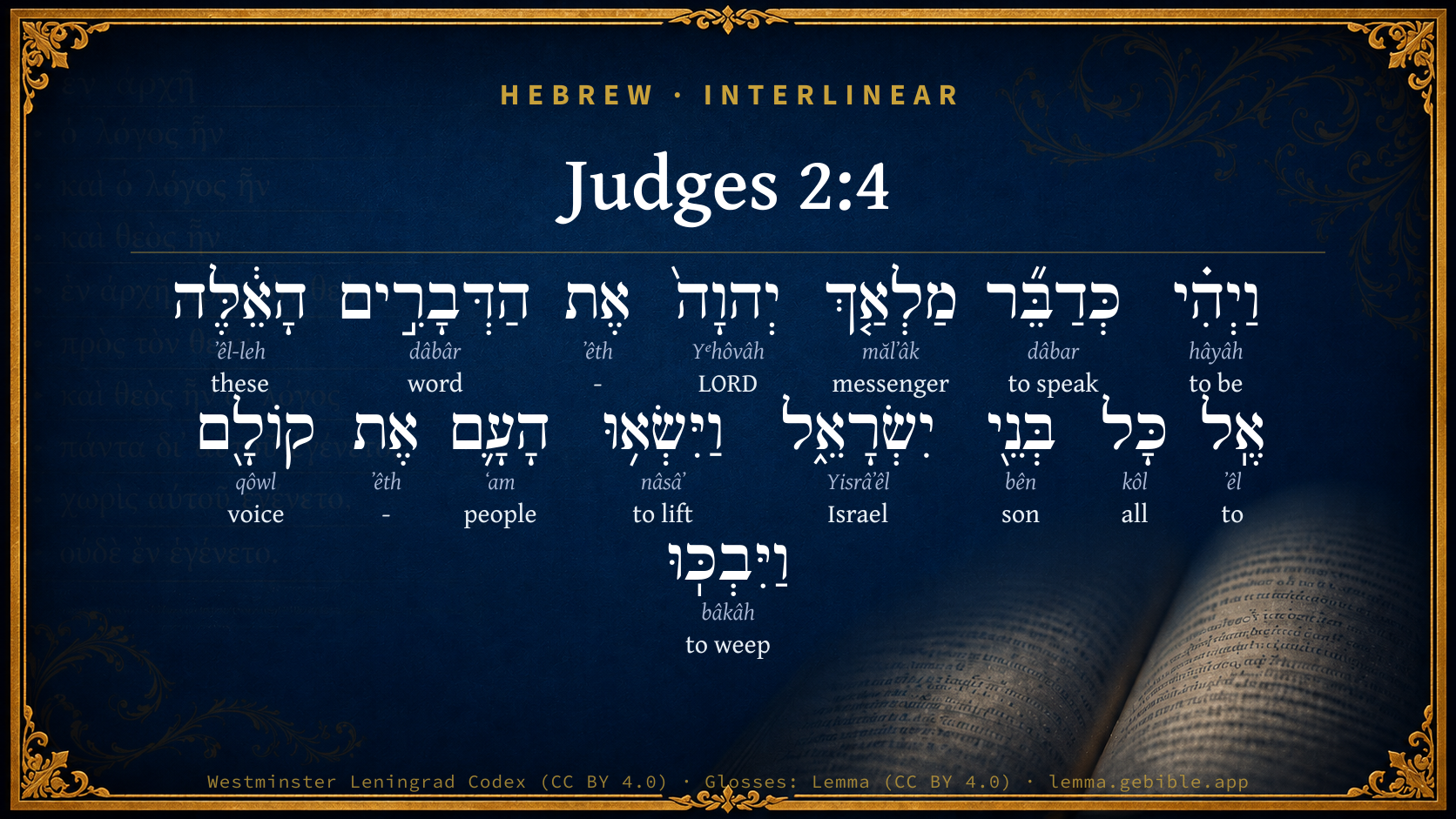
Hebrew (Westminster Leningrad Codex) Judges 2:4 appears in the Hebrew Old Testament. The text above is from the Westminster Leningrad Codex. Each word links to its Strong’s number, a concise gloss, and parsing drawn from the Open Scriptures Hebrew Bible morphology. Click any word for its full Brown-Driver-Briggs (BDB) entry.
Download image
Cite this verse

Judges 2:4 (World English Bible). Public Domain. Lemma interlinear Bible study tool, https://lemma.gebible.app/v/judges/2/4.

Show BibTeX & RIS
BibTeX
RIS
English Translation
It happened, when the angel of Yahweh spoke these words to all the children of Israel, that the people lifted up their voice, and wept.
World English Bible · Public Domain
Download a study sheet

One document with this verse’s original text, its word-by-word gloss line, the meaning frame, cross-references with their text, attributed commentary, and full source and license credits — printable, and it pastes into notes with its structure intact.

This verse Autodidact and up

Study sheet (.html) Plain text (.txt)

A passage Seminary Student

Up to 50 verses in one chapter. A passage sheet keeps up to 6 commentary sources and 12 cross-references per verse, in the order this page ranks them, and says so on the sheet whenever that leaves anything out. Ask for a single verse and you get the Autodidact verse sheet above.

Everything on this page stays free to read, with no account — the sheet is a download of what is already on screen, not access to it.

Want to remove ads? Support Godless Engineer
Compare translations 3

The same verse in 3 English versions, stacked beneath the original-language interlinear above. Click any original word for its lexicon entry.

Each is an independent rendering of the whole verse — the interlinear is not word-aligned to these translations.

Highlighted words mark where these versions differ — a whole-verse word diff, not a word-by-word alignment.

  • World English Bible Public Domain
    It happened, when the angel of Yahweh spoke these words to all the children of Israel, that the people lifted up their voice, and wept.
  • King James Version Public Domain
    And it came to pass, when the angel of the LORD spake these words unto all the children of Israel, that the people lifted up their voice, and wept.
  • unfoldingWord Literal Text CC BY-SA 4.0
    Now it happened, as the angel of Yahweh spoke these words to all the sons of Israel, that the people lifted up their voice and wept.

unfoldingWord Literal Text — © unfoldingWord, licensed CC BY-SA 4.0. Word-aligned USFM3 via Door43 (git.door43.org/unfoldingWord/en_ult).

Versions to compare (up to 4)

3 of 4 selected

Show all 18 translations

Every available English version of this verse, each an independent rendering of the whole verse.

  • World English Bible Public Domain
    It happened, when the angel of Yahweh spoke these words to all the children of Israel, that the people lifted up their voice, and wept.
  • Berean Standard Bible Public Domain
    When the angel of the LORD had spoken these words to all the Israelites, the people lifted up their voices and wept.
  • Majority Standard Bible Public Domain
    When the angel of the LORD had spoken these words to all the Israelites, the people lifted up their voices and wept.
  • King James Version Public Domain
    And it came to pass, when the angel of the LORD spake these words unto all the children of Israel, that the people lifted up their voice, and wept.
  • American Standard Version (1901) Public Domain
    And it came to pass, when the angel of Jehovah spake these words unto all the children of Israel, that the people lifted up their voice, and wept.
  • Revised Version (1885) Public Domain
    And it came to pass, when the angel of the LORD spake these words unto all the children of Israel, that the people lifted up their voice, and wept.
  • Geneva Bible (1599) Public Domain
    And when the Angel of the Lord spake these wordes vnto all the children of Israel, the people lift vp their voyce, and wept.
  • Douay-Rheims (1899) Public Domain
    And when the angel of the Lord spoke these words to all the children of Israel, they lifted up their voice, and wept.
  • Young's Literal Translation Public Domain
    And it cometh to pass, when the messenger of Jehovah speaketh these words unto all the sons of Israel, that the people lift up their voice and weep,
  • Literal Standard Version CC BY-SA 4.0
    And it comes to pass, when the Messenger of YHWH speaks these words to all the sons of Israel, that the people lift up their voice and weep,
  • Unlocked Literal Bible CC BY-SA 4.0
    When the angel of Yahweh spoke these words to all the people of Israel, the people shouted and wept.
  • unfoldingWord Literal Text CC BY-SA 4.0
    Now it happened, as the angel of Yahweh spoke these words to all the sons of Israel, that the people lifted up their voice and wept.
  • Darby Bible Public Domain
    When the angel of the LORD spoke these words to all the people of Israel, the people lifted up their voices and wept.
  • World Messianic Bible Public Domain
    When the LORD’s angel spoke these words to all the children of Israel, the people lifted up their voice and wept.
  • Webster's Bible Public Domain
    And it came to pass, when the angel of the LORD spoke these words to all the children of Israel, that the people lifted up their voice, and wept.
  • Free Bible Version CC BY-SA 4.0
    After the angel of the Lord had explained this to all the Israelites, the people wept out loud.
  • Bible in Basic English Public Domain
    Now on hearing these words which the angel of the Lord said to all the children of Israel, the people gave themselves up to loud crying and weeping.
  • JPS Tanakh (1917) Public Domain
    And it came to pass, when the angel of the LORD spoke these words unto all the children of Israel, that the people lifted up their voice, and wept.

Literal Standard Version (2020), Covenant Press — licensed CC BY-SA 4.0. Text via the HelloAO Bible API (eBible.org). Unlocked Literal Bible (unfoldingWord) — licensed CC BY-SA 4.0. Text via the HelloAO Bible API (eBible.org). unfoldingWord Literal Text — © unfoldingWord, licensed CC BY-SA 4.0. Word-aligned USFM3 via Door43 (git.door43.org/unfoldingWord/en_ult). Free Bible Version, Dr. Jonathan Gallagher — licensed CC BY-SA 4.0. Text via the HelloAO Bible API (eBible.org).

Word by word

More ways to search: Search by grammar → Find every occurrence → Compare this word →

Practice this passage: Drill this verse → Learn its vocabulary →

וַיִּבְכּֽוּ
bâkâh
H1058
“and · to weep”
Conjunction + Verb, Qal, Sequential Imperfect, 3rd Person, Masculine, Plural
Part of Speech
Conjunction + Verb
Stem
Qal
Form
Sequential Imperfect
Person
3rd Person
Gender
Masculine
Number
Plural
Full BDB Definition

Origin: a primitive root

TWOT: 243

to weep, bewail, cry, shed tears - (Qal) - to weep (in grief, humiliation, or joy) - to weep bitterly (with cognate acc.) - to weep upon (embrace and weep) - to bewail - (Piel) participle - lamenting - bewailing
  1. וַיְהִ֗י hâyâh H1961 “and · to be” Conjunction + Verb, Qal, Sequential Imperfect, 3rd Person, Masculine, Singular
  2. כְּדַבֵּ֞ר dâbar H1696 “like/as · to speak” Preposition + Verb, Piel, Infinitive Construct
  3. מַלְאַ֤ךְ mălʼâk H4397 “messenger of” Noun, Common, Masculine, Singular, Construct
  4. יְהוָה֙ Yᵉhôvâh H3068 “LORD” Noun, Proper
  5. אֶת ʼêth H853 “-” Particle, Direct Object
  6. הַדְּבָרִ֣ים dâbâr H1697 “the · words” Particle, Definite Article + Noun, Common, Masculine, Plural, Absolute
  7. הָאֵ֔לֶּה ʼêl-leh H428 “the · these” Particle, Definite Article + Pronoun, Demonstrative, Common, Plural
  8. אֶֽל ʼêl H413 “to” Preposition
  9. כָּל kôl H3605 “all of” Noun, Common, Masculine, Singular, Construct
  10. בְּנֵ֖י bên H1121 “sons of” Noun, Common, Masculine, Plural, Construct
  11. יִשְׂרָאֵ֑ל Yisrâʼêl H3478 “Israel” Noun, Proper
  12. וַיִּשְׂא֥וּ nâsâʼ H5375 “and · to lift” Conjunction + Verb, Qal, Sequential Imperfect, 3rd Person, Masculine, Plural
  13. הָעָ֛ם ʻam H5971 “the · people” Particle, Definite Article + Noun, Common, Masculine, Singular, Absolute
  14. אֶת ʼêth H853 “-” Particle, Direct Object
  15. קוֹלָ֖ם qôwl H6963 “voice · their” Noun, Common, Masculine, Singular, Construct + Suffix, Personal, 3rd Person, Masculine, Plural

About this verse

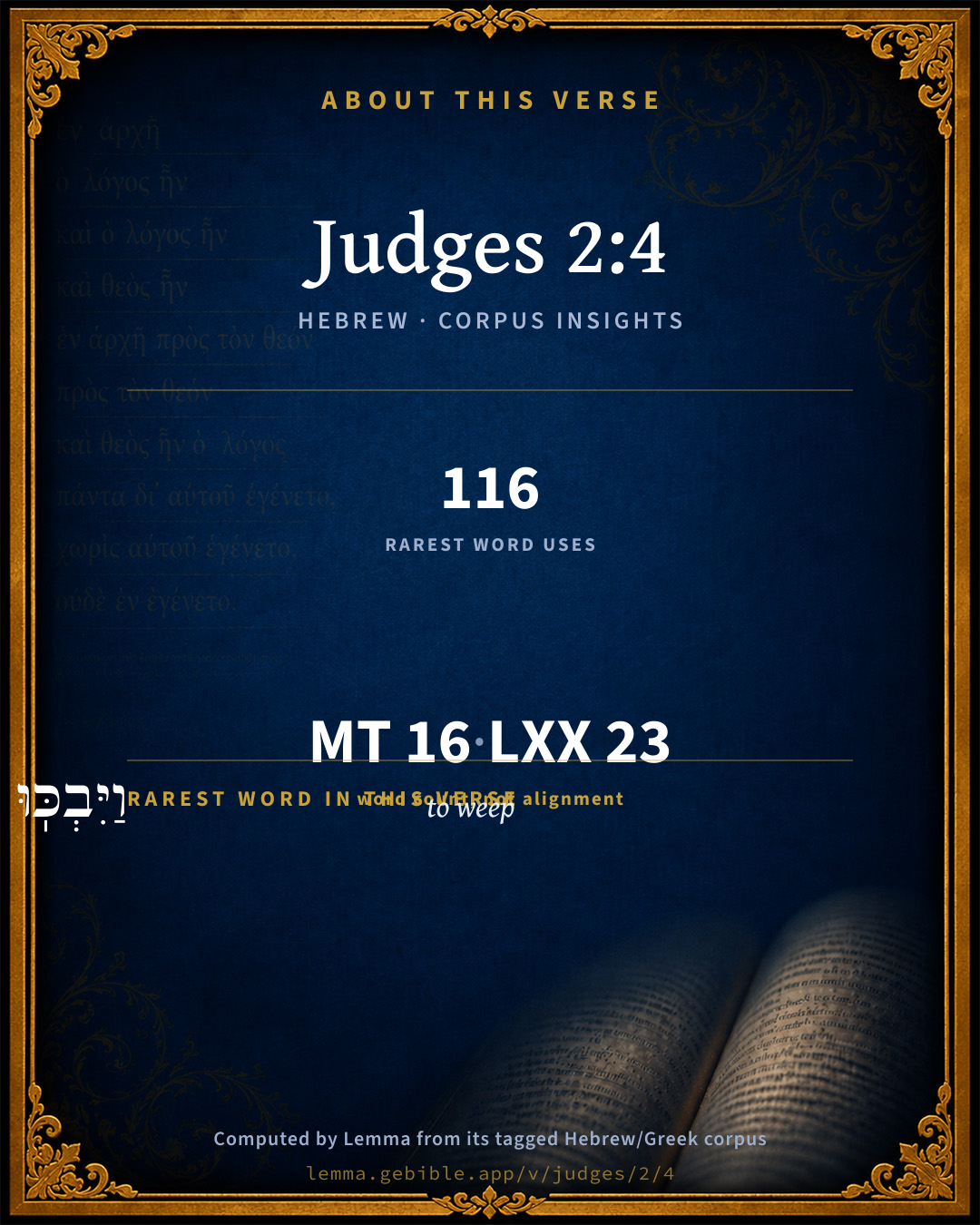
These counts appear in no published source. They are computed here, from the morphology-tagged text and Lemma’s own curated glosses. What Lemma adds →

16
words
15
distinct lemmas
Historical
section

Grammatical profile

  • 4 verbs
  • 8 nouns
  • 1 pronoun
  • 1 preposition
  • 2 particles

Verb forms

  • וַיְהִ֗י Qal · Sequential Imperfect
  • כְּדַבֵּ֞ר Piel · Infinitive Construct
  • וַיִּשְׂא֥וּ Qal · Sequential Imperfect
  • וַיִּבְכּֽוּ Qal · Sequential Imperfect

Hebrew & Septuagint length

In English translation the verse runs 25 words from the Hebrew and 29 from the Septuagint (LXX English) — closely comparable.

A rough comparison of the two English renderings, which tokenize alike — not a word-level alignment.

Word counts can differ between the Hebrew and the Greek without any difference in meaning — e.g. the Hebrew direct-object marker אֵת has no separate Greek word, and Greek often adds the article ὁ.

In the original languages it is 16 Hebrew tokens and 23 Greek tokens — but the two are counted differently (Hebrew bundles its prefixes and suffixes into one token; the Greek is in lemma form), so that isn’t a like-for-like length.

Cross-references

9

Topical passages linked to Judges 2:4 in the Treasury of Scripture Knowledge — connected by theme and wording, ordered by reader-vote popularity; previews shown in the World English Bible.

  • 2 Corinthians 7:10 For godly sorrow works repentance to salvation, which brings no regret. But the sorrow of the world works death.
  • James 4:9 Lament, mourn, and weep. Let your laughter be turned to mourning, and your joy to gloom.
  • 1 Samuel 7:6 They gathered together to Mizpah, and drew water, and poured it out before Yahweh, and fasted on that day, and said there, We have sinned against Yahweh. Samuel judged the children of Israel in Mizpah.
  • Ezra 10:1 Now while Ezra prayed and made confession, weeping and casting himself down before the house of God, there was gathered together to him out of Israel a very great assembly of men and women and children; for the people wept very sore.
  • Proverbs 17:10 A rebuke enters deeper into one who has understanding Than a hundred lashes into a fool.
  • Jeremiah 31:9 They shall come with weeping; and with petitions will I lead them: I will cause them to walk by rivers of waters, in a straight way in which they shall not stumble; for I am a father to Israel, and Ephraim is my firstborn.
  • Zechariah 12:10 I will pour on the house of David, and on the inhabitants of Jerusalem, the spirit of grace and of supplication; and they will look to me whom they have pierced; and they shall mourn for him, as one mourns for his only son, and will grieve bitterly for him, as one grieves for his firstborn.
  • Luke 6:21 Blessed are you who hunger now, For you will be filled. Blessed are you who weep now, For you will laugh.
  • Luke 7:38 Standing behind at his feet weeping, she began to wet his feet with her tears, and she wiped them with the hair of her head, kissed his feet, and anointed them with the ointment.

Cross-references courtesy of OpenBible.info (CC BY 4.0).

Hebrew and Greek witnesses Masoretic Hebrew ↔ Greek Septuagint

The same verse in the two great witnesses to the Old Testament, shown verse-for-verse.

These are two independent witnesses, not word-aligned to each other, and the Septuagint is shown in lemma (dictionary) form.

Hebrew Judges 2:4 Masoretic · Westminster Leningrad Codex

וַיְהִ֗י כְּדַבֵּ֞ר מַלְאַ֤ךְ יְהוָה֙ אֶת הַדְּבָרִ֣ים הָאֵ֔לֶּה אֶֽל כָּל בְּנֵ֖י יִשְׂרָאֵ֑ל וַיִּשְׂא֥וּ הָעָ֛ם אֶת קוֹלָ֖ם וַיִּבְכּֽוּ

It happened, when the angel of Yahweh spoke these words to all the children of Israel, that the people lifted up their voice, and wept.

World English Bible · Public Domain

Greek LXX Judges 2:4 Septuagint · lemma form

καί γίγνομαι ὡς λαλέω ὁ ἄγγελος κύριος ὁ λόγος οὗτος πρός πᾶς υἱός ἰσραήλ καί ἐπιαἴρω ὁ λαός ὁ φωνή αὐτός καί κλαίω

And it came to pass when the angel of the Lord spoke these words to all the children of Israel, that the people lifted up their voice, and wept.

LXX2012 (modern English Septuagint) · Public Domain

Hebrew: Westminster Leningrad Codex (CC BY 4.0). Greek: Septuagint (public domain); English from LXX2012 (modern English Septuagint) (Public Domain). How the Septuagint differs from the Hebrew →

Targum (Aramaic paraphrase)

1

The Targum is the ancient Jewish Aramaic paraphrase of the Hebrew Scriptures — an interpretive translation, not the Hebrew text itself. Onkelos (literal) and Pseudo-Jonathan (expansive) render the Torah, and Jonathan the Prophets. Coverage is partial: where no permissively-licensed English translation exists for a verse, only the Aramaic is shown. This is verse-level text, not a word-by-word alignment to the Hebrew.

  1. Targum Jonathan Prophets (Joshua–Malachi)
    וַהֲוָה כַּד מַלֵיל נְבִיָא דַייָ יַת פִּתְגָמַיָא הָאִלֵין לְכָל בְּנֵי יִשְׂרָאֵל וַאֲרִימוּ עַמָא יַת קַלְהוֹן וּבְכוֹ:

    (no public-domain English translation for this verse)

    Targum Jonathan — Aramaic: “Mikraot Gedolot” (public domain). English: “Sefaria Community Translation” (CC0 1.0 (public-domain dedication)); “London "Chaldee Paraphrase," 1871” (public domain). Text via Sefaria.

Commentary

Notes on Judges 2:4 from classic Christian and Jewish commentators (each source and its license shown beneath its notes). The classic Christian expositions comment on the surrounding passage and are grouped to its opening verse, so a note may address several verses; the Jewish commentaries on the Tanakh (Rashi and others) are per-verse, so they appear only where the commentator wrote on this verse.

Lemma curates 59 commentaries, every one of them public domain or Creative Commons licensed, each selected and text-cleaned for this edition rather than reprinted as found. About our sources →

Trapp's Complete Commentary

John Trapp

Jdg 2:4 And it came to pass, when the angel of the LORD spake these words unto all the children of Israel, that the people lifted up their voice, and wept.

Ver. 4. The people lifted up their voice, and wept.] Thus they were wrought upon by the word preached, even unto tears; as were likewise David, Josiah, Hezekiah, Magdalen, Peter. So these hearers of his "were pricked at heart," {Act 2:37} and Paul’s at Ephesus wept sore. {Act 20:37} Few such to be seen in our congregations: some, as they say of witches, cannot weep. The enemy, when he hath stopt the wells and stayed the watercourses of a town, hath good hope to take it. So hath Satan remorseless souls.

John Trapp, A Commentary or Exposition upon All the Books of the Old and New Testament (1647–1656) — public domain. Text from a community e-Sword module.

Jamieson, Fausset & Brown

Robert Jamieson, A. R. Fausset & David Brown

when the angel of the Lord spake these words . . . the people lifted up their voice, and wept--The angel's expostulation made a deep and painful impression. But the reformation was but temporary, and the gratifying promise of a revival which this scene of emotion held out, was, ere long, blasted by speedy and deeper relapses into the guilt of defection and idolatry.

Jamieson, Fausset & Brown — Commentary Critical and Explanatory on the Whole Bible (1871) — public domain (CC PDM 1.0). Text via the HelloAO Bible API.

The Cambridge Bible for Schools and Colleges

gen. ed. J. J. S. Perowne

4. unto all the children of Israel] although, as ch. 1 has told, the tribes were dispersed in their various settlements. The expression, as indeed the whole situation presupposed in Jdg_2:1 b–5a, is influenced by later conceptions of national unity; cf. the editorial passages Jdg_6:8, Jdg_10:11.

lifted up their voice, and wept] Similarly at Beth-el Jdg_21:2.

The Cambridge Bible for Schools and Colleges (gen. ed. J. J. S. Perowne; Cambridge University Press, 1878–1918) — public domain. Text from a community e-Sword module.

John Gill's Exposition

And it came to pass, when the angel of the Lord spake these words unto all the children of Israel,.... This being either one of the three solemn feasts, when all the males appeared at the tabernacle of the Lord; or else here was now a solemn convention of all the tribes to inquire of the Lord the reason why they were not able to drive out the Canaanites in some places, and why they prevailed over them in many:

that the people lift up their voice, and wept; being affected with what the angel said, and convicted in their consciences of their sins, and so fearing the bad consequences thereof, they wept because of the sins they had been guilty of, and because of the evils that were like to befall them on account of them.

John Gill's Exposition of the Whole Bible (1746–1763) — public domain (CC PDM 1.0). Text via the HelloAO Bible API.

Matthew Poole's English Annotations

Some of them from a true sense of their sins; but most of them from a just apprehension of their danger and approaching misery from the Canaanites’ growing power, and God’s forsaking of them; as the following history makes most probable.

Matthew Poole's English Annotations on the Holy Bible (1683–1685) — public domain. Text from a community e-Sword/MySword module.

Whedon's Commentary on the Bible

Daniel D. Whedon

4. Spake these words unto all the children of Israel — This is the only instance on record where the angel of the Lord addressed an assembly; and even if these words were spoken only to the heads and representatives of the people, such representatives would still have constituted an assembly. But this fact is insufficient to set aside the above mentioned reasons for believing that this was the Angel of Jehovah, and not merely a prophet. We see no reason why the covenant Angel might not have revealed himself, at times, to an assembly as well as to individuals.

Lifted up their voice, and wept — Man is so constituted in his moral nature that conviction of sin arises when the sinner has a clear view of what he is in contrast with what he ought to be. These two views the Lord held up before all the people, till they could endure the sight no longer. Six hundred thousand sinners in tears of penitence! No wonder that Bochim, a monumental name, was given to the place of such national penitence.

Daniel D. Whedon (gen. ed.), Commentary on the Old and New Testaments (1874–1909) — public domain. Text from a community e-Sword module.

John Wesley's Explanatory Notes

Wept - Some of them from a true sense of their sins; others from a just apprehension of their approaching misery.

John Wesley, Explanatory Notes Upon the Whole Bible (1754–1765) — public domain. Text via the GEBible commentary corpus.

Keil & Delitzsch

C. F. Keil & F. Delitzsch

The people broke out into loud weeping on account of this reproof. And since the weeping, from which the place received the name of Bochim, was a sign of their grief on account of their sin, this grief led on to such repentance that "they sacrificed there unto the Lord," no doubt presenting sin-offerings and burnt-offerings, that they might obtain mercy and the forgiveness of their sins. It does not follow from this sacrifice, however, that the tabernacle or the ark of the covenant was to be found at Bochim. In any place where the Lord appeared to His people, sacrifices might be offered to Him (see Jdg 6:20, Jdg 6:26, Jdg 6:28; Jdg 13:16.; Sa2 24:25, and the commentary of Deu 12:5). On the other hand, it does follow from the sacrifice at Bochim, where there was no sanctuary of Jehovah, that the person who appeared to the people was not a prophet, nor even an ordinary angel, but the angel of the Lord, who is essentially one with Jehovah.

Keil & Delitzsch — Biblical Commentary on the Old Testament (1861–1891) — public domain (CC PDM 1.0). Text via the HelloAO Bible API. (Old Testament only.)

Lesson kit

Teaching starters — assembled from the data on this page, not authored interpretation. Every prompt links to the verse data it draws on. Edit before teaching.

Judges, in the Historical, opens this verse with 16 words (15 distinct Hebrew lemmas). Its most distinctive word is bâkâh (“to weep”). A historical commentator’s framing appears above. Read the whole chapter for the surrounding context.

Discussion questions

  1. What does “to weep” (bâkâh) contribute to the verse as a whole?
  2. 2 Corinthians 7:10 shares this passage’s theme. How do the two illuminate each other?
  3. The translations on this page render this verse differently — a whole-verse word diff, not a word-by-word alignment. What might account for the different wordings?
  4. The verb «וַיְהִ֗י» is Qal Sequential Imperfect. How does its form color the action?
  5. Reading how Trapp's Complete Commentary and Jamieson, Fausset & Brown read this verse, where do the two commentators agree and where do they part?

Things to notice

Reading settings

Reading text

Shown beneath each verse's original-language words.

Old Testament
Old Testament edition

Read the OT as the Masoretic Hebrew (MT) or the Greek Septuagint (LXX).

English shown for the Greek Septuagint (in the Hebrew ↔ Greek comparison).

Comparing translations? Open the Compare panel on any verse page to stack up to four side by side.