
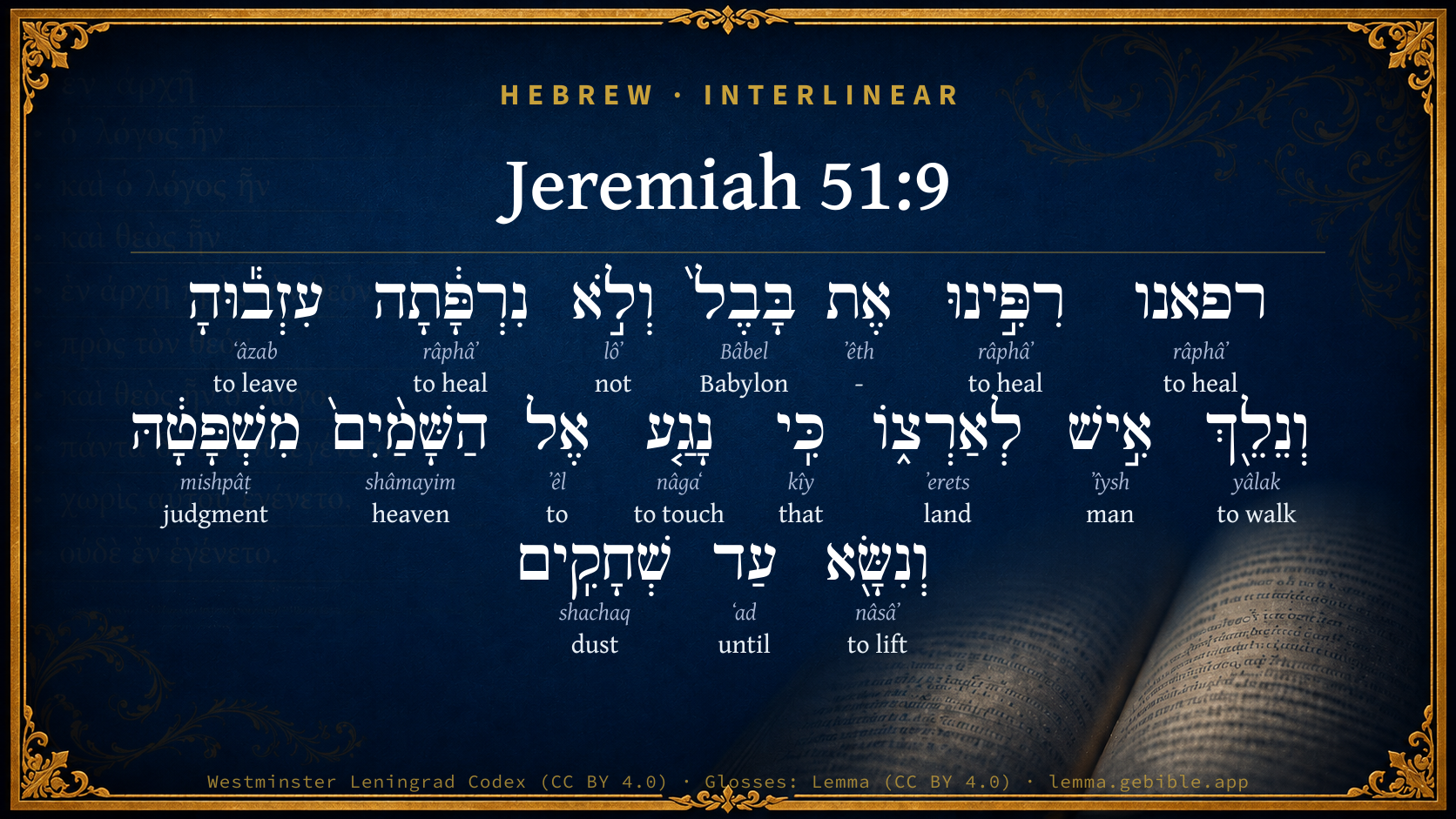
Jeremiah 51:9

Hebrew (Westminster Leningrad Codex) Jeremiah 51:9 appears in the Hebrew Old Testament. The text above is from the Westminster Leningrad Codex. Each word links to its Strong’s number, a concise gloss, and parsing drawn from the Open Scriptures Hebrew Bible morphology. Click any word for its full Brown-Driver-Briggs (BDB) entry.
Download image
Cite this verse

Jeremiah 51:9 (World English Bible). Public Domain. Lemma interlinear Bible study tool, https://lemma.gebible.app/v/jeremiah/51/9.

Show BibTeX & RIS
BibTeX
RIS
English Translation
We would have healed Babylon, but she is not healed: forsake her, and let us go everyone into his own country; for her judgment reaches to heaven, and is lifted up even to the skies.
World English Bible · Public Domain
Download a study sheet

One document with this verse’s original text, its word-by-word gloss line, the meaning frame, cross-references with their text, attributed commentary, and full source and license credits — printable, and it pastes into notes with its structure intact.

This verse Autodidact and up

Study sheet (.html) Plain text (.txt)

A passage Seminary Student

Up to 50 verses in one chapter. A passage sheet keeps up to 6 commentary sources and 12 cross-references per verse, in the order this page ranks them, and says so on the sheet whenever that leaves anything out. Ask for a single verse and you get the Autodidact verse sheet above.

Everything on this page stays free to read, with no account — the sheet is a download of what is already on screen, not access to it.

Want to remove ads? Support Godless Engineer
Compare translations 3

The same verse in 3 English versions, stacked beneath the original-language interlinear above. Click any original word for its lexicon entry.

Each is an independent rendering of the whole verse — the interlinear is not word-aligned to these translations.

Highlighted words mark where these versions differ — a whole-verse word diff, not a word-by-word alignment.

  • World English Bible Public Domain
    We would have healed Babylon, but she is not healed: forsake her, and let us go everyone into his own country; for her judgment reaches to heaven, and is lifted up even to the skies.
  • King James Version Public Domain
    We would have healed Babylon, but she is not healed: forsake her, and let us go every one into his own country: for her judgment reacheth unto heaven, and is lifted up even to the skies.
  • unfoldingWord Literal Text CC BY-SA 4.0
    ‘We wished to heal Babylon, but she is not healed. Let us all leave her and go away, to our own land. For her guilt reaches up to the heavens; it is piled up to the clouds.

unfoldingWord Literal Text — © unfoldingWord, licensed CC BY-SA 4.0. Word-aligned USFM3 via Door43 (git.door43.org/unfoldingWord/en_ult).

Versions to compare (up to 4)

3 of 4 selected

Show all 18 translations

Every available English version of this verse, each an independent rendering of the whole verse.

  • World English Bible Public Domain
    We would have healed Babylon, but she is not healed: forsake her, and let us go everyone into his own country; for her judgment reaches to heaven, and is lifted up even to the skies.
  • Berean Standard Bible Public Domain
    “We tried to heal Babylon, but she could not be healed. Abandon her! Let each of us go to his own land, for her judgment extends to the sky and reaches to the clouds.”
  • Majority Standard Bible Public Domain
    “We tried to heal Babylon, but she could not be healed. Abandon her! Let each of us go to his own land, for her judgment extends to the sky and reaches to the clouds.”
  • King James Version Public Domain
    We would have healed Babylon, but she is not healed: forsake her, and let us go every one into his own country: for her judgment reacheth unto heaven, and is lifted up even to the skies.
  • American Standard Version (1901) Public Domain
    We would have healed Babylon, but she is not healed: forsake her, and let us go every one into his own country; for her judgment reacheth unto heaven, and is lifted up even to the skies.
  • Revised Version (1885) Public Domain
    We would have healed Babylon, but she is not healed: forsake her, and let us go every one into his own country: for her judgment reacheth unto heaven, and is lifted up even to the skies.
  • Geneva Bible (1599) Public Domain
    We would haue cured Babel, but she could not be healed: forsake her, and let vs go euery one into his owne countrey: for her iudgement is come vp vnto heauen, and is lifted vp to ye cloudes.
  • Douay-Rheims (1899) Public Domain
    We would have cured Babylon, but she is not healed: let us forsake her, and let us go every man to his own land: because her judgment hath reached even to the heavens, and is lifted up to the clouds.
  • Young's Literal Translation Public Domain
    We healed Babylon, and she was not healed, Forsake her, and we go, each to his land, For come unto the heavens hath its judgment, And it hath been lifted up unto the clouds.
  • Literal Standard Version CC BY-SA 4.0
    We healed Babylon, and she was not healed, || Forsake her, and we go, each to his land, || For her judgment has come to the heavens, || And it has been lifted up to the clouds.
  • Unlocked Literal Bible CC BY-SA 4.0
    'We wished to heal Babylon, but she is not healed. Let us all leave her and go away, to our own land. For her guilt reaches up to the heavens; it is piled up to the clouds.
  • unfoldingWord Literal Text CC BY-SA 4.0
    ‘We wished to heal Babylon, but she is not healed. Let us all leave her and go away, to our own land. For her guilt reaches up to the heavens; it is piled up to the clouds.
  • Darby Bible Public Domain
    We have treated Babylon, but she is not healed: forsake her, and let us go every one into his own country; for her judgment reacheth unto the heavens, and is lifted up to the skies.
  • World Messianic Bible Public Domain
    “We would have healed Babylon, but she is not healed. Forsake her, and let’s each go into his own country; for her judgment reaches to heaven, and is lifted up even to the skies.
  • Webster's Bible Public Domain
    We would have healed Babylon, but she is not healed: forsake her, and let us go every one into his own country: for her judgment reacheth to heaven, and is lifted even to the skies.
  • Free Bible Version CC BY-SA 4.0
    “We tried to heal her, but she couldn't be helped. So give up on her! All of us should go home to where we came from. The news of her punishment has reached everywhere, all the way to heaven.
  • Bible in Basic English Public Domain
    We would have made Babylon well, but she is not made well: give her up, and let us go everyone to his country: for her punishment is stretching up to heaven, and lifted up even to the skies.
  • JPS Tanakh (1917) Public Domain
    We would have healed Babylon, but she is not healed; forsake her, and let us go every one into his own country; for her judgment reacheth unto heaven, and is lifted up even to the skies.

Literal Standard Version (2020), Covenant Press — licensed CC BY-SA 4.0. Text via the HelloAO Bible API (eBible.org). Unlocked Literal Bible (unfoldingWord) — licensed CC BY-SA 4.0. Text via the HelloAO Bible API (eBible.org). unfoldingWord Literal Text — © unfoldingWord, licensed CC BY-SA 4.0. Word-aligned USFM3 via Door43 (git.door43.org/unfoldingWord/en_ult). Free Bible Version, Dr. Jonathan Gallagher — licensed CC BY-SA 4.0. Text via the HelloAO Bible API (eBible.org).

Word by word

More ways to search: Search by grammar → Find every occurrence → Compare this word →

Practice this passage: Drill this verse → Learn its vocabulary →

שְׁחָקִֽים
shachaq
H7834
“clouds”
Noun, Common, Masculine, Plural, Absolute
Part of Speech
Noun
Type
Common
Gender
Masculine
Number
Plural
State
Absolute
Full BDB Definition

Origin: from H7833

TWOT: 2367a

dust, cloud - fine dust - (thin) cloud
  1. רפאנו râphâʼ H7495 “to heal” Verb, Piel, Perfect, 1st Person, Common, Plural
  2. רִפִּ֣ינוּ râphâʼ H7495 “to heal” Verb, Piel, Perfect, 1st Person, Common, Plural
  3. אֶת ʼêth H853 “-” Particle, Direct Object
  4. בָּבֶל֙ Bâbel H894 “Babylon” Noun, Proper
  5. וְלֹ֣א lôʼ H3808 “and · not” Conjunction + Particle, Negative
  6. נִרְפָּ֔תָה râphâʼ H7495 “to heal” Verb, Niphal, Perfect, 3rd Person, Feminine, Singular
  7. עִזְב֕וּהָ ʻâzab H5800 “leave · her” Verb, Qal, Imperative, 2nd Person, Masculine, Plural + Suffix, Personal, 3rd Person, Feminine, Singular
  8. וְנֵלֵ֖ךְ yâlak H3212 “and · to walk” Conjunction + Verb, Qal, Imperfect, 1st Person, Common, Plural
  9. אִ֣ישׁ ʼîysh H376 “man” Noun, Common, Masculine, Singular, Absolute
  10. לְאַרְצ֑וֹ ʼerets H776 “to/for · land · his” Preposition + Noun, Common, Both, Singular, Construct + Suffix, Personal, 3rd Person, Masculine, Singular
  11. כִּֽי kîy H3588 “that” Conjunction
  12. נָגַ֤ע nâgaʻ H5060 “to touch” Verb, Qal, Perfect, 3rd Person, Masculine, Singular
  13. אֶל ʼêl H413 “to” Preposition
  14. הַשָּׁמַ֨יִם֙ shâmayim H8064 “the · heaven(s)” Particle, Definite Article + Noun, Common, Masculine, Plural, Absolute
  15. מִשְׁפָּטָ֔הּ mishpâṭ H4941 “judgment · her” Noun, Common, Masculine, Singular, Construct + Suffix, Personal, 3rd Person, Feminine, Singular
  16. וְנִשָּׂ֖א nâsâʼ H5375 “and · to lift” Conjunction + Verb, Niphal, Perfect, 3rd Person, Masculine, Singular
  17. עַד ʻad H5704 “until” Preposition

About this verse

These counts appear in no published source. They are computed here, from the morphology-tagged text and Lemma’s own curated glosses. What Lemma adds →

18
words
16
distinct lemmas
Prophets
section

Notable vocabulary

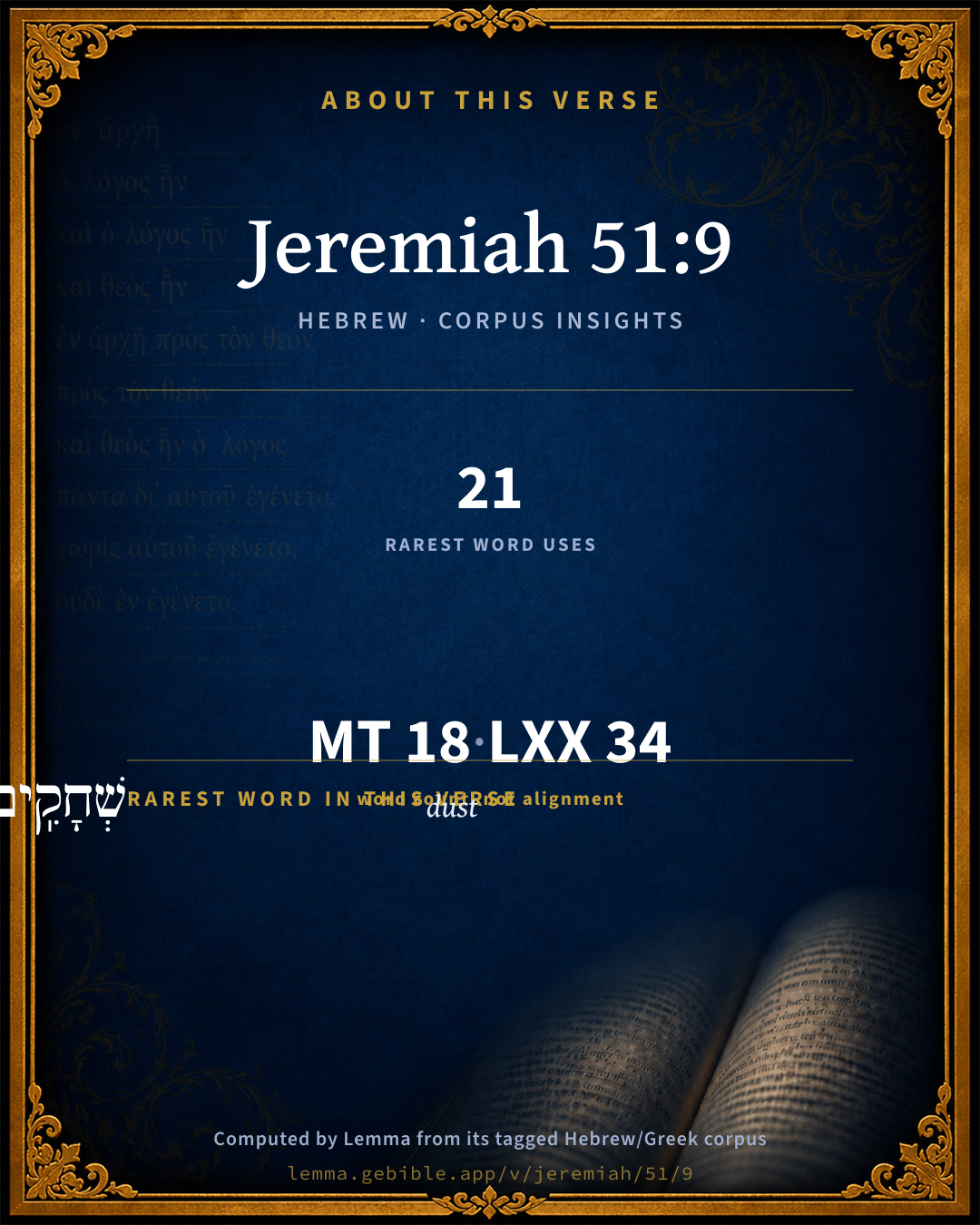
The rarest word here is שְׁחָקִֽים dust H7834 — appearing just 21 times in the whole Hebrew Bible.

Shared distinctive vocabulary

שְׁחָקִֽים dust H7834 occurs in 21 verses of the Hebrew Bible. Also found in:

Grammatical profile

  • 7 verbs
  • 6 nouns
  • 2 prepositions
  • 1 conjunction
  • 2 particles

Verb forms

  • רפאנו Piel · Perfect
  • רִפִּ֣ינוּ Piel · Perfect
  • נִרְפָּ֔תָה Niphal · Perfect
  • עִזְב֕וּהָ Qal · Imperative
  • וְנֵלֵ֖ךְ Qal · Imperfect
  • נָגַ֤ע Qal · Perfect
  • וְנִשָּׂ֖א Niphal · Perfect

Repetition

A word recurs within this verse — often emphatic in Hebrew:

  • רפאנו to heal H7495 ×3

Hebrew & Septuagint length

In the original languages it is 18 Hebrew tokens and 34 Greek tokens — but the two are counted differently (Hebrew bundles its prefixes and suffixes into one token; the Greek is in lemma form), so that isn’t a like-for-like length.

Cross-references

11

Topical passages linked to Jeremiah 51:9 in the Treasury of Scripture Knowledge — connected by theme and wording, ordered by reader-vote popularity; previews shown in the World English Bible.

  • Jeremiah 50:16 Cut off the sower from Babylon, and him who handles the sickle in the time of harvest: for fear of the oppressing sword they shall turn everyone to his people, and they shall flee everyone to his own land.
  • Isaiah 13:14 It shall happen, that as the chased roe, and as sheep that no man gathers, they shall turn every man to his own people, and shall flee every man to his own land.
  • Revelation 18:5 for her sins have reached to the sky, and God has remembered her iniquities.
  • Jeremiah 46:16 He made many to stumble, yes, they fell one on another: and they said, Arise, and let us go again to our own people, and to the land of our birth, from the oppressing sword.
  • Ezra 9:6 and I said, my God, I am ashamed and blush to lift up my face to you, my God; for our iniquities are increased over our head, and our guiltiness is grown up to the heavens.
  • Daniel 4:20–22 The tree that you saw, which grew, and was strong, whose height reached to the sky, and the sight of it to all the earth;
  • 2 Chronicles 28:9 But a prophet of Yahweh was there, whose name was Oded: and he went out to meet the host that came to Samaria, and said to them, Behold, because Yahweh, the God of your fathers, was angry with Judah, he has delivered them into your hand, and you have slain them in a rage which has reached up to heaven.
  • Isaiah 47:15 Thus shall the things be to you in which you have labored: those who have trafficked with you from your youth shall wander everyone to his quarter; there shall be none to save you.
  • Jeremiah 8:20 The harvest is past, the summer is ended, and we are not saved.
  • Jeremiah 46:21 Also her hired men in the midst of her are like calves of the stall; for they also are turned back, they are fled away together, they didn't stand: for the day of their calamity is come on them, the time of their visitation.
  • Matthew 25:10–13 While they went away to buy, the bridegroom came, and those who were ready went in with him to the marriage feast, and the door was shut.

Cross-references courtesy of OpenBible.info (CC BY 4.0).

Hebrew and Greek witnesses Masoretic Hebrew ↔ Greek Septuagint

The same verse in the two great witnesses to the Old Testament, shown verse-for-verse.

These are two independent witnesses, not word-aligned to each other, and the Septuagint is shown in lemma (dictionary) form.

Hebrew Jeremiah 51:9 Masoretic · Westminster Leningrad Codex

רפאנו רִפִּ֣ינוּ אֶת בָּבֶל֙ וְלֹ֣א נִרְפָּ֔תָה עִזְב֕וּהָ וְנֵלֵ֖ךְ אִ֣ישׁ לְאַרְצ֑וֹ כִּֽי נָגַ֤ע אֶל הַשָּׁמַ֨יִם֙ מִשְׁפָּטָ֔הּ וְנִשָּׂ֖א עַד שְׁחָקִֽים

We would have healed Babylon, but she is not healed: forsake her, and let us go everyone into his own country; for her judgment reaches to heaven, and is lifted up even to the skies.

World English Bible · Public Domain

Greek LXX Structure differs

In the Septuagint, Jeremiah is about an eighth shorter than the Hebrew and arranges its material differently — the Oracles Against the Nations (Hebrew chapters 46–51) appear in the middle of the Greek book, after 25:13. Because the chapter and verse boundaries do not line up, a verse-for-verse comparison with the Hebrew is not shown.

A verse-for-verse comparison isn’t shown here because the chapters and verses don’t line up. Switch to the LXX edition with the MT / LXX toggle above to read the Greek directly.

Hebrew: Westminster Leningrad Codex (CC BY 4.0). Greek: Septuagint (public domain); English from a public-domain English Septuagint. How the Septuagint differs from the Hebrew →

Targum (Aramaic paraphrase)

1

The Targum is the ancient Jewish Aramaic paraphrase of the Hebrew Scriptures — an interpretive translation, not the Hebrew text itself. Onkelos (literal) and Pseudo-Jonathan (expansive) render the Torah, and Jonathan the Prophets. Coverage is partial: where no permissively-licensed English translation exists for a verse, only the Aramaic is shown. This is verse-level text, not a word-by-word alignment to the Hebrew.

  1. Targum Jonathan Prophets (Joshua–Malachi)
    אֲסֵינָא יַת בָּבֶל וְלָא מִתַּסְיָא שַׁבְקוּהָא וְנֵיזֵיל גְבַר לְאַרְעֵיהּ אֲרֵי קָרִיב לִשְׁמַיָא תְּבִירָהּ וּמְנַטֵל עַד שְׁמֵי שְׁמַיָא:

    (no public-domain English translation for this verse)

    Targum Jonathan — Aramaic: “Mikraot Gedolot” (public domain). English: “Sefaria Community Translation” (CC0 1.0 (public-domain dedication)); “London "Chaldee Paraphrase," 1871” (public domain). Text via Sefaria.

Commentary

Notes on Jeremiah 51:9 from classic Christian and Jewish commentators (each source and its license shown beneath its notes). The classic Christian expositions comment on the surrounding passage and are grouped to its opening verse, so a note may address several verses; the Jewish commentaries on the Tanakh (Rashi and others) are per-verse, so they appear only where the commentator wrote on this verse.

Lemma curates 59 commentaries, every one of them public domain or Creative Commons licensed, each selected and text-cleaned for this edition rather than reprinted as found. About our sources →

Trapp's Complete Commentary

John Trapp

Jer 51:9 We would have healed Babylon, but she is not healed: forsake her, and let us go every one into his own country: for her judgment reacheth unto heaven, and is lifted up [even] to the skies.

Ver. 9. We would have healed Babylon.] Say the foreign nations that came to help her, or the people of God, {a} say others, that were kept captive by her, as Daniel and the rest.

But she is not healed.] Or, She could not be healed. See Hos 7:1.

For her judgment reacheth unto heaven.] It coelo clamor, proportionable to her sin. {Rev 18:5}

{a} Vox electorum. - Oecolamp.

John Trapp, A Commentary or Exposition upon All the Books of the Old and New Testament (1647–1656) — public domain. Text from a community e-Sword module.

Tyndale Open Study Notes

Tyndale Open Resources

51:9-10 Nothing could save Babylon; her punishment could not be measured. After Babylon collapsed, it would be time for the exiles to return home, where they could tell others of God’s wonderful acts on their behalf.

Tyndale Open Study Notes — © Tyndale Open Resources, licensed CC BY-SA 4.0. Text via the HelloAO Bible API.

Geneva Bible (1599)

Geneva Bible translators

Thus the people of God exhort one another to go to Zion and praise God.

Geneva Bible (1599) marginal notes — public domain. Text via Bolls.life.

Jamieson, Fausset & Brown

Robert Jamieson, A. R. Fausset & David Brown

We would have healed--We attempted to heal.

her judgment--her crimes provoking God's "judgments" [GROTIUS].

reacheth unto heaven-- (Gen 18:21; Jon 1:2; Rev 18:5). Even the heathen nations perceive that her awful fall must be God's judgment for her crying sins (Psa 9:16; Psa 64:9).

Jamieson, Fausset & Brown — Commentary Critical and Explanatory on the Whole Bible (1871) — public domain (CC PDM 1.0). Text via the HelloAO Bible API.

Adam Clarke's Commentary

Verse 9. We would have healed Babylon] Had it been in our power, we would have saved her; but we could not turn away the judgment of God.

Adam Clarke's Commentary on the Bible (1810–1826) — public domain. Text from a community e-Sword/MySword module.

John Calvin's Commentaries

The Prophet assumes different characters; he speaks here in the person of those who of themselves brought help to the Babylonians. And many, no doubt, would have been ready to assist them, had King Belshazzar wished to accept aid; and we know also, that the city had a large army. He compares, then, the nations subject to the Babylonians, and also the hired and foreign soldiers, to physicians, as though he had said, “Babylon has been, with great care, healed.” As when a great prince is taken ill, he sends here and there for the best and most skillful physicians; but when the disease is incurable, they all strive in vain to save his life: so now the Prophet speaks, using a metaphor; but he speaks in the person of those who either had set to hire their services, or had come from a sense of duty to heal Babylon. “See,” they said, “the fault is not with us, for we have faithfully and carefully done our best to heal her, but she has not been healed.”

He then adds, Leave her, and let us depart, every one to his own land. This was the language of foreign soldiers and mercenaries. When they saw that the safety of the city was hopeless, they began to counsel one another, “What do we? Ought we not rather to consult our own safety? for our efforts are wholly useless. It is then time for every one to return to his own country, for the end of Babylon is come.” But the change of person has much more force than if the Prophet had spoken thus, “The time shall come when the auxiliaries shall flee away, for they will see that it would be all in vain to defend her.” But when he compares them to physicians, this similitude more fully illustrates the case; and then when he speaks in their person, this renders what is said still more emphatieal.

He at length adds, For her judgment has reached to the heavens, and has been elevated to the clouds. Jeremiah could not have properly addressed what he said to the unbelieving, if you explain this of God being adverse and hostile to the Babylonians; for it never occurred to the hired soldiers,

that Babylon perished through the just judgment of God. But the Prophet, according to a usual mode of speaking, says, Her judgment (that is, her destruction) reached to the heavens, and has been elevated to the clouds; that is, no aid shall be found under heaven, which can deliver Babylon, — how so? because it will be the same as though destruction came from heaven itself, and from the clouds. For when danger is nigh either from behind or from before us, we can turn aside either to the right hand or to the left, so that we may escape the evils which men may bring on us: but when heaven itself seems to threaten our heads, then an escape is attempted in vain. This then is the reason why the Prophet says that the judgment of Babylon had reached to the heavens and had been elevated to the clouds. It follows, —

John Calvin's Commentaries (1540-1563) — public domain. Text from the Calvin Translation Society English edition (1840s-50s) via the Christian Classics Ethereal Library (ccel.org). Calvin's coverage is partial (roughly two-thirds of the Bible); uncommented books and verses are honest gaps, never fabricated. The 19th-century editor's footnotes and remarks are omitted so the notes are faithfully Calvin's own voice.

Ellicott's Commentary for English Readers

(9) We would have healed Babylon . . .—This is the dramatic answer of the Israelite exiles to the prophet’s appeal. They have done what they could, but all was in vain. The guilt could not be washed away, the punishment could not be averted. The “judgment” is measureless as is the distance from heaven to earth. This is also reproduced in Rev_18:5. For the phrase, as applied to Nebuchadnezzar, see Dan_4:20. Possibly there may be an allusive reference to the tower of Babel, “reaching unto heaven,” as the type of Babylonian greatness (Gen_11:4).

A Bible Commentary for English Readers, edited by Charles John Ellicott (1878–1897) — public domain. Text from a community e-Sword module.

The Cambridge Bible for Schools and Colleges

gen. ed. J. J. S. Perowne

9. We would have healed, etc.] As the v. cannot be taken to express Jewish sentiment, we must suppose it to be put in the mouth of the nations, intoxicated by their share in the splendour of Babylon, and so lamenting its fall and desiring to restore its fortunes. Cp. Rev_18:9-19, and for Israel’s joy (Jer_51:10) at the judgement which befalls its oppressor, Rev_18:20.

her judgement] i.e. her punishment.

The Cambridge Bible for Schools and Colleges (gen. ed. J. J. S. Perowne; Cambridge University Press, 1878–1918) — public domain. Text from a community e-Sword module.

John Gill's Exposition

We would have healed Babylon, but she is not healed,.... These are either the words of the friends of Babylon of her auxiliaries and allies, who did all they could to defend her against the Persians, but to no purpose; it was not in their power to help her; the time of her destruction was come, and there was no avoiding it; or of the prophets and good people of the Jews that were in Babylon, that took pains to convince, the inhabitants of Babylon of their idolatries and other sins, and reform them, that so they might not be their ruin; but all instructions and admonitions were in vain; in like manner many worthy reformers have laboured much to reclaim mystical Babylon, or the church of Rome, from her errors and idolatries; but still she retains them; wherefore it follows:

forsake her, and let us go everyone into his own country; so said the auxiliary troops that were in the service of the king of Babylon; since we can do him no good, and are ourselves posed to danger, let us desert him, and provide for our safety by hastening to our own country as fast as we can; this was really the case after the first battle of Cyrus with the Babylonians, in which their king Neriglissar was slain: Croesus and the rest of the allies, seeing their case so distressed and helpless, left them to shift for themselves, and fled by night (h): or so might the Jews say when the city was taken, and they were delivered out of the hands of their oppressors; and so will the people of God say, who shall be called out of mystical Babylon just before its ruin, Rev 18:4;

for her judgment reacheth unto heaven, and is lifted up even to the skies: that is, her sins were so many, that they reached even to heaven; and were taken notice of by God that dwelleth there; and were the cause of judgment or punishment being from thence inflicted on her, which was unavoidable, being the decree of heaven, and the just demerit of her sin; and therefore no help could be afforded her; nor was there any safety by being in her; see Rev 18:5.

(h) Xenophon, Cyropaedia l. 4. c. 2.

John Gill's Exposition of the Whole Bible (1746–1763) — public domain (CC PDM 1.0). Text via the HelloAO Bible API.

Albert Barnes' Notes on the Bible

Omit would. All was done that it was possible to do to heal her.

To the skies - Or, to the clouds.

Albert Barnes' Notes on the Bible (1834–1885) — public domain. Text from a community e-Sword/MySword module.

Haydock's Catholic Bible Commentary

We. The guardian angels, or Jews reply. Miracles are lost on her. --- Heavens. Her crimes call for punishment, Genesis xviii. 21., and Jonas i. 2.

George Leo Haydock (1774–1849), Haydock's Catholic Family Bible and Commentary, 1859 edition — public domain. Excludes Psalms (Douay-Rheims chapter numbering differs from Protestant) and Deuterocanonical books (Catholic canon only).

Matthew Poole's English Annotations

The prophet here seemeth to personate the mercenary soldiers that should come to help the Chaldeans, as if they should say this, they would have helped Babylon, but there was no healing for her; and therefore they call one to another to leave her to herself, and return each man to his own country, for her punishment was very great, her case too sad for them to help. The reaching of things to the heavens, and lifting them up to the skies, are phrases used to signify high and great measures and degrees of things, so expressed Gen 11:4; 28:12; Deu 1:28; 1Sa 5:12; 2Ch 28:9; Psa 107:26.

Matthew Poole's English Annotations on the Holy Bible (1683–1685) — public domain. Text from a community e-Sword/MySword module.

Whedon's Commentary on the Bible

Daniel D. Whedon

9. Let us go every one into his own country — This is the language of mercenaries from different lands. Hence they say, We would have healed, etc.

Judgment — Really the sin by which the “judgment” is measured.

Daniel D. Whedon (gen. ed.), Commentary on the Old and New Testaments (1874–1909) — public domain. Text from a community e-Sword module.

The Pulpit Commentary

We would have healed Babylon. Experience shows that it is useless to attempt to correct such inveterate evils. Everyone into his own country. (as Jer_50:16) Her judgment; i.e. her punishment. Perhaps there is an allusion to the fate of Sodom and Gomorrah, burned by fire from heaven. But we might also render "her crime". (comp. Deu_19:6, where "worthy of death" is more strictly "a capital crime

The Pulpit Commentary (1880–1919), ed. H.D.M. Spence-Jones & Joseph S. Exell — public domain. Text from a community e-Sword module.

John Wesley's Explanatory Notes

We - The prophet seems to personate the mercenary soldiers, saying, they would have helped Babylon, but there was no healing for her.

John Wesley, Explanatory Notes Upon the Whole Bible (1754–1765) — public domain. Text via the GEBible commentary corpus.

unfoldingWord translationNotes

Door43 World Missions Community

General Information:

Yahweh used Babylon to punish Judah and the nation. It is either the people of Judah or the people of the nations who are speaking the words in this quotation.

Babylon ... she is not healed ... leave her ... her guilt

The name of the city is a metonym for the people who live there, and the city is spoken of as if it were a woman. AT: "the people of Babylon ... they are not healed ... leave them ... their guilt" (See: Metonymy and Metaphor)

she is not healed

This can be translated in active form. AT: "we have not been able to heal her" (See: Active or Passive)

For her guilt reaches up to the heavens; it is piled up to the clouds

Guilt is spoken of as if it were an object that could be made into a pile. The words "to the heavens" and "to the clouds" are an exaggeration for something that is very high. AT: "For Babylon is so very guilty" (See: Metaphor and Hyperbole and Generalization)

Yahweh has declared our innocence

Yahweh had punished the Israelites for their sins, but now has let them return to him.

translationWords

Babylon

guilt

heaven

Yahweh

innocent

Zion

works

God

unfoldingWord translationNotes — © Distant Shores Media and the Door43 World Missions Community, licensed CC BY-SA 4.0. Source: git.door43.org/Door43/en_tn.

Rashi

Rabbi Shlomo Yitzchaki (Rashi)

her judgment has touched the sky Their retribution has reached high up to the sky.

Rashi on the Tanakh — English translations: “The Judaica Press complete Tanach with Rashi, translated by A. J. Rosenberg” (CC BY 4.0); “Pentateuch with Rashi's commentary by M. Rosenbaum and A.M. Silbermann, 1929-1934” (public domain); “The Metsudah Tanach series, Lakewood, N.J” (CC BY 4.0); and “The Book of Joshua, Metsudah Publications, 1997” (CC BY 4.0). Text via Sefaria.

Lesson kit

Teaching starters — assembled from the data on this page, not authored interpretation. Every prompt links to the verse data it draws on. Edit before teaching.

Jeremiah, in the Prophets, opens this verse with 18 words (16 distinct Hebrew lemmas). Its most distinctive word is shachaq (“dust”). A historical commentator’s framing appears above. Read the whole chapter for the surrounding context.

Discussion questions

  1. What does “dust” (shachaq) contribute to the verse as a whole?
  2. Deuteronomy 33:26 shares the word «dust» with this verse. How do the two illuminate each other?
  3. “to heal” occurs 3× in this one verse. What is the effect of the repetition?
  4. These translations render this verse differently; the difference is in the English rendering, not the original. What questions does that raise?
  5. The verb «רפאנו» is Piel Perfect. How does its form color the action?
  6. Reading how Trapp's Complete Commentary and Tyndale Open Study Notes read this verse, where do the two commentators agree and where do they part?

Things to notice

Reading settings

Reading text

Shown beneath each verse's original-language words.

Old Testament
Old Testament edition

Read the OT as the Masoretic Hebrew (MT) or the Greek Septuagint (LXX).

English shown for the Greek Septuagint (in the Hebrew ↔ Greek comparison).

Comparing translations? Open the Compare panel on any verse page to stack up to four side by side.