
2 Kings 3:14

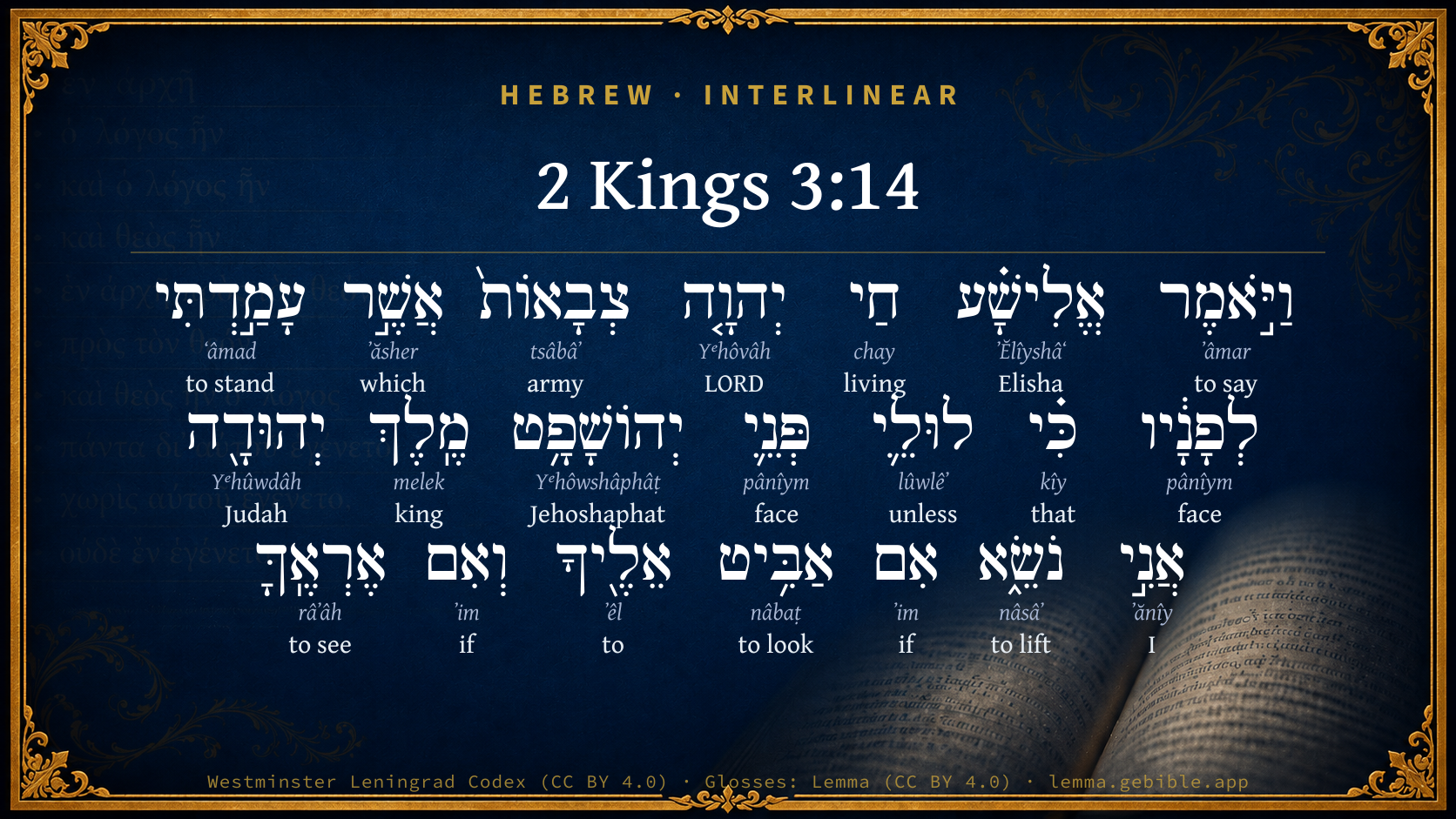
Hebrew (Westminster Leningrad Codex) 2 Kings 3:14 appears in the Hebrew Old Testament. The text above is from the Westminster Leningrad Codex. Each word links to its Strong’s number, a concise gloss, and parsing drawn from the Open Scriptures Hebrew Bible morphology. Click any word for its full Brown-Driver-Briggs (BDB) entry.
Download image
Cite this verse

2 Kings 3:14 (World English Bible). Public Domain. Lemma interlinear Bible study tool, https://lemma.gebible.app/v/2-kings/3/14.

Show BibTeX & RIS
BibTeX
RIS
English Translation
Elisha said, As Yahweh of Hosts lives, before whom I stand, surely, were it not that I regard the presence of Jehoshaphat the king of Judah, I would not look toward you, nor see you.
World English Bible · Public Domain
Download a study sheet

One document with this verse’s original text, its word-by-word gloss line, the meaning frame, cross-references with their text, attributed commentary, and full source and license credits — printable, and it pastes into notes with its structure intact.

This verse Autodidact and up

Study sheet (.html) Plain text (.txt)

A passage Seminary Student

Up to 50 verses in one chapter. A passage sheet keeps up to 6 commentary sources and 12 cross-references per verse, in the order this page ranks them, and says so on the sheet whenever that leaves anything out. Ask for a single verse and you get the Autodidact verse sheet above.

Everything on this page stays free to read, with no account — the sheet is a download of what is already on screen, not access to it.

Want to remove ads? Support Godless Engineer
Compare translations 3

The same verse in 3 English versions, stacked beneath the original-language interlinear above. Click any original word for its lexicon entry.

Each is an independent rendering of the whole verse — the interlinear is not word-aligned to these translations.

Highlighted words mark where these versions differ — a whole-verse word diff, not a word-by-word alignment.

  • World English Bible Public Domain
    Elisha said, As Yahweh of Hosts lives, before whom I stand, surely, were it not that I regard the presence of Jehoshaphat the king of Judah, I would not look toward you, nor see you.
  • King James Version Public Domain
    And Elisha said, As the LORD of hosts liveth, before whom I stand, surely, were it not that I regard the presence of Jehoshaphat the king of Judah, I would not look toward thee, nor see thee.
  • unfoldingWord Literal Text CC BY-SA 4.0
    And Elisha said, “The life of Yahweh of armies, to whose face I stand, that unless I were lifting the face of Jehoshaphat, the king of Judah, if I would look at you and if I would regard you.

unfoldingWord Literal Text — © unfoldingWord, licensed CC BY-SA 4.0. Word-aligned USFM3 via Door43 (git.door43.org/unfoldingWord/en_ult).

Versions to compare (up to 4)

3 of 4 selected

Show all 18 translations

Every available English version of this verse, each an independent rendering of the whole verse.

  • World English Bible Public Domain
    Elisha said, As Yahweh of Hosts lives, before whom I stand, surely, were it not that I regard the presence of Jehoshaphat the king of Judah, I would not look toward you, nor see you.
  • Berean Standard Bible Public Domain
    Then Elisha said, “As surely as the LORD of Hosts lives, before whom I stand, were it not for my regard for the presence of Jehoshaphat king of Judah, I would not look at you or acknowledge you.
  • Majority Standard Bible Public Domain
    Then Elisha said, “As surely as the LORD of Hosts lives, before whom I stand, were it not for my regard for the presence of Jehoshaphat king of Judah, I would not look at you or acknowledge you.
  • King James Version Public Domain
    And Elisha said, As the LORD of hosts liveth, before whom I stand, surely, were it not that I regard the presence of Jehoshaphat the king of Judah, I would not look toward thee, nor see thee.
  • American Standard Version (1901) Public Domain
    And Elisha said, As Jehovah of hosts liveth, before whom I stand, surely, were it not that I regard the presence of Jehoshaphat the king of Judah, I would not look toward thee, nor see thee.
  • Revised Version (1885) Public Domain
    And Elisha said, As the LORD of hosts liveth, before whom I stand, surely, were it not that I regard the presence of Jehoshaphat the king of Judah, I would not look toward thee, nor see thee.
  • Geneva Bible (1599) Public Domain
    Then Elisha said, As the Lord of hostes liueth, in whose sight I stande, if it were not, that I regarde the presence of Iehoshaphat the King of Iudah, I woulde not haue looked towarde thee, nor seene thee.
  • Douay-Rheims (1899) Public Domain
    And Eliseus said to him: As the Lord of hosts liveth, in whose sight I stand, if I did not reverence the face of Josaphat king of Juda, I would not have hearkened to thee, nor looked on thee.
  • Young's Literal Translation Public Domain
    And Elisha saith, `Jehovah of Hosts liveth, before whom I have stood; for unless the face of Jehoshaphat king of Judah I am lifting up, I do not look unto thee, nor see thee;
  • Literal Standard Version CC BY-SA 4.0
    And Elisha says, “YHWH of Hosts lives, before whom I have stood; for unless I am lifting up the face of Jehoshaphat king of Judah, I do not look to you, nor see you;
  • Unlocked Literal Bible CC BY-SA 4.0
    Elisha replied, “As Yahweh of hosts lives, before whom I stand, surely were it not for the fact that I honor the presence of Jehoshaphat king of Judah, I would not pay any attention to you, or even look at you.
  • unfoldingWord Literal Text CC BY-SA 4.0
    And Elisha said, “The life of Yahweh of armies, to whose face I stand, that unless I were lifting the face of Jehoshaphat, the king of Judah, if I would look at you and if I would regard you.
  • Darby Bible Public Domain
    And Elisha said, As Jehovah of hosts liveth, before whom I stand, surely, were it not that I regard the presence of Jehoshaphat the king of Judah, I would not look toward thee nor see thee.
  • World Messianic Bible Public Domain
    Elisha said, “As the LORD of Hosts lives, before whom I stand, surely, were it not that I respect the presence of Jehoshaphat the king of Judah, I would not look toward you, nor see you.
  • Webster's Bible Public Domain
    And Elisha said, As the LORD of hosts liveth, before whom I stand, surely, were it not that I regard the presence of Jehoshaphat the king of Judah, I would not look towards thee, nor see thee.
  • Free Bible Version CC BY-SA 4.0
    Elisha replied, “As the Lord Almighty lives, the one I serve, if I didn't respect the fact that Jehoshaphat, king of Judah, is here, I wouldn't even look in your direction or acknowledge you.
  • Bible in Basic English Public Domain
    Then Elisha said, By the life of the Lord of armies whose servant I am, if it was not for the respect I have for Jehoshaphat, king of Judah, I would not give a look at you, or see you.
  • JPS Tanakh (1917) Public Domain
    And Elisha said: 'As the LORD of hosts liveth, before whom I stand, surely, were it not that I regard the presence of Jehoshaphat the king of Judah, I would not look toward thee, nor see thee.

Literal Standard Version (2020), Covenant Press — licensed CC BY-SA 4.0. Text via the HelloAO Bible API (eBible.org). Unlocked Literal Bible (unfoldingWord) — licensed CC BY-SA 4.0. Text via the HelloAO Bible API (eBible.org). unfoldingWord Literal Text — © unfoldingWord, licensed CC BY-SA 4.0. Word-aligned USFM3 via Door43 (git.door43.org/unfoldingWord/en_ult). Free Bible Version, Dr. Jonathan Gallagher — licensed CC BY-SA 4.0. Text via the HelloAO Bible API (eBible.org).

Word by word

More ways to search: Search by grammar → Find every occurrence → Compare this word →

Practice this passage: Drill this verse → Learn its vocabulary →

לוּלֵ֛י
lûwlêʼ
H3884
“unless”
Conjunction
Part of Speech
Conjunction
Full BDB Definition

Origin: from H3863 and H3808

TWOT: 1085a

unless, if not, except
  1. וַיֹּ֣אמֶר ʼâmar H559 “and · to say” Conjunction + Verb, Qal, Sequential Imperfect, 3rd Person, Masculine, Singular
  2. אֱלִישָׁ֗ע ʼĔlîyshâʻ H477 “Elisha” Noun, Proper
  3. חַי chay H2416 “living” Adjective, Adjective, Masculine, Singular, Absolute
  4. יְהוָ֤ה Yᵉhôvâh H3068 “LORD” Noun, Proper
  5. צְבָאוֹת֙ tsâbâʼ H6635 “armies” Noun, Common, Both, Plural, Absolute
  6. אֲשֶׁ֣ר ʼăsher H834 “which” Particle, Relative
  7. עָמַ֣דְתִּי ʻâmad H5975 “to stand” Verb, Qal, Perfect, 1st Person, Common, Singular
  8. לְפָנָ֔יו pânîym H6440 “to/for · face(s) · his” Preposition + Noun, Common, Both, Plural, Construct + Suffix, Personal, 3rd Person, Masculine, Singular
  9. כִּ֗י kîy H3588 “that” Conjunction
  10. פְּנֵ֛י pânîym H6440 “face(s) of” Noun, Common, Both, Plural, Construct
  11. יְהוֹשָׁפָ֥ט Yᵉhôwshâphâṭ H3092 “Jehoshaphat” Noun, Proper
  12. מֶֽלֶךְ melek H4428 “king of” Noun, Common, Masculine, Singular, Construct
  13. יְהוּדָ֖ה Yᵉhûwdâh H3063 “Judah” Noun, Proper
  14. אֲנִ֣י ʼănîy H589 “I” Pronoun, Personal, 1st Person, Common, Singular
  15. נֹשֵׂ֑א nâsâʼ H5375 “lifting” Verb, Qal, Participle Active, Masculine, Singular, Absolute
  16. אִם ʼim H518 “if” Conjunction
  17. אַבִּ֥יט nâbaṭ H5027 “to look” Verb, Hiphil, Imperfect, 1st Person, Common, Singular
  18. אֵלֶ֖יךָ ʼêl H413 “to · you” Preposition + Suffix, Personal, 2nd Person, Masculine, Singular
  19. וְאִם ʼim H518 “and · if” Conjunction + Conjunction
  20. אֶרְאֶֽךָּ râʼâh H7200 “to see · you” Verb, Qal, Imperfect, 1st Person, Common, Singular + Suffix, Personal, 2nd Person, Masculine, Singular

About this verse

These counts appear in no published source. They are computed here, from the morphology-tagged text and Lemma’s own curated glosses. What Lemma adds →

21
words
19
distinct lemmas
Historical
section

Notable vocabulary

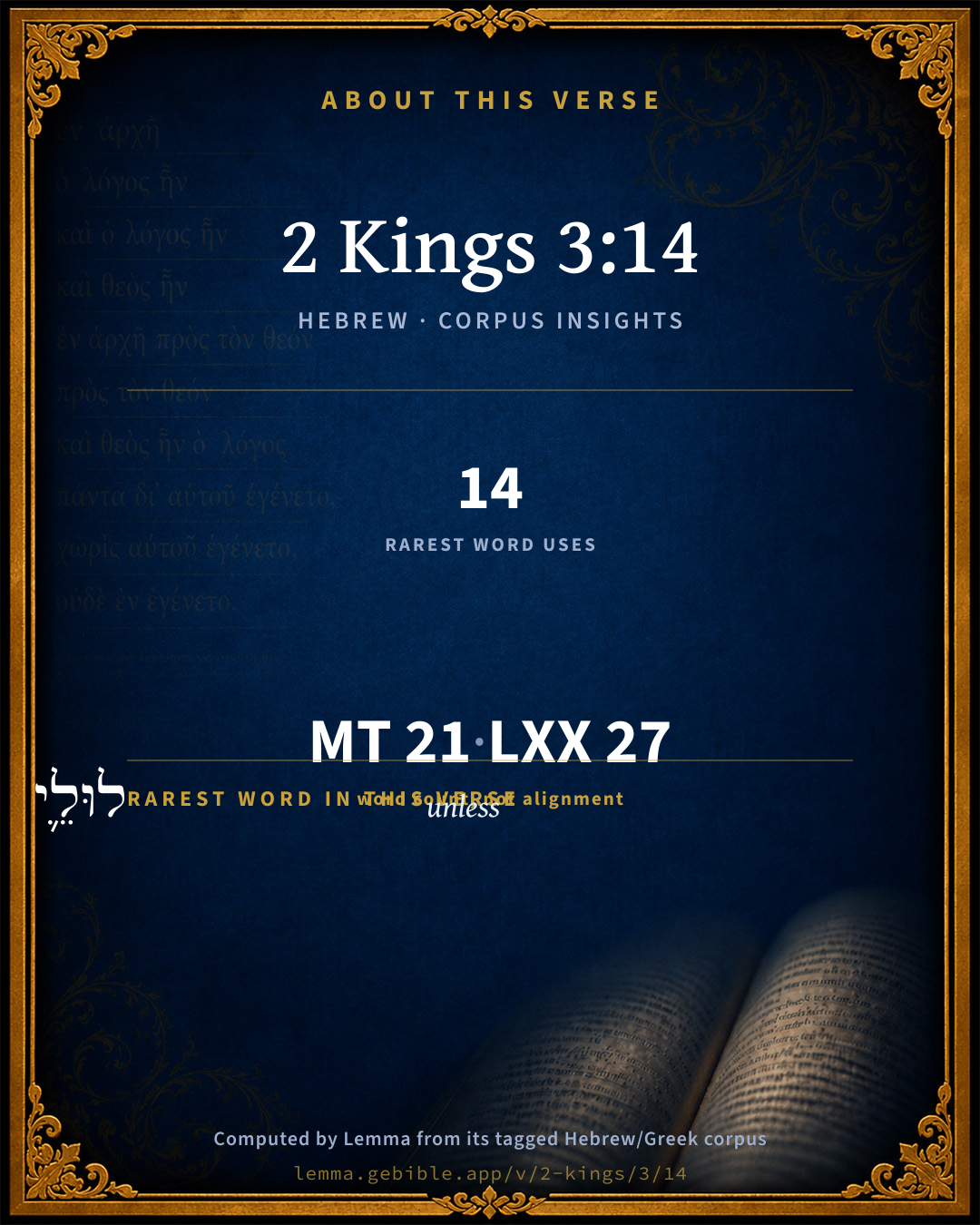
The rarest word here is לוּלֵ֛י unless H3884 — appearing just 14 times in the whole Hebrew Bible.

Shared distinctive vocabulary

לוּלֵ֛י unless H3884 occurs in 14 verses of the Hebrew Bible. Also found in:

Grammatical profile

  • 5 verbs
  • 8 nouns
  • 1 adjective
  • 1 pronoun
  • 1 preposition
  • 4 conjunctions
  • 1 particle

Verb forms

  • וַיֹּ֣אמֶר Qal · Sequential Imperfect
  • עָמַ֣דְתִּי Qal · Perfect
  • נֹשֵׂ֑א Qal · Participle Active
  • אַבִּ֥יט Hiphil · Imperfect
  • אֶרְאֶֽךָּ Qal · Imperfect

Repetition

Words recur within this verse — often emphatic in Hebrew:

  • לְפָנָ֔יו face H6440 ×2
  • אִם if H518 ×2

Hebrew & Septuagint length

In English translation the verse runs 35 words from the Hebrew and 34 from the Septuagint (LXX English) — closely comparable.

A rough comparison of the two English renderings, which tokenize alike — not a word-level alignment.

Word counts can differ between the Hebrew and the Greek without any difference in meaning — e.g. the Hebrew direct-object marker אֵת has no separate Greek word, and Greek often adds the article ὁ.

In the original languages it is 21 Hebrew tokens and 27 Greek tokens — but the two are counted differently (Hebrew bundles its prefixes and suffixes into one token; the Greek is in lemma form), so that isn’t a like-for-like length.

Cross-references

12

Topical passages linked to 2 Kings 3:14 in the Treasury of Scripture Knowledge — connected by theme and wording, ordered by reader-vote popularity; previews shown in the World English Bible.

  • 2 Kings 5:16 But he said, As Yahweh lives, before whom I stand, I will receive none. He urged him to take it; but he refused.
  • 1 Kings 17:1 Elijah the Tishbite, who was of the foreigners of Gilead, said to Ahab, As Yahweh, the God of Israel, lives, before whom I stand, there shall not be dew nor rain these years, but according to my word.
  • 1 Samuel 15:26–31 Samuel said to Saul, I will not return with you; for you have rejected the word of Yahweh, and Yahweh has rejected you from being king over Israel.
  • 1 Kings 14:5–18 Yahweh said to Ahijah, Behold, the wife of Jeroboam comes to inquire of you concerning her son; for he is sick: thus and thus shall you tell her; for it will be, when she comes in, that she will feign herself to be another woman.
  • 1 Kings 18:15 Elijah said, As Yahweh of Hosts lives, before whom I stand, I will surely show myself to him today.
  • 1 Kings 21:20 Ahab said to Elijah, Have you found me, my enemy? He answered, I have found you, because you have sold yourself to do that which is evil in the sight of Yahweh.
  • 2 Chronicles 17:3–9 Yahweh was with Jehoshaphat, because he walked in the first ways of his father David, and didn't seek the Baals,
  • 2 Chronicles 19:3–4 Nevertheless there are good things found in you, in that you have put away the Asheroth out of the land, and have set your heart to seek God.
  • Psalms 15:4 In whose eyes a vile man is despised, But who honors those who fear Yahweh; He who keeps an oath even when it hurts, and doesn't change;
  • Jeremiah 1:18 For, behold, I have made you this day a fortified city, and an iron pillar, and brazen walls, against the whole land, against the kings of Judah, against the princes of it, against the priests of it, and against the people of the land.
  • Daniel 5:17–23 Then Daniel answered before the king, Let your gifts be to yourself, and give your rewards to another; nevertheless I will read the writing to the king, and make known to him the interpretation.
  • Matthew 22:16 They sent their disciples to him, along with the Herodians, saying, "Teacher, we know that you are honest, and teach the way of God in truth, no matter who you teach, for you aren't partial to anyone.

Cross-references courtesy of OpenBible.info (CC BY 4.0).

Hebrew and Greek witnesses Masoretic Hebrew ↔ Greek Septuagint

The same verse in the two great witnesses to the Old Testament, shown verse-for-verse.

These are two independent witnesses, not word-aligned to each other, and the Septuagint is shown in lemma (dictionary) form.

Hebrew 2 Kings 3:14 Masoretic · Westminster Leningrad Codex

וַיֹּ֣אמֶר אֱלִישָׁ֗ע חַי יְהוָ֤ה צְבָאוֹת֙ אֲשֶׁ֣ר עָמַ֣דְתִּי לְפָנָ֔יו כִּ֗י לוּלֵ֛י פְּנֵ֛י יְהוֹשָׁפָ֥ט מֶֽלֶךְ יְהוּדָ֖ה אֲנִ֣י נֹשֵׂ֑א אִם אַבִּ֥יט אֵלֶ֖יךָ וְאִם אֶרְאֶֽךָּ

Elisha said, As Yahweh of Hosts lives, before whom I stand, surely, were it not that I regard the presence of Jehoshaphat the king of Judah, I would not look toward you, nor see you.

World English Bible · Public Domain

Greek LXX 2 Kings 3:14 Septuagint · lemma form

καί εἶπον ελισαιε ζάω κύριος ὁ δύναμις ὅς παραἵστημι ἐνώπιον αὐτός ὅτι εἰ μή πρόσωπον ιωσαφατ βασιλεύς ιουδα ἐγώ λαμβάνω εἰ ἐπιβλέπω πρός σύ καί ὁράω σύ

And Elisaie said, As the Lord of hosts before whom I stand lives, unless I regarded the presence of Josaphat the king of Juda, I would not have looked on you, nor seen you.

LXX2012 (modern English Septuagint) · Public Domain

Hebrew: Westminster Leningrad Codex (CC BY 4.0). Greek: Septuagint (public domain); English from LXX2012 (modern English Septuagint) (Public Domain). How the Septuagint differs from the Hebrew →

Targum (Aramaic paraphrase)

1

The Targum is the ancient Jewish Aramaic paraphrase of the Hebrew Scriptures — an interpretive translation, not the Hebrew text itself. Onkelos (literal) and Pseudo-Jonathan (expansive) render the Torah, and Jonathan the Prophets. Coverage is partial: where no permissively-licensed English translation exists for a verse, only the Aramaic is shown. This is verse-level text, not a word-by-word alignment to the Hebrew.

  1. Targum Jonathan Prophets (Joshua–Malachi)
    וַאֲמַר אֱלִישָׁע קַיָם הוּא יְיָ צְבָאוֹת דִמְשַׁמֵשְׁנָא קֳדָמוֹהִי אֲרֵי אִלוּלָא פוֹן אַפֵּי יְהוֹשָׁפָט מֶלֶךְ שִׁבְטָא דְבֵית יְהוּדָה אֲנָא נָסֵיב אִם אִסְתַּכַּל בָּךְ וְאִם אַחֲזִינָךְ:

    (no public-domain English translation for this verse)

    Targum Jonathan — Aramaic: “Mikraot Gedolot” (public domain). English: “Sefaria Community Translation” (CC0 1.0 (public-domain dedication)); “London "Chaldee Paraphrase," 1871” (public domain). Text via Sefaria.

Commentary

Notes on 2 Kings 3:14 from classic Christian and Jewish commentators (each source and its license shown beneath its notes). The classic Christian expositions comment on the surrounding passage and are grouped to its opening verse, so a note may address several verses; the Jewish commentaries on the Tanakh (Rashi and others) are per-verse, so they appear only where the commentator wrote on this verse.

Lemma curates 59 commentaries, every one of them public domain or Creative Commons licensed, each selected and text-cleaned for this edition rather than reprinted as found. About our sources →

Trapp's Complete Commentary

John Trapp

2Ki 3:14 And Elisha said, [As] the LORD of hosts liveth, before whom I stand, surely, were it not that I regard the presence of Jehoshaphat the king of Judah, I would not look toward thee, nor see thee.

Ver. 14. As the Lord of hosts liveth, before whom I stand.] As his servant; and therefore may not fear the face of any mortal wight, be he never so great a king or kaiser.

Surely, were it not that I regard the presence.] So saith the Lord to the world of wicked ones, concerning his saints and servants mixed among them. The scaffold standeth but only for the building’s sake; the hedge for the grain’s sake: when the building is finished, the scaffold is taken down; when the grain is ripe, the hedge is burned; so here.

John Trapp, A Commentary or Exposition upon All the Books of the Old and New Testament (1647–1656) — public domain. Text from a community e-Sword module.

Joseph Benson's Commentary

2Ki 3:14. Were it not that I regard the presence of Jehoshaphat — Whom I reverence and love for his piety, and therefore for his sake will inquire of the Lord for you all. It is good being with those who possess God’s favour and the love of his people. Wicked men often fare the better for the friendship and society of good men.

Joseph Benson's Commentary on the Old and New Testaments (1811–1818) — public domain. Text from a community e-Sword module.

Geneva Bible (1599)

Geneva Bible translators

God suffereth his word to be declared to the wicked, because of the godly that are among them.

Geneva Bible (1599) marginal notes — public domain. Text via Bolls.life.

Adam Clarke's Commentary

Verse 14. Were it not that I regard the presence of Jehoshaphat] He worshipped the true God; Jehoram was an idolater.

Adam Clarke's Commentary on the Bible (1810–1826) — public domain. Text from a community e-Sword/MySword module.

Ellicott's Commentary for English Readers

(14) Before whom I stand.—As a minister. (Comp. 1Ki_17:1; 1Ki_18:15.)

Surely.—Kî (for); used as in 2Ki_3:10 (“I cry, alas!” “I thus swear,” for, &c.). Jehoshaphat is accepted because of his faithful dependence on Jehovah (2Ki_3:11). Jehoram still maintained or tolerated the cultus of Bethel and Dan. (See 2Ki_3:3.)

Regard the presence.—Literally, lift the face. (Comp. Gen_19:21; Gen_32:21.)

A Bible Commentary for English Readers, edited by Charles John Ellicott (1878–1897) — public domain. Text from a community e-Sword module.

The Cambridge Bible for Schools and Colleges

gen. ed. J. J. S. Perowne

14. As the Lord of hosts liveth] Probably the use of this expression is due to the circumstances. Jehovah, set before the Jews as the Lord of the armies both of heaven and of earth, would be fitly spoken of by this title at this time. There were three armies together all reduced to the greatest straits, and brought to sue for help to the prophet of the Lord. It was a fit opportunity for pointing out that though armies may be gathered, yet the issue of their undertaking is in His hands alone. He is the living God, all others are no gods.

were it not that I regard the presence of Jehoshaphat] Thus the prophet continues the same thought. Jehovah, the Lord of hosts, is specially the protector of His people. When they are in danger, and cry to Him, He heareth them. And the prophet is the representative of God. Jehoshaphat joins in the appeal, and for his sake mercy is extended to the less deserving also.

I would not look toward thee, nor see thee] There is no sense employed with less labour to the possessor than that of sight. Hence the expression here used implies that Elisha would not have made the faintest effort for Jehoram’s sake alone.

The Cambridge Bible for Schools and Colleges (gen. ed. J. J. S. Perowne; Cambridge University Press, 1878–1918) — public domain. Text from a community e-Sword module.

John Gill's Exposition

And he said, thus saith the Lord, make this valley full of ditches. In which the allied army lay encamped, that they might be ready to receive large quantities of water, sufficient for the whole army and cattle, when it came.

And he said, thus saith the Lord, make this valley full of ditches. In which the allied army lay encamped, that they might be ready to receive large quantities of water, sufficient for the whole army and cattle, when it came.

2 Kings 3:17

kg2 3:17

kg2 3:17

kg2 3:17For thus saith the Lord, ye shall not see wind, neither shall ye see the rain,.... Neither perceive the south wind blow, which usually brings rain, nor clouds gathering in the heavens, as portending it, nor any filling from thence:

yet that valley shall be filled with water; and all the ditches dug in it:

that ye may drink, both ye and your cattle, and all your beasts; there would be such a quantity as would be enough for them all, the soldiers, the horses they rode on, and the beasts that drew their wagons.

John Gill's Exposition of the Whole Bible (1746–1763) — public domain (CC PDM 1.0). Text via the HelloAO Bible API.

Haydock's Catholic Bible Commentary

Reverence, (erubescerem) "blush at," may imply a degree of censure at Josaphat’s being again found in such bad company, ver. 2. (Haydock) --- Hebrew, "If I did not receive (Calmet) or regard the face." (Haydock)

George Leo Haydock (1774–1849), Haydock's Catholic Family Bible and Commentary, 1859 edition — public domain. Excludes Psalms (Douay-Rheims chapter numbering differs from Protestant) and Deuterocanonical books (Catholic canon only).

Matthew Poole's English Annotations

Jehoshaphat the king of Judah, whom I reverence and love for his virtue and piety.

Matthew Poole's English Annotations on the Holy Bible (1683–1685) — public domain. Text from a community e-Sword/MySword module.

The Pulpit Commentary

And Elisha said, As the Lord of hosts liveth, before whom I stand, surely, were it not that I regard the presence of Jehoshaphat, the king of Judah, I would not look toward thee, nor see thee. Jehoshaphat"s conduct had not been blameless; he had twice incurred the rebuke of a prophet for departures from the line of strict duty once for "helping the ungodly" Ahab at Ramoth-Gilead; (2Ch_19:2) and a second time for "joining himself with Ahaziah to make ships to go to Ophir" (2Ch_20:36; comp. 1Ki_22:48) Even now he was engaged in an expedition which had received no Divine sanction, and was allied with two idolatrous monarchs. But Elisha condones these derelictions of duty in consideration of the king"s honesty of purpose and steady attachment to Jehovah, which is witnessed to by the authors both of (1Ki_22:43; 2Ki_3:11) and Chronicles. (2Ch_17:3-6 2Ch_19:4-11 2Ch_20:5-21, etc.) He "regards the presence of Jehoshaphat," and therefore consents to return an answer to the three kings, and announce to them the mode of their deliverance. The adjuration wherewith he opens his speech is one of great solemnity, only used upon very special occasions (see 1Ki_17:1; 2Ki_5:16) and adds great force to his declaration.

The Pulpit Commentary (1880–1919), ed. H.D.M. Spence-Jones & Joseph S. Exell — public domain. Text from a community e-Sword module.

John Wesley's Explanatory Notes

Jehoshaphat - Whom I reverence and love for his piety. It is good being with those who have God's favour, and the love of his people. Wicked men often fare the better, for the friendship and society of good men.

John Wesley, Explanatory Notes Upon the Whole Bible (1754–1765) — public domain. Text via the GEBible commentary corpus.

Lesson kit

Teaching starters — assembled from the data on this page, not authored interpretation. Every prompt links to the verse data it draws on. Edit before teaching.

2 Kings, in the Historical, opens this verse with 21 words (19 distinct Hebrew lemmas). Its most distinctive word is lûwlêʼ (“unless”). A historical commentator’s framing appears above. Read the whole chapter for the surrounding context.

Discussion questions

  1. The word lûwlêʼ carries the sense “unless.” How does it shape the verse?
  2. Genesis 31:42 shares the word «unless» with this verse. How do the two illuminate each other?
  3. “face” occurs 2× in this one verse. What is the effect of the repetition?
  4. These translations render this verse differently. What is at stake in choosing one wording over another?
  5. The verb «וַיֹּ֣אמֶר» is Qal Sequential Imperfect. How does its form color the action?
  6. Reading how Trapp's Complete Commentary and Joseph Benson's Commentary read this verse, where do the two commentators agree and where do they part?

Things to notice

Reading settings

Reading text

Shown beneath each verse's original-language words.

Old Testament
Old Testament edition

Read the OT as the Masoretic Hebrew (MT) or the Greek Septuagint (LXX).

English shown for the Greek Septuagint (in the Hebrew ↔ Greek comparison).

Comparing translations? Open the Compare panel on any verse page to stack up to four side by side.