Daniel 11:12

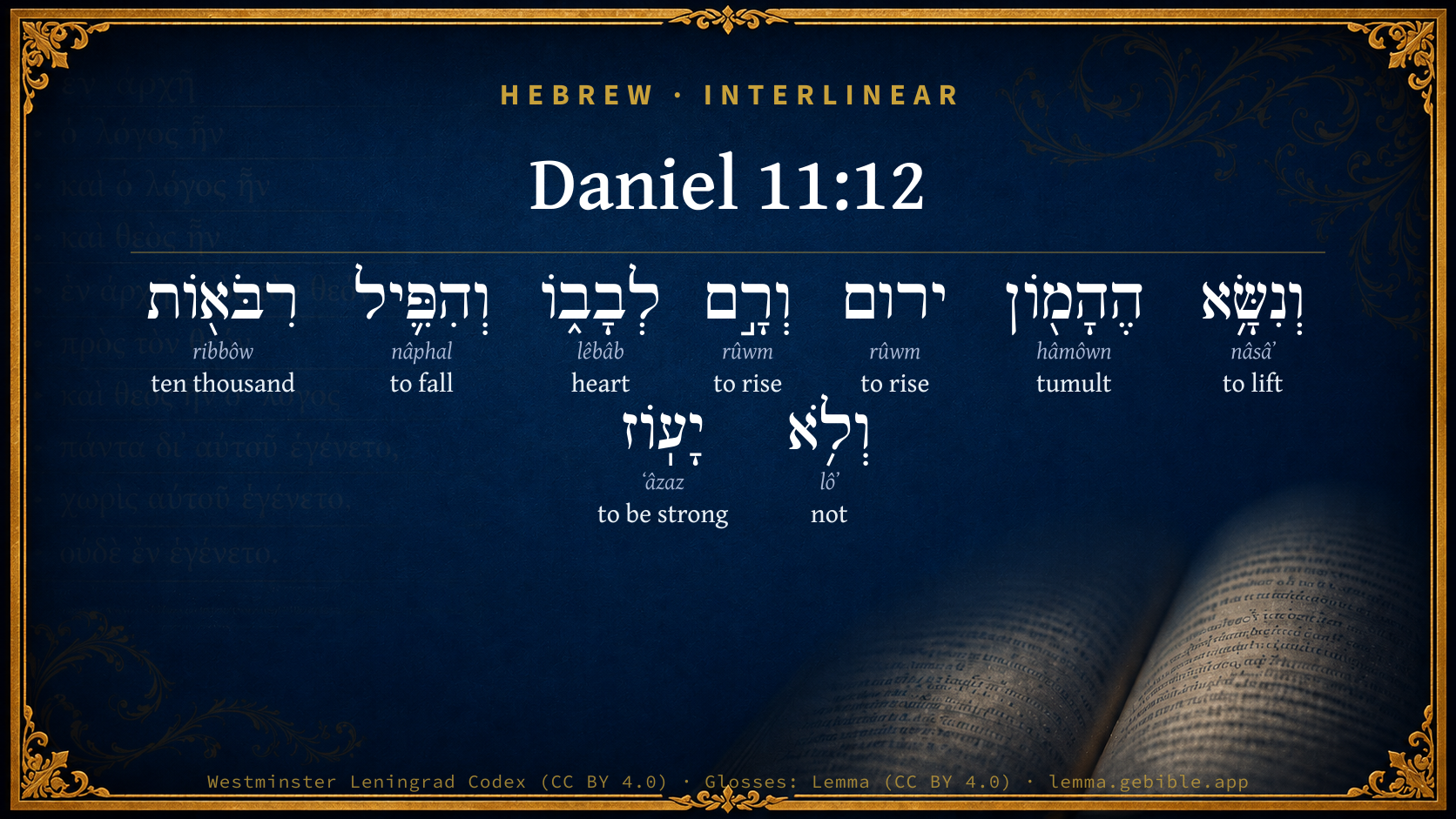
Hebrew (Westminster Leningrad Codex) Daniel 11:12 appears in the Hebrew Old Testament. The text above is from the Westminster Leningrad Codex. Each word links to its Strong’s number, a concise gloss, and parsing drawn from the Open Scriptures Hebrew Bible morphology. Click any word for its full Brown-Driver-Briggs (BDB) entry.
Download image
Cite this verse

Daniel 11:12 (World English Bible). Public Domain. Lemma interlinear Bible study tool, https://lemma.gebible.app/v/daniel/11/12.

Show BibTeX & RIS
BibTeX
RIS
English Translation
The multitude shall be lifted up, and his heart shall be exalted; and he shall cast down tens of thousands, but he shall not prevail.
World English Bible · Public Domain
Download a study sheet

One document with this verse’s original text, its word-by-word gloss line, the meaning frame, cross-references with their text, attributed commentary, and full source and license credits — printable, and it pastes into notes with its structure intact.

This verse Autodidact and up

Study sheet (.html) Plain text (.txt)

A passage Seminary Student

Up to 50 verses in one chapter. A passage sheet keeps up to 6 commentary sources and 12 cross-references per verse, in the order this page ranks them, and says so on the sheet whenever that leaves anything out. Ask for a single verse and you get the Autodidact verse sheet above.

Everything on this page stays free to read, with no account — the sheet is a download of what is already on screen, not access to it.

Want to remove ads? Support Godless Engineer
Compare translations 3

The same verse in 3 English versions, stacked beneath the original-language interlinear above. Click any original word for its lexicon entry.

Each is an independent rendering of the whole verse — the interlinear is not word-aligned to these translations.

Highlighted words mark where these versions differ — a whole-verse word diff, not a word-by-word alignment.

  • World English Bible Public Domain
    The multitude shall be lifted up, and his heart shall be exalted; and he shall cast down tens of thousands, but he shall not prevail.
  • King James Version Public Domain
    And when he hath taken away the multitude, his heart shall be lifted up; and he shall cast down many ten thousands: but he shall not be strengthened by it.
  • unfoldingWord Literal Text CC BY-SA 4.0
    When the multitude is carried off, his heart will be lifted up, and he will cause tens of thousands to fall, but he will not prevail.

unfoldingWord Literal Text — © unfoldingWord, licensed CC BY-SA 4.0. Word-aligned USFM3 via Door43 (git.door43.org/unfoldingWord/en_ult).

Versions to compare (up to 4)

3 of 4 selected

Show all 18 translations

Every available English version of this verse, each an independent rendering of the whole verse.

  • World English Bible Public Domain
    The multitude shall be lifted up, and his heart shall be exalted; and he shall cast down tens of thousands, but he shall not prevail.
  • Berean Standard Bible Public Domain
    When the army is carried off, the king of the South will be proud in heart and will cast down tens of thousands, but he will not triumph.
  • Majority Standard Bible Public Domain
    When the army is carried off, the king of the South will be proud in heart and will cast down tens of thousands, but he will not triumph.
  • King James Version Public Domain
    And when he hath taken away the multitude, his heart shall be lifted up; and he shall cast down many ten thousands: but he shall not be strengthened by it.
  • American Standard Version (1901) Public Domain
    And the multitude shall be lifted up, and his heart shall be exalted; and he shall cast down tens of thousands, but he shall not prevail.
  • Revised Version (1885) Public Domain
    And the multitude shall be lifted up, and his heart shall be exalted: and he shall cast down tens of thousands, but he shall not prevail.
  • Geneva Bible (1599) Public Domain
    Then the multitude shall be proude, and their heart shall be lifted vp: for hee shall cast downe thousands: but he shall not still preuaile.
  • Douay-Rheims (1899) Public Domain
    And he shall take a multitude, and his heart shall be lifted up, and he shall cast down many thousands: but he shall not prevail.
  • Young's Literal Translation Public Domain
    and he hath carried away the multitude, his heart is high, and he hath caused myriads to fall, and he doth not become strong.
  • Literal Standard Version CC BY-SA 4.0
    and he has carried away the multitude, his heart is high, and he has caused myriads to fall, and he does not become strong.
  • Unlocked Literal Bible CC BY-SA 4.0
    The army will be carried off, and the heart of the king of the South will be lifted up, and he will make tens of thousands to fall, but he will not be victorious.
  • unfoldingWord Literal Text CC BY-SA 4.0
    When the multitude is carried off, his heart will be lifted up, and he will cause tens of thousands to fall, but he will not prevail.
  • Darby Bible Public Domain
    And when the multitude shall have been taken away, his heart shall be exalted; and he shall cast down myriads; but he shall not prevail.
  • World Messianic Bible Public Domain
    The multitude will be carried off, and his heart will be exalted. He will cast down tens of thousands, but he won’t prevail.
  • Webster's Bible Public Domain
    And when he hath taken away the multitude, his heart shall be lifted up; and he shall cast down many ten thousands: but he shall not be strengthened by it.
  • Free Bible Version CC BY-SA 4.0
    After capturing such a large army, he will become very proud, and will kill thousands. But this triumph will not last long.
  • Bible in Basic English Public Domain
    And the army will be taken away, and his heart will be uplifted: he will be the cause of the downfall of tens of thousands, but he will not be strong.
  • JPS Tanakh (1917) Public Domain
    and the multitude shall be carried away, and his heart shall be lifted up; and he shall cast down tens of thousands; but he shall not prevail.

Literal Standard Version (2020), Covenant Press — licensed CC BY-SA 4.0. Text via the HelloAO Bible API (eBible.org). Unlocked Literal Bible (unfoldingWord) — licensed CC BY-SA 4.0. Text via the HelloAO Bible API (eBible.org). unfoldingWord Literal Text — © unfoldingWord, licensed CC BY-SA 4.0. Word-aligned USFM3 via Door43 (git.door43.org/unfoldingWord/en_ult). Free Bible Version, Dr. Jonathan Gallagher — licensed CC BY-SA 4.0. Text via the HelloAO Bible API (eBible.org).

Word by word

More ways to search: Search by grammar → Find every occurrence → Compare this word →

Practice this passage: Drill this verse → Learn its vocabulary →

About this verse

These counts appear in no published source. They are computed here, from the morphology-tagged text and Lemma’s own curated glosses. What Lemma adds →

9
words
8
distinct lemmas
Prophets
section

Notable vocabulary

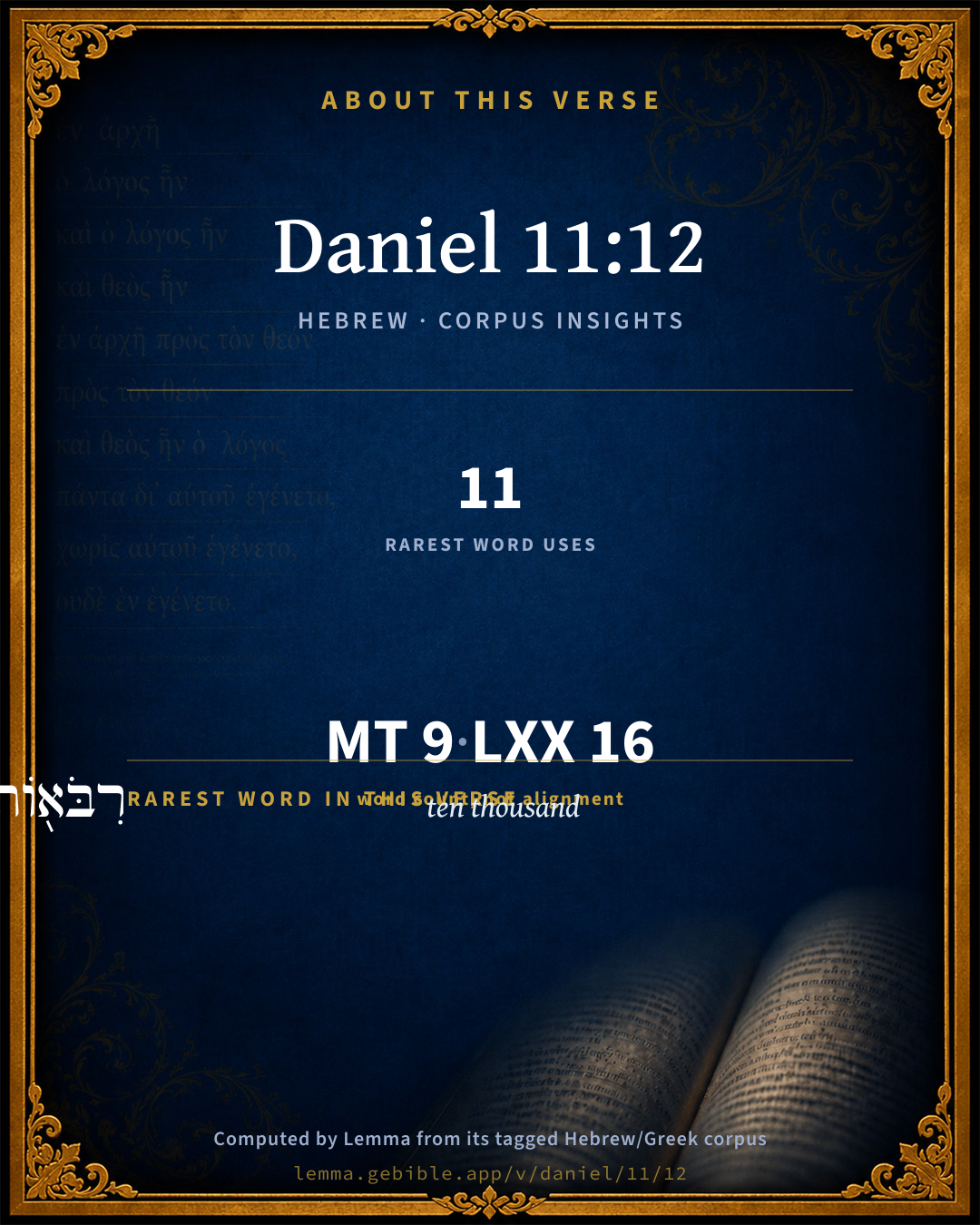
The rarest word here is רִבֹּא֖וֹת ten thousand H7239 — appearing just 11 times in the whole Hebrew Bible.

Shared distinctive vocabulary

רִבֹּא֖וֹת ten thousand H7239 occurs in 10 verses of the Hebrew Bible. Also found in:

Grammatical profile

  • 5 verbs
  • 3 nouns
  • 1 particle

Verb forms

  • וְנִשָּׂ֥א Niphal · Sequential Perfect
  • ירום Qal · Imperfect
  • וְרָ֣ם Qal · Sequential Perfect
  • וְהִפִּ֛יל Hiphil · Perfect
  • יָעֽוֹז Qal · Imperfect

Repetition

A word recurs within this verse — often emphatic in Hebrew:

  • ירום to rise H7311 ×2

Hebrew & Septuagint length

In English translation the verse runs 25 words from the Hebrew and 24 from the Septuagint (LXX English) — closely comparable.

A rough comparison of the two English renderings, which tokenize alike — not a word-level alignment.

Word counts can differ between the Hebrew and the Greek without any difference in meaning — e.g. the Hebrew direct-object marker אֵת has no separate Greek word, and Greek often adds the article ὁ.

In the original languages it is 9 Hebrew tokens and 16 Greek tokens — but the two are counted differently (Hebrew bundles its prefixes and suffixes into one token; the Greek is in lemma form), so that isn’t a like-for-like length.

Cross-references

17

Topical passages linked to Daniel 11:12 in the Treasury of Scripture Knowledge — connected by theme and wording, ordered by reader-vote popularity; previews shown in the World English Bible.

  • Habakkuk 2:4–6 Behold, his soul is puffed up. It is not upright in him, but the righteous will live by his faith.
  • 1 Peter 5:5 Likewise, you younger ones, be subject to the elder. Yes, all of you gird yourselves with humility, to subject yourselves to one another; for "God resists the proud, but gives grace to the humble."
  • Deuteronomy 8:14 then your heart be lifted up, and you forget Yahweh your God, who brought you forth out of the land of Egypt, out of the house of bondage;
  • 2 Kings 14:10 You have indeed struck Edom, and your heart has lifted you up: glory of it, and abide at home; for why should you meddle to [your] hurt, that you should fall, even you, and Judah with you?
  • 2 Chronicles 25:19 You say, Behold, you have struck Edom; and your heart lifts you up to boast: abide now at home; why should you meddle to [your] hurt, that you should fall, even you, and Judah with you?
  • 2 Chronicles 26:16 But when he was strong, his heart was lifted up, so that he did corruptly, and he trespassed against Yahweh his God; for he went into the temple of Yahweh to burn incense on the altar of incense.
  • 2 Chronicles 32:25 But Hezekiah didn't render again according to the benefit done to him; for his heart was lifted up: therefore there was wrath on him, and on Judah and Jerusalem.
  • Proverbs 16:18 Pride goes before destruction, And a haughty spirit before a fall.
  • Isaiah 10:7–12 However he doesn't mean so, neither does his heart think so; but it is in his heart to destroy, and to cut off not a few nations.
  • Ezekiel 28:2 Son of man, tell the prince of Tyre, Thus says the Lord Yahweh: Because your heart is lifted up, and you have said, I am a god, I sit in the seat of God, in the midst of the seas; yet you are man, and not God, though you did set your heart as the heart of God;-
  • Ezekiel 28:5 by your great wisdom [and] by your traffic have you increased your riches, and your heart is lifted up because of your riches;-
  • Ezekiel 28:17 Your heart was lifted up because of your beauty; you have corrupted your wisdom by reason of your brightness: I have cast you to the ground; I have laid you before kings, that they may see you.
  • Daniel 5:19–20 and because of the greatness that he gave him, all the peoples, nations, and languages trembled and feared before him: whom he would he killed, and whom he would he kept alive; and whom he would he raised up, and whom he would he put down.
  • Daniel 5:23 but have lifted up yourself against the Lord of heaven; and they have brought the vessels of his house before you, and you and your lords, your wives and your concubines, have drunk wine from them; and you have praised the gods of silver and gold, of brass, iron, wood, and stone, which don't see, nor hear, nor know; and the God in whose hand your breath is, and whose are all your ways, you have not glorified.
  • Daniel 8:25 Through his policy he shall cause craft to prosper in his hand; and he shall magnify himself in his heart, and in [their] security shall he destroy many: he shall also stand up against the prince of princes; but he shall be broken without hand.
  • Acts 12:22–23 The people shouted, "The voice of a god, and not of a man!"
  • 1 Timothy 3:6 not a new convert, lest being puffed up he fall into the same condemnation as the devil.

Cross-references courtesy of OpenBible.info (CC BY 4.0).

Hebrew and Greek witnesses Masoretic Hebrew ↔ Greek Septuagint

The same verse in the two great witnesses to the Old Testament, shown verse-for-verse.

These are two independent witnesses, not word-aligned to each other, and the Septuagint is shown in lemma (dictionary) form.

Hebrew Daniel 11:12 Masoretic · Westminster Leningrad Codex

וְנִשָּׂ֥א הֶהָמ֖וֹן ירום וְרָ֣ם לְבָב֑וֹ וְהִפִּ֛יל רִבֹּא֖וֹת וְלֹ֥א יָעֽוֹז

The multitude shall be lifted up, and his heart shall be exalted; and he shall cast down tens of thousands, but he shall not prevail.

World English Bible · Public Domain

Greek LXX Daniel 11:12 Septuagint · lemma form

καί λαμβάνω ὁ συναγωγή καί ὑψόω ὁ καρδία αὐτός καί ταράσσω πολύς καί οὐ μή φοβέω

And he shall take the multitude, and his heart shall be exalted; and he shall cast down many thousands; but he shall not prevail.

LXX2012 (modern English Septuagint) · Public Domain

On this verse, Ellicott's Commentary for English Readers discusses the Septuagint’s reading. Read the note in Commentary ↓

Hebrew: Westminster Leningrad Codex (CC BY 4.0). Greek: Septuagint (public domain); English from LXX2012 (modern English Septuagint) (Public Domain). How the Septuagint differs from the Hebrew →

Commentary

Notes on Daniel 11:12 from classic Christian and Jewish commentators (each source and its license shown beneath its notes). The classic Christian expositions comment on the surrounding passage and are grouped to its opening verse, so a note may address several verses; the Jewish commentaries on the Tanakh (Rashi and others) are per-verse, so they appear only where the commentator wrote on this verse.

Lemma curates 59 commentaries, every one of them public domain or Creative Commons licensed, each selected and text-cleaned for this edition rather than reprinted as found. About our sources →

Trapp's Complete Commentary

John Trapp

Dan 11:12 [And] when he hath taken away the multitude, his heart shall be lifted up; and he shall cast down [many] ten thousands: but he shall not be strengthened [by it].

Ver. 12. His heart shall be lifted up.] So that he shall slight his enemy, and not pursue his victory, but give himself up to a luxurious life. Vincere scis, Hannibal, victoria uti nescis, said that Roman general.

John Trapp, A Commentary or Exposition upon All the Books of the Old and New Testament (1647–1656) — public domain. Text from a community e-Sword module.

The Biblical Illustrator

Joseph S. Exell

Dan_11:12

But he shall not be strengthened by it.

The Secret of Strength

There are five principal ways of coming to a clear perception of God.

1. We may know God by vision; that is, by the inner sense of the Spirit. This is the manner in which the Lord made known his mind and nature to the Old Testament saints. They saw the object which the divine being presented to their interior eye. Every sincerely spiritual man lays tacit claims to spiritual intercourse with God; to communications, directions, assurances, and inward voices and revelations from the Lord. It is a part of our spiritual nature, of our divine equipment, to enjoy immaterial contact with the heavenly world, and to hold personal fellowship with the Father, the Son and the Holy Ghost. This spiritual insight is the beginning of the knowledge of God. The people happy enough to know God in this sense will become strong, will have their feet upon the rock of ages.

2. God communicates Himself for our knowledge by His Word. The Word must be read, remembered, and searched out daily. The Bible needs digging, and patient, devout, sympathetic and determined digging.

3. God will reveal Himself for our knowledge in our experience. The history of the world is largely the account of the modes in which God has been making Himself known in it. Long, tedious, and interwoven has been the method of the revelation of the Father to us in our trial. But in the glass of our life we look back to see what God is. In that experimental commentary we find our best explanations of His darkest enigmas. Whatever we know of His providence has come from our own deliverances, guidances, and escapes from danger.

4. We may know God in history. The people that have learned to read history do therein know their God. They can see the tendency and destination of all things.

5. We may also know the Lord in nature. Can you know nature unless you know natures God? The world in its sophistry knew not God! (T. R. H. Sturges.)

The Biblical Illustrator, edited by Joseph S. Exell (c. 1880s–1900s) — public domain. Text from a community e-Sword module.

Joseph Benson's Commentary

Dan 11:12. When he hath taken away the multitude, his heart shall be lifted up — This is a description of the effect which this victory would have on Ptolemy, namely, to puff him up with pride and insolence: and so we are informed it did; for being freed by it from his fears, he now more freely indulged his lusts; and, after a few menaces and complaints, he granted peace to Antiochus, that he might be more at liberty to gratify his appetites and passions. He had before murdered his father, his mother, and his brother; and now he killed his wife, who was also his sister, and gave himself up entirely to the management of Agathoclea his harlot, and her brother, Agathocles, who was his catamite, and their equally vicious mother Oenanthe: and so, forgetful of the greatness of his name and majesty, he consumed his days in feasting, and his nights in lewdness, and became not only the spectator, but the master and leader of all wickedness. Alas! what availed it to have conquered his enemies, when he was thus overcome by his vices; he was so far from being strengthened by it, that even his own subjects, offended at his inglorious peace, and more inglorious life, rebelled against him.

After the retreat of Antiochus, Ptolemy visited the cities of Cœlosyria and Palestine, which had submitted to him; and, among others, in his progress, he came to Jerusalem, “where he took a view of the temple, and even offered sacrifices, &c., to the God of Israel. But, not being satisfied with viewing it only from the outer court, beyond which no Gentile was allowed to pass, he showed a great inclination to enter the sanctuary, and even the holy of holies itself. This occasioned a great uproar all over the city; the high-priest informed him of the holiness of the place, and the express law of God, by which he was forbid to enter it. But every sort of opposition only served to inflame his curiosity; he forced in as far as the second court, where, while he was preparing to enter the temple itself, he was struck by God with such terror, that he was carried off half dead. On this he left the city, highly exasperated against the whole Jewish nation, and loudly threatening future vengeance.” At his return, therefore, to Alexandria, he began a cruel persecution against the Jewish inhabitants of that city, and cast down many ten thousands; for it appears from Eusebius, that, about this time, forty thousand Jews, or, according to Jerome, sixty thousand, were slain. The loss of so many of his Jewish subjects, and the rebellion of the Egyptians, added to the mal-administration of the state, must certainly have very much weakened, and almost totally ruined his kingdom: see Bishop Newton, Wintle, and the Univ. Hist., vol. 9. p. 220.

Joseph Benson's Commentary on the Old and New Testaments (1811–1818) — public domain. Text from a community e-Sword module.

Keil & Delitzsch

C. F. Keil & F. Delitzsch

This verse illustrates the last clause of Dan 11:11, i.e., explains more fully how the great multitude of the enemy are given into his hand. The first two clauses of Dan 11:12 stand in correlation to each other, as the change of the time and the absence of the copula before ירוּם show (the Keri ורם proceeds from a misunderstanding). The meaning is this: "As the multitude rises up, so his heart is lifted up." ההמון, with the article, can only be the host of the king of the north mentioned in Dan 11:12. The supposition that the Egyptian army is meant, is the result of the difficulty arising out of the misapprehension of the right relation in which the perfect ונשּׂא (hath lifted up raised) stands to the imperfect ירוּם. נשּׂא as in Isa 33:10 : they raise themselves to the conflict. לבב רוּם, the lifting up of the heart, commonly in the sense of pride; here the increase of courage, but so that pride is not altogether to be excluded. The subject to ירוּם is the king of the south, to whom the suffix to בּידו, Dan 11:11, points. With excited courage he overthrows myriads, namely, the powerful multitude of the enemies, but he yet does not reach to power, he does not attain to the supremacy over the king of the north and over his kingdom which he is striving after. The Vulgate, without however fully expressing the meaning, has rendered יעוז ולא by sed non praevalebit.

Keil & Delitzsch — Biblical Commentary on the Old Testament (1861–1891) — public domain (CC PDM 1.0). Text via the HelloAO Bible API. (Old Testament only.)

Tyndale Open Study Notes

Tyndale Open Resources

11:12-13 Ptolemy IV’s success was short lived. In 198 BC, the king of the north—Antiochus III—returned. • Antiochus III had been conquering lands to the north and east, from which he raised a fully equipped army far greater than before (cp. 3 Maccabees 1:1-5).

Tyndale Open Study Notes — © Tyndale Open Resources, licensed CC BY-SA 4.0. Text via the HelloAO Bible API.

Jamieson, Fausset & Brown

Robert Jamieson, A. R. Fausset & David Brown

when he hath taken away--that is, subdued "the multitude" of Antiochus.

heart . . . lifted up--instead of following up his victory by making himself master of the whole of Syria, as he might, he made peace with Antiochus, and gave himself up to licentiousness [POLYBIUS, 87; JUSTIN, 30.4], and profaned the temple of God by entering the holy place [GROTIUS].

not be strengthened by it--He shall lose the power gained by his victory through his luxurious indolence.

Jamieson, Fausset & Brown — Commentary Critical and Explanatory on the Whole Bible (1871) — public domain (CC PDM 1.0). Text via the HelloAO Bible API.

Adam Clarke's Commentary

Verse 12. His heart shall be lifted up] Had Ptolemy improved his victory, he might have dispossessed Antiochus of his whole empire; but giving way to pride, and a criminally sensual life, he made peace on dishonourable terms; and though he had gained a great victory, yet his kingdom was not strengthened by it, for his subjects were displeased, and rebelled against him, or at least became considerably disaffected.

Adam Clarke's Commentary on the Bible (1810–1826) — public domain. Text from a community e-Sword/MySword module.

John Calvin's Commentaries

The angel here marks the close of the war. Had Ptolemy’s valor seconded his good fortune, he might easily have seized upon the whole kingdom of Syria, as profane historians report. But he was so given up to his own lusts, that he willingly entered into treaty with his enemy. On his return to his kingdom he slew his wife Eurydice, and was guilty of other enormities; he suffered a wicked woman, the sister of Agathocles, a victim of his passions, to rule over his kingdom, and lastly, he became a very foul example of a very cruel and degraded man. Therefore, the angel says at the beginning, his army should raise him aloft; his heart should be elevated, in consequence of his prosperity. He not only caused terror to Antiochus, but through all the neighboring regions. Where he might have drawn to himself the whole power of the East, he then declined in his course. He subdued, indeed, a hostile army, and in this exploit he was in no slight degree assisted by his sister Arsinoe, as historians relate, but yet after great slaughters he did not retain his position. And what was the obstacle? His idleness and drunkenness, and his caring for nothing but banquets and debaucheries, and the most obscene pleasures. This caused his fall, after he had been raised even to the clouds by his victories. It afterwards follows, —

John Calvin's Commentaries (1540-1563) — public domain. Text from the Calvin Translation Society English edition (1840s-50s) via the Christian Classics Ethereal Library (ccel.org). Calvin's coverage is partial (roughly two-thirds of the Bible); uncommented books and verses are honest gaps, never fabricated. The 19th-century editor's footnotes and remarks are omitted so the notes are faithfully Calvin's own voice.

Ellicott's Commentary for English Readers

(12) And when he.—It is not clear whether “the multitude” or “the king” is subject of the sentence, or whether the verb “he hath taken away” is to be translated active or passive. The verse might mean, “And the multitude is lifted up—i.e., takes courage—and its heart is exalted,” or, “when the multitude takes courage the king’s heart is exalted.” The English translation is most in accordance with the context, but the second rendering is preferred by many, according to which the king’s courage and pride increase as he perceives the mightiness of his troops. The LXX. follow a different reading throughout the verse.

And he shall cast down.—These words describe the victory of the southern king after he has taken the “multitude” of the northern king.

But he shall not be strengthened—i.e., he does not prove so successful as he had hoped. His aim was to gain complete supremacy over his rival, but for reasons which are about to be stated he was unable to gain his object. Those interpreters who see a distinct reference to the wars of Ptolemy and Antiochus point out that though the loss of the Syrians was very great, yet Ptolemy did not follow up his success as he should have done. Instead of striking a decisive blow, he was content with regaining the towns which Antiochus had taken from him.

A Bible Commentary for English Readers, edited by Charles John Ellicott (1878–1897) — public domain. Text from a community e-Sword module.

John Gill's Exposition

That is, when Ptolemy king of Egypt had defeated the large army of Antiochus, killed great numbers of them, and taken many:

his heart shall be lifted up; with pride, through the victory he obtained; and so he gave himself up to sensuality and luxury, judging himself now safe and secure in the possession of his kingdom: or, this may refer to his insolence, when he entered into Judea, went to Jerusalem, and forced his way into the holiest of all to offer sacrifice upon his victory; of which see third Maccabees chapter one:

and he shall cast down many ten thousands; or "many thousands", as the Vulgate Latin version; or rather "ten thousand" (m), either of the Jews, when he went into their country; or of the army of Antiochus the king of the north, as Jacchiades: and it may be rendered, "though he shall cast down many thousands" (n); that is, cast them down to the earth, slay them, as he did, even ten thousand of them, the number here mentioned:

yet he shall not be strengthened by it; for Antiochus escaped out of his hands, nor did he pursue his victory, and take all the advantages of it, as he might have done; for, as the historian (o) says, had he added valour to his fortune, he might have spoiled Antiochus of his kingdom; but, content with the recovery of the cities he lost, made peace, and greedily took the advantage of ease, and rolled himself in luxury, uncleanness, and intemperance.

(m) "decem millia", Pagninus, Montanus, so Ben Melech. (n) "etiamsi dejiciet", Gejerus; "quamvis prostraverit", Michaelis. (o) Justin, l. 30. c. 1.

John Gill's Exposition of the Whole Bible (1746–1763) — public domain (CC PDM 1.0). Text via the HelloAO Bible API.

Albert Barnes' Notes on the Bible

And when he hath takcn away the multitude - When he has subdued them. Lengerke, however, renders this, “And the multitude shall lift themselves up,” supposing it to refer to the fact that the people as well as the king would be excited. But the more natural interpretation is that in our common version, and the same sense of the word (נשׂא nâss'â') occurs in Ames Dan 4:2.

His heart shall be lifted up - That is, he will be proud and self-confident. The reference is to the effect which would be produced on him after his defeat of Antiochus. He was a man naturally indolent and effeminate - a most profligate and vicious prince. - Prideaux, Con. iii. 146. The effect of such a victory would be to lift him up with pride.

And he shall cast down many ten thousands - Or, rather, the meaning is, “he has cast down many myriads.” The object seems to be to give a reason why his heart was lifted up. The fact that he had been thus successful is the reason which is assigned, and this effect of a great victory has not been uncommon in the world.

But he shall not be strengthened by it - He was wholly given up to luxury, sloth, and voluptuousness, and returned immediately after his victory into Egypt, and surrendered himself up to the enjoyment of his pleasures. The consequence was, that he, by his conduct, excited some of his people to rebellion, and greatly weakened himself in the affections and confidence of the rest. After the victory, he concluded a truce with Antiochus; and the result was, that his people, who expected much more from him, and supposed that he would have prosecuted the war, became dissatisfied with his conduct, and broke out into rebellion. As a matter of fact, he was less strong in the confidence and affections of his people, and would have been less able to wage a war, after his triumph over Antiochus than he was before. See Prideaux, Con. iii. 155, following.

Albert Barnes' Notes on the Bible (1834–1885) — public domain. Text from a community e-Sword/MySword module.

Haydock's Catholic Bible Commentary

Prevail. Many fell on both sides. (Haydock) --- But Antiochus did not prevail; (Worthington) or rather Philopator neglected the opportunity of dethroning his rival, (Calmet) as he might have seized all his dominions, if he had not been too fond of ease. (Just. xxx.) --- He followed the suggestions of his proud heart, when he attempted to enter the most holy place of the temple; and though he was visibly chastised by God, he would have vented his resentment on the Jews, if Providence had not miraculously protected them. (3 Machabees) (Calmet) See Ecclesiasticus l. (Haydock)

George Leo Haydock (1774–1849), Haydock's Catholic Family Bible and Commentary, 1859 edition — public domain. Excludes Psalms (Douay-Rheims chapter numbering differs from Protestant) and Deuterocanonical books (Catholic canon only).

Matthew Poole's English Annotations

He might have conquered and recovered all again, but he grew proud of his victory, and returned again to his luxury. Entering Judea he entered into the temple of God at Jerusalem and the holy place against the law; yet, though he

cast down many thousands, he was not

strengthened by it.

Matthew Poole's English Annotations on the Holy Bible (1683–1685) — public domain. Text from a community e-Sword/MySword module.

Whedon's Commentary on the Bible

Daniel D. Whedon

12. Rather translate, with Terry, “And the multitude shall be carried away, and his heart shall be exalted.” That is, a vast number of the soldiers of Antiochus shall be killed or taken prisoners, because of which Ptolemy IV shall be greatly puffed up, “and he shall cast down myriads; but he shall not be strong,” or “he shall not prevail” (R.V.). He was naturally a weak and sluggish king, and he failed to follow up his advantage, only acquiring a little territory and then making peace.

Daniel D. Whedon (gen. ed.), Commentary on the Old and New Testaments (1874–1909) — public domain. Text from a community e-Sword module.

The Pulpit Commentary

And when he hath taken away the multitude, his heart shall be lifted up; and he shall cast down many ten thousands; but he shall not be strengthened by it. The rendering of the LXX is, "And he shall take the levy (sunagwghn), and his heart shall be lifted up, and he shall trouble many, and shall not be afraid." There seems to have been some difference of reading in the last clause, but it is not clear what. Theodotion renders the first clause as does the Septuagint; but the latter clause is more in accordance with the English version of the Massoretic text. The Peshitta from the same text differs in its interpretation, "And he shall destroy them mightily, and his heart shall be lifted up, and he shall cast down many, and shall not be strengthened." The Vulgate presents no occasion of remark. And he shall cast down many ten thousands. This, most probably, refers to the complete victory at Raphia, where Antiochus was reported to have lost ten thousand men. There is thus a repetition here of what has already been narrated. But he shall not be strengthened by it. It is very noticeable that Ptolemy did not even attempt to strengthen his position by vigorously following up his victory.

The Pulpit Commentary (1880–1919), ed. H.D.M. Spence-Jones & Joseph S. Exell — public domain. Text from a community e-Sword module.

John Wesley's Explanatory Notes

His heart shall be lifted up - He might have recovered all, but he grew proud of his victory, and returned again to his luxury.

John Wesley, Explanatory Notes Upon the Whole Bible (1754–1765) — public domain. Text via the GEBible commentary corpus.

Rashi

Rabbi Shlomo Yitzchaki (Rashi)

And the multitude will be raised up that of the king of the north, to become very haughty, for they planned in their hearts to be victorious in the war.

and he will fell myriads many of the army of the king of the south.

but he will not prevail Nevertheless, the victory of the war will not be his.

Rashi on the Tanakh — English translations: “The Judaica Press complete Tanach with Rashi, translated by A. J. Rosenberg” (CC BY 4.0); “Pentateuch with Rashi's commentary by M. Rosenbaum and A.M. Silbermann, 1929-1934” (public domain); “The Metsudah Tanach series, Lakewood, N.J” (CC BY 4.0); and “The Book of Joshua, Metsudah Publications, 1997” (CC BY 4.0). Text via Sefaria.

Lesson kit

Teaching starters — assembled from the data on this page, not authored interpretation. Every prompt links to the verse data it draws on. Edit before teaching.

Daniel, in the Prophets, opens this verse with 9 words (8 distinct Hebrew lemmas). Its most distinctive word is ribbôw (“ten thousand”). A historical commentator’s framing appears above. Read the whole chapter for the surrounding context.

Discussion questions

  1. How does “ten thousand” (ribbôw) shape what this verse is saying?
  2. 1 Chronicles 29:7 shares the word «ten thousand» with this verse. How do the two illuminate each other?
  3. “to rise” occurs 2× in this one verse. What is the effect of the repetition?
  4. The translations on this page render this verse differently — a whole-verse word diff, not a word-by-word alignment. What might account for the different wordings?
  5. The verb «וְנִשָּׂ֥א» is Niphal Sequential Perfect. How does its form color the action?
  6. Reading how Trapp's Complete Commentary and The Biblical Illustrator read this verse, where do the two commentators agree and where do they part?

Things to notice

Reading settings

Reading text

Shown beneath each verse's original-language words.

Old Testament
Old Testament edition

Read the OT as the Masoretic Hebrew (MT) or the Greek Septuagint (LXX).

English shown for the Greek Septuagint (in the Hebrew ↔ Greek comparison).

Comparing translations? Open the Compare panel on any verse page to stack up to four side by side.