2 Kings 19:22

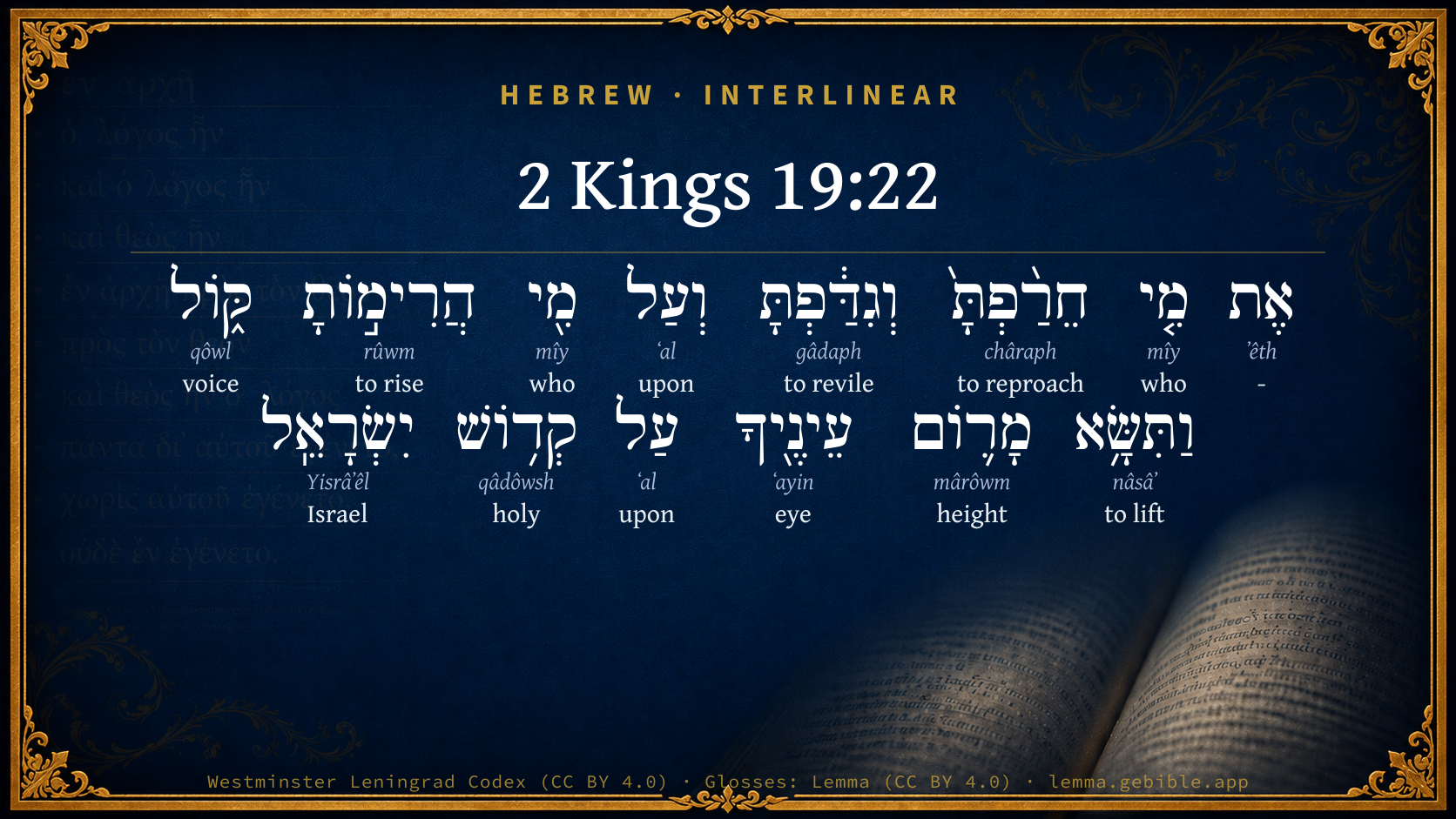
Hebrew (Westminster Leningrad Codex) 2 Kings 19:22 appears in the Hebrew Old Testament. The text above is from the Westminster Leningrad Codex. Each word links to its Strong’s number, a concise gloss, and parsing drawn from the Open Scriptures Hebrew Bible morphology. Click any word for its full Brown-Driver-Briggs (BDB) entry.
Download image
Cite this verse

2 Kings 19:22 (World English Bible). Public Domain. Lemma interlinear Bible study tool, https://lemma.gebible.app/v/2-kings/19/22.

Show BibTeX & RIS
BibTeX
RIS
English Translation
Whom have you defied and blasphemed? and against whom have you exalted your voice and lifted up your eyes on high? [even] against the Holy One of Israel.
World English Bible · Public Domain
Download a study sheet

One document with this verse’s original text, its word-by-word gloss line, the meaning frame, cross-references with their text, attributed commentary, and full source and license credits — printable, and it pastes into notes with its structure intact.

This verse Autodidact and up

Study sheet (.html) Plain text (.txt)

A passage Seminary Student

Up to 50 verses in one chapter. A passage sheet keeps up to 6 commentary sources and 12 cross-references per verse, in the order this page ranks them, and says so on the sheet whenever that leaves anything out. Ask for a single verse and you get the Autodidact verse sheet above.

Everything on this page stays free to read, with no account — the sheet is a download of what is already on screen, not access to it.

Want to remove ads? Support Godless Engineer
Compare translations 3

The same verse in 3 English versions, stacked beneath the original-language interlinear above. Click any original word for its lexicon entry.

Each is an independent rendering of the whole verse — the interlinear is not word-aligned to these translations.

Highlighted words mark where these versions differ — a whole-verse word diff, not a word-by-word alignment.

  • World English Bible Public Domain
    Whom have you defied and blasphemed? and against whom have you exalted your voice and lifted up your eyes on high? [even] against the Holy One of Israel.
  • King James Version Public Domain
    Whom hast thou reproached and blasphemed? and against whom hast thou exalted thy voice, and lifted up thine eyes on high? even against the Holy One of Israel.
  • unfoldingWord Literal Text CC BY-SA 4.0
    Whom have you mocked and taunted? And against whom have you raised a voice and lifted your eyes upward? Against the Holy of Israel!

unfoldingWord Literal Text — © unfoldingWord, licensed CC BY-SA 4.0. Word-aligned USFM3 via Door43 (git.door43.org/unfoldingWord/en_ult).

Versions to compare (up to 4)

3 of 4 selected

Show all 18 translations

Every available English version of this verse, each an independent rendering of the whole verse.

  • World English Bible Public Domain
    Whom have you defied and blasphemed? and against whom have you exalted your voice and lifted up your eyes on high? [even] against the Holy One of Israel.
  • Berean Standard Bible Public Domain
    Whom have you taunted and blasphemed? Against whom have you raised your voice and lifted your eyes in pride? Against the Holy One of Israel!
  • Majority Standard Bible Public Domain
    Whom have you taunted and blasphemed? Against whom have you raised your voice and lifted your eyes in pride? Against the Holy One of Israel!
  • King James Version Public Domain
    Whom hast thou reproached and blasphemed? and against whom hast thou exalted thy voice, and lifted up thine eyes on high? even against the Holy One of Israel.
  • American Standard Version (1901) Public Domain
    Whom hast thou defied and blasphemed? and against whom hast thou exalted thy voice and lifted up thine eyes on high? `even' against the Holy One of Israel.
  • Revised Version (1885) Public Domain
    Whom hast thou reproached and blasphemed? and against whom hast thou exalted thy voice and lifted up thine eyes on high? even against the Holy One of Israel.
  • Geneva Bible (1599) Public Domain
    Whome hast thou railed on? and whome hast thou blasphemed? and against whome hast thou exalted thy voyce, and lifted vp thine eyes on hie? euen against the Holie one of Israel.
  • Douay-Rheims (1899) Public Domain
    Whom hast thou reproached, and whom hast thou blasphemed? against whom hast thou exalted thy voice, and lifted up thy eyes on high? against the holy one of Israel.
  • Young's Literal Translation Public Domain
    Whom hast thou reproached and reviled? And against whom lifted up a voice? Yea, thou dost lift up on high thine eyes -- Against the Holy One of Israel!
  • Literal Standard Version CC BY-SA 4.0
    Whom have you reproached and reviled? And against whom lifted up a voice? Indeed, you lift up your eyes on high—Against the Holy One of Israel!
  • Unlocked Literal Bible CC BY-SA 4.0
    Whom have you defied and insulted? Against whom have you exalted your voice and lifted up your eyes in pride? Against the Holy One of Israel!
  • unfoldingWord Literal Text CC BY-SA 4.0
    Whom have you mocked and taunted? And against whom have you raised a voice and lifted your eyes upward? Against the Holy of Israel!
  • Darby Bible Public Domain
    Whom hast thou reproached and blasphemed? and against whom hast thou exalted the voice? Against the Holy one of Israel hast thou lifted up thine eyes on high.
  • World Messianic Bible Public Domain
    Whom have you defied and blasphemed? Against whom have you exalted your voice and lifted up your eyes on high? Against the Holy One of Israel!
  • Webster's Bible Public Domain
    Whom hast thou reproached and blasphemed? and against whom hast thou exalted thy voice, and lifted up thy eyes on high: even against the Holy One of Israel.
  • Free Bible Version CC BY-SA 4.0
    Who have you been insulting and ridiculing? Who did you raise your voice against? Who did you look at with so proud eyes? It was against the Holy One of Israel!
  • Bible in Basic English Public Domain
    Against whom have you said evil and bitter things? against whom has your voice been loud and your eyes lifted up? even against the Holy One of Israel.
  • JPS Tanakh (1917) Public Domain
    Whom hast thou taunted and blasphemed? and against whom hast thou exalted thy voice? Yea, thou hast lifted up thine eyes on high, even against the Holy One of Israel!

Literal Standard Version (2020), Covenant Press — licensed CC BY-SA 4.0. Text via the HelloAO Bible API (eBible.org). Unlocked Literal Bible (unfoldingWord) — licensed CC BY-SA 4.0. Text via the HelloAO Bible API (eBible.org). unfoldingWord Literal Text — © unfoldingWord, licensed CC BY-SA 4.0. Word-aligned USFM3 via Door43 (git.door43.org/unfoldingWord/en_ult). Free Bible Version, Dr. Jonathan Gallagher — licensed CC BY-SA 4.0. Text via the HelloAO Bible API (eBible.org).

Word by word

More ways to search: Search by grammar → Find every occurrence → Compare this word →

Practice this passage: Drill this verse → Learn its vocabulary →

וְגִדַּ֔פְתָּ
gâdaph
H1442
“and · to revile”
Conjunction + Verb, Piel, Perfect, 2nd Person, Masculine, Singular
Part of Speech
Conjunction + Verb
Stem
Piel
Form
Perfect
Person
2nd Person
Gender
Masculine
Number
Singular
Full BDB Definition

Origin: a primitive root

TWOT: 317

to revile men, blaspheme God - (Piel) - to revile (between men) - to blaspheme (God)
  1. אֶת ʼêth H853 “-” Particle, Direct Object
  2. מִ֤י mîy H4310 “who” Particle, Interrogative
  3. חֵרַ֨פְתָּ֙ châraph H2778 “to reproach” Verb, Piel, Perfect, 2nd Person, Masculine, Singular
  4. וְעַל ʻal H5921 “and · upon” Conjunction + Preposition
  5. מִ֖י mîy H4310 “who” Particle, Interrogative
  6. הֲרִימ֣וֹתָ rûwm H7311 “to rise” Verb, Hiphil, Perfect, 2nd Person, Masculine, Singular
  7. קּ֑וֹל qôwl H6963 “voice” Noun, Common, Masculine, Singular, Absolute
  8. וַתִּשָּׂ֥א nâsâʼ H5375 “and · to lift” Conjunction + Verb, Qal, Sequential Imperfect, 2nd Person, Masculine, Singular
  9. מָר֛וֹם mârôwm H4791 “height” Noun, Common, Masculine, Singular, Absolute
  10. עֵינֶ֖יךָ ʻayin H5869 “eyes · your” Noun, Common, Both, Dual, Construct + Suffix, Personal, 2nd Person, Masculine, Singular
  11. עַל ʻal H5921 “upon” Preposition
  12. קְד֥וֹשׁ qâdôwsh H6918 “holy of” Adjective, Adjective, Masculine, Singular, Construct
  13. יִשְׂרָאֵֽל Yisrâʼêl H3478 “Israel” Noun, Proper

About this verse

These counts appear in no published source. They are computed here, from the morphology-tagged text and Lemma’s own curated glosses. What Lemma adds →

14
words
12
distinct lemmas
Historical
section

Notable vocabulary

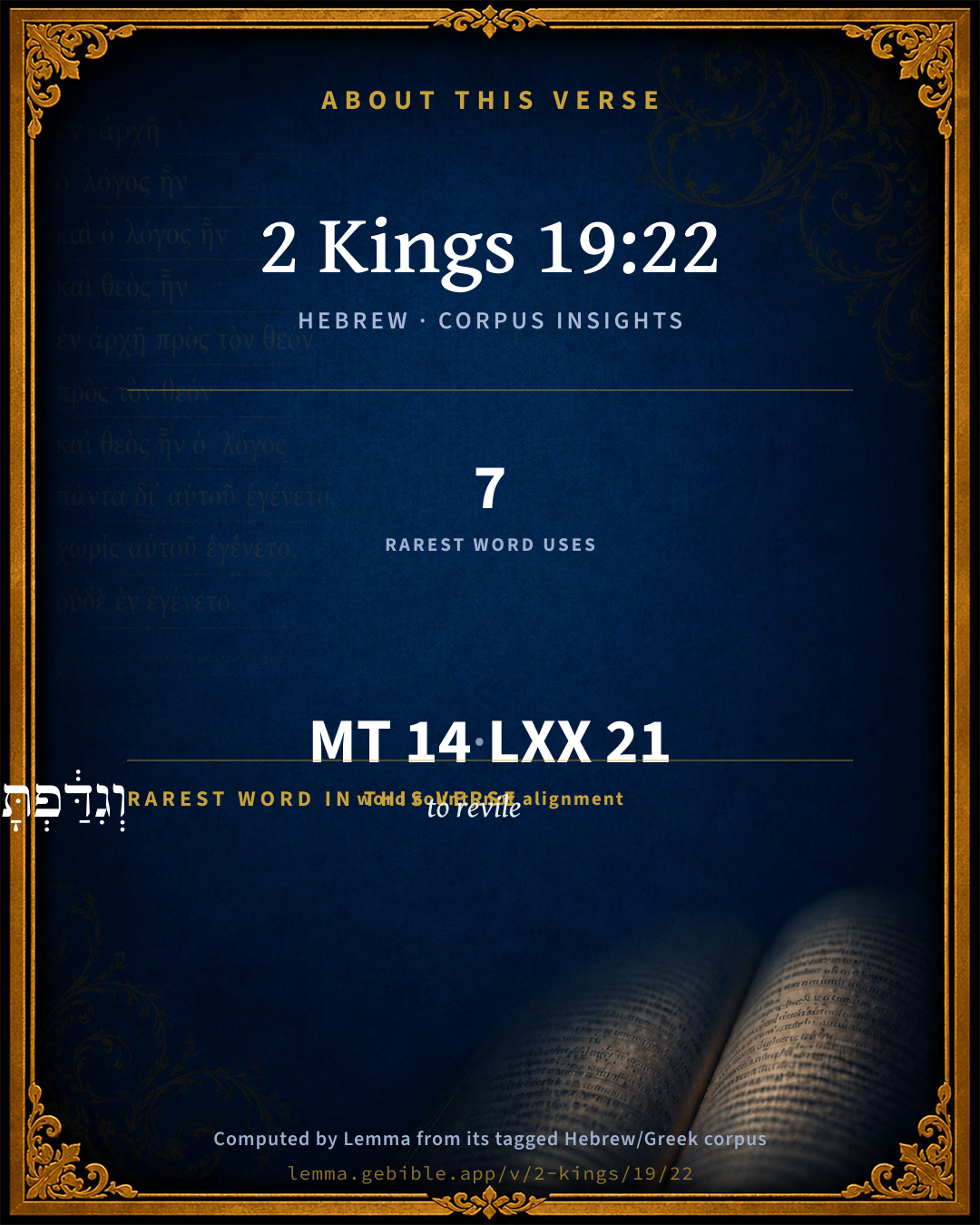
The rarest word here is וְגִדַּ֔פְתָּ to revile H1442 — appearing just 7 times in the whole Hebrew Bible.

Shared distinctive vocabulary

וְגִדַּ֔פְתָּ to revile H1442 occurs in 7 verses of the Hebrew Bible. Also found in:

Grammatical profile

  • 4 verbs
  • 4 nouns
  • 1 adjective
  • 2 prepositions
  • 3 particles

Verb forms

  • חֵרַ֨פְתָּ֙ Piel · Perfect
  • וְגִדַּ֔פְתָּ Piel · Perfect
  • הֲרִימ֣וֹתָ Hiphil · Perfect
  • וַתִּשָּׂ֥א Qal · Sequential Imperfect

Repetition

Words recur within this verse — often emphatic in Hebrew:

  • וְעַל upon H5921 ×2
  • מִ֤י who H4310 ×2

Hebrew & Septuagint length

In English translation the verse runs 28 words from the Hebrew and 32 from the Septuagint (LXX English) — closely comparable.

A rough comparison of the two English renderings, which tokenize alike — not a word-level alignment.

Word counts can differ between the Hebrew and the Greek without any difference in meaning — e.g. the Hebrew direct-object marker אֵת has no separate Greek word, and Greek often adds the article ὁ.

In the original languages it is 14 Hebrew tokens and 21 Greek tokens — but the two are counted differently (Hebrew bundles its prefixes and suffixes into one token; the Greek is in lemma form), so that isn’t a like-for-like length.

Cross-references

19

Topical passages linked to 2 Kings 19:22 in the Treasury of Scripture Knowledge — connected by theme and wording, ordered by reader-vote popularity; previews shown in the World English Bible.

  • Isaiah 5:24 Therefore as the tongue of fire devours the stubble, And as the dry grass sinks down in the flame, So their root shall be as rottenness, And their blossom shall go up as dust; Because they have rejected the law of Yahweh of Hosts, And despised the word of the Holy One of Israel.
  • Psalms 71:22 I will also praise you with the harp for your faithfulness, my God. I sing praises to you with the lyre, Holy One of Israel.
  • Isaiah 30:11–12 get out of the way, turn aside out of the path, cause the Holy One of Israel to cease from before us."
  • Isaiah 30:15 For thus said the Lord Yahweh, the Holy One of Israel, In returning and rest shall you be saved; in quietness and in confidence shall be your strength. You would not:
  • Jeremiah 51:5 For Israel is not forsaken, nor Judah, of his God, of Yahweh of Hosts; though their land is full of guilt against the Holy One of Israel.
  • 2 Thessalonians 2:4 he who opposes and exalts himself against all that is called God or that is worshiped; so that he sits as God in the temple of God, setting himself up as God.
  • Exodus 5:2 Pharaoh said, "Who is Yahweh, that I should listen to his voice to let Israel go? I don't know Yahweh, and moreover I will not let Israel go."
  • Exodus 9:17 as you still exalt yourself against my people, that you won't let them go.
  • 2 Kings 18:28–35 Then Rabshakeh stood, and cried with a loud voice in the Jews' language, and spoke, saying, Hear you the word of the great king, the king of Assyria.
  • 2 Kings 19:4 It may be Yahweh your God will hear all the words of Rabshakeh, whom the king of Assyria his master has sent to defy the living God, and will rebuke the words which Yahweh your God has heard. Therefore lift up your prayer for the remnant that is left.
  • Psalms 73:9 They have set their mouth in the heavens. Their tongue walks through the earth.
  • Psalms 74:22–23 Arise, God! Plead your own cause. Remember how the foolish man mocks you all day.
  • Proverbs 30:13 There is a generation, oh how lofty are their eyes! Their eyelids are lifted up.
  • Isaiah 10:15 Shall the axe boast itself against him who hews therewith? Shall the saw magnify itself against him who wields it? as if a rod should wield those who lift it up, [or] as if a staff should lift up [him who is] not wood.
  • Isaiah 14:13–14 You said in your heart, I will ascend into heaven, I will exalt my throne above the stars of God; and I will sit on the mountain of congregation, in the uttermost parts of the north;
  • Ezekiel 28:2–9 Son of man, tell the prince of Tyre, Thus says the Lord Yahweh: Because your heart is lifted up, and you have said, I am a god, I sit in the seat of God, in the midst of the seas; yet you are man, and not God, though you did set your heart as the heart of God;-
  • Daniel 5:20–23 But when his heart was lifted up, and his spirit was hardened so that he dealt proudly, he was deposed from his kingly throne, and they took his glory from him:
  • 2 Corinthians 10:5 throwing down imaginations and every high thing that is exalted against the knowledge of God, and bringing every thought into captivity to the obedience of Christ;
  • 2 Kings 19:6 Isaiah said to them, Thus shall you tell your master, Thus says Yahweh, Don't be afraid of the words that you have heard, with which the servants of the king of Assyria have blasphemed me.

Cross-references courtesy of OpenBible.info (CC BY 4.0).

Hebrew and Greek witnesses Masoretic Hebrew ↔ Greek Septuagint

The same verse in the two great witnesses to the Old Testament, shown verse-for-verse.

These are two independent witnesses, not word-aligned to each other, and the Septuagint is shown in lemma (dictionary) form.

Hebrew 2 Kings 19:22 Masoretic · Westminster Leningrad Codex

אֶת מִ֤י חֵרַ֨פְתָּ֙ וְגִדַּ֔פְתָּ וְעַל מִ֖י הֲרִימ֣וֹתָ קּ֑וֹל וַתִּשָּׂ֥א מָר֛וֹם עֵינֶ֖יךָ עַל קְד֥וֹשׁ יִשְׂרָאֵֽל

Whom have you defied and blasphemed? and against whom have you exalted your voice and lifted up your eyes on high? [even] against the Holy One of Israel.

World English Bible · Public Domain

Greek LXX 2 Kings 19:22 Septuagint · lemma form

τίς ὀνειδίζω καί βλασφημέω καί ἐπί τίς ὑψόω φωνή καί αἴρω εἰς ὕψος ὁ ὀφθαλμός σύ εἰς ὁ ἅγιος ὁ ἰσραήλ

Whom have you reproached, and whom have you reviled? and against whom have you lifted up your voice, and raised your eyes on high? Is it against the Holy One of Israel?

LXX2012 (modern English Septuagint) · Public Domain

Hebrew: Westminster Leningrad Codex (CC BY 4.0). Greek: Septuagint (public domain); English from LXX2012 (modern English Septuagint) (Public Domain). How the Septuagint differs from the Hebrew →

Targum (Aramaic paraphrase)

1

The Targum is the ancient Jewish Aramaic paraphrase of the Hebrew Scriptures — an interpretive translation, not the Hebrew text itself. Onkelos (literal) and Pseudo-Jonathan (expansive) render the Torah, and Jonathan the Prophets. Coverage is partial: where no permissively-licensed English translation exists for a verse, only the Aramaic is shown. This is verse-level text, not a word-by-word alignment to the Hebrew.

  1. Targum Jonathan Prophets (Joshua–Malachi)
    יַת מַן חֲסֵידְתָּא וְעַל מַן אִתְרַבְרַבְתָּא וְקָדָם מַן אֲרֵימְתָּא קָלָא וּזְקֵיפְתָּא לְרוֹמָא עֵינָךְ אֲמַרְתָּ מִלִין דְלָא כַשְׁרִין קֳדָם קַדִישָׁא דְיִשְׂרָאֵל:

    (no public-domain English translation for this verse)

    Targum Jonathan — Aramaic: “Mikraot Gedolot” (public domain). English: “Sefaria Community Translation” (CC0 1.0 (public-domain dedication)); “London "Chaldee Paraphrase," 1871” (public domain). Text via Sefaria.

Commentary

Notes on 2 Kings 19:22 from classic Christian and Jewish commentators (each source and its license shown beneath its notes). The classic Christian expositions comment on the surrounding passage and are grouped to its opening verse, so a note may address several verses; the Jewish commentaries on the Tanakh (Rashi and others) are per-verse, so they appear only where the commentator wrote on this verse.

Lemma curates 59 commentaries, every one of them public domain or Creative Commons licensed, each selected and text-cleaned for this edition rather than reprinted as found. About our sources →

Trapp's Complete Commentary

John Trapp

2Ki 19:22 Whom hast thou reproached and blasphemed? and against whom hast thou exalted [thy] voice, and lifted up thine eyes on high? [even] against the Holy [One] of Israel.

Ver. 22. Against whom hast thou exalted thy voice, and lifted up thine eyes on high?] God is "jealous for Jerusalem with a great jealousy." {Zec 1:14} He soon took notice of Cain’s frowns; {Gen 4:6} Laban’s lowerings; {Gen 31:2} Rabshakeh’s outcries here; those miscreants lolling out the tongue; {Isa 57:3-4} their wagging the head at Christ on the cross. {Mat 27:39}

John Trapp, A Commentary or Exposition upon All the Books of the Old and New Testament (1647–1656) — public domain. Text from a community e-Sword module.

Joseph Benson's Commentary

2Ki 19:22. And lifted up thieve eyes on high — As those do who have haughty thoughts, and look down on others with contempt and scorn. Even against the Holy One of Israel — Whose honour is dear to him, and who has power to vindicate it, which the gods of the heathen have not.

Joseph Benson's Commentary on the Old and New Testaments (1811–1818) — public domain. Text from a community e-Sword module.

Geneva Bible (1599)

Geneva Bible translators

God counteth that injury done to him, and will revenge it, which is done to any of his Saints.

Geneva Bible (1599) marginal notes — public domain. Text via Bolls.life.

Ellicott's Commentary for English Readers

(22) On high—i.e., towards heaven (Isa_40:26). (Comp. Isa_14:13-14.)

The Holy One of Israel.—A favourite expression of Isaiah’s, in whose book it occurs twenty-seven times, and only five times elsewhere in the Old Testameut (Psa_71:22; Psa_78:41; Psa_89:19; Jer_50:29; Jer_51:5).

A Bible Commentary for English Readers, edited by Charles John Ellicott (1878–1897) — public domain. Text from a community e-Sword module.

The Cambridge Bible for Schools and Colleges

gen. ed. J. J. S. Perowne

22. and lift [R.V. lifted] up thine eyes on high] The name by which Jehovah is often called is ‘the Most High’ (cf. Psa_56:2). To utter reproaches and blasphemies against Him betrays a great uplifting of the eyes, a terrible excess of arrogancy.

the Holy One of Israel] This title of God, which occurs very frequently in Isaiah, signifies not only that God Himself is holy and specially gracious unto Israel, but that He makes the people holy also, separate from the rest of the world and sanctified by and for Himself. It expresses both the praise of God, and the privilege of His people.

The Cambridge Bible for Schools and Colleges (gen. ed. J. J. S. Perowne; Cambridge University Press, 1878–1918) — public domain. Text from a community e-Sword module.

Albert Barnes' Notes on the Bible

The Holy One of Israel - This is a favorite phrase with Isaiah, in whose prophecies it is found 27 times, while it occurs five times only in the rest of Scripture Psa 71:22; Psa 78:41; Psa 89:18; Jer 50:29; Jer 51:5. Its occurrence here is a strong proof - one among many - of the genuineness of the present passage, which is not the composition of the writer of Kings, but an actual prophecy delivered at this time by Isaiah.

Albert Barnes' Notes on the Bible (1834–1885) — public domain. Text from a community e-Sword/MySword module.

Haydock's Catholic Bible Commentary

Of Israel. This title is often found in Isaias; xlv. 11., and xlvii. 4., &c.

George Leo Haydock (1774–1849), Haydock's Catholic Family Bible and Commentary, 1859 edition — public domain. Excludes Psalms (Douay-Rheims chapter numbering differs from Protestant) and Deuterocanonical books (Catholic canon only).

Matthew Poole's English Annotations

Exalted thy voice; by Rab-shakeh, who cried with a loud voice, 2Ki 18:28.

Lifted up thine eyes on high; a gesture of pride and scornfulness, Pro 21:4.

Against the Holy One of Israel: not against man, but against the holy God, who will not suffer thy impious blasphemies to go unpunished; and against the Holy One of Israel, who hath a special relation and kindness to Israel, having as it were set himself apart for them, and set them apart for himself, as being at this time the God of the Jews only, and not the God of the Gentiles; whom, as yet, he suffered to walk in their own evil ways, Act 14:16. And therefore he will plead their cause against thee.

Matthew Poole's English Annotations on the Holy Bible (1683–1685) — public domain. Text from a community e-Sword/MySword module.

Whedon's Commentary on the Bible

Daniel D. Whedon

22. Whom hast thou reproached — Art thou aware of the exalted and holy character of Him against whom thou hast exalted thyself?

Thine eyes on high — He had uttered his blasphemies as if looking up to the skies on purpose to defy Jehovah.

Daniel D. Whedon (gen. ed.), Commentary on the Old and New Testaments (1874–1909) — public domain. Text from a community e-Sword module.

The Pulpit Commentary

Whom hast thou reproached and blasphemed? i.e.

whom hast thou been mad enough to measure thyself? Whom hast thou dared to insult and defy?" Not an earthly king not a mere angelic being but the Omnipotent, the Lord of earth and heaven. What utter folly is this! What mere absurdity? And against whom hast thou exalted thy voice? i.e. "spoken proudly in the tone in which a superior speaks of an inferiorand lifted up thine eyes on high?i.e. "looked down upon treated with contempt, as not worth considerationeven against the Holy One of Israel. Isaiah"s favorite phrase used by him twenty-seven times, and only five times in the rest of Scripture marks this entire prophecy as his genuine utterance, net the composition of the writer of Kings, but a burst of sudden inspiration from the Coryphaeus of the prophetic band. The oracle bears all the marks of Isaiah"s elevated, fervid, and highly poetic style.

The Pulpit Commentary (1880–1919), ed. H.D.M. Spence-Jones & Joseph S. Exell — public domain. Text from a community e-Sword module.

Lesson kit

Teaching starters — assembled from the data on this page, not authored interpretation. Every prompt links to the verse data it draws on. Edit before teaching.

2 Kings, in the Historical, opens this verse with 14 words (12 distinct Hebrew lemmas). Its most distinctive word is gâdaph (“to revile”). A historical commentator’s framing appears above. Read the whole chapter for the surrounding context.

Discussion questions

  1. The word gâdaph carries the sense “to revile.” How does it shape the verse?
  2. Numbers 15:30 shares the word «to revile» with this verse. How do the two illuminate each other?
  3. “upon” occurs 2× in this one verse. What is the effect of the repetition?
  4. These translations render this verse differently; the difference is in the English rendering, not the original. What questions does that raise?
  5. The verb «חֵרַ֨פְתָּ֙» is Piel Perfect. How does its form color the action?
  6. Reading how Trapp's Complete Commentary and Joseph Benson's Commentary read this verse, where do the two commentators agree and where do they part?

Things to notice

Reading settings

Reading text

Shown beneath each verse's original-language words.

Old Testament
Old Testament edition

Read the OT as the Masoretic Hebrew (MT) or the Greek Septuagint (LXX).

English shown for the Greek Septuagint (in the Hebrew ↔ Greek comparison).

Comparing translations? Open the Compare panel on any verse page to stack up to four side by side.