
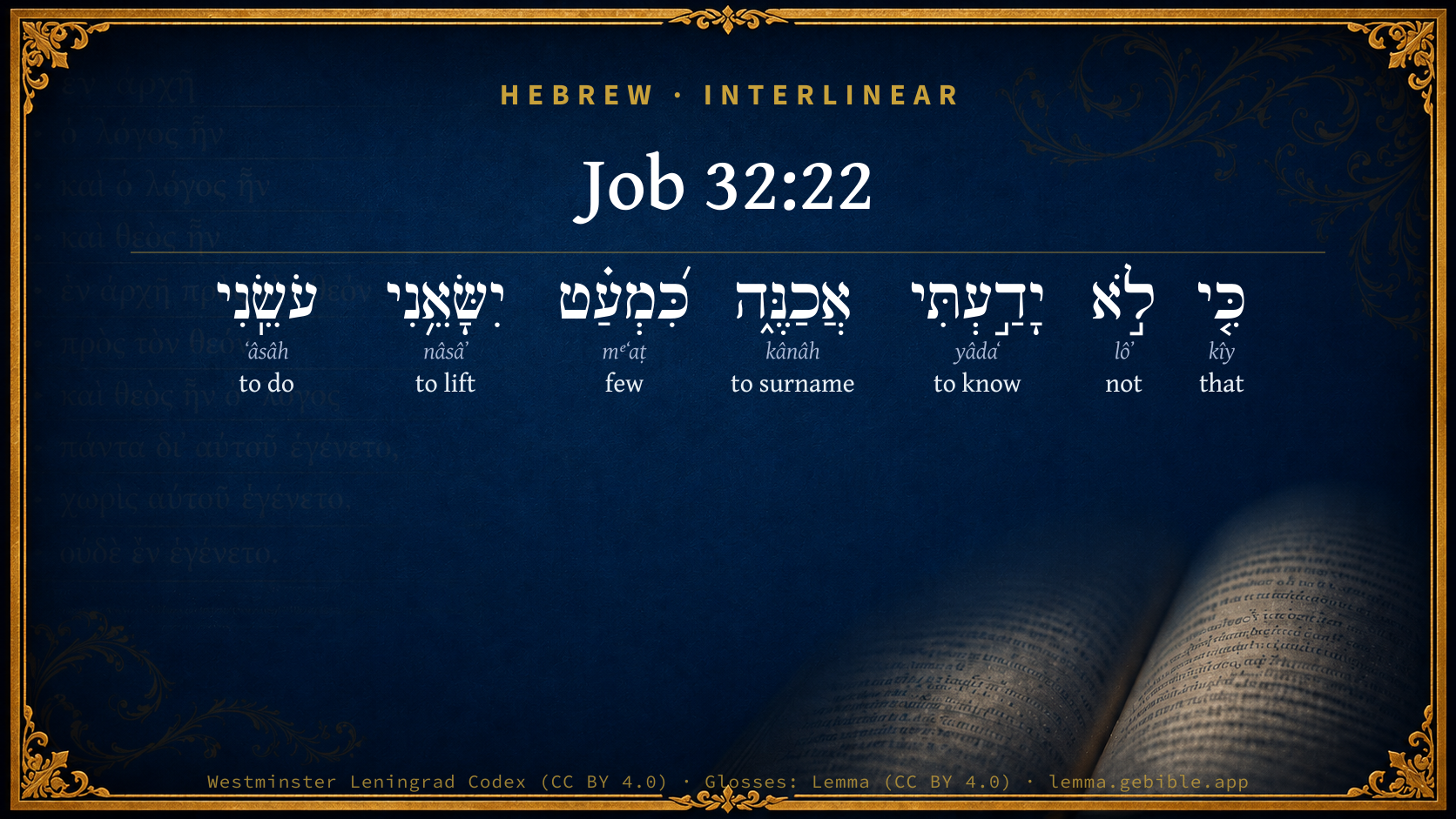
Job 32:22

Hebrew (Westminster Leningrad Codex) Job 32:22 appears in the Hebrew Old Testament. The text above is from the Westminster Leningrad Codex. Each word links to its Strong’s number, a concise gloss, and parsing drawn from the Open Scriptures Hebrew Bible morphology. Click any word for its full Brown-Driver-Briggs (BDB) entry.
Download image
Cite this verse

Job 32:22 (World English Bible). Public Domain. Lemma interlinear Bible study tool, https://lemma.gebible.app/v/job/32/22.

Show BibTeX & RIS
BibTeX
RIS
English Translation
For I don't know how to give flattering titles; Or else my Maker would soon take me away.
World English Bible · Public Domain
Download a study sheet

One document with this verse’s original text, its word-by-word gloss line, the meaning frame, cross-references with their text, attributed commentary, and full source and license credits — printable, and it pastes into notes with its structure intact.

This verse Autodidact and up

Study sheet (.html) Plain text (.txt)

A passage Seminary Student

Up to 50 verses in one chapter. A passage sheet keeps up to 6 commentary sources and 12 cross-references per verse, in the order this page ranks them, and says so on the sheet whenever that leaves anything out. Ask for a single verse and you get the Autodidact verse sheet above.

Everything on this page stays free to read, with no account — the sheet is a download of what is already on screen, not access to it.

Want to remove ads? Support Godless Engineer
Compare translations 3

The same verse in 3 English versions, stacked beneath the original-language interlinear above. Click any original word for its lexicon entry.

Each is an independent rendering of the whole verse — the interlinear is not word-aligned to these translations.

Highlighted words mark where these versions differ — a whole-verse word diff, not a word-by-word alignment.

  • World English Bible Public Domain
    For I don't know how to give flattering titles; Or else my Maker would soon take me away.
  • King James Version Public Domain
    For I know not to give flattering titles; in so doing my maker would soon take me away.
  • unfoldingWord Literal Text CC BY-SA 4.0
    For I do not know giving titles; my Maker would soon take me away.

unfoldingWord Literal Text — © unfoldingWord, licensed CC BY-SA 4.0. Word-aligned USFM3 via Door43 (git.door43.org/unfoldingWord/en_ult).

Versions to compare (up to 4)

3 of 4 selected

Show all 18 translations

Every available English version of this verse, each an independent rendering of the whole verse.

  • World English Bible Public Domain
    For I don't know how to give flattering titles; Or else my Maker would soon take me away.
  • Berean Standard Bible Public Domain
    For I do not know how to flatter, or my Maker would remove me in an instant.
  • Majority Standard Bible Public Domain
    For I do not know how to flatter, or my Maker would remove me in an instant.
  • King James Version Public Domain
    For I know not to give flattering titles; in so doing my maker would soon take me away.
  • American Standard Version (1901) Public Domain
    For I know not to give flattering titles; `Else' would my Maker soon take me away.
  • Revised Version (1885) Public Domain
    For I know not to give flattering titles; else would my Maker soon take me away.
  • Geneva Bible (1599) Public Domain
    For I may not giue titles, lest my Maker should take me away suddenly.
  • Douay-Rheims (1899) Public Domain
    For I know not how long I shall continue, and whether after a while my Maker may take me away.
  • Young's Literal Translation Public Domain
    For I have not known to give flattering titles, In a little doth my Maker take me away.
  • Literal Standard Version CC BY-SA 4.0
    For I have not known to give flattering titles, || My Maker takes me away in a little.”
  • Unlocked Literal Bible CC BY-SA 4.0
    For I do not know how to give such titles; if I did so, my Maker would soon take me away.
  • unfoldingWord Literal Text CC BY-SA 4.0
    For I do not know giving titles; my Maker would soon take me away.
  • Darby Bible Public Domain
    For I know not how to flatter; my Maker would soon take me away.
  • World Messianic Bible Public Domain
    For I don’t know how to give flattering titles, or else my Maker would soon take me away.
  • Webster's Bible Public Domain
    For I know not to give flattering titles; in so doing, my Maker would soon take me away.
  • Free Bible Version CC BY-SA 4.0
    I don't know how to flatter, and if I did my Creator would soon destroy me.”
  • Bible in Basic English Public Domain
    For I am not able to give names of honour to any man; and if I did, my Maker would quickly take me away.
  • JPS Tanakh (1917) Public Domain
    For I know not to give flattering titles; else would my Maker soon take me away.

Literal Standard Version (2020), Covenant Press — licensed CC BY-SA 4.0. Text via the HelloAO Bible API (eBible.org). Unlocked Literal Bible (unfoldingWord) — licensed CC BY-SA 4.0. Text via the HelloAO Bible API (eBible.org). unfoldingWord Literal Text — © unfoldingWord, licensed CC BY-SA 4.0. Word-aligned USFM3 via Door43 (git.door43.org/unfoldingWord/en_ult). Free Bible Version, Dr. Jonathan Gallagher — licensed CC BY-SA 4.0. Text via the HelloAO Bible API (eBible.org).

Word by word

More ways to search: Search by grammar → Find every occurrence → Compare this word →

Practice this passage: Drill this verse → Learn its vocabulary →

About this verse

These counts appear in no published source. They are computed here, from the morphology-tagged text and Lemma’s own curated glosses. What Lemma adds →

7
words
7
distinct lemmas
Wisdom
section

Notable vocabulary

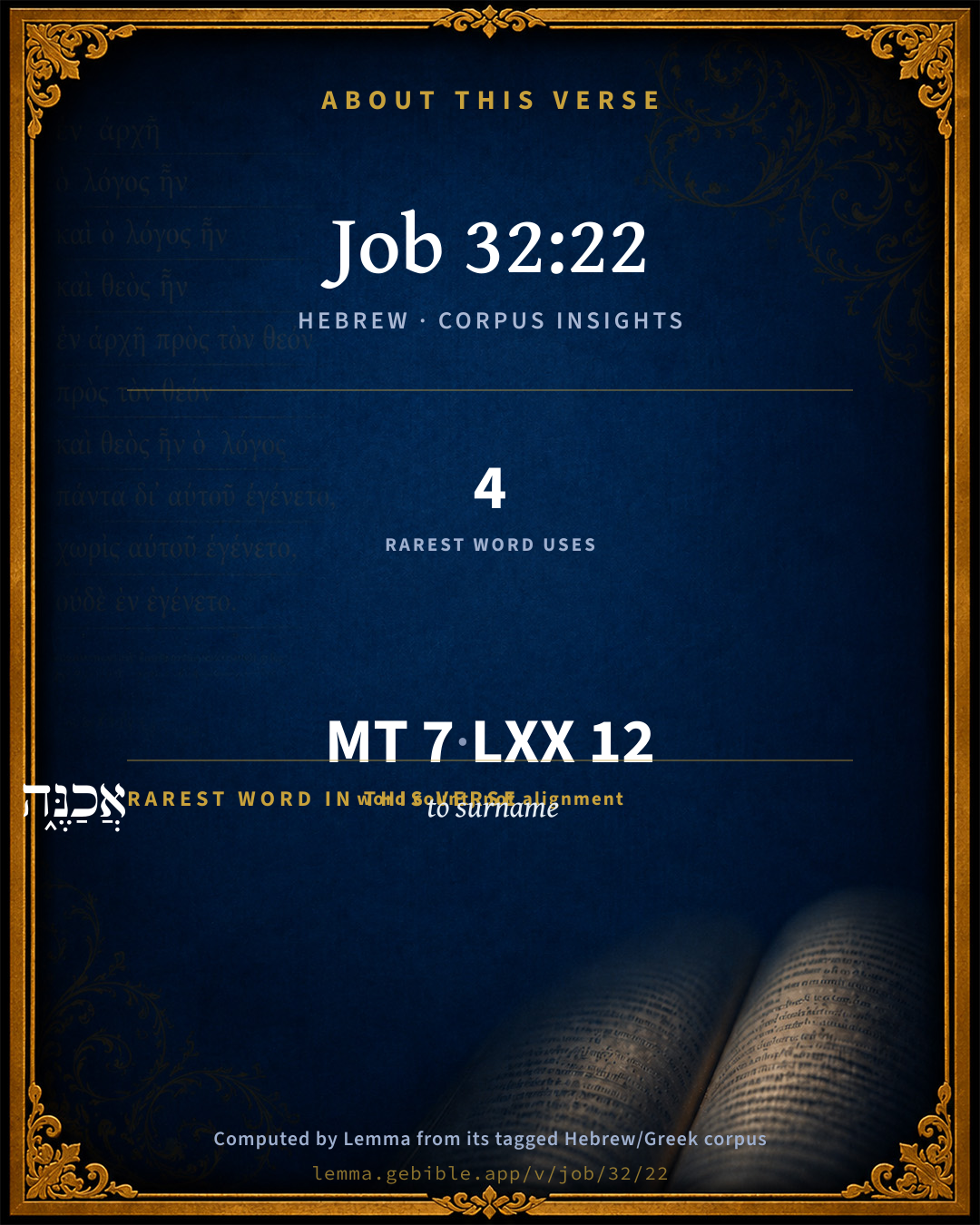
The rarest word here is אֲכַנֶּ֑ה to surname H3655 — appearing just 4 times in the whole Hebrew Bible.

Shared distinctive vocabulary

אֲכַנֶּ֑ה to surname H3655 occurs in 4 verses of the Hebrew Bible. Also found in:

Grammatical profile

  • 4 verbs
  • 1 noun
  • 1 conjunction
  • 1 particle

Verb forms

  • יָדַ֣עְתִּי Qal · Perfect
  • אֲכַנֶּ֑ה Piel · Imperfect
  • יִשָּׂאֵ֥נִי Qal · Imperfect
  • עֹשֵֽׂנִי Qal · Participle Active

Hebrew & Septuagint length

In English translation the verse runs 18 words from the Hebrew and 17 from the Septuagint (LXX English) — closely comparable.

A rough comparison of the two English renderings, which tokenize alike — not a word-level alignment.

Word counts can differ between the Hebrew and the Greek without any difference in meaning — e.g. the Hebrew direct-object marker אֵת has no separate Greek word, and Greek often adds the article ὁ.

In the original languages it is 7 Hebrew tokens and 12 Greek tokens — but the two are counted differently (Hebrew bundles its prefixes and suffixes into one token; the Greek is in lemma form), so that isn’t a like-for-like length.

Cross-references

5

Topical passages linked to Job 32:22 in the Treasury of Scripture Knowledge — connected by theme and wording, ordered by reader-vote popularity; previews shown in the World English Bible.

  • Psalms 12:2–3 Everyone lies to his neighbor. They speak with flattering lips, and with a double heart.
  • Proverbs 29:5 A man who flatters his neighbor, Spreads a net for his feet.
  • 1 Thessalonians 2:5 For neither were we at any time found using words of flattery, as you know, nor a cloak of covetousness (God is witness),
  • Job 17:5 He who denounces his friends for a prey, Even the eyes of his children shall fail.
  • Galatians 1:10 For am I now seeking the favor of men, or of God? Or am I striving to please men? For if I were still pleasing men, I wouldn't be a servant of Christ.

Cross-references courtesy of OpenBible.info (CC BY 4.0).

Hebrew and Greek witnesses Masoretic Hebrew ↔ Greek Septuagint

The same verse in the two great witnesses to the Old Testament, shown verse-for-verse.

These are two independent witnesses, not word-aligned to each other, and the Septuagint is shown in lemma (dictionary) form.

Hebrew Job 32:22 Masoretic · Westminster Leningrad Codex

כִּ֤י לֹ֣א יָדַ֣עְתִּי אֲכַנֶּ֑ה כִּ֝מְעַ֗ט יִשָּׂאֵ֥נִי עֹשֵֽׂנִי

For I don't know how to give flattering titles; Or else my Maker would soon take me away.

World English Bible · Public Domain

Greek LXX Job 32:22 Septuagint · lemma form

οὐ γάρ ἐπίσταμαι θαυμάζω πρόσωπον εἰ δέ μή καί ἐγώ σής ἐσθίω

For I know not how to respect persons: and if otherwise, even the moths would eat me.

LXX2012 (modern English Septuagint) · Public Domain

On this verse, Haydock's Catholic Bible Commentary discusses the Septuagint’s reading. Read the note in Commentary ↓

Hebrew: Westminster Leningrad Codex (CC BY 4.0). Greek: Septuagint (public domain); English from LXX2012 (modern English Septuagint) (Public Domain). How the Septuagint differs from the Hebrew →

Commentary

Notes on Job 32:22 from classic Christian and Jewish commentators (each source and its license shown beneath its notes). The classic Christian expositions comment on the surrounding passage and are grouped to its opening verse, so a note may address several verses; the Jewish commentaries on the Tanakh (Rashi and others) are per-verse, so they appear only where the commentator wrote on this verse.

Lemma curates 59 commentaries, every one of them public domain or Creative Commons licensed, each selected and text-cleaned for this edition rather than reprinted as found. About our sources →

Trapp's Complete Commentary

John Trapp

Job 32:22 For I know not to give flattering titles; [in so doing] my maker would soon take me away.

Ver. 22. For I know not to give, &c.] I have as little art in it (it is out of my road) as heart to it. For,

In so doing my maker should take me away] i.e. Kill me and send me packing to hell. He would soon snatch me away; he would burn me, as some render it; so dangerous is the sin of flattery. A preacher called Constantine the Great, Blessed, to his face, but he went away with a check. What will God say to such, think we? (Euseb. de Vita Const. l. iv. c. 4.)

John Trapp, A Commentary or Exposition upon All the Books of the Old and New Testament (1647–1656) — public domain. Text from a community e-Sword module.

Geneva Bible (1599)

Geneva Bible translators

The Hebrew word signifieth, to change the name, as to call a fool a wise man: meaning, that he would not cloak the truth to flatter men.

Geneva Bible (1599) marginal notes — public domain. Text via Bolls.life.

Jamieson, Fausset & Brown

Robert Jamieson, A. R. Fausset & David Brown

take me away--as a punishment (Psa 102:24).

Next: Job Chapter 33

Jamieson, Fausset & Brown — Commentary Critical and Explanatory on the Whole Bible (1871) — public domain (CC PDM 1.0). Text via the HelloAO Bible API.

Adam Clarke's Commentary

Verse 22. My Maker would soon take me away.] Were I to copy this conduct while under the influence which I now feel, God might justly consume me as in a moment. He is my Maker; he made me to know truth, to tell truth, and to live according to truth; for he is the God of truth: I shall, therefore through his help, speak the TRUTH, the WHOLE TRUTH, and NOTHING BUT THE TRUTH.

WE find from the above that vain titles of ceremony, expressive of the most eminent qualities, were given to worthless men, from time immemorial; and no wonder, for hypocrisy entered into man at the same time that sin entered into the world.

Of the flattering titles used in the East, I shall give a few specimens from the [Arabic] Kooayid us Sultanet SHAH JEHAN, or, "The Rules observed during the Reign of the Mogul Emperor Shah Jehan."

Speaking of the emperor, he is entitled,

"The SUN which illuminates the firmament in the universe of royalty and dominion; the MOON, which irradiates the sky of monarchy and felicity; the King who in pomp resembles Gem-sheed. His hand is boundless as the ocean in bestowing bounties, being the key of the gates of kindness and liberality!" Again: -

"The Sun of the heaven of prosperity and empire, the SHADOW OF GOD, the Asylum of the Universe, the splendour of whose instructive front causes light and gladness to the world and to mankind."

"The just and vigilant Monarch; the Asylum of Truth, the Refuge of the World; the Diffuser of Light, the Solver of all human difficulties."

"The Lord of the Age, who is endowed with such perfect excellence, both in internal and external qualifications, that on all occasions he holds fast the thread of good counsel, prudence, and purity of morals."

"The faculty of apprehension is possessed by him in such a degree, that before the matter ha s scarcely obtained utterance he comprehends the purport, and gives answers with the tongue of inspiration."

Addresses to Persons of Distinction

"Let them convey to the presence of glorious empire, the Sultan, in pomp like Solomon, the centre of the universe, powerful as heaven!"

"Let them who kiss the carpet of the palace, in pomp like heaven, convey this letter to his majesty, whose sight is as creative as alchymy, king of kings, the asylum of the world!"

"To the exalted presence, which gratifies the desires of all people, the most beneficent of the age, the vizier, protector of the universe, may the Almighty perpetuate his fortune!"

"May this letter be dignified in the presence of Naweeb Saheb, diffuser of benefits, of exalted pomp, the respectable, the discriminator of ranks! May his power increase!"

"Let them convey this to the perusal of his excellency, conversant in realities and mysteries, the support of excellencies, the cream of his contemporaries, and the cherisher of the poor!"

These are a specimen of the flattering titles given in the East to persons in eminent stations. Their kings they clothe in all the attributes of the Deity, when both in their public and private character they are corrupt and unholy, rascals in grain, and the ruthless oppressors of suffering humanity.

Adam Clarke's Commentary on the Bible (1810–1826) — public domain. Text from a community e-Sword/MySword module.

Ellicott's Commentary for English Readers

(22) In so doing my maker would soon take me away.—Or perhaps the meaning may be, “My Maker will almost have to forgive me:” that is, for being too candid, frank, and straightforward; for speaking too plainly. Some commentators regard Elihu’s character with great disfavour, and consider him to be an empty and arrogant talker, mainly, perhaps, from Job_32:18-19; others accept him as a wise and pious friend of Job, who not only gave him good advice, but perhaps more nearly than any other of the disputants hit the truth about Job’s afflictions. We are probably more right in this latter view, because at the climax of the poem we do not read that Elihu had any share in the condemnation which was passed by God on the three friends of Job. He is not noticed for either praise or blame.

It is to be observed that the last eight verses of this chapter are a kind of soliloquy, unlike the former part of it, which was addressed to the friends, or the next chapter, which is addressed to Job.

A Bible Commentary for English Readers, edited by Charles John Ellicott (1878–1897) — public domain. Text from a community e-Sword module.

The Cambridge Bible for Schools and Colleges

gen. ed. J. J. S. Perowne

22. Elihu is conscious of sincerity; it is not in his nature to flatter. His fear of God also and sense of His rectitude would deter him from such a thing; comp. Job’s language, ch. Job_13:7 seq.

These last words and many other things which Elihu says enable us to judge rightly of the part which the author intends him to play. There are some things in his manner of introducing himself and in the way in which he speaks of his own arguments, which seem to offend against modesty and almost shock our sense of decorum. We must not, however, apply Western standards of taste to the East. There was nothing further from the intention of the author of these Chapters than to make Elihu play a ridiculous part. This speaker is meant to offer what the writer judged a weighty contribution to the discussion, and to the vindication of the ways of God to man. It is just this fact, however, that Elihu is a serious speaker and yet so characterized by mannerisms that raises the question whether the author of such a character possessed the severe taste and high dramatic genius which so conspicuously belong to the author of the other characters; in other words, the question whether these chapters are not the composition of a different writer (see the Introduction).

The Cambridge Bible for Schools and Colleges (gen. ed. J. J. S. Perowne; Cambridge University Press, 1878–1918) — public domain. Text from a community e-Sword module.

John Gill's Exposition

For I know not to give flattering titles,.... He had not been brought up in such a manner, nor taught to use them; he had not been inured to them, nor did he know or approve of them; nor could he in conscience give them;

in so doing, my Maker would soon take me away; it being such a piece of wickedness, so abominable to him, and so highly resented by him, that I might justly expect he would, as he could, strike me dead at once; just as Ananias and Sapphira were struck dead for lying, Act 5:5, or he knew that it would be but a short time at most, and he should be taken out of the world by death, when he must appear before his Maker, his Judge, to whom he must give an account of his words, as well as actions; the awe of this being continually on his mind would not admit him to flatter any man. Some render it, "will burn me" (c), as in Sa2 5:21; so Aben Ezra and Ben Gersom, that is, in hell fire; see Psa 12:2.

(c) "comburet me", Pagninus.

Next: Job Chapter 33

John Gill's Exposition of the Whole Bible (1746–1763) — public domain (CC PDM 1.0). Text via the HelloAO Bible API.

Albert Barnes' Notes on the Bible

For I know not to give flattering titles - I do not know how to flatter. It is not in my character; it has not been my habit. “In so doing.” These words are not in the Hebrew, and they greatly mar the sense, and give a different idea from that which was intended by the speaker.

My Maker would soon take me away - Or, rather, “My Maker will soon take me away.” That is, “I know that I must soon be removed, and must stand before my Maker. I must give an account for all that I say. Knowing that I am to go to the realities of another state of being, I cannot flatter people. I must tell them the exact and simple truth.” There could be no better preventive of flattery than this. The conviction that we are soon to appear before God, where all are on a level, and where every mask will be stripped off, and everything appear as it is, would prevent us from ascribing to others qualities which we know they do not possess, and from giving them titles which will only exalt them in their own estimation, and hide the truth from their minds. Titles which properly belong to men, and which pertain to office, religion does not forbid us to confer - for the welfare of the community is promoted by a proper respect for the names and offices of those who rule. But no good end is answered in ascribing to men titles as mere matters of distinction, which serve to keep before them the idea of their own talents or importance; or which lead them to forget that they like others are soon to be “taken away,” and called to give up their account in another world. The deep conviction that we are all soon to try the realities of a bed of death and of the grave, and that we are to go to a world where there is no delusion, and where the ascription of qualities to us here which do not belong to us will be of no avail, would prompt to a wish to state always the simple truth. Under that conviction, we should never so ascribe to another any quality of beauty, strength, or talent, any name or title, as to leave him for one moment under a deception about himself. If this rule were followed, what a change would it produce in the social, the political, the literary, and even the religious world!

Albert Barnes' Notes on the Bible (1834–1885) — public domain. Text from a community e-Sword/MySword module.

Haydock's Catholic Bible Commentary

Away. I shall therefore speak with the utmost caution, (Haydock) as one who must shortly appear before the divine tribunal. (Menochius) --- Hebrew, "For I know not how to call things by their sirnames, (Calmet) or titles of vanity; (Haydock) If I do, may my Creator soon (Calmet) take me away." Septuagint, "I know not how to admire the face. If it be not so, the worms shall consume me." (Haydock)

George Leo Haydock (1774–1849), Haydock's Catholic Family Bible and Commentary, 1859 edition — public domain. Excludes Psalms (Douay-Rheims chapter numbering differs from Protestant) and Deuterocanonical books (Catholic canon only).

Matthew Poole's English Annotations

I have neither skill nor will to flatter Job or any man so as to debauch my conscience, or corrupt the truth, or speak falsely for his sake. If I should be guilty of that sin, God would quickly and sorely punish me for it. Or without this supplement,

my Maker will quickly take me away, to wit, out of this world. I dare not flatter any man, because I consider I must shortly die and go to judgment, to give an account of all my words and actions.

Matthew Poole's English Annotations on the Holy Bible (1683–1685) — public domain. Text from a community e-Sword/MySword module.

Whedon's Commentary on the Bible

Daniel D. Whedon

22. Give flattering titles — This expression means to give proud titles to persons who are worthless. (Dr. Clarke.) The practice was common among the Orientals of addressing superiors with long and fulsome, and even divine, titles. The ancient Egyptian and Assyrian inscriptions abound in illustrations. In thus paying greater homage to the creature than the Creator, “his Maker would soon take him away.”

Daniel D. Whedon (gen. ed.), Commentary on the Old and New Testaments (1874–1909) — public domain. Text from a community e-Sword module.

The Pulpit Commentary

For I know not to give flattering titles; i.e. it is not my habit to give flattering titles, nor have I any knowledge of the art. I should expect that, if such were my habit, my Maker would soon take me away; would soon, i.e. , remove me from the earth, as one whose influence was not for good, but for evil. Flattery is condemned by Job, in Job_17:5: by David, in the Psalms; (Psa_12:2, 3 78:36) and by Solomon, in the Book of Proverbs. (Pro_2:16 Pro_7:21 Pro_20:19 Pro_28:23, etc.)

The Pulpit Commentary (1880–1919), ed. H.D.M. Spence-Jones & Joseph S. Exell — public domain. Text from a community e-Sword module.

John Wesley's Explanatory Notes

I know not - The more closely we eye the majesty of God as our maker, the more we dread his wrath and justice, the less danger shall we be in of a sinful fearing or flattering of men.

John Wesley, Explanatory Notes Upon the Whole Bible (1754–1765) — public domain. Text via the GEBible commentary corpus.

Rashi

Rabbi Shlomo Yitzchaki (Rashi)

or else...would carry me away He would take me away from the world. Others interpret יִשָׂאֵנִי like (Nahum 1:5), “and the land raised up (ותשא) from before me [a pillar of smoke].”

Rashi on the Tanakh — English translations: “The Judaica Press complete Tanach with Rashi, translated by A. J. Rosenberg” (CC BY 4.0); “Pentateuch with Rashi's commentary by M. Rosenbaum and A.M. Silbermann, 1929-1934” (public domain); “The Metsudah Tanach series, Lakewood, N.J” (CC BY 4.0); and “The Book of Joshua, Metsudah Publications, 1997” (CC BY 4.0). Text via Sefaria.

Lesson kit

Teaching starters — assembled from the data on this page, not authored interpretation. Every prompt links to the verse data it draws on. Edit before teaching.

Job, in the Wisdom, opens this verse with 7 words (7 distinct Hebrew lemmas). Its most distinctive word is kânâh (“to surname”). A historical commentator’s framing appears above. Read the whole chapter for the surrounding context.

Discussion questions

  1. What does “to surname” (kânâh) contribute to the verse as a whole?
  2. Job 32:21 shares the word «to surname» with this verse. How do the two illuminate each other?
  3. The translations on this page render this verse differently — a whole-verse word diff, not a word-by-word alignment. What might account for the different wordings?
  4. The verb «יָדַ֣עְתִּי» is Qal Perfect. How does its form color the action?
  5. Reading how Trapp's Complete Commentary and Geneva Bible (1599) read this verse, where do the two commentators agree and where do they part?

Things to notice

Reading settings

Reading text

Shown beneath each verse's original-language words.

Old Testament
Old Testament edition

Read the OT as the Masoretic Hebrew (MT) or the Greek Septuagint (LXX).

English shown for the Greek Septuagint (in the Hebrew ↔ Greek comparison).

Comparing translations? Open the Compare panel on any verse page to stack up to four side by side.