Ezekiel 11:22

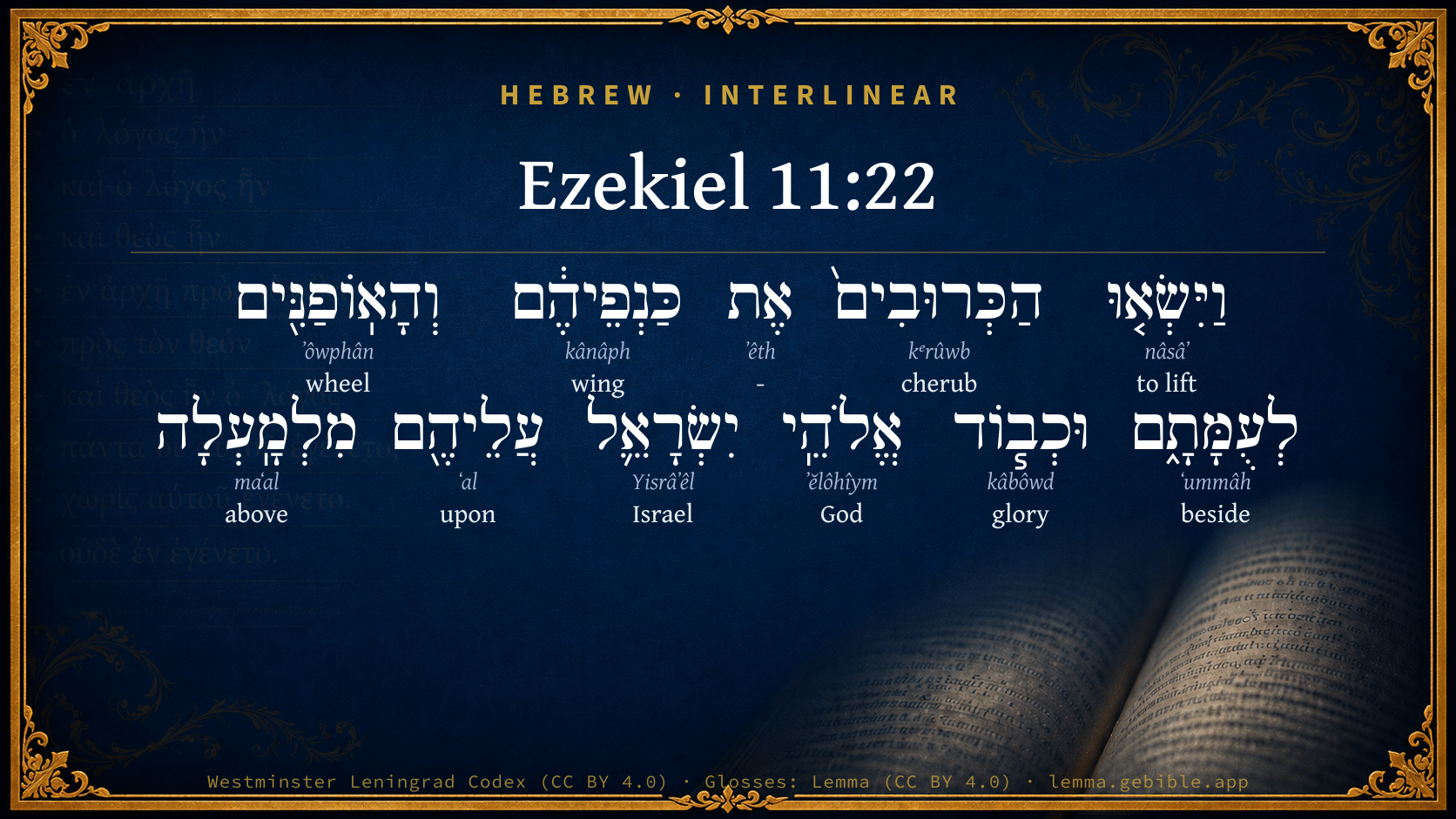
Hebrew (Westminster Leningrad Codex) Ezekiel 11:22 appears in the Hebrew Old Testament. The text above is from the Westminster Leningrad Codex. Each word links to its Strong’s number, a concise gloss, and parsing drawn from the Open Scriptures Hebrew Bible morphology. Click any word for its full Brown-Driver-Briggs (BDB) entry.
Download image
Cite this verse

Ezekiel 11:22 (World English Bible). Public Domain. Lemma interlinear Bible study tool, https://lemma.gebible.app/v/ezekiel/11/22.

Show BibTeX & RIS
BibTeX
RIS
English Translation
Then did the cherubim lift up their wings, and the wheels were beside them; and the glory of the God of Israel was over them above.
World English Bible · Public Domain
Download a study sheet

One document with this verse’s original text, its word-by-word gloss line, the meaning frame, cross-references with their text, attributed commentary, and full source and license credits — printable, and it pastes into notes with its structure intact.

This verse Autodidact and up

Study sheet (.html) Plain text (.txt)

A passage Seminary Student

Up to 50 verses in one chapter. A passage sheet keeps up to 6 commentary sources and 12 cross-references per verse, in the order this page ranks them, and says so on the sheet whenever that leaves anything out. Ask for a single verse and you get the Autodidact verse sheet above.

Everything on this page stays free to read, with no account — the sheet is a download of what is already on screen, not access to it.

Want to remove ads? Support Godless Engineer
Compare translations 3

The same verse in 3 English versions, stacked beneath the original-language interlinear above. Click any original word for its lexicon entry.

Each is an independent rendering of the whole verse — the interlinear is not word-aligned to these translations.

Highlighted words mark where these versions differ — a whole-verse word diff, not a word-by-word alignment.

  • World English Bible Public Domain
    Then did the cherubim lift up their wings, and the wheels were beside them; and the glory of the God of Israel was over them above.
  • King James Version Public Domain
    Then did the cherubims lift up their wings, and the wheels beside them; and the glory of the God of Israel was over them above.
  • unfoldingWord Literal Text CC BY-SA 4.0
    The cherubim lifted up their wings and the wheels that were beside them, and the glory of the God of Israel was high up over them.

unfoldingWord Literal Text — © unfoldingWord, licensed CC BY-SA 4.0. Word-aligned USFM3 via Door43 (git.door43.org/unfoldingWord/en_ult).

Versions to compare (up to 4)

3 of 4 selected

Show all 18 translations

Every available English version of this verse, each an independent rendering of the whole verse.

  • World English Bible Public Domain
    Then did the cherubim lift up their wings, and the wheels were beside them; and the glory of the God of Israel was over them above.
  • Berean Standard Bible Public Domain
    Then the cherubim, with the wheels beside them, spread their wings, and the glory of the God of Israel was above them.
  • Majority Standard Bible Public Domain
    Then the cherubim, with the wheels beside them, spread their wings, and the glory of the God of Israel was above them.
  • King James Version Public Domain
    Then did the cherubims lift up their wings, and the wheels beside them; and the glory of the God of Israel was over them above.
  • American Standard Version (1901) Public Domain
    Then did the cherubim lift up their wings, and the wheels were beside them; and the glory of the God of Israel was over them above.
  • Revised Version (1885) Public Domain
    Then did the cherubim lift up their wings, and the wheels were beside them; and the glory of the God of Israel was over them above.
  • Geneva Bible (1599) Public Domain
    Then did the Cherubims lift vp their wings, and the wheeles besides them, and the glorie of the God of Israel was vpon them on hie.
  • Douay-Rheims (1899) Public Domain
    And the cherubims lifted up their wings, and the wheels with them: and the glory of the God of Israel was over them.
  • Young's Literal Translation Public Domain
    And the cherubs lift up their wings, and the wheels `are' over-against them, and the honour of the God of Israel `is' over them above.
  • Literal Standard Version CC BY-SA 4.0
    And the cherubim lift up their wings, and the wheels [are] alongside them, and the glory of the God of Israel [is] over them above.
  • Unlocked Literal Bible CC BY-SA 4.0
    The cherubim lifted up their wings and the wheels that were beside them, and the glory of the God of Israel was high up over them.
  • unfoldingWord Literal Text CC BY-SA 4.0
    The cherubim lifted up their wings and the wheels that were beside them, and the glory of the God of Israel was high up over them.
  • Darby Bible Public Domain
    And the cherubim lifted up their wings, and the wheels were beside them; and the glory of the God of Israel was over them above.
  • World Messianic Bible Public Domain
    Then the cherubim lifted up their wings, and the wheels were beside them. The glory of the God of Israel was over them above.
  • Webster's Bible Public Domain
    Then the cherubim raised their wings, and the wheels beside them; and the glory of the God of Israel was over them above.
  • Free Bible Version CC BY-SA 4.0
    Then the cherubim opened their wings and took off, with the wheels alongside them, and with the glory of the God of Israel above them.
  • Bible in Basic English Public Domain
    Then the wings of the winged ones were lifted up, and the wheels were by their side; and the glory of the God of Israel was over them on high.
  • JPS Tanakh (1917) Public Domain
    Then did the cherubim lift up their wings, and the wheels were beside them; and the glory of the God of Israel was over them above.

Literal Standard Version (2020), Covenant Press — licensed CC BY-SA 4.0. Text via the HelloAO Bible API (eBible.org). Unlocked Literal Bible (unfoldingWord) — licensed CC BY-SA 4.0. Text via the HelloAO Bible API (eBible.org). unfoldingWord Literal Text — © unfoldingWord, licensed CC BY-SA 4.0. Word-aligned USFM3 via Door43 (git.door43.org/unfoldingWord/en_ult). Free Bible Version, Dr. Jonathan Gallagher — licensed CC BY-SA 4.0. Text via the HelloAO Bible API (eBible.org).

Word by word

More ways to search: Search by grammar → Find every occurrence → Compare this word →

Practice this passage: Drill this verse → Learn its vocabulary →

לְעֻמָּתָ֑ם
ʻummâh
H5980
“to/for · beside · their”
Preposition + Noun, Common, Feminine, Singular, Construct + Suffix, Personal, 3rd Person, Masculine, Plural
Part of Speech
Preposition + Noun
Type
Common
Gender
Feminine
Number
Singular
State
Construct
Full BDB Definition

Origin: from H6004

TWOT: 1640f

juxtaposition - used only as a preposition - close by, side by side with, alongside of, parallel with - agreeing with, corresponding to, exactly as, close beside - correspondingly to
  1. וַיִּשְׂא֤וּ nâsâʼ H5375 “and · to lift” Conjunction + Verb, Qal, Sequential Imperfect, 3rd Person, Masculine, Plural
  2. הַכְּרוּבִים֙ kᵉrûwb H3742 “the · cherubim” Particle, Definite Article + Noun, Common, Masculine, Plural, Absolute
  3. אֶת ʼêth H853 “-” Particle, Direct Object
  4. כַּנְפֵיהֶ֔ם kânâph H3671 “wings · their” Noun, Common, Feminine, Dual, Construct + Suffix, Personal, 3rd Person, Masculine, Plural
  5. וְהָאֽוֹפַנִּ֖ים ʼôwphân H212 “and · the · wheels” Conjunction + Particle, Definite Article + Noun, Common, Masculine, Plural, Absolute
  6. וּכְב֧וֹד kâbôwd H3519 “and · glory of” Conjunction + Noun, Common, Both, Singular, Construct
  7. אֱלֹהֵֽי ʼĕlôhîym H430 “God(s) of” Noun, Common, Masculine, Plural, Construct
  8. יִשְׂרָאֵ֛ל Yisrâʼêl H3478 “Israel” Noun, Proper
  9. עֲלֵיהֶ֖ם ʻal H5921 “upon · them” Preposition + Suffix, Personal, 3rd Person, Masculine, Plural
  10. מִלְמָֽעְלָה maʻal H4605 “from · to/for · above · toward” Preposition + Preposition + Adverb + Suffix, Demonstrative

About this verse

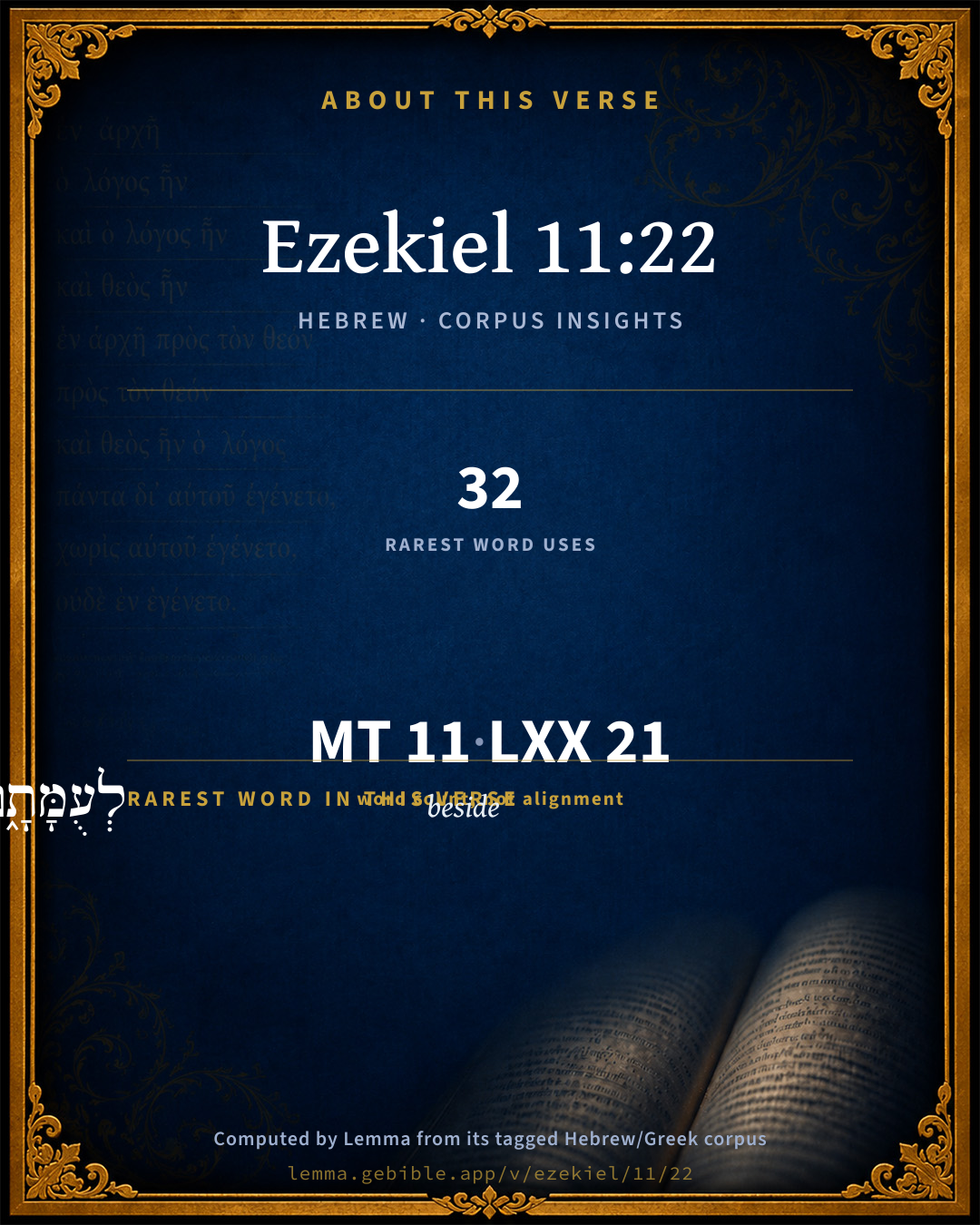
These counts appear in no published source. They are computed here, from the morphology-tagged text and Lemma’s own curated glosses. What Lemma adds →

11
words
11
distinct lemmas
Prophets
section

Shared distinctive vocabulary

לְעֻמָּתָ֑ם beside H5980 occurs in 28 verses of the Hebrew Bible. Also found in:

Grammatical profile

  • 1 verb
  • 7 nouns
  • 1 preposition
  • 1 adverb
  • 1 particle

Verb forms

  • וַיִּשְׂא֤וּ Qal · Sequential Imperfect

Hebrew & Septuagint length

In English translation the verse runs 26 words from the Hebrew and 24 from the Septuagint (LXX English) — closely comparable.

A rough comparison of the two English renderings, which tokenize alike — not a word-level alignment.

Word counts can differ between the Hebrew and the Greek without any difference in meaning — e.g. the Hebrew direct-object marker אֵת has no separate Greek word, and Greek often adds the article ὁ.

In the original languages it is 11 Hebrew tokens and 21 Greek tokens — but the two are counted differently (Hebrew bundles its prefixes and suffixes into one token; the Greek is in lemma form), so that isn’t a like-for-like length.

Cross-references

2

Topical passages linked to Ezekiel 11:22 in the Treasury of Scripture Knowledge — connected by theme and wording, ordered by reader-vote popularity; previews shown in the World English Bible.

  • Ezekiel 10:19 The cherubim lifted up their wings, and mounted up from the earth in my sight when they went forth, and the wheels beside them: and they stood at the door of the east gate of Yahweh's house; and the glory of the God of Israel was over them above.
  • Ezekiel 1:19–20 When the living creatures went, the wheels went beside them; and when the living creatures were lifted up from the earth, the wheels were lifted up.

Cross-references courtesy of OpenBible.info (CC BY 4.0).

Hebrew and Greek witnesses Masoretic Hebrew ↔ Greek Septuagint

The same verse in the two great witnesses to the Old Testament, shown verse-for-verse.

These are two independent witnesses, not word-aligned to each other, and the Septuagint is shown in lemma (dictionary) form.

Hebrew Ezekiel 11:22 Masoretic · Westminster Leningrad Codex

וַיִּשְׂא֤וּ הַכְּרוּבִים֙ אֶת כַּנְפֵיהֶ֔ם וְהָאֽוֹפַנִּ֖ים לְעֻמָּתָ֑ם וּכְב֧וֹד אֱלֹהֵֽי יִשְׂרָאֵ֛ל עֲלֵיהֶ֖ם מִלְמָֽעְלָה

Then did the cherubim lift up their wings, and the wheels were beside them; and the glory of the God of Israel was over them above.

World English Bible · Public Domain

Greek LXX Ezekiel 11:22 Septuagint · lemma form

καί ἐκαἴρω ὁ χερουβείμ ὁ πτέρυξ αὐτός καί ὁ τροχός ἔχω αὐτός καί ὁ δόξα θεός ἰσραήλ ἐπί αὐτός ὑπεράνω αὐτός

Then the cherubs lifted up their wings, and the wheels beside them; and the glory of the God of Israel was over them above.

LXX2012 (modern English Septuagint) · Public Domain

Hebrew: Westminster Leningrad Codex (CC BY 4.0). Greek: Septuagint (public domain); English from LXX2012 (modern English Septuagint) (Public Domain). How the Septuagint differs from the Hebrew →

Targum (Aramaic paraphrase)

1

The Targum is the ancient Jewish Aramaic paraphrase of the Hebrew Scriptures — an interpretive translation, not the Hebrew text itself. Onkelos (literal) and Pseudo-Jonathan (expansive) render the Torah, and Jonathan the Prophets. Coverage is partial: where no permissively-licensed English translation exists for a verse, only the Aramaic is shown. This is verse-level text, not a word-by-word alignment to the Hebrew.

  1. Targum Jonathan Prophets (Joshua–Malachi)
    וּנְטָלוּ כְרוּבַיָא יַת גַפֵּיהוֹן וְגַלְגְלַיָא לְקִבְלֵיהוֹן וִיקָר אֱלָהָא דְיִשְׂרָאֵל עֲלֵיהוֹן מִלְעֵילָא:

    (no public-domain English translation for this verse)

    Targum Jonathan — Aramaic: “Mikraot Gedolot” (public domain). English: “Sefaria Community Translation” (CC0 1.0 (public-domain dedication)); “London "Chaldee Paraphrase," 1871” (public domain). Text via Sefaria.

Commentary

Notes on Ezekiel 11:22 from classic Christian and Jewish commentators (each source and its license shown beneath its notes). The classic Christian expositions comment on the surrounding passage and are grouped to its opening verse, so a note may address several verses; the Jewish commentaries on the Tanakh (Rashi and others) are per-verse, so they appear only where the commentator wrote on this verse.

Lemma curates 59 commentaries, every one of them public domain or Creative Commons licensed, each selected and text-cleaned for this edition rather than reprinted as found. About our sources →

Matthew Henry's Commentary

Here is, 1. The departure of God's presence from the city and temple. When the message was committed to the prophet, and he was fully apprized of it, fully instructed how to separate between the precious and the vile, then the cherubim lifted up their wings and the wheels beside them (Eze 11:22) as before, Eze 10:19. Angels, when they have done their errands in this lower world, are upon the wing to be gone, for they lose no time. We left the glory of the Lord last at the east gate of the temple (Eze 10:19), which is here said to be in the midst of the city. Now here we are told that, finding and wondering that there was none to intercede, none to uphold, none to invite its return, it removed next to the mountain which is on the east side of the city (Eze 11:23); that was the mount of Olives. On this mountain they had set up their idols, to confront God in his temple, when he dwelt there (Kg1 11:7), and thence it was called the mount of corruption (Kg2 23:13); therefore there God does as it were set up his standard, his tribunal, as it were to confront those who thought to keep possession of the temple for themselves now that God had left it. From that mountain there was a full prospect of the city; thither God removed, to make good what he had said (Deu 32:20), I will hide my face from them, I will see what their end shall be. It was from this mountain that Christ beheld the city and wept over it, in the foresight of its last destruction by the Romans. The glory of the Lord removed thither, to be as it were yet within call, and ready to return if now at length, in this their day, they would have understood the things that belonged to their peace. Loth to depart bids oft farewell. God, by going away thus slowly, thus gradually, intimated that he left them with reluctance, and would not have gone if they had not perfectly forced him from them. He did now, in effect, say, How shall I give thee up, Ephraim? How shall I deliver thee, Israel? But, though he bear long, he will not bear always, but will at length forsake those, and cast them off for ever, who have forsaken him and cast him off. 2. The departure of this vision from the prophet. At length it went up from him (Eze 11:24); he saw it mount upwards, till it went out of sight, which would be a confirmation to his faith that it was a heavenly vision, that it descended from above, for thitherward it returned. Note, The visions which the saints have of the glory of God will not be constant will they come to heaven. They have glimpses of that glory, which they soon lose again, visions which go up from them, tastes of divine pleasures, but not a continual feast. It was from the mount of Olives that the vision went up, typifying the ascension of Christ to heaven from that very mountain, when those that had seen him manifested in the flesh saw him no more. It was foretold (Zac 14:4) that his feet should stand upon the mount of Olives, stand last there. 3. The prophet's return to those of the captivity. The same spirit that had carried him in a trance or ecstasy to Jerusalem brought him back to Chaldea; for there the bounds of his habitation are at present appointed, and that is the place of his service. The Spirit came to him, not to deliver him out of captivity, but (which was equivalent) to support and comfort him in his captivity. 4. The account which he gave to his hearers of all he had seen and heard, Eze 11:25. He received that he might give, and he was faithful to him that appointed him; he delivered his message very honestly: he spoke all that, and that only, which God had shown him. He told them of the great wickedness he had seen at Jerusalem, and the ruin that was hastening towards that city, that they might not repent of their surrendering themselves to the king of Babylon as Jeremiah advised them, and blame themselves for it, nor envy those that staid behind, and laughed at them for going when they did, nor wish themselves there again, but be content in their captivity. Who would covet to be in a city so full of sin and so near to ruin? It is better to be in Babylon under the favour of God than in Jerusalem under his wrath and curse. But, though this was delivered immediately to those of the captivity, yet we may suppose that they sent the contents of it to those at Jerusalem, with whom they kept up a correspondence; and well would it have been for Jerusalem if she had taken the warning hereby given.

Matthew Henry's Commentary on the Whole Bible (1708–1710) — public domain (CC PDM 1.0). Text via the HelloAO Bible API.

Trapp's Complete Commentary

John Trapp

Eze 11:22 Then did the cherubims lift up their wings, and the wheels beside them; and the glory of the God of Israel [was] over them above.

Ver. 22. Then did the cherubims.] Now God is utterly leaving the refractory Jews. He did so much more after their rejection of Christ and his gospel.

John Trapp, A Commentary or Exposition upon All the Books of the Old and New Testament (1647–1656) — public domain. Text from a community e-Sword module.

Whedon's Commentary on the Bible

Daniel D. Whedon

JEHOVAH LEAVES JERUSALEM, Eze_11:22-23.

22. The cherubim — See notes, chaps. 1 and 10.

Daniel D. Whedon (gen. ed.), Commentary on the Old and New Testaments (1874–1909) — public domain. Text from a community e-Sword module.

Keil & Delitzsch

C. F. Keil & F. Delitzsch

The promise that the Lord would preserve to Himself a holy seed among those who had been carried away captive, brought to a close the announcement of the judgment that would fall upon the ancient Israel and apostate Jerusalem. All that is now wanting, as a conclusion to the whole vision, is the practical confirmation of the announcement of judgment. This is given in the two following verses. - Eze 11:22. And the cherubim raised their wings, and the wheels beside them; and the glory of the God of Israel was up above them. Eze 11:23. And the glory of Jehovah ascended from the midst of the city, and took its stand upon the mountain which is to the east of the city. Eze 11:24. And wind lifted me up, and brought me to Chaldea to the exiles, in the vision, in the Spirit of God; and the vision ascended away from me, which I had seen. Eze 11:25. And I spoke to the exiles all the words of Jehovah, which He had shown to me. - The manifestation of the glory of the Lord had already left the temple, after the announcement of the burning of Jerusalem, and had taken its stand before the entrance of the eastern gate of the outer court, that is to say, in the city itself (Eze 10:19; Eze 11:1). But now, after the announcement had been made to the representatives of the authorities of their removal from the city, the glory of the God of Israel forsook the devoted city also, as a sign that both temple and city had ceased to be the seats of the gracious presence of the Lord. The mountain on the east of the city is the Mount of Olives, which affords a lofty outlook over the city. There the glory of God remained, to execute the judgment upon Jerusalem. Thus, according to Zac 14:4, will Jehovah also appear at the last judgment on the Mount of Olives above Jerusalem, to fight thence against His foes, and prepare a way of escape for those who are to be saved. It was from the Mount of Olives also that the Son of God proclaimed to the degenerate city the second destruction (Luk 19:21; Mat 24:3); and from the same mountain He made His visible ascension to heaven after His resurrection (Luk 24:50; cf. Act 1:12); and, as Grotius has observed, "thus did Christ ascend from this mountain into His kingdom, to execute judgment upon the Jews."

After this vision of the judgments of God upon the ancient people of the covenant and the kingdom of God, Ezekiel was carried back in the spirit into Chaldea, to the river Chaboras. The vision then vanished; and he related to the exiles all that he had seen.

Keil & Delitzsch — Biblical Commentary on the Old Testament (1861–1891) — public domain (CC PDM 1.0). Text via the HelloAO Bible API. (Old Testament only.)

Tyndale Open Study Notes

Tyndale Open Resources

11:22-23 Ezekiel’s vision of the Temple (chs 8–11) concludes with the chariot bearing the glory of . . . God away from the Temple. The glory of the Lord would depart from defiled Jerusalem, go east to Babylon with the exiles, and identify with their suffering (11:16). God’s glory halted temporarily above the mountain to the east of Jerusalem, the Mount of Olives, as if waiting to see the judgment descend upon the rebellious city. Having departed to the east, it would also return from the east to the renewed Temple (ch 43).

Tyndale Open Study Notes — © Tyndale Open Resources, licensed CC BY-SA 4.0. Text via the HelloAO Bible API.

John Calvin's Commentaries

Here Ezekiel repeats what we saw before, namely, that God as he had chosen Mount Zion had at length rejected it, because that place had been polluted by the many wickednesses of the people. The Jews fancied that God was, as it were, held captive among them, and in this confidence they gave themselves up to licentiousness. Hence the Prophet shows them that God was not so bound to them as not to go wherever he pleased, and what is more, he announces that he has migrated, and that the temple is deprived of his glory. This indeed was almost incredible. For since God had pro-raised to dwell there perpetually, (Psalm 132:14,) his faithful ones could scarcely suppose that he would neglect his promise, and desert the temple which he had chosen. But this interruption does not interfere with his promise, which was always true and firm. God, therefore, did not entirely desert Mount Zion, because the opposite promise concerning his return must be kept. Since then the exile was temporary, and the temple was to be restored after seventy years, these points may be reconciled: namely, that God departed from it and yet the place remained sacred, so that after the lapse of that time which God had previously determined, his worship should be restored again in the temple and on Mount Zion. But he says, that God had visibly gone out of the city and the cherubim also: that is, that God was borne above the wings of the cherubim, as also the scripture elsewhere says: and he does this, because the Jews were governed by external symbols, and when the ark of the covenant was shut up in the sanctuary, no one could be persuaded that God could be torn away from it. With this view the Prophet says, The cherubim had flown away elsewhere, and that at the same time God was carried upon their wings Now he adds —

John Calvin's Commentaries (1540-1563) — public domain. Text from the Calvin Translation Society English edition (1840s-50s) via the Christian Classics Ethereal Library (ccel.org). Calvin's coverage is partial (roughly two-thirds of the Bible); uncommented books and verses are honest gaps, never fabricated. The 19th-century editor's footnotes and remarks are omitted so the notes are faithfully Calvin's own voice.

Ellicott's Commentary for English Readers

(22) And the wheels beside them.—These are the wheels described as with the cherubim, and animated in their movements by one common impulse with them and, as all along, the Divine glory was above.

A Bible Commentary for English Readers, edited by Charles John Ellicott (1878–1897) — public domain. Text from a community e-Sword module.

John Gill's Exposition

Then did the cherubim lift up their wings,.... In order to remove, as in Eze 10:19;

and the wheels beside them; which were lifted up also along with the cherubim:

and the glory of the God of Israel was over them above; both cherubim and wheels.

John Gill's Exposition of the Whole Bible (1746–1763) — public domain (CC PDM 1.0). Text via the HelloAO Bible API.

Haydock's Catholic Bible Commentary

CHAPTER XI.

George Leo Haydock (1774–1849), Haydock's Catholic Family Bible and Commentary, 1859 edition — public domain. Excludes Psalms (Douay-Rheims chapter numbering differs from Protestant) and Deuterocanonical books (Catholic canon only).

Matthew Poole's English Annotations

The whole 22nd verse is in almost the same words you have in Eze 10:19, which see.

Matthew Poole's English Annotations on the Holy Bible (1683–1685) — public domain. Text from a community e-Sword/MySword module.

The Pulpit Commentary

Vers. 22, 23. Another stage of the departure of the Divine glory closes the vision. It had rested over the middle of the city. It now halts over the mountain on the east side of the city, i.e. on the Mount of Olives. (2Sa_15:30; Zec_14:4) Currey mentions, but without a reference, a Jewish tradition that the Shechinah, or glory cloud, remained there for three years, calling the people to repentance. What is here recorded may trove suggested the thought of Zec_14:4. We may remember that it was from this spot that Christ "beheld the city, and wept over it"; (Luk_19:41) that from it He, the true Shechinah, ascended into heaven. Here, perhaps, the dominant thought was that it remained for a time to direct the work of judgment. And so the vision was over, and the prophet was borne back in vision to Chaldea, and made known to the exiles of Tel-Abib the wonderful and terrible things tidal he had seem

The Pulpit Commentary (1880–1919), ed. H.D.M. Spence-Jones & Joseph S. Exell — public domain. Text from a community e-Sword module.

unfoldingWord translationNotes

Door43 World Missions Community

General Information:

The cherubim and the glory of God leave the temple and city.

cherubim

See how you translated this in Ezekiel 9:3.

translationWords

cherub

glory

God

Israel

Yahweh

unfoldingWord translationNotes — © Distant Shores Media and the Door43 World Missions Community, licensed CC BY-SA 4.0. Source: git.door43.org/Door43/en_tn.

Rashi

Rabbi Shlomo Yitzchaki (Rashi)

Then the cherubim lifted After He finished His words to me, He left.

Rashi on the Tanakh — English translations: “The Judaica Press complete Tanach with Rashi, translated by A. J. Rosenberg” (CC BY 4.0); “Pentateuch with Rashi's commentary by M. Rosenbaum and A.M. Silbermann, 1929-1934” (public domain); “The Metsudah Tanach series, Lakewood, N.J” (CC BY 4.0); and “The Book of Joshua, Metsudah Publications, 1997” (CC BY 4.0). Text via Sefaria.

Lesson kit

Teaching starters — assembled from the data on this page, not authored interpretation. Every prompt links to the verse data it draws on. Edit before teaching.

Ezekiel, in the Prophets, opens this verse with 11 words (11 distinct Hebrew lemmas). Its most distinctive word is ʻummâh (“beside”). A historical commentator’s framing appears above. Read the whole chapter for the surrounding context.

Discussion questions

  1. What does “beside” (ʻummâh) contribute to the verse as a whole?
  2. How does Exodus 25:27, which shares the word «beside», read alongside this verse?
  3. The translations on this page render this verse differently — a whole-verse word diff, not a word-by-word alignment. What might account for the different wordings?
  4. «וַיִּשְׂא֤וּ» is a Qal Sequential Imperfect verb. How does that grammatical form shape the action described?
  5. Compare how Matthew Henry's Commentary and Trapp's Complete Commentary read this verse. Where do they agree or differ?

Things to notice

Reading settings

Reading text

Shown beneath each verse's original-language words.

Old Testament
Old Testament edition

Read the OT as the Masoretic Hebrew (MT) or the Greek Septuagint (LXX).

English shown for the Greek Septuagint (in the Hebrew ↔ Greek comparison).

Comparing translations? Open the Compare panel on any verse page to stack up to four side by side.