
Deuteronomy 10:17

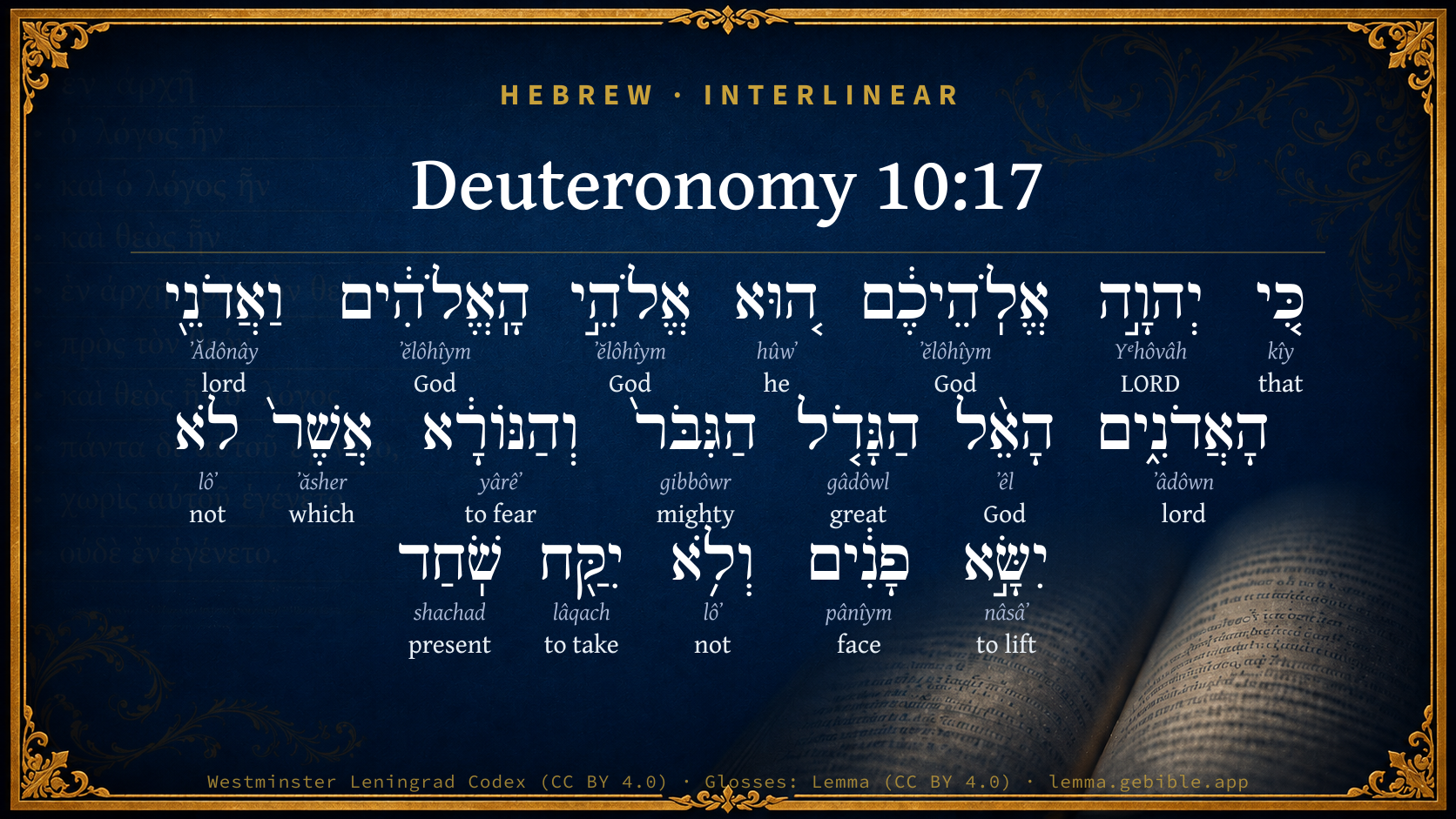
Hebrew (Westminster Leningrad Codex) Deuteronomy 10:17 appears in the Hebrew Old Testament. The text above is from the Westminster Leningrad Codex. Each word links to its Strong’s number, a concise gloss, and parsing drawn from the Open Scriptures Hebrew Bible morphology. Click any word for its full Brown-Driver-Briggs (BDB) entry.
Download image
Cite this verse

Deuteronomy 10:17 (World English Bible). Public Domain. Lemma interlinear Bible study tool, https://lemma.gebible.app/v/deuteronomy/10/17.

Show BibTeX & RIS
BibTeX
RIS
English Translation
For Yahweh your God, he is God of gods, and Lord of lords, the great God, the mighty, and the awesome, who doesn't regard persons, nor takes reward.
World English Bible · Public Domain
Download a study sheet

One document with this verse’s original text, its word-by-word gloss line, the meaning frame, cross-references with their text, attributed commentary, and full source and license credits — printable, and it pastes into notes with its structure intact.

This verse Autodidact and up

Study sheet (.html) Plain text (.txt)

A passage Seminary Student

Up to 50 verses in one chapter. A passage sheet keeps up to 6 commentary sources and 12 cross-references per verse, in the order this page ranks them, and says so on the sheet whenever that leaves anything out. Ask for a single verse and you get the Autodidact verse sheet above.

Everything on this page stays free to read, with no account — the sheet is a download of what is already on screen, not access to it.

Want to remove ads? Support Godless Engineer
Compare translations 3

The same verse in 3 English versions, stacked beneath the original-language interlinear above. Click any original word for its lexicon entry.

Each is an independent rendering of the whole verse — the interlinear is not word-aligned to these translations.

Highlighted words mark where these versions differ — a whole-verse word diff, not a word-by-word alignment.

  • World English Bible Public Domain
    For Yahweh your God, he is God of gods, and Lord of lords, the great God, the mighty, and the awesome, who doesn't regard persons, nor takes reward.
  • King James Version Public Domain
    For the LORD your God is God of gods, and Lord of lords, a great God, a mighty, and a terrible, which regardeth not persons, nor taketh reward:
  • unfoldingWord Literal Text CC BY-SA 4.0
    For Yahweh your God is the God of gods and the Lord of lords, the great God, the mighty one and the fearsome one, who does not lift up a face and does not take a bribe.

unfoldingWord Literal Text — © unfoldingWord, licensed CC BY-SA 4.0. Word-aligned USFM3 via Door43 (git.door43.org/unfoldingWord/en_ult).

Versions to compare (up to 4)

3 of 4 selected

Show all 18 translations

Every available English version of this verse, each an independent rendering of the whole verse.

  • World English Bible Public Domain
    For Yahweh your God, he is God of gods, and Lord of lords, the great God, the mighty, and the awesome, who doesn't regard persons, nor takes reward.
  • Berean Standard Bible Public Domain
    For the LORD your God is God of gods and Lord of lords, the great, mighty, and awesome God, showing no partiality and accepting no bribe.
  • Majority Standard Bible Public Domain
    For the LORD your God is God of gods and Lord of lords, the great, mighty, and awesome God, showing no partiality and accepting no bribe.
  • King James Version Public Domain
    For the LORD your God is God of gods, and Lord of lords, a great God, a mighty, and a terrible, which regardeth not persons, nor taketh reward:
  • American Standard Version (1901) Public Domain
    For Jehovah your God, he is God of gods, and Lord of lords, the great God, the mighty, and the terrible, who regardeth not persons, nor taketh reward.
  • Revised Version (1885) Public Domain
    For the LORD your God, he is God of gods, and Lord of lords, the great God, the mighty, and the terrible, which regardeth not persons, nor taketh reward.
  • Geneva Bible (1599) Public Domain
    For the Lord your God is God of gods, and Lord of lordes, a great God, mightie and terrible, which accepteth no persons nor taketh reward:
  • Douay-Rheims (1899) Public Domain
    Because the Lord your God he is the God of gods, and the Lord of lords, a great God and mighty and terrible, a who accepteth no person nor taketh bribes.
  • Young's Literal Translation Public Domain
    for Jehovah your God -- He `is' God of the gods, and Lord of the lords; God, the great, the mighty, and the fearful; who accepteth not persons, nor taketh a bribe;
  • Literal Standard Version CC BY-SA 4.0
    For He, your God YHWH, [is] God of the gods and Lord of the lords—the great, the mighty, and the fearful God, who does not accept by appearances, nor takes a bribe;
  • Unlocked Literal Bible CC BY-SA 4.0
    For Yahweh your God, he is God of gods and Lord of masters, the great God, the mighty one and the fearsome one, who favors no one and takes no bribes.
  • unfoldingWord Literal Text CC BY-SA 4.0
    For Yahweh your God is the God of gods and the Lord of lords, the great God, the mighty one and the fearsome one, who does not lift up a face and does not take a bribe.
  • Darby Bible Public Domain
    For Jehovah your God is the God of gods, and the Lord of lords, the great ùGod, the mighty and the terrible, who regardeth not persons, nor taketh reward;
  • World Messianic Bible Public Domain
    For the LORD your God, he is God of gods and Lord of lords, the great God, the mighty, and the awesome, who doesn’t respect persons or take bribes.
  • Webster's Bible Public Domain
    For the LORD your God is God of gods, and Lord of lords, a great God, a mighty, and a terrible, who regardeth not persons, nor taketh reward:
  • Free Bible Version CC BY-SA 4.0
    For the Lord your God is God of gods and Lord of lords. He is the great, powerful, and awesome God. He shows no favoritism and accepts no bribes.
  • Bible in Basic English Public Domain
    For the Lord your God is God of gods and Lord of lords, the great God, strong in power and greatly to be feared, who has no respect for any man's position and takes no rewards:
  • JPS Tanakh (1917) Public Domain
    For the LORD your God, He is God of gods, and Lord of lords, the great God, the mighty, and the awful, who regardeth not persons, nor taketh reward.

Literal Standard Version (2020), Covenant Press — licensed CC BY-SA 4.0. Text via the HelloAO Bible API (eBible.org). Unlocked Literal Bible (unfoldingWord) — licensed CC BY-SA 4.0. Text via the HelloAO Bible API (eBible.org). unfoldingWord Literal Text — © unfoldingWord, licensed CC BY-SA 4.0. Word-aligned USFM3 via Door43 (git.door43.org/unfoldingWord/en_ult). Free Bible Version, Dr. Jonathan Gallagher — licensed CC BY-SA 4.0. Text via the HelloAO Bible API (eBible.org).

Word by word

More ways to search: Search by grammar → Find every occurrence → Compare this word →

Practice this passage: Drill this verse → Learn its vocabulary →

שֹֽׁחַד
shachad
H7810
“present”
Noun, Common, Masculine, Singular, Absolute
Part of Speech
Noun
Type
Common
Gender
Masculine
Number
Singular
State
Absolute
Full BDB Definition

Origin: from H7809

TWOT: 2359a

present, bribe
  1. כִּ֚י kîy H3588 “that” Conjunction
  2. יְהוָ֣ה Yᵉhôvâh H3068 “LORD” Noun, Proper
  3. אֱלֹֽהֵיכֶ֔ם ʼĕlôhîym H430 “God(s) · your” Noun, Common, Masculine, Plural, Construct + Suffix, Personal, 2nd Person, Masculine, Plural
  4. ה֚וּא hûwʼ H1931 “he” Pronoun, Personal, 3rd Person, Masculine, Singular
  5. אֱלֹהֵ֣י ʼĕlôhîym H430 “God(s) of” Noun, Common, Masculine, Plural, Construct
  6. הָֽאֱלֹהִ֔ים ʼĕlôhîym H430 “the · God(s)” Particle, Definite Article + Noun, Common, Masculine, Plural, Absolute
  7. וַאֲדֹנֵ֖י ʼĂdônây H136 “and · Lord of” Conjunction + Noun, Common, Masculine, Plural, Construct
  8. הָאֲדֹנִ֑ים ʼâdôwn H113 “the · lords” Particle, Definite Article + Noun, Common, Masculine, Plural, Absolute
  9. הָאֵ֨ל ʼêl H410 “the · God” Particle, Definite Article + Noun, Common, Masculine, Singular, Absolute
  10. הַגָּדֹ֤ל gâdôwl H1419 “the · great” Particle, Definite Article + Adjective, Adjective, Masculine, Singular, Absolute
  11. הַגִּבֹּר֙ gibbôwr H1368 “the · mighty” Particle, Definite Article + Adjective, Adjective, Masculine, Singular, Absolute
  12. וְהַנּוֹרָ֔א yârêʼ H3372 “and · the · fearing” Conjunction + Particle, Definite Article + Verb, Niphal, Participle Active, Masculine, Singular, Absolute
  13. אֲשֶׁר֙ ʼăsher H834 “which” Particle, Relative
  14. לֹא lôʼ H3808 “not” Particle, Negative
  15. יִשָּׂ֣א nâsâʼ H5375 “to lift” Verb, Qal, Imperfect, 3rd Person, Masculine, Singular
  16. פָנִ֔ים pânîym H6440 “face(s)” Noun, Common, Both, Plural, Absolute
  17. וְלֹ֥א lôʼ H3808 “and · not” Conjunction + Particle, Negative
  18. יִקַּ֖ח lâqach H3947 “to take” Verb, Qal, Imperfect, 3rd Person, Masculine, Singular

About this verse

These counts appear in no published source. They are computed here, from the morphology-tagged text and Lemma’s own curated glosses. What Lemma adds →

19
words
16
distinct lemmas
Pentateuch
section

Notable vocabulary

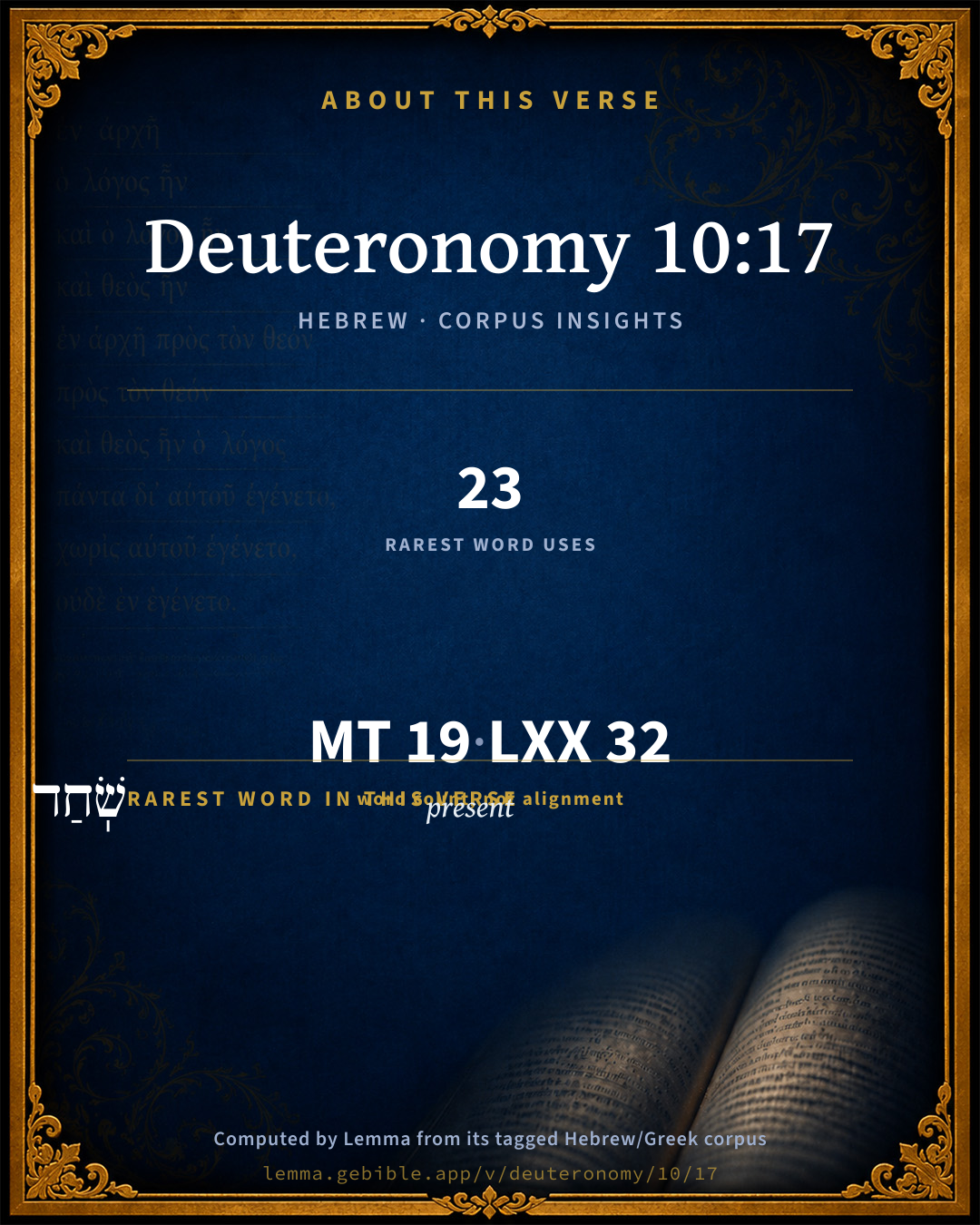
The rarest word here is שֹֽׁחַד present H7810 — appearing just 23 times in the whole Hebrew Bible.

Shared distinctive vocabulary

שֹֽׁחַד present H7810 occurs in 21 verses of the Hebrew Bible. Also found in:

Grammatical profile

  • 3 verbs
  • 9 nouns
  • 2 adjectives
  • 1 pronoun
  • 1 conjunction
  • 3 particles

Verb forms

  • וְהַנּוֹרָ֔א Niphal · Participle Active
  • יִשָּׂ֣א Qal · Imperfect
  • יִקַּ֖ח Qal · Imperfect

Repetition

Words recur within this verse — often emphatic in Hebrew:

  • אֱלֹֽהֵיכֶ֔ם God H430 ×3
  • לֹא not H3808 ×2

Hebrew & Septuagint length

In English translation the verse runs 28 words from the Hebrew and 36 from the Septuagint (LXX English) — closely comparable.

A rough comparison of the two English renderings, which tokenize alike — not a word-level alignment.

Word counts can differ between the Hebrew and the Greek without any difference in meaning — e.g. the Hebrew direct-object marker אֵת has no separate Greek word, and Greek often adds the article ὁ.

In the original languages it is 19 Hebrew tokens and 32 Greek tokens — but the two are counted differently (Hebrew bundles its prefixes and suffixes into one token; the Greek is in lemma form), so that isn’t a like-for-like length.

Cross-references

23

Topical passages linked to Deuteronomy 10:17 in the Treasury of Scripture Knowledge — connected by theme and wording, ordered by reader-vote popularity; previews shown in the World English Bible.

  • Acts 10:34 Peter opened his mouth and said, "Truly I perceive that God doesn't show favoritism;
  • Romans 2:11 For there is no partiality with God.
  • Daniel 2:47 The king answered to Daniel, and said, Of a truth your God is the God of gods, and the Lord of kings, and a revealer of secrets, seeing you have been able to reveal this secret.
  • Nehemiah 9:32 Now therefore, our God, the great, the mighty, and the awesome God, who keep covenant and loving kindness, don't let all the travail seem little before you, that has come on us, on our kings, on our princes, and on our priests, and on our prophets, and on our fathers, and on all your people, since the time of the kings of Assyria to this day.
  • Job 34:19 Who doesn't respect the persons of princes, Nor regards the rich more than the poor; For they all are the work of his hands.
  • Galatians 2:6 But from those who were reputed to be important (whatever they were, it makes no difference to me; God doesn't show partiality to man)--they, I say, who were respected imparted nothing to me,
  • Deuteronomy 7:21 You shall not be scared of them; for Yahweh your God is in the midst of you, a great and awesome God.
  • Joshua 22:22 The Mighty One, God, Yahweh, the Mighty One, God, Yahweh, he knows; and Israel he shall know: if it be in rebellion, or if in trespass against Yahweh (don't save us this day),
  • 1 Chronicles 16:25–26 For great is Yahweh, and greatly to be praised: He also is to be feared above all gods.
  • Ephesians 6:9 You masters, do the same things to them, and give up threatening, knowing that he who is both their Master and yours is in heaven, and there is no partiality with him.
  • Revelation 19:16 He has on his garment and on his thigh a name written, "KING OF KINGS, AND LORD OF LORDS."
  • Nehemiah 1:5 and said, I beg you, Yahweh, the God of heaven, the great and awesome God, who keeps covenant and loving kindness with those who love him and keep his commandments:
  • Psalms 99:3 Let them praise your great and awesome name. He is Holy!
  • Psalms 136:2–3 Give thanks to the God of gods; For his loving kindness endures forever.
  • Daniel 11:36 The king shall do according to his will; and he shall exalt himself, and magnify himself above every god, and shall speak marvelous things against the God of gods; and he shall prosper until the indignation be accomplished; for that which is determined shall be done.
  • Revelation 17:14 These will war against the Lamb, and the Lamb will overcome them, for he is Lord of lords, and King of kings. They also will overcome who are with him, called and chosen and faithful."
  • 2 Chronicles 19:7 Now therefore let the fear of Yahweh be on you; take heed and do it: for there is no iniquity with Yahweh our God, nor respect of persons, nor taking of bribes.
  • Nehemiah 4:14 I looked, and rose up, and said to the nobles, and to the rulers, and to the rest of the people, Don't be you afraid of them: remember the Lord, who is great and awesome, and fight for your brothers, your sons, and your daughters, your wives, and your houses.
  • Job 37:22–23 Out of the north comes golden splendor; With God is awesome majesty.
  • Jeremiah 20:11 But Yahweh is with me as an awesome mighty one: therefore my persecutors shall stumble, and they shall not prevail; they shall be utterly disappointed, because they have not dealt wisely, even with an everlasting dishonor which shall never be forgotten.
  • Colossians 3:25 But he who does wrong will receive again for the wrong that he has done, and there is no partiality.
  • 1 Peter 1:17 If you call on him as Father, who without respect of persons judges according to each man's work, pass the time of your living as strangers here in reverent fear:
  • Mark 12:14 When they had come, they asked him, "Teacher, we know that you are honest, and don't defer to anyone; for you aren't partial to anyone, but truly teach the way of God. Is it lawful to pay taxes to Caesar, or not?

Cross-references courtesy of OpenBible.info (CC BY 4.0).

Hebrew and Greek witnesses Masoretic Hebrew ↔ Greek Septuagint

The same verse in the two great witnesses to the Old Testament, shown verse-for-verse.

These are two independent witnesses, not word-aligned to each other, and the Septuagint is shown in lemma (dictionary) form.

Hebrew Deuteronomy 10:17 Masoretic · Westminster Leningrad Codex

כִּ֚י יְהוָ֣ה אֱלֹֽהֵיכֶ֔ם ה֚וּא אֱלֹהֵ֣י הָֽאֱלֹהִ֔ים וַאֲדֹנֵ֖י הָאֲדֹנִ֑ים הָאֵ֨ל הַגָּדֹ֤ל הַגִּבֹּר֙ וְהַנּוֹרָ֔א אֲשֶׁר֙ לֹא יִשָּׂ֣א פָנִ֔ים וְלֹ֥א יִקַּ֖ח שֹֽׁחַד

For Yahweh your God, he is God of gods, and Lord of lords, the great God, the mighty, and the awesome, who doesn't regard persons, nor takes reward.

World English Bible · Public Domain

Greek LXX Deuteronomy 10:17 Septuagint · lemma form

ὁ γάρ κύριος ὁ θεός σύ οὗτος θεός ὁ θεός καί κύριος ὁ κύριος ὁ θεός ὁ μέγας καί ἰσχυρός καί ὁ φοβερός ὅστις οὐ θαυμάζω πρόσωπον οὐδέ οὐ μή λαμβάνω δῶρον

For the Lord your God, he is God of gods, and the Lord of lords, the great, and strong, and terrible God, who does not accept persons, nor will he by any means accept a bribe:

LXX2012 (modern English Septuagint) · Public Domain

Hebrew: Westminster Leningrad Codex (CC BY 4.0). Greek: Septuagint (public domain); English from LXX2012 (modern English Septuagint) (Public Domain). How the Septuagint differs from the Hebrew →

Targum (Aramaic paraphrase)

2

The Targum is the ancient Jewish Aramaic paraphrase of the Hebrew Scriptures — an interpretive translation, not the Hebrew text itself. Onkelos (literal) and Pseudo-Jonathan (expansive) render the Torah, and Jonathan the Prophets. Coverage is partial: where no permissively-licensed English translation exists for a verse, only the Aramaic is shown. This is verse-level text, not a word-by-word alignment to the Hebrew.

  1. Targum Onkelos Torah (Genesis–Deuteronomy)
    אֲרֵי יְיָ אֱלָהֲכוֹן הוּא אֱלָהָא דַיָנִין וּמָרֵי מַלְכִין אֱלָהָא רַבָּא גִבָּרָא וּדְחִילָא דִי לֵית קֳדָמוֹהִי מִסַב אַפִּין וְאַף לָא לְקַבָּלָא שָׁחְדָא

    (no public-domain English translation for this verse)

    Targum Onkelos — Aramaic: “Onkelos Genesis” (public domain); “Onkelos Exodus” (public domain); “Onkelos Leviticus” (public domain); “Onkelos Numbers” (public domain); “Onkelos Deuteronomy” (public domain). English: “Sefaria Community Translation” (CC0 1.0 (public-domain dedication)); “J.W. Etheridge. The Targums of Onkelos and Jonathan Ben Uzziel on the Pentateuch. London: Longmans, Green, 1862” (public domain). Text via Sefaria.

  2. Targum Pseudo-Jonathan Torah (Genesis–Deuteronomy)
    אֲרוּם יְיָ אֱלָהָכוֹן הוּא אֱלָהָא דַיָינָא וּמָארֵי מַלְכִין אֱלָהָא רַבָּא גִבָּרָא וּדְחִילָא דְּלֵית קֳדָמוֹי מֵיסַב אַפִּין וְאוּף לָא לְקַבָּלָא שׁוֹחֲדָא

    for the Lord thy God is God, the Judge, and the Monarch of kings, a Great God, mighty and terrible, before whom there is no respect of persons, and who taketh no bribe;

    Targum Pseudo-Jonathan — Aramaic: “Targum Jonathan on Genesis” (public domain); “Targum Jonathan on Exodus” (public domain); “Targum Jonathan on Leviticus” (public domain); “Targum Jonathan on Numbers” (public domain); “Targum Jonathan on Deuteronomy” (public domain). English: “The Targum of Jonathan ben Uzziel, trans. J. W. Etheridge, London, 1862” (public domain). Text via Sefaria.

Commentary

Notes on Deuteronomy 10:17 from classic Christian and Jewish commentators (each source and its license shown beneath its notes). The classic Christian expositions comment on the surrounding passage and are grouped to its opening verse, so a note may address several verses; the Jewish commentaries on the Tanakh (Rashi and others) are per-verse, so they appear only where the commentator wrote on this verse.

Lemma curates 59 commentaries, every one of them public domain or Creative Commons licensed, each selected and text-cleaned for this edition rather than reprinted as found. About our sources →

Trapp's Complete Commentary

John Trapp

Deu 10:17 For the LORD your God [is] God of gods, and Lord of lords, a great God, a mighty, and a terrible, which regardeth not persons, nor taketh reward:

Ver. 17. Is God of gods.] And will be served like himself.

John Trapp, A Commentary or Exposition upon All the Books of the Old and New Testament (1647–1656) — public domain. Text from a community e-Sword module.

Joseph Benson's Commentary

Deu 10:17. Who regardeth not persons — Whether Jews or Gentiles, but deals justly and equally with all sorts of men; and as whosoever fears and obeys him shall be accepted, (namely, through faith in the Messiah, working by love,) so all incorrigible transgressors shall be severely punished, and you no less than other people; therefore, do not flatter yourselves, as if God would bear with your sins because of his particular kindness to you or to your fathers.

Joseph Benson's Commentary on the Old and New Testaments (1811–1818) — public domain. Text from a community e-Sword module.

Tyndale Open Study Notes

Tyndale Open Resources

10:17 The phrase God of gods does not affirm the existence of other gods; rather, it affirms God’s absolute sovereignty over all powers in heaven and earth. The Hebrew ’elohim, translated gods, can also refer to angels or other powerful beings (see Ps 82:1). • shows no partiality: God is not impressed with people who hold power and influence, and therefore he offers them no privileged consideration (see Deut 1:17).

Tyndale Open Study Notes — © Tyndale Open Resources, licensed CC BY-SA 4.0. Text via the HelloAO Bible API.

Adam Clarke's Commentary

Verse 17. God of gods, and Lord of lords] That is, He is the source whence all being and power proceed; every agent is finite but himself; and he can counteract, suspend, or destroy all the actions of all creatures whensoever he pleases. If he determine to save, none can destroy; if he purpose to destroy, none can save. How absolutely necessary to have such a God for our friend!

A great God - mighty] האל הגבר hael haggibbor, the mighty God; this is the very title that is given to our blessed Lord and Saviour, Isa 9:6.

Adam Clarke's Commentary on the Bible (1810–1826) — public domain. Text from a community e-Sword/MySword module.

The Cambridge Bible for Schools and Colleges

gen. ed. J. J. S. Perowne

17. God of gods, and Lord of lords] Heb. idiom for the highest God and Lord (cp. Deu_10:14, heaven of heavens).

the great God, the mighty, and the terrible] The Heb. can also mean, as in A.V., a great God, etc.; or the superlative, the God, the greatest, most mighty, and terrible. This is probably to be preferred. Yet even so there is no assertion, such as we find in exilic and post-exilic writers, of the sole Godhead of Jehovah. See above on Deu_6:4.

regardeth not persons] Lit. lifteth not up faces (opposed to turning away faces), i.e. either by granting their requests (Gen_19:21) or receiving them graciously (Gen_32:20); or by being inordinately influenced by them (Job_32:21); or, as here, by showing them an unjust partiality (cp. Deu_28:50). The same idea concerning human judges is found in Deu_1:17, but expressed by another verb.

reward] or, bribe, Exo_23:8, R.V. a gift. See further on Deu_16:19.

The Cambridge Bible for Schools and Colleges (gen. ed. J. J. S. Perowne; Cambridge University Press, 1878–1918) — public domain. Text from a community e-Sword module.

John Gill's Exposition

For the Lord your God is God of gods,.... Of angels and civil magistrates, who are sometimes so called: these are his creatures, act for him and under him, and are accountable to him:

the Lord of lords; of the kings and princes of the earth, who have their crowns, sceptres, and kingdoms from him, and hold them of him, by and under whom they reign and decree judgment, and who are subject to his authority and control:

a great God; as the perfections of his nature, the works of his hands, the blessings of his providence and grace, and the extensiveness of his dominion in heaven, earth, and hell, show him to be:

a mighty and a terrible; mighty and powerful to help, protect, and defend his people; terrible to his and their enemies, even to the kings of the earth:

which regardeth not persons; but bestows his favours, whether in a way of providence or grace, according to his sovereign will and pleasure, without regard to the works and merits of men, their characters or circumstances:

nor taketh reward; or bribes, to avert threatened and deserved judgments; see Job 36:18.

John Gill's Exposition of the Whole Bible (1746–1763) — public domain (CC PDM 1.0). Text via the HelloAO Bible API.

Haydock's Catholic Bible Commentary

Gods. Idols are nothing, 1 Corinthians viii. 4. Hence Theodoret supposes, that all who have authority upon earth are here designated. But admitting the false notions of the pagans respecting their gods, the superiority of the true God is here asserted; (Calmet) and all, both in heaven and on earth, gods and lords, must bow before him. (Haydock)

George Leo Haydock (1774–1849), Haydock's Catholic Family Bible and Commentary, 1859 edition — public domain. Excludes Psalms (Douay-Rheims chapter numbering differs from Protestant) and Deuterocanonical books (Catholic canon only).

Matthew Poole's English Annotations

Regardeth not persons, whether Jews or Gentiles, but deals justly and equally with all sorts of men; and as whosoever fears and obeys him shall be accepted of him, so all incorrigible transgressors shall be severely punished, and you no less than other people; therefore do not flatter yourselves as if God would bear with your sins because of his particular kindness to you or to your fathers.

Matthew Poole's English Annotations on the Holy Bible (1683–1685) — public domain. Text from a community e-Sword/MySword module.

Whedon's Commentary on the Bible

Daniel D. Whedon

17, 18. A mighty, and a terrible — Here Moses describes the infinite greatness and wonderful tenderness of Jehovah. He is God of gods, Lord of lords, yet he cares for the fatherless, the widow, and the stranger.

Daniel D. Whedon (gen. ed.), Commentary on the Old and New Testaments (1874–1909) — public domain. Text from a community e-Sword module.

The Pulpit Commentary

God of gods. (Psa_136:2) Not only supreme over all that are called god, but the complex and sum of all that is Divine; the Great Reality, of which the "gods many" of the nations were at the best but the symbols of particular attributes or qualities. Which regardeth not persons; is not partial, as a judge who has respect to the condition and circumstances of parties rather than to the merits of the case (cf. Lev_19:15; Act_10:34; Eph_6:9; Jud_1:16) Nor taketh reward; cloth not accept presents as bribes. (cf. 2Ch_19:7; Job_34:19; Mic_3:11)

Ver. 17-11:1God no respecter of persons.

Having reminded the people of their duty towards God, the aged lawgiver next shows the people what their God is to them, and draws from thence a new argument for obedience and love towards him. In doing this, however, while there is much which we treat of in other Homilies, there is one special sentence, peculiar to this passage, which is yet made so much use of in the teachings of other parts of the Word of God, that we feel called on to note it as the center point of this paragraph, to show what the truth is which is indicated therein, and the bearing of that truth on the various phases of life and duty. We have in the Word of God no fewer than ten or twelve quotations or uses of this text, each one setting it in some special aspect as a point of doctrine, or drawing therefrom some special inference on a matter of duty. These several allusions, direct or indirect, will suggest the plan of this Homily. The verse thus frequently referred to is the seventeenth. "For the Lord your God regardeth not persons, nor taketh reward.

I WHAT DO SUCH WORDS MEAN, AS A STATEMENT OF TRUTH? We might not have seen much in them, if the Holy Ghost had not inspired the sacred writers to quote them so frequently in new and varied lights. Being thus quoted, however, we ought to show by reference to the several quotations, the varied phases of their meaning.

1. God knows no distinctions in his moral government of the nations. This is suggested by the words in this passage. Moses says, in effect, to Israel, "You have been chosen, out of all the nations, to receive a special revelation, and to be made the bearers of a special mission to the world; but do not think that because of that you are at liberty to trifle with the rules of the Divine Law: God will not tolerate sin in you any more than he will in other nations. Think not that he frowns on iniquity on Canaan and regards it more mildly with you. "He regardeth not persons." And only as you are loyal to him, and faithful in doing the right, will he smile upon you.

2. God makes no distinction in the basis on which men are accepted in his sight. The Apostle Peter throws quite an unexpected (and we fear to a large extent as unperceived) light on these words in Act_10:34. He is preaching to Cornelius; he is opening the kingdom of heaven to the Gentile. To induce him to do this, he needed the vision of the great sheet let down from heaven. That gave him a new revelation. God"s grace was larger than he had thought for. He had never seen till then the deep meaning of the words in his old legislator"s code. He saw them then, and they shone with glory a truth but in every nation." As if he had said, "I used to think that because our nation was favored with more light, therefore it stood on another basis fur acceptance and safety. And now I find that the great plan of God"s grace so covers the globe, that in every nation, he who fears God and follows the light is accepted with him!" Men are saved, not according to the measure of light they have received, but according to the use they have made of the light which God has given them.

3. God is exercising over every man a present judgment according to perfect impartiality. The truth just now referred to made so deep an impression upon the Apostle Peter, that he refers to it again in 1Pe_1:17, and would have the thought of the absolute impartiality of God act as a perpetual influence on believers, generating and maintaining a holy fear. There is no favoritism with God. He regards not the person, but the deed; "judging according to every man"s work.

4. God revealed this attribute of his in the Lord Jesus Christ. For this sidelight on the truth, we are indebted to a scribe, an uninspired man, who, possibly indeed in flattery, but we rather think otherwise, intimates that this attribute of impartial equity, which his lawgiver attributed to the Divine Being, was manifest conspicuously in the Lord Jesus Christ. (see Mar_12:14) However he may have meant it, he certainly uttered a profound and glorious truth. For who, on earth, ever so clearly showed himself no respecter of persons, as our Divine Lord and Master?

5. Precisely the same feature of God"s government will mark the final judgment. (Rom_2:11, Rom_2:16) There will be one rule of righteousness, which will be inflexibly adhered to then, and which not even the glorious grace manifested in the gospel will deflect or obscure. Not from the most hidden souls, nor from the most prominent, will any impeachment of the Divine righteousness ever rise up. The great system of mediatorial administration may then reveal a plan of larger grace than ever entered into the heart of man to conceive, but most assuredly there will be no flaw in its equitable impartiality, for "there is no respect of persons with God." That very impartiality will bring about many startling changes, for "many that are first shall be last, and the last first.

II TO WHOM ARE THESE WORDS APPLIED IN SCRIPTURE, AS A DIRECTORY OF DUTY?

1. They are applied to the querulous. This absolute righteousness being revealed as an attribute of God, should teach men to be cautious, who are too ready to pass judgment on the ways of God when they are past finding out. Such is the use to which Elihu applies the doctrine. He did not understand Job"s case, perhaps, any better than Eliphaz, Bildad, or Zophar; but in this point he is undoubtedly correct. We know God is righteous, therefore we must not impeach what he does.

2. They are applied to magistrates and judges. (see 2Ch_19:6, 2Ch_19:7) The like equity to that which marks the Supreme Judge should characterize all who have to administer justice in any nation.

3. They are applied by Paul as a guide in religious controversy (Gal_2:6) "God accepteth no man"s person, therefore," says Paul, "neither might I Truth with me must be supreme, and even if James, Cephas, or John, who seemed to be pillars, were to utter aught inconsistent with the gospel or grace of God, whosoever they are, it matters not." The truth, not the person, commands our homage. Well would it have been if in all ages this had been a guiding principle in the controversies of the Church. Well would it be, if it were men"s guide now.

4. The words are applied to individual treatment and judgment of others in the varied relations of private life. (Col_3:25) A man, however lordly, or however lowly, will receive from God a reward or penalty according to what he hath done, and not according to his station in life. And we, like God, must apply like moral rules all round, and never justify a bad act because done by a rich man, nor depreciate a good act because done by a poor one.

5. They are applied to masters with regard to their treatment of servants (Eph_6:9) We must not forget that the "servants" here referred to were "slaves." Neither Jesus Christ nor his apostles, any more than Moses had done, made any open attack on slavery. But by teaching this principle of the equality of men in God"s sight, they dropped a truth which, when it had time to grow, would cause slavery to fall, by uplifting the people to so high a standard of moral virtue that it would no longer be tolerated by them. And even now there is need for the continued reiteration of the same truth, that masters on the one hand may feel their responsibility to God for dealing justly with their servants, and that servants may feel their responsibility for doing justice to their masters.

6. They are applied to Church members, in reference to their treatment of the poorer members. (see Jam_2:1-9) Church life is social life gathered round the cross. "Life"s poor distinctions vanish here." "The rich and the poor meet together, and the Lord is the Maker of them all." Each one is at liberty to form his own private circle of friendship, according to taste, culture, etc. But in Church life, work, and worship, all ranks meet on one common platform, acknowledging "one Lord, one-faith, one baptism," and recounting in song one common salvation. The artificial distinctions set up by men are nothing in the eye of God. To reproduce them in the Church is an offence in his sight. If here we have respect of persons, we commit sin, and are convicted of the Law as transgressors.

7. The principle implied in the words is taught by the evangelist in its most impressive form in the cross of Christ. Such, surely, is the conclusion to be drawn from the weighty words of the Apostle Paul, "Wherefore, henceforth know we no man after the flesh". (2Co_5:16) "Wherefore;" because Christ died for all. "Henceforth;" from the time that we understand the world-embracing purpose of his death, do we know no man after the flesh. The little distinctions men make so much of here, all vanish in the light of the cross. We ask not whether men are rich or poor; we ask not their name, nationality, or rank. "Christ died for all." That stamps on every man"s brow the inscription, "Dear to Christ." Wherefore he will be dear to us for Christ"s sake, the wide world over, whatever his caste, country, color, or clime. If Christ died for all, we preach to all. So that the very principle which under the old covenant is enforced by Law, is under the new created by love. That selfsame impartiality disclosed from Horeb in the methods of Law, is again revealed from Calvary in the methods of God"s grace. And thus, through Old and New Testaments the appeal is the same, though made first through thunder, and afterwards through tears. "Be ye imitators of God." Plant your feet firmly on the revealed doctrine of the impartial equity of God. Accepting that, acquiesce with loving submission in the mysteries of his ways, even when they are in the deep waters, and when his footsteps are not known. Then seek in your sphere to follow God in his. Let the judge and magistrate in his decisions, the disputant in his arguments, the private individual in his home sphere, the master in ruling, the servant in obeying, the Church member in his worship and fellowship with his brethren, the evangelist in evangelizing, all remember that as there is no respect of persons with God, there must be none with them. And let all strive to be like God, who in his Law encircles all men with one bond of duty, while in his gospel he holds them all under one dispensation of grace!

The Pulpit Commentary (1880–1919), ed. H.D.M. Spence-Jones & Joseph S. Exell — public domain. Text from a community e-Sword module.

John Wesley's Explanatory Notes

Regardeth not persons - Whether Jews or Gentiles, but deals justly and equally with all sorts of men; and as whosoever fears and obeys him shall be accepted, so all incorrigible transgressors shall be severely punished, and you no less than other people: therefore do not flatter yourselves as if God would bear with your sins because of his particular kindness to you or to your fathers.

John Wesley, Explanatory Notes Upon the Whole Bible (1754–1765) — public domain. Text via the GEBible commentary corpus.

Rashi

Rabbi Shlomo Yitzchaki (Rashi)

ואדני האדנים [FOR THE LORD YOUR GOD IS …] LORD OF LORDS (i.e. He is Lord over those who are lords, kings, governors, etc.) — so that no lord is able to deliver you from His hand.

לא ישא פנים HE WILL NOT REGARD PERSONS, if you cast off His yoke,

ולא יקח שֹחד NOR WILL HE TAKE A BRIBE, that one should appease Him by money.

Rashi on the Tanakh — English translations: “The Judaica Press complete Tanach with Rashi, translated by A. J. Rosenberg” (CC BY 4.0); “Pentateuch with Rashi's commentary by M. Rosenbaum and A.M. Silbermann, 1929-1934” (public domain); “The Metsudah Tanach series, Lakewood, N.J” (CC BY 4.0); and “The Book of Joshua, Metsudah Publications, 1997” (CC BY 4.0). Text via Sefaria.

Sforno

Rabbi Ovadia Sforno

The Almighty — the Great. There is nothing that can compare to him on any of the levels of creation.

The powerful. Who gives continued existence to all of creation, as they said, “You give life to everything” (Nechemiah 9:6).

The Awesome. Who watches to reward and punish those who fear Him accordingly.

Who neither exercises favoritism. To a son who breaks away, to show favor to the righteous father. Even though He will hold back His anger for a long time in the merit of the father.

Nor accepts bribes. He will not remove the punishment for the sin because of the reward of a mitzvah that the sinner has done. As our Sages teach: A mitzvah does not extinguish a sin (Sotah 21a). All of this comes to teach that if you sin you may not rely on Hashem to save you from any punishment in any merit, unless you perform complete teshuvah.

Sforno on the Tanakh — English translation: “Yalkut, Sifsei Chachomim Chumash, Metsudah Publications, 2009” (CC BY 4.0). Text via Sefaria.

Lesson kit

Teaching starters — assembled from the data on this page, not authored interpretation. Every prompt links to the verse data it draws on. Edit before teaching.

Deuteronomy, in the Pentateuch, opens this verse with 19 words (16 distinct Hebrew lemmas). Its most distinctive word is shachad (“present”). A historical commentator’s framing appears above. Read the whole chapter for the surrounding context.

Discussion questions

  1. The word shachad carries the sense “present.” How does it shape the verse?
  2. Exodus 23:8 shares the word «present» with this verse. How do the two illuminate each other?
  3. “God” occurs 3× in this one verse. What is the effect of the repetition?
  4. These translations render this verse differently; the difference is in the English rendering, not the original. What questions does that raise?
  5. The verb «וְהַנּוֹרָ֔א» is Niphal Participle Active. How does its form color the action?
  6. Reading how Trapp's Complete Commentary and Joseph Benson's Commentary read this verse, where do the two commentators agree and where do they part?

Things to notice

Reading settings

Reading text

Shown beneath each verse's original-language words.

Old Testament
Old Testament edition

Read the OT as the Masoretic Hebrew (MT) or the Greek Septuagint (LXX).

English shown for the Greek Septuagint (in the Hebrew ↔ Greek comparison).

Comparing translations? Open the Compare panel on any verse page to stack up to four side by side.