
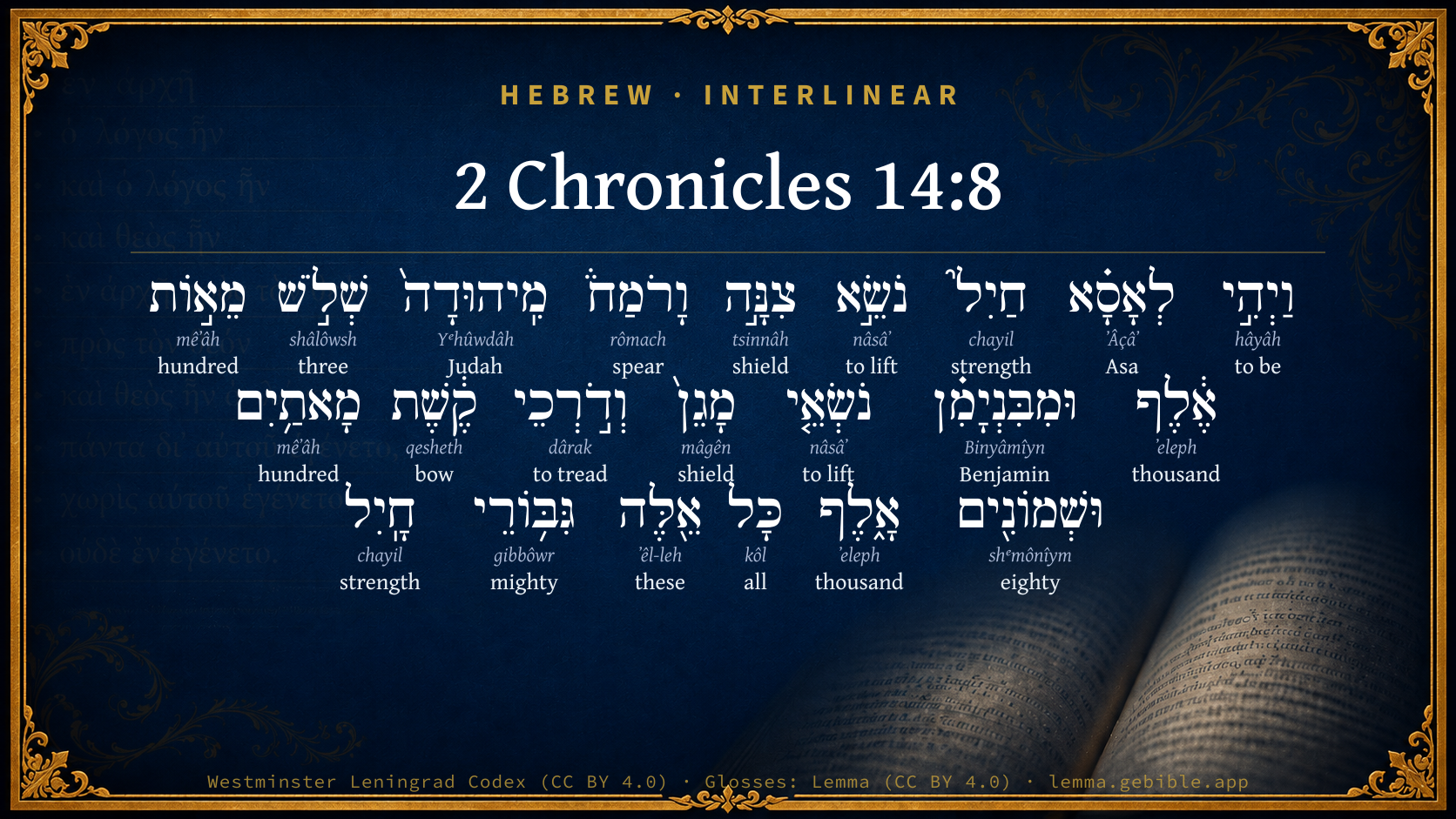
2 Chronicles 14:8

Hebrew (Westminster Leningrad Codex) 2 Chronicles 14:8 appears in the Hebrew Old Testament. The text above is from the Westminster Leningrad Codex. Each word links to its Strong’s number, a concise gloss, and parsing drawn from the Open Scriptures Hebrew Bible morphology. Click any word for its full Brown-Driver-Briggs (BDB) entry.
Download image
Cite this verse

2 Chronicles 14:8 (World English Bible). Public Domain. Lemma interlinear Bible study tool, https://lemma.gebible.app/v/2-chronicles/14/8.

Show BibTeX & RIS
BibTeX
RIS
English Translation
Asa had an army that bore bucklers and spears, out of Judah three hundred thousand; and out of Benjamin, that bore shields and drew bows, two hundred eighty thousand: all these were mighty men of valor.
World English Bible · Public Domain
Download a study sheet

One document with this verse’s original text, its word-by-word gloss line, the meaning frame, cross-references with their text, attributed commentary, and full source and license credits — printable, and it pastes into notes with its structure intact.

This verse Autodidact and up

Study sheet (.html) Plain text (.txt)

A passage Seminary Student

Up to 50 verses in one chapter. A passage sheet keeps up to 6 commentary sources and 12 cross-references per verse, in the order this page ranks them, and says so on the sheet whenever that leaves anything out. Ask for a single verse and you get the Autodidact verse sheet above.

Everything on this page stays free to read, with no account — the sheet is a download of what is already on screen, not access to it.

Want to remove ads? Support Godless Engineer
Compare translations 3

The same verse in 3 English versions, stacked beneath the original-language interlinear above. Click any original word for its lexicon entry.

Each is an independent rendering of the whole verse — the interlinear is not word-aligned to these translations.

Highlighted words mark where these versions differ — a whole-verse word diff, not a word-by-word alignment.

  • World English Bible Public Domain
    Asa had an army that bore bucklers and spears, out of Judah three hundred thousand; and out of Benjamin, that bore shields and drew bows, two hundred eighty thousand: all these were mighty men of valor.
  • King James Version Public Domain
    And Asa had an army of men that bare targets and spears, out of Judah three hundred thousand; and out of Benjamin, that bare shields and drew bows, two hundred and fourscore thousand: all these were mighty men of valor.
  • unfoldingWord Literal Text CC BY-SA 4.0
    And there was to Asa an army carrying large shield and spear; from Judah, 300,000. And from Benjamin, ones carrying shield and drawing bow, 280,000. All these were mighty ones of strength.

unfoldingWord Literal Text — © unfoldingWord, licensed CC BY-SA 4.0. Word-aligned USFM3 via Door43 (git.door43.org/unfoldingWord/en_ult).

Versions to compare (up to 4)

3 of 4 selected

Show all 18 translations

Every available English version of this verse, each an independent rendering of the whole verse.

  • World English Bible Public Domain
    Asa had an army that bore bucklers and spears, out of Judah three hundred thousand; and out of Benjamin, that bore shields and drew bows, two hundred eighty thousand: all these were mighty men of valor.
  • Berean Standard Bible Public Domain
    Asa had an army of 300,000 men from Judah bearing large shields and spears, and 280,000 men from Benjamin bearing small shields and drawing the bow. All these were mighty men of valor.
  • Majority Standard Bible Public Domain
    Asa had an army of 300,000 men from Judah bearing large shields and spears, and 280,000 men from Benjamin bearing small shields and drawing the bow. All these were mighty men of valor.
  • King James Version Public Domain
    And Asa had an army of men that bare targets and spears, out of Judah three hundred thousand; and out of Benjamin, that bare shields and drew bows, two hundred and fourscore thousand: all these were mighty men of valor.
  • American Standard Version (1901) Public Domain
    And Asa had an army that bare bucklers and spears, out of Judah three hundred thousand; and out of Benjamin, that bare shields and drew bows, two hundred and fourscore thousand: all these were mighty men of valor.
  • Revised Version (1885) Public Domain
    And Asa had an army that bare bucklers and spears, out of Judah three hundred thousand; and out of Benjamin, that bare shields and drew bows, two hundred and fourscore thousand: an these were mighty men of valour.
  • Geneva Bible (1599) Public Domain
    And Asa had an armie of Iudah that bare shieldes and speares, three hundreth thousande, and of Beniamin that bare shieldes and drewe bowes, two hundreth and foure score thousande: all these were valiant men.
  • Douay-Rheims (1899) Public Domain
    And Asa had in his army of men that bore shields and spears of Juda three hundred thousand, and of Benjamin that bore shields and drew bows, two hundred and eighty thousand, all these were most valiant men.
  • Young's Literal Translation Public Domain
    And there is to Asa a force bearing target and spear, out of Judah three hundred thousand, and out of Benjamin, bearing shield and treading bow, two hundred and eighty thousand: all these `are' mighty of valour.
  • Literal Standard Version CC BY-SA 4.0
    And Asa has a force of three hundred thousand from Judah carrying buckler and spear, and two hundred and eighty thousand from Benjamin carrying shield and treading bow; all these [are] mighty men of valor.
  • Unlocked Literal Bible CC BY-SA 4.0
    Asa had an army that carried shields and spears; from Judah he had 300,000 men, and from Benjamin, 280,000 men who carried shields and drew bows. All of these were mighty men.
  • unfoldingWord Literal Text CC BY-SA 4.0
    And there was to Asa an army carrying large shield and spear; from Judah, 300,000. And from Benjamin, ones carrying shield and drawing bow, 280,000. All these were mighty ones of strength.
  • Darby Bible Public Domain
    And Asa had an army that bore targets and spears: out of Judah three hundred thousand; and out of Benjamin, that bore shields and drew the bow, two hundred and eighty thousand: all these, mighty men of valour.
  • World Messianic Bible Public Domain
    Asa had an army of three hundred thousand out of Judah who bore bucklers and spears, and two hundred eighty thousand out of Benjamin who bore shields and drew bows. All these were mighty men of valor.
  • Webster's Bible Public Domain
    And Asa had an army of men that bore targets and spears, out of Judah three hundred thousand; and out of Benjamin, that bore shields and drew bows, two hundred and eighty thousand: all these were mighty men of valor.
  • Free Bible Version CC BY-SA 4.0
    Asa had an army made up of three hundred thousand men from Judah who carried large shields and spears, and two hundred eighty thousand men from Benjamin who carried regular shields and bows. All of them were brave warriors.
  • Bible in Basic English Public Domain
    And Asa had an army of three hundred thousand men of Judah armed with body-covers and spears, and two hundred and eighty thousand of Benjamin armed with body-covers and bows; all these were men of war.
  • JPS Tanakh (1917) Public Domain
    (14-7) And Asa had an army that bore bucklers and spears, out of Judah three hundred thousand; and out of Benjamin, that bore shields and drew bows, two hundred and fourscore thousand; all these were mighty men of valour.

Literal Standard Version (2020), Covenant Press — licensed CC BY-SA 4.0. Text via the HelloAO Bible API (eBible.org). Unlocked Literal Bible (unfoldingWord) — licensed CC BY-SA 4.0. Text via the HelloAO Bible API (eBible.org). unfoldingWord Literal Text — © unfoldingWord, licensed CC BY-SA 4.0. Word-aligned USFM3 via Door43 (git.door43.org/unfoldingWord/en_ult). Free Bible Version, Dr. Jonathan Gallagher — licensed CC BY-SA 4.0. Text via the HelloAO Bible API (eBible.org).

Word by word

More ways to search: Search by grammar → Find every occurrence → Compare this word →

Practice this passage: Drill this verse → Learn its vocabulary →

וָרֹמַח֒
rômach
H7420
“and · spear”
Conjunction + Noun, Common, Masculine, Singular, Absolute
Part of Speech
Conjunction + Noun
Type
Common
Gender
Masculine
Number
Singular
State
Absolute
Full BDB Definition

Origin: from an unused root meaning to hurl

TWOT: 2172

spear, lance
  1. וַיְהִ֣י hâyâh H1961 “and · to be” Conjunction + Verb, Qal, Sequential Imperfect, 3rd Person, Masculine, Singular
  2. לְאָסָ֗א ʼÂçâʼ H609 “to/for · Asa” Preposition + Noun, Proper
  3. חַיִל֮ chayil H2428 “strength” Noun, Common, Masculine, Singular, Absolute
  4. נֹשֵׂ֣א nâsâʼ H5375 “lifting” Verb, Qal, Participle Active, Masculine, Singular, Absolute
  5. צִנָּ֣ה tsinnâh H6793 “shield” Noun, Common, Feminine, Singular, Absolute
  6. מִֽיהוּדָה֙ Yᵉhûwdâh H3063 “from · Judah” Preposition + Noun, Proper
  7. שְׁלֹ֣שׁ shâlôwsh H7969 “three” Adjective, Cardinal number, Feminine, Singular, Absolute
  8. מֵא֣וֹת mêʼâh H3967 “hundred” Adjective, Cardinal number, Both, Plural, Absolute
  9. אֶ֔לֶף ʼeleph H505 “thousand” Adjective, Cardinal number, Both, Singular, Absolute
  10. וּמִבִּנְיָמִ֗ן Binyâmîyn H1144 “and · from · Benjamin” Conjunction + Preposition + Noun, Proper
  11. נֹשְׂאֵ֤י nâsâʼ H5375 “lifting” Verb, Qal, Participle Active, Masculine, Plural, Construct
  12. מָגֵן֙ mâgên H4043 “shield” Noun, Common, Both, Singular, Absolute
  13. וְדֹ֣רְכֵי dârak H1869 “and · treading” Conjunction + Verb, Qal, Participle Active, Masculine, Plural, Construct
  14. קֶ֔שֶׁת qesheth H7198 “bow” Noun, Common, Feminine, Singular, Absolute
  15. מָאתַ֥יִם mêʼâh H3967 “hundred” Adjective, Cardinal number, Both, Dual, Absolute
  16. וּשְׁמוֹנִ֖ים shᵉmônîym H8084 “and · eighty” Conjunction + Adjective, Cardinal number, Both, Plural, Absolute
  17. אָ֑לֶף ʼeleph H505 “thousand” Adjective, Cardinal number, Both, Singular, Absolute
  18. כָּל kôl H3605 “all of” Noun, Common, Masculine, Singular, Construct
  19. אֵ֖לֶּה ʼêl-leh H428 “these” Pronoun, Demonstrative, Common, Plural
  20. גִּבּ֥וֹרֵי gibbôwr H1368 “mighty of” Adjective, Adjective, Masculine, Plural, Construct
  21. חָֽיִל chayil H2428 “strength” Noun, Common, Masculine, Singular, Absolute

About this verse

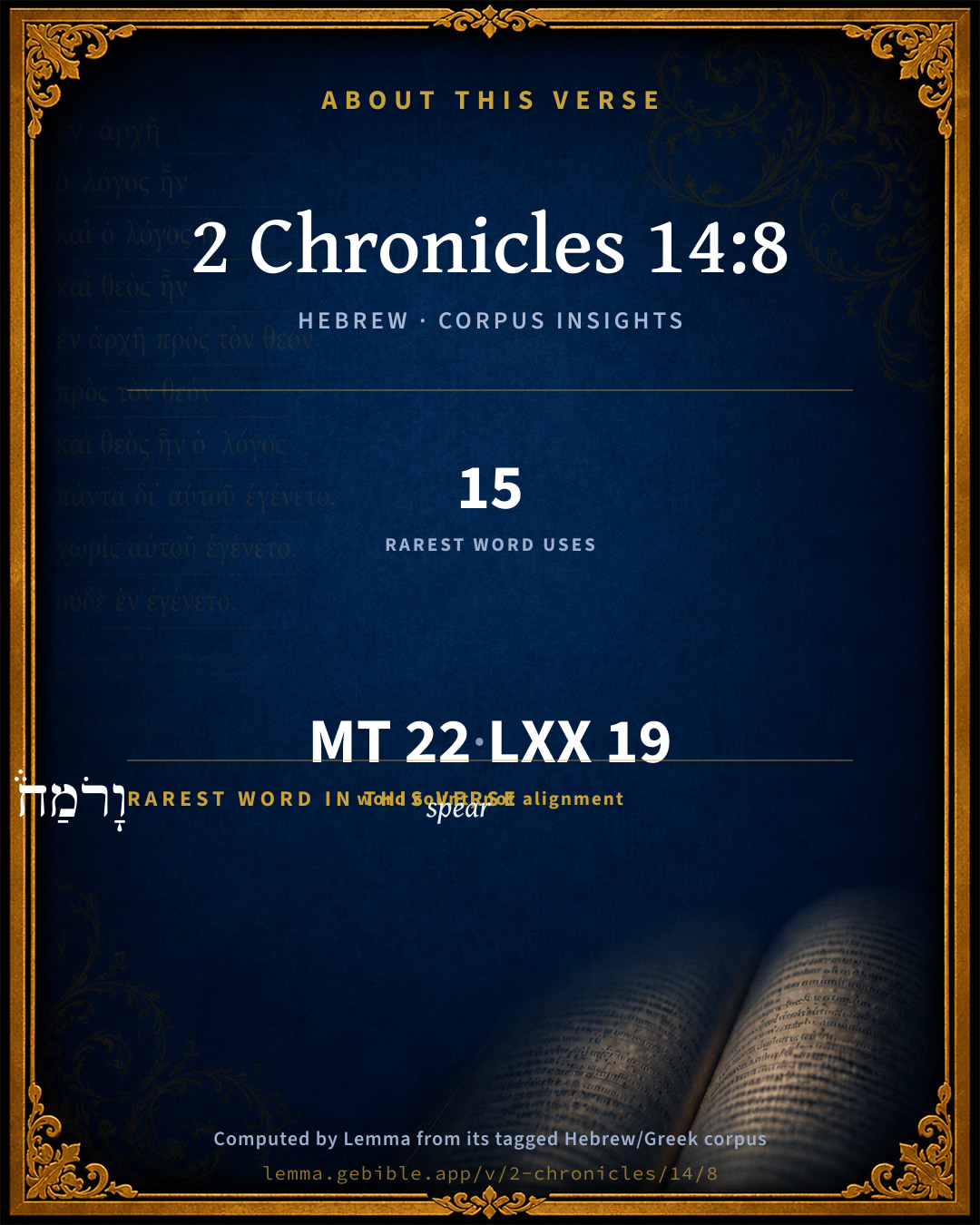
These counts appear in no published source. They are computed here, from the morphology-tagged text and Lemma’s own curated glosses. What Lemma adds →

22
words
18
distinct lemmas
Historical
section

Notable vocabulary

The rarest word here is וָרֹמַח֒ spear H7420 — appearing just 15 times in the whole Hebrew Bible.

Shared distinctive vocabulary

וָרֹמַח֒ spear H7420 occurs in 15 verses of the Hebrew Bible. Also found in:

Grammatical profile

  • 4 verbs
  • 10 nouns
  • 7 adjectives
  • 1 pronoun

Verb forms

  • וַיְהִ֣י Qal · Sequential Imperfect
  • נֹשֵׂ֣א Qal · Participle Active
  • נֹשְׂאֵ֤י Qal · Participle Active
  • וְדֹ֣רְכֵי Qal · Participle Active

Repetition

Words recur within this verse — often emphatic in Hebrew:

  • חַיִל֮ strength H2428 ×2
  • נֹשֵׂ֣א to lift H5375 ×2
  • מֵא֣וֹת hundred H3967 ×2
  • אֶ֔לֶף thousand H505 ×2

Hebrew & Septuagint length

In English translation the verse runs 36 words from the Hebrew and 40 from the Septuagint (LXX English) — closely comparable.

A rough comparison of the two English renderings, which tokenize alike — not a word-level alignment.

Word counts can differ between the Hebrew and the Greek without any difference in meaning — e.g. the Hebrew direct-object marker אֵת has no separate Greek word, and Greek often adds the article ὁ.

In the original languages it is 22 Hebrew tokens and 19 Greek tokens — but the two are counted differently (Hebrew bundles its prefixes and suffixes into one token; the Greek is in lemma form), so that isn’t a like-for-like length.

Cross-references

4

Topical passages linked to 2 Chronicles 14:8 in the Treasury of Scripture Knowledge — connected by theme and wording, ordered by reader-vote popularity; previews shown in the World English Bible.

  • 2 Chronicles 13:3 Abijah joined battle with an army of valiant men of war, even four hundred thousand chosen men: and Jeroboam set the battle in array against him with eight hundred thousand chosen men, who were mighty men of valor.
  • 2 Chronicles 11:1 When Rehoboam was come to Jerusalem, he assembled the house of Judah and Benjamin, one hundred eighty thousand chosen men, who were warriors, to fight against Israel, to bring the kingdom again to Rehoboam.
  • 2 Chronicles 17:14–19 This was the numbering of them according to their fathers' houses: Of Judah, the captains of thousands: Adnah the captain, and with him mighty men of valor three hundred thousand;
  • 2 Chronicles 25:5 Moreover Amaziah gathered Judah together, and ordered them according to their fathers' houses, under captains of thousands and captains of hundreds, even all Judah and Benjamin: and he numbered them from twenty years old and upward, and found them three hundred thousand chosen men, able to go forth to war, who could handle spear and shield.

Cross-references courtesy of OpenBible.info (CC BY 4.0).

Hebrew and Greek witnesses Masoretic Hebrew ↔ Greek Septuagint

The same verse in the two great witnesses to the Old Testament, shown verse-for-verse.

These are two independent witnesses, not word-aligned to each other, and the Septuagint is shown in lemma (dictionary) form.

Hebrew 2 Chronicles 14:8 Masoretic · Westminster Leningrad Codex

וַיְהִ֣י לְאָסָ֗א חַיִל֮ נֹשֵׂ֣א צִנָּ֣ה וָרֹמַח֒ מִֽיהוּדָה֙ שְׁלֹ֣שׁ מֵא֣וֹת אֶ֔לֶף וּמִבִּנְיָמִ֗ן נֹשְׂאֵ֤י מָגֵן֙ וְדֹ֣רְכֵי קֶ֔שֶׁת מָאתַ֥יִם וּשְׁמוֹנִ֖ים אָ֑לֶף כָּל אֵ֖לֶּה גִּבּ֥וֹרֵי חָֽיִל

Asa had an army that bore bucklers and spears, out of Judah three hundred thousand; and out of Benjamin, that bore shields and drew bows, two hundred eighty thousand: all these were mighty men of valor.

World English Bible · Public Domain

Greek LXX 2 Chronicles 14:8 Septuagint · lemma form

καί ἐκἔρχομαι ἐπί αὐτός ζαρε ὁ αἰθίοψ ἐν δύναμις ἐν χίλιοι χιλίας καί ἅρμα τριακόσιοι καί ἔρχομαι ἕως μαρισα

And Asa had a force of armed men bearing shields and spears in the land of Juda, even three hundred thousand, and in the land of Benjamin two hundred and eighty thousand targeteers and archers: all these were mighty warriors.

LXX2012 (modern English Septuagint) · Public Domain

On this verse, The Cambridge Bible for Schools and Colleges discusses the Septuagint’s reading. Read the note in Commentary ↓

Hebrew: Westminster Leningrad Codex (CC BY 4.0). Greek: Septuagint (public domain); English from LXX2012 (modern English Septuagint) (Public Domain). How the Septuagint differs from the Hebrew →

Commentary

Notes on 2 Chronicles 14:8 from classic Christian and Jewish commentators (each source and its license shown beneath its notes). The classic Christian expositions comment on the surrounding passage and are grouped to its opening verse, so a note may address several verses; the Jewish commentaries on the Tanakh (Rashi and others) are per-verse, so they appear only where the commentator wrote on this verse.

Lemma curates 59 commentaries, every one of them public domain or Creative Commons licensed, each selected and text-cleaned for this edition rather than reprinted as found. About our sources →

Trapp's Complete Commentary

John Trapp

2Ch 14:8 And Asa had an army [of men] that bare targets and spears, out of Judah three hundred thousand; and out of Benjamin, that bare shields and drew bows, two hundred and fourscore thousand: all these [were] mighty men of valour.

Ver. 8. Two hundred and fourscore thousand.] "Little Benjamin" was grown very numerous and potent.

John Trapp, A Commentary or Exposition upon All the Books of the Old and New Testament (1647–1656) — public domain. Text from a community e-Sword module.

Keil & Delitzsch

C. F. Keil & F. Delitzsch

The victory over the Cushite Zerah. - Ch2 14:8. "And there went forth against them Zerah." אליהם for עליהם refers to Asa's warriors mentioned in Ch2 14:7. The number of the men in Judah capable of bearing arms is mentioned only to show that Asa set his hope of victory over the innumerable host of the Cushites not on the strength of his army, but on the all-powerful help of the Lord (Ch2 14:10). The Cushite זרח is usually identified with the second king of the 22nd (Bubastitic) dynasty, Osorchon I; while Brugsch, hist. de l'Eg. i. p. 298, on the contrary, has raised objections, and holds Zerah to be an Ethiopian and not an Egyptian prince, who in the reign of Takeloth I, about 944 b.c., probably marched through Egypt as a conqueror (cf. G. Rsch in Herz.'s Realenc. xviii. S. 460). The statement as to Zerah's army, that it numbered 1,000,000 warriors and 300 war-chariots, rests upon a rough estimate, in which 1000 times 1000 expresses the idea of the greatest possible number. The Cushites pressed forward to Mareshah, i.e., Marissa, between Hebron and Ashdod (see on Ch2 11:8).

Ch2 14:9

Thither Asa marched to meet them, and drew up his army in battle array in the valley Zephathah, near Mareshah. The valley Zephathah is not, as Robins., Pal. sub voce, thinks, to be identified with Tel es Safieh, but must lie nearer Mareshah, to the west or north-west of Marsch.

Ch2 14:10

Then he called upon the Lord his God for help. וגו עמּך אין we translate, with Berth., "None is with Thee (on עמּך, cf. Ch2 20:6; Psa 73:25) to help between a mighty one and a weak," i.e., no other than Thou can help in an unequal battle, i.e., help the weaker side; while the Vulg., on the contrary, after the analogy of Sa1 14:6, translates, "non est apud te ulla distantia, utrum in paucis auxilieris an in pluribus;" and the older commentators (Schmidt, Ramb.) give the meaning thus: "perinde est tibi potentiori vel imbecilliori opem ferre." But in Sa1 14:16 the wording is different, so that that passage cannot be a standard for us here. "In Thy name (i.e., trusting in Thy help) are we come against this multitude" (not "have we fallen upon this multitude"). וגו יעצר אל, "Let not a mortal retain strength with Thee" (עצר = כּח עצר, Ch2 13:20; Ch1 29:14), i.e., let not weak men accomplish anything with Thee, show Thy power or omnipotence over weak men.

Ch2 14:11

God heard this prayer. Jahve drove the Cushites into flight before Asa, scil. by His mighty help.

Ch2 14:12

Asa, with his people, pursued to Gerar, the old ancient Philistine city, whose ruins Rowlands has discovered in the Khirbet el Gerar, in the Wady Jorf el Gerar (the torrent of Gerar), three leagues south-south-east of Gaza (see on Gen 20:1). "And there fell of the Cushites, so that to them was not revival," i.e., so many that they could not make a stand and again collect themselves, ut eis vivificatio i. e. copias restaurandi ratio non esset, as older commentators, in Annott. uberior. ad h. l., have already rightly interpreted it. The words are expressions for complete defeat. Berth. translates incorrectly: "until to them was nothing living;" for לאין does not stand for לאין עד, but ל serves to subordinate the clause, "so that no one," where in the older language אין alone would have been sufficient, as in Ch2 20:25; Ch1 22:4, cf. Ew. 315, c; and מחיה denotes, not "a living thing," but only "preservation of life, vivification, revival, maintenance." For they were broken before Jahve and before His host. מחנהוּ, i.e., Asa's army is called Jahve's, because Jahve fought in and with it against the enemy. There is no reason to suppose, with some older commentators, that there is any reference to an angelic host or heavenly camp (Gen 32:2.). And they (Asa and his people) brought back very much booty.

Ch2 14:13

"They smote all the cities round about Gerar," which, as we must conclude from this, had made common cause with the Cushites, being inhabited by Philistines; for the fear of Jahve had fallen upon them. יהוה פּחד יהוה . here, and in Ch2 17:10; Ch2 20:29, as in Sa1 11:7, the fear of the omnipotence displayed by Jahve in the annihilation of the innumerable hostile army. In these cities Judah found much booty.

Ch2 14:14-15

They also smote the tents of the herds of the wandering tribes of that district, and carried away many sheep and camels as booty.

Keil & Delitzsch — Biblical Commentary on the Old Testament (1861–1891) — public domain (CC PDM 1.0). Text via the HelloAO Bible API. (Old Testament only.)

Adam Clarke's Commentary

Verse 8. Targets and spears] Probably targets with the dagger in the centre, and javelins for distant fight.

Bare shields and drew bows] They were not only archers, but had shield and sword for close fight.

Adam Clarke's Commentary on the Bible (1810–1826) — public domain. Text from a community e-Sword/MySword module.

Ellicott's Commentary for English Readers

(8) Targets and spears.—Shield (or buckler) and lance. The large shield is meant (see 2Ch_9:15). The same phrase is used to describe the warriors of Judah. (1Ch_12:24.)

That bare shields—i.e., the short or round shield (2Ch_9:16).

Drew bows.—(1Ch_8:40; 1Ch_12:2.) The Judæans were the hoplites, or heavy-armed; the Benjaminites the light-armed, or peltasts, as a Greek writer would have said.

Three hundred thousand . . . two hundred and fourscore thousand.—A total of 580,000, warriors. (Comp. Abijah’s 400,000, 2Ch_13:3.) The entire male population capable of bearing arms must be included in these high figures. Of course, such a thing as a standing army of this strength is not to be thought of.

The proportion of Benjamin relatively to Judah appears much too high. It must, however, be remembered that Benjamin was always famous as a tribe of warriors. (See Gen_49:27; 1Ch_7:6-11.)

(b) INVASION OF THE CUSHITE ZERAH, AND HIS SIGNAL OVERTHROW (2Ch_14:9-15)—This Section has no Parallel in Kings.

A Bible Commentary for English Readers, edited by Charles John Ellicott (1878–1897) — public domain. Text from a community e-Sword module.

The Cambridge Bible for Schools and Colleges

gen. ed. J. J. S. Perowne

8. that bare targets and spears … that bare shields and drew bows] LXX., δύναμις ὁπλοφόρων (= ὁπλιτῶν) αἰρόντων θυρεοὺς καὶ δόρατα … πελτασταὶ καὶ τοξόται. The Chronicler divides Asa’s army into the heavy-armed men belonging to Judah and the light-armed bowmen belonging to Benjamin. Asa apparently had no chariots, “targets” and “shields” should be transposed as in 2Ch_9:15.

of Judah three hundred thousand … of Benjamin … two hundred and fourscore thousand] The total is 580,000. Under Asa’s successor, Jehoshaphat, the numbers are (2Ch_17:14-18), Judah 780,000, Benjamin 380,000, making a total of 1,160,000, i.e. the double of the total given above. Whether the Chronicler drew these numbers from any ancient document is not known, but his main point seems to be that Judah was strong in the early days of Asa, while Asa shewed faith in God, and that Judah became still stronger under his really religious successor, Jehoshaphat. It is to be noted that it is not said that Asa brought these 580,000 men into the field against the Ethiopians; cp. note on 2Ch_13:3.

The Cambridge Bible for Schools and Colleges (gen. ed. J. J. S. Perowne; Cambridge University Press, 1878–1918) — public domain. Text from a community e-Sword module.

John Gill's Exposition

And there came out against them Zerah the Ethiopian, with an host of thousand thousand, and three hundred chariots,.... According to Josephus (b), this army consisted of 900,000 foot, and 100,000 horsemen, and certain it is there were horsemen among them, Ch2 16:8 some say these were not the Ethiopians in Africa, beyond Egypt, being, as is said, too far off for such an army to travel, and it would be hard to say what should induce them to it; and besides it is urged, the king of Egypt would never have suffered them to pass through his dominions, as they must to come to Judea; but that they were the Cushite Arabs, that inhabited Midian, part of Arabia Petraea, and Arabia Felix, near Judaea; see Gill on Num 12:1, but since this great host consisted of Lubim or Libyans, inhabitants of Africa, as well as of Ethiopians, Ch2 16:8, these Ethiopians seem to be rather those in Africa, who were masters of Egypt and Libya, as well as Ethiopia, quickly after the death of Shishak, or Sesostris, see Ch2 12:2, which accounts for the size of this army, and their passage through Egypt: that there were two sorts of Ethiopians, the western and eastern ones, the one that dwelt in Africa, the other in Asia, appears clearly from Homer (c), Herodotus (d), and Heliodorus (e), the former of which seem here meant; nor need this army be thought incredible, especially since they were joined by the Lubim or Libyans, and assisted by the Philistines, as appears by what follows; besides, the two armies of Israel and Judah we read of in the preceding chapter, when put together, exceed this; see also Ch2 17:14, so the armies of Tamerlane and Bajazet, that of the former being 1,600,000, and that of the latter 1,400,000 (f):

and came unto Mareshah; a city in the tribe of Judah, on the borders of it, Ch2 11:8.

(b) Antiqu. l. 8. c. 12. sect. 1. (c) Odyss. 1. ver. 23, 24. (d) Polymnia, sive, l. 7. c. 69, 70. (e) Ethiopic. l. 9. c. 6. (f) Laonic. Chalcocond. de rebus Turc. l. 3. p. 98, 102.

John Gill's Exposition of the Whole Bible (1746–1763) — public domain (CC PDM 1.0). Text via the HelloAO Bible API.

Albert Barnes' Notes on the Bible

The men of Judah served as heavy-armed troops, while the Benjamites were light-armed. Their numbers accord well with those of 2Ch 13:3. As the boundaries of Judah had been enlarged 2Ch 13:19, and as for ten years at least there had been no war 2Ch 14:1, the effective force had naturally increased. It was 400, 000; it is now 580, 000.

Albert Barnes' Notes on the Bible (1834–1885) — public domain. Text from a community e-Sword/MySword module.

Matthew Poole's English Annotations

Asa had an army; which, as it seems, he had now gathered together upon the information of Zerah’s design against him.

Matthew Poole's English Annotations on the Holy Bible (1683–1685) — public domain. Text from a community e-Sword/MySword module.

The Pulpit Commentary

The "ten years" quiet" (ver. 1) begins to see its end. Targets; (2Ch_9:15) spears; (2Ch_11:12) for both, see 1Ch_12:24. Out of Benjamin shields and bows. The minuter coincidences of the history are very observable and very interesting; for see 1Ch_8:40 1Ch_12:2; and much earlier, Gen_49:27; Jud_1:20:16, 17.

Vers. 8-15.

The secret and the spirit of true defence.

We may learn from this narrative of unprovoked attack and triumphant defence

I THAT OUR UPMOST PREPARATION WILL NOT SECURE US FROM ATTACK. Asa endeavoured to make his little kingdom impregnable to assault by

(1) fortifying the outposts, and

(2) training and equipping a large army (vers. 7, 8).

Nevertheless, the Ethiopians came up against him with an army far stronger than his. The military and naval preparations of one country usually incite to greater preparations in another, and instead of war becoming impossible because each nation is invulnerable, it becomes probable because the combative spirit has been developed; one nation considers itself challenged by another, and because a large number of professional men are eager to exert their power and improve their position. But not only does "history repeat itself" thus; we have here an illustration of a wider truth that whatever efforts we may make to guard ourselves against the inroad of evils, we shall surely fail. Sickness of some kind will attack us; disappointment and disillusion will find their way to our heart; sorrow will surprise us; loss and separation will befall us; death will knock at our door. There are no fortifications we can construct, there are no forces we can raise, Be we never so vigilant and alert, which will keep all enemies from the gate. Spite of fenced cities and many thousands of Jewish spears and Benjamite bows, the Ethiopian army comes up against Jerusalem.

II THAT IN THE PATH OF MORAL AND SPIRITUAL RECTITUDE WE ARE IN THE WAY OF SAFETY. Asa had no need to be alarmed. Had he wickedly departed from the Lord he might well have been in the greatest consternation, for then the severe warnings of sacred Scripture would have been as a knell in his ears; but as it was, his fidelity to Jehovah was an assurance of safety. He was God"s servant; he was in a position to "cry unto the Lord his God" (ver. 11); to say, "O Lord our God;" to claim that the Ethiopian"s triumph would be a prevailing against the Lord himself: "Let not man prevail against thee." The king could hide in the cleft of the rock; he could fall back on almighty power; he was safe Before a blow was struck. He did the right thing on the occasion.

(1) He brought his army into the field, well equipped and well arrayed (ver. 10); and then

(2) he made his earnest, Believing appeal to the Lord his God. This is the path of safety, the place of wisdom. Let us, in days of peace and plenty, in the time of joy and honour, seek and serve the Lord our God, and then, when the darkness falls, when the enemy appears, when such power is needed as goes far beyond our small resources, we can turn with a holy confidence and with Christian calmness tot he sucoour of the faithful and the mighty Friend. We shall indeed do as Asa did; we shall summon all our own powers and wisdom to confront the danger, to meet the difficulty; but, like the King of Judah, we shall feel that our true hope is in the living God, and we shall hide in him, our Refuge and our Strength. "In his Name" we shall "go against this multitude.

III THAT AS THOSE WHO FIGHT FOR GOD WE HAVE A POWERFUL PLEA. As those who are enlisted and engaged in the great campaign against moral evil in this world, we have a strong plea to urge when we draw nigh to God in prayer and seek his conquering power.

1. God is our God; the God of our choice and of his own faithful Word.

2. God is able to give us the victory even against the greatest odds: "It isnothing with thee to help" (ver. 11). "If thou wilt, thou canst." "All things are possible" with him,

3. We do all that we do in his Name, for the extension of his kingdom.

The work is thine, not mine, O Lord, It is thy race we run.

"Let not man prevail against thee.

IV THAT, GOD WITH US, ANXIOUS FEAR WILL CHANGE TO JOYOUS VICTORY. "The Lord smote the Ethiopians and Asa and the people pursued them," etc. (vers. 12-15). The king and the people of Judah went out of Jerusalem with the most grave concern in their hearts; they reentered the royal city with their souls full of joy and their arms full of spoil. Their courage and, more especially, their fidelity were crowned with a true and a great success. So in due time will ours also. It is true that our fight with wrong and woe is not (like this one of Asa"s) a short sharp battle; it is a long campaign; it is a campaign in which fortune wavers, or seems to waver, from side to side; in which many good soldiers of Christ are seen to fall. But there can be no doubt about the issue. The Lord is on our side. Victorious Love is our great Captain, and the time will come when we too shall "return to Jerusalem," with songs of joy and triumph on our lips. C.

The Pulpit Commentary (1880–1919), ed. H.D.M. Spence-Jones & Joseph S. Exell — public domain. Text from a community e-Sword module.

Scofield Reference Notes

C. I. Scofield

three hundred thousand

(See Scofield "1Co 10:8").

The Scofield Reference Bible (1917 edition), notes by C. I. Scofield — public domain. Text from a community e-Sword module.

Lesson kit

Teaching starters — assembled from the data on this page, not authored interpretation. Every prompt links to the verse data it draws on. Edit before teaching.

2 Chronicles, in the Historical, opens this verse with 22 words (18 distinct Hebrew lemmas). Its most distinctive word is rômach (“spear”). A historical commentator’s framing appears above. Read the whole chapter for the surrounding context.

Discussion questions

  1. The word rômach carries the sense “spear.” How does it shape the verse?
  2. How does Numbers 25:7, which shares the word «spear», read alongside this verse?
  3. What does the repetition of “strength” (2× in this one verse) do in this verse?
  4. These translations render this verse differently; the difference is in the English rendering, not the original. What questions does that raise?
  5. «וַיְהִ֣י» is a Qal Sequential Imperfect verb. How does that grammatical form shape the action described?
  6. Compare how Trapp's Complete Commentary and Keil & Delitzsch read this verse. Where do they agree or differ?

Things to notice

Reading settings

Reading text

Shown beneath each verse's original-language words.

Old Testament
Old Testament edition

Read the OT as the Masoretic Hebrew (MT) or the Greek Septuagint (LXX).

English shown for the Greek Septuagint (in the Hebrew ↔ Greek comparison).

Comparing translations? Open the Compare panel on any verse page to stack up to four side by side.