
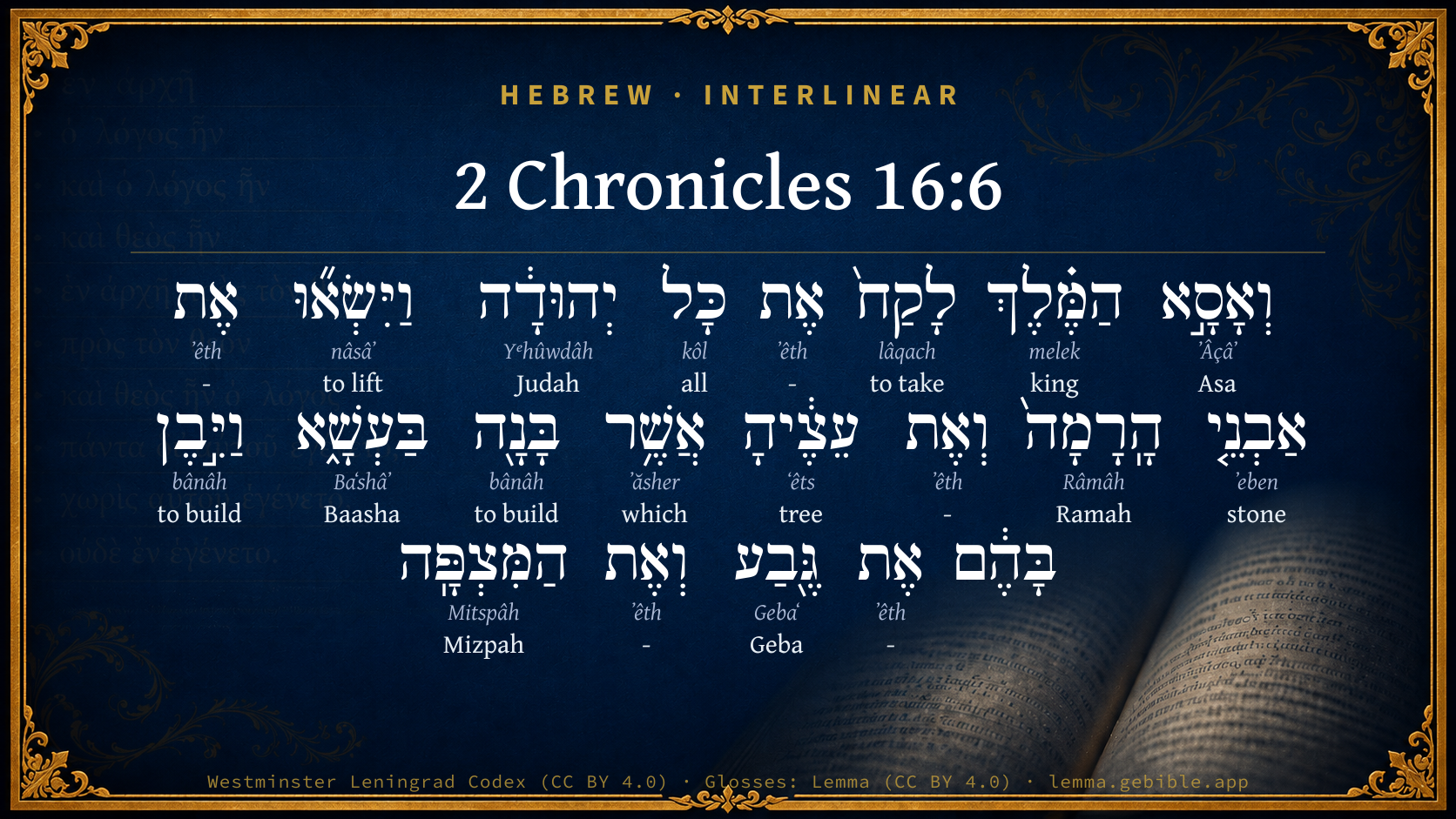
2 Chronicles 16:6

Hebrew (Westminster Leningrad Codex) 2 Chronicles 16:6 appears in the Hebrew Old Testament. The text above is from the Westminster Leningrad Codex. Each word links to its Strong’s number, a concise gloss, and parsing drawn from the Open Scriptures Hebrew Bible morphology. Click any word for its full Brown-Driver-Briggs (BDB) entry.
Download image
Cite this verse

2 Chronicles 16:6 (World English Bible). Public Domain. Lemma interlinear Bible study tool, https://lemma.gebible.app/v/2-chronicles/16/6.

Show BibTeX & RIS
BibTeX
RIS
English Translation
Then Asa the king took all Judah; and they carried away the stones of Ramah, and the timber of it, with which Baasha had built; and he built therewith Geba and Mizpah.
World English Bible · Public Domain
Download a study sheet

One document with this verse’s original text, its word-by-word gloss line, the meaning frame, cross-references with their text, attributed commentary, and full source and license credits — printable, and it pastes into notes with its structure intact.

This verse Autodidact and up

Study sheet (.html) Plain text (.txt)

A passage Seminary Student

Up to 50 verses in one chapter. A passage sheet keeps up to 6 commentary sources and 12 cross-references per verse, in the order this page ranks them, and says so on the sheet whenever that leaves anything out. Ask for a single verse and you get the Autodidact verse sheet above.

Everything on this page stays free to read, with no account — the sheet is a download of what is already on screen, not access to it.

Want to remove ads? Support Godless Engineer
Compare translations 3

The same verse in 3 English versions, stacked beneath the original-language interlinear above. Click any original word for its lexicon entry.

Each is an independent rendering of the whole verse — the interlinear is not word-aligned to these translations.

Highlighted words mark where these versions differ — a whole-verse word diff, not a word-by-word alignment.

  • World English Bible Public Domain
    Then Asa the king took all Judah; and they carried away the stones of Ramah, and the timber of it, with which Baasha had built; and he built therewith Geba and Mizpah.
  • King James Version Public Domain
    Then Asa the king took all Judah; and they carried away the stones of Ramah, and the timber thereof, wherewith Baasha was building; and he built therewith Geba and Mizpah.
  • unfoldingWord Literal Text CC BY-SA 4.0
    And King Asa took all Judah. And they carried away the stones of Ramah and its wood with which Baasha had been building, and he built with them Geba and Mizpah.

unfoldingWord Literal Text — © unfoldingWord, licensed CC BY-SA 4.0. Word-aligned USFM3 via Door43 (git.door43.org/unfoldingWord/en_ult).

Versions to compare (up to 4)

3 of 4 selected

Show all 18 translations

Every available English version of this verse, each an independent rendering of the whole verse.

  • World English Bible Public Domain
    Then Asa the king took all Judah; and they carried away the stones of Ramah, and the timber of it, with which Baasha had built; and he built therewith Geba and Mizpah.
  • Berean Standard Bible Public Domain
    Then King Asa brought all the men of Judah, and they carried away the stones of Ramah and the timbers Baasha had used for building. And with these materials he built up Geba and Mizpah.
  • Majority Standard Bible Public Domain
    Then King Asa brought all the men of Judah, and they carried away the stones of Ramah and the timbers Baasha had used for building. And with these materials he built up Geba and Mizpah.
  • King James Version Public Domain
    Then Asa the king took all Judah; and they carried away the stones of Ramah, and the timber thereof, wherewith Baasha was building; and he built therewith Geba and Mizpah.
  • American Standard Version (1901) Public Domain
    Then Asa the king took all Judah; and they carried away the stones of Ramah, and the timber thereof, wherewith Baasha had builded; and he built therewith Geba and Mizpah.
  • Revised Version (1885) Public Domain
    Then Asa the king took all Judah; and they carried away the stones of Ramah, and the timber thereof, wherewith Baasha had builded; and he built therewith Geba and Mizpah.
  • Geneva Bible (1599) Public Domain
    Then Asa the King tooke all Iudah, and caryed away the stones of Ramah and the tymber thereof, wherewith Baasha did builde, and he built therewith Geba and Mizpah.
  • Douay-Rheims (1899) Public Domain
    Then king Asa took all Juda, and they carried away from Rama the stones, and the timber that Baasa had prepared for the building: and he built with them Gabaa, and Maspha.
  • Young's Literal Translation Public Domain
    and Asa the king hath taken all Judah, and they bear away the stones of Ramah, and its wood, that Baasha hath built, and he buildeth with them Geba and Mizpah.
  • Literal Standard Version CC BY-SA 4.0
    and Asa the king has taken all Judah, and they carry away the stones of Ramah and its wood that Baasha has built [with], and he builds Geba and Mizpah with them.
  • Unlocked Literal Bible CC BY-SA 4.0
    Then Asa the king took all Judah with him. They carried away the stones and timbers of Ramah with which Baasha had been building up the city. Then King Asa used that building material to build up Geba and Mizpah.
  • unfoldingWord Literal Text CC BY-SA 4.0
    And King Asa took all Judah. And they carried away the stones of Ramah and its wood with which Baasha had been building, and he built with them Geba and Mizpah.
  • Darby Bible Public Domain
    And king Asa took all Judah; and they carried away the stones and the timber from Ramah, with which Baasha had been building, and he built with them Geba and Mizpah.
  • World Messianic Bible Public Domain
    Then Asa the king took all Judah, and they carried away the stones and timber of Ramah, with which Baasha had built; and he built Geba and Mizpah with them.
  • Webster's Bible Public Domain
    Then Asa the king took all Judah; and they carried away the stones of Ramah, and the timber of it, with which Baasha was building, and he built with it Geba and Mizpah.
  • Free Bible Version CC BY-SA 4.0
    So King Asa went with all the men of Judah, and they carried away from Ramah the stones and the timbers Baasha had used for building, and with them he built up Geba and Mizpah.
  • Bible in Basic English Public Domain
    Then King Asa, with all Judah, took away the stones and wood with which Baasha was building Ramah, and he made use of them for building Geba and Mizpah.
  • JPS Tanakh (1917) Public Domain
    Then Asa the king took all Judah; and they carried away the stones of Ramah, and the timber thereof, wherewith Baasa had builded; and he built therewith Geba and Mizpah.

Literal Standard Version (2020), Covenant Press — licensed CC BY-SA 4.0. Text via the HelloAO Bible API (eBible.org). Unlocked Literal Bible (unfoldingWord) — licensed CC BY-SA 4.0. Text via the HelloAO Bible API (eBible.org). unfoldingWord Literal Text — © unfoldingWord, licensed CC BY-SA 4.0. Word-aligned USFM3 via Door43 (git.door43.org/unfoldingWord/en_ult). Free Bible Version, Dr. Jonathan Gallagher — licensed CC BY-SA 4.0. Text via the HelloAO Bible API (eBible.org).

Word by word

More ways to search: Search by grammar → Find every occurrence → Compare this word →

Practice this passage: Drill this verse → Learn its vocabulary →

גֶּ֖בַע
Gebaʻ
H1387
“Geba”
Noun, Proper
Part of Speech
Noun
Type
Proper
Full BDB Definition

Origin: from the same as H1375

TWOT: None

Gaba or Geba or Gibeah = "hill" - a city in Benjamin, modern 'Jeba', which stands on the top of a steep terraced hill, six miles or ten kilometres north east of Jerusalem and three miles or five kilometres from Gibeah, on the edge of the Wadi Suweinit looking northward to the opposite village of ancient Michmash, modern 'Mukhmas'
  1. וְאָסָ֣א ʼÂçâʼ H609 “and · Asa” Conjunction + Noun, Proper
  2. הַמֶּ֗לֶךְ melek H4428 “the · king” Particle, Definite Article + Noun, Common, Masculine, Singular, Absolute
  3. לָקַח֙ lâqach H3947 “to take” Verb, Qal, Perfect, 3rd Person, Masculine, Singular
  4. אֶת ʼêth H853 “-” Particle, Direct Object
  5. כָּל kôl H3605 “all of” Noun, Common, Masculine, Singular, Construct
  6. יְהוּדָ֔ה Yᵉhûwdâh H3063 “Judah” Noun, Proper
  7. וַיִּשְׂא֞וּ nâsâʼ H5375 “and · to lift” Conjunction + Verb, Qal, Sequential Imperfect, 3rd Person, Masculine, Plural
  8. אֶת ʼêth H853 “-” Particle, Direct Object
  9. אַבְנֵ֤י ʼeben H68 “stones of” Noun, Common, Feminine, Plural, Construct
  10. הָֽרָמָה֙ Râmâh H7414 “the · Ramah” Particle, Definite Article + Noun, Proper
  11. וְאֶת ʼêth H853 “and · -” Conjunction + Particle, Direct Object
  12. עֵצֶ֔יהָ ʻêts H6086 “trees · her” Noun, Common, Masculine, Plural, Construct + Suffix, Personal, 3rd Person, Feminine, Singular
  13. אֲשֶׁ֥ר ʼăsher H834 “which” Particle, Relative
  14. בָּנָ֖ה bânâh H1129 “to build” Verb, Qal, Perfect, 3rd Person, Masculine, Singular
  15. בַּעְשָׁ֑א Baʻshâʼ H1201 “Baasha” Noun, Proper
  16. וַיִּ֣בֶן bânâh H1129 “and · to build” Conjunction + Verb, Qal, Sequential Imperfect, 3rd Person, Masculine, Singular
  17. אֶת ʼêth H853 “-” Particle, Direct Object
  18. וְאֶת ʼêth H853 “and · -” Conjunction + Particle, Direct Object
  19. הַמִּצְפָּֽה Mitspâh H4709 “the · Mizpah” Particle, Definite Article + Noun, Proper

About this verse

These counts appear in no published source. They are computed here, from the morphology-tagged text and Lemma’s own curated glosses. What Lemma adds →

21
words
15
distinct lemmas
Historical
section

Notable vocabulary

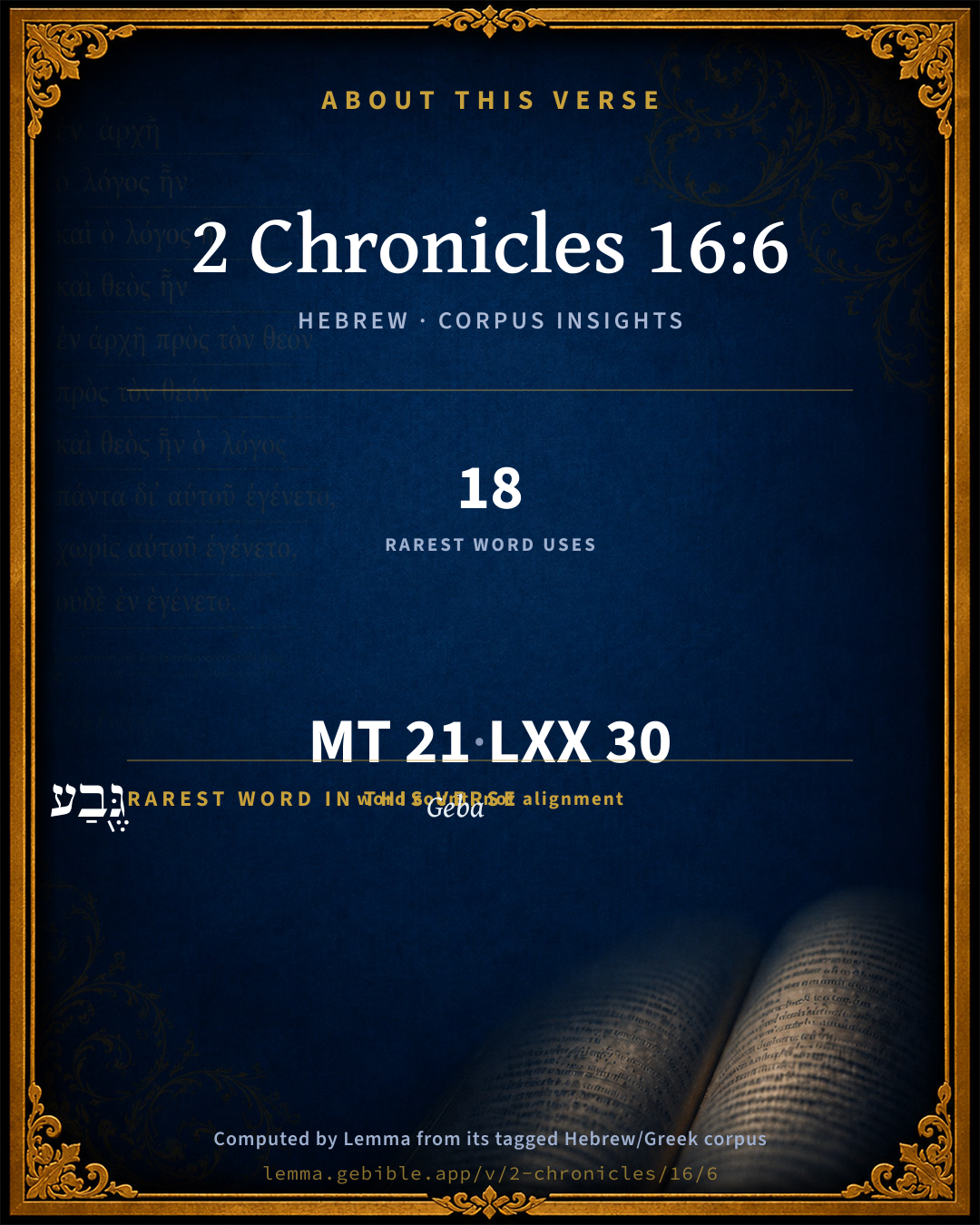
The rarest word here is גֶּ֖בַע Geba H1387 — appearing just 18 times in the whole Hebrew Bible.

Shared distinctive vocabulary

גֶּ֖בַע Geba H1387 occurs in 18 verses of the Hebrew Bible. Also found in:

Grammatical profile

  • 4 verbs
  • 10 nouns
  • 1 preposition
  • 6 particles

Verb forms

  • לָקַח֙ Qal · Perfect
  • וַיִּשְׂא֞וּ Qal · Sequential Imperfect
  • בָּנָ֖ה Qal · Perfect
  • וַיִּ֣בֶן Qal · Sequential Imperfect

Repetition

A word recurs within this verse — often emphatic in Hebrew:

  • בָּנָ֖ה to build H1129 ×2

Hebrew & Septuagint length

In English translation the verse runs 32 words from the Hebrew and 28 from the Septuagint (LXX English) — closely comparable.

A rough comparison of the two English renderings, which tokenize alike — not a word-level alignment.

Word counts can differ between the Hebrew and the Greek without any difference in meaning — e.g. the Hebrew direct-object marker אֵת has no separate Greek word, and Greek often adds the article ὁ.

In the original languages it is 21 Hebrew tokens and 30 Greek tokens — but the two are counted differently (Hebrew bundles its prefixes and suffixes into one token; the Greek is in lemma form), so that isn’t a like-for-like length.

Cross-references

10

Topical passages linked to 2 Chronicles 16:6 in the Treasury of Scripture Knowledge — connected by theme and wording, ordered by reader-vote popularity; previews shown in the World English Bible.

  • Joshua 15:38 and Dilean, and Mizpeh, and Joktheel,
  • Joshua 18:24–26 and Chephar Ammoni, and Ophni, and Geba; twelve cities with their villages:
  • 1 Samuel 7:6 They gathered together to Mizpah, and drew water, and poured it out before Yahweh, and fasted on that day, and said there, We have sinned against Yahweh. Samuel judged the children of Israel in Mizpah.
  • 1 Samuel 10:17 Samuel called the people together to Yahweh to Mizpah;
  • 1 Kings 15:22 Then king Asa made a proclamation to all Judah; none was exempted: and they carried away the stones of Ramah, and the timber of it, with which Baasha had built; and king Asa built therewith Geba of Benjamin, and Mizpah.
  • 1 Chronicles 6:60 and out of the tribe of Benjamin, Geba with its suburbs, and Allemeth with its suburbs, and Anathoth with its suburbs. All their cities throughout their families were thirteen cities.
  • 2 Chronicles 21:17 and they came up against Judah, and broke into it, and carried away all the substance that was found in the king's house, and his sons also, and his wives; so that there was never a son left him, save Jehoahaz, the youngest of his sons.
  • Isaiah 10:29 they are gone over the pass; they have taken up their lodging at Geba; Ramah trembles; Gibeah of Saul is fled.
  • Zechariah 14:10 All the land will be made like the Arabah, from Geba to Rimmon south of Jerusalem; and she will be lifted up, and will dwell in her place, from Benjamin's gate to the place of the first gate, to the corner gate, and from the tower of Hananel to the king's wine-presses.
  • 1 Samuel 7:16 He went from year to year in circuit to Bethel and Gilgal, and Mizpah; and he judged Israel in all those places.

Cross-references courtesy of OpenBible.info (CC BY 4.0).

Hebrew and Greek witnesses Masoretic Hebrew ↔ Greek Septuagint

The same verse in the two great witnesses to the Old Testament, shown verse-for-verse.

These are two independent witnesses, not word-aligned to each other, and the Septuagint is shown in lemma (dictionary) form.

Hebrew 2 Chronicles 16:6 Masoretic · Westminster Leningrad Codex

וְאָסָ֣א הַמֶּ֗לֶךְ לָקַח֙ אֶת כָּל יְהוּדָ֔ה וַיִּשְׂא֞וּ אֶת אַבְנֵ֤י הָֽרָמָה֙ וְאֶת עֵצֶ֔יהָ אֲשֶׁ֥ר בָּנָ֖ה בַּעְשָׁ֑א וַיִּ֣בֶן בָּהֶ֔ם אֶת גֶּ֖בַע וְאֶת הַמִּצְפָּֽה

Then Asa the king took all Judah; and they carried away the stones of Ramah, and the timber of it, with which Baasha had built; and he built therewith Geba and Mizpah.

World English Bible · Public Domain

Greek LXX 2 Chronicles 16:6 Septuagint · lemma form

καί ασα ὁ βασιλεύς λαμβάνω πᾶς ὁ ἰούδας καί λαμβάνω ὁ λίθος ὁ ραμα καί ὁ ξύλον αὐτός ὅς οἰκοδομέω βαασα καί οἰκοδομέω ἐν αὐτός ὁ γαβαε καί ὁ μασφα

then king Asa took all Juda, and took the stones of Rama, and its timber, with which Baasa had built; and he built with them Gabae and Maspha.

LXX2012 (modern English Septuagint) · Public Domain

Hebrew: Westminster Leningrad Codex (CC BY 4.0). Greek: Septuagint (public domain); English from LXX2012 (modern English Septuagint) (Public Domain). How the Septuagint differs from the Hebrew →

Commentary

Notes on 2 Chronicles 16:6 from classic Christian and Jewish commentators (each source and its license shown beneath its notes). The classic Christian expositions comment on the surrounding passage and are grouped to its opening verse, so a note may address several verses; the Jewish commentaries on the Tanakh (Rashi and others) are per-verse, so they appear only where the commentator wrote on this verse.

Lemma curates 59 commentaries, every one of them public domain or Creative Commons licensed, each selected and text-cleaned for this edition rather than reprinted as found. About our sources →

Tyndale Open Study Notes

Tyndale Open Resources

16:6 Asa drafted laborers to use the materials from Ramah to fortify the northern border of his kingdom. Mizpah is usually identified with Tell en-Nasba, about four miles north of Ramah and two miles from Bethel. Geba was probably located three miles beyond the watershed east of Gibeah, protecting a wadi leading down to Jericho and the sanctuary at Gilgal.

Tyndale Open Study Notes — © Tyndale Open Resources, licensed CC BY-SA 4.0. Text via the HelloAO Bible API.

Adam Clarke's Commentary

Verse 6. Took all Judah] See on 1Kg 15:22.

Adam Clarke's Commentary on the Bible (1810–1826) — public domain. Text from a community e-Sword/MySword module.

Ellicott's Commentary for English Readers

(6) Then.—And.

Asa the king took all Judah.—1Ki_15:22 : “And the king Asa called together all Judah; none was exempted.” The chronicler has modified an obscure sentence. The rest of the verse coincides with Kings, save that the latter reads “Geba of Benjamin.”

Mizpah.—Jer_41:9-10, mentions a great cistern which Asa made in Mizpah “for fear of Baasha king of Israel.”

A Bible Commentary for English Readers, edited by Charles John Ellicott (1878–1897) — public domain. Text from a community e-Sword module.

The Cambridge Bible for Schools and Colleges

gen. ed. J. J. S. Perowne

6. took all Judah] In 1 Kin. summoned all Judah (so translate); none was exempted.

was a building] R.V. had builded.

Geba and Mizpah] The names signify, “the hill and the watch-tower.” The two cities were on the northern border of Benjamin. For Mizpah see Jer_41:1-9.

The Cambridge Bible for Schools and Colleges (gen. ed. J. J. S. Perowne; Cambridge University Press, 1878–1918) — public domain. Text from a community e-Sword module.

The Pulpit Commentary

he affair seems thus to have come to an unbloody termination. The parallel is (1Ki_15:22) so much the more graphic that it contains the two additions that Asa "made a proclamation throughout all Judah," and one that "exempted none" from joining in the duty of moving all the stones and all the timber from Ramah, and diverting" them to the use of building Geba and Mizpah. This greatly contributed to command the road from the north to Jerusalem. Geba. This was Geba of Benjamin, as clearly stated in the parallel. It was a position north of Ramah, whether opposite Michmash and the modern Jeba is not certain, as some think this answers to Gibeah of Saul. (1Sa_14:2, 1Sa_14:5) Mizpah. (see Jer_41:2, Jer_41:3, Jer_41:9, Jer_41:10) This Mizpah is not that of the Shefelah, (Jos_15:38) but was situate about two hours, or a short six miles, north-west of Jerusalem, on the Samaria route, and is probably the modern Neby Samwil (see also (2Ki_25:22-26; Jer_40:5-16; Jer_41:1-18)

The Pulpit Commentary (1880–1919), ed. H.D.M. Spence-Jones & Joseph S. Exell — public domain. Text from a community e-Sword module.

Keil & Delitzsch

C. F. Keil & F. Delitzsch

In regard to the building of Mizpah, it is casually remarked in Jer 41:9 that Asa had there built a cistern.

Keil & Delitzsch — Biblical Commentary on the Old Testament (1861–1891) — public domain (CC PDM 1.0). Text via the HelloAO Bible API. (Old Testament only.)

Lesson kit

Teaching starters — assembled from the data on this page, not authored interpretation. Every prompt links to the verse data it draws on. Edit before teaching.

2 Chronicles, in the Historical, opens this verse with 21 words (15 distinct Hebrew lemmas). Its most distinctive word is Gebaʻ (“Geba”). A historical commentator’s framing appears above. Read the whole chapter for the surrounding context.

Discussion questions

  1. How does “Geba” (Gebaʻ) shape what this verse is saying?
  2. How does Joshua 18:24, which shares the word «Geba», read alongside this verse?
  3. What does the repetition of “to build” (2× in this one verse) do in this verse?
  4. These translations render this verse differently; the difference is in the English rendering, not the original. What questions does that raise?
  5. «לָקַח֙» is a Qal Perfect verb. How does that grammatical form shape the action described?
  6. Compare how Tyndale Open Study Notes and Adam Clarke's Commentary read this verse. Where do they agree or differ?

Things to notice

Reading settings

Reading text

Shown beneath each verse's original-language words.

Old Testament
Old Testament edition

Read the OT as the Masoretic Hebrew (MT) or the Greek Septuagint (LXX).

English shown for the Greek Septuagint (in the Hebrew ↔ Greek comparison).

Comparing translations? Open the Compare panel on any verse page to stack up to four side by side.