
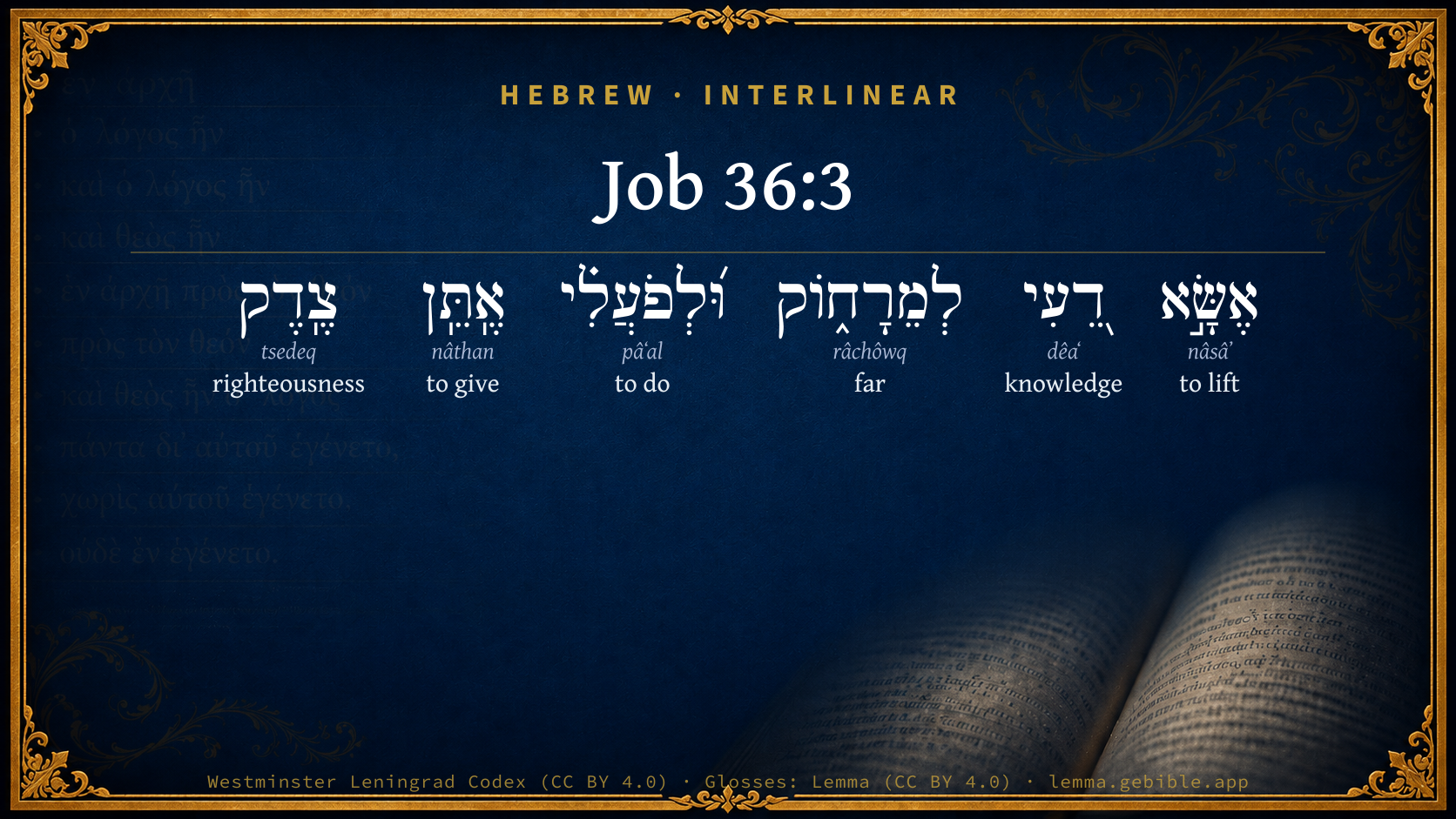
Job 36:3

Hebrew (Westminster Leningrad Codex) Job 36:3 appears in the Hebrew Old Testament. The text above is from the Westminster Leningrad Codex. Each word links to its Strong’s number, a concise gloss, and parsing drawn from the Open Scriptures Hebrew Bible morphology. Click any word for its full Brown-Driver-Briggs (BDB) entry.
Download image
Cite this verse

Job 36:3 (World English Bible). Public Domain. Lemma interlinear Bible study tool, https://lemma.gebible.app/v/job/36/3.

Show BibTeX & RIS
BibTeX
RIS
English Translation
I will get my knowledge from afar, And will ascribe righteousness to my Maker.
World English Bible · Public Domain
Download a study sheet

One document with this verse’s original text, its word-by-word gloss line, the meaning frame, cross-references with their text, attributed commentary, and full source and license credits — printable, and it pastes into notes with its structure intact.

This verse Autodidact and up

Study sheet (.html) Plain text (.txt)

A passage Seminary Student

Up to 50 verses in one chapter. A passage sheet keeps up to 6 commentary sources and 12 cross-references per verse, in the order this page ranks them, and says so on the sheet whenever that leaves anything out. Ask for a single verse and you get the Autodidact verse sheet above.

Everything on this page stays free to read, with no account — the sheet is a download of what is already on screen, not access to it.

Want to remove ads? Support Godless Engineer
Compare translations 3

The same verse in 3 English versions, stacked beneath the original-language interlinear above. Click any original word for its lexicon entry.

Each is an independent rendering of the whole verse — the interlinear is not word-aligned to these translations.

Highlighted words mark where these versions differ — a whole-verse word diff, not a word-by-word alignment.

  • World English Bible Public Domain
    I will get my knowledge from afar, And will ascribe righteousness to my Maker.
  • King James Version Public Domain
    I will fetch my knowledge from afar, and will ascribe righteousness to my Maker.
  • unfoldingWord Literal Text CC BY-SA 4.0
    I will carry my knowledge to from afar, and I will attribute righteousness to my Maker.

unfoldingWord Literal Text — © unfoldingWord, licensed CC BY-SA 4.0. Word-aligned USFM3 via Door43 (git.door43.org/unfoldingWord/en_ult).

Versions to compare (up to 4)

3 of 4 selected

Show all 18 translations

Every available English version of this verse, each an independent rendering of the whole verse.

  • World English Bible Public Domain
    I will get my knowledge from afar, And will ascribe righteousness to my Maker.
  • Berean Standard Bible Public Domain
    I get my knowledge from afar, and I will ascribe justice to my Maker.
  • Majority Standard Bible Public Domain
    I get my knowledge from afar, and I will ascribe justice to my Maker.
  • King James Version Public Domain
    I will fetch my knowledge from afar, and will ascribe righteousness to my Maker.
  • American Standard Version (1901) Public Domain
    I will fetch my knowledge from afar, And will ascribe righteousness to my Maker.
  • Revised Version (1885) Public Domain
    I will fetch my knowledge from afar, and will ascribe righteousness to my Maker.
  • Geneva Bible (1599) Public Domain
    I will fetche my knowledge afarre off, and will attribute righteousnes vnto my Maker.
  • Douay-Rheims (1899) Public Domain
    I will repeat my knowledge from the beginning, and I will prove my Maker just.
  • Young's Literal Translation Public Domain
    I lift up my knowledge from afar, And to my Maker I ascribe righteousness.
  • Literal Standard Version CC BY-SA 4.0
    I lift up my knowledge from afar, || And I ascribe righteousness to my Maker.
  • Unlocked Literal Bible CC BY-SA 4.0
    I will obtain my knowledge from far off; I will acknowledge that righteousness belongs to my Maker.
  • unfoldingWord Literal Text CC BY-SA 4.0
    I will carry my knowledge to from afar, and I will attribute righteousness to my Maker.
  • Darby Bible Public Domain
    I will fetch my knowledge from afar, and will ascribe righteousness to my Creator.
  • World Messianic Bible Public Domain
    I will get my knowledge from afar, and will ascribe righteousness to my Maker.
  • Webster's Bible Public Domain
    I will bring my knowledge from afar, and will ascribe righteousness to my Maker.
  • Free Bible Version CC BY-SA 4.0
    I will share my extensive knowledge, and I will prove my Creator is in the right.
  • Bible in Basic English Public Domain
    I will get my knowledge from far, and I will give righteousness to my Maker.
  • JPS Tanakh (1917) Public Domain
    I will fetch my knowledge from afar, and will ascribe righteousness to my Maker.

Literal Standard Version (2020), Covenant Press — licensed CC BY-SA 4.0. Text via the HelloAO Bible API (eBible.org). Unlocked Literal Bible (unfoldingWord) — licensed CC BY-SA 4.0. Text via the HelloAO Bible API (eBible.org). unfoldingWord Literal Text — © unfoldingWord, licensed CC BY-SA 4.0. Word-aligned USFM3 via Door43 (git.door43.org/unfoldingWord/en_ult). Free Bible Version, Dr. Jonathan Gallagher — licensed CC BY-SA 4.0. Text via the HelloAO Bible API (eBible.org).

Word by word

More ways to search: Search by grammar → Find every occurrence → Compare this word →

Practice this passage: Drill this verse → Learn its vocabulary →

About this verse

These counts appear in no published source. They are computed here, from the morphology-tagged text and Lemma’s own curated glosses. What Lemma adds →

6
words
6
distinct lemmas
Wisdom
section

Notable vocabulary

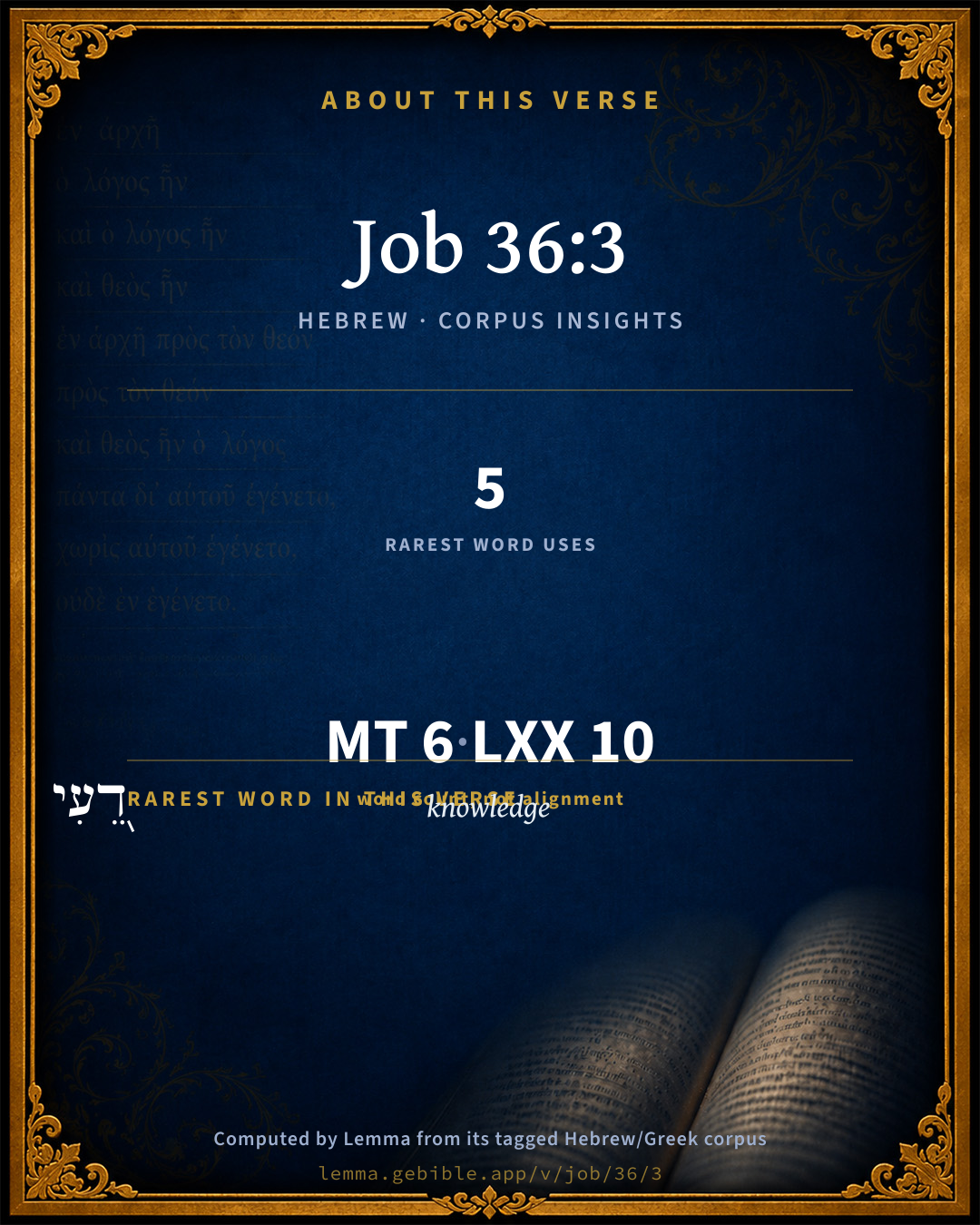
The rarest word here is דֵ֭עִי knowledge H1843 — appearing just 5 times in the whole Hebrew Bible.

Shared distinctive vocabulary

דֵ֭עִי knowledge H1843 occurs in 5 verses of the Hebrew Bible. Also found in:

Grammatical profile

  • 3 verbs
  • 2 nouns
  • 1 adjective

Verb forms

  • אֶשָּׂ֣א Qal · Imperfect
  • וּ֝לְפֹעֲלִ֗י Qal · Participle Active
  • אֶֽתֵּֽן Qal · Imperfect

Hebrew & Septuagint length

In English translation the verse runs 14 words from the Hebrew and 11 from the Septuagint (LXX English) — closely comparable.

A rough comparison of the two English renderings, which tokenize alike — not a word-level alignment.

Word counts can differ between the Hebrew and the Greek without any difference in meaning — e.g. the Hebrew direct-object marker אֵת has no separate Greek word, and Greek often adds the article ὁ.

In the original languages it is 6 Hebrew tokens and 10 Greek tokens — but the two are counted differently (Hebrew bundles its prefixes and suffixes into one token; the Greek is in lemma form), so that isn’t a like-for-like length.

Cross-references

25

Topical passages linked to Job 36:3 in the Treasury of Scripture Knowledge — connected by theme and wording, ordered by reader-vote popularity; previews shown in the World English Bible.

  • James 3:17 But the wisdom that is from above is first pure, then peaceful, gentle, reasonable, full of mercy and good fruits, without partiality, and without hypocrisy.
  • James 1:17 Every good gift and every perfect gift is from above, coming down from the Father of lights, with whom can be no variation, nor turning shadow.
  • Deuteronomy 32:4 The Rock, his work is perfect; For all his ways are justice: A God of faithfulness and without iniquity, Just and right is he.
  • Job 8:3 Does God pervert justice? Or does the Almighty pervert righteousness?
  • Job 32:8 But there is a spirit in man, And the breath of the Almighty gives them understanding.
  • Psalms 11:7 For Yahweh is righteous. He loves righteousness. The upright shall see his face.
  • Psalms 145:17 Yahweh is righteous in all his ways, And gracious in all his works.
  • Daniel 9:7 Lord, righteousness belongs to you, but to us confusion of face, as at this day; to the men of Judah, and to the inhabitants of Jerusalem, and to all Israel, who are near, and who are far off, through all the countries where you have driven them, because of their trespass that they have trespassed against you.
  • Daniel 9:14 Therefore has Yahweh watched over the evil, and brought it on us; for Yahweh our God is righteous in all his works which he does, and we have not obeyed his voice.
  • Revelation 15:3 They sang the song of Moses, the servant of God, and the song of the Lamb, saying, "Great and marvelous are your works, Lord God, the Almighty; Righteous and true are your ways, you King of the nations.
  • Job 28:12–13 "But where shall wisdom be found? Where is the place of understanding?
  • Job 28:20–24 Whence then comes wisdom? Where is the place of understanding?
  • Job 32:2 Then the wrath of Elihu the son of Barachel, the Buzite, of the family of Ram, was kindled against Job. His wrath was kindled because he justified himself rather than God.
  • Job 34:5 For Job has said, 'I am righteous, God has taken away my right:
  • Job 34:10–12 "Therefore listen to me, you men of understanding: Far be it from God, that he should do wickedness, From the Almighty, that he should commit iniquity.
  • Job 37:23 We can't reach the Almighty, He is exalted in power; In justice and great righteousness he will not oppress.
  • Proverbs 2:4–5 If you seek her as silver, And search for her as for hidden treasures:
  • Jeremiah 12:1 Righteous are you, Yahweh, when I contend with you; yet would I reason the cause with you: why does the way of the wicked prosper? why are all they at ease who deal very treacherously?
  • Matthew 2:1–2 Now when Jesus was born in Bethlehem of Judea in the days of Herod the king, behold, wise men from the east came to Jerusalem, saying,
  • Matthew 12:42 The queen of the south will rise up in the judgment with this generation, and will condemn it, for she came from the ends of the earth to hear the wisdom of Solomon; and behold, someone greater than Solomon is here.
  • Acts 8:27–40 He arose and went; and behold, there was a man of Ethiopia, a eunuch of great authority under Candace, queen of the Ethiopians, who was over all her treasure, who had come to Jerusalem to worship.
  • Romans 3:25–26 whom God set forth to be an atoning sacrifice, through faith in his blood, for a demonstration of his righteousness through the passing over of prior sins, in God's forbearance;
  • Romans 9:14 What shall we say then? Is there unrighteousness with God? May it never be!
  • Romans 10:6–8 But the righteousness which is of faith says this, "Don't say in your heart, 'Who will ascend into heaven?' (that is, to bring Christ down);
  • James 1:5 But if any of you lacks wisdom, let him ask of God, who gives to all liberally and without reproach; and it will be given to him.

Cross-references courtesy of OpenBible.info (CC BY 4.0).

Hebrew and Greek witnesses Masoretic Hebrew ↔ Greek Septuagint

The same verse in the two great witnesses to the Old Testament, shown verse-for-verse.

These are two independent witnesses, not word-aligned to each other, and the Septuagint is shown in lemma (dictionary) form.

Hebrew Job 36:3 Masoretic · Westminster Leningrad Codex

אֶשָּׂ֣א דֵ֭עִי לְמֵרָח֑וֹק וּ֝לְפֹעֲלִ֗י אֶֽתֵּֽן צֶֽדֶק

I will get my knowledge from afar, And will ascribe righteousness to my Maker.

World English Bible · Public Domain

Greek LXX Job 36:3 Septuagint · lemma form

ἀναλαμβάνω ὁ ἐπιστήμη ἐγώ μακράν ἔργον δέ ἐγώ δίκαιος εἶπον

Having fetched my knowledge from afar, and according to my works,

LXX2012 (modern English Septuagint) · Public Domain

Hebrew: Westminster Leningrad Codex (CC BY 4.0). Greek: Septuagint (public domain); English from LXX2012 (modern English Septuagint) (Public Domain). How the Septuagint differs from the Hebrew →

Commentary

Notes on Job 36:3 from classic Christian and Jewish commentators (each source and its license shown beneath its notes). The classic Christian expositions comment on the surrounding passage and are grouped to its opening verse, so a note may address several verses; the Jewish commentaries on the Tanakh (Rashi and others) are per-verse, so they appear only where the commentator wrote on this verse.

Lemma curates 59 commentaries, every one of them public domain or Creative Commons licensed, each selected and text-cleaned for this edition rather than reprinted as found. About our sources →

Trapp's Complete Commentary

John Trapp

Job 36:3 I will fetch my knowledge from afar, and will ascribe righteousness to my Maker.

Ver. 3. I will fetch my knowledge from afar] Even from heaven, as one taught of God; I will discourse of ancient things (for τα καινα κενα), and fetch my reasons from the wonderful and sublime works of God, De arduis atque admirandis Dei operibus, those real demonstrations of his Deity. Est autem plane hic Elihu mirus et egregius, saith Mercer. And he is not a little wronged by that French Paraphrast, who saith of him, That he knew well how to begin a discourse, but knew not how to end it; and that seeing well that his tediousness might make him troublesome, he awakened his languishing auditors by this artificial preface.

And will ascribe righteousness to my Maker] This is both the main proposition of the ensuing oration and the main end of man’s creation, viz. to glorify his Maker, Rom 11:36 Rev 4:11.

John Trapp, A Commentary or Exposition upon All the Books of the Old and New Testament (1647–1656) — public domain. Text from a community e-Sword module.

Geneva Bible (1599)

Geneva Bible translators

He showeth that when we speak of God, we must lift up our spirits more high, than our natural sense is able to reach.

Geneva Bible (1599) marginal notes — public domain. Text via Bolls.life.

Jamieson, Fausset & Brown

Robert Jamieson, A. R. Fausset & David Brown

from afar--not trite commonplaces, but drawn from God's mighty works.

ascribe righteousness--whereas Job ascribed unrighteousness (Job 34:10, Job 34:12). A man, in enquiring into God's ways, should at the outset presume they are all just, be willing to find them so, and expect that the result of investigation will prove them to be so; such a one will never be disappointed [BARNES].

Jamieson, Fausset & Brown — Commentary Critical and Explanatory on the Whole Bible (1871) — public domain (CC PDM 1.0). Text via the HelloAO Bible API.

Adam Clarke's Commentary

Verse 3. I will fetch my knowledge from afar] למרחוק lemerachok, "from the distant place," meaning probably both remote antiquity and heaven; see below. I will show thee that all antiquity and experience are on my side. I can bring proofs from the remotest ages and from the most distant countries to demonstrate that God is infinitely WISE, and can do nothing foolish or erroneous; that he is infinitely POWERFUL, and can bring all the purposes of his wisdom to effect; that he is infinitely GOOD, and can will nothing, and can do nothing that is not good in itself, and well calculated to do good to his creatures. And I shall show that his operations in the heavens and on the earth prove and demonstrate the whole.

And will ascribe righteousness to my Maker.] By proving the above points, the righteous conduct of God, and his gracious government of the world, will be fully established.

That Elihu brings his knowledge from afar - from every part of the creation, as well as from the Divine nature - is evident from the end of the chapter. Job 36:32

1. The omnipotence of God; - God is great.

2. The eternity of God - We know him not, the number of his years cannot be found out, Job 36:26.

3. From the economy of God in the atmosphere, in dews, rain, vapour, and the irrigation of the earth; - He maketh small the drops, c., Job 36:27-28.

4. In the thunder and lightning, by which he performs such wonders in the atmosphere, and executes such judgments in the world-Also who can understand the noise of his tabernacle? He spreadeth his light upon it. He judgeth the people, &c., Job 36:29-33.

Adam Clarke's Commentary on the Bible (1810–1826) — public domain. Text from a community e-Sword/MySword module.

Ellicott's Commentary for English Readers

(3) I will fetch my knowledge from afar.—But is not this what Bildad had said before him? (Job_8:8, &c.); and yet the teaching of Job_36:6 is not very different from his.

A Bible Commentary for English Readers, edited by Charles John Ellicott (1878–1897) — public domain. Text from a community e-Sword module.

The Cambridge Bible for Schools and Colleges

gen. ed. J. J. S. Perowne

3. from afar] He will speak comprehensively, embracing the distant parts of the subject in his survey, or throwing light upon it from far-off regions.

righteousness to my Maker] Elihu gives here in a word the ruling idea of his discourses: they are all meant to ascribe righteousness or right to God; they are a defence of God against the charges of Job. The expression rendered my Maker does not occur elsewhere in the Old Testament.

The Cambridge Bible for Schools and Colleges (gen. ed. J. J. S. Perowne; Cambridge University Press, 1878–1918) — public domain. Text from a community e-Sword module.

John Gill's Exposition

I will fetch my knowledge from afar,.... Not from himself; for it is but a small share of knowledge that a man gets of himself, or attains to by the light of nature, and especially concerning God and divine things; but from others, either from persons that lived in former ages, and in foreign countries; it being usual for men desirous of acquiring knowledge to travel into distant parts for it; and such were generally much esteemed of, and the knowledge they professed to have got and published; as the queen of Sheba came from the further parts of the earth to hear and learn the wisdom of Solomon, Kg1 10:1, or rather the sense is, he would fetch the knowledge he should now communicate concerning God from God himself, from the nature and perfections of God, who, and his knowledge, are high as heaven; and from the works of God, which are far above men; or should treat of things deep and sublime, and not common; though perhaps it is best of all to read the words, "I will bring forth knowledge concerning", or "with respect to him that is afar off" (i); that is, God, who is in the highest heavens, and inhabits the high and holy place; a God both at hand and afar off; with which agrees what follows; though some interpret it of lifting it up, and causing it to be heard afar off so some, as Aben Ezra;

and will ascribe righteousness to my Maker: God is the Maker of all men; Elihu considered him as his Maker with gratitude, while many have no regard of him, Job 35:10; and therefore thought himself obliged to speak for him, and on his behalf; and particularly in vindication of his righteousness; assert this to be an essential attribute and perfection of his nature; own, acknowledge, publish, and declare it; give him the glory of it, and demonstrate that he is righteous in all his ways and works; and clear him from all imputation of unrighteousness.

(i) "ei, vel de eo qui est longinquus"; so Aben Ezra, Bar Tzemach.

John Gill's Exposition of the Whole Bible (1746–1763) — public domain (CC PDM 1.0). Text via the HelloAO Bible API.

Albert Barnes' Notes on the Bible

I will fetch my knowledge from afar - What I say shall not be mere commonplace. It shall be the result of reflection on subjects that lie out of the ordinary range of thought. The idea is, that he did not mean to go over the ground that had been already trodden, or to suggest such reflections as would occur to anyone, but that he meant to bring his illustrations from abstruser matters, and from things that had escaped their attention. He in fact appeals to the various operations of nature - the rain, the dew, the light, the instincts of the animal creation, the vicissitudes of the seasons, the laws of heat and cold, and shows that all these prove that God is inscrutably wise and gloriously great.

And will ascribe righteousness to my Maker - That is, I will show that these things to which I now appeal, “prove” that he is righteous, and is worthy of universal confidence. Perhaps, also, he means to contrast the result of his reflections with those of Job. He regarded him as having charged his Maker with injustice and wrong. Elihu says that it was a fixed principle with him to ascribe righteousness to God, and that he believed it could be fully sustained by an appeal to his works. Man should “presume” that his Maker is good, and wise, and just; he should be “willing” to find that he is so; he should “expect” that the result of the profoundest investigation of his ways and works will prove that he is so - and in such an investigation he will never be disappointed. A man is in no good frame of mind, and is not likely to be led to any good result in his investigations, when he “begins” his inquiries by believing that his Maker is unjust, and who “prosecutes” them with the hope and expectation that he will find him to be so. Yet do people never do this?

Albert Barnes' Notes on the Bible (1834–1885) — public domain. Text from a community e-Sword/MySword module.

Haydock's Catholic Bible Commentary

Beginning. Hebrew, "afar" from that God, who is ancient, and not of human invention; (Jeremias xxiii. 23.) or from the consideration of the heavens. Nothing could be more magnificent than the descriptions which conclude this fourth part of the discourse. (Calmet)

George Leo Haydock (1774–1849), Haydock's Catholic Family Bible and Commentary, 1859 edition — public domain. Excludes Psalms (Douay-Rheims chapter numbering differs from Protestant) and Deuterocanonical books (Catholic canon only).

Matthew Poole's English Annotations

From afar, i.e. from remote times, and places, and things. I will not confine my discourse to thy particular case, but will justify God by declaring his great and glorious works of creation and providence, both in the heaven and earth, and the manner of his dealing with men in other parts and ages of the world; for these are the chief heads of the following discourse, and therefore the best comment upon this general expression.

I will acknowledge that which is true, that God is righteous. He adds the words,

my Maker, either,

1. As an argument or evidence of God’s righteousness; partly, because it is not likely that God should be unjust to his own creatures, since even men are not only just, but kind, to their own works and relations; and partly, because the work of creation gave unto God an absolute right and power to dispose of Job as he saw fit, as the potter hath power over the clay, Rom 9:21, and therefore there was no foundation for unrighteousness, nor any temptation upon God to do it; and partly, because man’s Maker must needs be a being of all possible perfection, and therefore one of perfect righteousness. Or,

2. As a motive or obligation upon him to plead God’s cause. I do not engage myself in this controversy out of a pragmatical or contentious humour, nor out of any prejudice or ill-will to thee, but merely from the sense of my duty to my blessed Creator. Withal he reflects upon Job as guilty of great folly and ingratitude in contending with him, in or by whom he lived, and moved, and had his being.

Matthew Poole's English Annotations on the Holy Bible (1683–1685) — public domain. Text from a community e-Sword/MySword module.

Whedon's Commentary on the Bible

Daniel D. Whedon

First Division — THE PROVIDENCE OF GOD IN THE MORAL WORLD, CHIEFLY AS MADE KNOWN THROUGH THE ECONOMY OF SUFFERING, Job_36:2-21.

Introduction — Elihu has yet much more to say in vindication of the ways of God, Job_36:2-4.

The three preceding speeches were introduced by ויען, “and he answered,” the present speech, with ויס, “and he added,” showing that Elihu intends it as a resumption and continuation of the main argument of his other speeches.

3. From afar — From out the wide domain of the divine workings, both in providence and in nature. Elihu will take a far-reaching view.

Daniel D. Whedon (gen. ed.), Commentary on the Old and New Testaments (1874–1909) — public domain. Text from a community e-Sword module.

The Pulpit Commentary

I will fetch my knowledge from afar (compare the declaration of Bildad, Job_8:8) In neither case does the performance justify the pretentious character of the preface. Elihu"s arguments are, for the most part, trite and commonplace. And will ascribe righteousness to my Maker. I will show, i.e., that God is righteous and just. (comp. Job_34:10, Job_34:12)

Knowledge fetched from afar.

I KNOWLEDGE MUST BE FETCHED FROM AFAR. True to his character, the brilliant but pretentious young Elihu makes an ostentatious claim to having gone far for the knowledge that he is now about to declare. It might be said that many precious truths lie at our feet ready for us if only we would have the humility to stoop for them. Diamonds sparkle in the dust; we need not be for ever straining after the stars. Still, there is a knowledge that can only be got by far searching.

1. Over a wide realm. Elihu is about to launch forth into the great sea of nature. The infinite variety of facts and the grand harmony of laws there displayed are not perceived at a glance. Truth covers a large area. Many of our notions are erroneous just because our inductions are too narrow. We judge of the world by the parish. We estimate man by our private circle of acquaintances. We value life by our own experience. We must learn to break down the barriers, to master our shortness of sight, to take broad views, and look down long vistas of truth.

2. By persevering thought. A mere glance at truth is not enough. We must search for wisdom as for hidden treasure.

II KNOWLEDGE FETCHED FROM AFAR VINDICATES THE RIGHTEOUSNESS OF GOD. This is the conclusion to which Elihu has come. The three friends had declared for the same result, but they had started from much narrower premises, and their cramped ideas could not satisfy Job. Elihu professes to take a wider view of the world, and so to establish his conclusion on a broader basis. We have only to know enough of God to be assured that all he does is good. The hard thoughts of God which we are tempted to entertain spring from partial and one-sided views of his works.

III CHRIST HAS BROUGHT US KNOWLEDGE FROM AFAR WHICH REVEALS THE GOODNESS OF GOD. We are not left entirely to our own dim groping after truth in the great wilderness of existence. What we could never have discovered for ourselves has been brought to us by Jesus Christ. He has come from afar, from the distant heavens; and he has brought the knowledge of God and of eternity to earth. Now, if we would have the highest wisdom, our first course is, like Mary, to sit at the feet of Jesus. When we do this we shall learn that all that God does is good. Then we shall see that he is our Father, and that love is the principle that pervades all his government of the world. Some of us may yet be far from a perception of these glorious truths because we are far from Christ. We have to know and trust him in order to reach the truest and best thoughts of God. W.F.A.

The Pulpit Commentary (1880–1919), ed. H.D.M. Spence-Jones & Joseph S. Exell — public domain. Text from a community e-Sword module.

John Wesley's Explanatory Notes

Afar - From remote times, and places, and things. I will not confine my discourse to thy particular case, but wilt justify God by declaring his great and glorious works of creation and providence both in the heaven and in the earth, and the manner of his dealing with men in other parts and ages of the world. Ascribe - I will clear and maintain this truth, that God is righteous in all his ways.

John Wesley, Explanatory Notes Upon the Whole Bible (1754–1765) — public domain. Text via the GEBible commentary corpus.

Lesson kit

Teaching starters — assembled from the data on this page, not authored interpretation. Every prompt links to the verse data it draws on. Edit before teaching.

Job, in the Wisdom, opens this verse with 6 words (6 distinct Hebrew lemmas). Its most distinctive word is dêaʻ (“knowledge”). A historical commentator’s framing appears above. Read the whole chapter for the surrounding context.

Discussion questions

  1. How does “knowledge” (dêaʻ) shape what this verse is saying?
  2. How does Job 32:6, which shares the word «knowledge», read alongside this verse?
  3. The translations on this page render this verse differently — a whole-verse word diff, not a word-by-word alignment. What might account for the different wordings?
  4. «אֶשָּׂ֣א» is a Qal Imperfect verb. How does that grammatical form shape the action described?
  5. Compare how Trapp's Complete Commentary and Geneva Bible (1599) read this verse. Where do they agree or differ?

Things to notice

Reading settings

Reading text

Shown beneath each verse's original-language words.

Old Testament
Old Testament edition

Read the OT as the Masoretic Hebrew (MT) or the Greek Septuagint (LXX).

English shown for the Greek Septuagint (in the Hebrew ↔ Greek comparison).

Comparing translations? Open the Compare panel on any verse page to stack up to four side by side.