Exodus 23:21

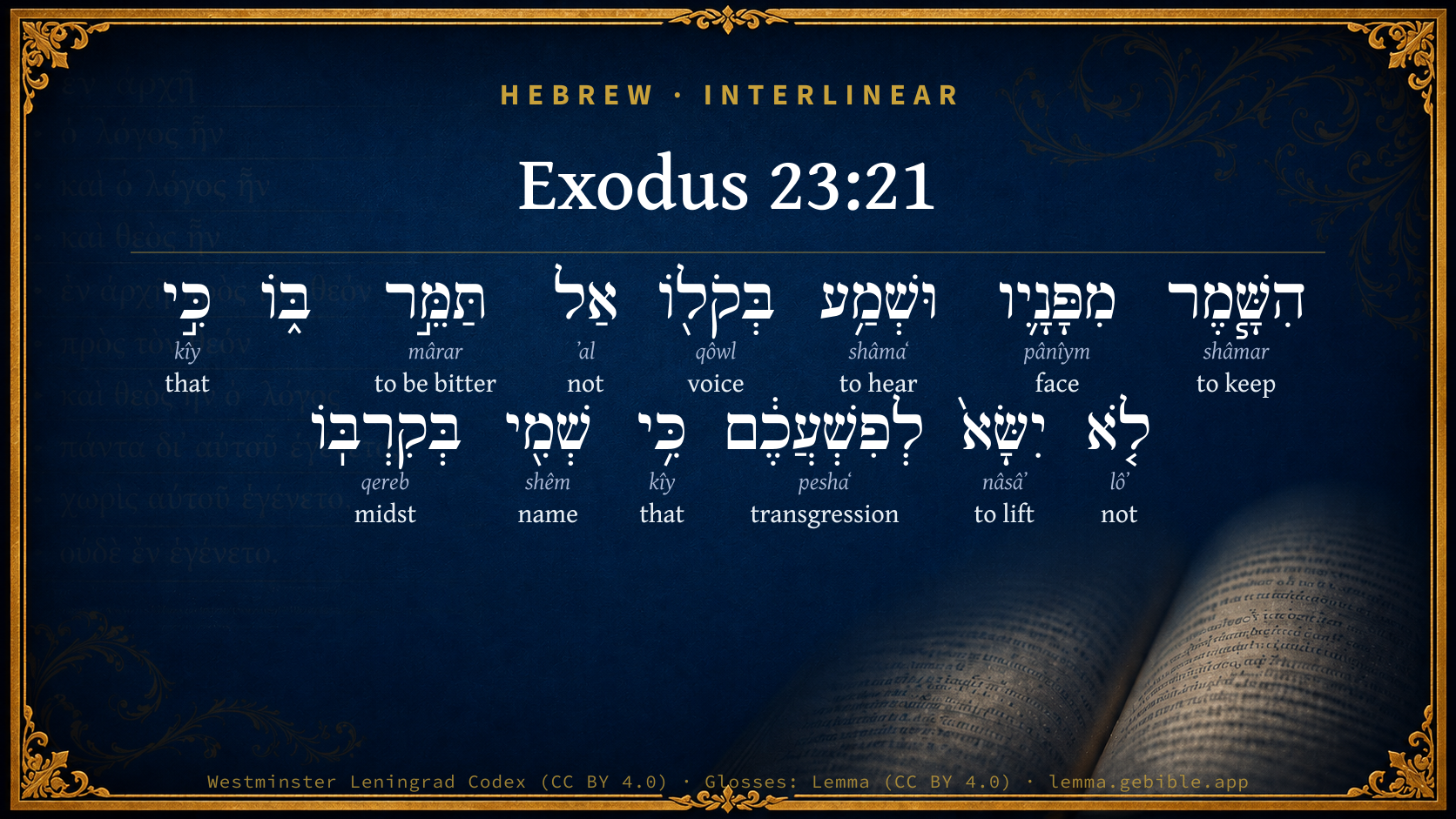
Hebrew (Westminster Leningrad Codex) Exodus 23:21 appears in the Hebrew Old Testament. The text above is from the Westminster Leningrad Codex. Each word links to its Strong’s number, a concise gloss, and parsing drawn from the Open Scriptures Hebrew Bible morphology. Click any word for its full Brown-Driver-Briggs (BDB) entry.
Download image
Cite this verse

Exodus 23:21 (World English Bible). Public Domain. Lemma interlinear Bible study tool, https://lemma.gebible.app/v/exodus/23/21.

Show BibTeX & RIS
BibTeX
RIS
English Translation
Pay attention to him, and listen to his voice. Don't provoke him, for he will not pardon your disobedience, for my name is in him.
World English Bible · Public Domain
Download a study sheet

One document with this verse’s original text, its word-by-word gloss line, the meaning frame, cross-references with their text, attributed commentary, and full source and license credits — printable, and it pastes into notes with its structure intact.

This verse Autodidact and up

Study sheet (.html) Plain text (.txt)

A passage Seminary Student

Up to 50 verses in one chapter. A passage sheet keeps up to 6 commentary sources and 12 cross-references per verse, in the order this page ranks them, and says so on the sheet whenever that leaves anything out. Ask for a single verse and you get the Autodidact verse sheet above.

Everything on this page stays free to read, with no account — the sheet is a download of what is already on screen, not access to it.

Want to remove ads? Support Godless Engineer
Compare translations 3

The same verse in 3 English versions, stacked beneath the original-language interlinear above. Click any original word for its lexicon entry.

Each is an independent rendering of the whole verse — the interlinear is not word-aligned to these translations.

Highlighted words mark where these versions differ — a whole-verse word diff, not a word-by-word alignment.

  • World English Bible Public Domain
    Pay attention to him, and listen to his voice. Don't provoke him, for he will not pardon your disobedience, for my name is in him.
  • King James Version Public Domain
    Beware of him, and obey his voice, provoke him not; for he will not pardon your transgressions: for my name is in him.
  • unfoldingWord Literal Text CC BY-SA 4.0
    Be guarded from his face and listen to his voice. Do not cause bitterness in him, for he will not bear with your transgressions, for my name is within him.

unfoldingWord Literal Text — © unfoldingWord, licensed CC BY-SA 4.0. Word-aligned USFM3 via Door43 (git.door43.org/unfoldingWord/en_ult).

Versions to compare (up to 4)

3 of 4 selected

Show all 18 translations

Every available English version of this verse, each an independent rendering of the whole verse.

  • World English Bible Public Domain
    Pay attention to him, and listen to his voice. Don't provoke him, for he will not pardon your disobedience, for my name is in him.
  • Berean Standard Bible Public Domain
    Pay attention to him and listen to his voice; do not defy him, for he will not forgive rebellion, since My Name is in him.
  • Majority Standard Bible Public Domain
    Pay attention to him and listen to his voice; do not defy him, for he will not forgive rebellion, since My Name is in him.
  • King James Version Public Domain
    Beware of him, and obey his voice, provoke him not; for he will not pardon your transgressions: for my name is in him.
  • American Standard Version (1901) Public Domain
    Take ye heed before him, and hearken unto his voice; provoke him not; for he will not pardon your transgression: for my name is in him.
  • Revised Version (1885) Public Domain
    Take ye heed of him, and hearken unto his voice; provoke him not: for he will not pardon your transgression; for my name is in him.
  • Geneva Bible (1599) Public Domain
    Beware of him, and heare his voyce, and prouoke him not: for he will not spare your misdeedes, because my name is in him.
  • Douay-Rheims (1899) Public Domain
    Take notice of him, and hear his voice, and do not think him one to be contemned: for he will not forgive when thou hast sinned, and my name is in him.
  • Young's Literal Translation Public Domain
    be watchful because of his presence, and hearken to his voice, rebel not against him, for he beareth not with your transgression, for My name `is' in his heart;
  • Literal Standard Version CC BY-SA 4.0
    be watchful because of His presence, and listen to His voice, do not rebel against Him, for He does not bear with your transgression, for My Name [is] in His heart;
  • Unlocked Literal Bible CC BY-SA 4.0
    Be attentive to him and obey him. Do not provoke him, for he will not pardon your transgressions. My name is on him.
  • unfoldingWord Literal Text CC BY-SA 4.0
    Be guarded from his face and listen to his voice. Do not cause bitterness in him, for he will not bear with your transgressions, for my name is within him.
  • Darby Bible Public Domain
    Be careful in his presence, and hearken unto his voice: do not provoke him, for he will not forgive your transgressions; for my name is in him.
  • World Messianic Bible Public Domain
    Pay attention to him, and listen to his voice. Don’t provoke him, for he will not pardon your disobedience, for my name is in him.
  • Webster's Bible Public Domain
    Beware of him, and obey his voice, provoke him not; for he will not pardon your transgressions: for my name is in him.
  • Free Bible Version CC BY-SA 4.0
    Make sure you pay attention to him and do what he says. Don't oppose him, because he won't forgive rebellion, for he carries my authority.
  • Bible in Basic English Public Domain
    Give attention to him and give ear to his voice; do not go against him; for your wrongdoing will not be overlooked by him, because my name is in him.
  • JPS Tanakh (1917) Public Domain
    Take heed of him, and hearken unto his voice; be not rebellious against him; for he will not pardon your transgression; for My name is in him.

Literal Standard Version (2020), Covenant Press — licensed CC BY-SA 4.0. Text via the HelloAO Bible API (eBible.org). Unlocked Literal Bible (unfoldingWord) — licensed CC BY-SA 4.0. Text via the HelloAO Bible API (eBible.org). unfoldingWord Literal Text — © unfoldingWord, licensed CC BY-SA 4.0. Word-aligned USFM3 via Door43 (git.door43.org/unfoldingWord/en_ult). Free Bible Version, Dr. Jonathan Gallagher — licensed CC BY-SA 4.0. Text via the HelloAO Bible API (eBible.org).

Word by word

More ways to search: Search by grammar → Find every occurrence → Compare this word →

Practice this passage: Drill this verse → Learn its vocabulary →

תַּמֵּ֣ר
mârar
H4843
“to be bitter”
Verb, Hiphil, Jussive, 2nd Person, Masculine, Singular
Part of Speech
Verb
Stem
Hiphil
Form
Jussive
Person
2nd Person
Gender
Masculine
Number
Singular
Full BDB Definition

Origin: a primitive root

TWOT: 1248

to be bitter - (Qal) to be bitter - (Piel) - to show bitterness - to make bitter - (Hiphil) to make bitter, embitter - (Hithpalpel) - to embitter oneself - to be enraged - (TWOT) to be strong, strengthen
  1. הִשָּׁ֧מֶר shâmar H8104 “keep” Verb, Niphal, Imperative, 2nd Person, Masculine, Singular
  2. מִפָּנָ֛יו pânîym H6440 “from · face(s) · his” Preposition + Noun, Common, Both, Plural, Construct + Suffix, Personal, 3rd Person, Masculine, Singular
  3. וּשְׁמַ֥ע shâmaʻ H8085 “and · hear” Conjunction + Verb, Qal, Imperative, 2nd Person, Masculine, Singular
  4. בְּקֹל֖וֹ qôwl H6963 “in/at · voice · his” Preposition + Noun, Common, Masculine, Singular, Construct + Suffix, Personal, 3rd Person, Masculine, Singular
  5. אַל ʼal H408 “not” Particle, Negative
  6. כִּ֣י kîy H3588 “that” Conjunction
  7. לֹ֤א lôʼ H3808 “not” Particle, Negative
  8. יִשָּׂא֙ nâsâʼ H5375 “to lift” Verb, Qal, Imperfect, 3rd Person, Masculine, Singular
  9. לְפִשְׁעֲכֶ֔ם peshaʻ H6588 “to/for · transgression · your” Preposition + Noun, Common, Masculine, Singular, Construct + Suffix, Personal, 2nd Person, Masculine, Plural
  10. כִּ֥י kîy H3588 “that” Conjunction
  11. שְׁמִ֖י shêm H8034 “name · my” Noun, Common, Masculine, Singular, Construct + Suffix, Personal, 1st Person, Common, Singular
  12. בְּקִרְבּֽוֹ qereb H7130 “in/at · midst · his” Preposition + Noun, Common, Masculine, Singular, Construct + Suffix, Personal, 3rd Person, Masculine, Singular

About this verse

These counts appear in no published source. They are computed here, from the morphology-tagged text and Lemma’s own curated glosses. What Lemma adds →

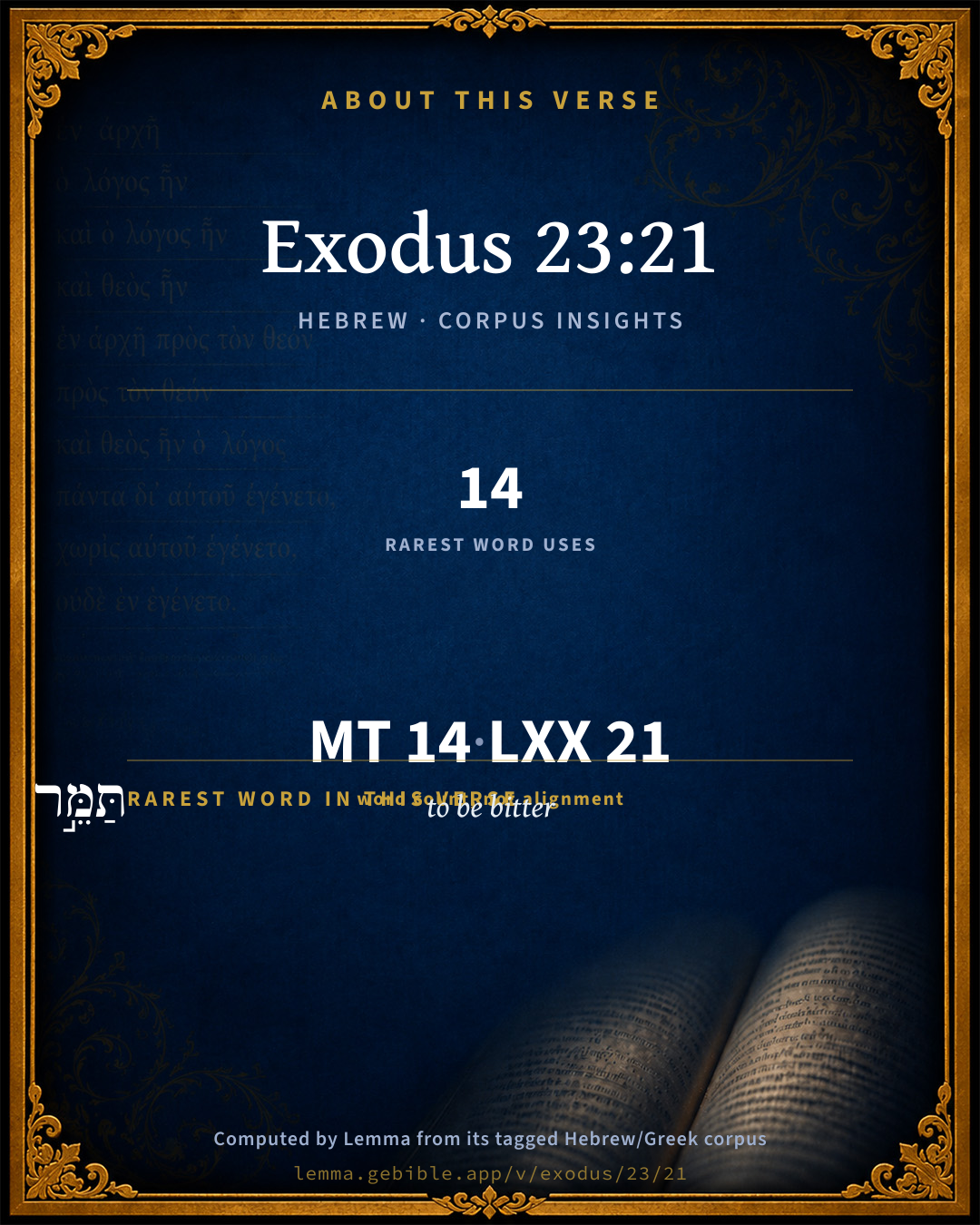
14
words
12
distinct lemmas
Pentateuch
section

Notable vocabulary

The rarest word here is תַּמֵּ֣ר to be bitter H4843 — appearing just 14 times in the whole Hebrew Bible.

Shared distinctive vocabulary

תַּמֵּ֣ר to be bitter H4843 occurs in 13 verses of the Hebrew Bible. Also found in:

Grammatical profile

  • 4 verbs
  • 5 nouns
  • 1 preposition
  • 2 conjunctions
  • 2 particles

Verb forms

  • הִשָּׁ֧מֶר Niphal · Imperative
  • וּשְׁמַ֥ע Qal · Imperative
  • תַּמֵּ֣ר Hiphil · Jussive
  • יִשָּׂא֙ Qal · Imperfect

Repetition

A word recurs within this verse — often emphatic in Hebrew:

  • כִּ֣י that H3588 ×2

Hebrew & Septuagint length

In English translation the verse runs 25 words from the Hebrew and 26 from the Septuagint (LXX English) — closely comparable.

A rough comparison of the two English renderings, which tokenize alike — not a word-level alignment.

Word counts can differ between the Hebrew and the Greek without any difference in meaning — e.g. the Hebrew direct-object marker אֵת has no separate Greek word, and Greek often adds the article ὁ.

In the original languages it is 14 Hebrew tokens and 21 Greek tokens — but the two are counted differently (Hebrew bundles its prefixes and suffixes into one token; the Greek is in lemma form), so that isn’t a like-for-like length.

Cross-references

37

Topical passages linked to Exodus 23:21 in the Treasury of Scripture Knowledge — connected by theme and wording, ordered by reader-vote popularity; previews shown in the World English Bible.

  • Psalms 78:56 Yet they tempted and rebelled against the Most High God, And didn't keep his testimonies;
  • Psalms 78:40 How often they rebelled against him in the wilderness, And grieved him in the desert!
  • Hebrews 12:25 See that you don't refuse him who speaks. For if they didn't escape when they refused him who warned on the Earth, how much more will we not escape who turn away from him who warns from heaven,
  • John 10:30 I and the Father are one."
  • John 10:38 But if I do them, though you don't believe me, believe the works; that you may know and believe that the Father is in me, and I in the Father."
  • Exodus 3:14 God said to Moses, "I AM WHO I AM," and he said, "You shall tell the children of Israel this: "I AM has sent me to you."
  • Deuteronomy 18:19 It shall happen, that whoever will not listen to my words which he shall speak in my name, I will require it of him.
  • Joshua 24:19 Joshua said to the people, You can't serve Yahweh; for he is a holy God; he is a jealous God; he will not forgive your disobedience nor your sins.
  • John 5:23 that all may honor the Son, even as they honor the Father. He who doesn't honor the Son doesn't honor the Father who sent him.
  • Ephesians 4:30 Don't grieve the Holy Spirit of God, in whom you were sealed for the day of redemption.
  • Hebrews 10:26–29 For if we sin willfully after we have received the knowledge of the truth, there remains no more a sacrifice for sins,
  • Colossians 2:9 For in him all the fullness of the Godhead dwells bodily,
  • Exodus 6:3 and I appeared to Abraham, to Isaac, and to Jacob, as God Almighty; but by my name Yahweh I was not known to them.
  • Exodus 32:34 Now go, lead the people to the place of which I have spoken to you. Behold, my angel shall go before you. Nevertheless in the day when I punish, I will punish them for their sin."
  • Exodus 34:5–7 Yahweh descended in the cloud, and stood with him there, and proclaimed the name of Yahweh.
  • Numbers 14:11 Yahweh said to Moses, How long will this people despise me? and how long will they not believe in me, for all the signs which I have worked among them?
  • Numbers 14:35 I, Yahweh, have spoken, surely this will I do to all this evil congregation, who are gathered together against me: in this wilderness they shall be consumed, and there they shall die.
  • Psalms 2:12 Kiss the son, lest he be angry, and you perish in the way, For his wrath will soon be kindled. Blessed are all those who take refuge in him.
  • Psalms 72:19 Blessed be his glorious name forever! Let the whole earth be filled with his glory! Amen and amen.
  • Psalms 83:18 That they may know that you alone, whose name is Yahweh, Are the Most High over all the earth.
  • Isaiah 7:14 Therefore the Lord himself will give you a sign. Behold, the virgin will conceive, and bear a son, and shall call his name Immanuel.
  • Isaiah 9:6 For to us a child is born, to us a son is given; and the government shall be on his shoulder: and his name shall be called Wonderful, Counselor, Mighty God, Everlasting Father, Prince of Peace.
  • Isaiah 42:8 I am Yahweh, that is my name; and my glory will I not give to another, neither my praise to engraved images.
  • Isaiah 45:6 that they may know from the rising of the sun, and from the west, that there is none besides me: I am Yahweh, and there is no one else.
  • Jeremiah 23:6 In his days Judah shall be saved, and Israel shall dwell safely; and this is his name by which he shall be called: Yahweh our righteousness.
  • Matthew 1:23 "Behold, the virgin shall be with child, And shall bring forth a son. They shall call his name Immanuel;" Which is, being interpreted, "God with us."
  • Revelation 2:8 "To the angel of the assembly in Smyrna write: "The first and the last, who was dead, and has come to life says these things:
  • Revelation 2:23 I will kill her children with Death, and all the assemblies will know that I am he who searches the minds and hearts. I will give to each one of you according to your deeds.
  • Isaiah 57:15 For thus says the high and lofty One who inhabits eternity, whose name is Holy: I dwell in the high and holy place, with him also who is of a contrite and humble spirit, to revive the spirit of the humble, and to revive the heart of the contrite.
  • Matthew 17:5 While he was still speaking, behold, a bright cloud overshadowed them. Behold, a voice came out of the cloud, saying, "This is my beloved Son, in whom I am well pleased. Listen to him."
  • John 14:9–10 Jesus said to him, "Have I been with you such a long time, and do you not know me, Philip? He who has seen me has seen the Father. How do you say, 'Show us the Father?'
  • Hebrews 3:16 For who, when they heard, rebelled? No, didn't all those who came out of Egypt by Moses?
  • 1 John 5:16 If anyone sees his brother sinning a sin not leading to death, he shall ask, and God will give him life for those who sin not leading to death. There is a sin leading to death. I don't say that he should make a request concerning this.
  • Revelation 1:8 "I am the Alpha and the Omega," says the Lord God, "who is and who was and who is to come, the Almighty."
  • Revelation 3:7 "To the angel of the assembly in Philadelphia write: "He who is holy, he who is true, he who has the key of David, he who opens and no one can shut, and who shuts and no one opens, says these things:
  • Hebrews 3:10–11 Therefore I was displeased with that generation, And said, 'They always err in their heart, But they didn't know my ways;'
  • Jeremiah 5:7 How can I pardon you? your children have forsaken me, and sworn by them that are no gods: when I had fed them to the full, they committed adultery, and assembled themselves in troops at the prostitutes' houses.

Cross-references courtesy of OpenBible.info (CC BY 4.0).

Hebrew and Greek witnesses Masoretic Hebrew ↔ Greek Septuagint

The same verse in the two great witnesses to the Old Testament, shown verse-for-verse.

These are two independent witnesses, not word-aligned to each other, and the Septuagint is shown in lemma (dictionary) form.

Hebrew Exodus 23:21 Masoretic · Westminster Leningrad Codex

הִשָּׁ֧מֶר מִפָּנָ֛יו וּשְׁמַ֥ע בְּקֹל֖וֹ אַל תַּמֵּ֣ר בּ֑וֹ כִּ֣י לֹ֤א יִשָּׂא֙ לְפִשְׁעֲכֶ֔ם כִּ֥י שְׁמִ֖י בְּקִרְבּֽוֹ

Pay attention to him, and listen to his voice. Don't provoke him, for he will not pardon your disobedience, for my name is in him.

World English Bible · Public Domain

Greek LXX Exodus 23:21 Septuagint · lemma form

προςἔχω σεαυτοῦ καί εἰςἀκούω αὐτός καί μή ἀπειθέω αὐτός οὐ γάρ μή ὑποστέλλω σύ ὁ γάρ ὄνομα ἐγώ εἰμί ἐπί αὐτός

Take heed to yourself and listen to him, and disobey him not; for he will not give way to you, for my name is on him.

LXX2012 (modern English Septuagint) · Public Domain

On this verse, John Gill's Exposition discusses the Septuagint’s reading. Read the note in Commentary ↓

Hebrew: Westminster Leningrad Codex (CC BY 4.0). Greek: Septuagint (public domain); English from LXX2012 (modern English Septuagint) (Public Domain). How the Septuagint differs from the Hebrew →

Targum (Aramaic paraphrase)

2

The Targum is the ancient Jewish Aramaic paraphrase of the Hebrew Scriptures — an interpretive translation, not the Hebrew text itself. Onkelos (literal) and Pseudo-Jonathan (expansive) render the Torah, and Jonathan the Prophets. Coverage is partial: where no permissively-licensed English translation exists for a verse, only the Aramaic is shown. This is verse-level text, not a word-by-word alignment to the Hebrew.

  1. Targum Onkelos Torah (Genesis–Deuteronomy)
    אִסְתַּמַּר מִן קֳדָמוֹהִי וְקַבֵּל לְמֵימְרֵהּ לָא תְסָרֵב לְקִבְלֵהּ אֲרֵי לָא יִשְׁבּוֹק לְחוֹבֵיכוֹן אֲרֵי בִשְׁמִי מֵימְרֵהּ:

    (no public-domain English translation for this verse)

    Targum Onkelos — Aramaic: “Onkelos Genesis” (public domain); “Onkelos Exodus” (public domain); “Onkelos Leviticus” (public domain); “Onkelos Numbers” (public domain); “Onkelos Deuteronomy” (public domain). English: “Sefaria Community Translation” (CC0 1.0 (public-domain dedication)); “J.W. Etheridge. The Targums of Onkelos and Jonathan Ben Uzziel on the Pentateuch. London: Longmans, Green, 1862” (public domain). Text via Sefaria.

  2. Targum Pseudo-Jonathan Torah (Genesis–Deuteronomy)
    אִיזְדַהַר מִן קֳדָמוֹי וְקַבֵּיל לְמֵימְרֵיהּ לָא תְסָרֵיב עַל מִילוֹי אֲרוּם לָא יִשְׁבּוֹק לְחוֹבֵיכוֹן אֲרוּם בִּשְׁמִי מֵימְרֵיהּ

    Be circumspect before Him, and obey His word, and be not rebellious against His words; for He will not forgive your sins, because His word is in My Name.

    Targum Pseudo-Jonathan — Aramaic: “Targum Jonathan on Genesis” (public domain); “Targum Jonathan on Exodus” (public domain); “Targum Jonathan on Leviticus” (public domain); “Targum Jonathan on Numbers” (public domain); “Targum Jonathan on Deuteronomy” (public domain). English: “The Targum of Jonathan ben Uzziel, trans. J. W. Etheridge, London, 1862” (public domain). Text via Sefaria.

Commentary

Notes on Exodus 23:21 from classic Christian and Jewish commentators (each source and its license shown beneath its notes). The classic Christian expositions comment on the surrounding passage and are grouped to its opening verse, so a note may address several verses; the Jewish commentaries on the Tanakh (Rashi and others) are per-verse, so they appear only where the commentator wrote on this verse.

Lemma curates 59 commentaries, every one of them public domain or Creative Commons licensed, each selected and text-cleaned for this edition rather than reprinted as found. About our sources →

Trapp's Complete Commentary

John Trapp

Exo 23:21 Beware of him, and obey his voice, provoke him not; for he will not pardon your transgressions: for my name [is] in him.

Ver. 21. My name is in him,] i.e., He is of the same nature with myself. See Php 2:6 Heb 1:3. {See Trapp on "Php 2:6"} {See Trapp on "Heb 1:3"}

John Trapp, A Commentary or Exposition upon All the Books of the Old and New Testament (1647–1656) — public domain. Text from a community e-Sword module.

Geneva Bible (1599)

Geneva Bible translators

I will give him mine authority, and he shall govern you in my name.

Geneva Bible (1599) marginal notes — public domain. Text via Bolls.life.

Jamieson, Fausset & Brown

Robert Jamieson, A. R. Fausset & David Brown

my name is in him--This angel is frequently called Jehovah and Elohim, that is, God.

Jamieson, Fausset & Brown — Commentary Critical and Explanatory on the Whole Bible (1871) — public domain (CC PDM 1.0). Text via the HelloAO Bible API.

Adam Clarke's Commentary

Verse 21. He will not pardon your transgressions] He is not like a man, with whom ye may think that ye may trifle; were he either man or angel, in the common acceptation of the term, it need not be said, He will not pardon your transgressions, for neither man nor angel could do it.

My name is in him.] The Jehovah dwells in him; in him dwelt all the fulness of the Godhead bodily; and because of this he could either pardon or punish. All power is given unto me in heaven and earth, Mt 28:18.

Adam Clarke's Commentary on the Bible (1810–1826) — public domain. Text from a community e-Sword/MySword module.

Ellicott's Commentary for English Readers

(21) My name is in him.—God and His Name are in Scripture almost convertible terms. He is never said to set His Name in a man.

A Bible Commentary for English Readers, edited by Charles John Ellicott (1878–1897) — public domain. Text from a community e-Sword module.

The Cambridge Bible for Schools and Colleges

gen. ed. J. J. S. Perowne

21. A warning against disobedience.

hearken unto his voice] Cf. Exo_15:26, Exo_19:5.

be not rebellious (or defiant) against him] Num_20:24, Psa_78:40 al.

my name] The manifestation of My being. The ‘name’ is almost objective reality; it is almost a personal manifestation of Jehovah (DB. v. 641a): cf. Psa_20:1; Psa_54:3, Deu_12:5, &c.; and esp. Isa_30:27. The ‘angel’ is Jehovah Himself ‘in a temporary descent to visibility for a special purpose’ (McNeile). Cf. on Exo_3:2 : also Exo_33:2; DB. v. 638 f.; and G. A. Smith, The Twelve Prophets, ii. 310–319.

The Cambridge Bible for Schools and Colleges (gen. ed. J. J. S. Perowne; Cambridge University Press, 1878–1918) — public domain. Text from a community e-Sword module.

John Gill's Exposition

For mine Angel shall go before thee,.... The same as before described:

and bring thee in unto the Amorite, and the Hittite, and the Perizzite, and the Canaanite, and the Hivite, and the Jebusite; six nations are only mentioned, though there were seven; the Girgashites are omitted, though added in the Septuagint version; and this omission of them might be, either because they were swallowed up by one or other of the other nations, particularly the Amorites, who were the most powerful; or rather, having mentioned the most and chiefest, the Lord was not careful, as Aben Ezra observes, to take notice of the least:

and I will cut them off; from being a nation, either of them; for though there were some of them left, and dwelt about in the land, yet not as a kingdom and nation of themselves, as they had been, but became tributary to the Israelites.

John Gill's Exposition of the Whole Bible (1746–1763) — public domain (CC PDM 1.0). Text via the HelloAO Bible API.

Haydock's Catholic Bible Commentary

Forgive. Dimittet, as well as the Hebrew and Septuagint, may signify, "he will not abandon." (Haydock) --- My name. Moses, Josue, and still more our Saviour, acted in the name and by the authority of God the Father.

George Leo Haydock (1774–1849), Haydock's Catholic Family Bible and Commentary, 1859 edition — public domain. Excludes Psalms (Douay-Rheims chapter numbering differs from Protestant) and Deuterocanonical books (Catholic canon only).

Matthew Poole's English Annotations

He will not pardon your transgressions, i.e. he will severely punish you for them, by a common meiosis, as Exo 20:7. Understand, if you continue obstinate in your sins.

My name is in him, Heb. is in his inward parts, i.e. is intimately united to him, according to Joh 14:11,

I am in the Father, and the Father in me. It not only signifies that he acts in his name, and by his power and authority, which even the apostles did, and other ministers of the gospel do, and therefore it is unreasonable to think no more is ascribed to this Angel; but that his Divine nature or essence is in him, whence he is called the Lord our Righteousness, Jer 23:6; and God, who will not give his glory to another, Isa 42:8, hath given it to Christ, that all men should honour the Son even as they honour the Father, Joh 5:23, which never was nor can be said of any angel without blasphemy. Add to this, that the word name is oft put for the thing or being, whether it be human or Divine, as is manifest from Deu 28:58; Psa 20:1; 115:1; Isa 30:27; Act 1:15; Rev 3:4; 11:13. And so it must be here, because this name is not said to be given to him, as it would be, if it were properly taken; but to be in him; or in his inwards, which agrees well to the Divine nature or essence, but not to the mere name.

Matthew Poole's English Annotations on the Holy Bible (1683–1685) — public domain. Text from a community e-Sword/MySword module.

The Pulpit Commentary

Provoke him not. On the disobedience of the Israelites to this precept, see Num_14:11 Psa_78:17, Psa_78:40, Psa_78:56, etc. My name is in him. God"s honour he will not give to another. He does not set His Name in a man. The angel, in whom was God"s Blame, must have been co-equal with God one of the Persons of the Blessed Trinity.

The angel provoked.

The language in this passage is very strong, and may occasion difficulty. "Provoke him not, for he will not pardon your transgressions; for my name is in him." If this angel is the Son of God, he who afterwards became incarnate for man"s salvation, and who died to procure forgiveness for us, it startles us to hear of him will not pardon your transgressions." When we think, too, on what God"s name imports on the revelation subsequently made of it, Lord, the Lord God, merciful and gracious, long-suffering, and abundant in goodness and truth, keeping mercy for thousands, forgiving iniquity and transgression and sin," etc., it astonishes us to learn that this angel, in whom the name is, will not pardon Israel"s sin. The history, also, may be thought to create difficulties. For, undeniably, the Israelites were often pardoned. They were, in truth, continually being pardoned; for, "stiff-necked" as they were, they could not have stood for a day in their covenant, had not God"s mercy been constantly extended to them. It is plain, therefore, from the nature of the case, that the expression is not to be taken absolutely; the sense in which it is to be understood well deserves investigation.

I IN WHAT SENSE TRUE OF ISRAEL. The general meaning is, as stated above, that the angel would not look lightly on their offences, would not pass them over, but would severely punish them. This accorded with the constitution under which they were placed, to which it belonged, that "every transgression and disobedience" should "receive a just recompense of reward". (Heb_2:2) The context suggests, or admits of, the following qualifications

1. The statement refers, it will be observed, to what the angel will do when"provoked to what will happen when his wrath is "kindled" against Israel. (cf. Psa_78:21, Psa_78:49, Psa_78:50, Psa_78:59, etc.) But how long did this Divine conductor bear with Israel before permitting his wrath to be thus kindled against them! He was "slow to anger." What pardon was implied in his very long-suffering!

2. The transgressions alluded to are not ordinary offences not the sins ofinfirmity and short-coming which mark the lives even of the best but such outstanding acts of transgression as are mentioned in the context fundamental breaches of the covenant. These were the sins which would specially provoke the angel. (cf. Deu_32:5, Deu_32:15-28) They would be "surely" punished.

3. The general assertion that transgressions will not be pardoned does notimply that there is no room left for intercession and repentance; that, e.g. , an alteration in the spiritual conditions might not procure, if not remission, at least a sensible alleviation of the penalty; that prayer, proceeding from a contrite heart, might not obtain the removal of affliction, or the restoration of the penitent to Divine favour. Great severity, nevertheless, attaches to this announcement. The history is the best commentary upon it. It is literally true that, after the ratification of the covenant at Sinai, no serious transgression of Israel was allowed to go unpunished. In no case did even repentance avail wholly to avert chastisement. At most, the penalty was lightened, or shortened in duration. Thus, on the occasion of the sin of the golden calf, the earnest intercession of Moses availed to save the people from destruction, and obtained from God the promise that he would still go with them; but it did not save the idolaters from being smitten with the sword of Levi, (Exo_32:28) or prevent the Lord from still "plaguing" the people "because they made the calf, which Aaron made". (Exo_32:35) Cf. later instances, e.g. , Nadab and Abihu; (Lev_10:1-8) the murmuring at Taberah; (Num_11:1-3) the lusting at Kibroth-hattaavah; (Num_11:4-35) the rebellion at Kadesh, punished by the rejection of that whole generation; (Nu 13 Nu 14) the revolt of Korah; (Nu 16 Nu 17) the sin at Meribah, when even Moses forfeited his right to enter the land of promise; (Num_20:1-13) the later murmuring, when the people were punished by fiery serpents; (Num_21:7-9) the idolatry and fornication of Baal-peor. (Nu 25) This severity is the more remarkable when we remember how leniently God dealt with the people before the ratification of the covenant with Sinai. "All murmurings before they came to Sinai were passed over, or merely rebuked; all murmurings and rebellions after Sinai bring down punishment and death" (Kitto). We trace the same principle of dealing through the whole history of the Old Testament. David, e.g. , is personally forgiven for his sin of adultery; but the temporal penalty is not remitted. (2Sa 12) He is punished on a later occasion for numbering the people, and has the choice given him of three evils; and this, notwithstanding his sincere repentance. (2Sa 24) So Manasseh is said to have "filled Jerusalem with innocent blood, which the Lord would not pardon". (2Ki_24:5) The congruity of this strict dealing with a dispensation of law is sufficiently obvious; and, in the light of the examples quoted, the language of the text will not be felt to be too strong.

II HOW FAR TRUE UNDER THE GOSPEL. The Gospel, as befits its nature, places in the forefront, not the declaration that God will not pardon sin, but the announcement of the terms on which he will pardon. It is a declaration of mercy to those who are viewed as already under wrath the law having accomplished its design of convincing men of sin. The terms, however, on which the Gospel proposes to grant forgiveness are of such a nature as fully to establish the truth underlying this text; viz., that God, as a God of holiness, will not clear the guilty. (cf. Exo_34:7)

1. This truth is the presupposition of the Gospel Else whence its demandfor atonement? Why is sin not simply condoned not simply waived aside as something admitting of unconditional pardon? In view of the fact that the Gospel absolutely refuses pardon save on the ground of "the shedding of blood," it certainly cannot be accused of making light of guilt, or of ignoring its relations to justice. God remains the just God, even while he is the Saviour. (Rom_3:26) Stated otherwise, it is on the ground of the principle in the text, that a Gospel is needed. "The wrath of God is revealed from heaven against all ungodliness and unrighteousness of men". (Rom_1:18) No clearing of the guilty here. The principle in question is the general principle of God"s moral administration. (Rom_2:6-12)

1. This truth still applies in its rigour to those who "disobey" the Gospel. For these there is no pardon. There remains for them only judgment and fiery indignation. (Heb_10:27) So solemn is the truth that "there is none other name under heaven given among men whereby we must be saved". (Act_4:12)

2. Even believers, notwithstanding that they receive spiritual pardon, mustnot expect to escape temporal chastisements, appropriate to their offences. So far as sin"s penalties are bound up with natural law it is certain that they will not escape them. They may be spiritually pardoned, yet, as respects the temporal penalty, may, like Esau, find no place for repentance, though they seek it carefully with tears. (Heb_12:17) God alone is judge of how far, and with what measure of benefit to the individual, and of glory to himself, he can remit temporal chastisements. (Exo_33:19) Respect will doubtless be had to the circumstances under which the sin was committed, to the depth and sincerity of the repentance, to the publicity of the scandal, (cf. 2Sa_12:14) to the moral benefit likely to accrue, etc.

3. Hypocritical professors of Christ"s name will be dealt with according tothis rule. They will be punished with special severity. (Mat_24:51)

III HOW RECONCILABLE WITH GOD"S REVEALED ATTRIBUTE OF MERCY. Our thoughts revert to the revelation of God"s name in ch. 34:6, 7. The attributes of mercy occupy the foreground, yet not to the denial of the sternness of holiness, which, in the latter clauses, finds distinct expression. "Forgiving iniquity and transgression and sin, and that will by no means clear the guilty, visiting the iniquity of the fathers," etc. God"s mercy to Israel was exhibited compatibly with what has been seen to be the meaning of the text

(1) In his great long-suffering in bearing with their provocations.

(2) In his turning aside the fierceness of his anger, in answer to earnest intercession, or when signs were shown of repentance.

(3) In limiting the measure of his wrath either by exchanging a severer penalty for a lighter one, or by shortening the time of infliction. Cf. Psa_78:38 he, being full of compassion, forgave their iniquity, anddestroyed them not, yea, many a time turned he his anger away and did not stir up all his wrath. For he remembered that they were but flesh," etc.

(4) In granting spiritual pardons, even when temporal penalties were not revoked.

(5) In restoring the penitent to favour, after punishment had taken effect in inducing contrition.

(6) In keeping covenant with the children, even when rejecting the fathers.

(7) The full reconciliation is seen in the Gospel, in the fact of the atonement. J.O.

The Pulpit Commentary (1880–1919), ed. H.D.M. Spence-Jones & Joseph S. Exell — public domain. Text from a community e-Sword module.

John Wesley's Explanatory Notes

Beware of him, and obey his voice; provoke him not - It is at your peril if you do; for my name - My nature, my authority is in him.

John Wesley, Explanatory Notes Upon the Whole Bible (1754–1765) — public domain. Text via the GEBible commentary corpus.

Rashi

Rabbi Shlomo Yitzchaki (Rashi)

אל תמר בו EXASPERATE HIM NOT — This verb is a term denoting rebellion (המראה), similar to, (Joshua 1:18) “Whosoever he be that rebel (ימרה) against thy commandment”.

כי לא ישא לפשעכם FOR HE WILL NOT PARDON YOUR TRESPASS — He is not accustomed to it (to sin) for he is one of a class of beings who never sin. Besides he is only a messenger and only carries out the mission entrusted to him (i. e. he has no right to pardon you, for this is My prerogative: it is his only to insist upon obedience to My commands) (Midrash Tanchuma, Mishpatim 18).

כי שמי בקרבו FOR MY NAME IS IN HIM — This passage must be connected with the beginning of the verse: Take heed of him etc. — for (כי) My Name is associated with his (i. e. whatever he does, he does in My Name). Our Rabbis said that he (the angel) is Mattatron (מטטרון) whose name is even as the name of his Master, for מטטרון has the numerical value of שדי “the Almighty” (Sanhedrin 38b).

Rashi on the Tanakh — English translations: “The Judaica Press complete Tanach with Rashi, translated by A. J. Rosenberg” (CC BY 4.0); “Pentateuch with Rashi's commentary by M. Rosenbaum and A.M. Silbermann, 1929-1934” (public domain); “The Metsudah Tanach series, Lakewood, N.J” (CC BY 4.0); and “The Book of Joshua, Metsudah Publications, 1997” (CC BY 4.0). Text via Sefaria.

Ramban (Nachmanides)

Rabbi Moshe ben Nachman (Ramban / Nachmanides)

For he will not pardon your transgression; for My Name is in him. He is saying: “Be not rebellious against him, for he will not pardon your transgression if you rebel against his word, for he who rebels against him, rebels against the Great Name which is in him, and he deserves to be cut off by the attribute of justice.” It is possible that the expression My Name is in Him, is connected to the above verses: hearken to his voice, for My Name is in him, and his voice is the voice of the Supreme One.

Ramban (Nachmanides) on the Tanakh — English translation: “Commentary on the Torah by Ramban (Nachmanides). Translated and annotated by Charles B. Chavel. New York, Shilo Pub. House, 1971-1976” (CC BY 4.0). Text via Sefaria.

Lesson kit

Teaching starters — assembled from the data on this page, not authored interpretation. Every prompt links to the verse data it draws on. Edit before teaching.

Exodus, in the Pentateuch, opens this verse with 14 words (12 distinct Hebrew lemmas). Its most distinctive word is mârar (“to be bitter”). A historical commentator’s framing appears above. Read the whole chapter for the surrounding context.

Discussion questions

  1. What does “to be bitter” (mârar) contribute to the verse as a whole?
  2. Genesis 49:23 shares the word «to be bitter» with this verse. How do the two illuminate each other?
  3. “that” occurs 2× in this one verse. What is the effect of the repetition?
  4. These translations render this verse differently. What is at stake in choosing one wording over another?
  5. The verb «הִשָּׁ֧מֶר» is Niphal Imperative. How does its form color the action?
  6. Reading how Trapp's Complete Commentary and Geneva Bible (1599) read this verse, where do the two commentators agree and where do they part?

Things to notice

Reading settings

Reading text

Shown beneath each verse's original-language words.

Old Testament
Old Testament edition

Read the OT as the Masoretic Hebrew (MT) or the Greek Septuagint (LXX).

English shown for the Greek Septuagint (in the Hebrew ↔ Greek comparison).

Comparing translations? Open the Compare panel on any verse page to stack up to four side by side.