2 Samuel 3:32

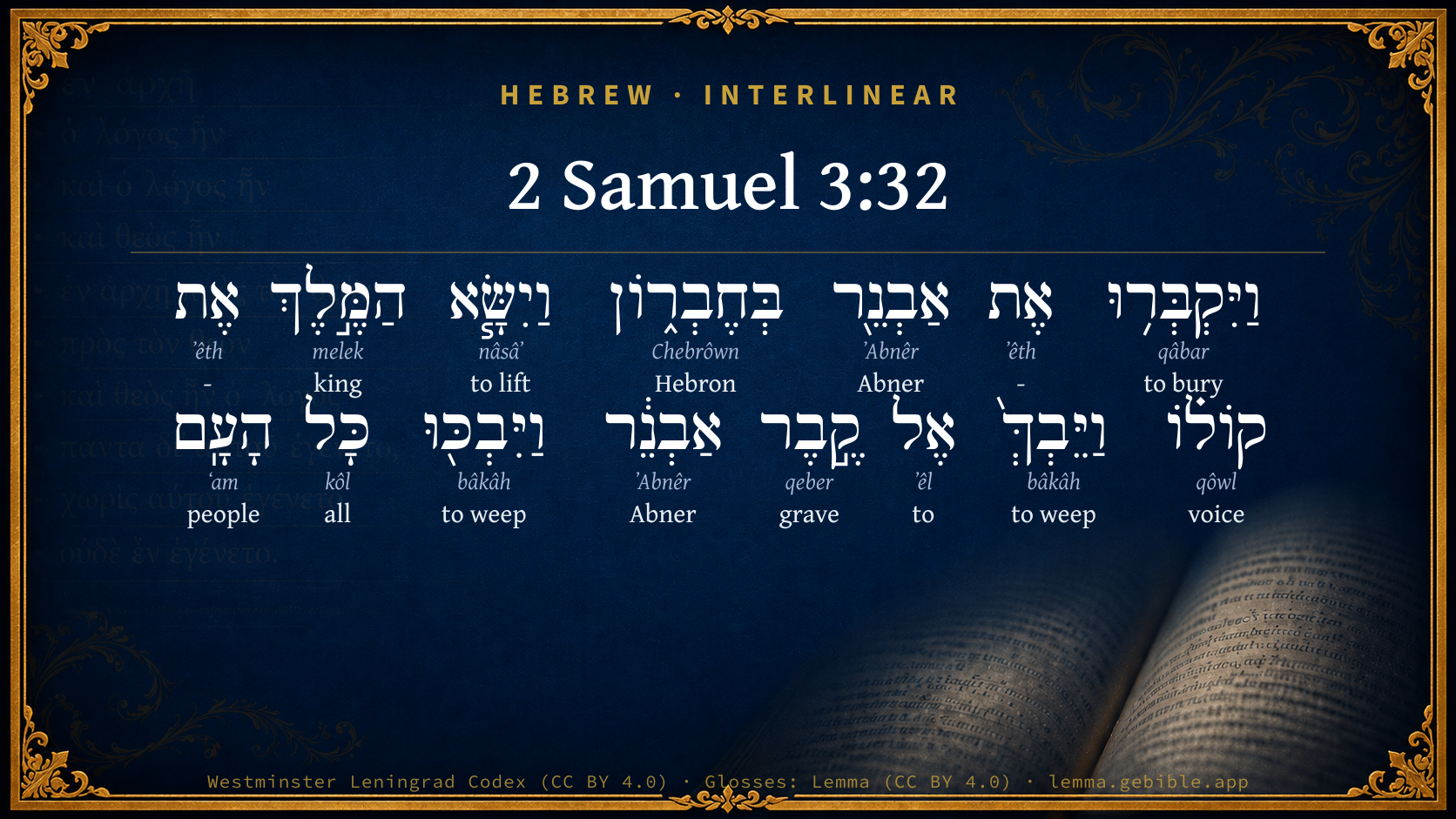
Hebrew (Westminster Leningrad Codex) 2 Samuel 3:32 appears in the Hebrew Old Testament. The text above is from the Westminster Leningrad Codex. Each word links to its Strong’s number, a concise gloss, and parsing drawn from the Open Scriptures Hebrew Bible morphology. Click any word for its full Brown-Driver-Briggs (BDB) entry.
Download image
Cite this verse

2 Samuel 3:32 (World English Bible). Public Domain. Lemma interlinear Bible study tool, https://lemma.gebible.app/v/2-samuel/3/32.

Show BibTeX & RIS
BibTeX
RIS
English Translation
They buried Abner in Hebron: and the king lifted up his voice, and wept at the grave of Abner; and all the people wept.
World English Bible · Public Domain
Download a study sheet

One document with this verse’s original text, its word-by-word gloss line, the meaning frame, cross-references with their text, attributed commentary, and full source and license credits — printable, and it pastes into notes with its structure intact.

This verse Autodidact and up

Study sheet (.html) Plain text (.txt)

A passage Seminary Student

Up to 50 verses in one chapter. A passage sheet keeps up to 6 commentary sources and 12 cross-references per verse, in the order this page ranks them, and says so on the sheet whenever that leaves anything out. Ask for a single verse and you get the Autodidact verse sheet above.

Everything on this page stays free to read, with no account — the sheet is a download of what is already on screen, not access to it.

Want to remove ads? Support Godless Engineer
Compare translations 3

The same verse in 3 English versions, stacked beneath the original-language interlinear above. Click any original word for its lexicon entry.

Each is an independent rendering of the whole verse — the interlinear is not word-aligned to these translations.

Highlighted words mark where these versions differ — a whole-verse word diff, not a word-by-word alignment.

  • World English Bible Public Domain
    They buried Abner in Hebron: and the king lifted up his voice, and wept at the grave of Abner; and all the people wept.
  • King James Version Public Domain
    And they buried Abner in Hebron: and the king lifted up his voice, and wept at the grave of Abner; and all the people wept.
  • unfoldingWord Literal Text CC BY-SA 4.0
    And they buried Abner in Hebron. And the king lifted up his voice and wept at the grave of Abner, and all of the people wept.

unfoldingWord Literal Text — © unfoldingWord, licensed CC BY-SA 4.0. Word-aligned USFM3 via Door43 (git.door43.org/unfoldingWord/en_ult).

Versions to compare (up to 4)

3 of 4 selected

Show all 18 translations

Every available English version of this verse, each an independent rendering of the whole verse.

  • World English Bible Public Domain
    They buried Abner in Hebron: and the king lifted up his voice, and wept at the grave of Abner; and all the people wept.
  • Berean Standard Bible Public Domain
    When they buried Abner in Hebron, the king wept aloud at Abner’s tomb, and all the people wept.
  • Majority Standard Bible Public Domain
    When they buried Abner in Hebron, the king wept aloud at Abner’s tomb, and all the people wept.
  • King James Version Public Domain
    And they buried Abner in Hebron: and the king lifted up his voice, and wept at the grave of Abner; and all the people wept.
  • American Standard Version (1901) Public Domain
    And they buried Abner in Hebron: and the king lifted up his voice, and wept at the grave of Abner; and all the people wept.
  • Revised Version (1885) Public Domain
    And they buried Abner in Hebron: and the king lifted up his voice, and wept at the grave of Abner; and all the people wept.
  • Geneva Bible (1599) Public Domain
    And when they had buryed Abner in Hebron, the King lift vp his voyce, and wept beside the sepulchre of Abner, and all the people wept.
  • Douay-Rheims (1899) Public Domain
    And when they had buried Abner in Hebron, king David lifted up his voice, and wept at the grave of Abner: and all the people also wept.
  • Young's Literal Translation Public Domain
    And they bury Abner in Hebron, and the king lifteth up his voice, and weepeth at the grave of Abner, and all the people weep;
  • Literal Standard Version CC BY-SA 4.0
    And they bury Abner in Hebron, and the king lifts up his voice, and weeps at the grave of Abner, and all the people weep;
  • Unlocked Literal Bible CC BY-SA 4.0
    They buried Abner in Hebron. The king wept and cried loudly at the tomb of Abner, and all the people also wept.
  • unfoldingWord Literal Text CC BY-SA 4.0
    And they buried Abner in Hebron. And the king lifted up his voice and wept at the grave of Abner, and all of the people wept.
  • Darby Bible Public Domain
    And they buried Abner in Hebron; and the king lifted up his voice and wept at the grave of Abner; and all the people wept.
  • World Messianic Bible Public Domain
    They buried Abner in Hebron; and the king lifted up his voice and wept at Abner’s grave; and all the people wept.
  • Webster's Bible Public Domain
    And they buried Abner in Hebron: and the king lifted up his voice and wept at the grave of Abner; and all the people wept.
  • Free Bible Version CC BY-SA 4.0
    They buried Abner in Hebron, and the king cried loudly at the grave, along with all the people.
  • Bible in Basic English Public Domain
    And they put Abner's body to rest in Hebron; and the king and all the people were weeping loudly by the resting-place of Abner's body.
  • JPS Tanakh (1917) Public Domain
    And they buried Abner in Hebron; and the king lifted up his voice, and wept at the grave of Abner; and all the people wept.

Literal Standard Version (2020), Covenant Press — licensed CC BY-SA 4.0. Text via the HelloAO Bible API (eBible.org). Unlocked Literal Bible (unfoldingWord) — licensed CC BY-SA 4.0. Text via the HelloAO Bible API (eBible.org). unfoldingWord Literal Text — © unfoldingWord, licensed CC BY-SA 4.0. Word-aligned USFM3 via Door43 (git.door43.org/unfoldingWord/en_ult). Free Bible Version, Dr. Jonathan Gallagher — licensed CC BY-SA 4.0. Text via the HelloAO Bible API (eBible.org).

Word by word

More ways to search: Search by grammar → Find every occurrence → Compare this word →

Practice this passage: Drill this verse → Learn its vocabulary →

אַבְנֵ֖ר
ʼAbnêr
H74
“Abner”
Noun, Proper
Part of Speech
Noun
Type
Proper
Full BDB Definition

Origin: from H1 and H5216

TWOT: None

Abner = "my father is a lamp" - Saul's cousin and army captain, treacherously slain by Joab
  1. וַיִּקְבְּר֥וּ qâbar H6912 “and · to bury” Conjunction + Verb, Qal, Sequential Imperfect, 3rd Person, Masculine, Plural
  2. אֶת ʼêth H853 “-” Particle, Direct Object
  3. בְּחֶבְר֑וֹן Chebrôwn H2275 “in/at · Hebron” Preposition + Noun, Proper
  4. וַיִשָּׂ֧א nâsâʼ H5375 “and · to lift” Conjunction + Verb, Qal, Sequential Imperfect, 3rd Person, Masculine, Singular
  5. הַמֶּ֣לֶךְ melek H4428 “the · king” Particle, Definite Article + Noun, Common, Masculine, Singular, Absolute
  6. אֶת ʼêth H853 “-” Particle, Direct Object
  7. קוֹל֗וֹ qôwl H6963 “voice · his” Noun, Common, Masculine, Singular, Construct + Suffix, Personal, 3rd Person, Masculine, Singular
  8. וַיֵּבְךְּ֙ bâkâh H1058 “and · to weep” Conjunction + Verb, Qal, Sequential Imperfect, 3rd Person, Masculine, Singular
  9. אֶל ʼêl H413 “to” Preposition
  10. קֶ֣בֶר qeber H6913 “grave of” Noun, Common, Masculine, Singular, Construct
  11. אַבְנֵ֔ר ʼAbnêr H74 “Abner” Noun, Proper
  12. וַיִּבְכּ֖וּ bâkâh H1058 “and · to weep” Conjunction + Verb, Qal, Sequential Imperfect, 3rd Person, Masculine, Plural
  13. כָּל kôl H3605 “all of” Noun, Common, Masculine, Singular, Construct
  14. הָעָֽם ʻam H5971 “the · people” Particle, Definite Article + Noun, Common, Masculine, Singular, Absolute

About this verse

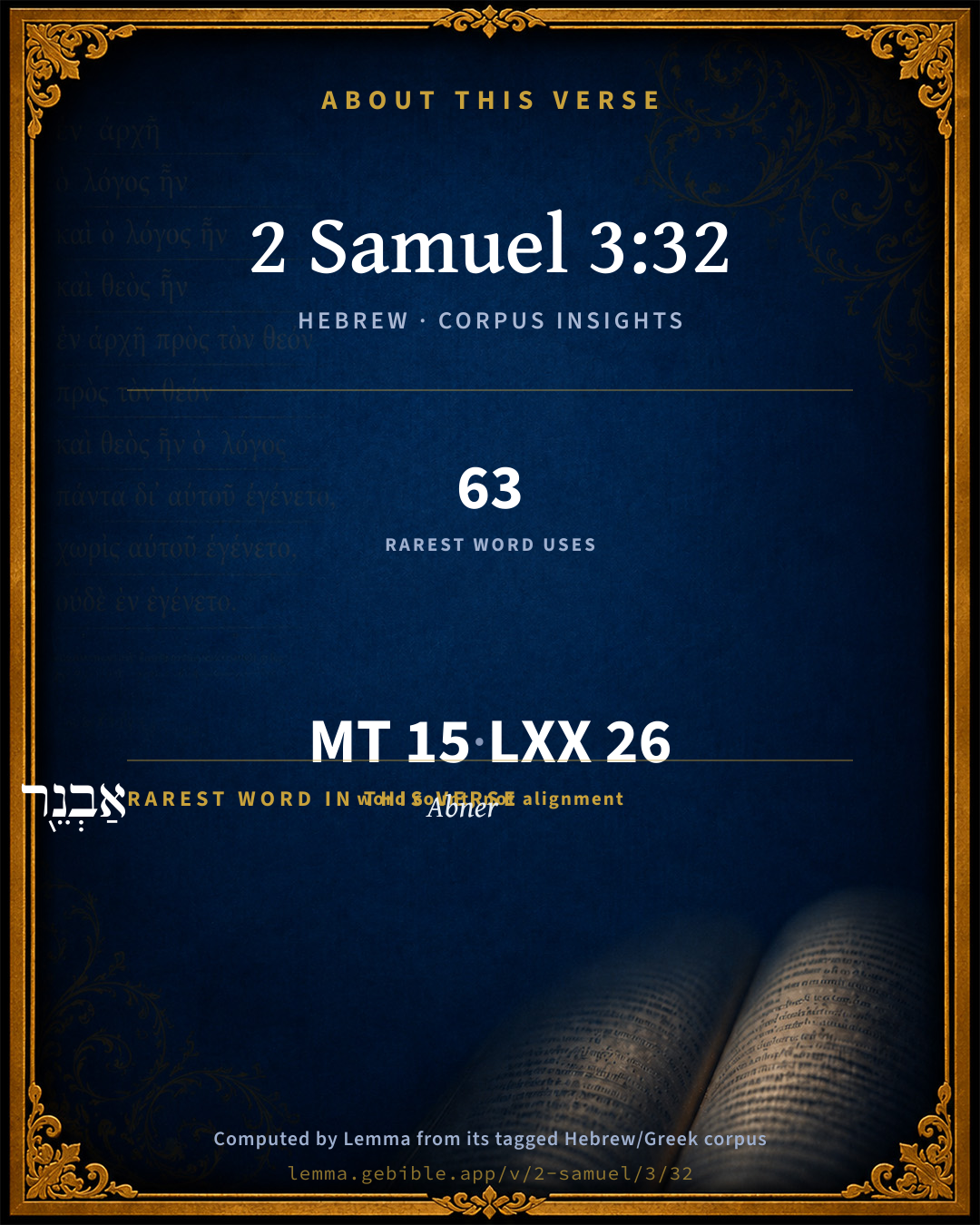
These counts appear in no published source. They are computed here, from the morphology-tagged text and Lemma’s own curated glosses. What Lemma adds →

15
words
12
distinct lemmas
Historical
section

Grammatical profile

  • 4 verbs
  • 8 nouns
  • 1 preposition
  • 2 particles

Verb forms

  • וַיִּקְבְּר֥וּ Qal · Sequential Imperfect
  • וַיִשָּׂ֧א Qal · Sequential Imperfect
  • וַיֵּבְךְּ֙ Qal · Sequential Imperfect
  • וַיִּבְכּ֖וּ Qal · Sequential Imperfect

Repetition

Words recur within this verse — often emphatic in Hebrew:

  • אַבְנֵ֖ר Abner H74 ×2
  • וַיֵּבְךְּ֙ to weep H1058 ×2

Hebrew & Septuagint length

In English translation the verse runs 24 words from the Hebrew and 25 from the Septuagint (LXX English) — closely comparable.

A rough comparison of the two English renderings, which tokenize alike — not a word-level alignment.

Word counts can differ between the Hebrew and the Greek without any difference in meaning — e.g. the Hebrew direct-object marker אֵת has no separate Greek word, and Greek often adds the article ὁ.

In the original languages it is 15 Hebrew tokens and 26 Greek tokens — but the two are counted differently (Hebrew bundles its prefixes and suffixes into one token; the Greek is in lemma form), so that isn’t a like-for-like length.

Cross-references

6

Topical passages linked to 2 Samuel 3:32 in the Treasury of Scripture Knowledge — connected by theme and wording, ordered by reader-vote popularity; previews shown in the World English Bible.

  • Proverbs 24:17 Don't rejoice when your enemy falls. Don't let your heart be glad when he is overthrown;
  • Job 31:28 This also would be an iniquity to be punished by the judges; For I should have denied the God who is above.
  • 1 Samuel 30:4 Then David and the people who were with him lifted up their voice and wept, until they had no more power to weep.
  • 2 Samuel 1:12 and they mourned, and wept, and fasted until even, for Saul, and for Jonathan his son, and for the people of Yahweh, and for the house of Israel; because they were fallen by the sword.
  • 2 Samuel 18:33 The king was much moved, and went up to the chamber over the gate, and wept: and as he went, thus he said, my son Absalom, my son, my son Absalom! would I had died for you, Absalom, my son, my son!
  • Luke 19:41–42 When he drew near, he saw the city and wept over it,

Cross-references courtesy of OpenBible.info (CC BY 4.0).

Hebrew and Greek witnesses Masoretic Hebrew ↔ Greek Septuagint

The same verse in the two great witnesses to the Old Testament, shown verse-for-verse.

These are two independent witnesses, not word-aligned to each other, and the Septuagint is shown in lemma (dictionary) form.

Hebrew 2 Samuel 3:32 Masoretic · Westminster Leningrad Codex

וַיִּקְבְּר֥וּ אֶת אַבְנֵ֖ר בְּחֶבְר֑וֹן וַיִשָּׂ֧א הַמֶּ֣לֶךְ אֶת קוֹל֗וֹ וַיֵּבְךְּ֙ אֶל קֶ֣בֶר אַבְנֵ֔ר וַיִּבְכּ֖וּ כָּל הָעָֽם

They buried Abner in Hebron: and the king lifted up his voice, and wept at the grave of Abner; and all the people wept.

World English Bible · Public Domain

Greek LXX 2 Samuel 3:32 Septuagint · lemma form

καί θάπτω ὁ αβεννηρ εἰς χεβρων καί αἴρω ὁ βασιλεύς ὁ φωνή αὐτός καί κλαίω ἐπί ὁ τάφος αὐτός καί κλαίω πᾶς ὁ λαός ἐπί αβεννηρ

And they bury Abenner in Chebron: and the king lifted up his voice, and wept at his tomb, and all the people wept for Abenner.

LXX2012 (modern English Septuagint) · Public Domain

Hebrew: Westminster Leningrad Codex (CC BY 4.0). Greek: Septuagint (public domain); English from LXX2012 (modern English Septuagint) (Public Domain). How the Septuagint differs from the Hebrew →

Targum (Aramaic paraphrase)

1

The Targum is the ancient Jewish Aramaic paraphrase of the Hebrew Scriptures — an interpretive translation, not the Hebrew text itself. Onkelos (literal) and Pseudo-Jonathan (expansive) render the Torah, and Jonathan the Prophets. Coverage is partial: where no permissively-licensed English translation exists for a verse, only the Aramaic is shown. This is verse-level text, not a word-by-word alignment to the Hebrew.

  1. Targum Jonathan Prophets (Joshua–Malachi)
    וּקְבַרוּ יַת אַבְנֵר בְּחֶבְרוֹן וַאֲרֵים מַלְכָּא יַת קָלֵיהּ וּבְכָא עַל קִבְרָא דְאַבְנֵר וּבְכוֹ כָּל עַמָא:

    (no public-domain English translation for this verse)

    Targum Jonathan — Aramaic: “Mikraot Gedolot” (public domain). English: “Sefaria Community Translation” (CC0 1.0 (public-domain dedication)); “London "Chaldee Paraphrase," 1871” (public domain). Text via Sefaria.

Commentary

Notes on 2 Samuel 3:32 from classic Christian and Jewish commentators (each source and its license shown beneath its notes). The classic Christian expositions comment on the surrounding passage and are grouped to its opening verse, so a note may address several verses; the Jewish commentaries on the Tanakh (Rashi and others) are per-verse, so they appear only where the commentator wrote on this verse.

Lemma curates 59 commentaries, every one of them public domain or Creative Commons licensed, each selected and text-cleaned for this edition rather than reprinted as found. About our sources →

Trapp's Complete Commentary

John Trapp

2Sa 3:32 And they buried Abner in Hebron: and the king lifted up his voice, and wept at the grave of Abner; and all the people wept.

Ver. 32. And they buried Abner in Hebron.] The burial place of the patriarchs. The wicked may be with the saints in area, sed non in horreo; in the floor, but not in the garner.

John Trapp, A Commentary or Exposition upon All the Books of the Old and New Testament (1647–1656) — public domain. Text from a community e-Sword module.

Tyndale Open Study Notes

Tyndale Open Resources

3:32 Burying Abner in Hebron, David’s capital city at the time, rather than at some northern site reinforced Abner’s shift of support from Saul to David. Presumably it encouraged others from the northern tribes to follow Abner’s example.

Tyndale Open Study Notes — © Tyndale Open Resources, licensed CC BY-SA 4.0. Text via the HelloAO Bible API.

Ellicott's Commentary for English Readers

(32) In Hebron.—The family home, and therefore the natural burial-place, of Abner was at Gibeon (1Ch_8:29; 1Ch_8:33; 1Ch_9:33); but this may have been now under Ish-bosheth’s control, and, at all events, a burial in the royal city of Hebron was more honourable and a more marked testimony to the grief of David.

A Bible Commentary for English Readers, edited by Charles John Ellicott (1878–1897) — public domain. Text from a community e-Sword module.

John Gill's Exposition

And they buried Abner in Hebron,.... According to the Jewish account of places of burial (s), he was buried in the midst of the city, though burying places were generally without; and so Fuller (t) places this in his map; whether the cave of Machpelah, which was near Hebron, was now used for a burying place, is not certain:

and the king lifted up his voice and wept at the grave of Abner; made a great outcry, a loud lamentation, so as to be heard by all the people; and which no doubt was real and hearty, and not done merely with political views:

and all the people wept; through concern for the death of Abner, especially on account of the manner in which it was, and in imitation of the king, and being affected with his tears and cries.

(s) Cippi Heb. p. 8. (t) Pisgah-Sight, &c. in the Map of Judah.

John Gill's Exposition of the Whole Bible (1746–1763) — public domain (CC PDM 1.0). Text via the HelloAO Bible API.

Haydock's Catholic Bible Commentary

CHAPTER III.

George Leo Haydock (1774–1849), Haydock's Catholic Family Bible and Commentary, 1859 edition — public domain. Excludes Psalms (Douay-Rheims chapter numbering differs from Protestant) and Deuterocanonical books (Catholic canon only).

Whedon's Commentary on the Bible

Daniel D. Whedon

32. The people wept — The grief of David and the people produced a profound impression, and convinced the entire nation that the king had no hand in the death of Abner.

Daniel D. Whedon (gen. ed.), Commentary on the Old and New Testaments (1874–1909) — public domain. Text from a community e-Sword module.

Lesson kit

Teaching starters — assembled from the data on this page, not authored interpretation. Every prompt links to the verse data it draws on. Edit before teaching.

2 Samuel, in the Historical, opens this verse with 15 words (12 distinct Hebrew lemmas). Its most distinctive word is ʼAbnêr (“Abner”). A historical commentator’s framing appears above. Read the whole chapter for the surrounding context.

Discussion questions

  1. What does “Abner” (ʼAbnêr) contribute to the verse as a whole?
  2. How does Proverbs 24:17, which shares this passage’s theme, read alongside this verse?
  3. What does the repetition of “Abner” (2× in this one verse) do in this verse?
  4. «וַיִּקְבְּר֥וּ» is a Qal Sequential Imperfect verb. How does that grammatical form shape the action described?
  5. Compare how Trapp's Complete Commentary and Tyndale Open Study Notes read this verse. Where do they agree or differ?

Things to notice

Reading settings

Reading text

Shown beneath each verse's original-language words.

Old Testament
Old Testament edition

Read the OT as the Masoretic Hebrew (MT) or the Greek Septuagint (LXX).

English shown for the Greek Septuagint (in the Hebrew ↔ Greek comparison).

Comparing translations? Open the Compare panel on any verse page to stack up to four side by side.