1 Chronicles 12:24

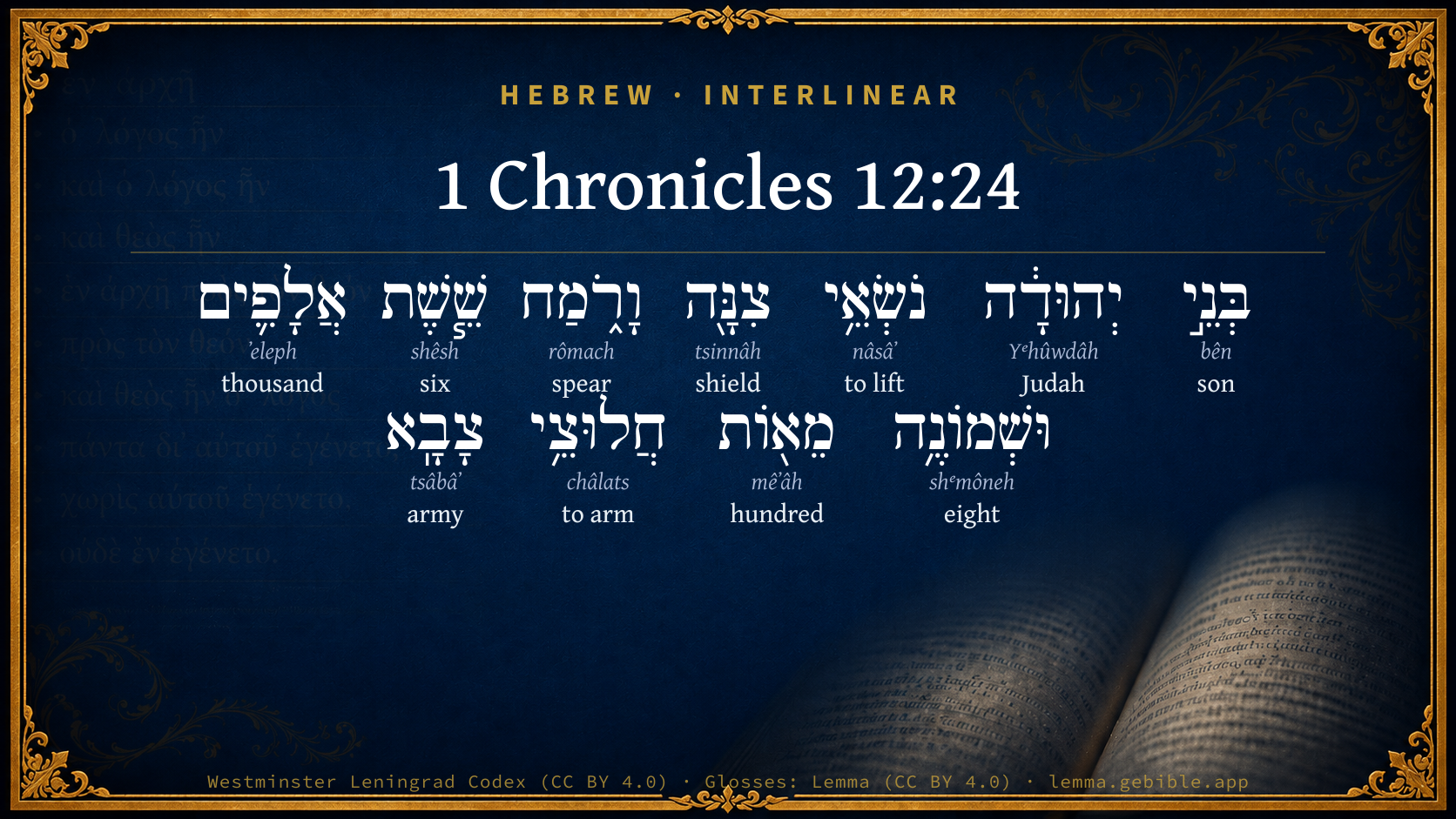
Hebrew (Westminster Leningrad Codex) 1 Chronicles 12:24 appears in the Hebrew Old Testament. The text above is from the Westminster Leningrad Codex. Each word links to its Strong’s number, a concise gloss, and parsing drawn from the Open Scriptures Hebrew Bible morphology. Click any word for its full Brown-Driver-Briggs (BDB) entry.
Download image
Cite this verse

1 Chronicles 12:24 (World English Bible). Public Domain. Lemma interlinear Bible study tool, https://lemma.gebible.app/v/1-chronicles/12/24.

Show BibTeX & RIS
BibTeX
RIS
English Translation
The children of Judah who bore shield and spear were six thousand and eight hundred, armed for war.
World English Bible · Public Domain
Download a study sheet

One document with this verse’s original text, its word-by-word gloss line, the meaning frame, cross-references with their text, attributed commentary, and full source and license credits — printable, and it pastes into notes with its structure intact.

This verse Autodidact and up

Study sheet (.html) Plain text (.txt)

A passage Seminary Student

Up to 50 verses in one chapter. A passage sheet keeps up to 6 commentary sources and 12 cross-references per verse, in the order this page ranks them, and says so on the sheet whenever that leaves anything out. Ask for a single verse and you get the Autodidact verse sheet above.

Everything on this page stays free to read, with no account — the sheet is a download of what is already on screen, not access to it.

Want to remove ads? Support Godless Engineer
Compare translations 3

The same verse in 3 English versions, stacked beneath the original-language interlinear above. Click any original word for its lexicon entry.

Each is an independent rendering of the whole verse — the interlinear is not word-aligned to these translations.

Highlighted words mark where these versions differ — a whole-verse word diff, not a word-by-word alignment.

  • World English Bible Public Domain
    The children of Judah who bore shield and spear were six thousand and eight hundred, armed for war.
  • King James Version Public Domain
    The children of Judah that bare shield and spear were six thousand and eight hundred, ready armed to the war.
  • unfoldingWord Literal Text CC BY-SA 4.0
    The sons of Judah, carriers of the shield and the spear, 6,800 equipped of war.

unfoldingWord Literal Text — © unfoldingWord, licensed CC BY-SA 4.0. Word-aligned USFM3 via Door43 (git.door43.org/unfoldingWord/en_ult).

Versions to compare (up to 4)

3 of 4 selected

Show all 18 translations

Every available English version of this verse, each an independent rendering of the whole verse.

  • World English Bible Public Domain
    The children of Judah who bore shield and spear were six thousand and eight hundred, armed for war.
  • Berean Standard Bible Public Domain
    From Judah: 6,800 armed troops bearing shields and spears.
  • Majority Standard Bible Public Domain
    From Judah: 6,800 armed troops bearing shields and spears.
  • King James Version Public Domain
    The children of Judah that bare shield and spear were six thousand and eight hundred, ready armed to the war.
  • American Standard Version (1901) Public Domain
    The children of Judah that bare shield and spear were six thousand and eight hundred, armed for war.
  • Revised Version (1885) Public Domain
    The children of Judah that bare shield and spear were six thousand and eight hundred, armed for war.
  • Geneva Bible (1599) Public Domain
    The children of Iudah that bare shield and speare, were sixe thousand and eight hundreth armed to the warre.
  • Douay-Rheims (1899) Public Domain
    The sons of Juda bearing shield and spear, six thousand eight hundred well appointed to war.
  • Young's Literal Translation Public Domain
    The sons of Judah, bearing target and spear, `are' six thousand and eight hundred, armed ones of the host.
  • Literal Standard Version CC BY-SA 4.0
    The sons of Judah, carrying buckler and spear, [are] six thousand and eight hundred, armed ones of the host.
  • Unlocked Literal Bible CC BY-SA 4.0
    From Judah those who carried shield and spear were 6,800, armed for war.
  • unfoldingWord Literal Text CC BY-SA 4.0
    The sons of Judah, carriers of the shield and the spear, 6,800 equipped of war.
  • Darby Bible Public Domain
    The children of Judah that bore shield and spear were six thousand eight hundred, equipped for military service.
  • World Messianic Bible Public Domain
    The children of Judah who bore shield and spear were six thousand eight hundred, armed for war.
  • Webster's Bible Public Domain
    The children of Judah that bore shield and spear were six thousand and eight hundred, ready armed for war.
  • Free Bible Version CC BY-SA 4.0
    From the tribe of Judah, 6,800 warriors carrying shields and spears.
  • Bible in Basic English Public Domain
    There were six thousand, eight hundred spearmen of the children of Judah, armed for war;
  • JPS Tanakh (1917) Public Domain
    (12-25) The children of Judah that bore shield and spear were six thousand and eight hundred, armed for war.

Literal Standard Version (2020), Covenant Press — licensed CC BY-SA 4.0. Text via the HelloAO Bible API (eBible.org). Unlocked Literal Bible (unfoldingWord) — licensed CC BY-SA 4.0. Text via the HelloAO Bible API (eBible.org). unfoldingWord Literal Text — © unfoldingWord, licensed CC BY-SA 4.0. Word-aligned USFM3 via Door43 (git.door43.org/unfoldingWord/en_ult). Free Bible Version, Dr. Jonathan Gallagher — licensed CC BY-SA 4.0. Text via the HelloAO Bible API (eBible.org).

Word by word

More ways to search: Search by grammar → Find every occurrence → Compare this word →

Practice this passage: Drill this verse → Learn its vocabulary →

וָרֹ֑מַח
rômach
H7420
“and · spear”
Conjunction + Noun, Common, Masculine, Singular, Absolute
Part of Speech
Conjunction + Noun
Type
Common
Gender
Masculine
Number
Singular
State
Absolute
Full BDB Definition

Origin: from an unused root meaning to hurl

TWOT: 2172

spear, lance
  1. בְּנֵ֣י bên H1121 “sons of” Noun, Common, Masculine, Plural, Construct
  2. יְהוּדָ֔ה Yᵉhûwdâh H3063 “Judah” Noun, Proper
  3. נֹשְׂאֵ֥י nâsâʼ H5375 “lifting” Verb, Qal, Participle Active, Masculine, Plural, Construct
  4. צִנָּ֖ה tsinnâh H6793 “shield” Noun, Common, Feminine, Singular, Absolute
  5. שֵׁ֧שֶׁת shêsh H8337 “six” Adjective, Cardinal number, Masculine, Singular, Construct
  6. אֲלָפִ֛ים ʼeleph H505 “thousand” Adjective, Cardinal number, Both, Plural, Absolute
  7. וּשְׁמוֹנֶ֥ה shᵉmôneh H8083 “and · eight” Conjunction + Adjective, Cardinal number, Feminine, Singular, Absolute
  8. מֵא֖וֹת mêʼâh H3967 “hundred” Adjective, Cardinal number, Both, Plural, Absolute
  9. חֲלוּצֵ֥י châlats H2502 “armed” Verb, Qal, Participle Passive, Masculine, Plural, Construct
  10. צָבָֽא tsâbâʼ H6635 “army” Noun, Common, Both, Singular, Absolute

About this verse

These counts appear in no published source. They are computed here, from the morphology-tagged text and Lemma’s own curated glosses. What Lemma adds →

11
words
11
distinct lemmas
Historical
section

Notable vocabulary

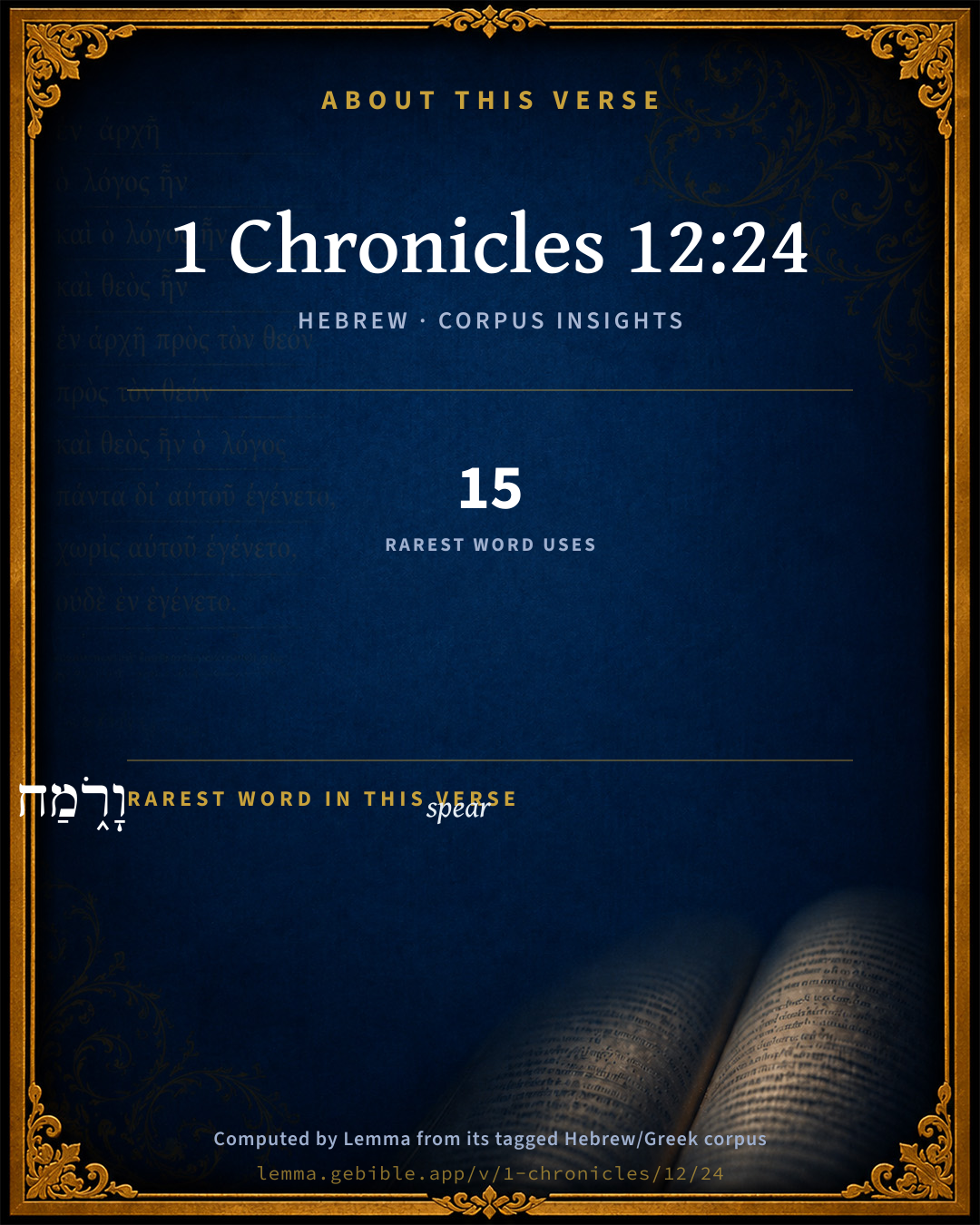
The rarest word here is וָרֹ֑מַח spear H7420 — appearing just 15 times in the whole Hebrew Bible.

Shared distinctive vocabulary

וָרֹ֑מַח spear H7420 occurs in 15 verses of the Hebrew Bible. Also found in:

Grammatical profile

  • 2 verbs
  • 5 nouns
  • 4 adjectives

Verb forms

  • נֹשְׂאֵ֥י Qal · Participle Active
  • חֲלוּצֵ֥י Qal · Participle Passive

Hebrew & Septuagint length

In English translation the verse runs 18 words from the Hebrew and 16 from the Septuagint (LXX English) — closely comparable.

A rough comparison of the two English renderings, which tokenize alike — not a word-level alignment.

Word counts can differ between the Hebrew and the Greek without any difference in meaning — e.g. the Hebrew direct-object marker אֵת has no separate Greek word, and Greek often adds the article ὁ.

Hebrew and Greek witnesses Masoretic Hebrew ↔ Greek Septuagint

The same verse in the two great witnesses to the Old Testament, shown verse-for-verse.

These are two independent witnesses, not word-aligned to each other, and the Septuagint is shown in lemma (dictionary) form.

Hebrew 1 Chronicles 12:24 Masoretic · Westminster Leningrad Codex

בְּנֵ֣י יְהוּדָ֔ה נֹשְׂאֵ֥י צִנָּ֖ה וָרֹ֑מַח שֵׁ֧שֶׁת אֲלָפִ֛ים וּשְׁמוֹנֶ֥ה מֵא֖וֹת חֲלוּצֵ֥י צָבָֽא

The children of Judah who bore shield and spear were six thousand and eight hundred, armed for war.

World English Bible · Public Domain

Greek LXX 1 Chronicles 12:24 Septuagint · lemma form

καί οὗτος ὁ ὄνομα ὁ ἄρχων ὁ στρατιά ὁ ἔρχομαι πρός δαυίδ εἰς χεβρων ὁ ἀποστρέφω ὁ βασιλεία σαούλ πρός αὐτός κατά ὁ λόγος κύριος

The sons of Juda, bearing shields and spears, six thousand and eight hundred mighty in war.

LXX2012 (modern English Septuagint) · Public Domain

Hebrew: Westminster Leningrad Codex (CC BY 4.0). Greek: Septuagint (public domain); English from LXX2012 (modern English Septuagint) (Public Domain). How the Septuagint differs from the Hebrew →

Commentary

Notes on 1 Chronicles 12:24 from classic Christian and Jewish commentators (each source and its license shown beneath its notes). The classic Christian expositions comment on the surrounding passage and are grouped to its opening verse, so a note may address several verses; the Jewish commentaries on the Tanakh (Rashi and others) are per-verse, so they appear only where the commentator wrote on this verse.

Lemma curates 59 commentaries, every one of them public domain or Creative Commons licensed, each selected and text-cleaned for this edition rather than reprinted as found. About our sources →

Trapp's Complete Commentary

John Trapp

1Ch 12:24 The children of Judah that bare shield and spear [were] six thousand and eight hundred, ready armed to the war.

Ver. 24. That bare shield and year,] i.e., Weapons defensive and offensive; so must the Christian soldier. {Eph 6:12-17}

John Trapp, A Commentary or Exposition upon All the Books of the Old and New Testament (1647–1656) — public domain. Text from a community e-Sword module.

Geneva Bible (1599)

Geneva Bible translators

Or, buckler.

Geneva Bible (1599) marginal notes — public domain. Text via Bolls.life.

Ellicott's Commentary for English Readers

(24) The sons of Judah.—The following list proceeds from south to north, and then passes over to the trans-Jordanic tribes.

That bare shield and spear.—Comp. 1Ch_12:8.

Ready armed to the war.—Equipped for war fare. The tribe of Judah, which had acknowledged the sovereignty of David for the last seven years, had no need to appear in full force on the occasion of his recognition by the other tribes.

A Bible Commentary for English Readers, edited by Charles John Ellicott (1878–1897) — public domain. Text from a community e-Sword module.

The Cambridge Bible for Schools and Colleges

gen. ed. J. J. S. Perowne

24. The children of Judah, etc.] The list which follows suggests two questions, (1) Whence did the Chronicler derive it? (2) Are the statements of numbers contained in it trustworthy?

In answer to the first question it may be confidently said that the list as it stands is the composition of the Chronicler himself, for the syntax and vocabulary of the passage are his. Its statements may, however, be based on those of some ancient document. As to the second question it must be confessed that the numbers given to the Northern tribes, especially the trans-Jordanic tribes, are surprisingly large, especially when compared with those of the Southern; thus while the totals of Judah, Simeon, Levi, and Benjamin taken together amount to 25,200 warriors, those of Zebulun, Naphtali, Dan, and Asher amount to 155,600. Yet compare the numbers given in 2Sa_24:9 (800,000 men in Israel who drew sword).

The Cambridge Bible for Schools and Colleges (gen. ed. J. J. S. Perowne; Cambridge University Press, 1878–1918) — public domain. Text from a community e-Sword module.

Matthew Poole's English Annotations

Who came hither in the name of all their brethren; for that whole tribe stuck to David at his very first coming to Hebron.

Matthew Poole's English Annotations on the Holy Bible (1683–1685) — public domain. Text from a community e-Sword/MySword module.

Whedon's Commentary on the Bible

Daniel D. Whedon

24. Judah… six thousand and eight hundred — It has been thought strange that David’s own tribe should have had so small a representation in comparison with remote tribes like Zebulun, Naphtali, and Asher. Compare 1Ch_12:33-34; 1Ch_12:36. But David had already ruled over Judah seven years, and on this occasion it was unnecessary for his own tribe to be present in great numbers. The same remarks apply to the tribe of Simeon, which had already become largely identified with that of Judah.

Daniel D. Whedon (gen. ed.), Commentary on the Old and New Testaments (1874–1909) — public domain. Text from a community e-Sword module.

The Pulpit Commentary

Vers. 24, 25. David had already found friends and adherents in these two southern tribes of Judah and Simeon.

The Pulpit Commentary (1880–1919), ed. H.D.M. Spence-Jones & Joseph S. Exell — public domain. Text from a community e-Sword module.

John Wesley's Explanatory Notes

Six thousand, &c. - Who came hither in the name of their brethren; for that whole tribe stuck to David.

John Wesley, Explanatory Notes Upon the Whole Bible (1754–1765) — public domain. Text via the GEBible commentary corpus.

Rashi

Rabbi Shlomo Yitzchaki (Rashi)

to turn Saul’s kingdom to him from Saul’s sons. A similar instance is (I Kings 2:15): “...but the kingdom turned about.”

Rashi on the Tanakh — English translations: “The Judaica Press complete Tanach with Rashi, translated by A. J. Rosenberg” (CC BY 4.0); “Pentateuch with Rashi's commentary by M. Rosenbaum and A.M. Silbermann, 1929-1934” (public domain); “The Metsudah Tanach series, Lakewood, N.J” (CC BY 4.0); and “The Book of Joshua, Metsudah Publications, 1997” (CC BY 4.0). Text via Sefaria.

Lesson kit

Teaching starters — assembled from the data on this page, not authored interpretation. Every prompt links to the verse data it draws on. Edit before teaching.

1 Chronicles, in the Historical, opens this verse with 11 words (11 distinct Hebrew lemmas). Its most distinctive word is rômach (“spear”). A historical commentator’s framing appears above. Read the whole chapter for the surrounding context.

Discussion questions

  1. What does “spear” (rômach) contribute to the verse as a whole?
  2. Numbers 25:7 shares the word «spear» with this verse. How do the two illuminate each other?
  3. These translations render this verse differently; the difference is in the English rendering, not the original. What questions does that raise?
  4. The verb «נֹשְׂאֵ֥י» is Qal Participle Active. How does its form color the action?
  5. Reading how Trapp's Complete Commentary and Geneva Bible (1599) read this verse, where do the two commentators agree and where do they part?

Things to notice

Reading settings

Reading text

Shown beneath each verse's original-language words.

Old Testament
Old Testament edition

Read the OT as the Masoretic Hebrew (MT) or the Greek Septuagint (LXX).

English shown for the Greek Septuagint (in the Hebrew ↔ Greek comparison).

Comparing translations? Open the Compare panel on any verse page to stack up to four side by side.