
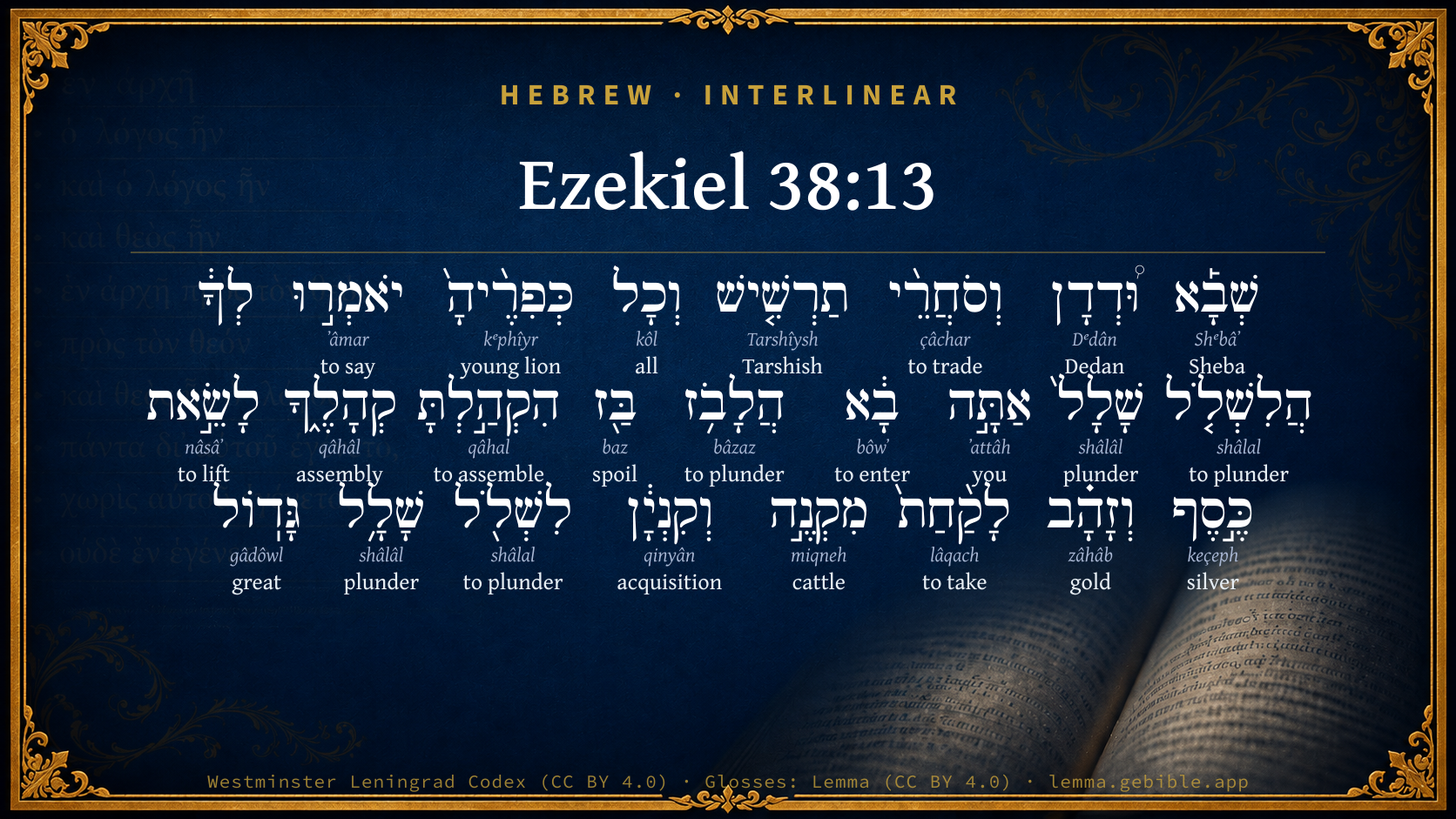
Ezekiel 38:13

Hebrew (Westminster Leningrad Codex) Ezekiel 38:13 appears in the Hebrew Old Testament. The text above is from the Westminster Leningrad Codex. Each word links to its Strong’s number, a concise gloss, and parsing drawn from the Open Scriptures Hebrew Bible morphology. Click any word for its full Brown-Driver-Briggs (BDB) entry.
Download image
Cite this verse

Ezekiel 38:13 (World English Bible). Public Domain. Lemma interlinear Bible study tool, https://lemma.gebible.app/v/ezekiel/38/13.

Show BibTeX & RIS
BibTeX
RIS
English Translation
Sheba, and Dedan, and the merchants of Tarshish, with all the young lions of it, shall tell you, Are you come to take the spoil? have you assembled your company to take the prey? to carry away silver and gold, to take away cattle and goods, to take great spoil?
World English Bible · Public Domain
Download a study sheet

One document with this verse’s original text, its word-by-word gloss line, the meaning frame, cross-references with their text, attributed commentary, and full source and license credits — printable, and it pastes into notes with its structure intact.

This verse Autodidact and up

Study sheet (.html) Plain text (.txt)

A passage Seminary Student

Up to 50 verses in one chapter. A passage sheet keeps up to 6 commentary sources and 12 cross-references per verse, in the order this page ranks them, and says so on the sheet whenever that leaves anything out. Ask for a single verse and you get the Autodidact verse sheet above.

Everything on this page stays free to read, with no account — the sheet is a download of what is already on screen, not access to it.

Want to remove ads? Support Godless Engineer
Compare translations 3

The same verse in 3 English versions, stacked beneath the original-language interlinear above. Click any original word for its lexicon entry.

Each is an independent rendering of the whole verse — the interlinear is not word-aligned to these translations.

Highlighted words mark where these versions differ — a whole-verse word diff, not a word-by-word alignment.

  • World English Bible Public Domain
    Sheba, and Dedan, and the merchants of Tarshish, with all the young lions of it, shall tell you, Are you come to take the spoil? have you assembled your company to take the prey? to carry away silver and gold, to take away cattle and goods, to take great spoil?
  • King James Version Public Domain
    Sheba, and Dedan, and the merchants of Tarshish, with all the young lions thereof, shall say unto thee, Art thou come to take a spoil? hast thou gathered thy company to take a prey? to carry away silver and gold, to take away cattle and goods, to take a great spoil?
  • unfoldingWord Literal Text CC BY-SA 4.0
    Sheba and Dedan, and the traders of Tarshish along with all its young warriors will say to you, ‘Have you come to plunder? Have you assembled your armies to take away spoil, to carry off silver and gold, to take their livestock and property and to haul away much plunder?’

unfoldingWord Literal Text — © unfoldingWord, licensed CC BY-SA 4.0. Word-aligned USFM3 via Door43 (git.door43.org/unfoldingWord/en_ult).

Versions to compare (up to 4)

3 of 4 selected

Show all 18 translations

Every available English version of this verse, each an independent rendering of the whole verse.

  • World English Bible Public Domain
    Sheba, and Dedan, and the merchants of Tarshish, with all the young lions of it, shall tell you, Are you come to take the spoil? have you assembled your company to take the prey? to carry away silver and gold, to take away cattle and goods, to take great spoil?
  • Berean Standard Bible Public Domain
    Sheba and Dedan and the merchants of Tarshish with all its villages will ask, ‘Have you come to capture the plunder? Have you assembled your hordes to carry away loot, to make off with silver and gold, to take cattle and goods, to seize great spoil?’
  • Majority Standard Bible Public Domain
    Sheba and Dedan and the merchants of Tarshish with all its villages will ask, ‘Have you come to capture the plunder? Have you assembled your hordes to carry away loot, to make off with silver and gold, to take cattle and goods, to seize great spoil?’
  • King James Version Public Domain
    Sheba, and Dedan, and the merchants of Tarshish, with all the young lions thereof, shall say unto thee, Art thou come to take a spoil? hast thou gathered thy company to take a prey? to carry away silver and gold, to take away cattle and goods, to take a great spoil?
  • American Standard Version (1901) Public Domain
    Sheba, and Dedan, and the merchants of Tarshish, with all the young lions thereof, shall say unto thee, Art thou come to take the spoil? hast thou assembled thy company to take the prey? to carry away silver and gold, to take away cattle and goods, to take great spoil?
  • Revised Version (1885) Public Domain
    Sheba, and Dedan, and the merchants of Tarshish; with all the young lions thereof, shall say unto thee, Art thou come to take the spoil? hast thou assembled thy company to take the prey? to carry away silver and gold, to take away cattle and goods, to take great spoil?
  • Geneva Bible (1599) Public Domain
    Sheba and Dedan, and the marchantes of Tarshish with all the lions thereof shall say vnto thee, Art thou come to spoyle the praye? hast thou gathered thy multitude to take a booty? to cary away siluer and golde, to take away cattell and goods, and to spoyle a great pray?
  • Douay-Rheims (1899) Public Domain
    Saba, and Dedan, and the merchants of Tharsis, and all the lions thereof shall say to thee: Art thou come to take spoils? behold, thou hast gathered thy multitude to take a prey, to take silver, and gold, and to carry away goods and substance, and to take rich spoils.
  • Young's Literal Translation Public Domain
    Sheba, and Dedan, and merchants of Tarshish, And all its young lions say to thee: To take a spoil art thou come in? To take a prey assembled thine assembly? To bear away silver and gold? To take away cattle and substance? To take a great spoil?
  • Literal Standard Version CC BY-SA 4.0
    Sheba, and Dedan, and merchants of Tarshish, || And all its young lions say to you, || Are you coming to take spoil? Have you assembled your assembly to take prey? To carry away silver and gold? To take away livestock and substance? To take a great spoil?
  • Unlocked Literal Bible CC BY-SA 4.0
    Sheba and Dedan, and the traders of Tarshish along with all its young warriors will say to you, 'Have you come to plunder? Have you assembled your armies to take away spoil, to carry off silver and gold, to take their livestock and property and to haul away much plunder?'
  • unfoldingWord Literal Text CC BY-SA 4.0
    Sheba and Dedan, and the traders of Tarshish along with all its young warriors will say to you, ‘Have you come to plunder? Have you assembled your armies to take away spoil, to carry off silver and gold, to take their livestock and property and to haul away much plunder?’
  • Darby Bible Public Domain
    Sheba, and Dedan, and the merchants of Tarshish, with all the young lions thereof, shall say unto thee, Art thou come to seize a spoil? hast thou gathered thine assemblage to take a prey? to carry away silver and gold, to take cattle and goods, to seize a great spoil?
  • World Messianic Bible Public Domain
    Sheba, Dedan, and the merchants of Tarshish, with all its young lions, will ask you, ‘Have you come to take the plunder? Have you assembled your company to take the prey, to carry away silver and gold, to take away livestock and goods, to take great plunder?’”’
  • Webster's Bible Public Domain
    Sheba, and Dedan, and the merchants of Tarshish, with all its young lions, shall say to thee, Art thou come to take a spoil? hast thou gathered thy company to take a prey? to carry away silver and gold, to take away cattle and goods, to take a great spoil?
  • Free Bible Version CC BY-SA 4.0
    Sheba and Dedan and the traders from Tarshish with all its strong leaders will ask, ‘Are you going to loot the place? Have you gathered your armies to rob them, to carry away silver and gold, to take cattle and possessions—to grab a great deal of plunder?’
  • Bible in Basic English Public Domain
    Sheba, and Dedan and her traders, Tarshish with all her traders, will say to you, Have you come to take our goods? have you got your armies together to take away our property by force? to take away silver and gold, cattle and goods, to go off with great wealth?
  • JPS Tanakh (1917) Public Domain
    Sheba, and Dedan, and the merchants of Tarshish, with all the magnates thereof, shall say unto thee: Comest thou to take the spoil? hast thou assembled thy company to take the prey? to carry away silver and gold, to take away cattle and goods, to take great spoil?

Literal Standard Version (2020), Covenant Press — licensed CC BY-SA 4.0. Text via the HelloAO Bible API (eBible.org). Unlocked Literal Bible (unfoldingWord) — licensed CC BY-SA 4.0. Text via the HelloAO Bible API (eBible.org). unfoldingWord Literal Text — © unfoldingWord, licensed CC BY-SA 4.0. Word-aligned USFM3 via Door43 (git.door43.org/unfoldingWord/en_ult). Free Bible Version, Dr. Jonathan Gallagher — licensed CC BY-SA 4.0. Text via the HelloAO Bible API (eBible.org).

Word by word

More ways to search: Search by grammar → Find every occurrence → Compare this word →

Practice this passage: Drill this verse → Learn its vocabulary →

וְקִנְיָ֔ן
qinyân
H7075
“and · acquisition”
Conjunction + Noun, Common, Masculine, Singular, Absolute
Part of Speech
Conjunction + Noun
Type
Common
Gender
Masculine
Number
Singular
State
Absolute
Full BDB Definition

Origin: from H7069

TWOT: 2039a

thing acquired, acquisition, possession, purchased property, wealth - thing acquired (by purchase) - creatures (more general)
  1. שְׁבָ֡א Shᵉbâʼ H7614 “Sheba” Noun, Proper
  2. וּ֠דְדָן Dᵉdân H1719 “and · Dedan” Conjunction + Noun, Proper
  3. וְסֹחֲרֵ֨י çâchar H5503 “and · trading” Conjunction + Verb, Qal, Participle Active, Masculine, Plural, Construct
  4. תַרְשִׁ֤ישׁ Tarshîysh H8659 “Tarshish” Noun, Proper
  5. וְכָל kôl H3605 “and · all of” Conjunction + Noun, Common, Masculine, Singular, Construct
  6. כְּפִרֶ֨יהָ֙ kᵉphîyr H3715 “young lions · her” Noun, Common, Masculine, Plural, Construct + Suffix, Personal, 3rd Person, Feminine, Singular
  7. יֹאמְר֣וּ ʼâmar H559 “to say” Verb, Qal, Imperfect, 3rd Person, Masculine, Plural
  8. הֲלִשְׁלֹ֤ל shâlal H7997 “to plunder” Particle, Interrogative + Preposition + Verb, Qal, Infinitive Construct
  9. שָׁלָל֙ shâlâl H7998 “plunder” Noun, Common, Masculine, Singular, Absolute
  10. אַתָּ֣ה ʼattâh H859 “you” Pronoun, Personal, 2nd Person, Masculine, Singular
  11. בָ֔א bôwʼ H935 “entering” Verb, Qal, Participle Active, Masculine, Singular, Absolute
  12. הֲלָבֹ֥ז bâzaz H962 “to plunder” Particle, Interrogative + Preposition + Verb, Qal, Infinitive Construct
  13. בַּ֖ז baz H957 “spoil” Noun, Common, Masculine, Singular, Absolute
  14. הִקְהַ֣לְתָּ qâhal H6950 “to assemble” Verb, Hiphil, Perfect, 2nd Person, Masculine, Singular
  15. קְהָלֶ֑ךָ qâhâl H6951 “assembly · your” Noun, Common, Masculine, Singular, Construct + Suffix, Personal, 2nd Person, Masculine, Singular
  16. לָשֵׂ֣את nâsâʼ H5375 “to lift” Preposition + Verb, Qal, Infinitive Construct
  17. כֶּ֣סֶף keçeph H3701 “silver” Noun, Common, Masculine, Singular, Absolute
  18. וְזָהָ֗ב zâhâb H2091 “and · gold” Conjunction + Noun, Common, Masculine, Singular, Absolute
  19. לָקַ֨חַת֙ lâqach H3947 “to take” Preposition + Verb, Qal, Infinitive Construct
  20. מִקְנֶ֣ה miqneh H4735 “cattle” Noun, Common, Masculine, Singular, Absolute
  21. לִשְׁלֹ֖ל shâlal H7997 “to plunder” Preposition + Verb, Qal, Infinitive Construct
  22. שָׁלָ֥ל shâlâl H7998 “plunder” Noun, Common, Masculine, Singular, Absolute
  23. גָּדֽוֹל gâdôwl H1419 “great” Adjective, Adjective, Masculine, Singular, Absolute

About this verse

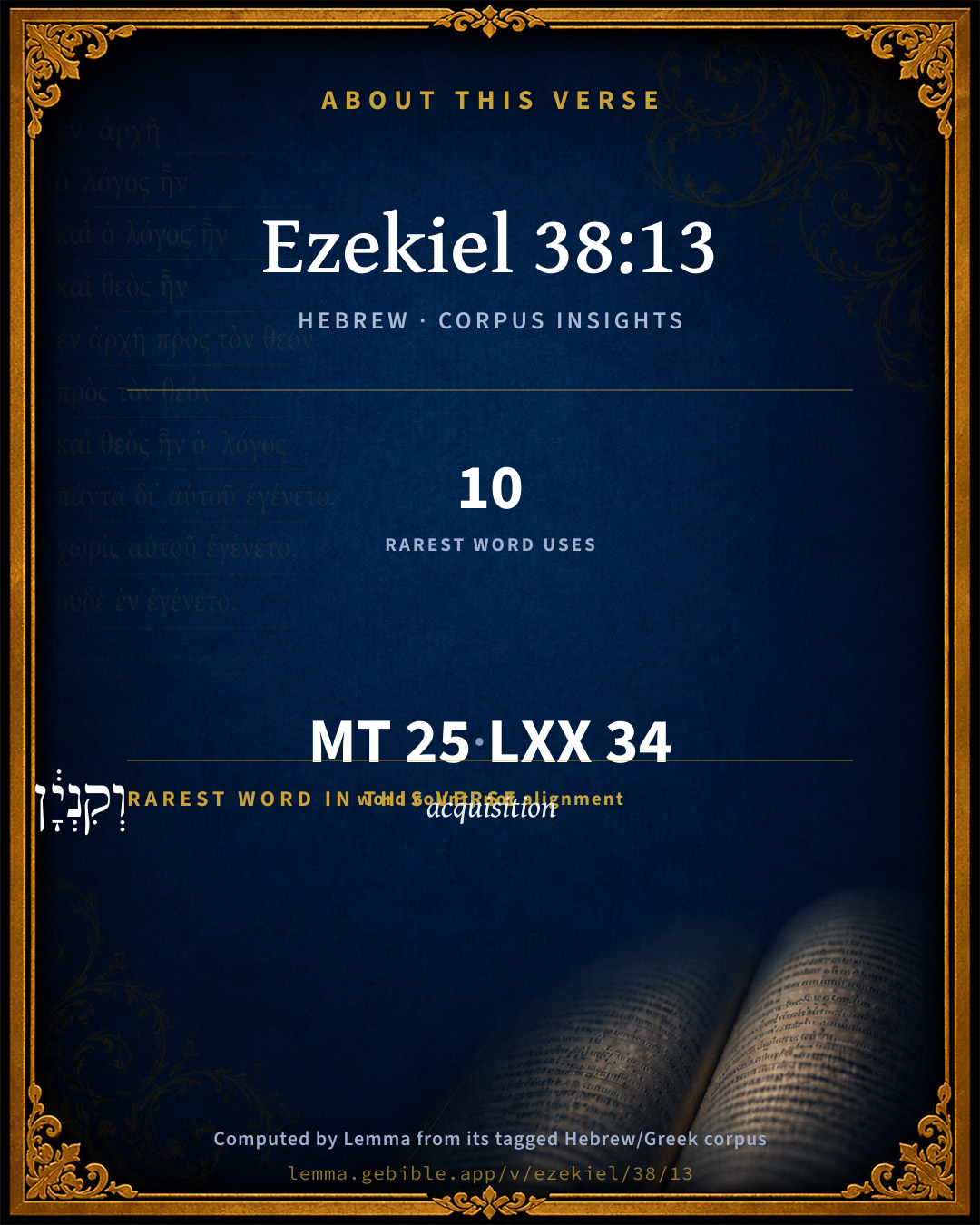
These counts appear in no published source. They are computed here, from the morphology-tagged text and Lemma’s own curated glosses. What Lemma adds →

25
words
22
distinct lemmas
Prophets
section

Notable vocabulary

The rarest word here is וְקִנְיָ֔ן acquisition H7075 — appearing just 10 times in the whole Hebrew Bible.

Shared distinctive vocabulary

וְקִנְיָ֔ן acquisition H7075 occurs in 10 verses of the Hebrew Bible. Also found in:

Grammatical profile

  • 9 verbs
  • 13 nouns
  • 1 adjective
  • 1 pronoun
  • 1 preposition

Verb forms

  • וְסֹחֲרֵ֨י Qal · Participle Active
  • יֹאמְר֣וּ Qal · Imperfect
  • הֲלִשְׁלֹ֤ל Qal · Infinitive Construct
  • בָ֔א Qal · Participle Active
  • הֲלָבֹ֥ז Qal · Infinitive Construct
  • הִקְהַ֣לְתָּ Hiphil · Perfect
  • לָשֵׂ֣את Qal · Infinitive Construct
  • לָקַ֨חַת֙ Qal · Infinitive Construct
  • לִשְׁלֹ֖ל Qal · Infinitive Construct

Repetition

Words recur within this verse — often emphatic in Hebrew:

  • הֲלִשְׁלֹ֤ל to plunder H7997 ×2
  • שָׁלָל֙ plunder H7998 ×2

Hebrew & Septuagint length

In English translation the verse runs 50 words from the Hebrew and 44 from the Septuagint (LXX English) — closely comparable.

A rough comparison of the two English renderings, which tokenize alike — not a word-level alignment.

Word counts can differ between the Hebrew and the Greek without any difference in meaning — e.g. the Hebrew direct-object marker אֵת has no separate Greek word, and Greek often adds the article ὁ.

In the original languages it is 25 Hebrew tokens and 34 Greek tokens — but the two are counted differently (Hebrew bundles its prefixes and suffixes into one token; the Greek is in lemma form), so that isn’t a like-for-like length.

Cross-references

15

Topical passages linked to Ezekiel 38:13 in the Treasury of Scripture Knowledge — connected by theme and wording, ordered by reader-vote popularity; previews shown in the World English Bible.

  • Ezekiel 27:15 The men of Dedan were your traffickers; many isles were the market of your hand: they brought you in exchange horns of ivory and ebony.
  • Ezekiel 27:22–23 The traffickers of Sheba and Raamah, they were your traffickers; they traded for your wares with the chief of all spices, and with all precious stones, and gold.
  • Ezekiel 32:2 Son of man, take up a lamentation over Pharaoh king of Egypt, and tell him, You were likened to a young lion of the nations: yet are you as a monster in the seas; and you did break forth with your rivers, and troubled the waters with your feet, and fouled their rivers.
  • Isaiah 10:6 I will send him against a profane nation, and against the people of my wrath will I give him a charge, to take the spoil, and to take the prey, and to tread them down like the mire of the streets.
  • Jeremiah 51:38 They shall roar together like young lions; they shall growl as lions' cubs.
  • Ezekiel 19:3–6 She brought up one of her cubs: he became a young lion, and he learned to catch the prey; he devoured men.
  • Ezekiel 25:13 therefore thus says the Lord Yahweh, I will stretch out my hand on Edom, and will cut off man and animal from it; and I will make it desolate from Teman; even to Dedan shall they fall by the sword.
  • Ezekiel 27:12 Tarshish was your merchant by reason of the multitude of all kinds of riches; with silver, iron, tin, and lead, they traded for your wares.
  • Ezekiel 27:20 Dedan was your trafficker in precious cloths for riding.
  • Ezekiel 27:25 The ships of Tarshish were your caravans for your merchandise: and you were replenished, and made very glorious in the heart of the seas.
  • Nahum 2:11–13 Where is the den of the lions, and the feeding-place of the young lions, where the lion and the lioness walked, the lion's cubs, and no one made them afraid?
  • Psalms 57:4 My soul is among lions. I lie among those who are set on fire, Even the sons of men, whose teeth are spears and arrows, And their tongue a sharp sword.
  • Jeremiah 15:13 Your substance and your treasures will I give for a spoil without price, and that for all your sins, even in all your borders.
  • Jeremiah 50:17 Israel is a hunted sheep; the lions have driven him away: first, the king of Assyria devoured him; and now at last Nebuchadrezzar king of Babylon has broken his bones.
  • Zechariah 11:3 A voice of the wailing of the shepherds! For their glory is destroyed: a voice of the roaring of young lions! For the pride of the Jordan is ruined.

Cross-references courtesy of OpenBible.info (CC BY 4.0).

Hebrew and Greek witnesses Masoretic Hebrew ↔ Greek Septuagint

The same verse in the two great witnesses to the Old Testament, shown verse-for-verse.

These are two independent witnesses, not word-aligned to each other, and the Septuagint is shown in lemma (dictionary) form.

Hebrew Ezekiel 38:13 Masoretic · Westminster Leningrad Codex

שְׁבָ֡א וּ֠דְדָן וְסֹחֲרֵ֨י תַרְשִׁ֤ישׁ וְכָל כְּפִרֶ֨יהָ֙ יֹאמְר֣וּ לְךָ֔ הֲלִשְׁלֹ֤ל שָׁלָל֙ אַתָּ֣ה בָ֔א הֲלָבֹ֥ז בַּ֖ז הִקְהַ֣לְתָּ קְהָלֶ֑ךָ לָשֵׂ֣את כֶּ֣סֶף וְזָהָ֗ב לָקַ֨חַת֙ מִקְנֶ֣ה וְקִנְיָ֔ן לִשְׁלֹ֖ל שָׁלָ֥ל גָּדֽוֹל

Sheba, and Dedan, and the merchants of Tarshish, with all the young lions of it, shall tell you, Are you come to take the spoil? have you assembled your company to take the prey? to carry away silver and gold, to take away cattle and goods, to take great spoil?

World English Bible · Public Domain

Greek LXX Ezekiel 38:13 Septuagint · lemma form

σαβα καί δαιδαν καί ἔμπορος καρχηδόνιοι καί πᾶς ὁ κώμη αὐτός εἶπον σύ εἰς προνομή ὁ προνομεύω σύ ἔρχομαι καί σκυλεύω σκῦλον συνἄγω συναγωγή σύ λαμβάνω ἀργύριον καί χρυσίον ἀποφέρω κτῆσις ὁ σκυλεύω σκῦλον

Sabba, and Daedan, and Carthaginian merchants, and all their villages shall say to you, You are come for plunder to take a prey, and to get spoils: you have gathered your multitude to take silver and gold, to carry off property, to take spoils.

LXX2012 (modern English Septuagint) · Public Domain

On this verse, Haydock's Catholic Bible Commentary discusses the Septuagint’s reading. Read the note in Commentary ↓

Hebrew: Westminster Leningrad Codex (CC BY 4.0). Greek: Septuagint (public domain); English from LXX2012 (modern English Septuagint) (Public Domain). How the Septuagint differs from the Hebrew →

Targum (Aramaic paraphrase)

1

The Targum is the ancient Jewish Aramaic paraphrase of the Hebrew Scriptures — an interpretive translation, not the Hebrew text itself. Onkelos (literal) and Pseudo-Jonathan (expansive) render the Torah, and Jonathan the Prophets. Coverage is partial: where no permissively-licensed English translation exists for a verse, only the Aramaic is shown. This is verse-level text, not a word-by-word alignment to the Hebrew.

  1. Targum Jonathan Prophets (Joshua–Malachi)
    שְׁבָא וּדְדָן וְתַגְרֵי יַמָא וְכָל מַלְכָּהָא יֵימְרוּן לָךְ הַלְמִבַּז בִּזָא אַתְּ אָתֵי הַלְמֶעֱדֵי עָדָאָה כְּנִישַׁת מַשִׁרְיָתָךְ לְמִיסַב כְּסַף וּדְהַב לְמַשְׁבֵי נִכְסִין וְקִנְיָנִין לְמֶעְדֵי עֲדִי סַגִי:

    (no public-domain English translation for this verse)

    Targum Jonathan — Aramaic: “Mikraot Gedolot” (public domain). English: “Sefaria Community Translation” (CC0 1.0 (public-domain dedication)); “London "Chaldee Paraphrase," 1871” (public domain). Text via Sefaria.

Commentary

Notes on Ezekiel 38:13 from classic Christian and Jewish commentators (each source and its license shown beneath its notes). The classic Christian expositions comment on the surrounding passage and are grouped to its opening verse, so a note may address several verses; the Jewish commentaries on the Tanakh (Rashi and others) are per-verse, so they appear only where the commentator wrote on this verse.

Lemma curates 59 commentaries, every one of them public domain or Creative Commons licensed, each selected and text-cleaned for this edition rather than reprinted as found. About our sources →

Trapp's Complete Commentary

John Trapp

Eze 38:13 Sheba, and Dedan, and the merchants of Tarshish, with all the young lions thereof, shall say unto thee, Art thou come to take a spoil? hast thou gathered thy company to take a prey? to carry away silver and gold, to take away cattle and goods, to take a great spoil?

Ver. 13. Sheba and Dedan.] The Arabians, who lived by roving and robbing.

With all the young lions.] That lie in wait for gain, as lions do for prey.

Art thou come to take a prey?] q.d., If thou art, we are ready to set in with thee, or to traffic with thee for it. Mohammed came of these Arabians; the Pope hath his money merchants’ great store. {Rev 18:3-17}

John Trapp, A Commentary or Exposition upon All the Books of the Old and New Testament (1647–1656) — public domain. Text from a community e-Sword module.

Tyndale Open Study Notes

Tyndale Open Resources

38:13 The merchant nations of the world, from Sheba and Dedan in the east to Tarshish in the west, would line up to market the spoils from the apparently sure victory of Gog and his allies.

Tyndale Open Study Notes — © Tyndale Open Resources, licensed CC BY-SA 4.0. Text via the HelloAO Bible API.

Geneva Bible (1599)

Geneva Bible translators

One enemy shall envy another because everyone shall think to have the spoil of the Church.

Geneva Bible (1599) marginal notes — public domain. Text via Bolls.life.

Jamieson, Fausset & Brown

Robert Jamieson, A. R. Fausset & David Brown

Sheba, &c.--These mercantile peoples, though not taking an active part against the cause of God, are well pleased to see others do it. Worldliness makes them ready to deal in the ill-gotten spoil of the invaders of God's people. Gain is before godliness with them (1 Maccabees 3:41).

young lions--daring princes and leaders.

Jamieson, Fausset & Brown — Commentary Critical and Explanatory on the Whole Bible (1871) — public domain (CC PDM 1.0). Text via the HelloAO Bible API.

Adam Clarke's Commentary

Verse 13. Sheba, and Dedan] The Arabians, anciently great plunderers; and Tarshish, the inhabitants of the famous isle of Tartessus, the most noted merchants of the time. They are here represented as coming to Antiochus before he undertook the expedition, and bargaining for the spoils of the Jews. Art thou come to take a spoil, to carry away silver and gold, cattle and goods?

Adam Clarke's Commentary on the Bible (1810–1826) — public domain. Text from a community e-Sword/MySword module.

Ellicott's Commentary for English Readers

(13) Sheba, and Dedan . . . . Tarshish.—The first two are districts of Arabia, and the last is probably the Tartessus in Spain. These names seem to be added to those of Eze_38:5-6, to show that all the nations of the world sympathise in this attack upon the Church.

A Bible Commentary for English Readers, edited by Charles John Ellicott (1878–1897) — public domain. Text from a community e-Sword module.

The Cambridge Bible for Schools and Colleges

gen. ed. J. J. S. Perowne

13. The merchant peoples are roused to excitement by the enterprise of Gog; probably it is the hope of gain by trafficking with him for his spoil that excites them—hardly envy at the rich harvest lying before him. On Sheba Eze_27:22; Dedan Eze_27:20; Tarshish Eze_27:12.

all the young lions] Cf. Eze_19:3; Eze_19:5, Eze_32:2. The term might be thought not very suitable to a troop of camp followers intent merely on traffic. The term is probably used generally to describe the eminence of these merchant people—hardly to represent them as thirsting for gain, as lions for prey!

The Cambridge Bible for Schools and Colleges (gen. ed. J. J. S. Perowne; Cambridge University Press, 1878–1918) — public domain. Text from a community e-Sword module.

John Gill's Exposition

Therefore, son of man, prophesy, and say unto Gog,.... Since these are his thoughts and designs, and those his big words, and which he will endeavour to put in practice, and be applauded for it by others; deliver this prophecy to him, or concerning him:

thus saith the Lord God, in that day when my people of Israel dwelleth safely, shall thou not know it? that Israel are returned to their own land? that they dwell in it safely? that they have abundance of cattle, gold, and silver that they have no walls, gates, and bars to protect them? that they live without fear or suspicion of any enemy to annoy them, and therefore may be easily surprised and taken? this, when it comes to pass, will soon be known by the Turks, through their spies and informers: or, "shall thou not know?" (q) or experience the divine vengeance for thy wicked thoughts, intentions, and attempts against Israel? he should. So the Targum,

"shalt thou not know the vengeance of my power?''

or shalt thou not know that all attempts to make them uneasy and uncomfortable will be in vain?

(q) "experturus esses", Junius & Tremellius; "experieris, scil. poenam meam", Piscator.

John Gill's Exposition of the Whole Bible (1746–1763) — public domain (CC PDM 1.0). Text via the HelloAO Bible API.

Haydock's Catholic Bible Commentary

Tharsis. Septuagint, "Carthage, and all their villages." The merchants or naval forces of Cambyses spurred him forward, (see Psalm lxxvii. 6.) as well as the Arabs, Cuthites, &c., 1 Esdras iv. 8. (Calmet)

George Leo Haydock (1774–1849), Haydock's Catholic Family Bible and Commentary, 1859 edition — public domain. Excludes Psalms (Douay-Rheims chapter numbering differs from Protestant) and Deuterocanonical books (Catholic canon only).

Matthew Poole's English Annotations

Sheba: see Eze 27:22; this Sheba was southward, and contains all of that coast which assisted Gog.

Dedan; Idumeans, or the most easterly parts of Arabia Deserta: by these are noted the eastern nations that assisted, say some.

The merchants of Tarshish; the inhabitants of the sea-coast westward, and Magog north. Robbers by land on three sides, pirates by sea on the fourth, in a confederacy to spoil the church of God.

The young lions; young men thirsty of blood, but more of spoil, flock to Gog, resolved to join, if they may rob and spoil for themselves.

Art thou come to take a spoil? this repeated inquiry made by these, I suppose, is not so much to sound the intentions of Gog, as it is a capitulation and agreement to come to his assistance; and on condition they might have, possess, and carry away what they seize, they are for him; and they mention particulars,

silver, gold, cattle, goods. They are thus exact, out of foresight what little part they might have without such a compact.

Matthew Poole's English Annotations on the Holy Bible (1683–1685) — public domain. Text from a community e-Sword/MySword module.

Whedon's Commentary on the Bible

Daniel D. Whedon

13. For Sheba, Dedan, and Tarshish see notes Eze_27:20; Eze_27:22; Eze_27:25. The prominent and prosperous condition of the new Israel (Eze_38:12) and the terrific attack of Gog upon it draw the attention of these states and the young lions thereof. If the text is correct, compare Eze_29:3; Eze_29:6. Cornill reads, “traffickers thereof.” Slave dealers and other traders always hang upon the heels of an oriental army. (Compare Isa_23:8.)

Daniel D. Whedon (gen. ed.), Commentary on the Old and New Testaments (1874–1909) — public domain. Text from a community e-Sword module.

The Pulpit Commentary

Sheba, and Dorian, and the merchants of Tarshish were the great trading communities of the South, East, and West respectively. (see on Eze_27:15, Eze_27:20, Eze_27:22, Eze_27:25) The young lions thereofi.e. of Tarshish, not of the other communities (Keil) were probably intended to represent, not the" authorities" of Tarshish, as Hitzig suggests, but its smaller tradesmen who were equally rapacious with its larger merchants. All are depicted as following in the wake of Gog, like vultures in the rear of an army, and as inquiring whether Gog had come simply for the purpose of destruction or in the hope of trading with the booty he should capture. In this case they intimate their wish to be partakers of the spoil This (Plumptre), rather than the thirst for booty which characterized them (Keil), their question to Gog signified; Schroder"s idea, that they purposed ironically to ridicule the smallness of the spoil which would reward so gigantic an expedition, has as little to recommend it as Kliefoth"s suggestion, that they designed to intimate their sympathy with Gog"s invasion of Israel.

The Pulpit Commentary (1880–1919), ed. H.D.M. Spence-Jones & Joseph S. Exell — public domain. Text from a community e-Sword module.

John Wesley's Explanatory Notes

Sheba - This Sheba was southward, and contains all of that coast which assisted Gog. Dedan - By these are noted, the eastern nations that assisted. Tarshish - The inhabitants of the sea-coast westward, and Magog north. The young lions - Young men thirsty of blood, but more of spoil, resolve to join, if they may rob and spoil for themselves. Art thou come - This repeated enquiry seems to be an agreement to come to his assistance, on condition they might have, possess, and carry away what they seize.

John Wesley, Explanatory Notes Upon the Whole Bible (1754–1765) — public domain. Text via the GEBible commentary corpus.

unfoldingWord translationNotes

Door43 World Missions Community

Connecting Statement:

Yahweh continues speaking to Gog.

Sheba

See how you translated this in Ezekiel 27:22.

Dedan

See how you translated this in Ezekiel 25:13.

Have you come to plunder? Have you assembled your armies ... to haul away much plunder?

These two questions are used to accuse Gog of attacking Israel without cause. These can be translated as statements. AT: "It is not right for you to assemble your army to plunder, to carry off silver and gold, to take their livestock and property, and to haul away much plunder!" (See: Rhetorical Question)

to take their livestock and property ... to haul away much plunder

These phrases have similar meaning and can be combined into a single phrase. AT: "to take away their livestock and all their valuable possessions" (See: Doublet)

translationWords

Tarshish

gold

livestock

unfoldingWord translationNotes — © Distant Shores Media and the Door43 World Missions Community, licensed CC BY-SA 4.0. Source: git.door43.org/Door43/en_tn.

Rashi

Rabbi Shlomo Yitzchaki (Rashi)

and all its magnates [Heb. כְּפִירֶיהָ,] shrewd merchants therein, who are accustomed to roam, like young lions (כְּפִירִים), in all the countries and who know where the place of riches is.

Are you coming to take spoil i.e., who told you the place of the riches? Did you know [for a fact] that you are going to a land full of spoil and loot, and that there you will really find powerful wealth?

Rashi on the Tanakh — English translations: “The Judaica Press complete Tanach with Rashi, translated by A. J. Rosenberg” (CC BY 4.0); “Pentateuch with Rashi's commentary by M. Rosenbaum and A.M. Silbermann, 1929-1934” (public domain); “The Metsudah Tanach series, Lakewood, N.J” (CC BY 4.0); and “The Book of Joshua, Metsudah Publications, 1997” (CC BY 4.0). Text via Sefaria.

Lesson kit

Teaching starters — assembled from the data on this page, not authored interpretation. Every prompt links to the verse data it draws on. Edit before teaching.

Ezekiel, in the Prophets, opens this verse with 25 words (22 distinct Hebrew lemmas). Its most distinctive word is qinyân (“acquisition”). A historical commentator’s framing appears above. Read the whole chapter for the surrounding context.

Discussion questions

  1. How does “acquisition” (qinyân) shape what this verse is saying?
  2. Genesis 31:18 shares the word «acquisition» with this verse. How do the two illuminate each other?
  3. “to plunder” occurs 2× in this one verse. What is the effect of the repetition?
  4. The translations on this page render this verse differently — a whole-verse word diff, not a word-by-word alignment. What might account for the different wordings?
  5. The verb «וְסֹחֲרֵ֨י» is Qal Participle Active. How does its form color the action?
  6. Reading how Trapp's Complete Commentary and Tyndale Open Study Notes read this verse, where do the two commentators agree and where do they part?

Things to notice

Reading settings

Reading text

Shown beneath each verse's original-language words.

Old Testament
Old Testament edition

Read the OT as the Masoretic Hebrew (MT) or the Greek Septuagint (LXX).

English shown for the Greek Septuagint (in the Hebrew ↔ Greek comparison).

Comparing translations? Open the Compare panel on any verse page to stack up to four side by side.