
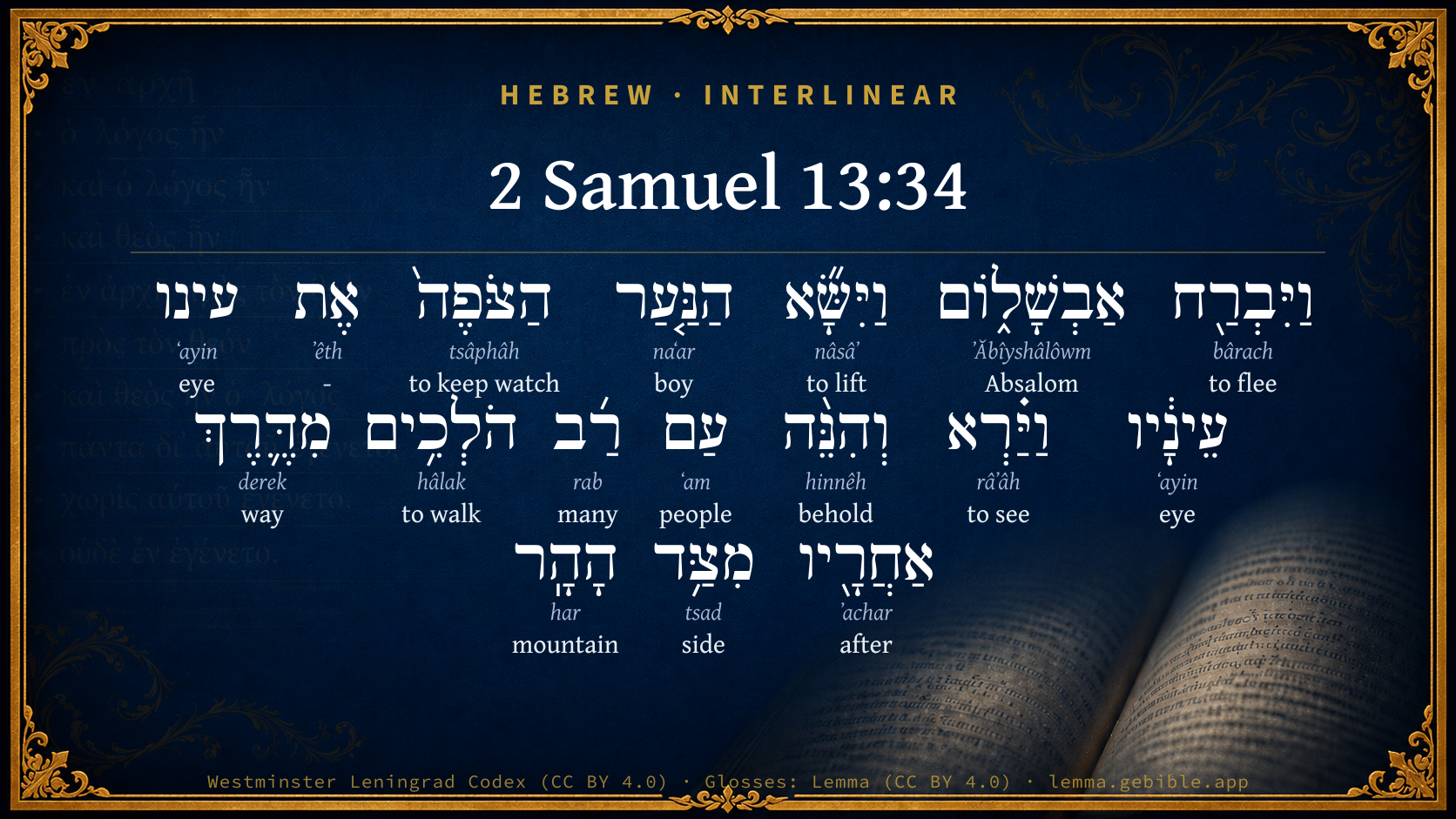
2 Samuel 13:34

Hebrew (Westminster Leningrad Codex) 2 Samuel 13:34 appears in the Hebrew Old Testament. The text above is from the Westminster Leningrad Codex. Each word links to its Strong’s number, a concise gloss, and parsing drawn from the Open Scriptures Hebrew Bible morphology. Click any word for its full Brown-Driver-Briggs (BDB) entry.
Download image
Cite this verse

2 Samuel 13:34 (World English Bible). Public Domain. Lemma interlinear Bible study tool, https://lemma.gebible.app/v/2-samuel/13/34.

Show BibTeX & RIS
BibTeX
RIS
English Translation
But Absalom fled. The young man who kept the watch lifted up his eyes, and looked, and, behold, there came much people by the way of the hill-side behind him.
World English Bible · Public Domain
Download a study sheet

One document with this verse’s original text, its word-by-word gloss line, the meaning frame, cross-references with their text, attributed commentary, and full source and license credits — printable, and it pastes into notes with its structure intact.

This verse Autodidact and up

Study sheet (.html) Plain text (.txt)

A passage Seminary Student

Up to 50 verses in one chapter. A passage sheet keeps up to 6 commentary sources and 12 cross-references per verse, in the order this page ranks them, and says so on the sheet whenever that leaves anything out. Ask for a single verse and you get the Autodidact verse sheet above.

Everything on this page stays free to read, with no account — the sheet is a download of what is already on screen, not access to it.

Want to remove ads? Support Godless Engineer
Compare translations 3

The same verse in 3 English versions, stacked beneath the original-language interlinear above. Click any original word for its lexicon entry.

Each is an independent rendering of the whole verse — the interlinear is not word-aligned to these translations.

Highlighted words mark where these versions differ — a whole-verse word diff, not a word-by-word alignment.

  • World English Bible Public Domain
    But Absalom fled. The young man who kept the watch lifted up his eyes, and looked, and, behold, there came much people by the way of the hill-side behind him.
  • King James Version Public Domain
    But Absalom fled. And the young man that kept the watch lifted up his eyes, and looked, and, behold, there came much people by the way of the hill side behind him.
  • unfoldingWord Literal Text CC BY-SA 4.0
    (Now Absalom had fled.) And the young man watching lifted his eyes, and he saw, and behold, many people were coming from the road behind him, from the side of the mountain.

unfoldingWord Literal Text — © unfoldingWord, licensed CC BY-SA 4.0. Word-aligned USFM3 via Door43 (git.door43.org/unfoldingWord/en_ult).

Versions to compare (up to 4)

3 of 4 selected

Show all 18 translations

Every available English version of this verse, each an independent rendering of the whole verse.

  • World English Bible Public Domain
    But Absalom fled. The young man who kept the watch lifted up his eyes, and looked, and, behold, there came much people by the way of the hill-side behind him.
  • Berean Standard Bible Public Domain
    Meanwhile, Absalom had fled. When the young man standing watch looked up, he saw many people coming down the road west of him, along the side of the hill. And the watchman went and reported to the king, “I see men coming from the direction of Horonaim, along the side of the hill.”
  • Majority Standard Bible Public Domain
    Meanwhile, Absalom had fled. When the young man standing watch looked up, he saw many people coming down the road west of him, along the side of the hill. And the watchman went and reported to the king, “I see men coming from the direction of Horonaim, along the side of the hill.”
  • King James Version Public Domain
    But Absalom fled. And the young man that kept the watch lifted up his eyes, and looked, and, behold, there came much people by the way of the hill side behind him.
  • American Standard Version (1901) Public Domain
    But Absalom fled. And the young man that kept the watch lifted up his eyes, and looked, and, behold, there came much people by the way of the hill-side behind him.
  • Revised Version (1885) Public Domain
    But Absalom fled. And the young man that kept the watch lifted up his eyes, and looked, and, behold, there came much people by the way of the hill side behind him.
  • Geneva Bible (1599) Public Domain
    Then Absalom fled: and the yong man that kept the watch, lift vp his eyes, and looked, and behold, there came much people by the way of the hill side behinde him.
  • Douay-Rheims (1899) Public Domain
    But Absalom fled away: and the young man that kept the watch, lifted up his eyes and looked, and behold there came much people by a by-way on the side of the mountain.
  • Young's Literal Translation Public Domain
    And Absalom fleeth, and the young man who is watching lifteth up his eyes and looketh, and lo, much people are coming by the way behind him, on the side of the hill.
  • Literal Standard Version CC BY-SA 4.0
    And Absalom flees, and the young man who is watching lifts up his eyes and looks, and behold, many people are coming by the way behind him, on the side of the hill.
  • Unlocked Literal Bible CC BY-SA 4.0
    Absalom fled away. A servant keeping watch raised his eyes and saw many people coming on the road on the hillside west of him.
  • unfoldingWord Literal Text CC BY-SA 4.0
    (Now Absalom had fled.) And the young man watching lifted his eyes, and he saw, and behold, many people were coming from the road behind him, from the side of the mountain.
  • Darby Bible Public Domain
    And Absalom fled. And the young man that watched lifted up his eyes and looked, and behold, there came much people from the way behind him, from the hill-side.
  • World Messianic Bible Public Domain
    But Absalom fled. The young man who kept the watch lifted up his eyes and looked, and behold, many people were coming by way of the hillside behind him.
  • Webster's Bible Public Domain
    But Absalom fled. And the young man that kept the watch lifted up his eyes, and looked, and behold, there came many people by the way of the hillside behind him.
  • Free Bible Version CC BY-SA 4.0
    In the meantime, Absalom had run away. When the watchman in Jerusalem looked out, he saw a large crowd coming along the road west of him, down the side of the hill.
  • Bible in Basic English Public Domain
    But Absalom went in flight. And the young man who kept the watch, lifting up his eyes, saw that a great band of people was coming down the slope by the way of the Horons; and the watchman came and gave word to the king, saying, I saw men coming down by the way of the Horons, from the hillside.
  • JPS Tanakh (1917) Public Domain
    But Absalom fled. And the young man that kept the watch lifted up his eyes, and looked, and, behold, there came much people in a roundabout way by the hill-side.

Literal Standard Version (2020), Covenant Press — licensed CC BY-SA 4.0. Text via the HelloAO Bible API (eBible.org). Unlocked Literal Bible (unfoldingWord) — licensed CC BY-SA 4.0. Text via the HelloAO Bible API (eBible.org). unfoldingWord Literal Text — © unfoldingWord, licensed CC BY-SA 4.0. Word-aligned USFM3 via Door43 (git.door43.org/unfoldingWord/en_ult). Free Bible Version, Dr. Jonathan Gallagher — licensed CC BY-SA 4.0. Text via the HelloAO Bible API (eBible.org).

Word by word

More ways to search: Search by grammar → Find every occurrence → Compare this word →

Practice this passage: Drill this verse → Learn its vocabulary →

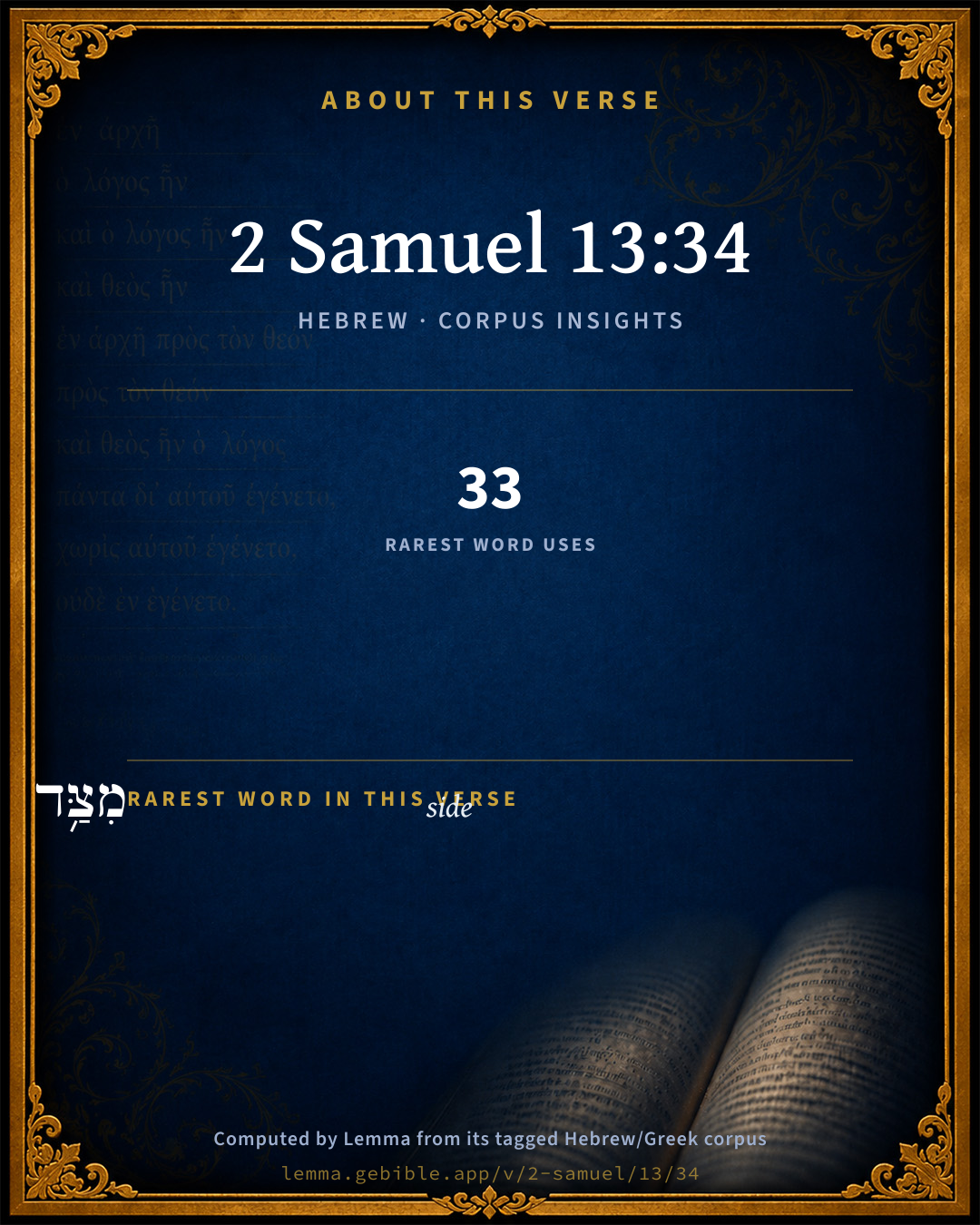
מִצַּ֥ד
tsad
H6654
“from · side of”
Preposition + Noun, Common, Masculine, Singular, Construct
Part of Speech
Preposition + Noun
Type
Common
Gender
Masculine
Number
Singular
State
Construct
Full BDB Definition

Origin: contr from an unused root meaning to sidle off

TWOT: 1876a

side
  1. וַיִּבְרַ֖ח bârach H1272 “and · to flee” Conjunction + Verb, Qal, Sequential Imperfect, 3rd Person, Masculine, Singular
  2. אַבְשָׁל֑וֹם ʼĂbîyshâlôwm H53 “Absalom” Noun, Proper
  3. וַיִּשָּׂ֞א nâsâʼ H5375 “and · to lift” Conjunction + Verb, Qal, Sequential Imperfect, 3rd Person, Masculine, Singular
  4. הַנַּ֤עַר naʻar H5288 “the · boy” Particle, Definite Article + Noun, Common, Masculine, Singular, Absolute
  5. הַצֹּפֶה֙ tsâphâh H6822 “the · keeping watch” Particle, Definite Article + Verb, Qal, Participle Active, Masculine, Singular, Absolute
  6. אֶת ʼêth H853 “-” Particle, Direct Object
  7. עינו ʻayin H5869 “eyes · his” Noun, Common, Both, Dual, Construct + Suffix, Personal, 3rd Person, Masculine, Singular
  8. עֵינָ֔יו ʻayin H5869 “eyes · his” Noun, Common, Both, Dual, Construct + Suffix, Personal, 3rd Person, Masculine, Singular
  9. וַיַּ֗רְא râʼâh H7200 “and · to see” Conjunction + Verb, Qal, Sequential Imperfect, 3rd Person, Masculine, Singular
  10. וְהִנֵּ֨ה hinnêh H2009 “and · behold” Conjunction + Particle, Demonstrative
  11. עַם ʻam H5971 “people” Noun, Common, Masculine, Singular, Absolute
  12. רַ֜ב rab H7227 “many” Adjective, Adjective, Masculine, Singular, Absolute
  13. הֹלְכִ֥ים hâlak H1980 “walking” Verb, Qal, Participle Active, Masculine, Plural, Absolute
  14. מִדֶּ֛רֶךְ derek H1870 “from · way” Preposition + Noun, Common, Both, Singular, Absolute
  15. אַחֲרָ֖יו ʼachar H310 “after · him” Preposition + Suffix, Personal, 3rd Person, Masculine, Singular
  16. הָהָֽר har H2022 “the · mountain” Particle, Definite Article + Noun, Common, Masculine, Singular, Absolute

About this verse

These counts appear in no published source. They are computed here, from the morphology-tagged text and Lemma’s own curated glosses. What Lemma adds →

17
words
16
distinct lemmas
Historical
section

Shared distinctive vocabulary

מִצַּ֥ד side H6654 occurs in 27 verses of the Hebrew Bible. Also found in:

Grammatical profile

  • 5 verbs
  • 8 nouns
  • 1 adjective
  • 1 preposition
  • 2 particles

Verb forms

  • וַיִּבְרַ֖ח Qal · Sequential Imperfect
  • וַיִּשָּׂ֞א Qal · Sequential Imperfect
  • הַצֹּפֶה֙ Qal · Participle Active
  • וַיַּ֗רְא Qal · Sequential Imperfect
  • הֹלְכִ֥ים Qal · Participle Active

Repetition

A word recurs within this verse — often emphatic in Hebrew:

Hebrew & Septuagint length

In English translation the verse runs 30 words from the Hebrew and 59 from the Septuagint (LXX English) — the Septuagint runs noticeably longer here. See the side-by-side →

A rough comparison of the two English renderings, which tokenize alike — not a word-level alignment.

Word counts can differ between the Hebrew and the Greek without any difference in meaning — e.g. the Hebrew direct-object marker אֵת has no separate Greek word, and Greek often adds the article ὁ.

Cross-references

4

Topical passages linked to 2 Samuel 13:34 in the Treasury of Scripture Knowledge — connected by theme and wording, ordered by reader-vote popularity; previews shown in the World English Bible.

  • Genesis 4:8–14 Cain said to Abel, his brother, "Let's go into the field." It happened, when they were in the field, that Cain rose up against Abel, his brother, and killed him.
  • 2 Samuel 13:37–38 But Absalom fled, and went to Talmai the son of Ammihur, king of Geshur. [David] mourned for his son every day.
  • Proverbs 28:17 A man who is tormented by life blood will be a fugitive until death; No one will support him.
  • Amos 5:19 As if a man fled from a lion, And a bear met him; Or he went into the house and leaned his hand on the wall, And a snake bit him.

Cross-references courtesy of OpenBible.info (CC BY 4.0).

Hebrew and Greek witnesses Masoretic Hebrew ↔ Greek Septuagint

The same verse in the two great witnesses to the Old Testament, shown verse-for-verse.

Here the Septuagint runs noticeably longer than the Hebrew — LXX2012 (modern English Septuagint) 59 words vs World English Bible 30. A rough length comparison of the two English translations, not a word-level alignment — read both below.

These are two independent witnesses, not word-aligned to each other, and the Septuagint is shown in lemma (dictionary) form.

Hebrew 2 Samuel 13:34 Masoretic · Westminster Leningrad Codex

וַיִּבְרַ֖ח אַבְשָׁל֑וֹם וַיִּשָּׂ֞א הַנַּ֤עַר הַצֹּפֶה֙ אֶת עינו עֵינָ֔יו וַיַּ֗רְא וְהִנֵּ֨ה עַם רַ֜ב הֹלְכִ֥ים מִדֶּ֛רֶךְ אַחֲרָ֖יו מִצַּ֥ד הָהָֽר

But Absalom fled. The young man who kept the watch lifted up his eyes, and looked, and, behold, there came much people by the way of the hill-side behind him.

World English Bible · Public Domain

Greek LXX 2 Samuel 13:34 Septuagint · lemma form

καί ἀποδιδράσκω αβεσσαλωμ καί αἴρω ὁ παιδάριον ὁ σκοπός ὁ ὀφθαλμός αὐτός καί ὁράω καί ὁράω λαός πολύς πορεύομαι ἐν ὁ ὁδός ὄπισθε αὐτός ἐκ πλευρά ὁ ὄρος ἐν ὁ κατάβασις καί παραγίγνομαι ὁ σκοπός καί ἀποἀγγέλλω ὁ βασιλεύς καί εἶπον ἀνήρ ὁράω ἐκ ὁ ὁδός ὁ ωρωνην ἐκ μέρος ὁ ὄρος

And Abessalom escaped: and the young man the watchman, lifted up his eyes, and looked; and, behold, much people went in the way behind him from the side of the mountain in the descent: and the watchman came and told the king, and said, I have seen men by the way of Oronen, by the side of the mountain.

LXX2012 (modern English Septuagint) · Public Domain

Hebrew: Westminster Leningrad Codex (CC BY 4.0). Greek: Septuagint (public domain); English from LXX2012 (modern English Septuagint) (Public Domain). How the Septuagint differs from the Hebrew →

Targum (Aramaic paraphrase)

1

The Targum is the ancient Jewish Aramaic paraphrase of the Hebrew Scriptures — an interpretive translation, not the Hebrew text itself. Onkelos (literal) and Pseudo-Jonathan (expansive) render the Torah, and Jonathan the Prophets. Coverage is partial: where no permissively-licensed English translation exists for a verse, only the Aramaic is shown. This is verse-level text, not a word-by-word alignment to the Hebrew.

  1. Targum Jonathan Prophets (Joshua–Malachi)
    וַעֲרַק אַבְשָׁלוֹם וּזְקֵף עוּלֵימָא סַכְוָאָה יַת עֵינוֹהִי וַחֲזָא וְהָא עַם סַגִי אָתָן מֵאוֹרַח מֵאֲחוֹרוֹהִי מִסְטַר טוּרָא:

    (no public-domain English translation for this verse)

    Targum Jonathan — Aramaic: “Mikraot Gedolot” (public domain). English: “Sefaria Community Translation” (CC0 1.0 (public-domain dedication)); “London "Chaldee Paraphrase," 1871” (public domain). Text via Sefaria.

Commentary

Notes on 2 Samuel 13:34 from classic Christian and Jewish commentators (each source and its license shown beneath its notes). The classic Christian expositions comment on the surrounding passage and are grouped to its opening verse, so a note may address several verses; the Jewish commentaries on the Tanakh (Rashi and others) are per-verse, so they appear only where the commentator wrote on this verse.

Lemma curates 59 commentaries, every one of them public domain or Creative Commons licensed, each selected and text-cleaned for this edition rather than reprinted as found. About our sources →

Trapp's Complete Commentary

John Trapp

2Sa 13:34 But Absalom fled. And the young man that kept the watch lifted up his eyes, and looked, and, behold, there came much people by the way of the hill side behind him.

Ver. 34. But Absalom fled.] If he had stayed, he should by right have been served as our king Richard I used to serve murderers: he caused such to be tied to the murdered, and buried with him quickly.

Lifted up his eyes, and looked.] And by the sound of his trumpet signified what he had seen.

By the way of the hill side,] viz., Between Baalhazer and Jerusalem: which were eight miles apart, saith Hen. Bunting. {a}

{a} Patr., Trav.

John Trapp, A Commentary or Exposition upon All the Books of the Old and New Testament (1647–1656) — public domain. Text from a community e-Sword module.

Joseph Benson's Commentary

2Sa 13:34. Absalom fled — He was now as much afraid of the king’s sons as they were of him; they fled from his malice, he from their justice. No part of the land of Israel could shelter him; the cities of refuge afforded no protection to a wilful murderer. Though David had let Amnon’s incest go unpunished, Absalom could not promise himself his pardon for this murder. He therefore made the best of his way to his mother’s relations, and was entertained and protected by his grandfather Talmai three years; David not demanding him, and Talmai not thinking himself obliged to send him back unless he were demanded.

Joseph Benson's Commentary on the Old and New Testaments (1811–1818) — public domain. Text from a community e-Sword module.

Tyndale Open Study Notes

Tyndale Open Resources

13:34-39 Absalom, now a fugitive, sought refuge among his mother’s family.

Tyndale Open Study Notes — © Tyndale Open Resources, licensed CC BY-SA 4.0. Text via the HelloAO Bible API.

Geneva Bible (1599)

Geneva Bible translators

Or, one after another.

Geneva Bible (1599) marginal notes — public domain. Text via Bolls.life.

Ellicott's Commentary for English Readers

(34) Absalom fled.—This is connected on one side with 2Sa_13:29, and on the other with 2Sa_13:37. Several things were happening at once. When the king’s sons fled to the palace, Absalom, taking advantage of the confusion, escaped another way. The reason for mentioning the fact just here is that otherwise he would seem to be included among “the king’s sons” of the two following verses.

Behind him—i.e., from the west, the Oriental always being supposed to face the east in speaking of the points of the compass.

A Bible Commentary for English Readers, edited by Charles John Ellicott (1878–1897) — public domain. Text from a community e-Sword module.

The Cambridge Bible for Schools and Colleges

gen. ed. J. J. S. Perowne

34. But Absalom fled] This brief statement of Absalom’s escape is inserted here in anticipation of 2Sa_13:37-38, in order to contrast Absalom’s flight with the return of the king’s sons to Jerusalem.

the young man that kept the watch] At Jerusalem, probably in the tower over one of the gates. Cp. ch. 2Sa_18:24.

much people] The princes had been attended by a numerous retinue of followers.

by the way of the hill side behind him] From the way behind him from the side of the hill: that is probably, if the text is sound, from the west. But the Sept. has important variations, thus: “And behold much people were coming in the way behind him by the side of the hill at the descent. And the watchman came and told the king, and said, I have seen men coming from the way of Oronen, by the side of the hill. And Jonadab said,” &c. Oronen may represent Horonaim or Beth-horon, the dual form referring to the two places of that name, the “Upper” and “Lower” Beth-horon—which lay north-west of Jerusalem.

The Cambridge Bible for Schools and Colleges (gen. ed. J. J. S. Perowne; Cambridge University Press, 1878–1918) — public domain. Text from a community e-Sword module.

John Gill's Exposition

But Absalom fled,.... He who promised his servants protection could not protect himself, and who no doubt fled with him; he knew what he had done was death by law, and that there was no city of refuge for such sort of murder as this, and he had no reason to hope the king would suffer so foul a crime as this to pass unpunished:

and the young man that kept the watch lifted up his eyes, and looked: to the way that led from Absalom's house to Jerusalem, to see if he could spy any other messenger on the road from thence:

and, behold, there came much people by the way of the hill side behind him; that is, behind the watchman, who, looking round him, saw them; these people were the king's sons and their attendants, who, being at some distance, the young man could not discern who they were; they did not come the direct road from Absalom's house, but came a round about way, for fear, as R. Isaiah rightly conjectures, lest Absalom should pursue, or send pursuers after them, and slay them; though others, as Kimchi, think this refers to the hill, and that the sense is, that the watchman saw them coming from the way which was behind the hill, and began to see them when they came to the side of it, which was the way that led to the city, surrounded by mountains, see Psa 125:2.

John Gill's Exposition of the Whole Bible (1746–1763) — public domain (CC PDM 1.0). Text via the HelloAO Bible API.

Albert Barnes' Notes on the Bible

Absalom fled - This is the sequel to 2Sa 13:29. The king’s sons rose from table and fled, and Absalom taking advantage of the confusion, also escaped and fled. This information is inserted here to account for the king’s sons returning unmolested.

Albert Barnes' Notes on the Bible (1834–1885) — public domain. Text from a community e-Sword/MySword module.

Haydock's Catholic Bible Commentary

Mountain. Olivet. (Calmet) --- They had not kept the high road through fear of Absalom; (Abulensis) who, on his part, fled out of the country, as no city of refuge was able to protect wilful murderers. (Haydock)

George Leo Haydock (1774–1849), Haydock's Catholic Family Bible and Commentary, 1859 edition — public domain. Excludes Psalms (Douay-Rheims chapter numbering differs from Protestant) and Deuterocanonical books (Catholic canon only).

Matthew Poole's English Annotations

Absalom fled; he who had undertaken to defend his servants flees or his own life.

Behind him; behind the watchman; for it seems they did not come in the direct road, where the watchman looked for them, but (for some reason or fancy they had) fetched a compass, and came that way which he least expected them.

Matthew Poole's English Annotations on the Holy Bible (1683–1685) — public domain. Text from a community e-Sword/MySword module.

The Pulpit Commentary

But Absalom fled. These words break the form of the narrative, but complete the sense. They briefly state that Jonadab was right; for, so far from molesting any of the rest of the king"s sons, Absalom had no other thought than for his own safety. He had avenged his sister, but had at present no other sinister design. It was David"s method of treating him which drove this youth, with a nature fit for treachery, into schemes of rebellion. The way of the hillside behind him. This may mean "from the west," as, in taking the points of the compass, the Hebrews looked to the east, which would thus be "before them." Compare "the backside of the desert," that is, "the western side," in Exo_3:1; and "the Syrians before and the Philistines behind," that is, on the east and west. (Isa_9:12) But the versions differ so strangely in their renderings that they could scarcely have been made from our present text.

The Pulpit Commentary (1880–1919), ed. H.D.M. Spence-Jones & Joseph S. Exell — public domain. Text from a community e-Sword module.

unfoldingWord translationNotes

Door43 World Missions Community

keeping watch

This means that the servant was watching for enemies while guarding at the city wall. AT: "who was guarding" or "who was guarding at the city wall" (See: Idiom)

raised his eyes

Here the servant looking up at something is spoken of as if he lifted up his eyes. AT: "looked up" (See: Metaphor)

So it came about

This phrase is used to introduce the next event in the story line. (See: Introduction of a New Event)

raised their voices

Here the sons crying out is spoken of as if their voices were something they lifted into the sky. AT: "cried out" (See: Metaphor)

translationWords

servant

watch

raise

people group

voice

unfoldingWord translationNotes — © Distant Shores Media and the Door43 World Missions Community, licensed CC BY-SA 4.0. Source: git.door43.org/Door43/en_tn.

Lesson kit

Teaching starters — assembled from the data on this page, not authored interpretation. Every prompt links to the verse data it draws on. Edit before teaching.

2 Samuel, in the Historical, opens this verse with 17 words (16 distinct Hebrew lemmas). Its most distinctive word is tsad (“side”). The Greek Septuagint runs longer here. A historical commentator’s framing appears above. Read the whole chapter for the surrounding context.

Discussion questions

  1. How does “side” (tsad) shape what this verse is saying?
  2. Genesis 6:16 shares the word «side» with this verse. How do the two illuminate each other?
  3. “eye” occurs 2× in this one verse. What is the effect of the repetition?
  4. Compared with the Hebrew, the Septuagint runs longer here. What questions does that raise?
  5. The translations on this page render this verse differently — a whole-verse word diff, not a word-by-word alignment. What might account for the different wordings?
  6. The verb «וַיִּבְרַ֖ח» is Qal Sequential Imperfect. How does its form color the action?
  7. Reading how Trapp's Complete Commentary and Joseph Benson's Commentary read this verse, where do the two commentators agree and where do they part?

Things to notice

Reading settings

Reading text

Shown beneath each verse's original-language words.

Old Testament
Old Testament edition

Read the OT as the Masoretic Hebrew (MT) or the Greek Septuagint (LXX).

English shown for the Greek Septuagint (in the Hebrew ↔ Greek comparison).

Comparing translations? Open the Compare panel on any verse page to stack up to four side by side.