
Nehemiah 13:25

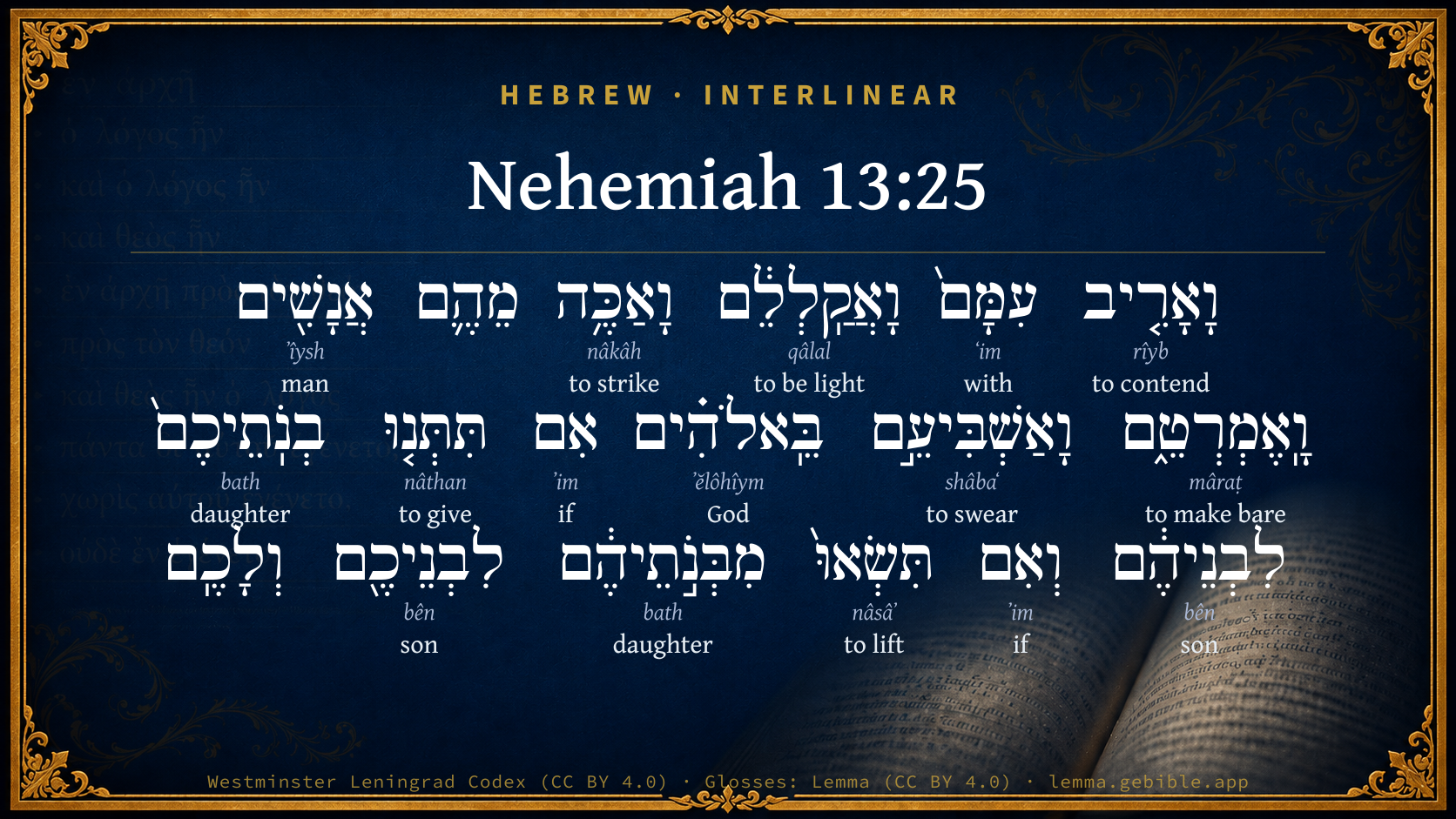
Hebrew (Westminster Leningrad Codex) Nehemiah 13:25 appears in the Hebrew Old Testament. The text above is from the Westminster Leningrad Codex. Each word links to its Strong’s number, a concise gloss, and parsing drawn from the Open Scriptures Hebrew Bible morphology. Click any word for its full Brown-Driver-Briggs (BDB) entry.
Download image
Cite this verse

Nehemiah 13:25 (World English Bible). Public Domain. Lemma interlinear Bible study tool, https://lemma.gebible.app/v/nehemiah/13/25.

Show BibTeX & RIS
BibTeX
RIS
English Translation
I contended with them, and cursed them, and struck certain of them, and plucked off their hair, and made them swear by God, [saying], You shall not give your daughters to their sons, nor take their daughters for your sons, or for yourselves.
World English Bible · Public Domain
Download a study sheet

One document with this verse’s original text, its word-by-word gloss line, the meaning frame, cross-references with their text, attributed commentary, and full source and license credits — printable, and it pastes into notes with its structure intact.

This verse Autodidact and up

Study sheet (.html) Plain text (.txt)

A passage Seminary Student

Up to 50 verses in one chapter. A passage sheet keeps up to 6 commentary sources and 12 cross-references per verse, in the order this page ranks them, and says so on the sheet whenever that leaves anything out. Ask for a single verse and you get the Autodidact verse sheet above.

Everything on this page stays free to read, with no account — the sheet is a download of what is already on screen, not access to it.

Want to remove ads? Support Godless Engineer
Compare translations 3

The same verse in 3 English versions, stacked beneath the original-language interlinear above. Click any original word for its lexicon entry.

Each is an independent rendering of the whole verse — the interlinear is not word-aligned to these translations.

Highlighted words mark where these versions differ — a whole-verse word diff, not a word-by-word alignment.

  • World English Bible Public Domain
    I contended with them, and cursed them, and struck certain of them, and plucked off their hair, and made them swear by God, [saying], You shall not give your daughters to their sons, nor take their daughters for your sons, or for yourselves.
  • King James Version Public Domain
    And I contended with them, and cursed them, and smote certain of them, and plucked off their hair, and made them swear by God, saying, Ye shall not give your daughters unto their sons, nor take their daughters unto your sons, or for yourselves.
  • unfoldingWord Literal Text CC BY-SA 4.0
    And I contended with them, and cursed them, and struck some of their men, and pulled out their hair. And I caused them to swear an oath by God: “If you give your daughters to their sons, or if you lift from their daughters for your sons, or for yourselves!

unfoldingWord Literal Text — © unfoldingWord, licensed CC BY-SA 4.0. Word-aligned USFM3 via Door43 (git.door43.org/unfoldingWord/en_ult).

Versions to compare (up to 4)

3 of 4 selected

Show all 18 translations

Every available English version of this verse, each an independent rendering of the whole verse.

  • World English Bible Public Domain
    I contended with them, and cursed them, and struck certain of them, and plucked off their hair, and made them swear by God, [saying], You shall not give your daughters to their sons, nor take their daughters for your sons, or for yourselves.
  • Berean Standard Bible Public Domain
    I rebuked them and called down curses on them. I beat some of these men and pulled out their hair. Then I made them take an oath before God and said, “You must not give your daughters in marriage to their sons or take their daughters as wives for your sons or for yourselves!
  • Majority Standard Bible Public Domain
    I rebuked them and called down curses on them. I beat some of these men and pulled out their hair. Then I made them take an oath before God and said, “You must not give your daughters in marriage to their sons or take their daughters as wives for your sons or for yourselves!
  • King James Version Public Domain
    And I contended with them, and cursed them, and smote certain of them, and plucked off their hair, and made them swear by God, saying, Ye shall not give your daughters unto their sons, nor take their daughters unto your sons, or for yourselves.
  • American Standard Version (1901) Public Domain
    And I contended with them, and cursed them, and smote certain of them, and plucked off their hair, and made them swear by God, `saying', Ye shall not give your daughters unto their sons, nor take their daughters for your sons, or for yourselves.
  • Revised Version (1885) Public Domain
    And I contended with them, and cursed them, and smote certain of them, and plucked off their hair, and made them swear by God, saying, Ye shall not give your daughters unto their sons, nor take their daughters for your sons, or for yourselves.
  • Geneva Bible (1599) Public Domain
    Then I reprooued them, and cursed them, and smote certaine of them, and pulled off their heare, and tooke an othe of them by God, Yee shall not giue your daughters vnto their sonnes, neither shall ye take of their daughters vnto your sonnes, nor for your selues.
  • Douay-Rheims (1899) Public Domain
    And I chid them, and laid my curse upon them. And I beat some of them, and shaved off their hair, and made them swear by God that they would not give their daughters to their sons, nor take their daughters for their sons, nor for themselves, saying:
  • Young's Literal Translation Public Domain
    And I strive with them, and declare them vile, and smite certain of them, and pluck off their hair, and cause them to swear by God, `Ye do not give your daughters to their sons, nor do ye take of their daughters to your sons, and to yourselves.
  • Literal Standard Version CC BY-SA 4.0
    And I strive with them, and declare them vile, and strike certain of them, and pluck off their hair, and cause them to swear by God, “You do not give your daughters to their sons, nor do you take of their daughters to your sons, and to yourselves.
  • Unlocked Literal Bible CC BY-SA 4.0
    I confronted them, and I cursed them, and I hit some of them and pulled out their hair. I made them swear by God, saying, “You shall not give your daughters to their sons, or take their daughters for your sons, or for yourselves.
  • unfoldingWord Literal Text CC BY-SA 4.0
    And I contended with them, and cursed them, and struck some of their men, and pulled out their hair. And I caused them to swear an oath by God: “If you give your daughters to their sons, or if you lift from their daughters for your sons, or for yourselves!
  • Darby Bible Public Domain
    And I contended with them, and cursed them, and smote certain of them and plucked off their hair, and adjured them by God [saying], Ye shall not give your daughters to their sons, nor take their daughters for your sons or for yourselves.
  • World Messianic Bible Public Domain
    I contended with them, cursed them, struck certain of them, plucked off their hair, and made them swear by God, “You shall not give your daughters to their sons, nor take their daughters for your sons, or for yourselves.
  • Webster's Bible Public Domain
    And I contended with them, and cursed them, and smote certain of them, and plucked off their hair, and made them swear by God, saying, Ye shall not give your daughters to their sons, nor take their daughters to your sons, or for yourselves.
  • Free Bible Version CC BY-SA 4.0
    So I confronted them and told them they were cursed. I beat some of them and pulled out their hair. Then I made them take an oath before God, saying, “You must not allow your daughters to marry their sons, or allow your sons—or yourselves— to marry their daughters.
  • Bible in Basic English Public Domain
    And I took up the cause against them, cursing them and giving blows to some of them and pulling out their hair; and I made them take an oath by God, saying, You are not to give your daughters to their sons or take their daughters for your sons or for yourselves.
  • JPS Tanakh (1917) Public Domain
    And I contended with them, and cursed them, and smote certain of them, and plucked off their hair, and made them swear by God: 'Ye shall not give your daughters unto their sons, nor take their daughters for your sons, or for yourselves.

Literal Standard Version (2020), Covenant Press — licensed CC BY-SA 4.0. Text via the HelloAO Bible API (eBible.org). Unlocked Literal Bible (unfoldingWord) — licensed CC BY-SA 4.0. Text via the HelloAO Bible API (eBible.org). unfoldingWord Literal Text — © unfoldingWord, licensed CC BY-SA 4.0. Word-aligned USFM3 via Door43 (git.door43.org/unfoldingWord/en_ult). Free Bible Version, Dr. Jonathan Gallagher — licensed CC BY-SA 4.0. Text via the HelloAO Bible API (eBible.org).

Word by word

More ways to search: Search by grammar → Find every occurrence → Compare this word →

Practice this passage: Drill this verse → Learn its vocabulary →

וָֽאֶמְרְטֵ֑ם
mâraṭ
H4803
“and · to make bare · them”
Conjunction + Verb, Qal, Sequential Imperfect, 1st Person, Common, Singular + Suffix, Personal, 3rd Person, Masculine, Plural
Part of Speech
Conjunction + Verb
Stem
Qal
Form
Sequential Imperfect
Person
1st Person
Gender
Common
Number
Singular
Full BDB Definition

Origin: a primitive root

TWOT: 1244

to bare, polish, make smooth or bald or bare - (Qal) - to make bare - to scour, polish - (Niphal) to be made bald
  1. וָאָרִ֤יב rîyb H7378 “and · to contend” Conjunction + Verb, Qal, Sequential Imperfect, 1st Person, Common, Singular
  2. עִמָּם֙ ʻim H5973 “with · them” Preposition + Suffix, Personal, 3rd Person, Masculine, Plural
  3. וָאֲקַֽלְלֵ֔ם qâlal H7043 “and · to be light · them” Conjunction + Verb, Piel, Sequential Imperfect, 1st Person, Common, Singular + Suffix, Personal, 3rd Person, Masculine, Plural
  4. וָאַכֶּ֥ה nâkâh H5221 “and · to strike” Conjunction + Verb, Hiphil, Sequential Imperfect, 1st Person, Common, Singular
  5. אֲנָשִׁ֖ים ʼîysh H376 “men” Noun, Common, Masculine, Plural, Absolute
  6. וָאַשְׁבִּיעֵ֣ם shâbaʻ H7650 “and · to swear · them” Conjunction + Verb, Hiphil, Sequential Imperfect, 1st Person, Common, Singular + Suffix, Personal, 3rd Person, Masculine, Plural
  7. בֵּֽאלֹהִ֗ים ʼĕlôhîym H430 “in/at · God(s)” Preposition + Noun, Common, Masculine, Plural, Absolute
  8. אִם ʼim H518 “if” Conjunction
  9. תִּתְּנ֤וּ nâthan H5414 “to give” Verb, Qal, Imperfect, 2nd Person, Masculine, Plural
  10. בְנֹֽתֵיכֶם֙ bath H1323 “daughters · your” Noun, Common, Feminine, Plural, Construct + Suffix, Personal, 2nd Person, Masculine, Plural
  11. לִבְנֵיהֶ֔ם bên H1121 “to/for · sons · their” Preposition + Noun, Common, Masculine, Plural, Construct + Suffix, Personal, 3rd Person, Masculine, Plural
  12. וְאִם ʼim H518 “and · if” Conjunction + Conjunction
  13. תִּשְׂאוּ֙ nâsâʼ H5375 “to lift” Verb, Qal, Imperfect, 2nd Person, Masculine, Plural
  14. מִבְּנֹ֣תֵיהֶ֔ם bath H1323 “from · daughters · their” Preposition + Noun, Common, Feminine, Plural, Construct + Suffix, Personal, 3rd Person, Masculine, Plural
  15. לִבְנֵיכֶ֖ם bên H1121 “to/for · sons · your” Preposition + Noun, Common, Masculine, Plural, Construct + Suffix, Personal, 2nd Person, Masculine, Plural

About this verse

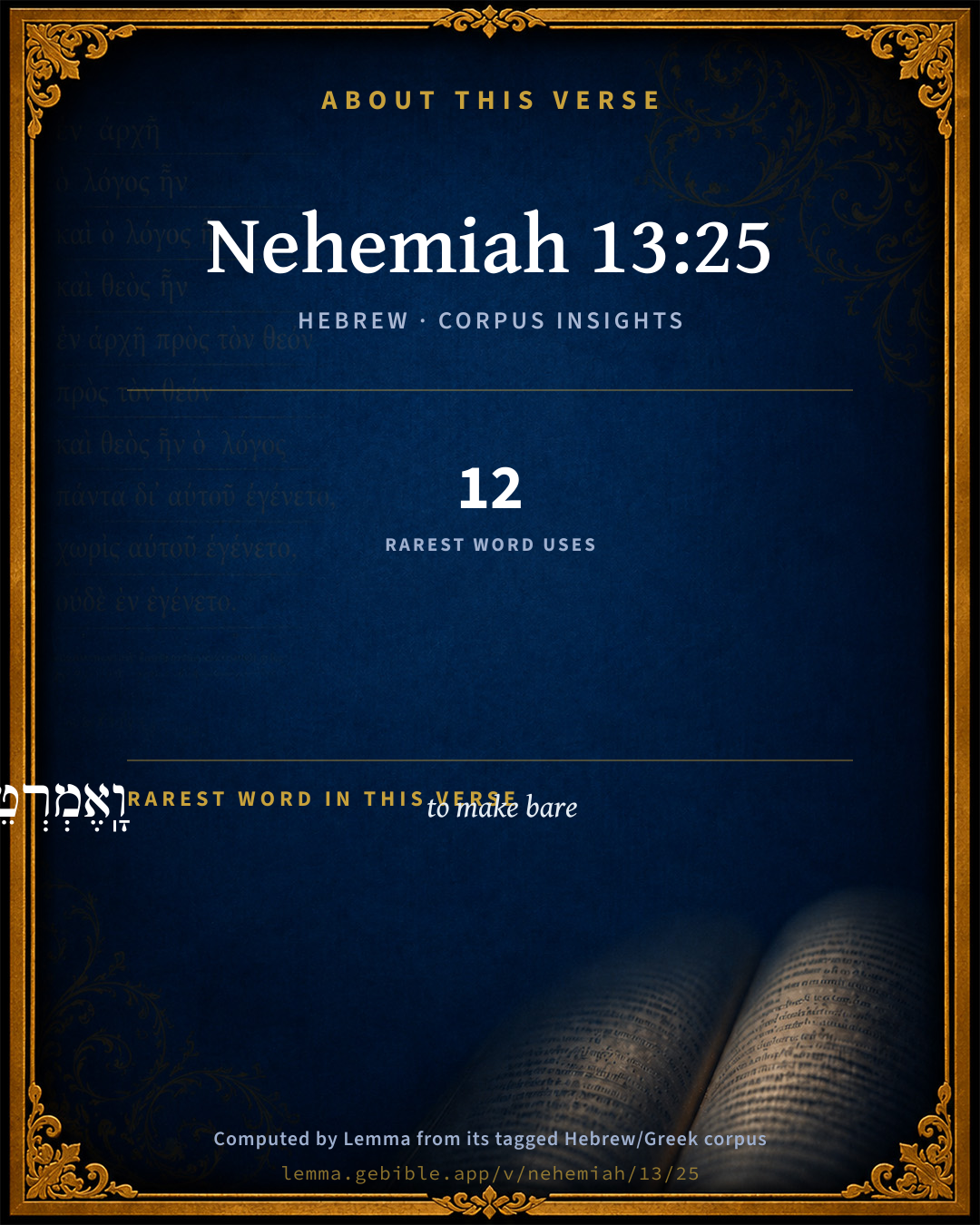
These counts appear in no published source. They are computed here, from the morphology-tagged text and Lemma’s own curated glosses. What Lemma adds →

18
words
13
distinct lemmas
Historical
section

Notable vocabulary

The rarest word here is וָֽאֶמְרְטֵ֑ם to make bare H4803 — appearing just 12 times in the whole Hebrew Bible.

Shared distinctive vocabulary

וָֽאֶמְרְטֵ֑ם to make bare H4803 occurs in 11 verses of the Hebrew Bible. Also found in:

Grammatical profile

  • 7 verbs
  • 6 nouns
  • 3 prepositions
  • 2 conjunctions

Verb forms

  • וָאָרִ֤יב Qal · Sequential Imperfect
  • וָאֲקַֽלְלֵ֔ם Piel · Sequential Imperfect
  • וָאַכֶּ֥ה Hiphil · Sequential Imperfect
  • וָֽאֶמְרְטֵ֑ם Qal · Sequential Imperfect
  • וָאַשְׁבִּיעֵ֣ם Hiphil · Sequential Imperfect
  • תִּתְּנ֤וּ Qal · Imperfect
  • תִּשְׂאוּ֙ Qal · Imperfect

Repetition

Words recur within this verse — often emphatic in Hebrew:

  • בְנֹֽתֵיכֶם֙ daughter H1323 ×2
  • לִבְנֵיהֶ֔ם son H1121 ×2
  • אִם if H518 ×2

Cross-references

16

Topical passages linked to Nehemiah 13:25 in the Treasury of Scripture Knowledge — connected by theme and wording, ordered by reader-vote popularity; previews shown in the World English Bible.

  • Deuteronomy 7:3 neither shall you make marriages with them; your daughter you shall not give to his son, nor his daughter shall you take to your son.
  • Ezra 10:5 Then arose Ezra, and made the chiefs of the priests, the Levites, and all Israel, to swear that they would do according to this word. So they swore.
  • Nehemiah 10:29–30 They joined with their brothers, their nobles, and entered into a curse, and into an oath, to walk in God's law, which was given by Moses the servant of God, and to observe and do all the commandments of Yahweh our Lord, and his ordinances and his statutes;
  • Nehemiah 13:17 Then I contended with the nobles of Judah, and said to them, What evil thing is this that you do, and profane the Sabbath day?
  • Nehemiah 5:13 Also I shook out my lap, and said, So God shake out every man from his house, and from his labor, that doesn't perform this promise; even thus be he shaken out, and emptied. All the assembly said, Amen, and praised Yahweh. The people did according to this promise.
  • Nehemiah 13:11 Then contended I with the rulers, and said, Why is the house of God forsaken? I gathered them together, and set them in their place.
  • Exodus 34:16 and you take of their daughters to your sons, and their daughters play the prostitute after their gods, and make your sons play the prostitute after their gods.
  • Deuteronomy 6:13 You shall fear Yahweh your God; and him shall you serve, and shall swear by his name.
  • Deuteronomy 25:2–3 and it shall be, if the wicked man be worthy to be beaten, that the judge shall cause him to lie down, and to be beaten before his face, according to his wickedness, by number.
  • Deuteronomy 27:14–26 The Levites shall answer, and tell all the men of Israel with a loud voice,
  • 2 Chronicles 15:12–15 They entered into the covenant to seek Yahweh, the God of their fathers, with all their heart and with all their soul;
  • Ezra 7:26 Whoever will not do the law of your God, and the law of the king, let judgment be executed on him with all diligence, whether it be to death, or to banishment, or to confiscation of goods, or to imprisonment.
  • Psalms 15:4 In whose eyes a vile man is despised, But who honors those who fear Yahweh; He who keeps an oath even when it hurts, and doesn't change;
  • Proverbs 28:4 Those who forsake the law praise the wicked; But those who keep the law contend with them.
  • Isaiah 50:6 I gave my back to the strikers, and my cheeks to those who plucked off the hair; I didn't hide my face from shame and spitting.
  • Luke 11:45–46 One of the lawyers answered him, "Teacher, in saying this you insult us also."

Cross-references courtesy of OpenBible.info (CC BY 4.0).

Hebrew and Greek witnesses Masoretic Hebrew ↔ Greek Septuagint

The same verse in the two great witnesses to the Old Testament, shown verse-for-verse.

These are two independent witnesses, not word-aligned to each other, and the Septuagint is shown in lemma (dictionary) form.

Hebrew Nehemiah 13:25 Masoretic · Westminster Leningrad Codex

וָאָרִ֤יב עִמָּם֙ וָאֲקַֽלְלֵ֔ם וָאַכֶּ֥ה מֵהֶ֛ם אֲנָשִׁ֖ים וָֽאֶמְרְטֵ֑ם וָאַשְׁבִּיעֵ֣ם בֵּֽאלֹהִ֗ים אִם תִּתְּנ֤וּ בְנֹֽתֵיכֶם֙ לִבְנֵיהֶ֔ם וְאִם תִּשְׂאוּ֙ מִבְּנֹ֣תֵיהֶ֔ם לִבְנֵיכֶ֖ם וְלָכֶֽם

I contended with them, and cursed them, and struck certain of them, and plucked off their hair, and made them swear by God, [saying], You shall not give your daughters to their sons, nor take their daughters for your sons, or for yourselves.

World English Bible · Public Domain

Greek LXX Structure differs

The Septuagint has no separate book of Nehemiah. Its Greek text is the second half of Esdras B (2 Esdras), chapters 11–23; Ezra is the first half (1–10).

A verse-for-verse comparison isn’t shown here because the chapters and verses don’t line up. Switch to the LXX edition with the MT / LXX toggle above to read the Greek directly.

On this verse, The Cambridge Bible for Schools and Colleges discusses the Septuagint’s reading. Read the note in Commentary ↓

Hebrew: Westminster Leningrad Codex (CC BY 4.0). Greek: Septuagint (public domain); English from a public-domain English Septuagint. How the Septuagint differs from the Hebrew →

Commentary

Notes on Nehemiah 13:25 from classic Christian and Jewish commentators (each source and its license shown beneath its notes). The classic Christian expositions comment on the surrounding passage and are grouped to its opening verse, so a note may address several verses; the Jewish commentaries on the Tanakh (Rashi and others) are per-verse, so they appear only where the commentator wrote on this verse.

Lemma curates 59 commentaries, every one of them public domain or Creative Commons licensed, each selected and text-cleaned for this edition rather than reprinted as found. About our sources →

Trapp's Complete Commentary

John Trapp

Neh 13:25 And I contended with them, and cursed them, and smote certain of them, and plucked off their hair, and made them swear by God, [saying], Ye shall not give your daughters unto their sons, nor take their daughters unto your sons, or for yourselves.

Ver. 25. And cursed them] i.e. I denounced God’s heavy curse and vengeance upon them (according to that themselves had wished and entered into, Neh 10:30), in case they repented not. This is nothing, then, in favour of our cursing men who are cursed men, &c.

And smote certain of them] So far was his heart enraged with a holy hatred of their sin, that he could not forbear them. So when Charles V had heard that Farnesius (General of the pope’s forces) had ravished certain ladies, he brake out into this speech (and was never in all his life observed to be more angry at anything), Si adesset impurus ille Farnesius, manu mea confoderem: Oh, if I had here that filthy fellow, I would slay him with mine own hand.

And made them swear by God] So they had done before, Neh 10:29-30. But now, alas, they were all gone aside, they were altogether become filthy, they stank above ground, Psa 14:3. He takes therefore another oath of them, &c.

John Trapp, A Commentary or Exposition upon All the Books of the Old and New Testament (1647–1656) — public domain. Text from a community e-Sword module.

Joseph Benson's Commentary

Neh 13:25. And I contended with them, &c. — These words, it must be acknowledged as proceeding from Nehemiah’s own mouth, sound somewhat harshly in our translation; but the meaning of them seems to be only as follows: I contended with them — That is, I expostulated the matter with them; I cursed them — That is, excommunicated them, and cast them out of the society of God’s people; in the doing of which, I denounced God’s judgments against them; I smote certain of them — That is, I ordered the officers to beat some of the most notorious offenders with rods or scourges, according to the law, Deu 25:2; and I plucked off their hair — That is, I commanded them to be shaved, thereby to put them to shame, and to make them look like vile slaves; for as the hair was esteemed a great ornament among the eastern nations, so baldness was accounted a great disgrace. And Nehemiah had a sufficient provocation to inflict these several punishments upon them, because, in their marrying with heathen nations, they had acted contrary, not only to the express law of God, but to their own late solemn covenant and promise. See Poole and Dodd.

Joseph Benson's Commentary on the Old and New Testaments (1811–1818) — public domain. Text from a community e-Sword module.

Tyndale Open Study Notes

Tyndale Open Resources

13:25 When Nehemiah called down curses on them, it was because the parents avoided Hebrew and did not teach their children the language of the Hebrew Bible. A curse called on God to remove his blessing on people. • I beat some of them and pulled out their hair: Apparently, some of the men did not accept Nehemiah’s rebuke at first, so he made them swear in the name of God not to intermarry with pagans.

Tyndale Open Study Notes — © Tyndale Open Resources, licensed CC BY-SA 4.0. Text via the HelloAO Bible API.

Geneva Bible (1599)

Geneva Bible translators

That is, I did excommunicate them, and drive them out of the congregation.

Geneva Bible (1599) marginal notes — public domain. Text via Bolls.life.

Jamieson, Fausset & Brown

Robert Jamieson, A. R. Fausset & David Brown

cursed them--that is, pronounced on them an anathema which entailed excommunication.

smote . . . and plucked off their hair--To cut off the hair of offenders seems to be a punishment rather disgraceful than severe; yet it is supposed that pain was added to disgrace, and that they tore off the hair with violence as if they were plucking a bird alive.

Next: Esther Introduction

Jamieson, Fausset & Brown — Commentary Critical and Explanatory on the Whole Bible (1871) — public domain (CC PDM 1.0). Text via the HelloAO Bible API.

Adam Clarke's Commentary

Verse 25. I contended with them] Proved the fact against these iniquitous fathers, in a legal assembly.

And cursed them] Denounced the judgments of God and the sentence of the law upon them.

Smote certain of them] Had them punished by whipping.

And plucked off their hair] Had them shaven, as a mark of the greatest ignominy.

And made them swear by God, saying, Ye shall not give] Caused them to bind themselves by an oath, that they would make no intermarriages with those who were not of the seed of Israel.

Adam Clarke's Commentary on the Bible (1810–1826) — public domain. Text from a community e-Sword/MySword module.

Ellicott's Commentary for English Readers

(25) Cursed them.—Nehemiah simply echoed the covenant sanction on this very point (Neh_10:29-30).

Certain of them.—Some were selected for special punishment and humiliation. Ezra, on a like occasion, humbled himself by plucking off the hair of his own head (Ezr_9:3). Then they were obliged to repeat the oath of the covenant.

A Bible Commentary for English Readers, edited by Charles John Ellicott (1878–1897) — public domain. Text from a community e-Sword module.

The Cambridge Bible for Schools and Colleges

gen. ed. J. J. S. Perowne

25. I contended] Cf. Neh_13:11; Neh_13:17.

cursed] R.V. marg. ‘Or, reviled’. For the word ‘to curse’ (qalal) cf. Neh_13:2; Mal_3:9; Mal_4:6.

smote … pluckt off their hair] Nehemiah’s frantic excitement against these countrymen was accompanied with gestures and blows such as may be witnessed in Syria but are almost incredible to our western ideas.

pluckt off their hair] LXX. ἐμαδάρωσα αὐτούς. Vulg. ‘decalvavi eos.’ Commentators suggest that this was done at Nehemiah’s command, and not by his own hand; further that it was a judicial sentence of ‘depilatio.’ But the context quite supports the idea that he personally ill-treated them; so frantic was his indignation. He did not intend, as some suggest, by pulling out their hair to compel them to assume the appearance of penitents. For the action of pulling out the hair cf. Ezr_9:3.

made them swear by God, saying] i.e. he made them swear an oath in God’s name, the words of the oath being given in the clause following.

This is better than the alternative rendering, ‘I adjured them by God’ (cf. 1Ki_18:10; Son_2:7).

Ye shall not] The oath which Nehemiah administered in the 2nd plur. was repeated by the Jews in the first pers.

unto your sons] R.V. for your sons.

The Cambridge Bible for Schools and Colleges (gen. ed. J. J. S. Perowne; Cambridge University Press, 1878–1918) — public domain. Text from a community e-Sword module.

John Gill's Exposition

And one of the sons of Joiada, the son of Eliashib the high priest,.... A grandson of the high priest; for the high priest here is Eliashib, according to our version, and not Joiada his son, according to Dr. Prideaux (i); the person designed, Josephus (k) makes to be Manasseh, the brother of Jaddua the high priest: was

son in law to Sanballat the Horonite; married a daughter of his, who was the avowed enemy of the Jewish nation; and for whom, according to the same writer, Sanballat obtained leave of Alexander to build a temple on Mount Gerizim; but this is to protract the age of Nehemiah and Sanballat to too great a length; besides, Eliashib seems to have been now high priest, and not even his son Joiada, and much less Jaddua, a grandson of Joiada:

therefore I chased him from me; drove him from his court, suffered him not to minister at the altar; banished him from the city, as Jarchi, and even from the land of Judea.

(i) Connect. par. 1. p. 412. (k) Antiqu. l. 11. c. 8. sect. 2, 4.

John Gill's Exposition of the Whole Bible (1746–1763) — public domain (CC PDM 1.0). Text via the HelloAO Bible API.

Haydock's Catholic Bible Commentary

Curse, or excommunicated them, (Calmet) the guilty parents. (Haydock) --- Shaved. Hebrew and Septuagint, "plucked off their hair," by the roots, for greater torment. Sometimes quicklime was then sprinkled on the head, (Calmet) as adulterers were treated at Athens. Schol. Aristoph.[Aristophanes?] --- King Artaxerxes changed this punishment, and ordered that his officers should be forbidden to wear the tiara instead. Domitian caused the hair and beard of Apollonius to be shaven. (Philost. iii. 14.) (Calmet) --- That they. Hebrew, "Ye shall not," &c.

George Leo Haydock (1774–1849), Haydock's Catholic Family Bible and Commentary, 1859 edition — public domain. Excludes Psalms (Douay-Rheims chapter numbering differs from Protestant) and Deuterocanonical books (Catholic canon only).

Matthew Poole's English Annotations

Cursed them, i.e. caused them to be excommunicated and cast out of the society and privileges of God’s people. This and the following punishments were justly inflicted upon them, because this transgression was contrary both to a very plain and express law of God, and also to their own late solemn covenants and promises, of which see Ezr 10; Ne 10:30.

Smote certain of them, i.e. I caused to be beaten with stripes, according to the law, Deu 25:2, those whose faults were most aggravated by their quality or other circumstances; to whom he added this punishment over and besides the former.

Plucked off their hair, or, shaved them. The hair was an ornament and ensign of liberty among the eastern nations; and baldness was a disgrace and token of slavery and sorrow. See Isa 3:24; Isa 15:2; Jer 48:37; Eze 29:18.

Matthew Poole's English Annotations on the Holy Bible (1683–1685) — public domain. Text from a community e-Sword/MySword module.

Whedon's Commentary on the Bible

Daniel D. Whedon

25. I contended with them — By rebuke and expostulation, as he had done with the rulers and nobles. Vers. 11, 17.

Cursed them — Comp. Mal_3:9. He went beyond mere expostulation, and pronounced them cursed of God in having thus violated the Divine law.

Smote certain of them — As governor he had them scourged as public offenders. Compare Deu_25:2-3.

Plucked off their hair — A penalty designed to be both painful and disgraceful. The offence was too great to be allowed to pass without severe treatment.

Made them swear — As Ezra had made the people, guilty of the same offence, do some years before. Ezr_10:5.

Not give your daughters — The principal members of the community had taken the same oath during Nehemiah’s administration, (Neh_10:30;) but, perhaps, the ones now guilty were not among that number.

Daniel D. Whedon (gen. ed.), Commentary on the Old and New Testaments (1874–1909) — public domain. Text from a community e-Sword module.

The Pulpit Commentary

I contended with them, and cursed them. Or, "reviled them," as Gesenius and Professor Lee explain. And smote certain of them. i.e. "had some of them beaten." Some understand by this that the offenders underwent the bastinado by sentence of a court; (Deu_25:2) others think Nehemiah had them struck informally by his attendants. This latter explanation "is supported by the following clause, since "plucking out the hair" was never a legal punishment. Made them swear by God. Literally, "swore them by God," i.e. dictated the words, and made them repeat the formula and accept the oath. Saying, Ye shall not give. Literally, "If ye shall give," etc. Nehemiah made them swear that they should intermarry with the heathen the curse of God should fall upon them.

The Pulpit Commentary (1880–1919), ed. H.D.M. Spence-Jones & Joseph S. Exell — public domain. Text from a community e-Sword module.

John Wesley's Explanatory Notes

Cursed - Caused them to be excommunicated and cast out of the society of God's people. This and the following punishments were justly inflicted upon them, because this transgression was contrary both to a plain law of God, and to their own late solemn covenants. Smote - I caused to be beaten with stripes, according to the law, Deut. xxv, 2, such whose faults were most aggravated; to whom he added this punishment over and above the former. Plucked off - Or, shaved them. The hair was an ensign of liberty among the eastern nations; and baldness was a disgrace, and token of slavery and sorrow.

John Wesley, Explanatory Notes Upon the Whole Bible (1754–1765) — public domain. Text via the GEBible commentary corpus.

Keil & Delitzsch

C. F. Keil & F. Delitzsch

With these people also Nehemiah contended (אריב like Neh 13:11 and Neh 13:17), cursed them, smote certain of their men, and plucked off their hair (מרט, see rem. on Ezr 9:3), and made them swear by God: Ye shall not give your daughters, etc.; comp. Neh 10:31. On the recurrence of such marriages after the separations effected by Ezra of those existing at his arrival at Jerusalem. Nehemiah did not insist on the immediate dissolution of these marriages, but caused the men to swear that they would desist from such connections, setting before them, in Neh 13:26, how grievous a sin they were committing. "Did not Solomon, king of Israel, sin on account of these?" (אלּה על, on account of strange wives). And among many nations there was no king like him (comp. Kg1 3:12., Ch2 1:12); and he was beloved of his God (alluding to Sa2 12:24), and God made him king over all Israel (Kg1 4:1); and even him did foreign women cause to sin (comp. Kg1 11:1-3). "And of you is it heard to do (that ye do) all this great evil, to transgress against our God, and to marry strange wives?" Bertheau thus rightly understands the sentence: "If the powerful King Solomon was powerless to resist the influence of foreign wives, and if he, the beloved God, found in his relation to God no defence against the sin to which they seduced him, is it not unheard of for you to commit so great an evil?" He also rightly explains הנשׁמע according to Deu 9:23; while Gesenius in his Thes. still takes it, like Rambach, as the first person imperf.: nobisne morem geramus faciendo; or: Should we obey you to do so great an evil? (de Wette); which meaning - apart from the consideration that no obedience, but only toleration of the illegal act, is here in question - greatly weakens, if it does not quite destroy, the contrast between Solomon and לכם.

Keil & Delitzsch — Biblical Commentary on the Old Testament (1861–1891) — public domain (CC PDM 1.0). Text via the HelloAO Bible API. (Old Testament only.)

unfoldingWord translationNotes

Door43 World Missions Community

I confronted them

"I spoke directly to them about what they had done"

I hit some of them

Nehemiah hit some of them with his hands.

I made them swear by God

"I made them say a promise before God"

Did not Solomon king of Israel sin on account of these women?

Nehemiah uses a rhetorical question to scold the men. This can be translated as a statement. AT: "You know that Solomon king of Israel sinned on account of these women." (See: Rhetorical Question)

Should we then listen to you and do all this great evil, and act treacherously against our God by marrying foreign women?

Nehemiah uses a rhetorical question to scold the men. This can be translated as a statement. AT: "We will not listen to you or do this great evil or act treacherously against our God by marrying foreign women." (See: Rhetorical Question)

translationWords

curse

oath

God

son

Solomon

king

Israel

sin

nation

love

alien

evil

unfoldingWord translationNotes — © Distant Shores Media and the Door43 World Missions Community, licensed CC BY-SA 4.0. Source: git.door43.org/Door43/en_tn.

Rashi

Rabbi Shlomo Yitzchaki (Rashi)

and I struck I gave them lashes in order to chastise them and remind them.

Rashi on the Tanakh — English translations: “The Judaica Press complete Tanach with Rashi, translated by A. J. Rosenberg” (CC BY 4.0); “Pentateuch with Rashi's commentary by M. Rosenbaum and A.M. Silbermann, 1929-1934” (public domain); “The Metsudah Tanach series, Lakewood, N.J” (CC BY 4.0); and “The Book of Joshua, Metsudah Publications, 1997” (CC BY 4.0). Text via Sefaria.

Lesson kit

Teaching starters — assembled from the data on this page, not authored interpretation. Every prompt links to the verse data it draws on. Edit before teaching.

Nehemiah, in the Historical, opens this verse with 18 words (13 distinct Hebrew lemmas). Its most distinctive word is mâraṭ (“to make bare”). A historical commentator’s framing appears above. Read the whole chapter for the surrounding context.

Discussion questions

  1. What does “to make bare” (mâraṭ) contribute to the verse as a whole?
  2. Leviticus 13:40 shares the word «to make bare» with this verse. How do the two illuminate each other?
  3. “daughter” occurs 2× in this one verse. What is the effect of the repetition?
  4. These translations render this verse differently; the difference is in the English rendering, not the original. What questions does that raise?
  5. The verb «וָאָרִ֤יב» is Qal Sequential Imperfect. How does its form color the action?
  6. Reading how Trapp's Complete Commentary and Joseph Benson's Commentary read this verse, where do the two commentators agree and where do they part?

Things to notice

Reading settings

Reading text

Shown beneath each verse's original-language words.

Old Testament
Old Testament edition

Read the OT as the Masoretic Hebrew (MT) or the Greek Septuagint (LXX).

English shown for the Greek Septuagint (in the Hebrew ↔ Greek comparison).

Comparing translations? Open the Compare panel on any verse page to stack up to four side by side.