
Joshua 4:3

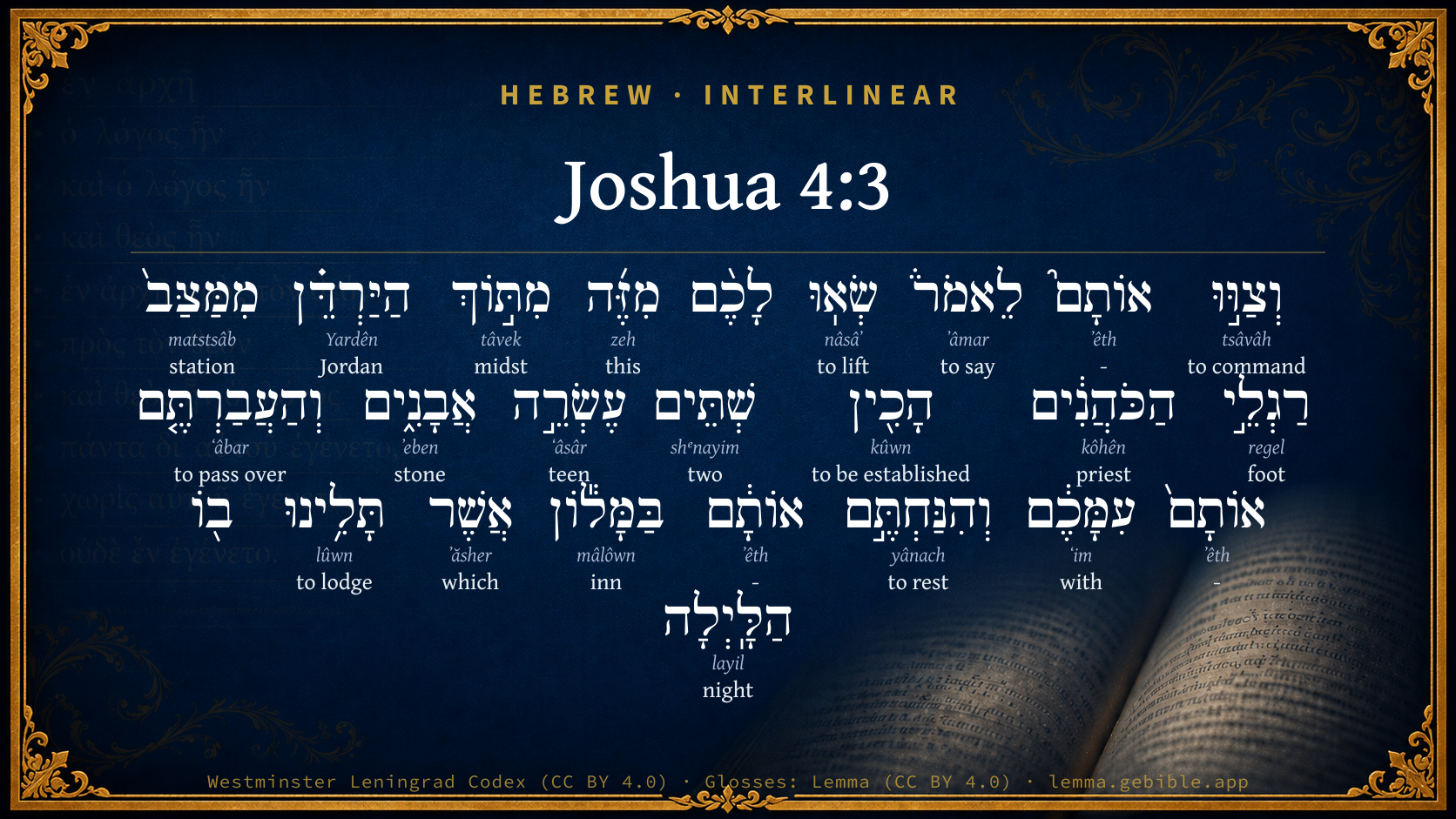
Hebrew (Westminster Leningrad Codex) Joshua 4:3 appears in the Hebrew Old Testament. The text above is from the Westminster Leningrad Codex. Each word links to its Strong’s number, a concise gloss, and parsing drawn from the Open Scriptures Hebrew Bible morphology. Click any word for its full Brown-Driver-Briggs (BDB) entry.
Download image
Cite this verse

Joshua 4:3 (World English Bible). Public Domain. Lemma interlinear Bible study tool, https://lemma.gebible.app/v/joshua/4/3.

Show BibTeX & RIS
BibTeX
RIS
English Translation
and command you them, saying, Take hence out of the midst of the Jordan, out of the place where the priests' feet stood firm, twelve stones, and carry them over with you, and lay them down in the lodging-place, where you shall lodge this night.
World English Bible · Public Domain
Highlights
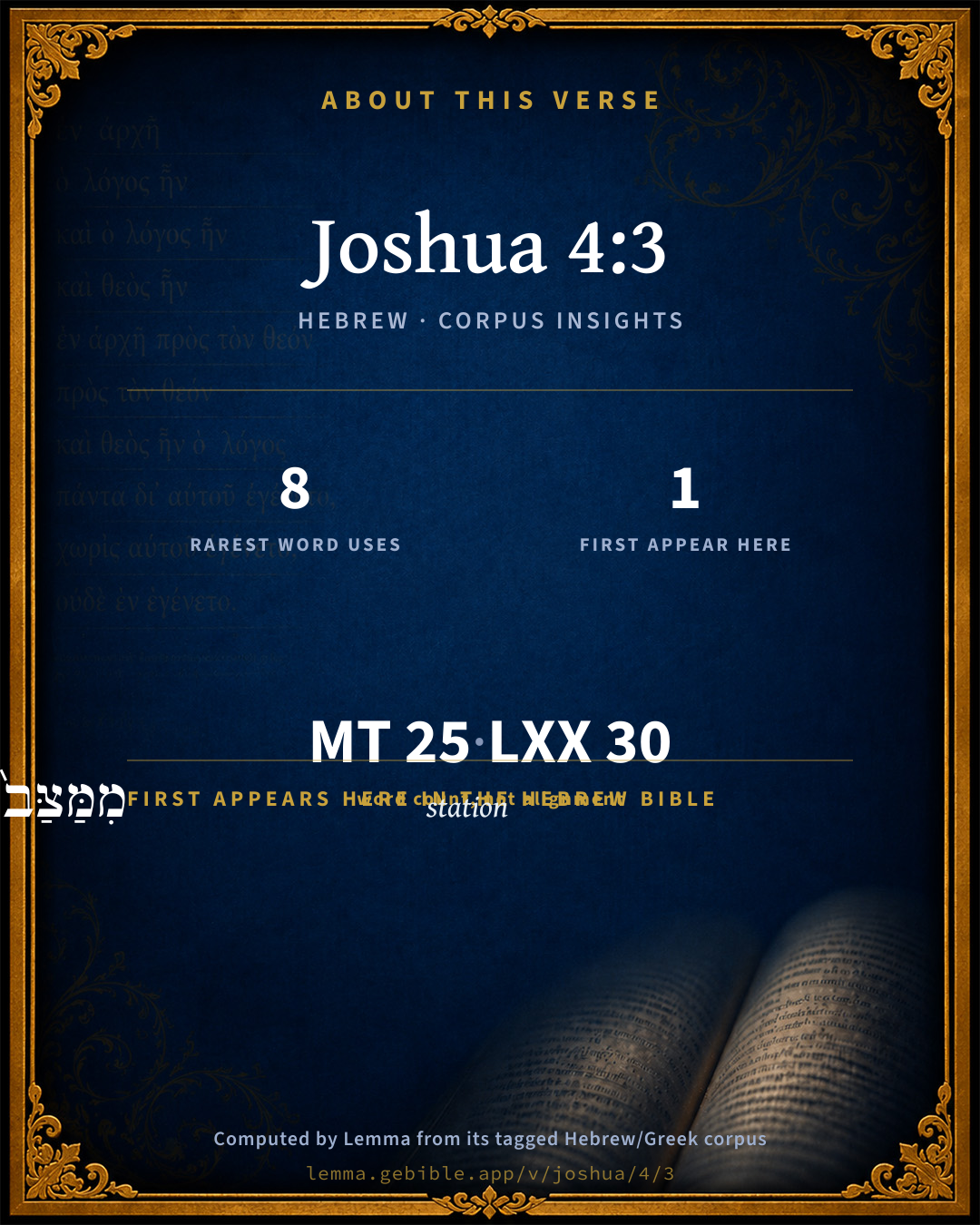
  • 1 first appearance in the Hebrew Bible
Full analysis ↓
Download a study sheet

One document with this verse’s original text, its word-by-word gloss line, the meaning frame, cross-references with their text, attributed commentary, and full source and license credits — printable, and it pastes into notes with its structure intact.

This verse Autodidact and up

Study sheet (.html) Plain text (.txt)

A passage Seminary Student

Up to 50 verses in one chapter. A passage sheet keeps up to 6 commentary sources and 12 cross-references per verse, in the order this page ranks them, and says so on the sheet whenever that leaves anything out. Ask for a single verse and you get the Autodidact verse sheet above.

Everything on this page stays free to read, with no account — the sheet is a download of what is already on screen, not access to it.

Want to remove ads? Support Godless Engineer
Compare translations 3

The same verse in 3 English versions, stacked beneath the original-language interlinear above. Click any original word for its lexicon entry.

Each is an independent rendering of the whole verse — the interlinear is not word-aligned to these translations.

Highlighted words mark where these versions differ — a whole-verse word diff, not a word-by-word alignment.

  • World English Bible Public Domain
    and command you them, saying, Take hence out of the midst of the Jordan, out of the place where the priests' feet stood firm, twelve stones, and carry them over with you, and lay them down in the lodging-place, where you shall lodge this night.
  • King James Version Public Domain
    And command ye them, saying, Take you hence out of the midst of Jordan, out of the place where the priests' feet stood firm, twelve stones, and ye shall carry them over with you, and leave them in the lodging place, where ye shall lodge this night.
  • unfoldingWord Literal Text CC BY-SA 4.0
    and command them, saying: ‘Lift up for yourselves from here, from the midst of the Jordan, from the firm standing place of the feet of the priests, 12 stones. And you shall bring them over with you and you shall leave them in the lodging place in which you will lodge tonight.’”

unfoldingWord Literal Text — © unfoldingWord, licensed CC BY-SA 4.0. Word-aligned USFM3 via Door43 (git.door43.org/unfoldingWord/en_ult).

Versions to compare (up to 4)

3 of 4 selected

Show all 18 translations

Every available English version of this verse, each an independent rendering of the whole verse.

  • World English Bible Public Domain
    and command you them, saying, Take hence out of the midst of the Jordan, out of the place where the priests' feet stood firm, twelve stones, and carry them over with you, and lay them down in the lodging-place, where you shall lodge this night.
  • Berean Standard Bible Public Domain
    and command them: ‘Take up for yourselves twelve stones from the middle of the Jordan where the priests were standing, carry them with you, and set them down in the place where you spend the night.’”
  • Majority Standard Bible Public Domain
    and command them: ‘Take up for yourselves twelve stones from the middle of the Jordan where the priests were standing, carry them with you, and set them down in the place where you spend the night.’”
  • King James Version Public Domain
    And command ye them, saying, Take you hence out of the midst of Jordan, out of the place where the priests' feet stood firm, twelve stones, and ye shall carry them over with you, and leave them in the lodging place, where ye shall lodge this night.
  • American Standard Version (1901) Public Domain
    and command ye them, saying, Take you hence out of the midst of the Jordan, out of the place where the priests' feet stood firm, twelve stones, and carry them over with you, and lay them down in the lodging-place, where ye shall lodge this night.
  • Revised Version (1885) Public Domain
    and command ye them, saying, Take you hence out of the midst of Jordan, out of the place where the priests’ feet stood firm, twelve stones, and carry them over with you, and lay them down in the lodging place, where ye shall lodge this night.
  • Geneva Bible (1599) Public Domain
    And command you them, saying, Take you hence out of the middes of Iorden, out of the place where the Priestes stoode in a readinesse, twelue stones, which ye shall take away with you, and leaue them in the lodging where you shall lodge this night)
  • Douay-Rheims (1899) Public Domain
    And command them to take out of the midst of the Jordan, where the feet of the priests stood, twelve very hard stones, which you shall set in the place of the camp, where you shall pitch your tents this night.
  • Young's Literal Translation Public Domain
    and command ye them, saying, Take up for you from this `place', from the midst of the Jordan, from the established standing-place of the feet of the priests, twelve stones, and ye have removed them over with you, and placed them in the lodging-place in which ye lodge to-night.'
  • Literal Standard Version CC BY-SA 4.0
    and command them, saying, Take up for yourselves from this [place], from the midst of the Jordan, from the established standing-place of the feet of the priests, twelve stones, and you have removed them over with you, and placed them in the lodging-place in which you lodge tonight.”
  • Unlocked Literal Bible CC BY-SA 4.0
    Give them this command: 'Take up twelve stones from the middle of the Jordan where the priests are standing on the dry ground, and bring them over with you and lay them down in the place where you will spend the night tonight.'”
  • unfoldingWord Literal Text CC BY-SA 4.0
    and command them, saying: ‘Lift up for yourselves from here, from the midst of the Jordan, from the firm standing place of the feet of the priests, 12 stones. And you shall bring them over with you and you shall leave them in the lodging place in which you will lodge tonight.’”
  • Darby Bible Public Domain
    and command them, saying, Take up hence out of the midst of the Jordan, from the place where the priests' feet stood firm, twelve stones, and carry them over with you, and lay them down in the lodging-place where ye shall lodge this night.
  • World Messianic Bible Public Domain
    and command them, saying, ‘Take from out of the middle of the Jordan, out of the place where the priests’ feet stood firm, twelve stones, carry them over with you, and lay them down in the place where you’ll camp tonight.’”
  • Webster's Bible Public Domain
    And command ye them, saying, Take you hence out of the midst of Jordan, from the place where the priests' feet stood firm, twelve stones, and ye shall carry them over with you, and leave them in the lodging-place where ye shall lodge this night.
  • Free Bible Version CC BY-SA 4.0
    and tell them, ‘Pick up twelve stones from the middle of the Jordan, from right where the priests are standing. Then carry them and set them down at the place where you will camp tonight.’”
  • Bible in Basic English Public Domain
    And say to them, Take up from the middle of Jordan, from the place where the feet of the priests were resting, twelve stones, and take them over with you and put them down in the place where you take your rest tonight.
  • JPS Tanakh (1917) Public Domain
    and command ye them, saying: Take you hence out of the midst of the Jordan, out of the place where the priests' feet stood, twelve stones made ready, and carry them over with you, and lay them down in the lodging-place, where ye shall lodge this night.'

Literal Standard Version (2020), Covenant Press — licensed CC BY-SA 4.0. Text via the HelloAO Bible API (eBible.org). Unlocked Literal Bible (unfoldingWord) — licensed CC BY-SA 4.0. Text via the HelloAO Bible API (eBible.org). unfoldingWord Literal Text — © unfoldingWord, licensed CC BY-SA 4.0. Word-aligned USFM3 via Door43 (git.door43.org/unfoldingWord/en_ult). Free Bible Version, Dr. Jonathan Gallagher — licensed CC BY-SA 4.0. Text via the HelloAO Bible API (eBible.org).

Word by word

More ways to search: Search by grammar → Find every occurrence → Compare this word →

Practice this passage: Drill this verse → Learn its vocabulary →

בַּמָּל֕וֹן
mâlôwn
H4411
“in/at the · inn”
Preposition, Determined + Noun, Common, Masculine, Singular, Absolute
Part of Speech
Preposition + Noun
Type
Common
Gender
Masculine
Number
Singular
State
Absolute
Full BDB Definition

Origin: from H3885

TWOT: 1096a

place of lodging, inn, khan
  1. וְצַוּ֣וּ tsâvâh H6680 “and · command” Conjunction + Verb, Piel, Imperative, 2nd Person, Masculine, Plural
  2. אוֹתָם֮ ʼêth H853 “- · them” Particle, Direct Object + Suffix, Personal, 3rd Person, Masculine, Plural
  3. לֵאמֹר֒ ʼâmar H559 “to say” Preposition + Verb, Qal, Infinitive Construct
  4. שְׂאֽוּ nâsâʼ H5375 “lift” Verb, Qal, Imperative, 2nd Person, Masculine, Plural
  5. מִזֶּ֜ה zeh H2088 “from · this” Preposition + Pronoun, Demonstrative, Masculine, Singular
  6. מִתּ֣וֹךְ tâvek H8432 “from · midst of” Preposition + Noun, Common, Masculine, Singular, Construct
  7. הַיַּרְדֵּ֗ן Yardên H3383 “the · Jordan” Particle, Definite Article + Noun, Proper
  8. מִמַּצַּב֙ matstsâb H4673 “from · station of” Preposition + Noun, Common, Masculine, Singular, Construct
  9. רַגְלֵ֣י regel H7272 “feet of” Noun, Common, Feminine, Dual, Construct
  10. הַכֹּהֲנִ֔ים kôhên H3548 “the · priests” Particle, Definite Article + Noun, Common, Masculine, Plural, Absolute
  11. הָכִ֖ין kûwn H3559 “to be established” Verb, Hiphil, Infinitive Construct
  12. שְׁתֵּים shᵉnayim H8147 “two” Adjective, Cardinal number, Feminine, Dual, Absolute
  13. עֶשְׂרֵ֣ה ʻâsâr H6240 “teen” Adjective, Cardinal number, Feminine, Singular, Absolute
  14. אֲבָנִ֑ים ʼeben H68 “stones” Noun, Common, Feminine, Plural, Absolute
  15. וְהַעֲבַרְתֶּ֤ם ʻâbar H5674 “and · to pass over” Conjunction + Verb, Hiphil, Sequential Perfect, 2nd Person, Masculine, Plural
  16. אוֹתָם֙ ʼêth H853 “- · them” Particle, Direct Object + Suffix, Personal, 3rd Person, Masculine, Plural
  17. עִמָּכֶ֔ם ʻim H5973 “with · you” Preposition + Suffix, Personal, 2nd Person, Masculine, Plural
  18. וְהִנַּחְתֶּ֣ם yânach H3240 “and · to rest” Conjunction + Verb, Hiphil, Sequential Perfect, 2nd Person, Masculine, Plural
  19. אוֹתָ֔ם ʼêth H853 “- · them” Particle, Direct Object + Suffix, Personal, 3rd Person, Masculine, Plural
  20. אֲשֶׁר ʼăsher H834 “which” Particle, Relative
  21. תָּלִ֥ינוּ lûwn H3885 “to lodge” Verb, Qal, Imperfect, 2nd Person, Masculine, Plural
  22. הַלָּֽיְלָה layil H3915 “the · night” Particle, Definite Article + Noun, Common, Masculine, Singular, Absolute

About this verse

These counts appear in no published source. They are computed here, from the morphology-tagged text and Lemma’s own curated glosses. What Lemma adds →

25
words
21
distinct lemmas
Historical
section

Notable vocabulary

The rarest word here is בַּמָּל֕וֹן inn H4411 — appearing just 8 times in the whole Hebrew Bible.

First appearance in Scripture

This word makes its first canonical appearance in the Hebrew Bible here:

  • מִמַּצַּב֙ station H4673

Shared distinctive vocabulary

בַּמָּל֕וֹן inn H4411 occurs in 8 verses of the Hebrew Bible. Also found in:

Grammatical profile

  • 7 verbs
  • 8 nouns
  • 2 adjectives
  • 1 pronoun
  • 3 prepositions
  • 4 particles

Verb forms

  • וְצַוּ֣וּ Piel · Imperative
  • לֵאמֹר֒ Qal · Infinitive Construct
  • שְׂאֽוּ Qal · Imperative
  • הָכִ֖ין Hiphil · Infinitive Construct
  • וְהַעֲבַרְתֶּ֤ם Hiphil · Sequential Perfect
  • וְהִנַּחְתֶּ֣ם Hiphil · Sequential Perfect
  • תָּלִ֥ינוּ Qal · Imperfect

Hebrew & Septuagint length

In English translation the verse runs 45 words from the Hebrew and 36 from the Septuagint (LXX English) — closely comparable.

A rough comparison of the two English renderings, which tokenize alike — not a word-level alignment.

Word counts can differ between the Hebrew and the Greek without any difference in meaning — e.g. the Hebrew direct-object marker אֵת has no separate Greek word, and Greek often adds the article ὁ.

In the original languages it is 25 Hebrew tokens and 30 Greek tokens — but the two are counted differently (Hebrew bundles its prefixes and suffixes into one token; the Greek is in lemma form), so that isn’t a like-for-like length.

Cross-references

10

Topical passages linked to Joshua 4:3 in the Treasury of Scripture Knowledge — connected by theme and wording, ordered by reader-vote popularity; previews shown in the World English Bible.

  • Joshua 4:19–20 The people came up out of the Jordan on the tenth day of the first month, and encamped in Gilgal, on the east border of Jericho.
  • Joshua 3:13 It shall come to pass, when the soles of the feet of the priests who bear the ark of Yahweh, the Lord of all the earth, shall rest in the waters of the Jordan, that the waters of the Jordan shall be cut off, even the waters that come down from above; and they shall stand in one heap.
  • Joshua 4:8 The children of Israel did so as Joshua commanded, and took up twelve stones out of the midst of the Jordan, as Yahweh spoke to Joshua, according to the number of the tribes of the children of Israel; and they carried them over with them to the place where they lodged, and laid them down there.
  • Genesis 28:22 then this stone, which I have set up for a pillar, will be God's house. Of all that you will give me I will surely give the tenth to you."
  • Deuteronomy 27:1–26 Moses and the elders of Israel commanded the people, saying, Keep all the commandment which I command you this day.
  • Joshua 24:27 Joshua said to all the people, Behold, this stone shall be a witness against us; for it has heard all the words of Yahweh which he spoke to us: it shall be therefore a witness against you, lest you deny your God.
  • 1 Samuel 7:12 Then Samuel took a stone, and set it between Mizpah and Shen, and called the name of it Ebenezer, saying, Hitherto has Yahweh helped us.
  • Psalms 11:4 Yahweh is in his holy temple. Yahweh is on his throne in heaven. His eyes observe. His eyes examine the children of men.
  • Psalms 103:2 Praise Yahweh, my soul, And don't forget all his benefits;
  • Luke 19:40 He answered them, "I tell you that if these were silent, the stones would cry out."

Cross-references courtesy of OpenBible.info (CC BY 4.0).

Hebrew and Greek witnesses Masoretic Hebrew ↔ Greek Septuagint

The same verse in the two great witnesses to the Old Testament, shown verse-for-verse.

These are two independent witnesses, not word-aligned to each other, and the Septuagint is shown in lemma (dictionary) form.

Hebrew Joshua 4:3 Masoretic · Westminster Leningrad Codex

וְצַוּ֣וּ אוֹתָם֮ לֵאמֹר֒ שְׂאֽוּ לָכֶ֨ם מִזֶּ֜ה מִתּ֣וֹךְ הַיַּרְדֵּ֗ן מִמַּצַּב֙ רַגְלֵ֣י הַכֹּהֲנִ֔ים הָכִ֖ין שְׁתֵּים עֶשְׂרֵ֣ה אֲבָנִ֑ים וְהַעֲבַרְתֶּ֤ם אוֹתָם֙ עִמָּכֶ֔ם וְהִנַּחְתֶּ֣ם אוֹתָ֔ם בַּמָּל֕וֹן אֲשֶׁר תָּלִ֥ינוּ ב֖וֹ הַלָּֽיְלָה

and command you them, saying, Take hence out of the midst of the Jordan, out of the place where the priests' feet stood firm, twelve stones, and carry them over with you, and lay them down in the lodging-place, where you shall lodge this night.

World English Bible · Public Domain

Greek LXX Joshua 4:3 Septuagint · lemma form

συντάσσω αὐτός λέγω ἀνααἱρέω ἐκ μέσος ὁ ἰορδάνης ἕτοιμος δώδεκα λίθος καί οὗτος διακομίζω ἅμα σύ αὐτός τίθημι αὐτός ἐν ὁ στρατοπεδεία σύ οὗ ἐάν παρα ἐνβάλλω ἐκεῖ ὁ νύξ

and charge them; and you⌃ shall take out of the midst of Jordan twelve fit stones, and having carried them across together with yourselves, place them in your camp, where you⌃ shall encamp for the night.

LXX2012 (modern English Septuagint) · Public Domain

On this verse, Haydock's Catholic Bible Commentary discusses the Septuagint’s reading. Read the note in Commentary ↓

Hebrew: Westminster Leningrad Codex (CC BY 4.0). Greek: Septuagint (public domain); English from LXX2012 (modern English Septuagint) (Public Domain). How the Septuagint differs from the Hebrew →

Targum (Aramaic paraphrase)

1

The Targum is the ancient Jewish Aramaic paraphrase of the Hebrew Scriptures — an interpretive translation, not the Hebrew text itself. Onkelos (literal) and Pseudo-Jonathan (expansive) render the Torah, and Jonathan the Prophets. Coverage is partial: where no permissively-licensed English translation exists for a verse, only the Aramaic is shown. This is verse-level text, not a word-by-word alignment to the Hebrew.

  1. Targum Jonathan Prophets (Joshua–Malachi)
    וּפַקֵידוּ יַתְהוֹן לְמֵימָר טוּלוּ לְכוֹן מִכָּא מִגוֹ יַרְדְנָא מֵאֲתַר מֵיקַם רִגְלֵי כַהֲנַיָא מְתַקְנַיָא תַּרְתֵּי עַסְרֵי אַבְנַיָא וּתְעַבְרִנוּן יַתְהוֹן עִמְכוֹן וְתַחֲתוּן יַתְהוֹן בְּבֵית מַבְּתָא דִתְבִיתוּן בֵּיהּ בְּלֵילְיָא:

    (no public-domain English translation for this verse)

    Targum Jonathan — Aramaic: “Mikraot Gedolot” (public domain). English: “Sefaria Community Translation” (CC0 1.0 (public-domain dedication)); “London "Chaldee Paraphrase," 1871” (public domain). Text via Sefaria.

Commentary

Notes on Joshua 4:3 from classic Christian and Jewish commentators (each source and its license shown beneath its notes). The classic Christian expositions comment on the surrounding passage and are grouped to its opening verse, so a note may address several verses; the Jewish commentaries on the Tanakh (Rashi and others) are per-verse, so they appear only where the commentator wrote on this verse.

Lemma curates 59 commentaries, every one of them public domain or Creative Commons licensed, each selected and text-cleaned for this edition rather than reprinted as found. About our sources →

Trapp's Complete Commentary

John Trapp

Jos 4:3 And command ye them, saying, Take you hence out of the midst of Jordan, out of the place where the priests’ feet stood firm, twelve stones, and ye shall carry them over with you, and leave them in the lodging place, where ye shall lodge this night.

Ver. 3. Twelve stones, and ye shall carry them over with you.] This is an ancient and commendable practice, by lasting monuments to propagate and perpetuate the memory of special mercies and signal deliverances; to set up some marks and mementoes upon them, that they grow not stale or moth eaten. To this end were those new names of places, Bethel, Penuel, Gilgal, Eben Ezer, Ramath Lehi, Berachah, &c. This is the best art of memory, and a very good means both to prevent Satan - who striveth to obliterate God’s great works, or else to alienate and translate them upon himself, - to excite ourselves to duty - for it fortifieth faith, feedeth hope, nourisheth joy, - and to do good to posterity. {Psa 48:13; Psa 102:18}

John Trapp, A Commentary or Exposition upon All the Books of the Old and New Testament (1647–1656) — public domain. Text from a community e-Sword module.

Geneva Bible (1599)

Geneva Bible translators

Meaning, the place where they should camp.

As Josh. 3:17.

Geneva Bible (1599) marginal notes — public domain. Text via Bolls.life.

Adam Clarke's Commentary

Verse 3. Where ye shall lodge this night.] This was in the place that was afterwards called Gilgal. See Jos 4:19.

Adam Clarke's Commentary on the Bible (1810–1826) — public domain. Text from a community e-Sword/MySword module.

Ellicott's Commentary for English Readers

IV.

(3) Out of the midst of Jordan . . . twelve stones—(9) Twelve stones in the midst of Jordan.—It would seem that we are to understand two cairns to have been set up, one on either side the river, to mark the place where the Israelites crossed. The western cairn was in Gilgal, the other on the opposite side, at the edge of the overflow, where the priests had stopped. The only difficulty lies in the words above cited, in the midst of Jordan. The phrase, like many other Hebrew phrases, is used in a different way from that in which we should use it. The words “in the middle of the Jordan” to an English reader appear to mean half-way between the banks. But if the river were divided, and half of it had recoiled many miles towards the north, and the rest flowed away to the south, any one standing between these two parts of the river might be said to stand in the midst of Jordan, the two parts being on either side; and he would be equally in the midst, as regards them, whether he were at the edge of the stream or not. It is contrary to common-sense, as well as to the words of the text, to suppose that a cairn was set up in the midst of the river’s bed. “They are there unto this day,” the writer adds in Jos_4:9. It is perfectly clear from Jos_3:8 that the priests stood at the brim of the overflow. That spot and no other would be the particular spot which it would be most interesting to mark, the place from which Jordan, in full flood, was driven back.

Further, the words “in the midst” (Hebrew, Vthôlc) do not necessarily mean more than within. In Jos_19:1, it is said the inheritance of Simeon was within (b’thôk) the inheritance of the children of Judah. Yet it was entirely on one edge of it. May not the ark standing in the midst of Jordan represent that suspension of the power of death which is effected by the interposition of our Saviour, and fills the interval between the reign of death “from Adam to Moses,” and the “second death” that is to come?

A Bible Commentary for English Readers, edited by Charles John Ellicott (1878–1897) — public domain. Text from a community e-Sword module.

The Cambridge Bible for Schools and Colleges

gen. ed. J. J. S. Perowne

3. twelve stones] We find on several occasions large stones set up to commemorate remarkable events, as (a) by Jacob in memory of the vision of the Angels at Beth-el (Gen_28:18); (b) by the same patriarch on his return from Padan-aram (Gen_35:14); (c) by the same patriarch again as a “heap of witness” between him and Laban (Gen_31:45-47); (d) by Samuel at “Eben-ezer” to mark the site of the victory over the Philistines (1Sa_7:12). Such stones were sometimes consecrated by anointing with oil (Gen_28:18).

The Cambridge Bible for Schools and Colleges (gen. ed. J. J. S. Perowne; Cambridge University Press, 1878–1918) — public domain. Text from a community e-Sword module.

John Gill's Exposition

And command you them, saying,.... As follows:

take you hence out of the midst of Jordan; so that they were obliged to go back into the midst of Jordan, having already passed over it, as appears from Jos 4:1,

out of the place where the priests' feet stood firm; where being stones, they chose to stand upon them, and which were a firm standing for them; and which secured them from the slime and mud at the bottom of the river the waters left behind; though it is not absolutely necessary to understand it that they were to take, and did take, the stones from under their feet, but those that lay about the place where they stood:

twelve stones; each man a stone; and, according to the Samaritan Chronicle (f), every man inscribed his name on the stone:

and ye shall carry them over with you; from the place they took them up, to the place they should next stop at:

and leave them in the lodging place where you shall lodge this night: which was in the place afterwards called Gilgal, Jos 4:19.

(f) Apud Hottinger. Smegma Oriental. p. 500, 503.

John Gill's Exposition of the Whole Bible (1746–1763) — public domain (CC PDM 1.0). Text via the HelloAO Bible API.

Haydock's Catholic Bible Commentary

Hard. The Hebrew term is referred by some to the priests, "from the station of the priests, prepared, or standing firm," (chap. iii. 17,) by others to the stones, which were to be prepared, hard, or exactly twelve. (Calmet) --- The Septuagint have take it in the latter sense, "twelve stones ready," or such as they might easily find, in the place where the priests had stood. They were of a flinty nature, (Haydock) that they might perpetuate the memory of this event. (Menochius)

George Leo Haydock (1774–1849), Haydock's Catholic Family Bible and Commentary, 1859 edition — public domain. Excludes Psalms (Douay-Rheims chapter numbering differs from Protestant) and Deuterocanonical books (Catholic canon only).

Matthew Poole's English Annotations

Out of the midst of Jordan; See POOLE "Jos 3:17". There ye shall lodge this night, i.e. in Gilgal, as is expressed below, Jos 4:19,20.

Matthew Poole's English Annotations on the Holy Bible (1683–1685) — public domain. Text from a community e-Sword/MySword module.

The Pulpit Commentary

Stood firm. Much discussion has taken place about the proper rendering of the word ykih which the LXX translates etoimouv , and the Vulgate durissimos. It seems best to take it, as our version does, as the infinitive absolute, and to translate as in ch. "Hi. 17. But the punctuation of the Masorites separates it from bXM They would apparently render "to set up."

The Pulpit Commentary (1880–1919), ed. H.D.M. Spence-Jones & Joseph S. Exell — public domain. Text from a community e-Sword module.

John Wesley's Explanatory Notes

Lodge this night - That is, in Gilgal, as is expressed below, ver. 19, 20.

John Wesley, Explanatory Notes Upon the Whole Bible (1754–1765) — public domain. Text via the GEBible commentary corpus.

Scofield Reference Notes

C. I. Scofield

The two memorials

The two memorials. The twelve stones taken out of Jordan and erected by Joshua in Gilgal, and the twelve stones left in Jordan to be overwhelmed by its waters, are memorials marking the distinction between Christ’s death under judgment in the believer’s place Psa 42:7; Psa 88:7; Joh 12:31-33 and the believer’s perfect deliverance from judgment. The stones in Jordan stand, typically, for Psa 22:1-8.

The Scofield Reference Bible (1917 edition), notes by C. I. Scofield — public domain. Text from a community e-Sword module.

Rashi

Rabbi Shlomo Yitzchaki (Rashi)

And cross them over with you. To fulfil the command of Moshe to build with them an Altar on Mt. Eivel, and to write upon them the words of Torah. On that same day they came to Mt. Eivel and built with them the Altar. They offered up burnt-offerings and peace-offerings, and they ate and drank. They then scraped the stones, and came and lodged in Gilgal.

Rashi on the Tanakh — English translations: “The Judaica Press complete Tanach with Rashi, translated by A. J. Rosenberg” (CC BY 4.0); “Pentateuch with Rashi's commentary by M. Rosenbaum and A.M. Silbermann, 1929-1934” (public domain); “The Metsudah Tanach series, Lakewood, N.J” (CC BY 4.0); and “The Book of Joshua, Metsudah Publications, 1997” (CC BY 4.0). Text via Sefaria.

Lesson kit

Teaching starters — assembled from the data on this page, not authored interpretation. Every prompt links to the verse data it draws on. Edit before teaching.

Joshua, in the Historical, opens this verse with 25 words (21 distinct Hebrew lemmas). Its most distinctive word is mâlôwn (“inn”). A historical commentator’s framing appears above. Read the whole chapter for the surrounding context.

Discussion questions

  1. What does “inn” (mâlôwn) contribute to the verse as a whole?
  2. This is the first place “station” appears in Scripture (first appears here). What does its debut here establish?
  3. How does Genesis 42:27, which shares the word «inn», read alongside this verse?
  4. These translations render this verse differently. What is at stake in choosing one wording over another?
  5. «וְצַוּ֣וּ» is a Piel Imperative verb. How does that grammatical form shape the action described?
  6. Compare how Trapp's Complete Commentary and Geneva Bible (1599) read this verse. Where do they agree or differ?

Things to notice

Reading settings

Reading text

Shown beneath each verse's original-language words.

Old Testament
Old Testament edition

Read the OT as the Masoretic Hebrew (MT) or the Greek Septuagint (LXX).

English shown for the Greek Septuagint (in the Hebrew ↔ Greek comparison).

Comparing translations? Open the Compare panel on any verse page to stack up to four side by side.