
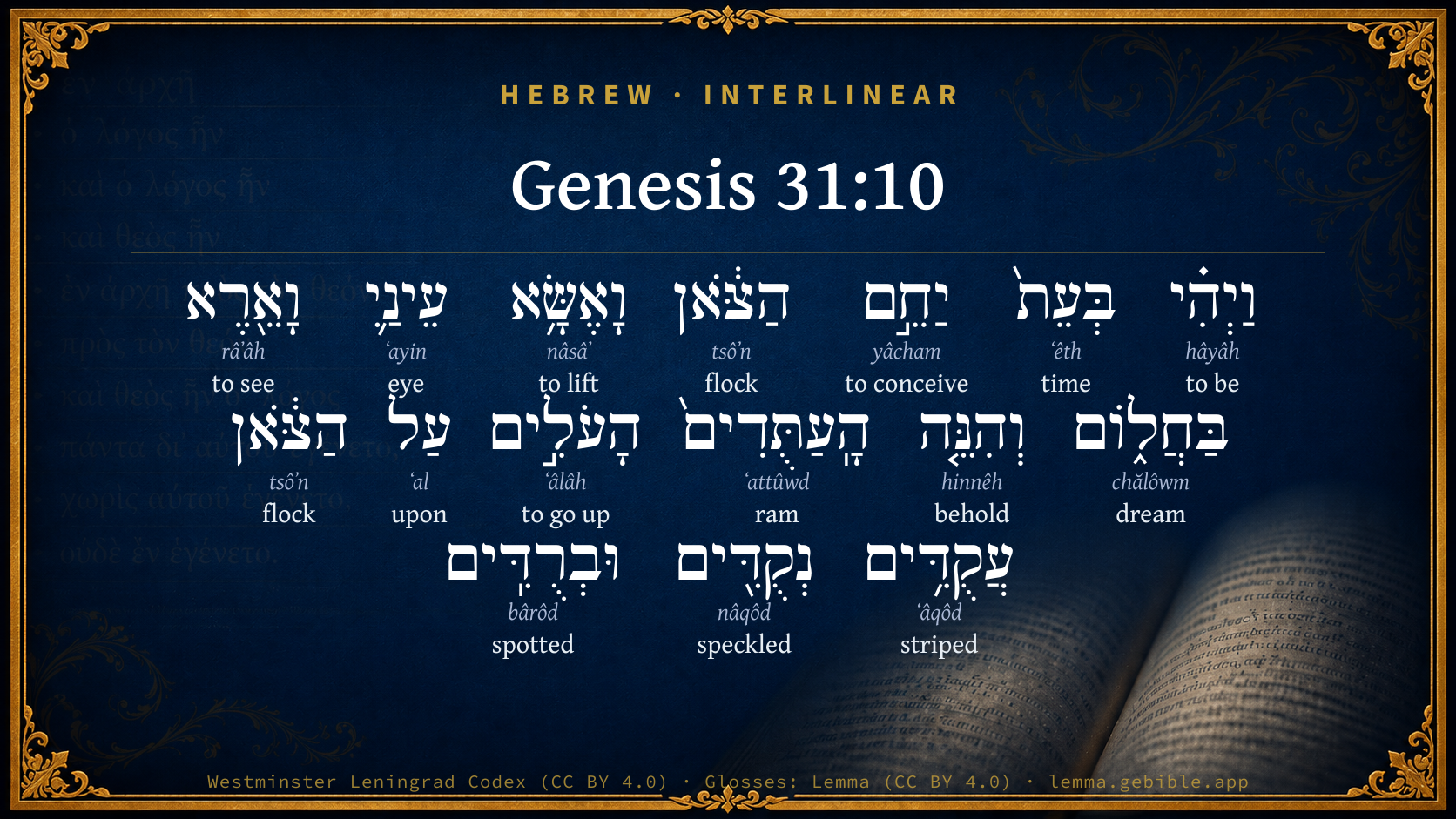
Genesis 31:10

Hebrew (Westminster Leningrad Codex) Genesis 31:10 appears in the Hebrew Old Testament. The text above is from the Westminster Leningrad Codex. Each word links to its Strong’s number, a concise gloss, and parsing drawn from the Open Scriptures Hebrew Bible morphology. Click any word for its full Brown-Driver-Briggs (BDB) entry.
Download image
Cite this verse

Genesis 31:10 (World English Bible). Public Domain. Lemma interlinear Bible study tool, https://lemma.gebible.app/v/genesis/31/10.

Show BibTeX & RIS
BibTeX
RIS
English Translation
It happened at the time that the flock conceive, that I lifted up my eyes, and saw in a dream, and behold, the male goats which leaped on the flock were streaked, speckled, and grizzled.
World English Bible · Public Domain
Highlights
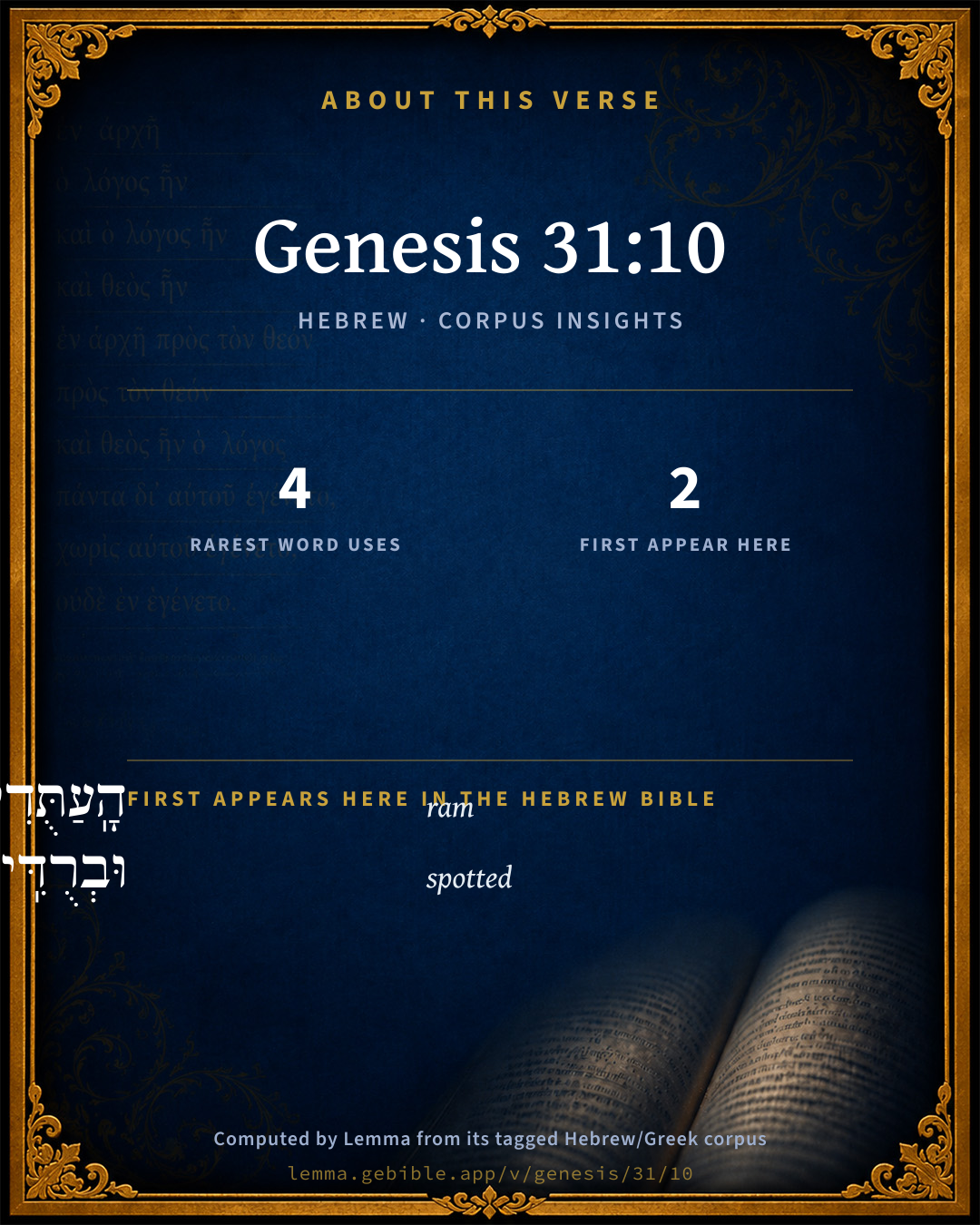
  • 2 first appearances in the Hebrew Bible
Full analysis ↓
Download a study sheet

One document with this verse’s original text, its word-by-word gloss line, the meaning frame, cross-references with their text, attributed commentary, and full source and license credits — printable, and it pastes into notes with its structure intact.

This verse Autodidact and up

Study sheet (.html) Plain text (.txt)

A passage Seminary Student

Up to 50 verses in one chapter. A passage sheet keeps up to 6 commentary sources and 12 cross-references per verse, in the order this page ranks them, and says so on the sheet whenever that leaves anything out. Ask for a single verse and you get the Autodidact verse sheet above.

Everything on this page stays free to read, with no account — the sheet is a download of what is already on screen, not access to it.

Want to remove ads? Support Godless Engineer
Compare translations 3

The same verse in 3 English versions, stacked beneath the original-language interlinear above. Click any original word for its lexicon entry.

Each is an independent rendering of the whole verse — the interlinear is not word-aligned to these translations.

Highlighted words mark where these versions differ — a whole-verse word diff, not a word-by-word alignment.

  • World English Bible Public Domain
    It happened at the time that the flock conceive, that I lifted up my eyes, and saw in a dream, and behold, the male goats which leaped on the flock were streaked, speckled, and grizzled.
  • King James Version Public Domain
    And it came to pass at the time that the cattle conceived, that I lifted up mine eyes, and saw in a dream, and, behold, the rams which leaped upon the cattle were ring-streaked, speckled, and grizzled.
  • unfoldingWord Literal Text CC BY-SA 4.0
    And it happened in the season the flock were in heat, and I lifted my eyes and saw in a dream that, behold, the he-goats that were mounting the flock streaked, speckled, and spotted.

unfoldingWord Literal Text — © unfoldingWord, licensed CC BY-SA 4.0. Word-aligned USFM3 via Door43 (git.door43.org/unfoldingWord/en_ult).

Versions to compare (up to 4)

3 of 4 selected

Show all 18 translations

Every available English version of this verse, each an independent rendering of the whole verse.

  • World English Bible Public Domain
    It happened at the time that the flock conceive, that I lifted up my eyes, and saw in a dream, and behold, the male goats which leaped on the flock were streaked, speckled, and grizzled.
  • Berean Standard Bible Public Domain
    When the flocks were breeding, I saw in a dream that the streaked, spotted, and speckled males were mating with the females.
  • Majority Standard Bible Public Domain
    When the flocks were breeding, I saw in a dream that the streaked, spotted, and speckled males were mating with the females.
  • King James Version Public Domain
    And it came to pass at the time that the cattle conceived, that I lifted up mine eyes, and saw in a dream, and, behold, the rams which leaped upon the cattle were ring-streaked, speckled, and grizzled.
  • American Standard Version (1901) Public Domain
    And it came to pass at the time that the flock conceive, that I lifted up mine eyes, and saw in a dream, and, behold, the he-goats which leaped upon the flock were ringstreaked, speckled, and grizzled.
  • Revised Version (1885) Public Domain
    And it came to pass at the time that the flock conceived, that I lifted up mine eyes, and saw in a dream, and, behold, the he-goats which leaped upon the flock were ringstraked, speckled, and grisled.
  • Geneva Bible (1599) Public Domain
    For in ramming time I lifted vp mine eyes and saw in a dreame, and beholde, ye hee goates leaped vpon the shee goates, that were partie coloured with litle and great spots spotted.
  • Douay-Rheims (1899) Public Domain
    For after that time came of the ewes conceiving, I lifted up my eyes, and saw in my sleep that the males which leaped upon the females were of diverse colors, and spotted, and speckled.
  • Young's Literal Translation Public Domain
    `And it cometh to pass at the time of the flock conceiving, that I lift up mine eyes and see in a dream, and lo, the he-goats, which are going up on the flock, `are' ring-straked, speckled, and grisled;
  • Literal Standard Version CC BY-SA 4.0
    And it comes to pass at the time of the flock conceiving, that I lift up my eyes and see in a dream, and behold, the male goats, which are going up on the flock, [are] striped, speckled, and spotted;
  • Unlocked Literal Bible CC BY-SA 4.0
    Once at the time of breeding season, I saw in a dream the male goats that were mating with the flock. The male goats were striped, speckled, and spotted.
  • unfoldingWord Literal Text CC BY-SA 4.0
    And it happened in the season the flock were in heat, and I lifted my eyes and saw in a dream that, behold, the he-goats that were mounting the flock streaked, speckled, and spotted.
  • Darby Bible Public Domain
    And it came to pass at the time of the ardour of the flocks, that I lifted up mine eyes, and saw in a dream, and behold, the rams that leaped upon the flocks were ringstraked, speckled, and spotted.
  • World Messianic Bible Public Domain
    During mating season, I lifted up my eyes, and saw in a dream, and behold, the male goats which leaped on the flock were streaked, speckled, and grizzled.
  • Webster's Bible Public Domain
    And it came to pass at the time that the cattle conceived, that I lifted up my eyes, and saw in a dream, and behold, the rams which leaped upon the cattle were ring-streaked, speckled, and grizzled.
  • Free Bible Version CC BY-SA 4.0
    During the time the flock was breeding I had a dream where I saw that the male goats mating with the flock were all streaked, speckled, or spotted.
  • Bible in Basic English Public Domain
    And at the time when the flock were with young, I saw in a dream that all the he-goats which were joined with the she-goats were banded and marked and coloured.
  • JPS Tanakh (1917) Public Domain
    And it came to pass at the time that the flock conceived, that I lifted up mine eyes, and saw in a dream, and, behold, the he-goats which leaped upon the flock were streaked, speckled, and grizzled.

Literal Standard Version (2020), Covenant Press — licensed CC BY-SA 4.0. Text via the HelloAO Bible API (eBible.org). Unlocked Literal Bible (unfoldingWord) — licensed CC BY-SA 4.0. Text via the HelloAO Bible API (eBible.org). unfoldingWord Literal Text — © unfoldingWord, licensed CC BY-SA 4.0. Word-aligned USFM3 via Door43 (git.door43.org/unfoldingWord/en_ult). Free Bible Version, Dr. Jonathan Gallagher — licensed CC BY-SA 4.0. Text via the HelloAO Bible API (eBible.org).

Word by word

More ways to search: Search by grammar → Find every occurrence → Compare this word →

Practice this passage: Drill this verse → Learn its vocabulary →

וּבְרֻדִּֽים
bârôd
H1261
“and · spotted”
Conjunction + Adjective, Adjective, Masculine, Plural, Absolute
Part of Speech
Conjunction + Adjective
Type
Adjective
Gender
Masculine
Number
Plural
State
Absolute
Full BDB Definition

Origin: from H1258

TWOT: 280b

spotted, marked
  1. וַיְהִ֗י hâyâh H1961 “and · to be” Conjunction + Verb, Qal, Sequential Imperfect, 3rd Person, Masculine, Singular
  2. בְּעֵת֙ ʻêth H6256 “in/at · time of” Preposition + Noun, Common, Both, Singular, Construct
  3. יַחֵ֣ם yâcham H3179 “to conceive” Verb, Piel, Infinitive Construct
  4. הַצֹּ֔אן tsôʼn H6629 “the · flock” Particle, Definite Article + Noun, Common, Both, Singular, Absolute
  5. וָאֶשָּׂ֥א nâsâʼ H5375 “and · to lift” Conjunction + Verb, Qal, Sequential Imperfect, 1st Person, Common, Singular
  6. עֵינַ֛י ʻayin H5869 “eyes · my” Noun, Common, Both, Dual, Construct + Suffix, Personal, 1st Person, Common, Singular
  7. וָאֵ֖רֶא râʼâh H7200 “and · to see” Conjunction + Verb, Qal, Sequential Imperfect, 1st Person, Common, Singular
  8. בַּחֲל֑וֹם chălôwm H2472 “in/at · dream” Preposition + Noun, Common, Masculine, Singular, Absolute
  9. וְהִנֵּ֤ה hinnêh H2009 “and · behold” Conjunction + Particle, Demonstrative
  10. הָֽעַתֻּדִים֙ ʻattûwd H6260 “the · rams” Particle, Definite Article + Noun, Common, Masculine, Plural, Absolute
  11. הָעֹלִ֣ים ʻâlâh H5927 “the · going up” Particle, Definite Article + Verb, Qal, Participle Active, Masculine, Plural, Absolute
  12. עַל ʻal H5921 “upon” Preposition
  13. הַצֹּ֔אן tsôʼn H6629 “the · flock” Particle, Definite Article + Noun, Common, Both, Singular, Absolute
  14. עֲקֻדִּ֥ים ʻâqôd H6124 “striped” Adjective, Adjective, Masculine, Plural, Absolute
  15. נְקֻדִּ֖ים nâqôd H5348 “speckled” Adjective, Adjective, Masculine, Plural, Absolute

About this verse

These counts appear in no published source. They are computed here, from the morphology-tagged text and Lemma’s own curated glosses. What Lemma adds →

16
words
15
distinct lemmas
Pentateuch
section

Notable vocabulary

The rarest word here is וּבְרֻדִּֽים spotted H1261 — appearing just 4 times in the whole Hebrew Bible.

First appearance in Scripture

These words make their first canonical appearance in the Hebrew Bible here:

  • הָֽעַתֻּדִים֙ ram H6260
  • וּבְרֻדִּֽים spotted H1261

Shared distinctive vocabulary

וּבְרֻדִּֽים spotted H1261 occurs in 4 verses of the Hebrew Bible. Also found in:

Grammatical profile

  • 5 verbs
  • 6 nouns
  • 3 adjectives
  • 1 preposition
  • 1 particle

Verb forms

  • וַיְהִ֗י Qal · Sequential Imperfect
  • יַחֵ֣ם Piel · Infinitive Construct
  • וָאֶשָּׂ֥א Qal · Sequential Imperfect
  • וָאֵ֖רֶא Qal · Sequential Imperfect
  • הָעֹלִ֣ים Qal · Participle Active

Repetition

A word recurs within this verse — often emphatic in Hebrew:

  • הַצֹּ֔אן flock H6629 ×2

Hebrew & Septuagint length

In English translation the verse runs 35 words from the Hebrew and 43 from the Septuagint (LXX English) — closely comparable.

A rough comparison of the two English renderings, which tokenize alike — not a word-level alignment.

Word counts can differ between the Hebrew and the Greek without any difference in meaning — e.g. the Hebrew direct-object marker אֵת has no separate Greek word, and Greek often adds the article ὁ.

Cross-references

7

Topical passages linked to Genesis 31:10 in the Treasury of Scripture Knowledge — connected by theme and wording, ordered by reader-vote popularity; previews shown in the World English Bible.

  • Deuteronomy 13:1 If there arise in the midst of you a prophet, or a dreamer of dreams, and he give you a sign or a wonder,
  • Genesis 20:6 God said to him in the dream, "Yes, I know that in the integrity of your heart you have done this, and I also withheld you from sinning against me. Therefore I didn't allow you to touch her.
  • Genesis 28:12 He dreamed. Behold, a stairway set up on the earth, and the top of it reached to heaven. Behold, the angels of God ascending and descending on it.
  • Genesis 30:39 The flocks conceived before the rods, and the flocks brought forth streaked, speckled, and spotted.
  • Genesis 31:24 God came to Laban, the Syrian, in a dream of the night, and said to him, "Take heed to yourself that you don't speak to Jacob either good or bad."
  • Numbers 12:6 He said, Hear now my words: if there be a prophet among you, I Yahweh will make myself known to him in a vision, I will speak with him in a dream.
  • 1 Kings 3:5 In Gibeon Yahweh appeared to Solomon in a dream by night; and God said, Ask what I shall give you.

Cross-references courtesy of OpenBible.info (CC BY 4.0).

Hebrew and Greek witnesses Masoretic Hebrew ↔ Greek Septuagint

The same verse in the two great witnesses to the Old Testament, shown verse-for-verse.

These are two independent witnesses, not word-aligned to each other, and the Septuagint is shown in lemma (dictionary) form.

Hebrew Genesis 31:10 Masoretic · Westminster Leningrad Codex

וַיְהִ֗י בְּעֵת֙ יַחֵ֣ם הַצֹּ֔אן וָאֶשָּׂ֥א עֵינַ֛י וָאֵ֖רֶא בַּחֲל֑וֹם וְהִנֵּ֤ה הָֽעַתֻּדִים֙ הָעֹלִ֣ים עַל הַצֹּ֔אן עֲקֻדִּ֥ים נְקֻדִּ֖ים וּבְרֻדִּֽים

It happened at the time that the flock conceive, that I lifted up my eyes, and saw in a dream, and behold, the male goats which leaped on the flock were streaked, speckled, and grizzled.

World English Bible · Public Domain

Greek LXX Genesis 31:10 Septuagint · lemma form

καί γίγνομαι ἡνίκα ἐνκισσάω ὁ πρόβατον καί ὁράω ὁ ὀφθαλμός αὐτός ἐν ὁ ὕπνος καί ἰδού ὁ τράγος καί ὁ κριός ἀναβαίνω εἰμί ἐπί ὁ πρόβατον καί ὁ αἴξ διάλευκος καί ποικίλος καί σποδοειδής ῥαντός

And it came to pass when the cattle conceived and were with young, that I saw with my eyes in sleep, and behold the he-goats and the rams leaping on the sheep and the she-goats, speckled and variegated and spotted with ash-colored spots.

LXX2012 (modern English Septuagint) · Public Domain

On this verse, The Pulpit Commentary discusses the Septuagint’s reading. Read the note in Commentary ↓

Hebrew: Westminster Leningrad Codex (CC BY 4.0). Greek: Septuagint (public domain); English from LXX2012 (modern English Septuagint) (Public Domain). How the Septuagint differs from the Hebrew →

Targum (Aramaic paraphrase)

2

The Targum is the ancient Jewish Aramaic paraphrase of the Hebrew Scriptures — an interpretive translation, not the Hebrew text itself. Onkelos (literal) and Pseudo-Jonathan (expansive) render the Torah, and Jonathan the Prophets. Coverage is partial: where no permissively-licensed English translation exists for a verse, only the Aramaic is shown. This is verse-level text, not a word-by-word alignment to the Hebrew.

  1. Targum Onkelos Torah (Genesis–Deuteronomy)
    וַהֲוָה בְּעִדַּן דְּאִתְיַחֲמָא עָנָא וּזְקָפִית עַיְנַי וַחֲזֵית בְּחֶלְמָא וְהָא תְיָשַׁיָּא דְּסָלְקִין עַל עָנָא רְגוֹלִין נְמוֹרִין וּפַצִיחִין

    (no public-domain English translation for this verse)

    Targum Onkelos — Aramaic: “Onkelos Genesis” (public domain); “Onkelos Exodus” (public domain); “Onkelos Leviticus” (public domain); “Onkelos Numbers” (public domain); “Onkelos Deuteronomy” (public domain). English: “Sefaria Community Translation” (CC0 1.0 (public-domain dedication)); “J.W. Etheridge. The Targums of Onkelos and Jonathan Ben Uzziel on the Pentateuch. London: Longmans, Green, 1862” (public domain). Text via Sefaria.

  2. Targum Pseudo-Jonathan Torah (Genesis–Deuteronomy)
    וַהֲוָה בְּעִידַן דְאִתְיַחֲמָא עָנָא וּזְקָפִית עֵינַי וְחָמִית בְּחֶלְמָא וְהָא בָּרְחַיָיא דְסַלְקִין עַל עָנָא שׁוּמָא בְּרַגְלֵיהוֹן וְקִירְוָוחִין וְגַבֵּיהוֹן חִיוָורִין

    And it was at the time when the flocks conceived, that I lifted up my eyes and saw in a dream, and, behold, the goats which rose upon the flock were spotted in their feet, or streaked or white in their backs.

    Targum Pseudo-Jonathan — Aramaic: “Targum Jonathan on Genesis” (public domain); “Targum Jonathan on Exodus” (public domain); “Targum Jonathan on Leviticus” (public domain); “Targum Jonathan on Numbers” (public domain); “Targum Jonathan on Deuteronomy” (public domain). English: “The Targum of Jonathan ben Uzziel, trans. J. W. Etheridge, London, 1862” (public domain). Text via Sefaria.

Commentary

Notes on Genesis 31:10 from classic Christian and Jewish commentators (each source and its license shown beneath its notes). The classic Christian expositions comment on the surrounding passage and are grouped to its opening verse, so a note may address several verses; the Jewish commentaries on the Tanakh (Rashi and others) are per-verse, so they appear only where the commentator wrote on this verse.

Lemma curates 59 commentaries, every one of them public domain or Creative Commons licensed, each selected and text-cleaned for this edition rather than reprinted as found. About our sources →

The Cambridge Bible for Schools and Colleges

gen. ed. J. J. S. Perowne

10. in a dream] Cf. Gen_20:3. It is thus revealed to Jacob (Gen_31:10-12) that the birth, in such numbers, of spotted and parti-coloured young is due to God’s goodness towards him, and in order to requite Laban (Gen_31:12).

grisled] i.e. “gray” (Fr. gris). This Old English word, now generally spelt “grizzled,” occurs also in Zec_6:3; Zec_6:6. Compare, in Bacon’s Essays, “pusled” for “puzzled.”

The Cambridge Bible for Schools and Colleges (gen. ed. J. J. S. Perowne; Cambridge University Press, 1878–1918) — public domain. Text from a community e-Sword module.

Trapp's Complete Commentary

John Trapp

Gen 31:10 And it came to pass at the time that the cattle conceived, that I lifted up mine eyes, and saw in a dream, and, behold, the rams which leaped upon the cattle [were] ringstraked, speckled, and grisled.

Ver. 10-12. I saw in a dream, &c.] Of divine dreams, such as this was, {See Trapp on "Gen 20:3"}

John Trapp, A Commentary or Exposition upon All the Books of the Old and New Testament (1647–1656) — public domain. Text from a community e-Sword module.

Ellicott's Commentary for English Readers

(10) Rams.—Heb., he-goats. The Authorised Version has made the alteration, because the word rendered “cattle” is really sheep (and so in Gen_31:8; Gen_31:12, &c.); but, like our word flock, it also included goats.

A Bible Commentary for English Readers, edited by Charles John Ellicott (1878–1897) — public domain. Text from a community e-Sword module.

John Gill's Exposition

And the Angel of God spake unto me in a dream,.... In the same dream before related, and to direct him to observe what was presented to him, and to confirm what he saw, and lead him to the design and use of it. This was not a created angel, but the eternal one, the Son of God, and who is afterwards called God, and to whom Jacob had made a vow, which he would never have done to an angel; but to God only, as Ben Melech observes:

saying, Jacob; and I said, here am I; the Angel called him by his name, to which he answered, and signified that he was ready to attend to whatsoever he should say to him.

John Gill's Exposition of the Whole Bible (1746–1763) — public domain (CC PDM 1.0). Text via the HelloAO Bible API.

Matthew Poole's English Annotations

i.e. Were marked with spots, like hail in colour and proportion, as the word signifieth.

Matthew Poole's English Annotations on the Holy Bible (1683–1685) — public domain. Text from a community e-Sword/MySword module.

Whedon's Commentary on the Bible

Daniel D. Whedon

10. Saw in a dream — In Gen_30:37-43, we have the human side of Jacob’s procedure. We there see his artifice and cunning. Here is another view, not at all in conflict with that, but designed to show that all Jacob’s tricks were as nothing without supernatural interference. God interposed to favour Jacob, not because of his guile or cunning, still less to sanction any thing of the kind as an example for others. Probably such dreams had come repeatedly during the last four or five years, and at the end of the sixth year of his independent service he received the revelation of Gen_31:11-13.

Daniel D. Whedon (gen. ed.), Commentary on the Old and New Testaments (1874–1909) — public domain. Text from a community e-Sword module.

The Pulpit Commentary

And it came to pus at the time that the cattle conceived (this obviously goes back to the commencement of the six years" service), that I lifted up mine eyes, and saw in a dream, and, behold, the rams he-goats, from an unused root, to be ready, perhaps because ready and prompt for fighting (Gesenius, sub voce)which leaped (literally, Heir up) upon the cattle were ringstraked, speckled, and grisled. The grisled ( beruddim, from barad, to scatter hail) were spotted animals, as if they had been sprinkled with hail, not a fifth sort in addition to the four already mentioned (Rosenm but the same as the teluim of Gen_30:35. (Kalisch) Wordsworth observes that the English term grisled, from the French word grele, hail, is a literal translation of the Hebrew. Gesenius connects with the Hebrew root the words pardov, pardus, leopard (so called from its spots), and the French broder, to embroider. The LXX understand the to include both sheep and goats, and translate oiJ tragoi kai oiJ kriointev ejpi tabata kai tav aijgav.

The Pulpit Commentary (1880–1919), ed. H.D.M. Spence-Jones & Joseph S. Exell — public domain. Text from a community e-Sword module.

unfoldingWord translationNotes

Door43 World Missions Community

General Information:

Jacob continues his story to his wives Leah and Rachel.

Once at the time of breeding season

"During the breeding season"

mating with the flock

Here "flock" represents only the female goats. AT: "mating with the female goats of the flock" (See: Synecdoche)

were striped, speckled, and spotted

"had stripes, little spots, and big spots"

angel of God

Possible meanings are 1) God himself appeared as a man or 2) one of God's messengers appeared. Since the phrase is not well understood, it is best to simply translate it as "the angel of God," using the normal word that you use for "angel."

I said

"And I answered"

Here I am

"Yes, I am listening" or "Yes, what is it?" See how you translated this in Genesis 22:1.

translationWords

dream

goat

angel

unfoldingWord translationNotes — © Distant Shores Media and the Door43 World Missions Community, licensed CC BY-SA 4.0. Source: git.door43.org/Door43/en_tn.

Rashi

Rabbi Shlomo Yitzchaki (Rashi)

והנה העתדים BEHOLD THE RAMS — Although Laban had separated all these so that the sheep should not give birth to young marked similar to them, angels brought them from the flock which had been placed in charge of Laban’s sons to the flock in Jacob’s charge (Genesis Rabbah 73:10).

וברדים GRISLED — Explain it as the Targum renders it: פציחין open; old French faissie, checquered. There was a white stripe going right round the body, the spots of which it was composed being open and running from one end to the other. But I can bring no evidence from Scripture that this is the meaning.

Rashi on the Tanakh — English translations: “The Judaica Press complete Tanach with Rashi, translated by A. J. Rosenberg” (CC BY 4.0); “Pentateuch with Rashi's commentary by M. Rosenbaum and A.M. Silbermann, 1929-1934” (public domain); “The Metsudah Tanach series, Lakewood, N.J” (CC BY 4.0); and “The Book of Joshua, Metsudah Publications, 1997” (CC BY 4.0). Text via Sefaria.

Ramban (Nachmanides)

Rabbi Moshe ben Nachman (Ramban / Nachmanides)

AND IT CAME TO PASS AT THE TIME THAT THE FLOCK CONCEIVED. This was after Laban changed his wages, and therefore the angel said to Jacob, For I have seen all that Laban does unto thee.

AND, BEHOLD THE HE-GOATS WHICH WENT UP ON THE FLOCKS [WERE RINGSTRAKED, SPECKLED, AND GRIZZLED]. The meaning thereof is that it was shown to Jacob in a dream that the he-goats which mounted the flocks were all ringstraked, and afterwards they were all speckled, and still later they were all grizzled. And the angel told him that in view of the injustice which Laban does him by changing his wages, the future offspring will have the appearance which Jacob will need, and that henceforth Jacob should not make the sticks, for Whoso putteth his trust in the Eternal shall be set up on high.

AND, BEHOLD, ‘HA’ATUDIM’ WHICH WENT UP ON THE FLOCKS. He-goats and rams are called atudim for all the adults in the flocks are so called. This applies also to the mighty ones among men, as in: ‘atudei’ (the chief ones) of the earth. And Rashi comments: “Although Laban had separated all these so that the sheep should not give birth to young marked similarly to them, angels brought them from the flock which had been placed in charge of Laban’s sons to the flock in Jacob’s charge.”In line with the simple meaning of Scripture this was a vision assuring Jacob that the flocks would give birth to young similar to the marked rams and he-goats, and the proof of it is the word vehinei (and behold), for this expression is used with respect to all dreams, indicating that it is as if the action is in the presence of the dreamer. In Bereshith Rabbah, the Sages did not mention the angels [bringing the marked ones from the flocks of Laban], but it may be inferred by exegesis. Thus they said: “It is not written here olim (went up) but ha’olim (those that mounted),” [meaning those which actually mounted. Thus the dream only indicated the action of the atudim which came from Laban’s flocks and that they were ringstraked, speckled, etc. However, the fact that they came was not part of the dream. This really occurred since the angels brought them]. But the plain sense of the verse is as we have said.

Ramban (Nachmanides) on the Tanakh — English translation: “Commentary on the Torah by Ramban (Nachmanides). Translated and annotated by Charles B. Chavel. New York, Shilo Pub. House, 1971-1976” (CC BY 4.0). Text via Sefaria.

Radak

Rabbi David Kimhi (Radak)

ויהי...העתודים, another word for he-goats, תישים.

וברודים, a variant of the word טלואים; the reason why the Torah switched to this term is to tell us that the whiteness of the spots in questions is similar to that of hail stones, ברד.

Radak on the Tanakh — English translations: “Sefaria Community Translation” (CC0 1.0 (public-domain dedication)); “Eliyahu Munk, HaChut Hameshulash” (CC BY 4.0); “Rabbi Mike Feuer, Jerusalem Anthology” (CC BY 4.0); and “R. David Kimhi on the first book of Psalms, Translated by R.G. Finch, London, 1919” (public domain). Text via Sefaria.

Lesson kit

Teaching starters — assembled from the data on this page, not authored interpretation. Every prompt links to the verse data it draws on. Edit before teaching.

Genesis, in the Pentateuch, opens this verse with 16 words (15 distinct Hebrew lemmas). Its most distinctive word is bârôd (“spotted”). A historical commentator’s framing appears above. Read the whole chapter for the surrounding context.

Discussion questions

  1. The word bârôd carries the sense “spotted.” How does it shape the verse?
  2. 2 words make their first appearance in Scripture here. What does this debut establish?
  3. How does Genesis 31:12, which shares the word «spotted», read alongside this verse?
  4. What does the repetition of “flock” (2× in this one verse) do in this verse?
  5. These translations render this verse differently; the difference is in the English rendering, not the original. What questions does that raise?
  6. «וַיְהִ֗י» is a Qal Sequential Imperfect verb. How does that grammatical form shape the action described?
  7. Compare how The Cambridge Bible for Schools and Colleges and Trapp's Complete Commentary read this verse. Where do they agree or differ?

Things to notice

  • 2 words make their first canonical appearance in Scripture here.
  • These translations choose different wording for 24 words in this verse.
  • “flock” occurs 2× in this single verse.
  • 15 distinct Hebrew lemmas span 16 words in this verse.

Reading settings

Reading text

Shown beneath each verse's original-language words.

Old Testament
Old Testament edition

Read the OT as the Masoretic Hebrew (MT) or the Greek Septuagint (LXX).

English shown for the Greek Septuagint (in the Hebrew ↔ Greek comparison).

Comparing translations? Open the Compare panel on any verse page to stack up to four side by side.