

Job 13:8

Hebrew (Westminster Leningrad Codex) Job 13:8 appears in the Hebrew Old Testament. The text above is from the Westminster Leningrad Codex. Each word links to its Strong’s number, a concise gloss, and parsing drawn from the Open Scriptures Hebrew Bible morphology. Click any word for its full Brown-Driver-Briggs (BDB) entry.
Download image
Cite this verse

Job 13:8 (World English Bible). Public Domain. Lemma interlinear Bible study tool, https://lemma.gebible.app/v/job/13/8.

Show BibTeX & RIS
BibTeX
RIS
English Translation
Will you show partiality to him? Will you contend for God?
World English Bible · Public Domain
Download a study sheet

One document with this verse’s original text, its word-by-word gloss line, the meaning frame, cross-references with their text, attributed commentary, and full source and license credits — printable, and it pastes into notes with its structure intact.

This verse Autodidact and up

Study sheet (.html) Plain text (.txt)

A passage Seminary Student

Up to 50 verses in one chapter. A passage sheet keeps up to 6 commentary sources and 12 cross-references per verse, in the order this page ranks them, and says so on the sheet whenever that leaves anything out. Ask for a single verse and you get the Autodidact verse sheet above.

Everything on this page stays free to read, with no account — the sheet is a download of what is already on screen, not access to it.

Want to remove ads? Support Godless Engineer
Compare translations 3

The same verse in 3 English versions, stacked beneath the original-language interlinear above. Click any original word for its lexicon entry.

Each is an independent rendering of the whole verse — the interlinear is not word-aligned to these translations.

Highlighted words mark where these versions differ — a whole-verse word diff, not a word-by-word alignment.

  • World English Bible Public Domain
    Will you show partiality to him? Will you contend for God?
  • King James Version Public Domain
    Will ye accept his person? will ye contend for God?
  • unfoldingWord Literal Text CC BY-SA 4.0
    Will you lift his face? Or will you plead for God?

unfoldingWord Literal Text — © unfoldingWord, licensed CC BY-SA 4.0. Word-aligned USFM3 via Door43 (git.door43.org/unfoldingWord/en_ult).

Versions to compare (up to 4)

3 of 4 selected

Show all 18 translations

Every available English version of this verse, each an independent rendering of the whole verse.

  • World English Bible Public Domain
    Will you show partiality to him? Will you contend for God?
  • Berean Standard Bible Public Domain
    Would you show Him partiality or argue in His defense?
  • Majority Standard Bible Public Domain
    Would you show Him partiality or argue in His defense?
  • King James Version Public Domain
    Will ye accept his person? will ye contend for God?
  • American Standard Version (1901) Public Domain
    Will ye show partiality to him? Will ye contend for God?
  • Revised Version (1885) Public Domain
    Will ye respect his person? will ye contend for God?
  • Geneva Bible (1599) Public Domain
    Will ye accept his person? or will ye contende for God?
  • Douay-Rheims (1899) Public Domain
    Do you accept his person, and do you endeavour to judge for God?
  • Young's Literal Translation Public Domain
    His face do ye accept, if for God ye strive?
  • Literal Standard Version CC BY-SA 4.0
    Do you accept His face, if you strive for God?
  • Unlocked Literal Bible CC BY-SA 4.0
    Will you show him partiality? Will you argue the case for God?
  • unfoldingWord Literal Text CC BY-SA 4.0
    Will you lift his face? Or will you plead for God?
  • Darby Bible Public Domain
    Will ye accept his person? will ye contend for ùGod?
  • World Messianic Bible Public Domain
    Will you show partiality to him? Will you contend for God?
  • Webster's Bible Public Domain
    Will ye accept his person? will ye contend for God?
  • Free Bible Version CC BY-SA 4.0
    Or are you wanting to show God favoritism? Are you going to argue God's case for him?
  • Bible in Basic English Public Domain
    Will you have respect for God's person in this cause, and put yourselves forward as his supporters?
  • JPS Tanakh (1917) Public Domain
    Will ye show Him favour? Will ye contend for God?

Literal Standard Version (2020), Covenant Press — licensed CC BY-SA 4.0. Text via the HelloAO Bible API (eBible.org). Unlocked Literal Bible (unfoldingWord) — licensed CC BY-SA 4.0. Text via the HelloAO Bible API (eBible.org). unfoldingWord Literal Text — © unfoldingWord, licensed CC BY-SA 4.0. Word-aligned USFM3 via Door43 (git.door43.org/unfoldingWord/en_ult). Free Bible Version, Dr. Jonathan Gallagher — licensed CC BY-SA 4.0. Text via the HelloAO Bible API (eBible.org).

Word by word

More ways to search: Search by grammar → Find every occurrence → Compare this word →

Practice this passage: Drill this verse → Learn its vocabulary →

About this verse

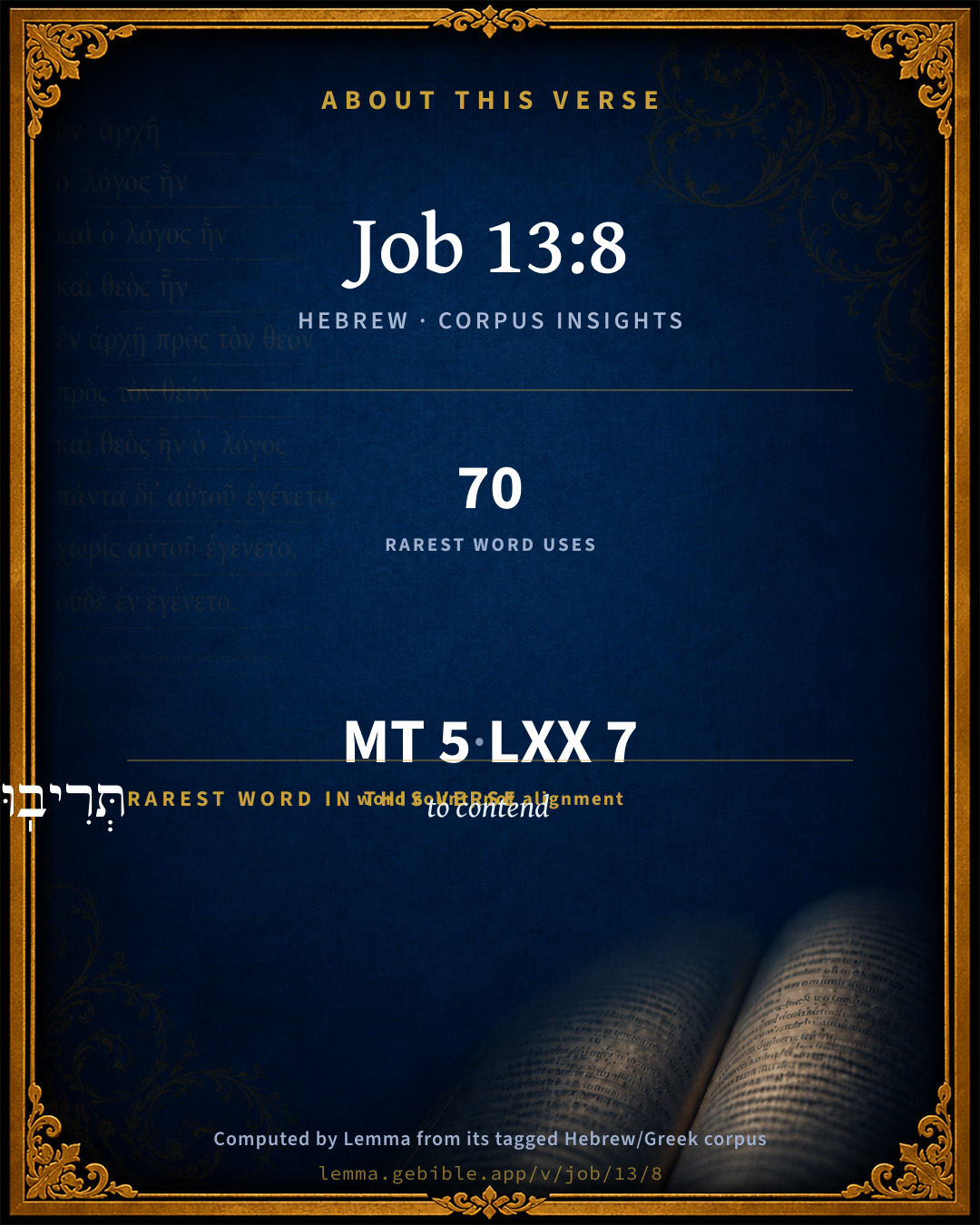
These counts appear in no published source. They are computed here, from the morphology-tagged text and Lemma’s own curated glosses. What Lemma adds →

5
words
5
distinct lemmas
Wisdom
section

Grammatical profile

  • 2 verbs
  • 2 nouns
  • 1 conjunction

Verb forms

  • תִּשָּׂא֑וּן Qal · Imperfect
  • תְּרִיבֽוּן Qal · Imperfect

Hebrew & Septuagint length

In English translation the verse runs 11 words from the Hebrew and 11 from the Septuagint (LXX English) — the same length.

A rough comparison of the two English renderings, which tokenize alike — not a word-level alignment.

Word counts can differ between the Hebrew and the Greek without any difference in meaning — e.g. the Hebrew direct-object marker אֵת has no separate Greek word, and Greek often adds the article ὁ.

In the original languages it is 5 Hebrew tokens and 7 Greek tokens — but the two are counted differently (Hebrew bundles its prefixes and suffixes into one token; the Greek is in lemma form), so that isn’t a like-for-like length.

Cross-references

6

Topical passages linked to Job 13:8 in the Treasury of Scripture Knowledge — connected by theme and wording, ordered by reader-vote popularity; previews shown in the World English Bible.

  • Exodus 23:2–3 You shall not follow a crowd to do evil; neither shall you testify in court to side with a multitude to pervert justice;
  • Proverbs 24:23 These also are sayings of the wise. To show partiality in judgment is not good.
  • Leviticus 19:15 "'You shall do no injustice in judgment: you shall not be partial to the poor, nor show favoritism to the great; but in righteousness shall you judge your neighbor.
  • Job 32:21 Please don't let me respect any man's person, Neither will I give flattering titles to any man.
  • Job 34:19 Who doesn't respect the persons of princes, Nor regards the rich more than the poor; For they all are the work of his hands.
  • Malachi 2:9 "Therefore I have also made you contemptible and base before all the people, according to the way you have not kept my ways, but have had respect for persons in the law.

Cross-references courtesy of OpenBible.info (CC BY 4.0).

Hebrew and Greek witnesses Masoretic Hebrew ↔ Greek Septuagint

The same verse in the two great witnesses to the Old Testament, shown verse-for-verse.

These are two independent witnesses, not word-aligned to each other, and the Septuagint is shown in lemma (dictionary) form.

Hebrew Job 13:8 Masoretic · Westminster Leningrad Codex

הֲפָנָ֥יו תִּשָּׂא֑וּן אִם לָאֵ֥ל תְּרִיבֽוּן

Will you show partiality to him? Will you contend for God?

World English Bible · Public Domain

Greek LXX Job 13:8 Septuagint · lemma form

ἦ ὑποστέλλω σύ δέ αὐτός κριτής γίγνομαι

Or will you⌃ draw back? nay do, you⌃ yourselves be judges.

LXX2012 (modern English Septuagint) · Public Domain

On this verse, Haydock's Catholic Bible Commentary discusses the Septuagint’s reading. Read the note in Commentary ↓

Hebrew: Westminster Leningrad Codex (CC BY 4.0). Greek: Septuagint (public domain); English from LXX2012 (modern English Septuagint) (Public Domain). How the Septuagint differs from the Hebrew →

Commentary

Notes on Job 13:8 from classic Christian and Jewish commentators (each source and its license shown beneath its notes). The classic Christian expositions comment on the surrounding passage and are grouped to its opening verse, so a note may address several verses; the Jewish commentaries on the Tanakh (Rashi and others) are per-verse, so they appear only where the commentator wrote on this verse.

Lemma curates 59 commentaries, every one of them public domain or Creative Commons licensed, each selected and text-cleaned for this edition rather than reprinted as found. About our sources →

Trapp's Complete Commentary

John Trapp

Job 13:8 Will ye accept his person? will ye contend for God?

Ver. 8. Will ye accept his person?] While you think to gratify him, and to ingratiate with him by oppressing me? Can you find no other way of justifying God’s proceedings than by condemning me for wicked, because by him so afflicted? The truth is, these friends of Job, out of a perverse zeal of advancing God’s righteousness, unrighteously suspected poor Job of wickedness, and so rejected his person to accept God’s. See the like done Isa 66:5 Jer 50:7 Joh 16:2. O sancta simplicitas! said John Huss, when, at the stake, he observed a plain country fellow busier than the rest in fetching faggots to burn the heretics.

Will ye contend for God?] Why not? Good blood will not belie itself; the love of God constraineth his people to stand to him and to stickle for him; Non amat, qui non zelat, saith a Father. But then it must be a zeal according to knowledge; for else it will appear to be but base and reprobate metal, such as though it seemeth to be all for God, yet it never received the image and impress of God’s Holy Spirit, and therefore is not current in heaven. But that I believe and know (said that fiery friar, Brusierd, in a conference with Bilney) that God and all his saints, whom thou hast so greatly dishonoured, will take revenge everlastingly on thee, I would surely with these nails of mine be thy death (Acts and Mon. 914). Another friar, preaching at Antwerp, wished that Luther were there, that he might bite out his throat with his teeth, and with the same teeth receive the Eucharist by Luther so dishonoured (Erasm. Epist. lib. 16).

John Trapp, A Commentary or Exposition upon All the Books of the Old and New Testament (1647–1656) — public domain. Text from a community e-Sword module.

Jamieson, Fausset & Brown

Robert Jamieson, A. R. Fausset & David Brown

accept his person--God's; that is, be partial for Him, as when a judge favors one party in a trial, because of personal considerations.

contend for God--namely, with fallacies and prepossessions against Job before judgment (Jdg 6:31). Partiality can never please the impartial God, nor the goodness of the cause excuse the unfairness of the arguments.

Jamieson, Fausset & Brown — Commentary Critical and Explanatory on the Whole Bible (1871) — public domain (CC PDM 1.0). Text via the HelloAO Bible API.

Adam Clarke's Commentary

Verse 8. Will ye accept his person?] Do you think to act by him as you would by a mortal; and, by telling lies in his favour, attempt to conciliate his esteem?

Adam Clarke's Commentary on the Bible (1810–1826) — public domain. Text from a community e-Sword/MySword module.

The Cambridge Bible for Schools and Colleges

gen. ed. J. J. S. Perowne

8. The same charge put more explicitly. To accept the person of one is to be partial on his side, cf. Job_13:10.

contend for God] i. e. will ye play the advocate for God? The charge made against his friends by Job is that they had no knowledge of his guilt, and merely took part for God against him out of servility to God. This servility was nothing but a superficial religiousness, allied to superstition, which did not form its conception of God from the broad facts of the universe.

The Cambridge Bible for Schools and Colleges (gen. ed. J. J. S. Perowne; Cambridge University Press, 1878–1918) — public domain. Text from a community e-Sword module.

John Gill's Exposition

Will ye accept his person?.... Accepting persons ought not to be done in judgment by earthly judges; which is done when they give a cause to one through favour and affection to his person, because rich, or their friend, and against another, because otherwise; and something like this Job intimates his friends did in the present case; they only considered what God was, holy, just, wise, and good in all he did, and so far they were right, and too much respect cannot be given him; but the fault was, that they only attended to this, and did not look into the cause of Job itself, but wholly neglected it, and gave it against him, he being poor, abject, and miserable, on the above consideration of the perfections of God; which looked like what is called among men acceptation, or respect of persons:

will ye contend for God? it is right to contend for God, for the being of God against atheists, for the perfections of God, his sovereignty, his omniscience, omnipresence, &c. against those that deny them, for his truths and doctrines, word, worship, and ordinances, against the corrupters of them; but then he and those are not to be contended for in a foolish and imprudent manner, or with a zeal, not according to knowledge, much less with an hypocritical one, as was Jehu's, Kg2 10:28; God needs no such advocates, he can plead his own cause, or make use of persons that can do it in a better manner, and to better purpose.

John Gill's Exposition of the Whole Bible (1746–1763) — public domain (CC PDM 1.0). Text via the HelloAO Bible API.

Albert Barnes' Notes on the Bible

Will ye accept his person? - That is, will you be partial to him? The language is such as is used in relation to courts of justice, where a judge shows favor to one of the parties on account of birth, rank, wealth, or personal friendship. The idea here is, “will you, from partiality to God, maintain unjust principles, and defend positions which are really untenable?” There was a controversy between Job and God. Job maintained that he was punished too severely; that the divine dealings were unequal and disproportioned to his offences. His friends, he alleges, have not done justice to the arguments which he had urged, but had taken sides with God against him, no matter what he urged or what he said. So little disposed were they to do justice to him and to listen to his vindication, that no matter what he said, they set it all down to impatience, rebellion, and insubmission.

They assumed that he was wrong, and that God was wholly right in all flyings. Of this position that God was right, no one could reasonably complain, and in his sober reflections Job himself would not be disposed to object to it; but his complaint is, that though the considerations which he urged were of the greatest weight, they would not allow their force, simply because they were determined to vindicate God. Their position was, that God dealt with people strictly according to their character; and that no matter what they suffered, their sufferings were the exact measure of their ill desert. Against this position, they would hear nothing that Job could say; and they maintained it by every kind of argument which was at their command - whether sound or unsound, sophistical or solid. Job says that this was showing partiality for God, and he felt that he had a right to complain. We need never show “partiality” even for God. He can be vindicated by just and equal arguments; and we need never injure others while we vindicate him. Our arguments for him should indeed be reverent, and we should desire to vindicate his character and government; but the considerations which we urge need not be those of mere partiality and favor.

Will ye contend for God? - Language taken from a court of justice, and referring to an argument in favor of a party or cause. Job asks whether they would undertake to maintain the cause of God, and he may mean to intimate that they were wholly disqualified for such an undertaking. He not only reproves them for a lack of candor and impartiality, as in the previous expressions, but he means to say that they were unfitted in all respects to be the advocates of God. They did not understand the principles of his administration. Their views were narrow, their information limited, and their arguments either common-place or unsound. According to this interpretation, the emphasis will be on the word “ye” - “will YE contend for God?” The whole verse may mean, “God is not to be defended by mere partiality, or favor. Solid arguments only should be employed in his cause. Such you have not used, and you have shown yourselves to be entirely unfitted for this great argument.”

The practical inference which we should draw from this is, that our arguments in defense of the divine administration, should be solid and sound. They should not be mere declamation, or mere assertion. They should be such as will become the great theme, and such as will stand the test of any proper trial that can be applied to reasoning. There are arguments which will “vindicate all God’s ways to men;” and to search them out should be one of the great employments of our lives. If ministers of the gospel would always abide by these principles, they would often do much more than they do now to commend religion to the sober views of mankind. No people are under greater temptations to use weak or unsound arguments than they are. They feel it to be their duty at all hazards to defend the divine administration. They are in circumstances where their arguments will not be subjected to the searching process which an argument at the bar will be, where a keen and interested opponent is on the alert, and will certainly sift every argument which is urged.

Either by inability to explain the difficulties of the divine government, or by indolence in searching out arguments, or by presuming on the ignorance and dullness of their hearers, or by a pride which will not allow them to confess their ignorance on any subject, they are in danger of attempting to hide a difficulty which they cannot explain, or of using arguments and resorting to reasoning, which would be regarded as unsound or worthless any where else. A minister should always remember that sound reasoning is as necessary in religion as in other things, and that there are always some people who can detect a fallacy or see through sophistry. With what diligent study then should the ministers of the gospel prepare for their work! How careful should they be, as the advocates of God and his cause in a world opposed to him, to find out solid arguments, to meet with candor every objection, and to convince people by sound reasoning, that God is right! Their work is to convince, not to denounce; and if there is any office of unspeakable responsibility on earth, it is that of undertaking to be the advocates of God.

Albert Barnes' Notes on the Bible (1834–1885) — public domain. Text from a community e-Sword/MySword module.

Haydock's Catholic Bible Commentary

Accept. Hebrew, "will you not be seized with fear?" Olympiodorus translates, "will you stad in his presence, and dispute with him?" (Calmet) --- Septuagint, "Are you sent to be judges?" &c., or, do you suppose that you hope to gain his favour? (Calmet) --- He knows the state of my soul best; then I myself: but you are quite in the dark. (Worthington)

George Leo Haydock (1774–1849), Haydock's Catholic Family Bible and Commentary, 1859 edition — public domain. Excludes Psalms (Douay-Rheims chapter numbering differs from Protestant) and Deuterocanonical books (Catholic canon only).

Matthew Poole's English Annotations

Will ye accept his person? not judging according to the right of the cause, but the quality of the person, as corrupt judges do.

Will ye contend, i.e. wrangle and quarrel with me, and cavil at my speeches, and pervert my meaning?

For God, i.e. that you may gratify him, or defend his rights.

Matthew Poole's English Annotations on the Holy Bible (1683–1685) — public domain. Text from a community e-Sword/MySword module.

Whedon's Commentary on the Bible

Daniel D. Whedon

8. Accept his person — Literally, face: that is, be partial for God. They gave a distorted view of the divine administration. They glossed over two unmistakable facts: the prosperity of the wicked and the sufferings of the innocent. This they did that they might relieve, as they thought, the character of God.

Daniel D. Whedon (gen. ed.), Commentary on the Old and New Testaments (1874–1909) — public domain. Text from a community e-Sword module.

The Pulpit Commentary

Will ye accept his person? will ye contend for God? Job intends to accuse his opponents of leaning unduly to God"s side, and being prepared to justify him in the teeth of reason and justice. This is like the conduct of a judge who should allow his decision to be biased by favour towards one or the other party in a suit.

The Pulpit Commentary (1880–1919), ed. H.D.M. Spence-Jones & Joseph S. Exell — public domain. Text from a community e-Sword module.

John Wesley's Explanatory Notes

Accept - Not judging according to the right of the cause, but the quality or the person.

John Wesley, Explanatory Notes Upon the Whole Bible (1754–1765) — public domain. Text via the GEBible commentary corpus.

Rashi

Rabbi Shlomo Yitzchaki (Rashi)

Will you show Him favor? Have you come to flatter Him by being partial to Him?

for God will you debate deceitfully?

Rashi on the Tanakh — English translations: “The Judaica Press complete Tanach with Rashi, translated by A. J. Rosenberg” (CC BY 4.0); “Pentateuch with Rashi's commentary by M. Rosenbaum and A.M. Silbermann, 1929-1934” (public domain); “The Metsudah Tanach series, Lakewood, N.J” (CC BY 4.0); and “The Book of Joshua, Metsudah Publications, 1997” (CC BY 4.0). Text via Sefaria.

Lesson kit

Teaching starters — assembled from the data on this page, not authored interpretation. Every prompt links to the verse data it draws on. Edit before teaching.

Job, in the Wisdom, opens this verse with 5 words (5 distinct Hebrew lemmas). Its most distinctive word is rîyb (“to contend”). A historical commentator’s framing appears above. Read the whole chapter for the surrounding context.

Discussion questions

  1. How does “to contend” (rîyb) shape what this verse is saying?
  2. How does Exodus 23:2–3, which shares this passage’s theme, read alongside this verse?
  3. These translations render this verse differently. What is at stake in choosing one wording over another?
  4. «תִּשָּׂא֑וּן» is a Qal Imperfect verb. How does that grammatical form shape the action described?
  5. Compare how Trapp's Complete Commentary and Jamieson, Fausset & Brown read this verse. Where do they agree or differ?

Things to notice

Reading settings

Reading text

Shown beneath each verse's original-language words.

Old Testament
Old Testament edition

Read the OT as the Masoretic Hebrew (MT) or the Greek Septuagint (LXX).

English shown for the Greek Septuagint (in the Hebrew ↔ Greek comparison).

Comparing translations? Open the Compare panel on any verse page to stack up to four side by side.